8 Cool Things about Robotics

Robots are perhaps the most polarizing subjects in pop culture. They are either great servants who seek to do us good, like the friendly robot anomaly Andrew Martin in Bicentennial Man, or the hilariously provocative Number Five in Short Circuit. Or, they are malevolent, ingenuous beings bent on the total enslavement and/or destruction of the human race. See such films as I, Robot, the Terminator franchise, and The Matrix series for those types.

It’s possible that in the future mankind will foolishly equip robots with the proper circuitry to enable them to conquer the planet. But for now we are safe because robots are still slow, inefficient, and above all, NOT sentient.  

Here are 8 cool things you may not have known about robotics:

1. The Origin of the Word “Robot”

Surprisingly, the term “robot” was not coined by a white-coated scientist hunkered down in his laboratory. It was actually a playwright named Karel Capek who came up with the word for his 1920 play R.U.R. (Rossum’s Universal Robots). Think of R.U.R. as a 1920’s version of I, Robot mixed with Planet of the Apes.

R.U.R. centers on a world where artificial humans are created from biological material to become servants. When their human masters begin abusing them, the robots stage a rebellion and massacre everyone.  Unable to reproduce, the robots seem destined to eventually die out themselves. But a lone scientist at last redeems humanity and offers the robots a chance to survive by constructing a male and female. Together, this pair wander off to become a sort of mechanical Adam and Eve. 

2. The Fearsome, the Terrifying, the Golem

Hollywood producers have played on people’s fears of a global robot takeover for decades. However, the idea of something man-made suddenly taking on a will of its own and turning on its creator is a fear that has long plagued mankind. Today when people imagine a malevolent robot they might think of the T-800 from Terminator. But centuries ago people dreaded the golem, an inanimate clay model that could be brought to life by speaking the name of God, according to Jewish mystics.  

One of the most famous stories about the golem came from Rabbi Judah Loew the Maharal of Prague, a rabbi in the 16th century. He was reported to have created a golem to defend the Prague ghetto from anti-Semitic attacks.  But the golem soon became bigger and more violent until it started killing the very people it was supposed to protect. Rabbi Loew finally ended the golem’s reign of terror by inscribing the Hebrew word meaning “death” on its forehead.

As the legend goes, the body of the golem was later stolen and buried in a graveyard in Zizkov, where the Zikovska Tower now stands. It was there years later when a Nazi soldier ascended to try and stab the golem, but was mysteriously killed instead. The attic remains closed to the public to this day.

For a more recent, pop culture interpretation of the golem, check out the Annihilator from the DC Universe. Invincible and fueled by aggression, the Annihilator is the product of both the golem myth and the Greek myth concerning Talos. Talos, as you’ll recall, made a famous appearance in the classic Jason and the Argonauts, and arguably could be considered the first fictional robot that defied mankind.     

3. Degrees of Freedom

Writing with a pencil, shaking hands, and waving to a friend are all things humans take for granted when they use their hands and fingers. But when you do those things you are actually exercising up to 23 degrees of freedom. One degree of freedom can basically be represented by every independent mode of motion.

What does this have to do with robotics? Creating degrees of freedom has consistently been one of the most challenging assignments for engineers for decades. Say you wanted to make a robot that could move around. You would have to install hardware equipped with the proper moving parts. These moving parts, or “actuators” as they’re called, could be in the form of wheels, legs, wings, or fins. But whatever form of actuator you choose, for every degree of freedom you want to allow your robot, you have to construct a separate bit of equations for the software that will control your robot’s movements.

A robot that only moves back and forth on the carpet on a set of wheels independently does not require a great deal of computer power because there are only two degrees of freedom involved. But try making a robot that can walk up stairs, carry luggage, or anything else we humans can do, and you’ll find that it becomes increasingly complicated to factor in each degree of freedom.

To give you an idea of the scale of the problem, consider Honda’s Asimo. At 6-foot, 460 lbs, Honda spent over 10 years developing this humanoid at a cost of almost $100 million. It’s capabilities: walking gingerly, climbing a flight of stairs, and even conducting an orchestra.

When you factor the costs involved, and the limitations of computer power, it will probably be decades before scientists create robots that can perform actions even close to what humans can do with ease.  And even then, artificial intelligence may not be a reality, in which case robots will still be controlled entirely by human-designed software. So, no need to fear Honda’s Asimo becoming a global dictator anytime soon.

4. Insect Inspiration

In their quest to make robots than can move around on legs, scientists have looked to the insect world for inspiration. Specifically, it is the movements of insects like the cockroach, with its “tripod gait,” that has given engineers a leg-up in their research.

If you’ve ever caught a cockroach scurrying around in your kitchen, your first instinct was probably to crush it before it got away. However, cockroaches, as do other six-legged creepy crawlies, exercise a profound method of walking known as the tripod gait. This gait allows them to lift three legs in the air when moving forward while leaving three legs on the ground for support (thus resembling a tripod if seen from overhead). Not only does this gait allow insects to support six legs, but it gives them greater speed to avoid predators, not to mention the sole of your shoe.

Researchers at Case Western Reserve University have designed hexapods that follow the tripod gait of insects. One researcher, a biologist named Robert Full at Berkley, has gone so far as to put roaches on treadmills to measure the electrical impulses in their muscles while recording them on video. Ever wonder how a roach can scurry away so fast despite its bulk? It’s because, as Full discovered, their muscles operate like a spring, allowing a roach to propel itself forward as though it were on auto pilot.

Is it worth it to create robots that can move around like insects? Consider that after the 9/11 attacks the Center for Robot-Assisted Search and Rescue orchestrated a number of robots for help in exploration and assessment of the ruins, as well as in the hunt for survivors. A robot that could move around like an insect would certainly be invaluable for poking into places where wheels or tracks would not suffice. But again, it is the degrees of freedom and all the computations involved therein that limit this development.

5. Hopping bots, snakebots, and scuttlebots

Insects are not the only creatures that have given scientists inspiration for creating robots of myriad variety. Everything from grasshoppers, snakes to fish have offered researchers ideas on robotic movements and functions.

Marc Raibert at the MIT Leg Laboratory created the famous hopping robot in the 1980s that bounced on one leg like a pogo stick and could even turn somersaults. In 2008, Christopher M. Schmidt-Wetekam won the Rudee Research Expo Aware for inventing a self-transforming reaction wheel-stabilized climbing rover. In the video below, Christopher explains the particulars of his robot creation:

During the 1990s, NASA became interested in using snakebots for exploration on other planets. Its research lead to Snakebot I, which required complete outside control by a user. Snakebot II, however, gained some autonomous control via several microcontrollers that allowed the main computer to focus on more important decisions.

The German MAKRO Project in the late 90s yielded a snakebot with a more commercial application: searching through sewage drain pipes.   

Robot fish have been used to investigate Gray’s Paradox. In the 1930s, a researcher named Sir James Gray decided to investigate how much power was required for dolphins to swim as fast as they do. What he found was dolphins required ten times as much power to propel themselves through water than what it appeared their muscles produced when swimming. This paradox later bore his name, and has remained a mystery to scientists for many years.

Starting in 1995 with the robot tuna, MIT eventually came to develop a robot pike that duplicated the flesh and bone structure of a pike with plastic. While the robot pike can turn and swim underwater, it can’t travel nearly as fast as a real pike.

Finally, a US company called iRobot has developed a scuttlebot to hunt for mines on beaches and underwater. Resembling a crab, Aerial, as it is named, is completely autonomous, can walk sideways on six legs, can adapt its gait if one leg gets damaged, and can even adjust its walking if it gets turned upside down.

6. A Robot’s Nose Knows

It’s estimated that humans have anywhere between 5 million and 15 million smell receptors in their noses. Dogs have anywhere between 125 million and 250 million. Installing smell sensors in robots of that number is still far beyond anything that has yet been engineered. But scientists may one day build robots that can detect explosives, rotting meat, or gas—capabilities that would offer invaluable assistance to law enforcement, the military, or in food inspection.

At the University of Portsmouth in England, researchers have created a robot dubbed “Smelly.” Smelly has smell receptors installed at the end of its two tubes, which draw in odors with the use of a small air pump.

The University of Pisa in Italy has built a handheld device that can detect, of all things, the presence of olive oil aromas.

A European Union project started in 2001 aims to build a fleet of artificial chemosensing moths for use in environmental monitoring.   

7. Robocup

Imagine it’s the year 2050. You switch on the television, or whatever form of entertainment module is created by then. You surf between a soap opera, a reality TV show (which are inexplicably still popular), and then come upon a soccer game played entirely by humanoid robots. Impossible? Actually, it’s already somewhat a reality.

In 1997 the Japanese roboticist Hiroaki Kitano established RoboCup. His aim was to create a forum in which a variety of emerging technologies could be assessed and integrated within the broader field of robotics. His primary challenge: To create a team of humanoid robots capable of beating the human soccer championship team by the year 2050.

While Robocup may seem like just a place for scientists to play with their robot toys, it actually provides a perfect environment for engineers to exercise various problems related to making robots useful. Each robot must know where the ball is in play, where the goals are, where its position is in relation to the other players, and who its opponents are. Additionally, robots must work together on their on teams to function best. These are all problems that if remedied would make robots practical not just in a sports arena but in law enforcement, the military, as well as in a host of commercial applications.

8. Energy Problems

One thing that has made advances in robotics difficult is the energy issue. Even were it possible today to construct a robot that could function practically, have a high number of degrees of freedom, and act autonomously, how would you power it? Common household batteries barely supply adequate fuel for even the simplest of robots.

Fuel cells have become one good source of power for robots. But they tend to be bulky and can restrict a robot’s movements. They also require frequent refueling for the robot to operate properly. The University of Sherbrooke in Canada has built robots capable of reading red signs that indicate a batter refueling station. So it appears that for now robots will either have to stay plugged in or recharge themselves if they are function. At least until some more advanced form of energy technology comes along.    

References

For more info on robotics, check out these sources:

Robots: Bringing Intelligent Machines to Life, by Ruth Aylett.

My novel Nemesis, a psychological thriller, is available on Amazon.

The Right Stuff – Book Review

The Right Stuff by Tom Wolfe is probably one of the most fascinating books I’ve read over the last few years. 

Now, I’ve read Tom Wolfe’s A Bonfire of the Vanities before. A fictional-cultural-commentary novel about a rich white New Yorker who crashes into a young black man with his car, drives off out of fear of attacks, only to deal with exponential repercussions later as he attempts to evade justice.  

Wolfe, a “New Journalist,” is, of course, famous for exploring culture in his books, fiction or otherwise, especially as it relates to that of particular institutions. In The Electric Kool-Aid Acid Test, Wolfe delves into the hippy subculture of Ken Kesey and the Merry Pranksters. In his more recent book I am Charlotte Simmons, a novel, Wolfe peels back the layers of the privileged elite at a top American university. 

Carrying the torch of Wolfe as a “social novelist,” these days, you could say is the bestselling author Ben Mezrich, who’s known for The Accidental Billionaires (which inspired the film The Social Network), Bitcoin Billionaires (a sequel of sorts), and the upcoming The Antisocial Network.

The Right Stuff, published in 1979, chronicles the lives of the American fighter pilots who became the first astronauts in NASAs Mercury Mission. 

It’s impossible to talk about The Right Stuff without mentioning the timing of its publication in American history. 1979. A time of deep economic stagnation. America had just seen President Nixon resign. The ending of the Vietnam War had left deep scars in the nation’s psyche. Americans were being held hostage by Iranian militants. And at that point many Americans were largely over some of NASAs greatest accomplishments. We’d landed on the moon ten years prior. Had gone back several times, actually. It was the time of the so-called “antihero.” 

The Right Stuff went against the grain, by reintroducing the American fighter pilot heroes that the nation had come to love during the early years of the NASA era. When rocket technology was still very experimental, and in fact, oftentimes killed the test pilots who flew new aircraft. A lot of people forget that from the late 40s through the early 60s, we were in a real technological tug of war with the Soviets, and for a time Russia was far ahead of the U.S. It really wasn’t clear during a good part of the Cold War which side would ultimately come out ahead. It was believed that whoever controlled space would come to dominate the globe. There was some real fear amongst our governmental leaders, and the American populace. Some of which was real. Some imagined. All of which was harnessed by the government to fund the early NASA program, in the effort to beat the Soviets into space. 

Wolfe’s writing, as always, is evocative, illustrative, and naturally cinematic. And it’s at its best when dealing with social psychology and culture in the hyper competitive, hyper driven, hyper masculine world of the fighter pilots.

Take for instance the way in which Wolfe describes the “great invisible ziggurat.” Which is a metaphorical pyramid of sorts and means to measure a pilot’s status amongst other pilots. One’s position on the ziggurat is critical, and something a pilot is always striving to elevate. Status is gained, essentially, through not only feats of flying, but staying cool under pressure. Being unflappable. Being not necessarily fearless, but not allowing fear to control you while operating aircraft. Performing flawlessly in the most dangerous of situations, while at the same time being unshakably suave about it. Grace under fire. That’s what it meant to have the “right stuff.” 

At the top of the great invisible ziggurat, at one point, was Chuck Yeager, the pilot who broke the sound barrier in 1947. Over the course of the early NASA missions into space–known as Project Mercury–the fighter pilots chosen would each have a turn to reach the summit themselves. Each demonstrating their own measure of the “right stuff” as they performed in the different missions into space. Alan Shepherd became the second man, and first American to go to space in 1961. John Glenn became the first American to orbit the earth one year later.  

The Right Stuff covers an intense period of American history, and profiles men who, really, were the best and the bravest in the world. Fighter pilots have to be in top physical and mental shape. Able to undergo hundreds, even thousands of hours of intense training. You have to be willing to risk your life every day. At one point, something like one out of four pilots were killed while testing experimental aircraft. Think of the incredible sacrifice that requires, of both the pilot, and his family. These were all young men, in their 20s, or early 30s, for the most part. Almost all of whom had wives and children staying with them on base during their flights. All while being paid a military wage, which was not that much. This was a special group of people who did extraordinary things.      

It would be impossible to run through everything Wolfe covers in this nonfiction novel. But there were definitely a few anecdotes and stories I found interesting.

Going back to Chuck Yeager. Did you know he broke the sound barrier with two broken ribs after a night of heavy drinking and horseback riding? Yes, horseback riding. See, Wolfe describes a culture of Flying & Drinking and Drinking & Driving that every pilot was generally expected to live up to, if they wanted to demonstrate that they had the right stuff. It wasn’t enough to do amazing things in the air. It was much better if you could do it on three hours sleep, loaded up with coffee, and maybe still sloshed from leaving the bar at three in the morning.

So, the night before Chuck Yeager was scheduled to attempt to break the sound barrier in the new X-1 at Muroc Army Base, which later became Edwards Air Force Base, he had gone out drinking with his wife, and at some point, decided to go horseback riding. Well, he got thrown from the horse when he crashed into a gate, and wound up with two broken ribs.

Now, having broken bones would obviously be a problem when flying in general. It was especially a problem considering the cockpit design of the X-1. The pilot had to secure the door to the cockpit from inside with his right arm, an almost impossible task for Yeager with his two broken ribs. So, he had a janitor named Sam secretly cut off nine inches from a broom handle so he could use it as leverage to properly shut the door.

I find this story really endearing, because it combines classic American recklessness with classic American ingenuity. America may blunder or fail sometimes, but it always seems to rise up to the occasion with some out of left field solution. Think of the ill-fated Apollo 13 mission, and how the NASA engineers and astronauts brilliantly Macgyvered their way out of that jam.

Another fascinating factoid Wolfe shares in The Right Stuff is the dangerousness and unreliability of the cockpit ejection system in the early, experimental aircraft. And this actually may still be the case now.  But in the event of an imminent crash, a pilot was far from safe when they ejected from a doomed aircraft. And that was because when the seat ejected from the plane, it hit a “wall” of air that was almost like hitting a solid substance. Pilots lost limbs, joints, even had the skin torn from their faces. Some were even killed by the force of hitting the air wall itself. Remember, when you eject from an aircraft, you’re still traveling at the same speed, only you’re not protected from the air current as you are behind the thick glass of the cockpit. Ejection was actually so hazardous that most pilots simply chose to stay with the aircraft in the attempt to control or mitigate a possible crash, no matter how lost the cause appeared.      

Imagine that for a second. You’re strapped to a giant rocket, basically, with your life in your hands. With no fail-safe. No secure, safe means of exiting in the event of a catastrophic failure, which happened a lot. At the time, there was something like a 56% that at some point a pilot would have to take their chances with ejection. Would you get into a car if you knew you had better than 50% odds of getting into an accident? Now think if you had to do that in a car where the air bag itself had a high chance of killing you. At least in the car example you’d be on the ground. But in the air, things can spiral into chaos really quickly. This is why only the best and brightest were allowed in experimental aircraft. It’s why pilots needed to have the right stuff.

I’ll leave you with Tom Wolfe’s definition of the right stuff. He writes:

“The idea here seemed to be that a man should have the ability to go up in a hurtling piece of machinery and put his hide on the line and then have the moxie, the reflexes, the experience, the coolness, to pull it back in the last yawning moment—and then go up again the next day, and the next day, and every next day…and, ultimately, in its best expression, do so in a cause that means something to thousands, to a people, a nation, to God.”

My novel Nemesis is now available on Amazon.

33 Disturbing But True Facts About Eugenics

What do the SAT, the Kellogg Company, Woodrow Wilson and Adolf Hitler all have in common? They are all connected by the practice of eugenics in the first half the 20th century.

From 1904 until shortly after the close of WWII, the United States aggressively engaged in a scientific quest to create a master race. This radical new science, dubbed “eugenics” by Sir Francis Galton in 1883, called for selective breeding between those deemed “fit” for existence (i.e. generally those of Nordic descent), with sterilization, marriage prohibition and even euthanasia aimed at those deemed “unfit.”

Based on an extreme view of social Darwinism, eugenics permeated the scientific and academic elite, securing funding through such notable organizations as the Carnegie Institute and the Rockefeller Foundation.  The Supreme Court eventually came to sanction eugenic practices, and 27 U.S. states enacted incredibly racist laws enforcing its doctrines. Overseeing these laws and heinous practices presided a virtual army of scientists and doctors steeped in the desire to eradicate anyone seen as a threat to society. These included immigrants flooding in from Europe, Native Americans, epileptics, alcoholics, Jews, Mexicans, Blacks, small-time crooks, the mentally ill, and even those unfortunate enough to be caught unemployed and homeless at the wrong time.

Spreading from Long Island to across the whole United States, from the Liberty Bell to the Golden Gate Bridge, eugenics wormed its way overseas to England and the whole of Europe before it ultimately landed, like a kind of lamp containing an evil genie, into the lap of Adolf Hitler.

Here are 33 disturbing but true facts about eugenics, a pseudoscientific belief that began in the cradle of the land of liberty and ended in the clutches of a genocidal regime:   

1.  Even with concentration camps, euthanasia campaigns and sterilization wards public knowledge in both Germany and America, early eugenic founders looked on with approval as Nazi Germany enacted brutal racial campaigns against its own citizens. Joseph DeJarnette, superintendent of Virginia’s Western State Hospital even complained in 1934, “Hitler is beating us at our own game.”

2. The term “social Darwinism” never came from Darwin himself. It was a term distilled around the notion that in the struggle for survival, some humans were not only less worthy but were actually more or less supposed to die away. Merely acting to help the weak and needy within society became itself an unnatural act. This thinking helped propel the eugenic movement forward during its embryonic stages at the start of the 20th century.

3. On July 15, 1911, the American Breeders Association, or ABA, an organization comprised of eugenic-minded scientists and doctors, met in Manhattan to identify ten groups classified as “socially unfit” and deserving of elimination. These included, in order of priority: the feebleminded, the pauper class, alcoholics, criminals of varying degrees such as petty thieves and those imprisoned for not paying fines, epileptics, the insane, the constitutionally weak class, those genetically predisposed to specific diseases, the deformed, and finally, the deaf, blind and mute.  

4. In 1907 Indiana became the first state to legalize forced sterilization on its mentally impaired patients and poorhouse residents. Known as Sharp’s Bill (named after a Dr. Harry Clay Sharp who was already sterilizing and castrating men and women in Indiana’s prisons well before it became legal) it passed the Indiana House 59 in favor, 22 opposed, and passed in the Senate with 28 ayes and 16 nays.  

5. New Jersey passed its own sterilization legislation in 1911. It allowed for the creation of a three-man board that would determine whether “procreation is inadvisable” for the reams of prisoners and children living in poor houses and other charitable organizations. The governor who signed the bill into law was Woodrow Wilson, who was elected president of the United States the following year.

6. The term “moron” comes from the eugenic movement. Coined by Henry Goddard, an early eugenic founder, it comes from the Greek word moros, meaning “stupid and foolish.” We use the term lightly these days as a kind of vague, almost teasing insult. For Goddard and the eugenic community, a “moron” was anyone deemed unfit for life and indeed a target to be eliminated.

7. The IQ Test also emerged from eugenics. In 1916, using an intelligence test created by a Dr. Binet of Stanford University, eugenic activist Lewis Terman devised a simple way to score an individual. By dividing mental age by chronological age and multiplying by 100, Terman created what he nicknamed “IQ” score, or “intelligence quotient.”     

8. In 1917, as America entered WWI, eugenic psychologists devised an intelligence test for the armed forces known as the Army Alpha Test. Carl Brigham adapted the test as part of a college entrance exam. The College Board later asked Brigham to create another qualifying test for other colleges in the country. Eventually, Brigham’s efforts produced the Scholastic Aptitude Test, or the SAT.

9. Dr. John Harvey Kellogg of Battle Creek, Michigan served as a member of the state board of health and operated a sanitarium known for its unorthodox food regimens. He developed for his patients a natural product made of wheat flakes. In 1898 his brother, Will Kellogg, invented the corn flake and began selling it commercially through a company that would ultimately become the cereal behemoth the Kellogg Company. In the same year as the founding of the company, Dr. Kellogg founded the Race Betterment Foundation to help stop the “propagation of defectives.”  

10. President Theodore Roosevelt long held eugenic views. After he left office, he wrote Charles Davenport, the man considered the father of the American eugenic movement, and said:

   Society has no business to permit degenerates to reproduce their kind.  Some day, we will realize that the prime duty, the inescapable duty, of the good citizen of the right type, is to leave his or her blood behind him in the world; and that we have no business to permit the perpetuation of citizens of the wrong type.

   Such a statement certainly takes the old snarky phrase “white man’s burden” a step further.

11.  Virginia may be “for lovers” these days, but shortly after WWI, the state was well known for sweeping its social outcasts into homes for the feebleminded and epileptic. While those two terms meant virtually the same thing in practice, they also equaled another kind of diagnosis: shiftlessness. Shiftlessness, a term that could easily be applied from unruly boys to legitimate mental patients, generally meant “worthless” or “unattached in life.”

12. On May 2, 1927, with only one justice dissenting, the Supreme Court officially sanctioned eugenic sterilization in the case of Buck v. Bell.  Justice Oliver Wendell Holmes, a man revered throughout the nation as a voice of reason and justice, wrote the opinion for the majority that could have sprung from the Third Reich:

   It is better for all the world, if instead of waiting to execute degenerate offspring for crime, or to let them starve for their imbecility, society can prevent those who are manifestly unfit from continuing their kind. The principle that sustains compulsory vaccination is broad enough to cover cutting the Fallopian tubes.

   Three generations of imbeciles are enough.    

13. The Beach Boys sang about the girls in California. The state is known for its pristine beaches and laid back populace. But the Golden State also is famous for something else: leading all states in the U.S. in eugenic sterilization. From 1907 to July of 1925, at least 4,636 sterilizations were performed. All mental patients and those deemed feebleminded were allowed to have their procreative powers removed. The threat of asexualization even included criminals found guilty of any crime three times, at the discretion of a consulting physician.

14. Although not wholly related to the eugenic movement, the birth control campaign as orchestrated by Margaret Sanger emerged from the conjoined spirits of women’s rights and population control. However, before the term “birth control” reached the American consciousness, it had many prior variations that included: voluntary parenthood, voluntary motherhood, the new motherhood, constructive generation, the new generation, Neo-Malthusianism, Family Limitation, Conscious Generation, population control, race control, and finally, birth rate control. It was only when someone suggested dropping the word “rate” from the previous term that “birth control” became the name of Sanger’s growing movement.  

   Is it any surprise that a campaign designed to eliminate the weakest within the population aborted so many undesirable names before finally choosing its correct moniker?

15. In its quest to find and identify anyone of mixed blood and separate them from those of pure, Nordic stock, the state of Virginia enacted the Racial Integrity Act on March 8, 1924. Falsely registering your race in the subsequent consensus and questionnaires was considered a felony and punishable by a year in prison.

16. Following the Racial Integrity Act, Virginia’s registrar encountered a problem. Some citizens of Indian descent were registering as white but actually had African ancestry in their genes as well. To remedy this intolerable snafu, the registrar devised used a highly scientific and accurate method to differentiate a person of Indian or African stock: a hair comb.  Walter Plecker, health officer of Elizabeth City County, wrote of the comb solution, “If it passes through the hair of an applicant he is an Indian. If not, he is a negro.” If those Guinness Ad guys had been around when Plecker devised his comb strategy, they would have surely declared “Brilliant!”

17. America was not alone in the growing field of eugenics. Britain passed its own legislation against the “unfit” in the form of the Mental Deficiency Act of April, 1914. The Act defined four classes of undesirables: idiots, imbeciles, the feebleminded and moral defectives. If you had the misfortune of having a doctor identify you as any one of those, you could then be carted off to a special colony, sanitarium, or hospital designed to house your kind.

18. Switzerland passed its own eugenically spirited law in 1928 that targeted a poorly defined class of “unfit.” While concrete numbers have never been ascertained concerning Switzerland’s eugenic conduct, some estimates say that 90% of sterilization procedures were performed on women. 

19. Norway had its own forced sterilization legislation on the books for 43 years. After passing a law legalizing it in 1934, it wasn’t until 1977 that the law was amended to make sterilization voluntary. In the interim, 41,000 operations we performed, with almost 75% done on women.

20. But even if you managed to escape Britain, Germany, and Norway, you still had Sweden to worry about. Known throughout the world for its mostly blonde-haired, blue-eyed populace, Sweden passed its own sterilization law in 1934 as well. Similar to laws in other countries at the time, the new law targeted pretty much anyone classified as having a mental illness or having mental defects in any way. It even targeted those who had an “anti-social way of life.” Again, as with Norway, the largest victim group was women, who suffered forced sterilization at the rates of 63% to 90% over their male counterparts. In all, over 63,000 government-approved sterilizations were performed on the “unfit” individuals who had the misfortune of living within Sweden’s borders.       

21. George Bernard Shaw, the renowned Irish playwright who has the distinction of being the only person to receive both a Nobel Prize for Literature and an Oscar, was also a eugenic extremist. Speaking at London’s Eugenic Education Society in 1910, the scribe had this to say regarding the use of lethal gas chambers on the unfit:

   A part of eugenics politics would finally land us in an extensive use of the lethal chamber. A great many people would have to be put out of existence, simply because it wastes other people’s time to look after them.

22. However, while lethal gas chambers weren’t employed on the weak until the rise of Nazi Germany, there were many instances of euthanasia performed by doctors of eugenic persuasion. On November 12, 1915, a woman named Anna Bollinger gave birth to a baby with severe intestinal abnormalities at German-American Hospital in Chicago.  But rather than fighting to keep the baby alive, the hospital chief of staff, Dr. Harry Haiselden, decided it was not fundamentally worth saving. A friend of the mother’s pleaded for him to save the baby’s life, but Dr. Haiselden only laughed and said, “I’m afraid it might get well.” The baby died shortly thereafter. A health commission investigation later questioned the doctor for his decision, but he was ultimately exonerated of any wrongdoing and allowed to continue practicing.

23. Haiselden persisted in his eugenic euthanasia over the years, and justified it by declaring that public institutions used to house the unfit in effect acted as lethal chambers anyway. He secretly visited the Illinois Institution for the Feebleminded where he discovered that windows were left open to allow the flies to cover the patients, and the inmates were given milk from a herd of cattle infected with tuberculosis.

24. Eugenics has its own movie. In 1917, Hollywood produced The Black Stork, a story about a mismatched couple who are counseled by a doctor against having children. However, the couple become pregnant anyway and the woman gives birth to a defective child that she allows to die. The deceased baby’s spirit then ascends into the arms of Jesus Christ.  Hailing it as a “eugenic love story” in publicity ads, the eugenic movement had its own propaganda film at last, and it promoted The Black Stork throughout the nation. It’s catch-phrase: “Kill Defectives, Save the Nation and See ‘The Black Stork.” Not quite “Save the Cheerleader, Save the World,” but close. Dr. Haiselden, then famous in eugenics circles for his baby-killing ways in Chicago, played himself as the doctor in the film.

25. Even during WWI the American eugenic movement strengthened its ties with Germany. The book credited with planting eugenics throughout Germany was Madison Grant’s The Passing of the Great Race. Published in 1916, Grant’s tome asserted that the white Nordic race was destined to rule the planet. It inspired thousands of German scientists, allowing them to mask their already racist feelings under the guise of objective science. It also galvanized the country’s future dictator, Adolf Hitler.

26. Not content to produce books and films extolling the virtues of eugenics, followers of the new pseudoscience in Germany introduced a series a race cards in 1927. Coming ten in a package just like baseball cards today, the cards profiled every racial variation from the Tamils of India to the Baskirs of the Ural Mountains.

27. Eugenic sterilizations began literally the moment Hitler assumed power in Germany. Starting on January 1, 1934, the Reich Interior Ministry’s eugenic expert declared that children as young as ten and men over the age of fifty were all able targets for the scalpel. Quickly, this mass program became known as Hitlerschnitte, or “Hitler’s cut.” In the first year alone, at least 56,000 Germans were sterilized, or almost 1 out of 1200 citizens.   

28. While Germany savaged Poland in the beginning of the Second World War, the Reich also committed euthanasia against elderly German citizens to conserve its valuable wartime resources. Starting in 1940, between 50,000 and 100,000 Germans were taken from old age homes, mental institutions, and other places and exterminated in gas chambers.

29. Dr. Edwin Katzen-Ellenbogen presided over the extermination practices at the concentration camp Buchenwald. He was also a founding member of the Eugenics Research Association and chief eugenicist of New Jersey under then-governor Woodrow Wilson.  

30. The rare brain disease Hallervorden-Spatz Syndrome is named after two Nazi doctors who discovered the condition in 1922. 

31. For years one of eugenics greatest crusaders, Harry Hamilton Laughlin, fought to sterilize the feebleminded and people diagnosed with epilepsy. He was well known for believing that people with epilepsy did not belong in society. Laughlin was also known among colleagues for his occasional seizures. It turned out the doctor kept a tightly held secret for most of his life: Harry Laughlin, the attacker of the “unfit” and eugenic co-founder, himself had epilepsy.

32. Even though they have not been used for years, eugenic sterilization laws are still officially on the books in North Carolina. Chapter 35, Article 7 permits the state to perform them for moral as well as medical improvement.

33. Despite post-war Germany denouncing its Nazi past, investigators discovered that some universities still house body parts taken from prisoners used in eugenic experiments and later killed in concentration camps. The University of Vienna’s Institute of Neurobiology still houses four hundred Holocaust victim’s brains. In addition, tissue samples and skeletons have also been found in Tubingen and Heidelberg. 

References

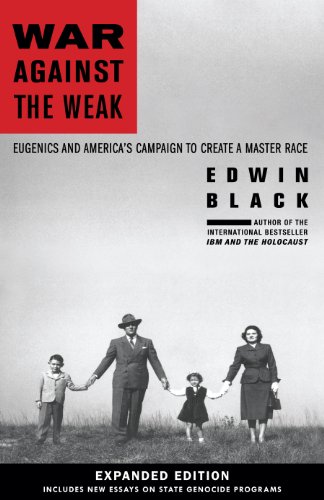
   For more information on the startling history of eugenics in America and other countries, I urge you to read War Against the Weak by Edwin Black. You can also visit the official site for the book.

   Black also wrote IBM and the Holocaust, and his book on eugenics is equally profound and revealing. I derived virtually all my data in the above article from his book, but what I’ve written only scratches the surface of the wealth of information contained in War Against the Weak.

   For a sampling of more diversified resources, the Wikipedia page on eugenics stands as a doorway to many informative sites and archives.

My novel Nemesis, a psychological thriller, is now available on Amazon.

What Does the Novel ‘This Perfect Day’ Have to Do With ‘The Matrix?’

As it turns out, quite a bit.

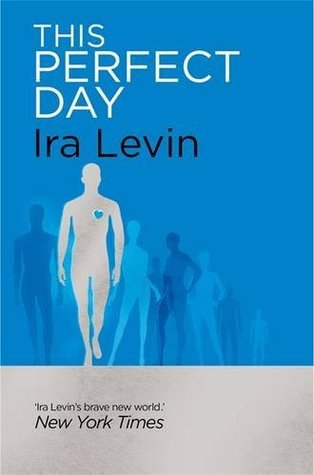
This Perfect Day is a 1970 science fiction novel written by Ira Levin. Think of it as a companion piece to Aldous Huxley’s Brave New World. It is set in a world in which all of humanity is enslaved under an all-powerful supercomputer named UniComp that controls literally EVERYTHING. Even the weather. Humans are constantly drugged into compliance through chemical injections in order to keep that old pesky free will and independent thought at bay. UniComp makes ALL decisions for humanity. It decides whether you’ll get married, and to whom, where you work, whether you’ll reproduce, when to eat, and even when you’ll die. Nobody lives past 60 or so. You are assigned a mentor, or counselor, a big brother of sorts, who checks in on you and makes sure you remain one with “The Family.”

Everything is designed around the concept of maximum efficiency, as you would expect under the control of a benevolent digital dictator. If life under a god-like Alexa sounds like a living nightmare, it’s because it totally is. Except no one cares because they’re basically all tripping balls and getting laid and living luxuriously in the high-tech futuristic world of UniComp.

All except one man, “Chip,” or Li RM35M4419. Everyone’s assigned a random barcode-type name based on the four philosophical giants/founders of this new perfect world—Christ, Marx, Wood, and Wei. Try as he might, Chip can never quite conform to this society, and the story is his waking up from programmed hypnosis to fight the system, and ultimately overthrow it.

So, what does this have to do with the 1999 film The Matrix? Well, whoa. I’d be very surprised if the Wachowski siblings had not read this book before writing the screenplay. There are simply too many similarities to the point where it’s fair to say some of the elements in Matrix are direct allusions or even homages to Levin’s masterpiece of a thriller.

To begin, both worlds begin in a world under a totalitarian computer system that has lulled humanity into complete submission. In This Perfect Day this is accomplished through chemical injections and social pressure. In The Matrix the computer has plugged everyone into a virtual world while in reality their bodies are used as batteries to power the machines.

Both stories center around a man, early-30s or so, who is somehow different than his contemporaries, and secretly wants to fight the system. Neo is computer hacker by night, and reluctant computer programmer by day. Chip is a “genetic taxonomist,” and due to a mistake in his own genetic inception, has one green eye and one brown.

Both stories show the hero learning about a secret organization trying to fight the system, and then receiving initial contact from a beautiful woman. Trinity, the alluring leather-clad rebel tracks down Neo, while in Levin’s novel Chip meets Snowflake, a member of of a group of “incurables,” though he eventually forms a relationship with the attractive Lilac.  

Chip and Neo are eventually introduced to the leader of the rebel group, both older, mature, mentor type guys. Chip meets King, a physician of sorts, while Neo meets Morpheus. And here’s where it gets really specific. Both characters are asked to swallow a RED PILL in order to free themselves from the computer’s mind control. Here’s a line from the novel (pg. 85) spoken by King to Chip:

“The red one has to be taken tonight and the other two as soon as you get up.”

From there the similarities between the two works begin to diverge somewhat. Chip, like Neo, struggles to maintain his new identity. He suffers a serious relapse and betrays his group, but it’s his love/lust for Lilac that eventually reactivates his humanity. Really, libido plays such a huge part in this novel as a catalyst and symbol of man’s free will (it was published in 1970, when basically everybody was banging all the time everywhere, remember).

The counselors in This Perfect Day aren’t exactly the fierce, ju-jitsu practicing supermen the agents are in The Matrix, but they are nonetheless powerful antagonists. Neo learns about Zion, a subterranean base for freed humans, though we don’t visit there until the sequels. Chip learns about an island for incurables called Majorca. There isn’t an Agent Smith, meaning a personified version of the computer, in the novel. Rather, Chip fights against the citizens of The Family, and even incurables themselves, in his quest to blow up Unicomp’s mainframe. But like Neo, Chip ends his mission in the air—not flying, but in a helicopter, soaring off to find his family and friends back on Majorica with Unicomp in ashes, and humanity apparently freed.

Clearly, Levin’s book served as inspiration for The Matrix, though to be clear it bears some big differences in plotting. This Perfect Day also has a fantastic reveal at the end that I won’t spoil here. I enjoyed this book immensely, but seeing how it influenced a major late 90s sci-fi smash hit was even more exciting. I’d even add that there are similar tropes to what you’ll find in current young adult “fight the power” genre, such as The Hunger Games and The Maze Runner. I hope you’ve enjoyed learning about these similarities. It was certainly fun finding them as I read along. Here are some fantastic lines from the book:

[Chip says on pg. 86] “It’s hard to believe it’s possible to have more than one orgasm a week.”

[Snowflake says on pg.69] “Machines are at home in the universe; people are aliens.”

Check out my novel Nemesis, a psychological thriller, now available on Amazon.

Why Guys Don’t Buy Furniture

For starters, it’s not because we don’t have money to buy furniture. At least, those of us who are still working these days and not just collecting Monopoly bills from Uncle J. Powell’s Magic Money Machine (the Fed) because our jobs got swallowed up by the Covid monster.

It’s not because we don’t enjoy using furniture. I love it, actually. There’s nothing better than going over to a friend’s house and quietly judging their marital relationship while seated in a plush leather loveseat or sofa on the other side of the room.

It’s not because we don’t know how to shop for furniture. These days, it’s easier than ever. You can furnish your whole house with just a few clicks on Amazon. Obviously, there’s IKEA, painted in that dark blue and yellow you can see from five miles down the highway. Even in small towns, there are usually a dozen furniture stores always having amazing inventory sales. Half the time you open your mailbox you’ll find glossy flyers spilling out, blaring about the Fourth of July/Black Friday/Christmas/Going out of Business sales coming up around the corner. We know all about the furniture world. We know it exists, how wonderful and comfortable it is, how we should get a protection plan for an additional $14.99, and how if we open a store credit card TODAY we can immediately get 15% off our purchase.    

And it’s not because we don’t like furniture or have some sort of agenda against it. When I see a nice plush, fabric sofa, my brain goes “I like sofa. Sofa good.” Whether we’re talking the ornate Louis XIV silk museum pieces, or whatever wacky designs Tim Burton uses in his movies, we’re pretty open-minded about all different sorts of furniture styles. I’m somewhat of a minimalist myself, which certainly doesn’t mean “cheapskate” or “tightwad.” I like simplicity. Practicality. I want furniture that just shuts up and does its job.    

Look, we all get it. You have a place where you live, you’re supposed to fill it with fabric and leather and other stuff. We understand the unwritten social rule. Here’s the deal though, at least for me until recently: We don’t care. 

Guys are by nature Anti-Furniturian. Probably, like so many other guy behaviors, it has to do with our caveman roots. Who has time to lug an 80-pound chaise lounge out of a cave when you’re being chased by a saber-toothed tiger? For hundreds of thousands of years, mankind was all about the hunter-gatherer life. We moved from place to place looking for food, not hot deals on matching bedroom packages.  

Now, I don’t pretend to speak for all guys. But I do know that for many years, as in for most of my adult life, I went without furniture beyond what was absolutely necessary: A bed, a desk, and a chair. I was an Anti-Furniturian without even realizing it. It’s only been very recently that I’ve started dabbling in the furniture dimension, slowly getting pieces for my apartment. It’s been tortuous, to say the least. Yesterday I agonized for hours over what reading lamp to buy until finally, my brow beading with sweat, I pulled the trigger on a black touch lamp with a white shade. Did I make the right life decision? Only time will tell. 

So having just gone through this recent metamorphosis/conversion, I decided to reflect on my former Anti-Furniturian past. What prevented me from buying furniture before? Why is it every guy friend I’ve ever had either has little to no furniture in their apartments, or if they have any, it literally looks like something they pulled off a curb in Tijuana? Why will a guy spend $2000 on a gaming computer that lights up like a disco ball if they blow up a Nazi, but won’t even spend as little as $199 (plus free shipping) for a bare bones sofa so they can at least pass for someone who’s partially civilized? And why is it every girl I’ve ever known has had a fully furnished apartment/house that looks like the “after” photo from a home makeover reality show? 

I don’t pretend to have all the answers. God knows the mindset of an Anti-Furniturian is rife with contradictions and self-righteous justifications. But I had my own reasons.

Firstly, I moved around a lot. I hate moving. Having lots of furniture makes moving suck even more than it already does. So by having as little as possible, I’m guaranteeing that I’ll be less-stressed in the future when I inevitably move again. I know we’re all hunkered down in our homes right now because of the rona, but it feels like these days people move around a lot more than they did in the past. The days where you’d “settle down” in one town forever to work and raise a family are pretty much gone. Everyone’s restless. It’s not unusual to pick up and move across the country for a new job. Even with today’s technology, video conferences, and such, I don’t see that trend changing. Who wants to live in one area forever? Things could be so much better in that cul-de-sac, or that street, or that neighborhood, or that other school district, or that place by the new Starbucks. It could always be better somewhere else. But you know what doesn’t make it easier to get to that other, better place? Having furniture! Who wants an oak dresser or recliner weighing them down and killing their wanderlust vibe? Not me. Plus, it’s expensive to move. So not buying furniture, and then not having to pay for it to be moved is a double savings. 

Secondly, indecision. I can’t even begin to describe the complex decision matrix that forms in my head when I start thinking about furnishing my apartment. If I get that piece, will it “match” that other piece? What does it even mean when something “matches.” Is it by color, style, or “feel.” What if I get one piece of this set, but when I go to buy the rest later it’s been discontinued and I’m stuck with an orphan piece? What’s in style these days? Modern? Retro? What is bonded leather? Leather’s leather, right? Yeah, but faux leather looks the same, doesn’t it? Will people notice the difference? What if I get this set, then I buy a house, and I need to get a bigger one? I’ll just be buying a set that’ll end up in my future basement, so why bother even getting it at all? 

You know that scene in Fight Club where the Narrator is pondering what sort of “sofa defines him as a person.” That’s basically what’s going on here. Going furniture shopping is like taking a journey into your own psyche.

Thirdly, the realization that most furniture sucks unless you spend a lot of money, and even then it’s probably a rip off. Having worked briefly in a furniture store, and made my fair share of deliveries, I can say with certainty that for the most part, whenever you buy furniture, you’re being totally screwed. Furniture these days is not furniture. Furniture only looks like furniture. Sure, it has the veneer of something you can sit in, lie on, put your feet on, or throw your jacket on when you come home from work. But furniture is fake news. It’s cheap. It’s compressed particle board. It’s something a factory spat out in 35 seconds. It’s something that might have shipped in a box that you have to assemble yourself. It’s a mirage made of wood, fabric, some metal, and maybe glass. It’s not that there is not good, quality furniture out there. Sure, everyone’s grandma has that one table built by Abraham Lincoln himself. It’s that the stuff produced for the masses is mostly overpriced junk. It’s junk! Even worse, it’s junk that they’ll try to get you to finance with a store card or line of credit. So you end up paying real interest and real money on make-believe furniture. 

Fourthly, and this goes along with the “We don’t care” reasoning posted above, it just never fit into my budget. It just didn’t compute. Even though you can reasonably furnish a whole apartment with as little as $1500 (more or less), and even though I make a decent salary, have good side income from investments, and can certainly afford to adequately fill my whole abode with all the bells and whistles like a normal person should, every time I got paid or made money, I just never made that critical, pro-furniture leap. And I honestly don’t know why. It’s just not something I ever cared to put much energy into. I don’t have a wife or kids, so I don’t need to be “domesticated” in that sense. It’s less for me to clean. It’s less for me to think about. Every time I made money I’d think to myself, “Save, invest, or spend on stuff?” and almost always I went with the first two options, unless I needed to pay bills. Not having furniture didn’t inhibit my life in any way. It’s not so much about minimalism–I think minimalists are really just lazy–it’s that when it came down to it, I’d rather buy more Bitcoin, or stocks, or put my money in a savings account for use later. Spending money on furniture, as opposed to a car, clothes, kitchen stuff, and other things, feels like such a waste because I don’t really “need” it. A bed, yes. A chair, sure. A computer desk, why not (though I used a kitchen counter for years before getting one). Anything else just feels excessive. I recently got a TV for the first time in almost 15 years. A TV that sits atop an entertainment center (!), which is something I’ve never had before. 

So, what prompted my big change? How did I finally turn away from my Anti-Furniturian past and see the light? I can’t point to a singular Road to Damascus moment. I just woke up one day and decided enough was enough. I’m tired of living this way. Though admittedly, it was a creeping sense of social pressure. I too feel the need to fit in by having sufficient quantities of faux leather, microfiber, and particle board in various states of compression, assembled in aesthetic shapes in my apartment. It’s society’s fault. It’s your fault. I blame you entirely. I hope you’re happy.  

Furniture is an inconvenience. It’s a hassle to shop for, even online. But especially in person. Has anyone ever gone into one of those furniture stores and actually had a good time? I worked in one and hated myself every day. I can’t even imagine what my poor customers were going through walking in those doors. 

Furniture sucks. I won’t say I’ll never backslide into my Anti-Furniturian ways ever again. But for now, bring on the particle board.

Five Reasons Why Editing a Novel Can Be a Struggle

Editing a novel, or screenplay, or even short story, hypothetically, should be easy.

I mean, most of the hard work is already done. You’ve created the world of the story. The main characters. The central conflict. The secondary threads. The theme. And likely had a hell of a time writing out some of the best scenes in the story.

But why is it that editing a story, trying to get it to the “next level,” can sometimes be so hard?

This is something I noticed when editing my “first” novel Nemesis.

Nemesis was not my first novel. Way back in 2007 I wrote a lengthy door stop of a novel. A thriller, of sorts. A kind of Chuck Pahlniuk-inspired messy tome about an office worker fed up with his bosses, who discovers he’s a part of a secretive organization that runs the world. Kind of like a half-assed Matrix. Or like a less sexy, less exciting version of the graphic novel Wanted.

It was a disaster, this first novel of mine. And not just because of a problematic narrative and witheringly boring characters. But because after I’d finished writing it, I sat back, and realized all I had on my hands was a giant compost heap of words with little connective tissue binding the Frankenstein thing together.

It demoralized me. So, I stuffed this embryonic mess into a plastic Kroger’s bag, all 500+ double-spaced pages of it, threw it into a big plastic bin, where it remains to this day. Sometimes I pull it out. Blow off the dust and cobwebs. Glance through the hastily typed sentences, only to stuff it back into its sarcophagus once my eyes begin to glaze over.

If your writing bores even yourself, you’re really in trouble. I mean, how the hell are you ever going to convince a random stranger to buy your book if you can’t even motivate yourself to read it?

My first novel was a failed experiment. But not a wasteful one. It taught me a lot about writing. About the importance of having a good outline (either written down or kept in your head). About staying focused. About keeping a steady pace, rather than trying to smash everything out in frenzied all-nighters. It was strange how obsessed I became writing it out. Imposing a completely unnecessary deadline for myself, as if believing I had to finish it before dropping dead.

I’m proud that I finished it. I suppose that was the real goal all along. Just write out something long and detailed. Like straining to lift a heavy weight at the gym to impress no one in particular. Maybe you throw your back out lifting it. But so what? You lifted a giant weight you never thought you could. That’s got to count for something, right?

Years later, having self-published my first “real” novel. At least, my first fully completed one. And now editing my “second,” I’ve found the rewriting/redrafting process slightly easier. At the least, I’ve gotten over the self-doubt and emotional immaturity that plagued me in my first attempt. I’m convinced all the struggles associated with writing are psychological, and can be mitigated by discipline and form. It’s a craft, after all. Not alchemy. Not magic. Though it feels like it is sometimes.

I think editing a novel can be a struggle for several reasons.

The first has to do with the quality of the manuscript you’re working on. How much precision and clarity you’ve built into it from the beginning. The more knots you leave behind in the first draft, the harder it is to untangle them in subsequent drafts. It’s easy to be clipping along, and think, “I’ll deal with that incongruity later.” But what happens when the potholes become gaping sinkholes? Have you ever seen a construction crew just randomly throwing bricks together into a pile, with the intention to fix it later once the structure is complete? Ridiculous. They operate based on a blueprint. A set of plans. Even a committed Anti-Outliner has at least some kind of vision for his story.

This is where discipline comes in. It’s better to spend time getting 500 words mostly right then banging out 1,500 words of utter gibberish. Dean Koontz writes this way. He doesn’t move on until he gets a passage right, rewriting as he goes. Considering that he puts out about three to four (or more) books a year, that strategy must work pretty well. He’s a machine. Danielle Steele likely has a similar method, as she pumps out 7-8 books a year these days. You write until it’s right, then move onto the next passage.  

Secondly, rewriting, or editing, is more a passive experience than the actual writing is itself. When I write, I feel like I’m in the driver’s seat. I’m in control. I’m the ringleader directing the various acts in the circus. But when I edit, it almost feels like I’m just watching TV. Even though I’m reading, because it’s my writing, it’s like a switch gets turned in my head. Sit back. Take it easy. Go with the flow. It’s a conscious effort to break this urge, and tweak stuff on the page. Making matters worse, ironically, is spell check and grammar check. It can make the whole editing process feel rote and mechanical. Just click “fix” on each error. Then onto the next.

Thirdly, the work feels “written in stone.” It’s not always easy to determine whether a passage is where it needs to be. That takes a neutral third party. Someone not afraid to tell you, “Hey, this actually kind of sucks.” It’s much easier to just glide on by, assured in a chapter’s “greatness.” Is rewriting this scene really going to make much of a difference? Is it really worth my time to dig deeper into this character interaction? Nah. Besides, I cleaned up the grammar and misspellings. Good enough for government work.

Fourth, as hinted at above, you simply don’t know how something comes across to a reader other than yourself. A passage may feel perfectly logical to you, but is unintelligible to someone else. You simply don’t know what you don’t know. Or maybe a certain scene felt inspired and necessary to you, but confusing and boring to another reader.

Fifth, and by no means final, is perfectionism. You start rewriting one passage, which only leads to having to rewrite another one. And then maybe you realize it’d be really cool if you just added a little something here. A line of dialogue there. Before you know it, you’re taking the whole scene in another direction that will force you to rewrite everything else to fit this new “vision” you’ve just had.

So, what is a solution to avoiding some of these editing pitfalls? I’d say the best thing is to follow the Koontz-Steele Method: Put as much effort into the first draft to avoid complicated editing maneuvers later. This may require constructing a better outline.

But what if you don’t outline? Or what if you use a light outline, letting yourself freestyle as needed? Then understand the genre you’re writing in well enough to know the kinds of conventions and expectations. I think this is the secret to Koontz and Steele’s longevity and prodigious output. Koontz mostly writes thrillers, dovetailing into other sub-genres as he chooses. Steele has cornered the market on romance for decades now. Both writers know their genres inside and out, and know their audience. And because of that, it wouldn’t surprise me if when they write, a lot of the plot is already mapped out in their heads. I mean, in a romance, at some point the two lovers are going to meet, they’re going to break up, and they’re going to get back together. Not necessarily in that order. But the Love Triangle is almost certainly going to make its presence known. For thrillers, you generally open up with a crime, especially a murder. And it’s a given that someone close to the hero will betray him. There’s a high probability of a final showdown involving guns, or threats of death. The hero wins by the skin of his teeth. You get the idea here.

Does that make all writing just a structured process? For the most part, yes.

“But that doesn’t sound creative. That doesn’t sound fun.”

Actually, I disagree. It gives you a set of rules to play by. But that doesn’t mean it has to be boring. Ever sat down to play Monopoly with three good friends or family members? How often does that become a boring event? Almost never. And Monopoly has plenty of rules.  

Think about the book The Shining by Stephen King. It’s basically a haunted house story. Nothing new there.  Richard Matheson did his own haunted house story with Hell House, another horror classic. The difference is that King took a familiar blueprint, and applied his own voice and style. As did Matheson. Editing should be less about the mechanics of writing itself. It should be more about making sure your voice is on the page. Your uniqueness.