A Few Reasons Marriage Rates are Falling Worldwide

Photo by Nghia Trinh from Pexels

As a lifelong bachelor who’s never had more than a passing interest in getting married, sometimes I like to take a moment to examine the institution from an outsider’s perspective.

It’s not that I don’t like or trust the concept of marriage. I’m not some cynical, jaded, red pill doomer/MGTOW misanthrope. Having seen my share of “manosphere” content on YouTube, my overall assessment is it’s like most gangsta rap. Hilarious subverse, fun to listen to, but not exactly meaningful or useful for leading a productive life. Most of the so-called “unplugged” red pillers are really nothing more than just unlikable a-holes with too much money and/or time on their hands.

Yet, many of them do make very valid points in their suspicions toward the institution of marriage. It’s a coin flip. A 50% chance you might lose half your possessions (or more) in a divorce. Who wants to take 50/50 odds their parachute won’t open after they jump out of a plane? You’ve heard all the analogies and seen all the statistics before, I’m sure.

On principle, marriage is a good idea. If it represents a genuine committment and a good faith promise from parties not to screw each other over in the event of a separation. Looked at from a financial and tax perspective, there are many benefits. Given how many Millennials (who are now in the thick of their getting hitched years given their age group) are supposedly broke/unemployed/in debt/under employed/not fulfilling their economic potential, it would seem getting married makes all kinds of sense financially. Two people to share onerous rent or mortgage payments, furniture costs, Netflix subscription fees, etc. Yet, marriage rates globally continue to decline.

So, why is this? The South China Morning Post lists three reasons. The first of which is:

Independent demographer He Yafu said young Chinese women were changing their view of marriage and parenting.

“As their education and economic independence levels increase, the percentage of women who are single is increasing,” He said.

Women becoming more independent and self-sufficient as a cause for declining marriage rates is not unique to China, of course. In all my searches, I found that to be a common theme. It’s certainly a cause here in the West, in the U.S. and Canada, and elsewhere. It’s here that a red piller might posit that feminism will “destroy civilization,” as it reduces women’s interest in having committed relationships during their peak fertile windows, leading to fewer births, leading to governments having to allow for laxxer immigration policies to prop up the tax base, leading to the dissolution of unified national identity, leading to globalization, and ultimately leadings to pods, bugs, fake meat, and mandatory soy injections in the dick, or something.

By the way, if all that does happen, I’ll be happy to admit I was wrong to doubt the red pillers and for not buying a MGTOW coaching session for $20 a minute so I can be told what a loser I am for not being a millionaire supermodel pussy slayer by age 25.

Going back to China, marriage rates have dropped to their lowest rate since 1986, when statistics first started being recorded. Naturally, China’s infamous one-child policy, which favored males, gets part of the blame. And rightly so. Now China has a demographic time bomb going off with excess men, and not enough women to go around as wives. Imagine a whole nation of incels. Actually, you don’t have to. That’s pretty much everywhere now.

However, while China’s lopsided male/female ratio may be unique on the national scale, it’s not necessarily so at the local level, depending on where you live. I currently live in Western North Dakota, having moved here for the oil boom many years back. It’s not as bad now, but certainly back during the heyday of the boom, there were far greater numbers of men than women. And what few women there were, were often already attached, had children, or were not exactly in the dating pool. Western North Dakota is the place where relationships go to die, I like to joke with friends and family. Strangely, it is also the place where your bank account and networth go to live. Can’t have it all, I guess.

That South China Morning Post article also blames the COVID-19 pandemic, as it forced so many young, potentially marriageable people indoors, where they couldn’t have gone on a coffee date even if they had wanted to.

I think if anything the pandemic acted an accelerant on an already growing societal trend, though it doesn’t really get at a big underlying cause: technology. Social media, in particular, which has a way of dehumanizing people. Even good people. This is true whether we’re talking Twitter, Facebook, or popular dating apps like PlentyofTrash and OkStupid. Most dating apps create a sort of digital China experience, in which the men vastly outnumber the women. Women are often inundated with messages from thirsty dudes, while most dudes are left shooting their shot into the void with not much to show for it. That’s not to say dating apps are pointless. I’ve had some anecdotal success with them, even while living on Mars, as I do, and not being some chiseled Adonis. However, I’ve found far more success when I actually go out, and put myself in the right social situations, as I’m sure most people have also experienced. I’d never want to rely solely on dating apps ever, though. That’d be like having to rely on Burger King for every meal.

So, China blames women becoming more independent and delaying marriage, or putting it off altogether, the nation’s disastrous one-child policy that led to too many boys, and COVID-19. I think you also see these reasons playing out in the West, but sometimes in a more localized way. For instance, even in big cities, where the male/female ratio is more balanced, either sex will still complain about a lack of suitable mates. Women may complain that there are too few high status guys who match their income or higher. While many guys who don’t feel they can compete in the dating market anyway (or just don’t want the hassle, period) may simply opt out in favor of video games, movies, or internet porn.

Overall, the falling marriage rate is an alarming trend. But I think it says more about how people today are failing to connect with one another in a meaningful way rather than anything about the failure of the institution itself. Marriage has been around for thousand sof years, afterall, and will continue into the future.

But hey, maybe we’ll all have better luck in the Metaverse. 🙂
For Steady Returns, Consider Polkadot for Your Crypto Portfolio

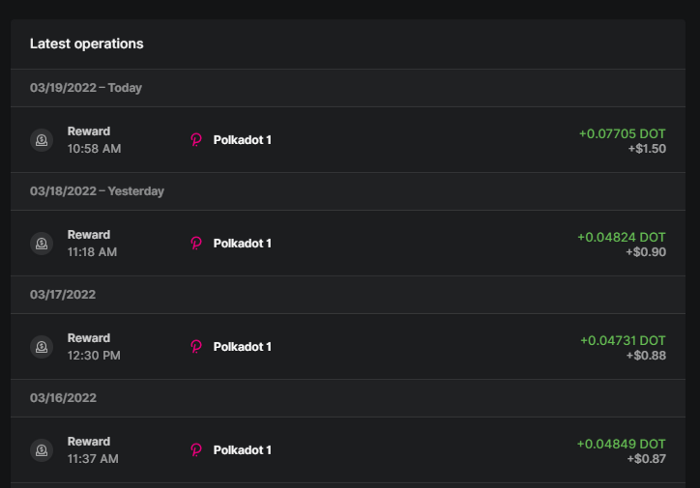
My recent Polkadot earnings.

If you’re more of a conservative investor (say, an index fund maximalist), you may feel put off or suspicious of any so-called “asset” in the crypto space.

You’ve no doubt noticed the wild price swings, rug pulls, and outright scams that have tarnished the crypto asset class over the last few years. And you’ve no doubt been put off by the hype mongering, and the constantly braying moon boys on YouTube and Twitter.

Even Bitcoin, the king of digital currencies, HODL’d by billionaires like Elon Musk and Michael Saylor, has seen its value soar to over $60,000 per coin, only to collapse by almost 50% in a matter of weeks, over the last year. I mean, yikes. You call Bitcoin an “investment?” More like a time bomb you stick down your pants and sit on until it explodes, only it doesn’t have a helpful digital counter like the ones in the movies always do.

You’ve looked at NFTs and probably wondered who in their right mind would spend millions on a ugly piece of “art” like a BoredApe. I know I have. Though far be it from me to criticise Justin Beiber’s digital token acquisition habits.

Or maybe you’ve looked askew at DeFi projects like UniSwap, PancakeSwap, and their many derivatives. SushiSwap. SundaeSwap. There’s even an ApeSwap, because why not. The crypto world seems to have a simian fascination. And a food obsession, apparently.

I consider myself more of a conservative buy-and-hold type investor, for the most part. There’s not a diversified index fund, mutual fund, bond/stock blend, Vanguard ETF, State Street ETF, etc. that doesn’t rustle my jimmies. You say safe, diversified S&P 500 fund, and I’m likely to respond like Jules Winnfield in Pulp Fiction, as you’ve put my fears of wild market fluctuations at rest.

As an investor who’s mainly stuck to the safer side of the risk curve over the years, it took me a long time to warm up to the idea of plunking down any money into crypto. I remember feeling guilty just setting up my Coinbase account back in August, 2020. Feeling like an ex-con with a passing cop looking my way as I bought my first bit of Bitcoin later in September. Bitcoin was around $10,000 at the time. God, how I wish I had bought more.

But then a funny thing happened. When I realized that my not exactly insignificant Bitcoin purchases weren’t oozing through my WiFi connection like some electronic demon, to strangle me while I slept at night, I began to experiment with other cryptocurrencies. Though I know now that there’s Bitcoin and then EVERYTHING ELSE, at the time, I didn’t exactly differentiate. I judged crypto assets rather informally, looking at market cap, and what was widely considered relatively “safe” to invest in. I went with Ethereum next, sometime around late December. It was around $700 or so per token then, though it quickly skyrocketed through March-April 2021. That was the first pump that showed me the potential for decent gains in the cryptoverse. Of course, crypto puked shortly after in May. But that first pump and dump only made me more intrigued.

Cryptocurrency is kind of like a drug. You’re always chasing that first high from your first buy.

Eventually, after accumulating more Bitcoin, Ethereum, and a small so-called “Ethereum killer” known as Algorand, I eventually discovered a little gem known as Polkadot (DOT).

Polkadot is often tagged as another “Ethereum killer,” just like Algorand, or Cardano, or Solana. Though it’s a bit more complicated than that. It’s basically a giant ecosystem containing numerous other tokens and projects, called “parachains.” It’s kind of like how the iPhone is a platform on which millions of apps (like the iBeer) operate. Polkadot helps enable other blockchains to “talk” to one another seamlessly. It was created by Gavin Wood, who co-founded Ethereum. But unlike other crypto tokens, where you buy, hold, and pray they go to the moon before your next shift at McDonald’s starts, Polkadot offers something unique in the way of staking rewards.

What is “staking?” That’s basically when a crypto pays you to hold it. It’s a bit more technical and complicated than that, I realize. But in essence, you’re paid rewards (in the form of the token you’re holding) for helping to maintain the blockchain. For Polkadot, the rewards work out to roughly 12–14% (give or take) APY. Check out this calculator here to see for yourself.

There are a few reasons why I, a more traditional type investor, found myself attracted to Polkadot. One, the lizard part of my brain interpreted the staking rewards as similar to opening up a high-interest rate CD at a bank. Or better yet, a stock dividend. You’d never see double-digit interest rates like that at a bank. We’ll likely never see such rates ever again in our lives. But you do see decent dividend yields like that in stocks. Particularly for Real Estate Investment Trusts (REITs). AGNC Investment Corp., for instance, pays a 10.90% annual dividend yield. And two, staking Polkadot is pretty easy, evenif you’re slightly technophobic. Polkadot offers the opportunity to gain in market cap, allowing for larger returns. Whereas in a dividend stock, sometimes the dividends themselves eat away at the value of the stock itself, causing your overall investment to slowly erode, offsetting any gains you might have made from the dividends. Look at AT&T for an example of this.

I bought my first bit of Polkadot back in July, 2021. It was trading around $10 at the time. Crypto had just crashed from their earlier spring highs. Similar to my first Bitcoin and Ethereum purchases, I only bought a little at a time. Gradually scaling up, and watching the price slowly appreciate. I learned that you can stake DOT on platforms like Kraken, and earn a reliable 12% annual APY. You can stake and unstake at any time. The only downside is you’re keeping your DOT on an exchange, under someone else’s custody, which for those who ascribe to the notion “Not Your Keys, Not Your Coins,” that would not be acceptable. But for most investors, staking on Kraken, or other exchanges, is going to be the simplest, fastest, and easiest way to getting the DOT gravy train rolling.

However, if you want to potentially earn a higher APY, and keep more control over your DOT tokens, you’ll have to stake them yourself directly onto the Polkadot network. DOT has “validators,” who are basically private individuals who run computer networks that monitor and secure the Polkadot network. Some of these validators manage networks comprised of millions of DOT tokens. By cutting out the middleman exchanges like Kraken, and going directly to the source, so to speak, you can increase your APY. To do this, you need a crypto wallet like a Ledger, which is set-up to allow you stake your DOT directly with a validator. Ledger is what I use, and even for a relative crypto newbie, it was pretty simple to set-up. After choosing a validator, you simply assign your tokens, and then let the rewards start to roll in.

IMPORTANT NOTE: You need a minimum of 120 DOT in order to stake directly with a validator. And once you stake, you won’t be able to unstake for 30 days. Kraken, on the other hand, does not require a minimum staking amount, and you can remove your DOT from staking at any time. There is also more risk to staking directly with a validator. You can be “slashed,” which is basically when a validator does not pay you fairly for your staking share. Be sure to do your own research.

As you can see from the screenshot I posted at the top of this article, my DOT validator sends me rewards everyday in exchange for me staking my tokens with their network. The rewards fluctuate. Sometimes it works out to 10%, while other times it’s gone as high as 20%. If you average it out, it comes to about 14%.

While 14% may not seem very high in our current WallStreetBets-ified culture of “To the moon, baby!” I find that seeing rewards trickle in like that to my account every day has a profoundly satisfying and even therapeutic effect. Even if it’s just a dollar, or a $1.50, it means progress. And remember, that 14% is of whatever the value of your DOT holdings currently are. So, let’s say you were to buy 120 DOT right now at around $20, and one year from now it doubles to $40. Then, instead of receiving roughly $.92 a day, you’d be getting almost $1.84. It works the other way, too. So if DOT is $10 one year from today, you’d be getting $.46 instead. Volitility is a two-way street, and higher returns almost always mean higher risk.

I find Polkadot a unique cryptocurrency in that it approximates the dividend payout you see with traditional stocks, with its staking rewards system. It’s as blue chip as you’re going to get when it comes to alt coins, with a current market cap of over $19 billion. And it has a growing, very active, and very diverse ecosystem of projects throughout its blockchain. Like with any tech-related investment, you want to see a lot of developer brain power working to take things to the next level. But also like with any crypto, it’s unpredictable, with sudden rapid price swungs. Be sure to do your own research. And as always, nothing in this article is intended as investment advice. This is simply my own experience with Polkadot.

What do you think of Polkadot? Would you invest in it, or have you already? What other sorts of cryptocurrencies have you found?

Looking for Ways to Market Your Book? BookTok May Be the Answer

Photo by cottonbro from Pexels

For anyone who’s self-published a book, or even had one put out by a traditional publisher, you know that selling your book can prove challenging. Many would-be indie authors might even put off self-publishing to begin with due to not knowing how to successfully market their work.

If you’re an author who’s struggled with this problem, then Booktok might be your solution.

What is Booktok? It’s a very popular, very active, very trendy, and evidently very influential book-loving community within the massive ecosystem that is TikTok.

Booktokers post reviews and reactions to all kinds of books, ranging in length from a few seconds to several minutes.

According to Dr. Brenda K. Wiederhold, who writes in the journal Cybersychology, Behavior, and Networking in her editorial, “Booktok Made Me Do It: The Evolution of Reading,” what makes Booktok particularly unique, as opposed to what you might find on Goodreads or YouTube (BookTube):

BookTok posts usually highlight the reader’s emotional reactions to the plot and characters, often featuring evocative imagery and dramatic soundtracks.

These types of micro reviews might at first appear superficial, silly, or inconsequential, especially to those outside the Gen-Z cohort. As an older Millennial/late Gen-Xer myself, I’ll admit I’ve kept TikTok off my radar until very recently. But as I explored BookTok after reading Wiederhold’s editorial, I found it was better to think of this particular social media not as a some refined mosaic of individualized editorial content, but more as a fluid, on-going conversation. Whereas YouTube rewards more structured and formalized mini-TED Talk-ish type content, Booktok is messier, unfiltered, but also more authentic and conversational.

Writes Wiederhold:

In a way, with its widely accessible, authentic, and entertaining content, TikTok in general — and BookTok in particular — brings storytelling full circle, back to its oral roots.

Okay, so people have found a new social media hangout to discuss their passion for reading, and they’re putting out all sorts of creative, funny videos.

Now for the big question:

Is the Booktok trend actually leading to higher sales?

Uh, yeah. Some publishers, like Bloomsbury, have seen a 220% rise in profits, which they report is due to BookTok. Many publishers also observed that many books on their bestsellers lists were not necessarily new releases, but older books experiencing renewed interests on TikTok’s virtual book club. This is a fascinating trend, as more often than not, a book tends to have its best success right at initial release, then generally fades away into obscurity barring something like a big shot movie deal or an uptick in ad spending.

Unsurprisingly, many of the books that have been elevated on BookTok are in the young adult and contemporary fiction categories. But the BookTok phenomenon has caused many publishers to rethink their marketing and promotional strategies for all kinds of genres.

For indie authors, BookTok could be a possible solution to generate organic interest in a new release, or maybe an old one that’s been sitting there collecting dust with a big ol’ goose egg sales count number that you’re trying to figure out how to put into reader’s hands. But it’s important to keep in mind that Booktok’s main currency is authenticity, not mindless shilling.

As Wiederhold says:

TikTok users tend to upvote honest, personal experiences.

And these experiences tend to be short and to the point. Whereas YouTube reviews usually require a lengthy time committment, BookTok is more like a good friend telling you about a cool thing they just read that you should go check out. TikTok’s overall algorithmic aesthetic seems designed to grease the skids of word-of-mouth advertising rather than the sit-down-and-consume model YouTube and other places seem to have.

So, what is the BookTok community like? I went to go check it out for myself, and actually signed up for a TikTok account for the first time ever. I’m also a fledgling indie author who’s struggled with the vexing problem of how to market my books, so this subject hit close to home.

Here’s a few cool accounts I found, and some of he things I learned about in my brief BookTok experience:

abbys_library3,” 21-year old woman who works at a publisher, has almost 90,000 followers, and has been posting regularly since just July of last year. She’s posted reviews of all sorts of books, particularly in the romance and thriller genres. One thing I learned checking out her videos is the variety of different titles. It isn’t just all Harry Potter and Twilight fans on Booktok. Some of her videos also feature theme music that matches the genre being discussed. For instance, her video “NEW BOOK ALERT: When You Are Mine” has suspense music overlaid with the review.

charlielovesbooks” is a pretty new channel just started last November by a man based out of NYC. He’s done videos on popular fiction like The Godfather by Mario Puzo, memoirs like The Ride of a Lifetime by Bob Iger, and other non-fiction like Bitcoin Billionaires by Ben Mezrich. Barely five months old, charlielovesbooks has over 4,000 followers, and most of the reviews are under two minutes long. His videos, some of which extend beyond just book reviews, have engagement, also. In his last upload, “My biggest pet peeve when reading,” has 148 comments since March 1st.

If you’re looking for an experience that’s more traditionally “Tiktokky,” check out “booktokbenny” who incorporates a lot of music and enthusiasm into his book reviews. He talks a lot about the adult high fantasy series A Court of Thorns and Roses, and has built up a following of 10,500 in just one month.

Overall, my Booktok plunge showed me that sometimes the places that can provide the best marketing opportunities are counter-intuitive. I never would have thought TikTok of all places would be thriving with book lovers. As an avenue for indie authors, it appears a worthwhile one to explore, that unlike much of Twitter and YouTube, hasn’t been swamped out yet with ruthless and spammy opportunists. It’s still the Wild West, in many ways. Just try to keep it real on there.

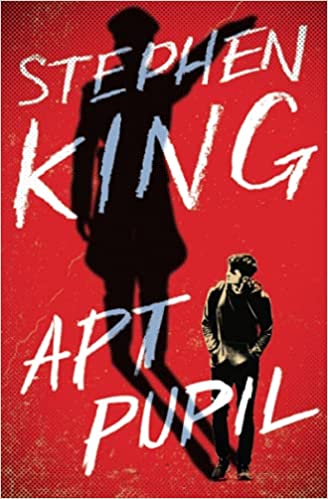
Book Review – Apt Pupil

Apt Pupil is a novella by Stephen King that comes from the short story collection Different Seasons.

It was published in 1982, and tells the story of a young Southern California teenager named Todd Bowden who discovers that his elderly neighbor, a supposed German immigrant, is actually a wanted Nazi war criminal named Kurt Dussander, who was personally responsible for committing horrible atrocities in the Holocaust.    

However, rather than reporting Dussander’s whereabouts to the authorities, Todd instead blackmails the Nazi into becoming sort of like his own personal historian. Todd is a bit of a strange kid. He’s obsessed with WWII history, in particular the Holocaust, and instead iof being repulsed by Dussander’s past actions, the kid is instead enthralled. Even inspired, to a degree. 

However, the blackmail goes both ways, as the Nazi Dussander turns the tables on the kid later. See, the longer the kid has known Dussander, the more complicit he has become in keeping him from being brought to justice. Furthermore, as an “all-American” kid, with potential and college prospects, Todd risks having his future and reputation destroyed forever due to his association with an older Nazi. 

With their hands on each other’s throats in a sense, Dussander and Todd are forced into an uncomfortable alliance of secrecy over a period of four years. Ultimately, Dussander’s real identity is found out through a coincidence, and Todd, now age 17, is forced to reconcile with not only how he protected a war criminal, but his own very twisted dark side.

It’s nice to every once in a while be able to read an old Stephen King story. Because, when you ignore all the films, especially the newer ones that have been made of his works, and how slick and clean they all look, you can really appreciate just how good of a writer Classic King really was. 

King is at his best when he’s exploring the darkness of the human heart. He may be categorized as a horror writer, but really, his best work looks into human nature itself. But he’s also a great plotter, always ratcheting up the tension like an ever-turning corkscrew.

When Todd’s grades begin to slip at school, the boy forces Dusaander to act as his grandfather for a meeting with the guidance counselor. 

Apt Pupil is unusual. A story about a young kid associating with a Nazi war criminal on its own would probably be enough. But King throws in the wild card that both Todd and Dussander start murdering homeless vagrants and bums around town. For me, it was sort of like smashing two concepts into one. And I was never entirely sure exactly what precipitated both of them to start killing. I never got the sense of Dussander being a serial killer. For sure, he was a brutal Nazi war criminal. But his crimes were state-directed, not necessarily ones he set out to do in order to satisfy his own desire for bloodshed. 

For Todd, his turn toward killing felt like it came out of left field. I was expecting something more along the lines of Dussander influencing the boy into killing, mirroring how the Nazi war machine, and Hitler’s propganda, tranformed Germany into a genocidal state. King, however, doesn’t go for subleties here. So essentially, what we have here is the story of two psychopaths meeting each other, and more or less provoking one another’s propensity for murder and violence. All while ironically occuring in an idyllic Southern California suburb.   

Apt Pupil is a worthwhile King novella to check out if you haven’t already. A few interesting facts: King started writing Apt Pupil immediately after The Shining. And the novella is placed right before another King classic, The Body, which of course became the film Stand By Me