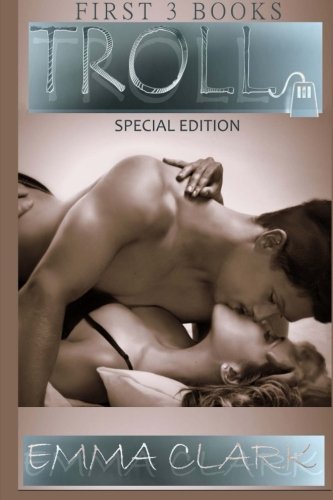
I first learned about this book courtesy of the YouTube algorithm, which one day randomly served up a video by popular nerd culture vlogger Jenny Nicholson. Jenny devotes over 23 minutes to discussing Troll in a vlog titled, “I Did it. I found the Worst Book.”
Now, call me an optimist, but if the supposedly “worst” book on Amazon can get someone talking about it for 23 minutes, then hey, there must be something special about it. It’s like what Jack Sparrow said when told he was the worst pirate anyone’s ever heard of. “Yeah, but you have heard of me.”
Troll may very well be the worst book ever written if Jenny’s to be believed, but you (and many others, courtesy of her vlog) have heard of it. I mean, fifty percent of the struggle of being a writer is just getting read. There are tons of books on Amazon that don’t even have a single review, much less a sale. Emma Clark succeeded here, and not just due to the negative publicity from Jenny’s vlog. Even before Jenny’s video, Troll had reviews and some sales. Troll had fans who were fans before it was cool, baby.
So, what’s Troll about anyway? From the author’s own book blurb:
Twenty-one-year-old Kyla Adkins frequents the Internet in search of her soul mate. While online, she meets hot and devilishly handsome Justin Brogan. Dangerous, arrogant and quite psychotic, Justin hacks into Kyla’s computer and soon he controls everything, including her heart and her life.
That’s not a bad concept, really. It’s topical, relevant, and hip for today’s internet savvy audiences. Who hasn’t secretly fantasized about a hot internet troll stalking them? Even though it was published in 2013, you could easily see Troll updated for the TikTok generation.
Troll: Special Edition, is actually an omnibus containing three previously published novels in the, uh, Troll universe. There are four parts to the Troll saga, so you’ll want to buy each edition separately so that you don’t miss out on any in the series.
The author has also written other erotic books, such as Boy Next Door, a sort of gritty Kmart version of 50 Shades of Grey, which contains “abusive themes such as captive scenarios and BDSM.” Hey, you could say the same thing about the Bible.
According to the author’s website, her other books include Drawn to Darkness, a series, Sea Angels: An Erotic Short, and various other erotic/romance books. It seems the author’s productivity dropped off around 2016, as there isn’t anything listed after that year. Can we hope that Troll will return for a fifth installment this decade? I’d like to see Troll take on the Metaverse. People are getting groped in Zuckerberg’s digital Twilight Zone already. So, if you’re out there reading this, Ms./Mrs. Clark, you’ve got a lot of new material to work with for a new Troll book. Just saying.
Most of Emma Clark’s books are short. Troll: Part I, for instance, is all of 18 pages, and boasts a respectable four out of five stars from six ratings. Troll: Special Edition, also known as Troll: First 3 Books, has 2.9 stars from 31 ratings. Though most of the reviews clearly derive from Jenny’s YouTube audience, many of whom sarcastically posted five-star and one-star reviews. Still, 2.9 is like a movie getting a 60% Rotten Tomatoes score. Sonic the Hedgehog got a 63% in its 2020 debut, and that movie did great at the box office, even after all that controversy about Sonic’s weird-ass creepy face.
What I Learned from Discovering Troll: Put yourself out there, regardless of whether you think you’re talented, ready, or not. You never know what will connect with people. You also never know when some random vlogger may discover your stuff, and decide to post a review of your work. While Clark’s book obviously got roasted, there have been examples from the opposite extreme. Andy Weir and The Martian, for instance.
Up next, I’d like to direct your eyes downward to:
This is another book I discovered via YouTube. Or rather, I discovered the author via YouTube. It goes to show that if you’re a writer trying to promote yourself and your books, YouTube is a great place to build a platform. TikTok, or more specifically, BookTok, is another good one, as I wrote about in this article.
So, what’s Ass Culture about? Gee, I wonder. Actually, little is known about it, as Goldberg never posted a blurb or summary on the book’s Amazon page. However, it appears to be about, based on some preliminary reading in the Kindle sample, the portrayal of the female posterior down through history, and its questionable association with feminine value and fertility.
That, or just a celebration of the ass.
The reason this is an important topic goes beyond the age-old debate of whether you are an “ass guy,” a “breast guy,” a “face guy,” or even a “legs guy.” It’s really about how you judge the opposite sex, and how by focusing on superficial physical qualities (such as a lady’s posterior) you can miss out on the qualities that do matter in a potential mate (character, values, etc.). Missing the forest for the ass, so to speak.
On an individual level, this may not be that important. We all have our kinks. On a culture-wide level, however, a preoccupation with ass can lead a whole civilization astray. Yeah, you thought Sir Mix-A-Lot’s 1992 hit “Baby Got Back” was just a fun pop hit? No, that was actually indicative of Western Civilization’s moral decay. And things aren’t getting any better, judging by Meghan Trainor’s 2014 hit “All About That Bass,” a decisively pro-booty song. Though if we’re going to point any fingers, let’s not forget Queen’s 1978 hit “Fat Bottomed Girls,” which may have gotten the party started.
The message here is shocking: There is a clear conspiracy afoot to poison the minds of Western men with an ass fetish. The effects of this could be calamitous. Will men today, with so much of their precious mental real estate absorbed by “dat ass,” be able to match the feats of men from precious generations? Could the Greatest Generation have landed at Normandy if their minds were warped by visions of bouncing buttocks? Could the brilliant engineers at NASA put Armstrong on the moon, if the only “moon” they were concerned with was the kind stuffed inside bikini bottoms? I think not.
The author, Martin Goldberg, is a YouTuber with 48,000 subscribers, according to Social Blade. He sporadically updates his channel nowadays. In the past, he was much more active, and appeared on camera. He covers a wide variety of topics, ranging from politics, history, culture, the “red pill,” MGTOW (that’s Men Going Their Own Way, for those of you wondering), and book reviews. I first found his channel several years ago when he was updating more regularly.
Goldberg has also written a bunch of other books, including Understanding and Overcoming the Black Pill, How to Suck at Business: A Case Study, and Total Invincibility: How to Crush Failure and Maximize Your Human Potential. Of note is that all of his books are, at minimum, rated four stars, with some five stars. And all with apparently little to no promotion, other than the small amount of notoriety from Goldberg’s YouTube channel.
What I Learned from Discovering Ass Culture: A Short History: Don’t be afraid of exploring topics, however niche or weird they might seem, that are of interest to you. Look for ways to illustrate history from different, or unconventional ends. And post a decent and intriguing blurb about your book on its Amazon page to get people interested. Even your biggest ass-enthusiasts are going to want to have at least some idea of what they’re in for in a book called Ass Culture.
Last year, I decided to finally purchase gold and silver bullion. Not because I thought the apocalypse was imminent. Or because I thought the economy was collapsing. Gold and silver bugs have long been lumped in with bunker-building doomsayers and economic Chicken Littles. I’m neither of those things. Even if civilization were to collapse, you wouldn’t want to be holding gold and silver anyway. In a post-apocalyptic society, things like food, water, clothing, bullets, gas, and oil represent far great currency than the yellow metal and its gray counterpart. You only need to look at places like Venezuela to see that.
No, it was curiosity and interest, and the desire to diversify my investments. I’ve been in stocks and options for years now. Two years ago, I got into cryptocurrency and DeFi. But last year, I finally made the plunge into the precious metals asset class.
Since then, I’ve accumulated what you might call a good “starter kit” of silver and gold, and the experience has been rewarding and fulfilling.
But why “invest” in gold and silver?
Firstly, it’s not an investment. It’s not even an “inflation hedge,” as gold is often touted as by the late-night infomercials. For something to truly be an inflation hedge, it should consistently outpace inflation. Gold and silver haven’t really ever done that over the last ten years. Going back over their history, there are much better asset alternatives that would have given you much higher returns. S&P 500 and NASDAQ ETFs and index funds, as well as your standard growth stocks, for example. Gold and silver on the other hand will generally just sit there collecting dust as far as the inflation-beating game goes.
Okay, so why would you put any money into them if you’re almost guaranteed to lose against inflation? Wouldn’t that money be better spent in an index or mutual fund, or something like Tesla or Bitcoin?
I think of gold and silver as a specialized savings account.
A traditional savings account offers little to no interest and may even cost you money depending on fees. If inflation continues at its current rate of about 8%, if you put $100,000 into a standard savings account, by the end of the year the purchasing power of that money is roughly equivalent to $92,000. That’s like throwing $8,000 into a bonfire. Gold and silver, however, will maintain as a store of value over the long term. Both metals have had their peaks and valleys over the last twenty years. But relative to the U.S. dollar, they’ve held strong.
They’ve also held up for almost 5,000 years of human history. One ounce of gold during Roman times bought you a nice outfit, a belt, and shoes. An ounce of gold will still buy you that now. Remember, with precious metals you have to take the long view. Don’t think in terms of years or even decades, but centuries. This is another reason I like gold. It’s “eternal.” Apple and Microsoft have delivered exponentially greater gains over the last 40 years of their existence than gold and silver have. But will those tech giants still be dominant or exist at all in another 40 years? Or eighty?
Putting your money into gold and silver is like putting it into cryostasis. You’re saving it for the future, and locking in the value of your hard-earned net worth. Even if gold and silver aren’t measured by the dollar in ten or twenty years, whatever currency they ARE measured by will likely properly match their value. This is why gold and silver are often referred to as “safe haven assets.” They have significant utility. Half of the gold in circulation is used in jewelry. The other half is used in industrial purposes and collectibles. It’s unlikely gold will lose its luster as a form of decoration in the future. And electronics will probably always have a need for gold. Silver also will maintain its industrial use into the future.
I think it’s important to own a non-liquid asset that you can’t just trade away with the swipe of a finger.
This is more of a philosophical rationale. We live in a disposable society in which so many things have become cheap, fast, and easy, like microwave dinners. Retail traders shuffle through stocks on smartphone apps like Robinhood and WeBull with the speed of a Las Vegas card dealer. Most trading on Wall Street isn’t even done manually, but with bots ruled by algorithms. I’ve traded hundreds of thousands of dollars of stocks and options myself to the point where sometimes the money doesn’t even feel real, but more like video game points. Money today, while as valuable and important to have as it has ever been, feels increasingly gaseous and fake. And not just because the Federal Reserve prints it out of thin air. But because it’s often disconnected from the hard labor, work, and risk that used to be required to possess it. For most of human history, if you wanted to make a fortune, you had to conquer someone else who had one. Or you had to be willing to face real danger, like crossing an ocean to seek trade. But capital is generally pretty easy to come by now, and this is only compounded by the ease with which it can be managed on a smartphone. A few taps on a piece of glass and you can move millions. Billions, even. It’s astounding how modern technology, while insanely convenient, has made the act of making money feel devalued and denigrated.
I like gold and silver because I like the idea of my money, my labor, and my time, being represented in something physical that’s been around for millions of years. Not just represented by a few digits on a computer screen.
Buying gold and silver can make you more responsible.
Wait, what? Precious metals can do that? Somewhat. It will certainly necessitate buying a safe for secure storage. It will literally force you to take into consideration the best way to protect your wealth. It prompts you to consider how and where you can store your precious metals. Which in turn prompts you to be more mindful of your surroundings, and your future. Even though you’d think keeping valuable pieces of metal in your home might make you worried for their security, in my experience it’s actually been the opposite. It’s a comforting feeling keeping metals under my roof. Just make sure you don’t go blabbing about your gold and silver to just anyone. And make sure you buy a good safe, particularly one that can withstand the elements, like fire and water. Most safes, as I discovered during my search, are actually ridiculously easy to break into (thanks LockPickingLawyer). But that doesn’t mean you shouldn’t buy one with some serious weight. The more precious metals you’re looking to buy, the better (and larger) your safe should be. Of course, you can always keep your metals inside a third-party vault, but that defeats the purpose (and to me, the real appeal) of owning them in the first place.
Afterall, one of the reasons Bitcoin is heralded as a valuable asset, is because you can self-custody it outside the control of any centralized entity, like a bank or government. Gold and silver have that same feature. Once that sliver of yellow or gray is dropped off at your door, or after you pick it up at a reputable dealer, it’s yours to have and to hold. Just make sure to keep a good eye on where you put it.
There’s also the diversification aspect to owning gold and silver.
When it comes to a lot of investments, people are quick to look at the ROI. The bigger the better, right? Except there’s a little thing called the risk curve. The greater the return on investment, the bigger the risk, generally speaking. Plain Jane mutual funds and bonds equal lower risk. That latest doggy-themed coin: high risk. Precious metals are closer to the safer side of the risk curve. It’s not a bad idea to own a little bit of every asset class, while focusing on the traditionally more successful and reliable ones. Stocks and real estate are always great. Crypto and Bitcoin are the future. But to me, gold and silver serve as an insurance policy. And even potentially as a “do-over fund,” if things really hit the fan. Bitcoin has the self-custody feature. But the downside there is that it’s volatile. Gold and silver tend to be pretty stable. Should you ever need to cash in your metals, there’s a good chance what you paid for them is close to what you’ll get, minus what you paid over spot.
This next reason is a little morbid, but it’s something you have to think about.
What are you going to pass down to your loved ones when you die?
Imagine being able to give them gold and silver, like you were some Medieval king (or a pirate). How cool is that? Call me a sentimentalist, but I like the idea of giving my future children and spouse something beyond just paper assets. Sure, real estate is fine, but it’s hard to split a house. A business is good, but your heirs may not want to or be able to continue running it. Gold coins and silver bars are easily divisible, and simple to trade-in for cash value.
There’s another smaller and sillier reason that motivates me to buy gold and silver.
I grew up loving Scrooge McDuck, from the Duck Tales cartoon. While I never thought I’d ever have a money bin filled with gold coins (and a Number One Dime) like he did, I always envisioned being able to have at least my own collection of coins.
A few things to consider before getting into precious metals.
Make sure you buy from a reputable dealer.
I use JM Bullion, which is a pretty well-established company. I’ve never had an issue with any deliveries. They have three pricing tiers depending on the method you use to pay. Electronic check is generally the cheaper option, but you can also use a debit card, or cryptocurrency. Be prepared to wait about two weeks if you use the e-check method. It’s worth the wait for the discount, though. Afterall, it’s not like gold or silver have expiration dates. A good dealer should ship your delivery discreetly, but you should make sure that your package requires a signature. If you live in an apartment building with a management office, try to have UPS deliver there, if you can’t have them deliver straight to your door. If you are shipping to your own house, either make a signature required, or make sure you or someone you trust is there for when the package is scheduled to arrive.
Get a good safe.
Or at least one that will withstand the elements, mainly fire and water. You don’t have to go all out and spend thousands, necessarily. But you want one that’s heavy enough to prevent someone from just easily walking off with it. Your safe’s size and cost should be proportional to your expected holdings. For a first-time buyer, a simple Sentry safe with a combo lock might be sufficient. It’s what I use myself. More experienced or higher net worth buyers may want something larger. You may also want to even look into keeping your metals in a vault with a private company. Or even in a safe deposit box. Whatever works for you.
Mind the over spot fees.
This is really important to consider, and it’s even something that puts some people off from buying precious metals in the first place. When a dealer like JM Bullion sells you gold, they add an over spot fee to the trading value of the gold item. So, if gold is currently trading at $2,000 an ounce in the market (AKA the “spot price”), JM Bullion might sell you a one-ounce gold American Eagle for $2,100, which would constitute a $100 over spot fee. Dealers have to collect a profit to stay in business, obviously. But depending on the over spot cost relative to the market price of the metal you’re buying, it can make a purchase more expensive than you might expect. A rule of thumb is that generally the smaller weight a metal is, the greater the proportion in over spot fee will be.
Silver has a much higher over spot cost than gold. A one-ounce American Eagle silver coin currently retails for $38 or more on JM Bullion, while the price of silver is at around $25. That’s almost a 50% mark-up! Yeah, silver coins are generally not really worth it, especially during periods of high demand like right now. It gets worse when you consider that if you were to sell your silver back to JM Bullion (or anyone else), you’ll likely only get spot value ($25 an ounce), NOT the over spot cost you initially paid. So, if you’re buying silver coins, you’re in the hole from the beginning. Not the best way to start a new relationship with a new asset. But again, this is why gold and silver are NOT true investments, but specialized savings accounts.
Remember, you’re also guaranteed to lose purchasing power if you hold your money in a traditional savings account in a low-rate environment (like today). But the value of keeping reserves liquid for an emergency, or saving for an upcoming purchase like a down payment on a house, is worth more than the risk of your money gradually losing out to inflation.
Some of my ten-ounce silver bars
To help mitigate the over spot fee for silver, I purchase ten-ounce silver bars, which in calmer market periods often only retail for about $3 or so over spot per ounce. The larger size you buy, the lower the over spot fee, generally speaking. JM Bullion also offers a discount on over spot if you buy in bulk. Though I don’t think I’d ever buy a kilo or 100 oz. bar of silver due to weight and storage issues.
I also don’t buy silver collectibles, such as silver bullets or figurines, or “junk silver,” aka old coins like quarters that were minted with real silver. I’ve found the over spot fees there especially egregious, to say nothing of the questionable “value” in those silver items. Many people buy gold and silver for emotional reasons over purely logical reasons. Metals are assets that make people “feel secure,” especially during turbulent times in the stock market, or during violent geopolitical affairs. This is why many precious metals dealers like to play on people’s fears in their marketing efforts. Dealers like JM Bullion market a variety of gold and silver products on their sites. JM even has a whole line of Disney-themed coins. If you’re into those sorts of products, fine. But collectibles need to be evaluated differently. You’ll almost certainly overpay not just on over spot fees, but mark-up, as well. For me, I stick solely with gold and silver bullion, and I don’t collect or wear jewelry.
As for things like commemorative coins, rare coins, or “proof” coins and such, you’ll also pay substantially higher premiums. The value of those sorts of coins is more in their scarcity and demand in collector circles, than in just their gold or silver content. They are better used as gifts than as “stores of value.” Last year I bought sealed American Silver Eagle coins for my newborn niece and nephew, for instance.
If you’re really serious about acquiring a lot of bullion, gold is going to be your most cost and storage-efficient option. Silver is nice and cheap to start out with. But its high over spot fees don’t make it worthwhile for the average person. To say nothing of the impracticality of trying to store large amounts of the metal. You can easily stick $10,000 in gold coins in your pocket. You’d need a shoebox to carry $10,000 worth of silver, and it’d be heavy to lug around.
For gold, I’ve found that you want to stick with at least one ounce or higher to keep those over spot fees low. Anything less than an ounce, and you’re overpaying substantially. For example, a quarter ounce American Eagle gold coin on JM Bullion currently goes for about $629, with gold at $1941. That means you’re paying almost $144 over spot, or almost 23%. Whereas if you buy the one-ounce American Eagle, it’ll cost you an extra $130, which represents a more tolerable 6.6% over spot cost. The coin posted at the top of this article is the British Britannia. I bought this coin not just for its beauty and its sensational design, but also because it offered the lowest over spot fee for a gold coin. As of now, the over spot cost is only $84, making it one of the best deals currently on JM Bullion.
The absolute cheapest way to buy gold with the lowest spot price is to buy the prepackaged bars in sealed plastic, either the one ounce or the ten-ounce kind. However, I really prefer the coins. The slightly higher over spot fee is negligible compared to the savings you get with the bars. And they just look cooler, too.
Another thing to consider is the purity of the gold you are buying.
American Eagles, for example, are .9167 purity. The remaining .0833 is a mixture of silver and copper to help protect the finish and make the coin tougher and harder to scratch (gold is a soft metal, remember). Even though American Eagles are among the most popular gold coins on the market, if you’re a purist like me, you may prefer as much gold as possible. Since American Eagles are only about 90% gold, while still having a higher over spot fee, I don’t find them to be a good deal. The British Brittanias, on the other hand, are .9999 purity, not to mention have a sharper design. And since I keep mine locked in a plastic holder anyway, I’m not concerned with it getting scratched. So, it eliminates the mixed-metal toughness “advantage” American Eagles have.
Most silver bullion is going to be .9999, so there are generally no purity issues to be concerned with there.
Lastly, you’ll want to carefully consider portfolio allocation.
This is going to be different for every individual. For me, I probably wouldn’t keep more than one or two percent of your net worth in precious metals. Remember, you are essentially “freezing” any money you put into metals. Money that won’t be potentially collecting dividends or increasing in value like it would in a good growth stock, ETF, or index fund. Money you can’t use to save toward a down payment on an investment property, or a small business. It’s also not money you can easily and quickly make liquid for emergencies. And, of course, you don’t want to have more than you can reasonably hold and secure in a good safe. It’s really not necessary to go heavy into precious metals.
A final word of caution. It’s very easy to get bit by the gold bug. Gold’s a metal that has attracted mankind for over 5,000 years, after all. It’s tempting to start collecting a lot more after you get your first shiny new coin or bar. But try to keep it in moderation.
I’ll leave you with a few interesting and fun facts about gold.
That’s a fascinating factoid, to be sure. But it got me thinking. How would one measure all of the gold in the form of Mr. T’s? Mr. T., as in the ‘80s pop icon famous for wearing myriad gold chains. Mr. T as in “I pity the fool.”
Mr. T is reputed to have worn approximately 100 ounces of gold, which incidentally would be valued at nearly $200,000 at the current spot price. That means you would need about 86,068,467 clones of Mr. T, all fully decked out in their gold chains, bracelets, and rings, to carry all of the world’s currently known gold reserves (including already mined gold and some discovered, but remaining in the earth). That’s almost the whole population of Germany. That’s a lot of Mr. T’s, and a lot of gold chains.
But you don’t have to be like B.A. Baracus, wearing enough metal around your neck to buy a Ferrari. You can start with a starter kit. A few “stacker bars” of silver. A gold coin or two. Maybe even diversifying further into alternative metals like platinum and palladium, if that’s your thing. Gradually scaling upward as your net worth climbs over time. Whatever you choose to buy, you’ll find precious metals collecting rewarding and fun.
No, it’s not investing in Dogecoin or Shiba Inu, or any other meme coin that rocketed to the moon and beyond. Though I do remember seeing Shiba offered on a decentralized exchange long before it went parabolic, chuckling at the dog symbol, and then simply scrolling past it. That’s the easiest 1000x bagger I’ve ever missed.
It’s not learning about DeFi platforms, such as PancakeSwap, and the numerous other liquidity pools on UniSwap, etc.Though I do remember hearing about PancakeSwap sometime in early 2021 on Twitter before it became super popular. CAKE was all of a few dollars at the time, and you could stake it for an APR of like 800%. It has since fallen back in price to about where it was when I first learned about it. And the APR is around 38% last I checked.
Here’s the deal: You’re almost certainly going to miss out on like 99.9% of the greatest investment opportunities out there. There’s no point in beating yourself up over that. Just accept it.
But that’s actually great news. Because the truth is that you also have a 99.9% chance of finding a few great investment opportunities BEFORE they get big and deliver those nice, multi-X gains.
The biggest question isn’t whether you can find those opportunities. If you keep looking for them, it’s practically a mathematical certainty that you’ll eventually find one sooner or later. “Seek and ye shall find,” as the Bible says.
The real question is whether you’ll fully take advantage of the opportunity when you do find one.
In probably no other asset class is this rule more apparent than in cryptocurrency. The asset class where a coin or token can skyrocket 100–1000% and higher in a matter of weeks or days.
But you don’t have to luck out with meme coins, or sh*t coins, or risk rug pulls on dubious dex coins, or anything ridiculous like that.
When I look back at my crypto investments, my biggest regret is simply not investing enough in solid, reputable projects when they were cheaper, and when I had the chance.
In my article on Polkadot, I mentioned first starting to buy it in July of 2021, after it had tumbled from its initial high in the $40s, to as cheap as $10-$11 per DOT. I knew it was a solid project with a lot of developers, and a rapidly growing ecosystem. So, of course, I only invested a few hundred on the outset. Gradually dollar-cost averaging in, as you’re supposed to for proper risk management. DOT then proceeded to climb to over $50 later in November before falling briefly back down to the mid-teens this past January. It’s now in the early $20s, and still pays roughly 14% in staking rewards.
For Bitcoin, I had a similar experience. My first purchase was for all of $25 worth back in September, 2020, when Bitcoin was “only” about $10,000. I probably only managed to put in a few hundred more before it started really climbing in early 2021. Same deal with Ethereum, which I started buying initially that December when it was in the $700s.
It’s not like I didn’t have more money to invest into those coins at the times I discovered and vetted them as risk-worthy assets. If anything, I was overcautious, allocating far below what I could have and should have, proportional to my income and net worth.
I didn’t lack funds. I lacked conviction. I was too timid. And that difference of temperament may have been what separated me between mere modest gains and possible financial independence.
Of course, to be fair, that overly cautious temperament of mine could also have been the difference between solvency and ruination, had those coins not broken out to the upside.
Look, I’m not saying to go out and plunk down tens of thousands on the first good investment you come across. And I’m certainly not saying to go all in on anything, no matter how much of a sure thing you think something is.
What I’m saying is sometimes all that stands between you and getting wealthy, or at least scoring big on an investment, is balls (or ovaries).
Sometimes you’ve got to go in BIG on a conviction.
Imagine if the Winklevoss twins hadn’t committed heavily into Bitcoin when they first learned about it in Ibiza in the summer of 2012. They probably wouldn’t be among the first crypto billionaires today. Even worse, they’d still be known as the guys Mark Zuckerberg screwed over in that movie. In fact, you could even say that because they didn’t fully commit to their social network ConnectU, that they gave Zuckerberg the opportunity to take advantage of them.
Asset diversification has its place. My retirement funds are diversified, for sure. But diversification is also, as Michael Saylor puts it, “Selling the winners for the losers.”
Proper asset concentration, on the other hand, can make you wealthy.
As I continue my investing journey, one thing I’ve learned more and more is that it’s not so much about numbers or dollars. It’s more about psychology. It’s about being able to fight through the fear of loss, and committing strongly to a good asset or opportunity when you find one.


 Dean Brooks