Did Humanity Peak in the Late ‘90s-Early 2000s?

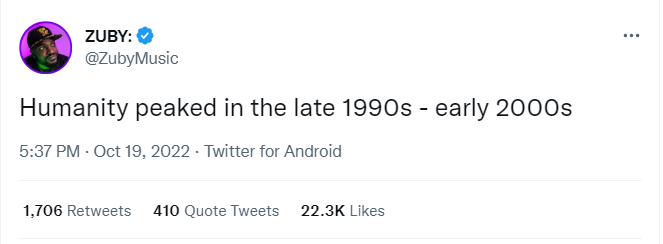
Source: Screenshot of ZubyMusic Twitter.

Or is this just pedestalization of the past?

I’ve followed ZubyMusic on Twitter for almost three years now, at least since around 2019.

If you’re not familiar with the artist, “Zuby,” short for Nzube Olisaebuka Udezue, is a 36-year old English rapper educated at Oxford University, with a substantial and growing audience of worldwide fans. Known mostly for his music, he’s also a strong conservative voice, often criticizing identity politics, and is a Christian. He’s self-released three albums, and has a podcast and YouTube channel.

I’m not a Christian myself, nor do I listen to rap. In fact, I’ve never once even listened to Zuby’s music, as I think “Christian” and “rap” sounds about as cringe as almost anything the “Christian” world tries to attach itself to in the secular realm in order to be hip and relevant. Christian comedy. Christian rock. Christian movies. Ugh. No, thanks.

Still, I like Zuby because he often makes interesting and thought-provoking tweets. Even if I don’t always agree, it’s nice to get a different or unique perspective on current events, especially on Twitter. It’s funny how conservativism is actually quite maintream and common in everyday life, yet online it’s seen as odd and “alternative,” with liberalism and left-wing politics seen as the default. In reality, it’s much more evenly split.

Last October Zuby tweeted the above comment, which I frankly dismissed almost immediately. I think there’s a temptation to glamorize one’s youth, seeing it as some bygone golden age. Zuby, born in 1986, would have had his most formative childhood years in the ’90s, and been a teen for the first half of the ’00s. I remember John Stewart on The Daily Show saying something like “you don’t miss that era, you just miss being a carefree child,” in response to a pre-sex scandal disgraced Bill O’Reilly saying how he felt the decade of the 1950’s (O’Reilly’s youth) constituted Americas best years. Politically, Stewart and myself are quite opposed, though I have to admit the guy could be pretty insightful at times.

Nostalgia-gazing is something particularly characteristic of the right wing. And while it’s soothing and addictive, it’s also as pointless and counter-productive as the left’s own habit of future utopia fantasizing. Neither side seems to want to deal with the here and the now, preferring to longingly await a DeLorean to whisk them away to another timeline. No wonder things remains such a mess, when both sides abdicate their responsibility in the present.

Then this morning I was reminded of Zuby’s tweet by Nick Sherwood, author of The Social Virus: Social Media’s Psychological and Social Impact on America (And What We Can Do About It). He posted a series of tweets articulating why he feels Zuby is correct.
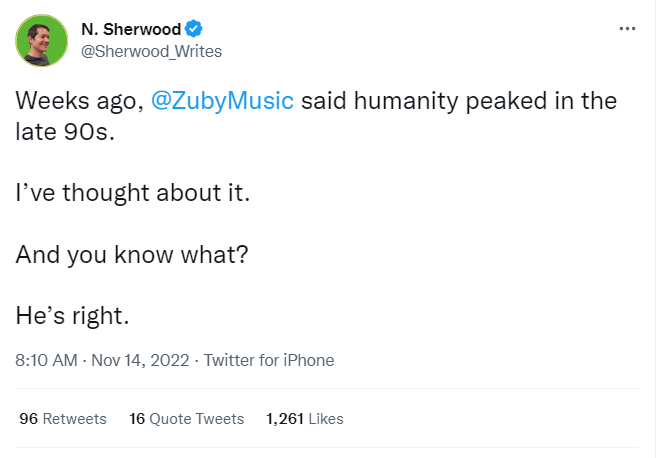
Source: Screenshot of N. Sherwood’s tweet.

The above was followed by a long thread of reasons and supportive evidence, some of which I thought had credence. Others I found questionable. And by “others,” I mean most. And by “questionable” I mean mostly B.S.

To begin, I don’t think it’s possible to declare any particular era in human history a “peak” at all, given that so many cultures and nations around the world are undergoing vastly different experiences than others, both positive and negative.

If we’re talking strictly the Western world (America and Western Europe), one could make the argument the late ’90s to early 2000s certainly wasn’t a bad era. The Cold War had ended, and the economy and job market were strong. But that’s looking at things from the macro view. For someone working a cash register in a small town in Idaho, was their life any better or worse, or much different for that matter, than ten years prior?

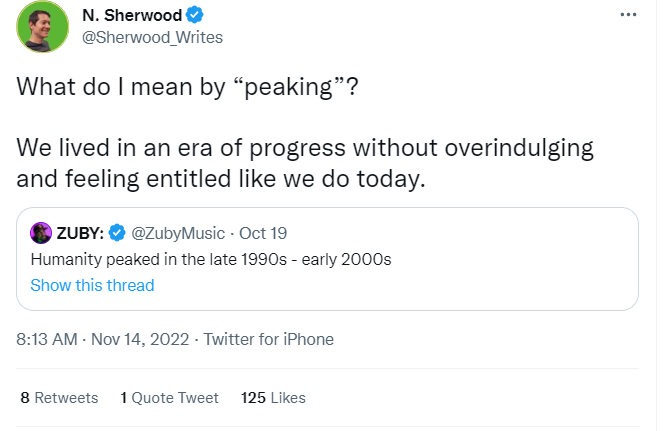
Sherwood continues:
Source: Screenshot of Sherwood’s Tweet.

I agree with the first half of the second sentence, if by “progress” we’re talking technologically and socially. No doubt the ’90s was an era of progress. But so was the ’80s, the ’70s, and almost every decade before. At least in America and other places in the world. “Progress” is also subjective. No doubt Lenin and Stalin would have considered their Communist Revolution in Russia “progress.” But was it? Big doubt.

The second half of the statement is basically meaningless. How do you even measure levels of overindulgence and entitlement? These are aspects of human nature, and I don’t think humanity has evolved much, if at all, in just the past 25 years. So I’d say there’s a good chance that we’re seeing the same levels of indulgence and entitlement now that we saw a quarter-century ago. Maybe now it’s just more visible due to social media.

Moving onto his next points:
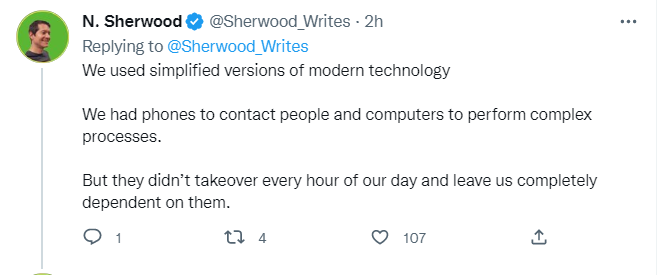
Source: Screenshot of N. Sherwood’s tweet.

Sherwood seems to posit that the late ’90s/early 2000’s comprised some kind of Goldilocks “sweet spot” era in which we had the just the “right amount” of technology. Not too much to where it became omnipresent, like the smartphone in everyone’s pocket, but just enough to where it acted in the background.

Again, this is highly subjective. One man’s too much technology is another man’s not enough. I can certainly remember people fixating on computers even as far back as the mid-90s, when the internet became more accessible to the mainstream.

Infrastructurally speaking, we’ve been dependent on computers probably since the 1960s. Almost all of our telecommunications, major medical equipment, civil defense systems, etc. all depend on computers and microchips.

If we’re talking about how the ’90s was the beginning of computers separating people into their own bubbles as everything went digital, there’s an argument for that. I do think people were more fluid socially back then than they are now. Younger generations today can’t seem to effectively communicate unless it’s through a screen. It was Millennials, afterall, who popularized “ghosting.” When people are reduced to simple online avatars, it’s much easier to dismiss their humanity and snap them out of your existence. People today shy from conflict more readily, and terms like “social anxiety” are prevalant.
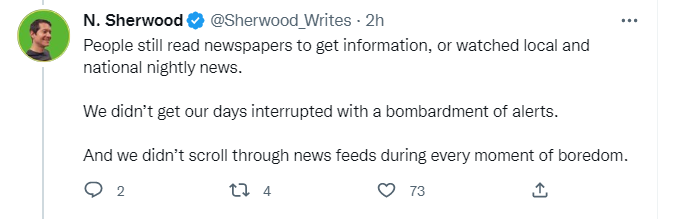
Source: Screenwhot of Sherwood’s tweet.

I wrote for a newspaper as a teen. Had my own column. I also worked in the printing industry for eight years as it transitioned into the digital age. Newspapers are cool, but I wouldn’t associate them specifically as being the best or even a good source of information necessarily. At least, not anymore than radio or TV. Local news hasn’t really changed in 25 years, either. Traffic on I-95. Some guy got busted for dealing drugs. A kindergarten teacher retires. New waffle restaurant just opened. The song remains the same.

It’s true we get hit way more with B.S. news alerts and app notifications. But that’s a simple fix. I either delete a misbehaving app, or don’t turn on notifications at all. The only alerts I get on my phone are from my Medium app, which is actually starting to get on my nerves.

But again, Sherwood is really making more of a case against smartphones, and by extension social media, and not so much a case for the ‘90s/2000s being some golden era. You can’t just argue in the negative. Smartphones didn’t exist during the Bubonic Plague in Europe either, and I don’t think anyone would argue those were good times. Not unless they’re some hardcore “survival of the fittest” Darwinist fanatic, or something.
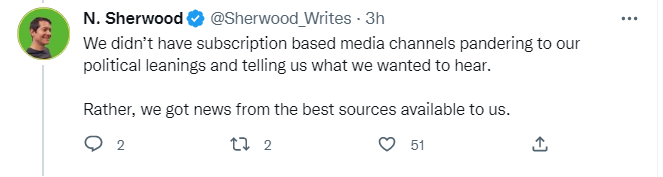
Source: Screenshot of Sherwood’s tweet.

What?! Has this guy not heard of the John Birch Society, which handed out leaflets and pamphlets pandering to very specific and extreme right wing beliefs WAY back in the ’50s and ‘60s?

Or The Daily Worker newspaper, published by the Communist Party USA back in the 1920s?

Or Bop Magazine, delivering steamy servings of teen heart throbs like Jonathan Taylor Thomas, Johnny Depp, and Jonathan Brandis?

Hmmm…if the ’90s was peak anything, it was was Peak Hot Guys Named John.
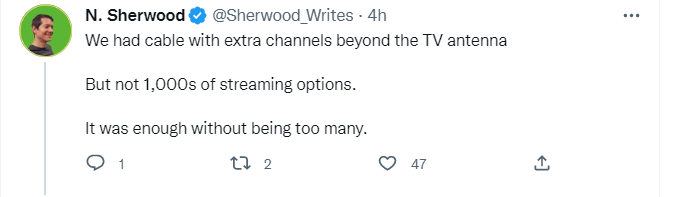
Source: Screenshot of Sherwood’s tweet.

No matter how many streaming or cable channel options exist, there are effectively only a small number that any one person will ever regularly watch, as there is only so much attention one can give, and limited time.

And why is the expansion of entertainment media necessarily a bad thing? You wouldn’t say the same about the millions of books that have been printed in the last few hundred years. So why would TV shows and movies be any different. There being five million Star Wars movies/shows/books/toys is annoying to me, yes, but it’s not like it ruins the quality of my life. I just ignore it, like anyone older than twelve and who possesses a frontal lobe should.

Source: Screenshot of Sherwood’s tweet.

Ah, so media is only “good” if EVERYONE is watching so they can dicuss it the next morning around the water cooler. Got it. That being the case, I guess the daily state broadcasts North Korea puts out to all its slaves, er, “citizens” must be of the highest excellence. I’m sure KCT fosters something a bit more than a “semblance of monoculture.”

It’s true that much of pop culture and media is fractured amongst varying demographics and audiences. But that’s always been the case. I can remember my friends and I discussing how freaking awesome the T-1000 was around the school cafeteria the year Terminator 2: Judgment Day came out, only to get blank stares from the girls, who themselves were talking about Beauty and the Beast. Then going home and my step-dad telling me to shut-up about “Turdinator” while watching a re-run of Welcome Back Kotter. Then running to my mom to whine that her husband insulted my hero Arnold, only for her to shut the door in my face so she could watch Knots Landing.

Like that South Park videogame, it’s always been a fractured but whole, Sherwood.

Monoculture is a myth. No matter how big a movie is, it’s likely not even three percent of the world population will even see it. Take Avatar, the highest grossing movie of all time not adjusted for inflation, at almost $3 billion in global ticket sales. In 2009, the year Avatar premiered, if the average movie ticket was $7.50, then that means a maximum of 400,000,000 saw James Cameron’s remake of Fern Gully in theaters, out of around 7 billion people. Except that number doesn’t count the people who went to go see the movie repeatedly. And it doesn’t count the fact that many people paid way more to see it in glorious 3D. If you cut that number in half to 200,000,000, that means only about 3% of the world population saw Avatar. Even if you double it to 6%, that’s still pitifully low in the grand scheme of things. And that’s the biggest movie ever released.

To put that in perspective, the biggest religion in the world, according to the Pew Research Center, is Christianity, and it hasn’t even cracked 1/3 of the global population with its 2.2 billion followers.
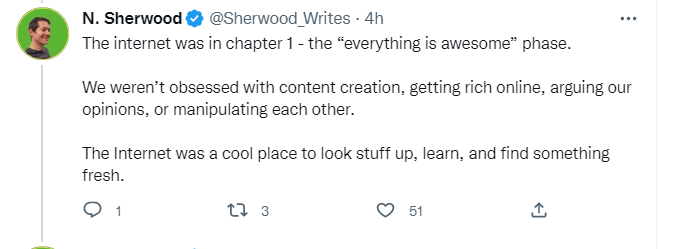
Source: Screenshot of Sherwood’s tweet.

No, Chapter 1 of the internet was “How Much Freaking Longer is This Thing Going to Take to Log On, Goddammit!” With the sub-chapter “Don’t Use the Phone I’m on AIM Right Now!” Chapter Two was “When Are We Getting Broadband, Everyone Else Has It Now!”

The internet sucked 98% of the time back in the ’90s. It wasn’t cool. It wasn’t aweome. You didn’t find anything “fresh.” It was where you IM’d your friends from school until some creep found your teen chat room and tried to have cybersex with you. There’s a reason why To Catch a Predator came out in the mid-2000s right after the supposed “golden age” of the internet. It’s because the world wide web, due to its anonymity and wild west novelty, empowered a lot of perverts in the early days.

The internet was also a place for piracy. Remember Napster, which single-handedly almost destroyed the entire music industry? “I Love the ’90s” my ass, especially if you played in a band named Metallica.

The internet was weird, distrusted, seen as a fleeting fad by some, buggy, slow, mostly useless, and the driver of the Dot Com meltdown. Saying the internet was “cool” back then before high-speed and regulation is like saying bloodletting was cool before modern medicine discovered viruses and bacteria.
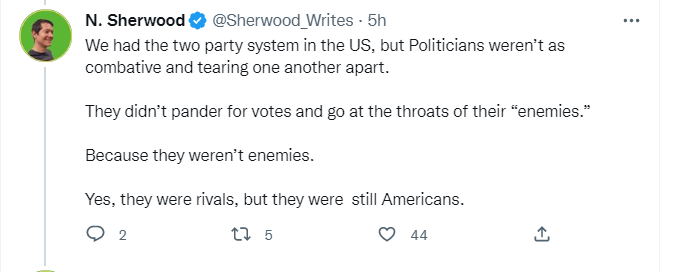
Source: Screenshot of Sherwood’s tweet.

Ah yes, that wonderful period in the late ’90s and early 2000s when politicians never pandered for votes, didn’t treat those across the aisle like horrid zombies, and joined arms as fellow Americans. Back then we didn’t have contested elections, or impeachment trials, or “vast right wing conspiracies,” or third party presidential runs conducted by eccentric billionaires. Politicians didn’t lie. They never even used foul language. Certainly they didn’t have affairs with interns, or cheat on their cancer-stricken wives. Or invade countries based on false claims of weapons of mass destruction. None of that ever happened.
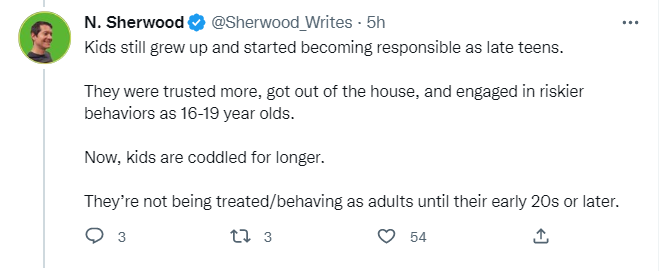
Source: Screenshot of Sherwood’s tweet.

If kids growing up and maturing sooner is your benchmark for the golden years, then you’d have to look way past the ’90s. Back to, say, during WWII, when kids lied about their age so they could go to war.

Take the case of Calvin Graham, for instance. Born in Canton, TX, Graham signed up for the U.S. Navy after the bombing of Pearl Harbor at 12 years old. He’d later get wounded by sharpnel at the Naval Battle of Gaudalcanal, for which he’d receive the Bronze Star and the Purple Heart. Graham would eventually get booted from the Navy after attending his grandmother’s funeral without permission. Get married at age 14. Become a father a year later. Divorced at 17. Then join the Marine Corps at 17 to serve in the Korean War. Then break his back in 1951 after falling off a pier.

Look at that. Two wars. Two branches of the military. Married and divorced. Has a kid. And even gets his first case of workman’s comp. All before most kids even learn how to shave.

Sorry, kids were not free-roaming Mad Max badasses in the ’90s. They were mostly soft, squishy, sticky bags of shit. Eating Lucky Charms, Pop Tarts, and Ellio’s Pizza. Capable only of Nintendo marathons, watching Saturday morning cartoons, remembering the Konami code, and making fun of Michael Jackson’s face.

I don’t know what causes people to glamorize and pedestalize the past. Nostalgia has practically become its own genre now, with Hollywood dumping ‘80s-inspired crap like Stranger Things on us constantly like Nickelodeon slime. I remember the ’80s, man. I was a kid then, too. Well, mostly I remember watching TV and movies during the late ’80s, and not having to worry about a whole hell of a lot. What do you mean the Russkies could drop a nuke on us any moment? I don’t care, I’m watching Inspector Gadget here and drinking chocolate milk.

For sure, sometimes I miss not having any responsibility other than deciding what kind of dinosaur I want to be for Halloween. But it’s kind of ridiculous and suspect to declare any particular era “humanity’s peak” when it just so happens to coincide with your childhood. It almost sounds like indulgence and entitlement, come to think of it.

Think of it this way. Right now there’s a horrible war going on in Ukraine. It’s the worst of times for anyone who lives there now. But somewhere in Colorado, Florida, Canada, or maybe even Japan, some kid somewhere is having the time of his life. He’ll grow up thinking it never got any better than the late teens and twenties. The ’90s and early 2000s will be as foreign to him as the ’60s and ’70s are to a Millennial or Gen Z’er.

And you know what? He’ll probably be right. At least he didn’t have to deal with the Macarena.

Should the Voting Age Be Raised to 28?

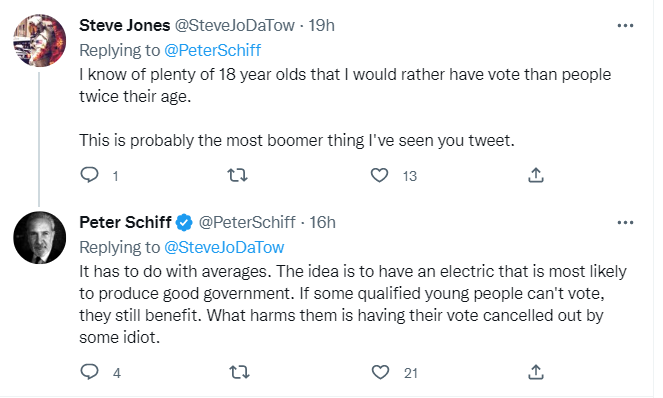
Source: Screenshot of Peter Schiff’s Twitter

Is voting an inherent right? Or is it something that should be “earned” with maturity?

I was scrolling through Twitter on Election Day afternoon when I came across Peter Schiff’s tweet, which I’ve screenshot above.

If you aren’t familiar with Schiff, he’s a popular gold bug, media commentator, and CEO of Euro Pacific Capital. He famously hates Bitcoin, considers all digital currencies Ponzi schemes, and is often regarded as an economic “doom and gloomer.”

He’s 59 years old, lives in Puerto Rico for the tax benefits, loves gold, has been warning of an imminent global economic collapse for almost two decades now, and favors fiscal conservatism.

He’s the quintessential Boomer’s Boomer.

I like Peter Schiff somewhat. I think he’s right on many things. Not Bitcoin. But I mostly agree with his overall ethos.

Which is why his tweet on voting yesterday afternoon got me thinking.

Admittedly, the knee-jerk response to his proposal to raise the voting age to 28 is a resounding “No!” It seems preposterous on its face. How dare you suggest taking the right to vote away from people who are old enough to join the military and die for their country.

You can drink at 21. You can sign up for six figures of student loan debt at 18, even if you’re going to a posh private art school to learn fingerpainting. You pay taxes even when you’re still a minor. You can sign business deals at 18.

So why should you not be able to vote starting at 18?

I can remember graduating high school in the thick of the 2000 presidential election, and actively looking forward to casting my first ballot. I even volunteered to work for the GOP on a street reconstruction project, as the convention was being held in Philadelphia, where I lived. The idea of being able to have even a very small say in who ran the government was an exciting prospect for me as a newly-minted adult.

Of course, that election became infamous for being undecided until December, hung up by “hanging chads” in Florida. George W. Bush slipped through with a razor-thin margin of victory, thanks in part to a Supreme Court ruling to stop the recount process. It was a cold-plunge initiation for me into the oftentimes crazy democratic process.

Schiff’s proposal may sound anti-democratic on its face. But I don’t think it’s that simple. It’s about applying more standards to a democratic practice that Schiff feels is sacred, beyond just the incidental component of age. You could argue it puts more of a premium on democracy. Something freely given is rarely valued as much as something earned, afterall.

We apply standards to nearly everything in life. You have to pass a test to obtain a driver’s license, and you must abide by the rules of the road if you intend to keep your license. You have to apply to college, and pass your classes if you expect to graduate. You have to show up to work on time and do the job if you want to stay employed.

So why not apply stricter standards to voting?

At its core is the idea that those with a bigger stake in society should have a bigger say in how it runs. Why should the middle-aged father or mother of two kids, who own a house, pay property taxes, work two jobs, have no greater say in who governs them than the 19-year-old unemployed college student living in their basement?

Schiff aticulates another angle to his argument here, in response to a tweet:

Source: Screenshot of Peter Schiff’s Twitter

I disagree with Schiff’s assumption that older voters necessarily equal a better government. Some of the Founding Fathers were in their mid to late 20s and early 30s during the American Revolution. In fact, the average age of the delegates during the Constitutional Convention was 42. If anything, Schiff’s argument puts a premium on middle-age. Schiff, at age 59, inadvertantly undercuts his own age group.

Nor do I think that just because someone has kids or a mortgage that they’re more qualified to vote than someone who doesn’t. Much less that they’re more mature. There are plenty of dumb parents and irresponsible people who got conned into bad mortgages. And there are also plenty of saavy wise-beyond-their-years young people well under Schiff’s critical age of 28.

Schiff’s stance is likely a recipe for stagnation. But I’d be remiss not to point out that underlying his argument is the idea of wanting to filter out younger voters because so many of them vote in socialist policies that increase taxes on people like Schiff and workers (like myself) in general. Schiff’s proposal is more about trying to protect his wealth than in advocating some more pristine version of democracy.

And he’s not wrong about wanting to do that. As someone who spent years working in the harsh North Dakota oilfields to obtain some measure of financial freedom, I abhor the idea of a bunch of freeloaders coming along and helping themselves to my money out of some half-baked notion of “equity.”

But then again, it’s not really the young, socialist voters that are the biggest threat to an investor’s net worth. Bad policies by the Federal Reserve that caused it to print too much money, have now led to spiraling inflation, which has helped crater the stock market and economy. And I don’t see too many young faces sitting on that banking board at all. So much for the wisdom and maturity that supposedly comes along with age.

Schiff is right, however, in wanting to apply stricter standards to the power and privilege of voting. I don’t think voting should be a free for all. Otherwise you run the risk of mob rule. Voting should be regarded as an important duty, given to those who have proven they care about this country and have a vested interest in securing their community.

But is age the best way to apply the standard of civic responsbility?

I can think of better metrics. Living independently. Paying your own bills. Being free of consumer debt. Being gainfully employed or financially secure. Not having a criminal record. All things that aren’t necessarily age-related.

I do think you should be able to prove that you aren’t a burden to society and dependent on others (outside of factors beyond your control like physical handicaps, etc.), if you intend to have a say via voting in how it runs. Voting is something that should be earned rather than just handed out by virtue of reaching a certain magical age.

“I Only Date White Guys,” She Said To Me, a (Mostly) White Guy

Is it racist to not date outside your own race? And why being biracial/biethnic sucks.

Photo by Robin Schreiner from Pexels: https://www.pexels.com/photo/arches-hallway-inside-building-2261166/

She had just broken up with her boyfriend, moved from a small town in Montana to North Dakota to live with a few friends of mine, and had small (almost baby) teeth. I don’t remember much else. She was cute, I guess, dirty blonde, blue or green-eyed, with an unremarkable personality. Though I had never shown interest in her, that didn’t stop a certain friend from trying to play Cupid.

“I only date white guys,” she said, my friend reported to me later.

I have to admit, even though I wasn’t attracted to her and had not expressed interest, that stung. We were living in the Martian landscape of the Bakken during the height of the oil boom. Women were few and far between, and usually taken. My friend had moved in with his girlfriend, an attractive and ambitious Philippina who worked at the local paper. I was 30, broke, in debt, having just started a new job. Not exactly in the market or mindset for a partner at the time, but it’s not like I would have turned the right one down had she come along.

Like any typical guy or girl, I’d been rejected for all kinds of reasons in the past. And most times, it never bothered me. Except this time it really did. It’s particularly rough to be rejected solely on race/ethnicity. I’d rather be called ugly, or told I have a boring personality. Those are things you can at least control. You can dress better, get fitter, even get plastic surgery if you think it’ll help. You can pick up a hobby, join an improv group, join Toastmasters, take dancing lessons, etc. There are all sorts of ways you can upgrade yourself in the dating marketplace. In fact, most criteria that determines your value to potential partners are things which you can improve.

But race/ethnicity? No changing that.

It’s such a superficial thing to be the sole reason for someone to dismiss you, romantic or otherwise. It’s like you could have a great personality, make high income, have all the features of a “good partner,” maybe even be attractive, and it’s all meaningless because you’re the wrong shade. Talk about demoralizing.

This rejection also bothered because it didn’t make much sense. It wasn’t even accurate. I mean, I am white. Mostly, anyway. About 65% Western European, mixed with about 25% Mexican/Native American, and 10% other regions. Most people guess I’m Italian because of my darker skin, while others pick up on the Hispanic part. But I don’t speak Spanish. I don’t “identify” with my Latino side, if that means anything. Being white isn’t really a culture. It’s more like a racial neutrality due to its majority in the U.S. So in that sense, “culturally,” I’m as white as the next guy. Really, I’m just American. Isn’t that enough? Or does the “one drop rule” still apply when it comes to defining “white guy,” and what is acceptably “white” in terms of partner selection?

Making matters worse, some time long before my encounter with the White Guy Rejection, I had an equally screwy talk-to-the-hand from another female. This one a Latina. My exact shade even, if you were to put a Sherwin-Williams color palette against our skin. I was going to college in Chicago at the time. We were working together at a market research company. She turned me down because I was “too white.”

Too white? Whaaat? Take a good look at me. I’m almost as equally tan as Ray Romano, and no one would say he’s “too white.” What does that even mean? Likely, it had to do with our different cultural and socio-economic backgrounds, I guess. She from the South Side of Chicago. Me, from lower-middle class Pennsylvania suburbia. I lacked the proper street cred probably. So alas, there’d be no West Side Story here.

Being biethnic or biracial sucks. I can’t say I’ve ever enjoyed looking mixed. It’s done nothing for me. If I could choose, I’d have just been plain white instead of “off-white.” It would have made things simpler.

I mean, which is it anyway? Am I too white, or not a white guy at all? Being mixed is like a racial version of Schrodinger’s Cat. I’m both too white and not white enough.

Being racially mixed is nothing but problems, unless you have some kind of “offsetting” quality, like being really attractive. Otherwise, it’s a shit deal. And no, I don’t give a fuck about supposed “multiracial beauty” or some “post-racial culture” fantasy people like to use to sell the idea.

But what about Tiger Woods? Or (insert random racially-mixed celebrity).

Tiger Woods is NOT black/white/asian. Tiger Woods’s race is ATTRACTIVE, RICH, and FAMOUS. Those things supercede race, and always have.

But going back to the White Guy Preferrer, it doesn’t stop there. Remember my friend, Cupid? He was part Mexican, too. More than me, actually. But he had fair skin and blue eyes, which some Mexicans have. So even though technically I was “whiter” culturally speaking (he could speak Spanish, for instance), that didn’t matter. All that mattered was the skin tone. He was a bona fide White Guy. I was nada.

Two years ago, I took one of those DNA tests through 23andMe. And like many other people who’ve taken them, the results were surprising. I found out I’m like 12-15% Irish, for instance. I took screenshots of my results, which I’ve displayed below.

Source: My DNA.
Source: My DNA
Source : My DNA

When I was younger, I struggled a great deal with my racial “identity.” But these days, I see myself only as an individual. The results above are just fun trivia. I don’t base my identity on race. Doing so is reductionist, and limits your ability to see yourself as whole person. I don’t believe in or accept “identity politics.” In fact, if there’s one benefit to being mixed, it’s like having the Uno reverse card to the race card. Yes, some of my ancestors were probably “oppressed.” So what? Don’t care. And some were likely “oppressors,” too. Also so what? And don’t care. Attempts to white guilt me have all fallen woefully short.

But at the same time, it’s not like you can go through life and pretend race doesn’t matter. You’ll be confronted with it one way or another. Even if it’s just in the mate selection game.

For the record, I don’t really care whether I’m a “White Guy” or not. The issue is purely academic to me now. As far as I’m concerned, I’m my own “race.” Just like I consider myself my own “generation,” refusing to align with Gen-Xers or Millennials. I’m Generation Dean. A lesser known but substantially greater era that started in 1982 and runs concurrent with the others like a multiverse dimension.

I kid, of course, but not really.

Anyway, getting back to the question posted below the title. Is it racist to not date outside your race?

No. I don’t think so. You can’t help who you’re attracted or not attracted to. I don’t hold it against the White Guy Preferrer or my South Side Latina, even if they have diametrically opposing definitions of “whiteness.” Whiteness can mean different things to different people, just as any race can, I suppose. Sometimes people use race as code for culture. Other times they actually do mean skin color specifically. Either way, I don’t really care. No one’s entitled to being liked or attracted to. And even if someone doesn’t like you for the most ridiculous of reasons, so what?

Personally, skin color by itself is not a big deal to me when it comes to potential mate appraisal. I’m much simpler. I ask women out if I think they’re hot, end of story.

40 Isn’t “Over the Hill,” But Death Does Move in Next Door

And occasionally knocks on your door late at night.

Photo by Renato Danyi from Pexels: https://www.pexels.com/photo/grey-skulls-piled-on-ground-1096925/

It’s strange how when you’re really young — early to late teens, even 20s — the idea of being a middle-aged adult seems ridiculously remote and impossible.

Getting older is for other people. Your parents, for example, who were born ancient. Or your aunts and uncles. Or that one teacher who’s been teaching algebra since the Apollo moon missions. People to whom the rules of life apply. Not you, of course.

And then it happens. Slowly, steadily, with the inevitability of Michael Myers stalking you across the neighborhood.

For sure, some people age better than others. I remember always being told that when I turned 30, that’d be “it.” Meaning I’d suddenly develop a massive beer belly, joint and back problems, lose my hair, incur all sorts of health problems, you name it. Thirty was the “turning midnight” in the Cinderella story of aging, apparently.

As it turned out, I actually lost weight and kept it off during my 30s. I still have all my hair, with some noble grays. And with the exception of a nasty flu back in 2019, I’ve hardly had any health issues. I never even caught Covid.

Actually, I ended my 30s in better shape than when I started them.

I’ve worked hard and tried my best to live a healthy life. Mostly, that just comes down to eating a proper diet and getting regular exercise. And maybe some genetics. I maintain that the rate at which you age is partially due to choices you make about whether to live a healthy life or not.

Six months ago I turned 40. A supposedly major milestone of a year. True middle-age. “Over the hill,” etc.

Though if we’re being technical, you won’t know when you’re truly middle-age until you’re dead, after which it won’t really matter. If you were to die at 40, then 20 was actually your true “middle-age.” Whereas if you die at 100, then 50 is your middle-aged point.

Statistically, men tend to die around 80 years old. So, it’s fair to say 40 is half-way to the grave.

And honestly, that’s exactly how it feels.

For me, forty is less a physical feeling than a mental one. For sure my body’s not as limber and springy as it was even five years ago. I am stronger. I still lift weights, and fit into jeans with a 32″ waist. I’m in better shape now than I’ve ever been.

A co-worker recently expressed shock when I revealed I was forty, telling me I look 30. I don’t actually believe him. Maybe I could pass for 35. But 30? I don’t think so.

He credited “clean living” for my youthful appearance. And he’s not wrong. I don’t drink, smoke, or do drugs. I’m all about boring sobriety. But also — and perhaps most importantly — I don’t have kids, and I’ve never been married. I’ve avoided a lot of major pitfalls many sadly fall into by middle-age. A crushing mortgage. A nasty divorce and alimony. Debt and work pressures. I’m debt-free, and live a quiet, modest life.

Physically, I may be aging slower. But mentally, that’s another matter. And I’m not talking about the capacity to learn or the brain’s elasticity. I read and write a lot. I’m curious about the world. My neurons are still growing and forming attachments.

The problem is that as you age you start to give less of a shit about anything, because little excites you. Life starts to lose its flavor, so to speak, until it feels like bland day-long chewed bubblegum. Increasingly less surprises you. The patterns of life start to become repetitive. It’s like sitting down to watch a bad movie and by the halfway point you’ve already figured out all the twists and turns.

I don’t mean you know everything. Not at all. Quite the opposite. It’s just that more and more matters less and less to you overall. It’s a kind of weird Nihilism Fog. It’s not that nothing matters. It’s that you see the long-term futility in a lot of human behavior, especially your own actions. Man’s miniscule place against monolithic, eternal Nature. It’s why I don’t get excited or care much about politics. Everything’s cyclical. One political party will dominate this year, and next year it will be the next one. Rinse, wash, repeat. Big deal.

This can make it hard to stay motivated. You feel like you’re going through the motions. You’re like a robot sometimes. With rare exceptions, very little excites you. If your mood was a echocardiogram, it would mainly be a flat line with ocassional bounces and spikes. Outwardly, you keep on a smiling, social-friendly mask, of course. Inside, you look like the faces on those Easter Island heads.

Example: I was at a job fair a while back, and the recruiter — this late 20s, maybe early 30s looking guy — was excitedly telling me about all the great company benefits. Like 401(k), life insurance, annual pay raises, and three-tier health options. You know, benefits that virtually EVERY company under the fu*king sun offers these days. I smiled and nodded, amused that he could maintain such fervor for corporate minutiae, or at least pretend to.

Another example: Very few movies look worth watching. If you are over 35 and are still a big fan of Marvel/Star Wars and Disney stuff, I don’t understand you. There’s been one new movie this year I’ve really liked: Top Gun: Maverick. Because it actually made me feel something. I suspect Avatar 2 will have been worth the wait, too.

The older you get, the harder it is to be impressed. On the flip side, you really value those rare moments when things are done right.

I suppose the doldrums of middle-age are what drive so many people to make sudden life changes. Career pivots. Divorces or marriages. Having children. Moving to another place. Going back to school. Picking up a new hobby. Cutting off old friendships. Building new ones. Changing appearances. Losing weight. Exercising. Or other, more extreme things, like joining a cult or religion. Anything to stimulate, and simulate the effervesence of youth.

A mid-life crisis is like racing around trying to put out a fire that doesn’t exist, except in your head.

But it’s not without reason. The aging process is simply Death moving closer. When you’re an adolescent or teen, the Grim Reaper isn’t even in the neighborhood, usually. He’s in the next town over. By your 20s, Death’s living in the upscale part of town, where all the “real adults” and old people live. By your 30s, he may have moved to your block. But by your 40s, he’s next door. You see him barbecuing on the weekends. He waves to you as you leave your driveway to go to work. Sometimes, he even plays pranks on you. Late at night you might hear a banging on your door. When you go to answer, there’s no one there. You know it’s Death, of course. But it’s not like you’re going over to his house to confront him. He’s a big guy. Bald. Drives a Harley. Always wears black. He’s just not the kind of guy you mess with.

When you’re 50, Death moves into your house. And no, he ain’t paying rent. By 60, he’s sleeping in the top bunk above you. By 70+, you’re bedmates. After that, well, you become a little more than just friends.

These days, everyone is so focused on stopping the physical effects of aging. Everyone wants to look young. And with exercise, a good diet, sunscreen, lots of hydration, avoiding vices, and maybe a touch of plastic surgery, you can Dorian Gray yourself a good long while. Look at Tom Cruise. That guy has looked 35 since 1997.

But stopping the mental effects of aging is much tricker. And while I suspect it involves a bit of self-deception or purposeful distraction, I applaud those who are able to pull it off.

Three People Who Destroyed Their Lives in Less Than 60 Seconds

Going from champ to chump at Ludicrous Speed. Three stories.

Photo by Pixabay from Pexels: https://www.pexels.com/photo/flare-of-fire-on-wood-with-black-smokes-57461/

They say it takes a lifetime to build a reputation, but only seconds to destroy one.

That’s especially true nowadays with the internet and social media. It’s almost impossible to just move to another town and start over in life. Bing knows all. And Google, too, I guess.

As we’ll see in the cases below, sometimes one little bad decision can lead to truly catstrophic (and even deadly) consequences.

Here are three such stories.

1.) Justine Sacco

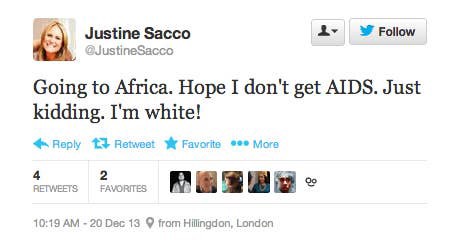
How long does it take to tweet? A few seconds? Maybe only one or two. That’s about as long as it probably took Ms. Justine Sacco, the former senior director of corporate communications at IAC to tweet this little “joke” out in 2013, and inadvertantly become global enemy number one online:

Source: Screenshot of Justine Sacco’s tweet via Buzzfeed News

At the time the 30-year old PR rep was traveling home to South Africa on the holidays to visit family. Right after she tweeted, her flight took off, and she went to sleep, unaware of the whirlwind she had just unleashed.

At first Sacco’s tweet went largely ignored, as she only had 170 followers. But then Sam Biddle, the editor of Gawker’s Valleywag, discovered the tweet via an anonymous tip, and retweeted it out to his 15,000 followers.

From there outrage and fury spread like a viral outbreak, and the hashtag #HasJustineLandedYet trended worldwide, as people eagerly awaited Ms. Sacco to land and get the nasty surprise of her life. There was the added dramatic irony component, as Ms. Sacco went the whole 11-hour flight unaware she was trending all over the internet as a virtual punching bag.

Ms. Sacco got sacked from her cushy PR job, naturally. Even while insisting that she didn’t mean for her joke to come across as insensitive and bigoted. Instead, she says she meant it as a commentary on Western privilege, stating in an interview with the NY Times:

To put it simply, I wasn’t trying to raise awareness of AIDS or piss off the world or ruin my life. Living in America puts us in a bit of a bubble when it comes to what is going on in the third world. I was making fun of that bubble.

Meanwhile, the bubble was unamused.

The internet, with all its collective wisdom of mankind, obviously disagreed with the intent behind Ms. Sacco’s ham-handed cultural musings. After losing her job, and becoming a worldwide hate magnet, she did eventually rebound. She volunteered in Addis Ababa in a PR job for a stint. Then landed a marketing and promotions gig at Hot or Not, a website used to rank stranger’s looks on a scale of 1 to 10, that was transitioning into a dating service.

Wait, Hot or Not? That site’s still around? I remember being a healthy 5.5 there back in the day.

:::sad slide whistle:::

Anyway, in a surprise twist, Ms. Sacco later returned to her former employer IAC, where she works in corporate communications for Match Group, the online dating company. According to her LinkedIn page, she’s still there.

Sacco’s experience at least proves it is possible to reconstitute yourself after being trampled to smithereens by a frenzied mob online, and get to a somewhat happy ending. I say good for her. Hopefully next time she decides to pop off irreverently about racy cultural stereotypes, she’ll remember she’s not a character on South Park.

2. Dr. Maurice Wolin (aka “talldreamy_doc”)

Source: Screenshot from “To Catch a Predator”

Ahh, To Catch a Predator, the gift that keeps on giving. That show, and the community of perv-busters it spawned, has proven a never ending source of entertainment.

Honestly, it was tough to decide which pervert to pick, as there is a cornucopia of creeps to choose from, all thanks to the hard work of giga chad Chris Handsome. But for me, Dr. Wolin stands head and shoulders (literally) above everyone else, given his high status and education, not to mention the staggering cost of his sick blunder. Most of the cretins caught on TCAP were already bottom-feeding low life losers anyway, with few prospects in life, who could barely even dress themselves.

Not Dr. Wolin. The year was 2006. The 48-year old was a prominent cancer research director in the San Fransisco area, married to a wife who was also a doctor, who had two daughters. Using the screen name “talldreamy_doc,” Dr. Wolin chatted online with a girl he believed to be 13 years old, but who was actually a decoy employed by an organization called Perverted Justice.

Wait — “talldreamy_doc?” Tall? Yes (Wolin was 6’2″). Doc? Yes. Dreamy? Oh, hell no.

After making a number of disgusting solicitations toward the decoy, Wolin made plans for a meet-up. Driving from Piedmont, CA to Peteluma, the affluent physician strolled inside the trap house, no doubt envisioning how he was about to indulge all his sick fantasies, only to be met by a camera crew and the police. Wolin desperately tried to fight the charges in a two-year legal battle. He even hired Blair Berk, a celebrity attorney who’d once represented Leonardo DiCaprio.

Guess that makes him the second person she’s represented who’s life got sunk like the Titanic for chasing some girl.

Eventually Wolin plead no contest. He was sentenced to two months of house arrest, three years probation, and lifetime registry as a sex offender. In addition, his license to practice medicine was revoked.

Out of all the TCAP cases, this particular one seriously amazes and disturbs me the most because of Dr. Wolin’s precipitous fall from grace, and the quickness of how his life unraveled. He’d only chatted with the decoy for a few days, maybe weeks, before visiting. Then it took all of a minute from the time he left his car, entered the backyard, to realizing he’d actually walked into a sex sting.

Imagine that. Throwing away a medical license you spent eight or more years in school to acquire, a high-paying, well-respected career, your reputation, and the respect of your family. All gone in less time than it takes to read the back of a Trix cereal box. And all for what? To be branded a sex offender forever. I mean, the guy could have cured cancer the next day at his lab and still nobody would ever think of him as anything other than a pedo. What a moron.

Dr. Wolin’s wife did later divorce him. And unlike Sacco’s story above, there is no happy ending here. Dr. Wolin recently committed suicide in January 2021, according to an offical coronor’s report as investigated by YouTuber “The Skip Tracer.”

3.) Garry Hoy

Source: https://commons.wikimedia.org/wiki/File:TD_Centre_View_from_Yonge_and_King.JPG

I have to admit, when I first heard about the tragic tale of Garry Hoy, I didn’t believe it. I thought it had to be a myth. There was just no way a lawyer could ever do something that wreckless and foolish. It seemed impossible.

But we’ve just seen a C-suite corporate ladder climber self-immolate, and a top cancer doc commit seppuku. Hey, why not an attorney, too? It sure seems these supposed “elite” types aren’t as bright as we’re led to believe.

Garry Hoy was a highly successful and regarded corporate and securities lawyer who worked at the Toronto-based law firm Holden Day Wilson. His office was located on the 24th floor of the Torono-Dominion Bank Tower Building (seen in the above pic).

Hoy liked to perform a little parlor trick on occassion. He would run into the office windows to show off their strength, surprising and shocking guests. On July 9, 1993, while showing some visiting law students around. Hoy decided to demonstrate his love of resilent window glass. He slammed into the glass the first time, bouncing off like he had so many times before. But when he tried a second time, he wound up crashing through and plunging 24 stories to his death. For sure he proved the toughness of the glass. It hadn’t shattered upon impact. Instead, it had popped out of its frame.

Police declared Hoy’s death “accidental self-defenestration,” which aside from sounding like a Jeopardy category, is a polite way of describing a dude accidentally killing himself in a stupidly avoidable way.

I mean, if you’re going to risk your life at high heights like that, at least do something cool like Philippe Petit did, the French high-wire artist who walked across the Twin Towers in 1974. Throwing yourself against a window? Kind of lame, really.

Hoy’s plummet may have even sunk his firm. Within three years of his lousy Peter Pan impression there was a mass exodus of attorneys, who evidently didn’t like working under the dark cloud of the Darwin Award-style death Hoy had left in his wake. In 1996, the firm finally closed for good.

Word on the street is the firm tried to sue gravity. And lost.

So, a good lesson there. If you’re a lawyer, please leave all the crazy antics to Saul Goodman. Chicago Sunroof, anyone?

As Nicolas Cage proved in the year 2000, you can steal almost any car in 60 seconds, not to mention Angelie Jolie’s heart. But as these poor people above proved, you can destroy your life just as quickly, if not faster. So be careful out there.

Screw Racism, Sexism, Economic Inequality, Corona, Fentanyl, Gentrification, Inflation, Wars, and TikTok — THIS is What’s Destroying This Country

And no, it’s not even puberty blockers for kiddies.

Photo by Mikhail Nilov from Pexels: https://www.pexels.com/photo/a-woman-biting-a-sugar-cube-8670115/

America. Land of the Lard Asses. Home of the Whopper and the Starbucks early morning milkshake. One nation, under obesity, with corndogs and Big Gulps for all.

I’m talking about SUGAR, of course. America’s original white powder addiction, which makes crack cocaine look like Stevia.

And that’s putting it lightly.

A little while ago I was at Wal-Mart and I had quite possibly the worst experience I’ve ever had in my life.

It was mid-morning. Around 9:30 AM. I forget exactly what I was there for, but I know I had to return something. So I was standing in line at customer service.

Ordinarily, I’m as focused as a stagecoach Clydesdale wearing blinders when I go to Wally World. I make a point to maintain precise tunnel vision. I won’t risk having my eyesight sullied by the likes of what you’ll see at a typical Flaw-Mart.

It started off no different that morning. I’d made it inside, blissfully unaware of any bothersome surrounding entitites.

Then I noticed the kid.

Or more precisely, this tubby, oozing, sluggish, pasty-skinned, hair-a-mussed, jelly-bellied, fat body of an adolescent hanging off his pear-shaped big-bootied mother. His cherry-red lips flapping as he whined and moaned for a snack. His voice like a buzzing mosquito. His sock-sandled feet clacking on the shiny tile floor in tune with his incessant dribblings for something to eat.

The mother, a beleaguered blimp in a floral-printed dress that looked like the print design from a ’70s sofa, huffed, and reached down into her cart. And what did she pull out?

A box of ice cream sandwiches.

The fatty pustule of a boy tore open the one side of the box, eagerly stripping the waxy paper from the sugary treat. Stuffing the black and white rectanglar sugary dessert in his maw, he oozed across the floor, toward a bench, on which he sprawled his spongy carcass. One hand securing the sandwich for steady bites, the other pulling out a massive smartphone. One grubby thumb activating some colorful mobile game with a lot of jangling sounds.

And there he sat. Slouched like some self-satisfied grotesque Buddha, kicking his feet in infantile glee, vanilla and chocolate lining his lips clownishly. His sweat clothes stuck to his round body like the plastic on those individual cheese slices.

“Sir, I can help you now,” some voice said from afar. I’d heard, but I was too in shock to move.

I couldn’t believe what I was seeing. It seemed impossible. And a whole number of implications were ping ponging around my head.

Firstly, this kid obviously had not had breakfast before he and his mother left the house that morning. Given the state of his hair, clothes, and sloppy demeanor, he’d likely rolled out of bed, and hopped in the car to go with mommy. Only for his hunger pangs to kick in after arriving.

Secondly, it was evidently acceptable in this kid’s household to eat ice cream for breakfast. And not just acceptable, but regularly occurring. The way the mom had offered this kid the sandwiches with an indulgent “there-he-goes-again” grin on her face made it obvious this wasn’t the first time.

Thirdly, it was acceptable for this kid to whine like a baby for food in public. Mind you, this kid wasn’t five or six. He looked about twelve.

Fourthly, it was okay to dress like a slob, and slouch around furniture. While loudly playing a stupid mobile game. And as if he wasn’t in public but at home in his living room.

And lastly, this kid had ZERO self-awareness of how ridiculous and pathetic he looked.

I tried to rationalize. Maybe this kid was disabled, or mentally ill, or had some kind of frontal lobe damage that explained his behavior.

But, no. He seemed lucid. Clearly dexterous enough to handle sucking on dessert while playing Candy Crush simultanenously. His eyes were clear. Everything about him looked normal, other than the flabbiness.

He was just a piece of sh*t, that’s all. And to say I hated that disgusting child is an understatement.

I wanted to punt that kid across the room.

But then I felt a smothering wave of sympathy for the boy, spiked with a righteous anger.

It wasn’t actually the kid I hated. Or even the mother, for allowing the kid to become a junior Blob. Though she certainly bears the blunt of the blame.

It was the growing trend of FAT ACCEPTANCE and widespread SUGAR INTAKE in this country, and all its unpleasant side effects on human behavior and thinking. A trend that prizes sloth. Swaps fitness and health for the dopamine pleasure high only sugar in factory-concentrated form can give. A trend that steals youth and energy, giving in its place sedentary cellulite. A trend that puts adolescents in the prime of puberty on a path to a life of early on-set diabetes, weakened joints, respiratory problems, heart disease, and a host of other ailments. A trend that turns ordinary human beings into shuffling, sliming, slouching, globular, sugar-addicted insects.

Growing up in the late ’80s and early ’90s, when I was the same age as this poor Wal-Mart kid, I remember that for every class of about 30 students, there was usually about one or two “fat” kids. But they werent even really fat. They were just “husky.” Big, but not looking like over inflated balloon animals.

Well, that ain’t the case anymore.

Recently, I was stopped at a crosswalk by a high school, and I had to wait for the river of kids to walk past the intersection. If I had to guess, I’d say up to half the teens were overweight.

A few years ago I returned to college to finish my degree. I was in an English class that was roughly two thirds female. Probably about half of them were obese. And I don’t mean a little junk in the trunk. I’m talking an ass cheek hanging out on both sides of the seat level of fatness. All slurping down their Starbucks milkshakes. Always complaining about their “anxiety” and “depression” out in the open, as if the classroom was their personal therapy session. I asked one of them — a chipmunk-cheeked chubbo — how often she exercised, and what her diet was like, as those two things have A LOT to do with your mental health. She looked at me like I had three heads. Then went back to listing off her preferred prescription psyche meds to her equally gelatinous girlfriend.

Silly me. I thought everyone knew a bad diet and no exercise can lead to poor physical and mental health. Who knew subsisting entirely on McDonald’s and Krispy Kreme doughnuts could turn you into a squishy, nerve-wracked mess?

I’ve known people who literally lived off of fast food. And I don’t mean that admitted grabby-handed weirdo Morgan Spurlock from Super Size Me. Real, actual people I’ve worked with, who never failed to have a Big Gulp soda gripped in hand. Men used to holster six-shooters on the Western frontier. In Medieval times, men carried swords and daggers. Nowadays, the only “weapons” people pack are shiny cola cans and Ding Dongs. The only dangerous “enemy” they’re concerned with — mild, momentary hunger.

When it comes to fast food, if I had to choose between swallowing nothing but Big Macs or a MAC-10, I’d say squeeze that trigger till it goes click.

We don’t need an annual State of the Union by the president. We need an Annual State of the Nation’s Waistline, which is forever expanding. We don’t need a nuclear Doomsday Clock, we need a Body Fat Caliper “Clock.” And by the way, we’re one minute to midnight.

Are people aware the Aviom Humans in Wall-E aren’t models to emulate?

Look, I can understand putting on a few pounds when you’re older. Women frequently pack on extra weight during and after childbirth that never quite goes away. Most middle-aged men get that typical pot-belly look if they’re not careful. Sometimes life’s responsibilities make it hard to follow a balanced diet and exercise the way you should. We can’t all be super jacked and hitting the gym like Patrick Bateman from American Psycho. I get it.

But when you look in the mirror and all you see is the Stay-Puft Marshmallow Man, wouldn’t some alarm bells go off? When you can barely fit in an airplane seat without rolls of fat spilling into the aisle and onto the next person, wouldn’t you think that that’s a little strange?

At one point does someone just accept that they’re going to cosplay as Violet Beauregarde after she chewed the three-course gum from Willy Wonka forever?

Are people confused about what foods are healthy or not? Here’s a little tip: If there’s a cartoon character on the box, it’s probably not good for you.

Meanwhile, that culturally acceptable fatness “trendline” seems to keep expanding outward. Before long, those walking signs on street corners are all going to have to be changed to the shape of beach balls in order to accurately reflect the typical human form.

And that’s a travesty, and totally unacceptable.

If people want to be fat, or are apathetic about fatness, that’s their prerogative. But I will never accept fatness as some kind of virtue or value in need “acceptance,” when it is actually destructive in every way to your health, and to society at large. I will not equivocate fatness with the civil rights movement, as so many causes are wont to do these days.

What is actually a travesty is that twelve-year old Wal-Mart boy, whose health has likely been destroyed for life, and all because of parental negligence, and food corporations that inject ungodly amounts of sugar into everything. It is very hard to undo the damage of obesity when you’ve been fat from youth. Not impossible, but very difficult.

The fatness trend and sugar consumption in this country are tantamout to self-abuse and slow suicide. No different than the smoking and casual day drinking seen in the ’50s and ’60s.

George W. Bush fretted about imaginary “weapons of mass destruction.” Except he wasn’t totally wrong. They exist. They’re sitting on the shelves at your local supermarket.