Welcome to the first edition of a new series I’m starting called Niche Knowledge. A series devoted to covering all sorts of fascinating and lucrative business niches where real people have found huge success.
These niches won’t be only limited to online ventures, but I’ll be concentrating mainly on YouTube and other web content at least to start. I’m fascinated by the idea of ordinary people starting a simple business like a website that becomes worth millions. It’s something I always wished I could do. I was always told you had to pick a specific niche if you wanted to succeed. But I could never just pick one. So I decided why not investigate all of them? Or at least as many as I can.
I hope you enjoy these niche profiles, and become inspired to start a business of your own. Each profile will have an overview of the business, how it works, and of course a look into how much money it makes. I’d like to perhaps do interviews with creators in the future also, but we’ll see.
First up is a YouTube channel I discovered a few months ago and have enjoyed watching: Code Blue Cam.
Overview
Code Blue Cam obtains primarily cop cam footage through Public Records Requests, according to its About page. The channel is not affiliated with law enforcement, and sometimes fees are required to acquire police footage.
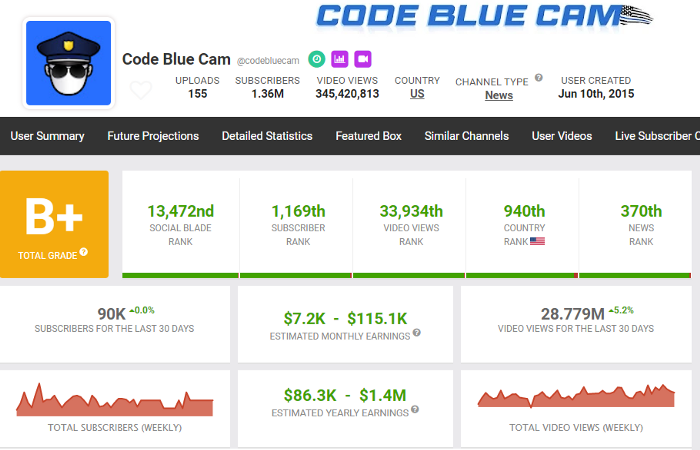
According to the website Social Blade, which tracks statistics for YouTube channels, Twitter, Twitch, TikTok, and others, Code Blue Cam currently has 155 uploads. Many of the videos come from police encounters and arrests with DUI suspects, police car and foot chases, drug busts, fugitives on the run, domestic violence, and even occassionally a celebrity confrontation. The video of Odell Beckham Jr getting kicked off an airplane has racked up 3.6 million views, for instance. It’s all pretty exciting stuff.
It’s not hard to see why this channel has found a big audience. Even after the TV show COPS got cancelled in 2020, people are still obsessed with watching the long arm of the law catch suspects. Code Blue Cam’s most popular video is one titled “Here’s Why You Shouldn’t Run From the Cops,” with 19 million views. Most uploads are in the million plus range. The thumbnails are typically just screenshots from the footage. No emojis or click bait. The video titles tend to be pretty straightforward, with sometimes a tinge of humor.
As of now, Code Blue Cam has 1.36 million subscribers. While it started back in 2015, it has seen the majority of its uploads and success in just the last few years. That’s remarkable growth in just a short period of time.
So, how has Code Blue Cam monetized its success? Obviously, the channel makes an income through Adsense. Social Blade estimates the channel makes anywhere from $7,200 — $115,000 a month, and $86,300 to $1,400,000 a year.
In addition to Adsense, Code Blue Cam has a Patreon page, with 491 patrons kicking in $5 (the only tier available) a month. That adds up to an additional $2,455 a month, and potentially $29,460 a year. The channel also sells t-shirts and other merch through its website. In addition, some of its videos include paid sponsors and affiliate links.
Even if the Adsense income is somewhere in the middle of Social Blade’s estimate, at around $500,000 a year, when you add in all the other revenue sources, Code Blue Cam has done quite well in the law enforcement video niche. This is no doubt due in part to regularly posting cleanly edited and often high-definition videos, as well as the channel’s dedicated, justice-seeking community. Freshly posted videos often generate thousands of comments very quickly.
Niche Deets
Important to note: Not only do police videos draw in a lot of views, they tend to be watched thoroughly due to several attractive elements. The escalatation in the encounter that often leads to a chase. The final arrest. And in some cases, the suspect’s freakout after being placed in the back seat of a squad car or at the jail. It creates a nice “story arc” of sorts, with rising tension, conflict expection, payoff, and spectacle. Important ingredients that keep people watching.
From an SEO perspective, if a cop cam video you post ranks for a particular news story, that has the possibility of generating a lot of organic views from Google over the long haul. Think of the Odell Beckham Jr. video I mentioned earlier. When that story broke, videos showing the incident almost certainly got a huge spike in views. Even smaller channels likely got a nice bump. Afterall, you want to not only post video content that an audience will want, but will keep you relevant in the search rankings.
The cop cam niche also has another nice element from a creator perspective. You don’t have to show your face. In fact, you don’t have to share any personal identifying information whatsoever. Code Blue Cam even uses a voice over artist to narrate portions of the videos.
This niche allows you to draw on an endless amount of content. There will always be arrests and police chases, unfortunately. These sorts of videos have a good chance for virality.
Another reason for Code Blue Cam’s success is in its strong and distinct branding. You know exactly what you’re going to get just from the logo and name. If you’re into watching cop cam videos, there’s a good chance you’ll watch a video in your feed when it pops up, and maybe even subscribe.
Summary
Code Blue Cam shows no signs of slowing down. It demonstrates that the cop cam niche is a strong and very lucrative one, that pretty much anyone can start.
What do you think of Code Blue Cam and the cop cam niche in general? Is it one you’ve ever considered starting yourself? What else do you think is responsible for its success?
A systematic and actionable list that can help take you from stage fright to stage bright.
Made with Midjourney
A lot of “fear of public speaking” articles I’ve read are frankly worthless. And I’ve read a ton of them. The advice essentially boils down to telling you to just “psyche” yourself out of the fear of talking to a room full of strangers. Or some variation of “believe in yourself,” and the confidence will come.
That’s all nonsense. The fact is, it’s normal and natural to have a fear of public speaking. It’s the exceptionally rare personality that truly thrives off stepping into the spotlight. Even professional speakers like Tony Robbins get stage fright.
However, there are a variety of ways for handling the fear itself, and becoming more effective at speaking to a group.
The first step is understanding that it’s a problem like anything else. A clogged toilet. A stalled engine. There’s nothing special about being afraid of speaking in public. Learning to handle the fear is a process like learning how to throw a football or swing a baseball bat.
It’s something you must train your brain to handle. In fact, you have to somewhat reprogram your mind to deal with it in a constructive way. No, I’m not talking about praying or speaking daily affirmations to juice yourself up before a big board meeting. I’m talking about simple activities you can take that can retrain your brain.
Handling a fear of public speaking is not a psychological problem. It’s a biochemical one. It’s like overcoming a drug withdrawal.
It can only be accomplished by incremental exposure and physical confrontation. Meaning that you put yourself into smaller, more manageable situations that gradually build up your tolerance over time. Here are a few steps that have helped me, that I hope will help you.
1. Sit in the Front Row
I used to be someone who was terrified of even introducing myself in a classrom or group. If the speaker started off with that ol’ “Let’s go around the room and introduce ourselves” bit, my pulse went from 72 to 115 almost instantly. I wear a FitBit, so I know that’s accurate.
However, I realized one day that the main reason I felt unnerving dread just saying my name was because I was unconsciously sabotaging myself by always sitting in the back of the room. It’s like I was telling myself I had nothing to contribute to the group, nothing of value to say, and that I didn’t even want to be there. I was making it 10x harder on myself by positioning my body in a way to simulate hiding from the group.
Now, I’m someone who does have mild claustrophobia. I hate sitting in small rooms with the door closed, or any physical spaces where I feel trapped. So anytime I would go into a room, I would try to find a spot near the door or in the back, as that fed my lizard brain the sense that escape was possible should things get hairy. But acquiesing to that mild irrational phobia in turn made speaking up way more difficult, because I was already grappling with the fear of merely being in the room.
So, the way I dealt with that was by forcing myself to sit in the front row whenever possible. This accomplishes a few things. One, it puts you closer to the action. Being close to the speaker helps you see and become more comfortable with the mechanics of a public presentation.
Two, it helps you become more comfortable with everyone’s eyes being on you, even if they’re only staring at the back of your head. Unlike sitting in the back or on the side, when you’re sitting in the front everyone will likely be looking at you if you ask a question or make a statement, because they’re obviously already facing that way anyway. This will help you become more comfortable with what I call the “spotlight effect.” If you can handle fifty people looking at you for thirty seconds while you respond to a speaker inquiry, the idea of speaking in front of those people for five minutes, ten minutes, or more, starts to become more managable.
Three, by sitting in the front row you are unconsciously validating your presence in the group. You’re telling yourself that your opinions and thoughts matter. That you’re worth listening to. I’m not saying that by sitting in the back or middle it means you don’t think those things. I’m saying that forcing yourself up front can give you an unconscious edge if you’re lacking one. I find that when I sit up front I feel way more involved and “ready to jump in” if the speaker asks questions or wants participation.
Fourth, sitting in the front row has a strategic benefit. If the speaker cruelly does do the go around the room and introduce yourselves trick, you’ll likely be among the first to go. So you can get that out of the way sooner. This is where sitting in the back has its major downside. There’s nothing worse than sitting there for ten minutes with the fear compounding, as you are forced to wait your turn to say your name and your favorite hobby, or something. If you sit up front you meet the challenge head-on, rather than letting it come to you on its own terms.
I still get nervous introducing myself, by the way. But I’m way better now than I was before.
2. Speak Up More in Smaller Groups
The fear of public speaking is generally a function of shyness. So if you’re already introverted, or someone who doesn’t like to talk much to begin with, getting in front of a crowd is going to be a challenge. Your brain will chemically repel from that, because your brain interprets the activity as a threat to your well-being.
Human beings, even shy ones, are still tribal, by nature. We want to feel that we are contributing to the group in some way. We want to feel involved and validated. Well, it’s much harder to do that if you are constantly avoiding even just talking to people in the first place. The more you are able to speak up in front of of several people, the better you’ll work up the nerve to speak in front of dozens, or even hundreds.
This is easy to do if you are in college, and you’re in several classrooms everyday. Groups tend to form based on seating proximity, or if the teacher hands out a group assignment. When that happens, be the initiator, or at least help facilitate conversation in some way.
If you’re a working adult, this can be accomplished during meetings at work, or by joining an organization like Toastmasters. While I was in college years ago, I joined a Toastmasters group that met at a Microsoft facility. They were a great group of people. Toastmasters has structured meetings, formal scheduled presentations, and offers feedback for you on a speech. Generally they meet once a week, and are always welcoming to new members. Toastmasters ia great training ground for learning to communicate more effectively period, much less public speaking. They can also be beneficial for people who are trying to improve their English-speaking skills. The group I went to had several individuals from other countries who were there to help improve their diction and pronunciation.
Nowadays, I work a job that has plenty of meetings. So whenever I can, I try to take advantage of that and participate reasonably. I make it a goal to participate with an observation or respond to a question at least once. This has helped to delegitamize the fear I used to have of being in groups, and cut back on my natural shyness.
Additionally, you can help knock the fear of public speaking by talking to strangers. Even if it’s something as simple as asking the time, or complimenting a retail worker. The idea here is to help break out of the “shyness shell,” so that your brain does not interpret other people automatically as threats that causes your ability to speak effectively to get shut down. The goal is social fluidity. The ability to effortlessly mingle in a comfortable and confident manner. Not an easy task for a shy person like myself. I’ve always envied those that are socially graceful outgoing friend-makers by nature. But the reality is those types are actually pretty rare. Most people don’t operate too well outside their usual group of friends or associates. So the more you place yourself outside of your social comfort zones, the more you’ll be equipped to handle the big Power Point speech, or the best man’s speech at your next wedding, and so forth.
Believe it or not, you can also help break out of that shyness shell by doing activities like commenting online, posting on social media, or writing a blog post or article. Any little way that helps break the negative feedback loop of non-participation can help, even if you’re just sitting behind a computer screen. Even though I’ve been writing articles for either newspapers or the web since I was 12, I didn’t feel comfortable writing on Medium when I first discovered it. I lurked for awhile. Now I write freely, and that’s had a positive effect on me feeling more confident when speaking to people in real life.
Made with Midjourney
3. Improve Your Diet, Exercise, and Stop Drinking
Like I mentioned at the top, the fear of public speaking is not psychological, it’s more biochemical. That means it’s not something you can just trick yourself out of having. “Mind over matter” only goes so far. It’s a naturally-occurring phobia because it’s rooted in a fear of exposure and shame and loss of status within the tribe. That means your body is doing its job by reacting with nerves, elevated heart rate, sweating, etc. That’s all perfectly normal. Your body is a machine to some degree, and it will respond to things automatically.
And therein lies an opportuntity. The stronger and better nourished your body is, the better it and your brain will be able to handle fearful situations. I don’t mean you have to have a full stomach before a speech or presentation. Personally, I usually skip lunch or breakfast as I never have much of an appetite before one anyway. I’m talking about improving your diet so your body is healthy overall. That means cutting out junk food, fast food, foods loaded with sugar and carbs, and focusing on healthy, nutritional foods that will give your mind and body all the vitamins it needs.
Some foods, like sweet potatoes, can help lower blood pressure. And that can have a big effect on feeling “chill” when you have to give a speech. I have naturally low blood pressure already. Usually I’m around 100/60 at rest. But I’ve found that staying hydrated with water, cutting down on caffeine, and eating a balanced diet regularly helps immensely. But there are many dangerous foods that can elevate blood pressure or cause a spike in your mood, only for it to crash later. You don’t want to be on a chemical rollercoaster the day of a speech. You want to be as cool and in control as possible.
By the way, I’ve also heard that some people take beta blockers, prescription pills, and even things like Tylenol or Advil before giving a speech, as it helps to calm them down and can lower heart rate/pressure and such. I don’t advocate taking any chemical supplements like that. I’m not a doctor or health/nutrition expert. I believe in fighting a public speaking phobia naturally. But if it’s something that works for you, and the supplements are healthy and ethical to take, then that’s your prerogative.
Another good way to protect your nerves is to cut out drinking, or stop altogether. I used to drink regularly, and often heavily, until I finally quit and have only rarely drank since. Drinking dehydrates you, even if you try to offset alcohol with regular glasses of water. Alcohol obviously distorts your ability to think clearly. It makes it harder to function at your best. A hangover can kill any ability to be productive. And that can make giving a speech a more difficult and terrifying event than it ordinarily would.
One of the reasons I quit drinking years ago is because the aftereffects of a nightly binge made my nerves completely shot the next day. So this only compounded my fear of public spaces, speaking, or being in rooms filled with people. It got so bad that if I was in a meeting, I would suddenly get hit with a jolt of fear. And this jolt would escalate. I’d get dizzy. The walls would start to close in on me. Until finally I had to get up and leave. Then I’d have to come up with some excuse later, like feeling sick, or having to use the bathroom. That is no way to live, and it’s totally unacceptable if you’re trying to succeed in the workplace.
The human body is a vast chemical ecosystem. While it’s nice to pretend that you can just will yourself through anything, the fact is we are very susceptible to chemical manipulation. So the better you treat your body, the better prepared it will be to handle challenges.
Lastly, I found that working out right before a meeting or speech can do wonders, as it can help increase the sense of well-being and improve my mood overall. I always feel confident (albeit maybe tired) after a good pump, but certainly in better condition to handle a social engagement. Ask yourself, will you feel better walking into a room full of strangers if you’re in good shape or bad shape? I’m not saying you’ve got to be jacked and tan like a bodybuilder. But again, it’s all about unconsciously validating yourself. When you exercise and take care of your body, you are telling yourself that you matter, and that can pay huge dividends in the social arena.
You can enhance the exercise benefit if you join a gym, too. That way you’re putting yourself in a social environment, and giving yourself a chance to interact with strangers outside of your comfort zone. No matter what, exercise will make you feel better and healthier overall.
4. Record Yourself Talking on Camera
This is a neat trick I’ve recently learned while developing my own YouTube channel. In fact, one of the main reasons I decided to start a channel is to work on my communication skills. I am not a good “on the spot” talker, either in an informal conversation, or when delivering a presentation. I need a written speech, or prepared remarks. I’d carry around a teleprompter if I could, even for a five minute talk.
But if you want to really improve speaking on front of others fluidly, you have to learn to do it without notes. Which can really amp up the pressure. I tend to freeze up in those situations. I’m a writer, not a talker. But both activities involve bridging your unconcious with your conscious mind. And there’s no downside to being a more effective communicator.
Well, one way I’ve found that helps is simply by putting your smartphone camera on yourself, and just talking about whatever comes to mind, for however long you want. You don’t have to upload these recordings to YouTube, of course. I still read a script when making my videos. However, I have found that talking while the red light is on helps to simulate what it’s like to talk in front of a group. And that can do wonders to alleviating the stress invovled with having to give an actual speech.
I think this is because when you hit record, you have to be “on.” And there’s pressure there, even if it’s just you sitting in your car by yourself talking to your steering wheel. But it helps to see yourself talking. It helps make you more self-aware. And it gives your unconscious the impression that you can not only communicate, but maybe even do so quite well. Again, it’s all about overcoming this negative self-image. Replacing the unconsciously-held version of you that can’t talk with one that can.
I’ve recorded hours of myself in my car just rambling. After every session, I always feel better and more confident. It’s great practice for the real thing. And when you get really good at it, then you can think about making full-fledged YouTube videos. My goal is to get to the point where I can talk fluidly in front of the camera without needing any notes, or having to read a paper. Extemporaneous talk has never come easy for me, so to me this a challenge. But it’s one I hope to overcome with time. And it’s way better than just talking in front of a mirror.
If you want to take things an additional step, you could even make Youtube Shorts or TikTok videos. Personally, my style of content creation tends more formalistic and structured. Freestyle, randomized stuff is not really my thing. But for someone else it might be a great way to break out of the shyness spell.
5. Stop Using Past Trauma as an Excuse
It’s very challenging to break out of a personal identity mold or a reoccurring negative feedback loop. But it’s a necessary and important step toward personal development and self-improvement.
I theorize that a fear of public speaking is more about genetics than past trauma, or bad childhood experiences. This is why public speaking is such a universal fear. Most people have it to some degree.
That doesn’t mean past events can’t have a big impact that cripple your ability to communicate to crowds. I can think of two episodes that happened during my formative years. In fact, one happens to be one of my very first memories. When I was four or five I was running around the hallway of a church when I tripped and smacked my forehead into a corner. It must have been a serious injury, because I was taken to the hospital next. But what I mostly remember is hospital staff trying to hold me down, and then putting me in some kind of child restraint system to prevent me from moving. I vaguely recall squirming and fighting hard to get away, and then being coccooned and immobile in the straps or straight jacket, or whatever was used to tie me up. I think this is what may have triggered my claustrophobia and fear of physical entrapment that I mentioned earlier. It’s a very unpleasant memory, to say the least, and it no doubt left a negative impression on me. Whether that had anything to do with triggering a fear of public speaking I’m not sure. But it certainly gave me an aversion to being the center of attention, and a nagging sense of insecurity. Or at least it exacerbated a fear of being in the spotlight that might have already been present.
The second episode involved an invitation to give a speech to a group of second or third graders when I was twelve or thirteen about writing. It was a hot spring day. For some stupid reason, I wore a sweater and long pants that day. The meeting was held in a stuffy room with little ventilation. So by the time it was my turn to talk, I was sweating and ready to pass out. On top of that, my nerves were already shot just having to give a speech. So I froze up. It was a terrible, embarrassing situation that I wasn’t prepared for. Looking back, that moment undoubtedly cemented a lifelong fear of giving speeches. It made presentations for school assignments dreaded events. No matter how much I’d try to prepare, I’d always always end up bombing, because I couldn’t get past the nerves. It’s like my confidence had been shattered permanently. Making matters worse, I moved around a lot as a kid. So I rarely had friends or allies in the classroom. It was always strangers. I had severe acne, which itself can ruin any natural proclivities to socialize, robbing you of the chance to learn at a crucial stage in life. So it’s fair to say I was set up poorly from the start.
But none of that matters. One of the things I’ve learned as I get older is that a big part of life is fixing problems in yourself that you didn’t think you could, because you have to. Your survival in some ways depends on it. You can’t live life hiding under a rock. At some point you have to confront your fears. Just because bad childhood events hurt you, or put you in a negative feedback loop, doesn’t mean you can’t break out of them. It doesn’t mean you can’t redefine yourself as an adult, on your own terms. I know it may sound like pointless idealism, but understanding that you have the ability to reprogram yourself, is a vital mindset shift toward self-improvement.
I’m by no means a master public speaker, or some great stage performer. Overcoming the fear of public speaking is still an ongoing struggle for me. But I’ve found that the above steps have helped me immensely. I hope they help you as well. 🙂
Like a lot of people, I had no idea that the film Planet of the Apes was actually based on a book. And that really goes to show the power of a big name in Hollywood. I always knew Rod Serling had a hand in it. I mean, that’s obvious. The movie is like a big budget Twilight Zone episode, complete with a classic twist ending. I actually thought he wrote the whole thing. I didn’t know it all came from a best-selling novel written by a French guy named Pierre Boulle, who also wrote another popular work that got the big screen treatment, The Bridge Over the River Kwai.
So, when I saw an actual book with the title Planet of the Apes on its cover sitting in the library, I almost didn’t believe my eyes. This is the curse of living in an age where literally everything is adapted from some stupid comic book or graphic novel, or a remake of a show or movie. You tend to forget that for most of Hollywood’s existence, it was books (classic ones, even) upon which everything was largely based. That’s not say that best-selling popular fiction doesn’t tickle H’wood’s G-Spot nowadays still, but it seems like most of the books pipelined into features are calculated for that exact purpose. Blame that on Michael Crichton. The guy who could sell movie rights to his books in a matter of seconds.
While we’re on the subject of movies, Boulle’s apes book makes a strong case for inspiring the largest amount of cinematic content from a singular literary source. There are currently nine Apes movies, with the tenth on the way in 2024. The franchise started with the Charlton Heston-starring original in 1968, continued with four more sequels through the early ’70s. Then there was that Tim Burton remake in 2001. Followed by the rebooted franchise films that began in 2011 with Rise of the Planet of the Apes, starring pre-sex scandal ruined James Franco and the stellar CGI services of Andy Serkis. The Apes franchise has certainly reached over a billion dollars in box office revenue, plus whatever merchandise might have been sold. I mean, you know EVERYONE is clambering for a Dr. Zaius action figure.
Hey, that’s not bad for a relatively short novel published way back in 1963.
But we’re not here to talk the Apes movies. We’re here to talk the Apes book. Which is a clever, high-concept story with some humorous sci-fi anachronisms (it was written before Neil Armstrong stepped on the moon), a likable if rather bland lead character, an odd and arguably pointless narative framing device, and not one, but two twist endings.
Suck on that Rod Serling and M. Night.
This was a good, breezy book that felt like a fun science lecture delivered by your favorite professor. Not too long. Not too short. It only clocks in at a short 250 pages or so. And that’s with a LOT of white space, mind you.
The book employs a weird framing device. We meet a rich couple “sailing” through space using some form of solar power or wind as a propulsion system. Space travel is now so commonplace that the leisure class now does it for going on vacation and honeymooning. This couple, Jinn and Phyllis, somehow, inexplicably happen across a message in a bottle floating in the endless void of space.
Yes, a literal message in a glass bottle hurling through space. No matter the trillion to one odds of such an event occurring. And in this bottle is a hand-written document containing a crazy story about human astronauts who lands on a faraway planet from earth that is populated by intelligent apes. The story is written by a journalist named Ulysse (no doubt inspired from Odysseus) who was invited by a professor and a physician on an interstellar journey in a rocket ship capable of reaching near-light speed. Due to a complicated time dilation function, as the rocket reaches the speed of light, time inside the ship behaves normally, while outside centuries pass. This allows the trio of men to reach the star Betelguese. Once they arrive on a habitable planet, the astronauts find some water. They throw off their clothes for a swim. But it isn’t long before they’re accosted by a tribe of humans, who ruin their clothing and their rocket ship.
Making matters worse, a gang of gorillas come along and capture two of the astronauts (one is killed in the attack), where they are taken to a lab for study. Ulysse makes friends with Zira, a chimpanzee researcher, and her fiance, Cornelius. But the journalist’s biggest challenge will be convincing the ape world he is actually intelligent and deserving of equal rights as the apes. A tall task considering the high-ranking orangutans, led by the hard-headed Dr. Zaius, are convinced the human is just mimicking them, and really could just use a good ol’ fashioned lobotomy instead.
Ulysse eventually escapes the monkey planet with a hot (human) native girl he names Nova, whom he’s gotten pregnant during his long period of incarceration. He jumps forward in time again, and eventually arrives back on earth. Only to discover that his home world has ALSO somehow become overrun by smart apes.
We then jump back to the rich vacationing couple to reveal that they are actually apes themselves, who find the story they just read so unbelievable, that they just laugh it off and keep heading into space.
Planet of the Apes is packed with a lot cool ideas. The ebb and flow of civilization. Special relativity. Science versus superstition. The staunch bureacracy of the scientific establishment. The ethics of animal experimentation, in this case using humans to help advance medicine for apes. Genetic memory. But the idea I find the most interesting concerns mimicry behavior. As Ulysse and his ape allies discover through the process of research and discovery, the apes didn’t so much become intelligent as became sophisticated copy cats of human behavior. Or copy apes.
The book proposes the troubling existential idea that true creative consicousness, and genuine originality — that unique candle flicker that defines humanity — is itself a rare and somewhat unquantifiable thing. The apes, for all their societal advancement, are almost no better than flesh and blood ChatGPT automatons covered in hair. Though most humans are essentially the same thing. Hence the common online put-down “NPC” (non-playable character) used against simpletons who float along with the crowd, uncritically mimicking the majority. As though plugged into some kind of hive mind. Ulysee uses the example of how once a century a true work of genuis is written, and then everyone else copies it, which begets more copies.
Naturally, this eerie and disquieting realization perturbs the ape intelligentsia. And it’s understandable. No one wants to know they’re essentially a puppet. But when you take a good look around, you can’t help but realize that this kind of explains why everything tends to be so screwed up. Because real thought and developing a true individual identity are hard to do. It’s much easier to copy and go along with the current status quo. Don’t agree? Okay, what language do you speak? Do you use money? Do you wear modern clothes? If you’re working, are you saving for retirement? Are you aware of the laws in your community? If you’re attending school, why are you attending school? For a job? Because it’s what you’re supposed to do to “make something of yourself?” Okay, now stop and think about who put all those ideas in your head about those things in the first place, and whether you really ever had a choice as to whether or not you were going to follow that societal programming.
Made with Midjourney
The concept of mimicry is actually kind of scary the more you think about it. It makes you doubt whether you even have a free will. Or your own mind. I’m not saying it’s all bad, or that it’s all some evil conspiracy. Most of our copied behavior is essential training that keeps us safe and alive. But it is alarming to realize how little we really think about what we’re doing as much as we’re coasting on a set of predetermined coding.
Not far behind the mimicry idea is genetic memory, also known as racial memory. Ulysee encounters a human subject who somehow is able to recount the entire history of the human/ape conflict that ultimately lead to the simian takeover by accessing traumatic memories hidden in their genetic code. It’s a rather bizarre scene altogether, and scientifically questionable. It may as well as be a psychic seance. But it’s a clever way for Boulle to provide some needed exposition to explain how the apes came to be.
I’d strongly recommend checking out Planet of the Apes. Not only is it intellectually stimulating, original, while also being enjoyable, but it’s also a classic. And I don’t know about you, but I’m always fascinated by cultural watershed works that inspire a franchise or a major milestone within its genre. Apes has that in spades.
Fiction Affliction #1: A review of Stephen King’s 1983 meditation on death, despair, and the heavy cost for refusing to let sleeping dogs (and cats) lie.
“CREEPY CAT” (Made with Dream by WOMBO)
Realtor: Hi, yes, Dr. Creed? Oh, I have the perfect house for you and your family.
Dr. Creed: I can’t wait to see it. My wife and two young kids, whom I’m dragging from their lifelong home in Chicago to Bangor, Maine for some reason, can’t wait to move.
Realtor: Well, firstly, and I just want to get this out of the way, it’s located right by a super busy road where giant trucks driven by idiots who don’t pay attention come rumbling by at 100 mph every minute of every day, all day and all night. There’s no fence or barrier by the road, so it would be really, really dangerous if you happened to have a kid who’s highly mobile and not old enough to recognize the danger of crossing the street yet. Is that okay with you?
Dr. Creed: Absolutely. I am a doctor.
Realtor: Also, and I just want to throw this minor little thing out there. But there’s a pet cemetary behind the house.
Dr. Creed: Oh, that’s interesting.
Realtor: Yes, many of the pets killed by those trucks over the years are buried there.
Dr. Creed: Well, I’ve been meaning to finally talk to my daughter about the facts of death, so this will be a good conversation starter.
Realtor: Great! Let’s schedule a showing for tomorrow!
This is the inaugural piece in a new series that I’m tentatively calling Fiction Affliction. This series will be mostly devoted to book reviews. But I’ll also be including screenplays, short stories, and basically anything EXCEPT TV shows and movies. There are enough people out there talking about stuff in the frame rate medium. I’m more interested in the written word. The boring black and white.
I’m also a novelist myself, having self-published two books, with more on the way. Fiction Affliction is my way of learning and reflecting on various novels and other written works I’ve read, and sharing them with everyone else. All wrapped in an informal, humorous, and always brutally honest style with a touch of irreverence. I’m trying to focus on stuff that’s either lesser known or niche, or if it’s by a popular author, something that’s not one of their marquee works. Pretty much everything by King is popular, obviously. Especially these days, when Hollywood is instantly making everything he writes into a movie. They even made a movie off a story he wrote about evil grass. The Maine man truly is the Main Man. You’ve got a better chance avoiding getting hacked to pieces by Jason Voorhees while you’re in the middle of having sex than not seeing some obscure King work get made into a series or feature film.
Pet Semetary was always a back burner King book for me. Over the years I’ve read pretty much all of his classics. The Shining. The Stand. Carrie. The Dead Zone. Salem’s Lot. I even read Insomnia, a forgotten door stop about some guy who somehow develops super powers because he can’t sleep. I still haven’t read IT, though I’ve tried twice. Clowns don’t scare me, and King is especially rambly in that one.
But Pet Semetary. That’s more like a cult classic of King’s. It’s not his best, though I’ve often seen on Reddit threads people mention it as their favorite. I can see why. It’s his purest meditation on death. The story has a cozy and intimate feeling notwithstanding. It’s like being slowly strangled by a warm, fuzzy blanket. There are some passages that are not only great in a literary sense, but also scary as hell. The chapter where Louis’s daugher Ellie comes to him and asks him about death, for example. And how that interaction triggers his wife Rachel to remember her horrifying ordeal with her dying sister Zelda.
The whole Zelda sequence could have almost been a seperate novel in and of itself. This was King in his prime. Back when he was a cocaine-fueled boozing maniac pounding away at the typewriter in the basement, and everyone was afraid he was going to finally go nuts and hack his family to pieces.
Man, I miss that guy. He used to riff off little stories within his stories like the way a carnival barker raffles off tickets to some ungodly (and unsafe) amusement park ride. You think of the numerous stories telling the history of the teleportation equipment in his short The Jaunt. That’s a story that should get reviewed on here at some point.
King used to be encyclopediac. His books used to be little labyrinthes packed to the gills with all kinds of frightening shit.
Now King is just another Twitter tweeting avatar.
Which reminds me. Fuck Twitter. Not only is it a morphine drip distraction, but I hate how it has sucked in so many great writers into its event horizon. I think social media has a way of watering down good writing, and reducing otherwise solid writers to time-wasting clout-chasers. How many good books have been lost, their creative energy transformed into worthless tweets? You hear that giant sucking sound? That’s the sound of Twitter sucking all the brain cells out through everyone’s ear holes.
Anyway, back to Pet Semetary. A novel about a doctor named Dr. Louis Creed who moves his family from the Land of Deep Dish Pizza to Bangor, Maine in order to take a job at a local university as the school physician. He moves into a nice house in the country, which happens to be right alongside the most dangeorous road in the universe. Where giant trucks come lumbering along regularly, killing pets and other wildlife. But those trucks are nothing compared to the creepy AF pet cemetary tucked behind his house down a trail. But even that’s small potatoes compared to the ancient Indian burial ground that’s located behind the pet cemetary. Man, if this doctor prescribes drugs as well as he picks houses, he’ll have you taking shots of hydrochloric acid for the common cold.
I am a slow reader. I like taking my time. Or as I like to call it, my eyes prefer a tantric experience with the ink and paper. But I have to say, Pet Semetary really slowed me down. The book is like wading through molasses wearing cement shoes. And I think that’s because it’s a deceptively heavy book. It’s all about death and despair. It’s unrelentingly sad. It’s an existential crisis hiding within the trappings of mass market horror. There’s a subtle nihilism that creeps through. Digging deeper, it’s not only about death. It’s about the fact that after death there really is nothing. Just a void. And to try to cheat that — to bring something or someone back — is just fooling yourself. The hardest part about losing someone isn’t just that they’re gone. It’s that you’re never going to see them again. That there is no happy afterlife where we’ll see each other. It’s as if King is saying the scariest part of life isn’t anything supernatural or otherwordly. It’s the simple fact that when the light goes out, that’s it. And all you can do is accept it.
Pet Semetary is a gut punch. It’s a middle finger to the religious minded confident in their inevitable Laz-E-Boy recliner cloud awaiting them in the sky post their final raspy breath. It’s about denial and the consequences of refusing to accept reality. It’s also a metaphor for psychological trauma, as seen in the Zelda story. Of the inability to get past some tragedy or loss.
This book hurts to read. Because you’ll find yourself thinking about loved ones you lost. It’s a smart choice to explore the concept via the death of Ellie’s cat Winston Churchill, or Church. Everyone’s lost a pet at some point. I found myself thinking of my beloved Himalayan ragdoll Napoleon Cataparte. A cat who who was there for me my last year in high school, my first few years in college, and then my entry into the real world. Napoleon was a regal feline with a strong personality. He was a boss. I loved that cat. When he got on in years, we were fortunate to find a home for him with a nice older lady who only adopted Himalayan cats. He passed away peacefully one evening, perched atop his lounge by the window. A king on his throne to the end. Long live Napoleon.
“KING NAPOLEON CATAPARTE” (Made with Dream by WOMBO)
Structurally, Pet Semetary is kinda wonky. The first act takes up almost the first half of the book. The second act is basically the event and aftermath of Gage’s (Creed’s two-year old son) death. And then the third act is told in one pulse-pounding one-night sequence where the doctor goes to dig up the corpse of his son and rebury him in the Indian burial ground so the toddler can be reanimated. The whole sequence is written like a heist.
Which makes me wonder…have the Ocean’s 11 writers ever considered putting a horror element in their franchise? Like instead of robbing just another boring bank or casino, they have to rob an Egyptian pyramid, or a South American crypt? And George Clooney gets killed by a mummy or something?
Anyway…
Pet Semetary is deeply morbid, depressing, soul-crushing stuff. It’s one of those novels that goes there. What else can be said about a book that features a two-year old getting run over by a semi-truck in grisly detail. It’s every parent’s worst nightmare.
There’s also one hell of a stinger at the very end.
I recommend Pet Semetary, but only if you’ve got a cast iron mind. Reading it is like swallowing a razor blade.






 Dean Brooks