What population and fertility trends in Nigeria say about the West.

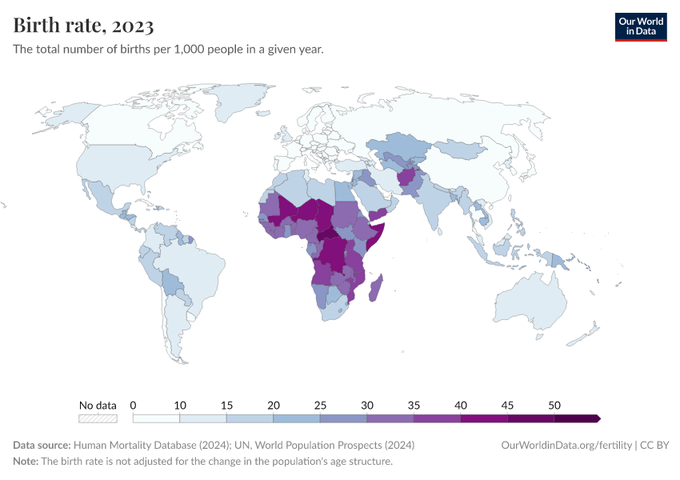
Despite not having any kids, I’ve become intrigued lately by all the doomsdayers out there raising alarms about birthrates and replacement rates. Elon Musk, who has 14 children with five different women himself, talks about it almost every day on X. Recently, he retweeted a user who shared some shocking graphs:
Then there’s this one:
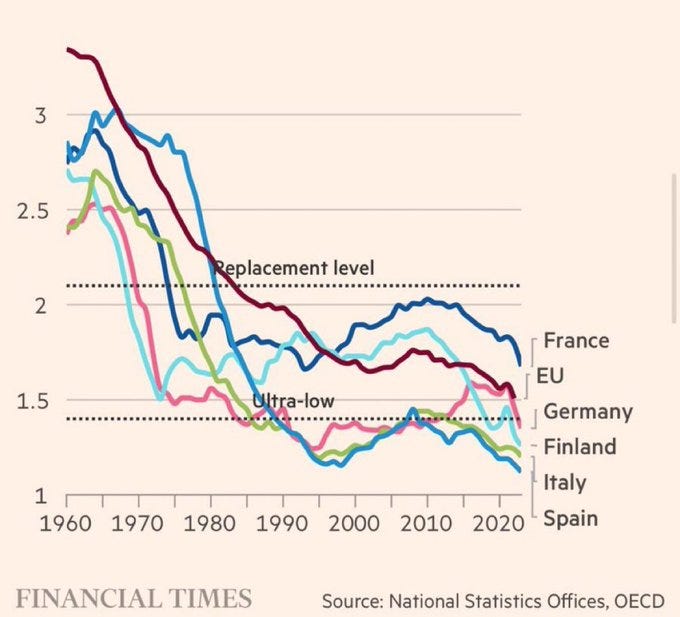
Wow. That is what’s called a precipitous collapse. The West will be extinct before long at this rate.
Anecdotally, my grandmother had eight kids. My biological father had seven. My mother had four. I have two half-siblings who have two kids each. My youngest half-sibling has none, as do I. Only a few of my cousins have more than one child. I’ve witnessed in my time a severe narrowing in the number of kids couples have over the generations. Marriage rates have also gone down. The average age people marry has gone up. And the number of children people have who happen to get married or cohabitate has shrunk across the board.
Not so in Africa, according to the graphs above. Especially countries like Nigeria, which actually has a population explosion that is projected to reach over 400 million by 2050, according to the World Bank. The United States’ population is currently 340 million for comparison.
So, what’s going on? Why can’t the West reproduce itself? I’ve heard all the excuses: expensive housing, cost of living, the job market, etc. However, according to a recent study that looked at the population trends in the African country, “income does not play any significant role in the demand for children in Nigeria.”
The 2022 study is titled “Fertility and Population Explosion in Nigeria: Does Income Actually Count?” You can check it out at this link here.
There are some key takeaways aside from the obvious ones involving increased life expectancy, declining death rate, and high infant mortality. Nigeria has seen improvements in both those areas over the last 59 years, though its infant mortality rate is among the highest in the world, and correlates with the higher number of births.
But if it’s not income or medical care that’s keeping the West from reproducing, what is? Culture, mainly. Take a look at Nigeria’s attitude toward children in general, and see if there’s a marked difference with the West’s.
From the study:
Children are viewed as a future investment and given the uncertainties of them having a brighter future, a poor household can produce more children to try their odds. That is, out of the very many children, some could have a chance to become prominent individuals in the society. Apart from that, some traditional Nigerian households views greater number of children as a strength to the family in terms of providing family labour at the subsistence level.
There are other cultural factors at play, which I’ve broken down here:
- early marriage
- universal marriage
- prolonged childbearing
- low contraceptive use
- cultural emphasis on large families due to fear of lineage extinction.
I bold-faced the last one because it ties in with high infant mortality.
Fear of extinction fostered increased reproduction in the face of perceived high child mortality with the expectation that some of the births would survive to carry on the lineage.
It also is what most differentiates Nigeria from the West. Those few who procreate here in the U.S. do so within a bubble of relative security. It’s never been safer or easier to have kids from a medical point of view. Yet families in the U.S. remain largely fractured and small. Members are often adrift from one another. Who fears their family name dying out who isn’t named Trump or Musk?
Meanwhile, Nigerians reproduce as if they have a gun to their heads. Is it mostly due to the infant mortality rates? I don’t think it’s that simple. I get the sense that even if infant mortality were to suddenly incline here, it’d be met with indifference. Most women support abortion rights and put off having children until their 30s. Few men want to become fathers. Fertility and parenthood are not treated with celebration but looked at like nuisances. As obstacles to having fun or achieving life and career goals.

People are staunch individualists, focused intensely (selfishly, even) on their career and capital acquisition over reproductive relationships. We’re a culture obsessed with entertainment, dopamine fixes, and endless sensory distraction. To put it crudely, women would rather strip on OnlyFans or sip mimosas at the bar with their girlfriends on Friday nights, while men would rather play video games and jack off to internet porn, than do something as backbreaking like start a family. Much less a family above the replacement rate.
Sex education starts young, with a heavy emphasis on contraceptive use. We all remember the condom and banana demonstration in fifth or sixth grade. Sex ed also pounds on this idea that getting preggo is basically the end of the world. While out-of-wedlock teen pregnancy is obviously not ideal, that anti-natal sentiment carries on into adulthood. Fewer people marry, and hardly anyone marries young. In fact, the idea of getting hitched prior to age 25 is seen as absurd. Your twenties are supposed to be for “experimentation,” and screwing around, not getting serious with anyone.
None of this is to say Nigeria’s population explosion is an ideal to aspire to for the West. Severe poverty persists. Excess population is a drain on resources. In fact, the baby boom is considered a crisis in the country. The study states in its conclusion:
Population control is therefore sacrosanct to save the nation from peril.
Nigeria’s high infant mortality rate also continues to be a problem. By reducing that, in addition to better sex education, the country may be able to reign in its population.
In fairness to the West, medical technology may help extend life spans and quality of life far beyond what’s typical. Many people continue to work into their seventies and beyond, and not just our politicians, either. Plus, our infant mortality rates are extremely low (5.6 deaths per 1,000) compared to Nigeria’s (72.2 deaths per 1,000) and other African countries.
It is possible that a birth rate below replacement is a natural and inevitable byproduct of a modern, developed civilization. But it’s odd and disquieting that even in the face of imminent extinction, our collective response is nonchalance. At what point, if at all, does self-preservation kick in? For many Millennials and Gen-Zers, it will be their social media accounts that will serve as their final legacy, not their genetic progeny. A sad state of affairs.
I found this study fascinating because it helps dispel the myth that income and cost of living are the biggest factors in why few in the West want kids or want many of them. It’s not a financial issue, it’s a cultural one. I don’t see those trends reversing anytime soon, if ever. We’re never doing away with sex education. We’re never going to tell our teens to shack up young or put off college to have a family. We’re never going to be anything but workaholic, screen-addicted, materialistic pleasure-seekers who only seem to have families by accident instead of intention. What modern woman aspires to having kids period, much less four or five? What man would choose breadwinning over fantasy football and e-thots? Face it. We just hate kids.
To quote a meme I recently found on X: “We traded bedtime stories for higher GDP.”
 Dean Brooks