The true cost of buying a house for a “pint of blueberries.”
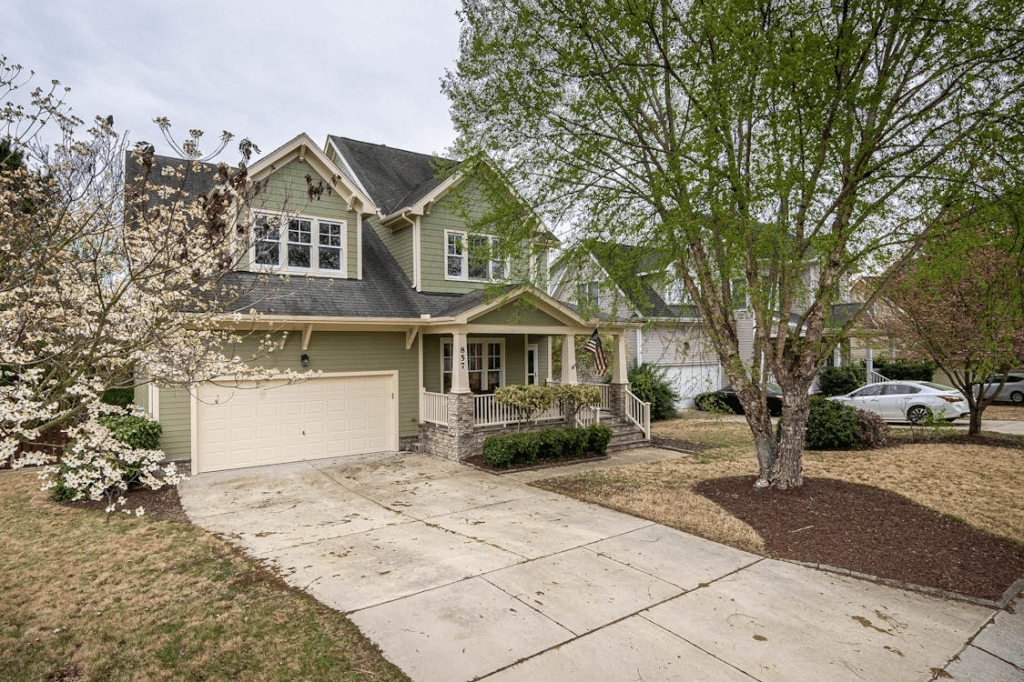
Every once in a while I like to indulge in a bit of “nostalgia-gazing.” This is when you look backward and become wistfully lost in reminiscence. Maybe you look up old neighborhoods or homes you lived in, schools you attended, or places you used to frequent. You might even take a road trip out to those places.
During one such bout of backwards-gaping, I happened to look up a house my family rented way back in the halcyon days of 1991 located in West Chester, PA. West Chester is a quiet, middle class town with a few upscale neighborhoods and cul-de-sacs. It’s an idyllic place with a small town feel, located just 40 minutes or so west of Philadelphia. It’s still one of the places I consider “home,” even though I haven’t lived there in over 30 years. Such is the impact of certain places we live in as children.
Anyway, I decided to look up my old house–an abode where I once enjoyed a Jaws-themed 10th birthday party, where my friends all dressed as different sea creatures. I was the Great White shark, of course, as I was obsessed with the movie at the time. I found a link to the house through Zillow, and up came the house’s sale history as well as the current estimated value. My family only rented the house from 1989-1991 before moving out after the school year in June, after which it was bought in ’91 for a whopping $150,000.
That sure sounds cheap by today’s standards. Especially when the estimate for the current value of the house is $750,000. And that’s actually cheaper than many of the surrounding homes in the circle in which we lived. Some homes just across the yard on the next street over are well past the million dollar mark.
You won’t find much affordable in West Chester, PA today, unsurprisingly. Homes tend to start around $650,000 and go up rapidly. The town is a perfect example of what many Millennials and Gen-Zers (and I suppose some underperforming Gen-Xers, too) gripe about when it comes to the inflated price of homes.
“The Baby Boomers had it so easy! They had cheap housing! Why, back in the late 80s and early 90s, you could practically buy a house for a pint of blueberries! Now a house costs a first born and your eternal soul just for a down payment! I’m gonna rent until I die!”
We’ve all read the histrionic and hysterical pronouncements on social media. We’ve all seen the memes. It’s an outraged generational war cry: “The Boomers had it easy!”
But did they really? I don’t think supposed “cheap housing” tells the whole story. I think there’s a lot of ill-informed and misplaced criticism here when it comes to the affordable housing shortage, as well as some selective memory on the part of Millennials. It puzzles me sometimes seeing my generation so appallingly ignorant. After all, we were there, too. As kids, but we were there. Sure, I spent my days jumping on enemies in Super Mario Bros. and watching Saturday Morning Cartoons. But I was there. I remember the context of the supposed “easy times.”
My family was not rich. We were lower-middle class. Even the “low” cost of $150,000 for that house was too much for us. Hell, the house we wound up buying some years later in another area was like half that price. We struggled. I was the oldest of four kids. My three younger half-siblings were born 5, 7, and 9 years after me.
See, people forget that the Boomers were BREEDERS in addition to “cheap” real estate beneficiaries. Boomers did what people have been doing for eons–they purposefully set out to get married and have kids. My father had seven. My mother had four. My step-father had three (my three half-siblings). And they had those children starting relatively young. My dad was 18 for his first. My mother was 24. Most of my aunts and uncles had children, sometimes multiple, before the age of 30. It’s only recently that couples are having fewer and fewer kids. It used to be common to have three or more. My grandmother had eight, for instance.
And what do you have to do when you have a lot of kids? Well, if you’re responsible, you put them up in a HOUSE. A house becomes a priority by default. And not because a house is a “good investment” or an asset or whatever else the finance bros want to call it. But because it’s an absolute necessity.
And therein lies the first major counterargument against the “Boomers had it easy” mantra. Boomers were forced to buy houses because they had lots of kids. Kids need toys. They need their own rooms. They need yards. Kids need a lot of stuff, actually, and a house is the best way to contain all that stuff.
For most Boomers, their house was EVERYTHING. It was the black hole that sucked in all their available money. Most Boomers were not rich. They were middle-class. Most Boomers did not invest in the stock market. They did not buy gold. They did not buy silver. They did not buy bonds. Obviously Bitcoin and crypto did not exist back then.
No, most Boomers had a little savings account that earned maybe 5-6% interest, and their house. That’s it.
Today, it’s never been easier to invest in the stock market. Download the Robinhood app and in seconds you too can be FOMO-ing into the latest meme stock or crypto that some dude on the internet told you is “going to the moon, brah.” Financial awareness has never been higher than now. Go on Youtube and there are a million finance dudes who will happily educate you on everything from “diversification” to the “4% rule,” to the “FIRE movement,” as well as on more complex investment instruments like LEAPS, scalping, daytrading, and more. But who knew about any of that stuff back during the Boomer’s time? No one. Because even today the majority of people remain woefully ignorant on financial matters.
Today, investing in a variety of assets is seamless and nearly cost-free. Back in the ’80s and ’90s you had to visit a broker in person. You had to mail them a check. You had to pay PER stock transaction. And it wasn’t cheap, either. I remember as late as the mid-2000s paying $9.95 to Scottrade just to buy a few shares in Apple. Most exchanges today allow you to trade stocks at no cost.
Back then, almost nobody knew about index funds, mutual funds, ETFs, dollar-cost-averaging, “buy the dip,” or anything else. The typical Boomer investment portfolio was their savings account, a CD, a government savings bond or two, and perhaps a few physical stock certificates in IBM their parents handed down, some baseball cards, and maybe a family heirloom like dishes or something.
And their house, of course. Their house, that certainly took up the lion’s share of their assets.
And how did they do with those “investments?”
Well, on the surface, they seemed to do okay. The house that my family passed on in 1991 sold for $150,000 but today is worth a staggering $750,000. Wow. That’s a 500% return. That’s good, right?
No, that’s awful. So, so awful. Especially over 35 years. Even if the house was worth $1,000,000 it would still be a bad return given that time frame.
And that’s only looking at the base price of $150,000, too. Houses have ongoing costs. You’ve got maintenance, insurance, property taxes, and of course the interest on the mortgage. Over that 35 year period until today, my Boomer mom and step-dad would have likely put in around $300,000 minimum, which means they would have only just barely more than doubled their money.
Also, there’s a little thing called “opportunity cost” that makes this awful return even worse. Opportunity cost is what you miss out on by investing in one thing versus another. By investing $150,000 into a house you miss out on investing it in other things like stocks, gold, and silver. Remember, for Boomers, their house was it. It was harder to invest in even simple things like mutual funds. If Boomers had exposure to stocks it was largely through their jobs, which may or may not have had a 401(k). They might have had an IRA or a personal brokerage. Just like today, most people did not invest in the stock market. Or anything, really.
But let’s look at how some other popular asset classes did during that 35-year time period. From June, 1991 until now (March, 2026) the S&P 500 Index has gone up over 1600%. Gold went up around 1200%. Silver 1700%. And the Nasdaq Index went up an unbelievable 4700%.
That means the return on that $150,000 investment becomes:
S&P 500 – $2,400,000.
Gold – $1,800,000.
Silver – $2,550,000.
Nasdaq – $7,050,000.
In an equally weighted portfolio (25% in each asset class), the return comes out to around $3,450,000.
Suddenly, that supposedly large $750,000 becomes rather puny, doesn’t it? If you had invested your money into pretty much anything else except housing from back then until now you would have made vastly more money.
“But, but, but, Boomers were also able to invest in those things in addition to enjoying cheap housing.”
Absolutely. A small minority of them did, anyway. But if the statistics on stock ownership of today are any indication, many of them did not. Or if they did, they didn’t own much for it to really matter. According to Pew Research Center, 58% to 62% of U.S. households today own stocks. The top 10% of households own almost 90% of all stocks. The top1% own 50% of all stocks. While the bottom 50% of households own only 1% of stocks. That’s even with widespread frictionless trading apps like Robinhood and others, and the YouTube and social media algorithms giga-pumping financial knowledge bombs on you left and right. I’d guess that almost certainly stock ownership was probably a lot lower back then than now.
Yes, in the purest technical sense, Boomers got housing “cheap.” Not “pint of blueberries” cheap perhaps. But certainly way cheaper than today, nominally-speaking. And now they are enjoying much higher valuations on their homes. But at what cost? No matter how you slice it, a barely 2x return over 35 years is absolutely abysmal relative to almost anything else. Even a CD with a rate of 5% beats it.
My West Chester, PA childhood home represents a good average. Homes in Southern California, of course, and other places, have gone up a lot more. But you can’t just look at the prices and compare them to decades past. That doesn’t give the whole contextual picture.
The average Boomer struggled just like the average Millennial and Gen-Zer does today. They had limited passive income, or no passive income. And even if they were aware of investment opportunities, they had to sacrifice investing into them for the sake of their families’ needs (i.e. you). I remember my mom being very aware of Microsoft back in the ’90s, and mentioning how we should put some money into the stock. But we were so poor at the time that my half-siblings and I had to go door-to-door selling candy to help pay the bills. Do you have any idea what a mere $1,000 into Microsoft stock back in 1991 would be worth today? At least $250,000, not counting dividends reinvested.
In actuality, the Boomers got screwed on housing. They were forced to buy homes because they had larger families. At the time, interest rates were much higher, sometimes even into the double digits. So they were also forced into loans with ruinous rates. Having a house balloon into a million-dollar asset today is great, don’t get me wrong. But it’s cold comfort when looking at how much was sacrificed to get it. And how many decades it took. And then there’s the question of whether or not you can even sell it. Many homes today are stuck going unsold because there are fewer qualified buyers.
The Boomers are not faceless amorphous entities. They are our parents. Often, I think my generation and Gen-Zers apply too much bad-faith and cold-hearted criticism toward them when it comes to housing. When I think back to that house in West Chester, I just think of the house ten-year-old me got to enjoy a Jaws-themed birthday party. I think of the hole I dug in the backyard all summer for some reason. I think of the many friends I played with in that circle and on other streets. It doesn’t represent some great investment I was cheated out of. Even though I only got to live there for two years, I’m glad I got to live there for the time I did. If I could, I’d move there again. But I can’t afford it. And I’m almost a millionaire. Yes, that’s disheartening. I make a substantial income and have a solid net worth and even I can’t afford to live where I did as a child.
Look, the housing market is ridiculous today. No one’s denying it. But we have easy access to many other types of investments and opportunities with way better rates of return. Interest rates are much lower. We’re far more mobile now than people were back then. Many have the freedom to work from home. We have more options. Boomers didn’t really have a choice. They still had to contend with a lot of traditional social and cultural pressure on their shoulders. It was “get married, have kids, and buy a house.” Imperatives that many today, even ones with money, are ignoring or avoiding.
 Dean Brooks