Why You Should Consider Owning Precious Metals

And some helpful tips if you plan to do so

My British Britannia

Last year, I decided to finally purchase gold and silver bullion. Not because I thought the apocalypse was imminent. Or because I thought the economy was collapsing. Gold and silver bugs have long been lumped in with bunker-building doomsayers and economic Chicken Littles. I’m neither of those things. Even if civilization were to collapse, you wouldn’t want to be holding gold and silver anyway. In a post-apocalyptic society, things like food, water, clothing, bullets, gas, and oil represent far great currency than the yellow metal and its gray counterpart. You only need to look at places like Venezuela to see that. 

No, it was curiosity and interest, and the desire to diversify my investments. I’ve been in stocks and options for years now. Two years ago, I got into cryptocurrency and DeFi. But last year, I finally made the plunge into the precious metals asset class. 

Since then, I’ve accumulated what you might call a good “starter kit” of silver and gold, and the experience has been rewarding and fulfilling. 

But why “invest” in gold and silver?

Firstly, it’s not an investment. It’s not even an “inflation hedge,” as gold is often touted as by the late-night infomercials. For something to truly be an inflation hedge, it should consistently outpace inflation. Gold and silver haven’t really ever done that over the last ten years. Going back over their history, there are much better asset alternatives that would have given you much higher returns. S&P 500 and NASDAQ ETFs and index funds, as well as your standard growth stocks, for example. Gold and silver on the other hand will generally just sit there collecting dust as far as the inflation-beating game goes. 

Okay, so why would you put any money into them if you’re almost guaranteed to lose against inflation? Wouldn’t that money be better spent in an index or mutual fund, or something like Tesla or Bitcoin?

I think of gold and silver as a specialized savings account.

A traditional savings account offers little to no interest and may even cost you money depending on fees. If inflation continues at its current rate of about 8%, if you put $100,000 into a standard savings account, by the end of the year the purchasing power of that money is roughly equivalent to $92,000. That’s like throwing $8,000 into a bonfire. Gold and silver, however, will maintain as a store of value over the long term. Both metals have had their peaks and valleys over the last twenty years. But relative to the U.S. dollar, they’ve held strong. 

They’ve also held up for almost 5,000 years of human history. One ounce of gold during Roman times bought you a nice outfit, a belt, and shoes. An ounce of gold will still buy you that now. Remember, with precious metals you have to take the long view. Don’t think in terms of years or even decades, but centuries. This is another reason I like gold. It’s “eternal.” Apple and Microsoft have delivered exponentially greater gains over the last 40 years of their existence than gold and silver have. But will those tech giants still be dominant or exist at all in another 40 years? Or eighty?

Putting your money into gold and silver is like putting it into cryostasis. You’re saving it for the future, and locking in the value of your hard-earned net worth. Even if gold and silver aren’t measured by the dollar in ten or twenty years, whatever currency they ARE measured by will likely properly match their value. This is why gold and silver are often referred to as “safe haven assets.” They have significant utility. Half of the gold in circulation is used in jewelry. The other half is used in industrial purposes and collectibles. It’s unlikely gold will lose its luster as a form of decoration in the future. And electronics will probably always have a need for gold. Silver also will maintain its industrial use into the future.            

I think it’s important to own a non-liquid asset that you can’t just trade away with the swipe of a finger. 

This is more of a philosophical rationale. We live in a disposable society in which so many things have become cheap, fast, and easy, like microwave dinners. Retail traders shuffle through stocks on smartphone apps like Robinhood and WeBull with the speed of a Las Vegas card dealer. Most trading on Wall Street isn’t even done manually, but with bots ruled by algorithms. I’ve traded hundreds of thousands of dollars of stocks and options myself to the point where sometimes the money doesn’t even feel real, but more like video game points. Money today, while as valuable and important to have as it has ever been, feels increasingly gaseous and fake. And not just because the Federal Reserve prints it out of thin air. But because it’s often disconnected from the hard labor, work, and risk that used to be required to possess it. For most of human history, if you wanted to make a fortune, you had to conquer someone else who had one. Or you had to be willing to face real danger, like crossing an ocean to seek trade. But capital is generally pretty easy to come by now, and this is only compounded by the ease with which it can be managed on a smartphone. A few taps on a piece of glass and you can move millions. Billions, even. It’s astounding how modern technology, while insanely convenient, has made the act of making money feel devalued and denigrated. 

I like gold and silver because I like the idea of my money, my labor, and my time, being represented in something physical that’s been around for millions of years. Not just represented by a few digits on a computer screen.

Buying gold and silver can make you more responsible.

Wait, what? Precious metals can do that? Somewhat. It will certainly necessitate buying a safe for secure storage. It will literally force you to take into consideration the best way to protect your wealth. It prompts you to consider how and where you can store your precious metals. Which in turn prompts you to be more mindful of your surroundings, and your future. Even though you’d think keeping valuable pieces of metal in your home might make you worried for their security, in my experience it’s actually been the opposite. It’s a comforting feeling keeping metals under my roof. Just make sure you don’t go blabbing about your gold and silver to just anyone. And make sure you buy a good safe, particularly one that can withstand the elements, like fire and water. Most safes, as I discovered during my search, are actually ridiculously easy to break into (thanks LockPickingLawyer). But that doesn’t mean you shouldn’t buy one with some serious weight. The more precious metals you’re looking to buy, the better (and larger) your safe should be. Of course, you can always keep your metals inside a third-party vault, but that defeats the purpose (and to me, the real appeal) of owning them in the first place.

Afterall, one of the reasons Bitcoin is heralded as a valuable asset, is because you can self-custody it outside the control of any centralized entity, like a bank or government. Gold and silver have that same feature. Once that sliver of yellow or gray is dropped off at your door, or after you pick it up at a reputable dealer, it’s yours to have and to hold. Just make sure to keep a good eye on where you put it.  

There’s also the diversification aspect to owning gold and silver.

When it comes to a lot of investments, people are quick to look at the ROI. The bigger the better, right? Except there’s a little thing called the risk curve. The greater the return on investment, the bigger the risk, generally speaking. Plain Jane mutual funds and bonds equal lower risk. That latest doggy-themed coin: high risk. Precious metals are closer to the safer side of the risk curve. It’s not a bad idea to own a little bit of every asset class, while focusing on the traditionally more successful and reliable ones. Stocks and real estate are always great. Crypto and Bitcoin are the future. But to me, gold and silver serve as an insurance policy. And even potentially as a “do-over fund,” if things really hit the fan. Bitcoin has the self-custody feature. But the downside there is that it’s volatile. Gold and silver tend to be pretty stable. Should you ever need to cash in your metals, there’s a good chance what you paid for them is close to what you’ll get, minus what you paid over spot. 

This next reason is a little morbid, but it’s something you have to think about.

What are you going to pass down to your loved ones when you die?

Imagine being able to give them gold and silver, like you were some Medieval king (or a pirate). How cool is that? Call me a sentimentalist, but I like the idea of giving my future children and spouse something beyond just paper assets. Sure, real estate is fine, but it’s hard to split a house. A business is good, but your heirs may not want to or be able to continue running it. Gold coins and silver bars are easily divisible, and simple to trade-in for cash value.

There’s another smaller and sillier reason that motivates me to buy gold and silver.

I grew up loving Scrooge McDuck, from the Duck Tales cartoon. While I never thought I’d ever have a money bin filled with gold coins (and a Number One Dime) like he did, I always envisioned being able to have at least my own collection of coins.     

A few things to consider before getting into precious metals. 

Make sure you buy from a reputable dealer.

I use JM Bullion, which is a pretty well-established company. I’ve never had an issue with any deliveries. They have three pricing tiers depending on the method you use to pay. Electronic check is generally the cheaper option, but you can also use a debit card, or cryptocurrency. Be prepared to wait about two weeks if you use the e-check method. It’s worth the wait for the discount, though. Afterall, it’s not like gold or silver have expiration dates. A good dealer should ship your delivery discreetly, but you should make sure that your package requires a signature. If you live in an apartment building with a management office, try to have UPS deliver there, if you can’t have them deliver straight to your door. If you are shipping to your own house, either make a signature required, or make sure you or someone you trust is there for when the package is scheduled to arrive. 

Get a good safe.

Or at least one that will withstand the elements, mainly fire and water. You don’t have to go all out and spend thousands, necessarily. But you want one that’s heavy enough to prevent someone from just easily walking off with it. Your safe’s size and cost should be proportional to your expected holdings. For a first-time buyer, a simple Sentry safe with a combo lock might be sufficient. It’s what I use myself. More experienced or higher net worth buyers may want something larger. You may also want to even look into keeping your metals in a vault with a private company. Or even in a safe deposit box. Whatever works for you.

Mind the over spot fees.

This is really important to consider, and it’s even something that puts some people off from buying precious metals in the first place. When a dealer like JM Bullion sells you gold, they add an over spot fee to the trading value of the gold item. So, if gold is currently trading at $2,000 an ounce in the market (AKA the “spot price”), JM Bullion might sell you a one-ounce gold American Eagle for $2,100, which would constitute a $100 over spot fee. Dealers have to collect a profit to stay in business, obviously. But depending on the over spot cost relative to the market price of the metal you’re buying, it can make a purchase more expensive than you might expect. A rule of thumb is that generally the smaller weight a metal is, the greater the proportion in over spot fee will be.

Silver has a much higher over spot cost than gold. A one-ounce American Eagle silver coin currently retails for $38 or more on JM Bullion, while the price of silver is at around $25. That’s almost a 50% mark-up! Yeah, silver coins are generally not really worth it, especially during periods of high demand like right now. It gets worse when you consider that if you were to sell your silver back to JM Bullion (or anyone else), you’ll likely only get spot value ($25 an ounce), NOT the over spot cost you initially paid. So, if you’re buying silver coins, you’re in the hole from the beginning. Not the best way to start a new relationship with a new asset. But again, this is why gold and silver are NOT true investments, but specialized savings accounts.

Remember, you’re also guaranteed to lose purchasing power if you hold your money in a traditional savings account in a low-rate environment (like today). But the value of keeping reserves liquid for an emergency, or saving for an upcoming purchase like a down payment on a house, is worth more than the risk of your money gradually losing out to inflation.   

Some of my ten-ounce silver bars

To help mitigate the over spot fee for silver, I purchase ten-ounce silver bars, which in calmer market periods often only retail for about $3 or so over spot per ounce. The larger size you buy, the lower the over spot fee, generally speaking. JM Bullion also offers a discount on over spot if you buy in bulk. Though I don’t think I’d ever buy a kilo or 100 oz. bar of silver due to weight and storage issues. 

I also don’t buy silver collectibles, such as silver bullets or figurines, or “junk silver,” aka old coins like quarters that were minted with real silver. I’ve found the over spot fees there especially egregious, to say nothing of the questionable “value” in those silver items. Many people buy gold and silver for emotional reasons over purely logical reasons. Metals are assets that make people “feel secure,” especially during turbulent times in the stock market, or during violent geopolitical affairs. This is why many precious metals dealers like to play on people’s fears in their marketing efforts. Dealers like JM Bullion market a variety of gold and silver products on their sites. JM even has a whole line of Disney-themed coins. If you’re into those sorts of products, fine. But collectibles need to be evaluated differently. You’ll almost certainly overpay not just on over spot fees, but mark-up, as well. For me, I stick solely with gold and silver bullion, and I don’t collect or wear jewelry.

As for things like commemorative coins, rare coins, or “proof” coins and such, you’ll also pay substantially higher premiums. The value of those sorts of coins is more in their scarcity and demand in collector circles, than in just their gold or silver content. They are better used as gifts than as “stores of value.” Last year I bought sealed American Silver Eagle coins for my newborn niece and nephew, for instance.      

If you’re really serious about acquiring a lot of bullion, gold is going to be your most cost and storage-efficient option. Silver is nice and cheap to start out with. But its high over spot fees don’t make it worthwhile for the average person. To say nothing of the impracticality of trying to store large amounts of the metal. You can easily stick $10,000 in gold coins in your pocket. You’d need a shoebox to carry $10,000 worth of silver, and it’d be heavy to lug around.

For gold, I’ve found that you want to stick with at least one ounce or higher to keep those over spot fees low. Anything less than an ounce, and you’re overpaying substantially. For example, a quarter ounce American Eagle gold coin on JM Bullion currently goes for about $629, with gold at $1941. That means you’re paying almost $144 over spot, or almost 23%. Whereas if you buy the one-ounce American Eagle, it’ll cost you an extra $130, which represents a more tolerable 6.6% over spot cost. The coin posted at the top of this article is the British Britannia. I bought this coin not just for its beauty and its sensational design, but also because it offered the lowest over spot fee for a gold coin. As of now, the over spot cost is only $84, making it one of the best deals currently on JM Bullion. 

The absolute cheapest way to buy gold with the lowest spot price is to buy the prepackaged bars in sealed plastic, either the one ounce or the ten-ounce kind. However, I really prefer the coins. The slightly higher over spot fee is negligible compared to the savings you get with the bars. And they just look cooler, too.    

Another thing to consider is the purity of the gold you are buying.

American Eagles, for example, are .9167 purity. The remaining .0833 is a mixture of silver and copper to help protect the finish and make the coin tougher and harder to scratch (gold is a soft metal, remember). Even though American Eagles are among the most popular gold coins on the market, if you’re a purist like me, you may prefer as much gold as possible. Since American Eagles are only about 90% gold, while still having a higher over spot fee, I don’t find them to be a good deal. The British Brittanias, on the other hand, are .9999 purity, not to mention have a sharper design. And since I keep mine locked in a plastic holder anyway, I’m not concerned with it getting scratched. So, it eliminates the mixed-metal toughness “advantage” American Eagles have.

Most silver bullion is going to be .9999, so there are generally no purity issues to be concerned with there. 

Lastly, you’ll want to carefully consider portfolio allocation.

This is going to be different for every individual. For me, I probably wouldn’t keep more than one or two percent of your net worth in precious metals. Remember, you are essentially “freezing” any money you put into metals. Money that won’t be potentially collecting dividends or increasing in value like it would in a good growth stock, ETF, or index fund. Money you can’t use to save toward a down payment on an investment property, or a small business. It’s also not money you can easily and quickly make liquid for emergencies. And, of course, you don’t want to have more than you can reasonably hold and secure in a good safe. It’s really not necessary to go heavy into precious metals.

A final word of caution. It’s very easy to get bit by the gold bug. Gold’s a metal that has attracted mankind for over 5,000 years, after all. It’s tempting to start collecting a lot more after you get your first shiny new coin or bar. But try to keep it in moderation.

I’ll leave you with a few interesting and fun facts about gold.

According to USGS, about 244,000 metric tons of gold has thus far been discovered. If all of that gold were to be gathered together into the shape of a cube, it would measure 28 meters (98 ft.) on every side.

That’s a fascinating factoid, to be sure. But it got me thinking. How would one measure all of the gold in the form of Mr. T’s? Mr. T., as in the ‘80s pop icon famous for wearing myriad gold chains. Mr. T as in “I pity the fool.”

Mr. T is reputed to have worn approximately 100 ounces of gold, which incidentally would be valued at nearly $200,000 at the current spot price. That means you would need about 86,068,467 clones of Mr. T, all fully decked out in their gold chains, bracelets, and rings, to carry all of the world’s currently known gold reserves (including already mined gold and some discovered, but remaining in the earth). That’s almost the whole population of Germany. That’s a lot of Mr. T’s, and a lot of gold chains.

But you don’t have to be like B.A. Baracus, wearing enough metal around your neck to buy a Ferrari. You can start with a starter kit. A few “stacker bars” of silver. A gold coin or two. Maybe even diversifying further into alternative metals like platinum and palladium, if that’s your thing. Gradually scaling upward as your net worth climbs over time. Whatever you choose to buy, you’ll find precious metals collecting rewarding and fun.  

The Number One Thing I Wish I Knew Before Investing in Cryptocurrency

Photo by RODNAE Productions from Pexels

No, it’s not investing in Dogecoin or Shiba Inu, or any other meme coin that rocketed to the moon and beyond. Though I do remember seeing Shiba offered on a decentralized exchange long before it went parabolic, chuckling at the dog symbol, and then simply scrolling past it. That’s the easiest 1000x bagger I’ve ever missed.

It’s not learning about DeFi platforms, such as PancakeSwap, and the numerous other liquidity pools on UniSwap, etc.Though I do remember hearing about PancakeSwap sometime in early 2021 on Twitter before it became super popular. CAKE was all of a few dollars at the time, and you could stake it for an APR of like 800%. It has since fallen back in price to about where it was when I first learned about it. And the APR is around 38% last I checked. 

Here’s the deal: You’re almost certainly going to miss out on like 99.9% of the greatest investment opportunities out there. There’s no point in beating yourself up over that. Just accept it.

But that’s actually great news. Because the truth is that you also have a 99.9% chance of finding a few great investment opportunities BEFORE they get big and deliver those nice, multi-X gains.

The biggest question isn’t whether you can find those opportunities. If you keep looking for them, it’s practically a mathematical certainty that you’ll eventually find one sooner or later. “Seek and ye shall find,” as the Bible says.

The real question is whether you’ll fully take advantage of the opportunity when you do find one.

In probably no other asset class is this rule more apparent than in cryptocurrency. The asset class where a coin or token can skyrocket 100–1000% and higher in a matter of weeks or days.

But you don’t have to luck out with meme coins, or sh*t coins, or risk rug pulls on dubious dex coins, or anything ridiculous like that.

When I look back at my crypto investments, my biggest regret is simply not investing enough in solid, reputable projects when they were cheaper, and when I had the chance.

In my article on Polkadot, I mentioned first starting to buy it in July of 2021, after it had tumbled from its initial high in the $40s, to as cheap as $10-$11 per DOT. I knew it was a solid project with a lot of developers, and a rapidly growing ecosystem. So, of course, I only invested a few hundred on the outset. Gradually dollar-cost averaging in, as you’re supposed to for proper risk management. DOT then proceeded to climb to over $50 later in November before falling briefly back down to the mid-teens this past January. It’s now in the early $20s, and still pays roughly 14% in staking rewards.

For Bitcoin, I had a similar experience. My first purchase was for all of $25 worth back in September, 2020, when Bitcoin was “only” about $10,000. I probably only managed to put in a few hundred more before it started really climbing in early 2021. Same deal with Ethereum, which I started buying initially that December when it was in the $700s.

It’s not like I didn’t have more money to invest into those coins at the times I discovered and vetted them as risk-worthy assets. If anything, I was overcautious, allocating far below what I could have and should have, proportional to my income and net worth. 

I didn’t lack funds. I lacked conviction. I was too timid. And that difference of temperament may have been what separated me between mere modest gains and possible financial independence.

Of course, to be fair, that overly cautious temperament of mine could also have been the difference between solvency and ruination, had those coins not broken out to the upside.

Look, I’m not saying to go out and plunk down tens of thousands on the first good investment you come across. And I’m certainly not saying to go all in on anything, no matter how much of a sure thing you think something is.

What I’m saying is sometimes all that stands between you and getting wealthy, or at least scoring big on an investment, is balls (or ovaries). 

Sometimes you’ve got to go in BIG on a conviction.

Imagine if the Winklevoss twins hadn’t committed heavily into Bitcoin when they first learned about it in Ibiza in the summer of 2012. They probably wouldn’t be among the first crypto billionaires today. Even worse, they’d still be known as the guys Mark Zuckerberg screwed over in that movie. In fact, you could even say that because they didn’t fully commit to their social network ConnectU, that they gave Zuckerberg the opportunity to take advantage of them.

Asset diversification has its place. My retirement funds are diversified, for sure. But diversification is also, as Michael Saylor puts it, “Selling the winners for the losers.”

Proper asset concentration, on the other hand, can make you wealthy.

As I continue my investing journey, one thing I’ve learned more and more is that it’s not so much about numbers or dollars. It’s more about psychology. It’s about being able to fight through the fear of loss, and committing strongly to a good asset or opportunity when you find one. 

A Few Reasons Marriage Rates are Falling Worldwide

Photo by Nghia Trinh from Pexels

As a lifelong bachelor who’s never had more than a passing interest in getting married, sometimes I like to take a moment to examine the institution from an outsider’s perspective.

It’s not that I don’t like or trust the concept of marriage. I’m not some cynical, jaded, red pill doomer/MGTOW misanthrope. Having seen my share of “manosphere” content on YouTube, my overall assessment is it’s like most gangsta rap. Hilarious subverse, fun to listen to, but not exactly meaningful or useful for leading a productive life. Most of the so-called “unplugged” red pillers are really nothing more than just unlikable a-holes with too much money and/or time on their hands.

Yet, many of them do make very valid points in their suspicions toward the institution of marriage. It’s a coin flip. A 50% chance you might lose half your possessions (or more) in a divorce. Who wants to take 50/50 odds their parachute won’t open after they jump out of a plane? You’ve heard all the analogies and seen all the statistics before, I’m sure.

On principle, marriage is a good idea. If it represents a genuine committment and a good faith promise from parties not to screw each other over in the event of a separation. Looked at from a financial and tax perspective, there are many benefits. Given how many Millennials (who are now in the thick of their getting hitched years given their age group) are supposedly broke/unemployed/in debt/under employed/not fulfilling their economic potential, it would seem getting married makes all kinds of sense financially. Two people to share onerous rent or mortgage payments, furniture costs, Netflix subscription fees, etc. Yet, marriage rates globally continue to decline.

So, why is this? The South China Morning Post lists three reasons. The first of which is:

Independent demographer He Yafu said young Chinese women were changing their view of marriage and parenting.

“As their education and economic independence levels increase, the percentage of women who are single is increasing,” He said.

Women becoming more independent and self-sufficient as a cause for declining marriage rates is not unique to China, of course. In all my searches, I found that to be a common theme. It’s certainly a cause here in the West, in the U.S. and Canada, and elsewhere. It’s here that a red piller might posit that feminism will “destroy civilization,” as it reduces women’s interest in having committed relationships during their peak fertile windows, leading to fewer births, leading to governments having to allow for laxxer immigration policies to prop up the tax base, leading to the dissolution of unified national identity, leading to globalization, and ultimately leadings to pods, bugs, fake meat, and mandatory soy injections in the dick, or something.

By the way, if all that does happen, I’ll be happy to admit I was wrong to doubt the red pillers and for not buying a MGTOW coaching session for $20 a minute so I can be told what a loser I am for not being a millionaire supermodel pussy slayer by age 25.

Going back to China, marriage rates have dropped to their lowest rate since 1986, when statistics first started being recorded. Naturally, China’s infamous one-child policy, which favored males, gets part of the blame. And rightly so. Now China has a demographic time bomb going off with excess men, and not enough women to go around as wives. Imagine a whole nation of incels. Actually, you don’t have to. That’s pretty much everywhere now.

However, while China’s lopsided male/female ratio may be unique on the national scale, it’s not necessarily so at the local level, depending on where you live. I currently live in Western North Dakota, having moved here for the oil boom many years back. It’s not as bad now, but certainly back during the heyday of the boom, there were far greater numbers of men than women. And what few women there were, were often already attached, had children, or were not exactly in the dating pool. Western North Dakota is the place where relationships go to die, I like to joke with friends and family. Strangely, it is also the place where your bank account and networth go to live. Can’t have it all, I guess.

That South China Morning Post article also blames the COVID-19 pandemic, as it forced so many young, potentially marriageable people indoors, where they couldn’t have gone on a coffee date even if they had wanted to.

I think if anything the pandemic acted an accelerant on an already growing societal trend, though it doesn’t really get at a big underlying cause: technology. Social media, in particular, which has a way of dehumanizing people. Even good people. This is true whether we’re talking Twitter, Facebook, or popular dating apps like PlentyofTrash and OkStupid. Most dating apps create a sort of digital China experience, in which the men vastly outnumber the women. Women are often inundated with messages from thirsty dudes, while most dudes are left shooting their shot into the void with not much to show for it. That’s not to say dating apps are pointless. I’ve had some anecdotal success with them, even while living on Mars, as I do, and not being some chiseled Adonis. However, I’ve found far more success when I actually go out, and put myself in the right social situations, as I’m sure most people have also experienced. I’d never want to rely solely on dating apps ever, though. That’d be like having to rely on Burger King for every meal.

So, China blames women becoming more independent and delaying marriage, or putting it off altogether, the nation’s disastrous one-child policy that led to too many boys, and COVID-19. I think you also see these reasons playing out in the West, but sometimes in a more localized way. For instance, even in big cities, where the male/female ratio is more balanced, either sex will still complain about a lack of suitable mates. Women may complain that there are too few high status guys who match their income or higher. While many guys who don’t feel they can compete in the dating market anyway (or just don’t want the hassle, period) may simply opt out in favor of video games, movies, or internet porn.

Overall, the falling marriage rate is an alarming trend. But I think it says more about how people today are failing to connect with one another in a meaningful way rather than anything about the failure of the institution itself. Marriage has been around for thousand sof years, afterall, and will continue into the future.

But hey, maybe we’ll all have better luck in the Metaverse. 🙂

For Steady Returns, Consider Polkadot for Your Crypto Portfolio

My recent Polkadot earnings.

If you’re more of a conservative investor (say, an index fund maximalist), you may feel put off or suspicious of any so-called “asset” in the crypto space.

You’ve no doubt noticed the wild price swings, rug pulls, and outright scams that have tarnished the crypto asset class over the last few years. And you’ve no doubt been put off by the hype mongering, and the constantly braying moon boys on YouTube and Twitter.

Even Bitcoin, the king of digital currencies, HODL’d by billionaires like Elon Musk and Michael Saylor, has seen its value soar to over $60,000 per coin, only to collapse by almost 50% in a matter of weeks, over the last year. I mean, yikes. You call Bitcoin an “investment?” More like a time bomb you stick down your pants and sit on until it explodes, only it doesn’t have a helpful digital counter like the ones in the movies always do.

You’ve looked at NFTs and probably wondered who in their right mind would spend millions on a ugly piece of “art” like a BoredApe. I know I have. Though far be it from me to criticise Justin Beiber’s digital token acquisition habits.

Or maybe you’ve looked askew at DeFi projects like UniSwap, PancakeSwap, and their many derivatives. SushiSwap. SundaeSwap. There’s even an ApeSwap, because why not. The crypto world seems to have a simian fascination. And a food obsession, apparently.

I consider myself more of a conservative buy-and-hold type investor, for the most part. There’s not a diversified index fund, mutual fund, bond/stock blend, Vanguard ETF, State Street ETF, etc. that doesn’t rustle my jimmies. You say safe, diversified S&P 500 fund, and I’m likely to respond like Jules Winnfield in Pulp Fiction, as you’ve put my fears of wild market fluctuations at rest.

As an investor who’s mainly stuck to the safer side of the risk curve over the years, it took me a long time to warm up to the idea of plunking down any money into crypto. I remember feeling guilty just setting up my Coinbase account back in August, 2020. Feeling like an ex-con with a passing cop looking my way as I bought my first bit of Bitcoin later in September. Bitcoin was around $10,000 at the time. God, how I wish I had bought more.

But then a funny thing happened. When I realized that my not exactly insignificant Bitcoin purchases weren’t oozing through my WiFi connection like some electronic demon, to strangle me while I slept at night, I began to experiment with other cryptocurrencies. Though I know now that there’s Bitcoin and then EVERYTHING ELSE, at the time, I didn’t exactly differentiate. I judged crypto assets rather informally, looking at market cap, and what was widely considered relatively “safe” to invest in. I went with Ethereum next, sometime around late December. It was around $700 or so per token then, though it quickly skyrocketed through March-April 2021. That was the first pump that showed me the potential for decent gains in the cryptoverse. Of course, crypto puked shortly after in May. But that first pump and dump only made me more intrigued.

Cryptocurrency is kind of like a drug. You’re always chasing that first high from your first buy.

Eventually, after accumulating more Bitcoin, Ethereum, and a small so-called “Ethereum killer” known as Algorand, I eventually discovered a little gem known as Polkadot (DOT).

Polkadot is often tagged as another “Ethereum killer,” just like Algorand, or Cardano, or Solana. Though it’s a bit more complicated than that. It’s basically a giant ecosystem containing numerous other tokens and projects, called “parachains.” It’s kind of like how the iPhone is a platform on which millions of apps (like the iBeer) operate. Polkadot helps enable other blockchains to “talk” to one another seamlessly. It was created by Gavin Wood, who co-founded Ethereum. But unlike other crypto tokens, where you buy, hold, and pray they go to the moon before your next shift at McDonald’s starts, Polkadot offers something unique in the way of staking rewards.

What is “staking?” That’s basically when a crypto pays you to hold it. It’s a bit more technical and complicated than that, I realize. But in essence, you’re paid rewards (in the form of the token you’re holding) for helping to maintain the blockchain. For Polkadot, the rewards work out to roughly 12–14% (give or take) APY. Check out this calculator here to see for yourself.

There are a few reasons why I, a more traditional type investor, found myself attracted to Polkadot. One, the lizard part of my brain interpreted the staking rewards as similar to opening up a high-interest rate CD at a bank. Or better yet, a stock dividend. You’d never see double-digit interest rates like that at a bank. We’ll likely never see such rates ever again in our lives. But you do see decent dividend yields like that in stocks. Particularly for Real Estate Investment Trusts (REITs). AGNC Investment Corp., for instance, pays a 10.90% annual dividend yield. And two, staking Polkadot is pretty easy, evenif you’re slightly technophobic. Polkadot offers the opportunity to gain in market cap, allowing for larger returns. Whereas in a dividend stock, sometimes the dividends themselves eat away at the value of the stock itself, causing your overall investment to slowly erode, offsetting any gains you might have made from the dividends. Look at AT&T for an example of this.

I bought my first bit of Polkadot back in July, 2021. It was trading around $10 at the time. Crypto had just crashed from their earlier spring highs. Similar to my first Bitcoin and Ethereum purchases, I only bought a little at a time. Gradually scaling up, and watching the price slowly appreciate. I learned that you can stake DOT on platforms like Kraken, and earn a reliable 12% annual APY. You can stake and unstake at any time. The only downside is you’re keeping your DOT on an exchange, under someone else’s custody, which for those who ascribe to the notion “Not Your Keys, Not Your Coins,” that would not be acceptable. But for most investors, staking on Kraken, or other exchanges, is going to be the simplest, fastest, and easiest way to getting the DOT gravy train rolling.

However, if you want to potentially earn a higher APY, and keep more control over your DOT tokens, you’ll have to stake them yourself directly onto the Polkadot network. DOT has “validators,” who are basically private individuals who run computer networks that monitor and secure the Polkadot network. Some of these validators manage networks comprised of millions of DOT tokens. By cutting out the middleman exchanges like Kraken, and going directly to the source, so to speak, you can increase your APY. To do this, you need a crypto wallet like a Ledger, which is set-up to allow you stake your DOT directly with a validator. Ledger is what I use, and even for a relative crypto newbie, it was pretty simple to set-up. After choosing a validator, you simply assign your tokens, and then let the rewards start to roll in.

IMPORTANT NOTE: You need a minimum of 120 DOT in order to stake directly with a validator. And once you stake, you won’t be able to unstake for 30 days. Kraken, on the other hand, does not require a minimum staking amount, and you can remove your DOT from staking at any time. There is also more risk to staking directly with a validator. You can be “slashed,” which is basically when a validator does not pay you fairly for your staking share. Be sure to do your own research.

As you can see from the screenshot I posted at the top of this article, my DOT validator sends me rewards everyday in exchange for me staking my tokens with their network. The rewards fluctuate. Sometimes it works out to 10%, while other times it’s gone as high as 20%. If you average it out, it comes to about 14%.

While 14% may not seem very high in our current WallStreetBets-ified culture of “To the moon, baby!” I find that seeing rewards trickle in like that to my account every day has a profoundly satisfying and even therapeutic effect. Even if it’s just a dollar, or a $1.50, it means progress. And remember, that 14% is of whatever the value of your DOT holdings currently are. So, let’s say you were to buy 120 DOT right now at around $20, and one year from now it doubles to $40. Then, instead of receiving roughly $.92 a day, you’d be getting almost $1.84. It works the other way, too. So if DOT is $10 one year from today, you’d be getting $.46 instead. Volitility is a two-way street, and higher returns almost always mean higher risk.

I find Polkadot a unique cryptocurrency in that it approximates the dividend payout you see with traditional stocks, with its staking rewards system. It’s as blue chip as you’re going to get when it comes to alt coins, with a current market cap of over $19 billion. And it has a growing, very active, and very diverse ecosystem of projects throughout its blockchain. Like with any tech-related investment, you want to see a lot of developer brain power working to take things to the next level. But also like with any crypto, it’s unpredictable, with sudden rapid price swungs. Be sure to do your own research. And as always, nothing in this article is intended as investment advice. This is simply my own experience with Polkadot.

What do you think of Polkadot? Would you invest in it, or have you already? What other sorts of cryptocurrencies have you found?

Looking for Ways to Market Your Book? BookTok May Be the Answer

Photo by cottonbro from Pexels

For anyone who’s self-published a book, or even had one put out by a traditional publisher, you know that selling your book can prove challenging. Many would-be indie authors might even put off self-publishing to begin with due to not knowing how to successfully market their work.

If you’re an author who’s struggled with this problem, then Booktok might be your solution.

What is Booktok? It’s a very popular, very active, very trendy, and evidently very influential book-loving community within the massive ecosystem that is TikTok.

Booktokers post reviews and reactions to all kinds of books, ranging in length from a few seconds to several minutes.

According to Dr. Brenda K. Wiederhold, who writes in the journal Cybersychology, Behavior, and Networking in her editorial, “Booktok Made Me Do It: The Evolution of Reading,” what makes Booktok particularly unique, as opposed to what you might find on Goodreads or YouTube (BookTube):

BookTok posts usually highlight the reader’s emotional reactions to the plot and characters, often featuring evocative imagery and dramatic soundtracks.

These types of micro reviews might at first appear superficial, silly, or inconsequential, especially to those outside the Gen-Z cohort. As an older Millennial/late Gen-Xer myself, I’ll admit I’ve kept TikTok off my radar until very recently. But as I explored BookTok after reading Wiederhold’s editorial, I found it was better to think of this particular social media not as a some refined mosaic of individualized editorial content, but more as a fluid, on-going conversation. Whereas YouTube rewards more structured and formalized mini-TED Talk-ish type content, Booktok is messier, unfiltered, but also more authentic and conversational.

Writes Wiederhold:

In a way, with its widely accessible, authentic, and entertaining content, TikTok in general — and BookTok in particular — brings storytelling full circle, back to its oral roots.

Okay, so people have found a new social media hangout to discuss their passion for reading, and they’re putting out all sorts of creative, funny videos.

Now for the big question:

Is the Booktok trend actually leading to higher sales?

Uh, yeah. Some publishers, like Bloomsbury, have seen a 220% rise in profits, which they report is due to BookTok. Many publishers also observed that many books on their bestsellers lists were not necessarily new releases, but older books experiencing renewed interests on TikTok’s virtual book club. This is a fascinating trend, as more often than not, a book tends to have its best success right at initial release, then generally fades away into obscurity barring something like a big shot movie deal or an uptick in ad spending.

Unsurprisingly, many of the books that have been elevated on BookTok are in the young adult and contemporary fiction categories. But the BookTok phenomenon has caused many publishers to rethink their marketing and promotional strategies for all kinds of genres.

For indie authors, BookTok could be a possible solution to generate organic interest in a new release, or maybe an old one that’s been sitting there collecting dust with a big ol’ goose egg sales count number that you’re trying to figure out how to put into reader’s hands. But it’s important to keep in mind that Booktok’s main currency is authenticity, not mindless shilling.

As Wiederhold says:

TikTok users tend to upvote honest, personal experiences.

And these experiences tend to be short and to the point. Whereas YouTube reviews usually require a lengthy time committment, BookTok is more like a good friend telling you about a cool thing they just read that you should go check out. TikTok’s overall algorithmic aesthetic seems designed to grease the skids of word-of-mouth advertising rather than the sit-down-and-consume model YouTube and other places seem to have.

So, what is the BookTok community like? I went to go check it out for myself, and actually signed up for a TikTok account for the first time ever. I’m also a fledgling indie author who’s struggled with the vexing problem of how to market my books, so this subject hit close to home.

Here’s a few cool accounts I found, and some of he things I learned about in my brief BookTok experience:

abbys_library3,” 21-year old woman who works at a publisher, has almost 90,000 followers, and has been posting regularly since just July of last year. She’s posted reviews of all sorts of books, particularly in the romance and thriller genres. One thing I learned checking out her videos is the variety of different titles. It isn’t just all Harry Potter and Twilight fans on Booktok. Some of her videos also feature theme music that matches the genre being discussed. For instance, her video “NEW BOOK ALERT: When You Are Mine” has suspense music overlaid with the review.

charlielovesbooks” is a pretty new channel just started last November by a man based out of NYC. He’s done videos on popular fiction like The Godfather by Mario Puzo, memoirs like The Ride of a Lifetime by Bob Iger, and other non-fiction like Bitcoin Billionaires by Ben Mezrich. Barely five months old, charlielovesbooks has over 4,000 followers, and most of the reviews are under two minutes long. His videos, some of which extend beyond just book reviews, have engagement, also. In his last upload, “My biggest pet peeve when reading,” has 148 comments since March 1st.

If you’re looking for an experience that’s more traditionally “Tiktokky,” check out “booktokbenny” who incorporates a lot of music and enthusiasm into his book reviews. He talks a lot about the adult high fantasy series A Court of Thorns and Roses, and has built up a following of 10,500 in just one month.

Overall, my Booktok plunge showed me that sometimes the places that can provide the best marketing opportunities are counter-intuitive. I never would have thought TikTok of all places would be thriving with book lovers. As an avenue for indie authors, it appears a worthwhile one to explore, that unlike much of Twitter and YouTube, hasn’t been swamped out yet with ruthless and spammy opportunists. It’s still the Wild West, in many ways. Just try to keep it real on there.

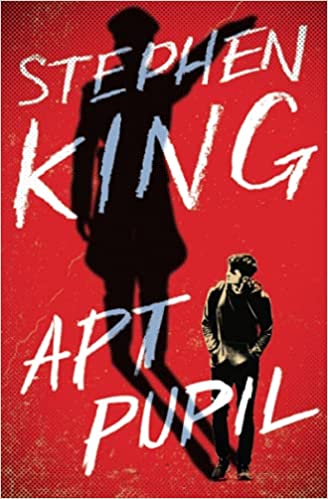
Book Review – Apt Pupil

Apt Pupil is a novella by Stephen King that comes from the short story collection Different Seasons.

It was published in 1982, and tells the story of a young Southern California teenager named Todd Bowden who discovers that his elderly neighbor, a supposed German immigrant, is actually a wanted Nazi war criminal named Kurt Dussander, who was personally responsible for committing horrible atrocities in the Holocaust.    

However, rather than reporting Dussander’s whereabouts to the authorities, Todd instead blackmails the Nazi into becoming sort of like his own personal historian. Todd is a bit of a strange kid. He’s obsessed with WWII history, in particular the Holocaust, and instead if being repulsed by Dussander’s past actions, the kid is instead enthralled. Even inspired, to a degree. 

However, the blackmail goes both ways, as the Nazi Dussander turns the tables on the kid later. See, the longer the kid has known Dussander, the more complicit he has become in keeping him from being brought to justice. Furthermore, as an “all-American” kid, with potential and college prospects, Todd risks having his future and reputation destroyed forever due to his association with an older Nazi. 

With their hands on each other’s throats in a sense, Dussander and Todd are forced into an uncomfortable alliance of secrecy over a period of four years. Ultimately, Dussander’s real identity is found out through a coincidence, and Todd, now age 17, is forced to reconcile with not only how he protected a war criminal, but his own very twisted dark side.

It’s nice to every once in a while be able to read an old Stephen King story. Because, when you ignore all the films, especially the newer ones that have been made of his works, and how slick and clean they all look, you can really appreciate just how good of a writer Classic King really was. 

King is at his best when he’s exploring the darkness of the human heart. He may be categorized as a horror writer, but really, his best work looks into human nature itself. But he’s also a great plotter, always ratcheting up the tension like an ever-turning corkscrew.

For instance, there’s a clever sequence when Todd’s grades begin to slip at school where the boy forces Dusaander to pretend to be his grandfather for a meeting with the guidance counselor. I’ll always champion the use of dramatic irony or an opportunity for a character to go undercover. You see this technique used to great effect in Tarantino’s Inglorious Basterds, where the Basterds have to constantly bluff their way through different situations, to mixed (and bloody) results.

Apt Pupil is unusual. A story about a young kid associating with a Nazi war criminal on its own would probably be enough. But King throws in the wild card that both Todd and Dussander start murdering homeless vagrants and bums around town. For me, it was sort of like smashing two concepts into one. And I was never entirely sure exactly what precipitated both of them to start killing. I never got the sense of Dussander being a serial killer. For sure, he was a brutal Nazi war criminal. But his crimes were state-directed, not necessarily ones he set out to do in order to satisfy his own desire for bloodshed. 

For Todd, his turn toward killing felt like it came out of left field. I was expecting something more along the lines of Dussander influencing the boy into killing, mirroring how the Nazi war machine, and Hitler’s propganda, tranformed Germany into a genocidal state. King, however, doesn’t go for subleties here. So essentially, what we have here is the story of two psychopaths meeting each other, and more or less provoking one another’s propensity for murder and violence. All while ironically occuring in an idyllic Southern California suburb.   

Apt Pupil is a worthwhile King novella to check out if you haven’t already. A few interesting facts: King started writing Apt Pupil immediately after The Shining. And the novella is placed right before another King classic, The Body, which of course became the film Stand By Me

Five Dead Writers Who Would Have Made Awesome Bloggers

5.  Shel Silverstein

   Just imagine if the author of The Giving Tree and Where the Sidewalk Ends was still alive today and updating his blog with periodic poems and illustrations. While Silverstein’s current website hosts the latest news about the late artist’s works, I think his subtle and oftentimes illuminating sense of humor would work phenomenally well in today’s blogging climate.

Why he’d be awesome: XKCD vs. Shel Silverstein. I wonder who would win that battle. Dubbed as a modern-day Renaissance man, Silverstein’s work affected other mediums aside from poetry. He wrote the song A Boy Named Sue for Johnny Cash, for which he won a Grammy in 1970. He was nominated for an Oscar for his music for the film Postcards from the Edge. He also published over a dozen books between 1956 and 1998 with posthumous releases in 2005 and 2008, before his death the weekend of May 8, 1999.

   Now, imagine that kind of talent applied to today’s internet, which often seems to blend multiple artistic mediums as one.  I think “Uncle Shelby” would have created further masterpieces with the tools of the internet at his disposal. 

4.  Bill Hicks

   Irreverent, obscene, but oftentimes breathtakingly insightful. His career may not have lasted that long, but the atheistic arguer who could have been George Carlin’s long lost son, certainly made his impact in the world of comedy by blending religion, politics and personal stories with his own brand of humor.  Sadly, Hicks died in 1994 of liver cancer after the disease spread from his pancreas. 

Why he’d be awesome: Before his untimely death, Hicks managed to land himself in controversy numerous times. Most famously his entire bit was cut from the Late Show with David Letterman after the producers found it too offensive for audiences. Hicks then wrote a 39-page letter to John Lahr of The New Yorker expressing his feelings of betrayal.  The whole incident passed without audiences realizing what had happened, and how CBS had blatantly censored a comedian who’d appeared on Letterman eleven times at that point. But what if Hicks had posted that letter to his own website? Or directly on social media? Imagine the immediate outcry from people all over the country. It’s one thing to write a letter that appears in print a few weeks after the fact, but a blog entry is immediate.  It probably would have forced the Late Show to release the segment of Hicks at the very least on YouTube or something.

   There was also the time when Hicks declared to a heckler, “Hitler had the right idea, he was just an underachiever!”  Hicks later clarified his statement as a reflection of his disgust with humanity in general, but not before charges of anti-Semitism were levied against him.   

   Over his career, Hicks frequently challenged the censors, challenged conventional thinking, and more often than not tore apart anyone who harassed him on stage. He was a comedian in a time when large corporations and behemoth monopolies solely controlled the dissemination of art. Now, anyone with the right tools and know-how on the internet can entertain their own audiences without censorship and without corporate oversight. The internet has brought artists and their followers closer, and has leveled the playing field in favor of those who desire to create their own material. This is the kind of environment Hicks would have thrived in.  He would have had full control and been able to influence a much greater range of people than ever before.

   Besides, how many comedians or humor writers are successful on the internet today? Very few. This is where Hicks would have been a stellar exception, and I can only imagine the kind of tell-all material he’d post from the sordid world of comedy.

3. Ayn Rand

   If the continued popularity of Ron Paul and his perfectly-named son Rand over the past few years is any indication, there is widespread interest throughout the country in the ideals of the free market and capitalism. People are fed up with a government growing out of control, absorbing more of their tax dollars, and eroding everyday freedoms through such overreaching laws like the Patriot Act and the wasteful wars of whim in Iraq and Afghanistan.

   But there’s a problem. There is very little mental muscle nowadays devoted to defending the principles that Ayn Rand espoused in her philosophy of Objectivism. Politicians are mostly divided between the heavy-spending warmongering Neocons of the far right, and the heavy-spending liberals of the far left. That’s not much of a choice considering neither side is devoted to upholding the Constitution or private property rights. If it wasn’t the War on Terror, it’d be the War on Global Warming. Then Covid came along, causing government spending to skyrocket to unprecedented levels.

Why she’d be awesome: Ayn Rand articulated the values of capitalism and private property rights in a way that no one had ever done before, at least since Adam Smith. She took abstract values broadly defined in the Constitution, but bandied about by fast-talking politicians as mere matters of individual opinion, and made them issues of moral certainty. Her books Atlas Shrugged and The Fountainhead took the abstract and made it concrete.

   Imagine a powerful voice like that cutting through the rhetoric and nonsense of today’s 24/7 media. Whether you agree or disagree with her philosophy, she’d certainly have a blog worth reading.      

2. Truman Capote

   If you think Perez Hilton is a shameless, self-promotional media sponge, you haven’t met his intellectual superior and gossipy predecessor, Truman Capote. Famous in the literary world for his classic books Breakfast at Tiffany’s and In Cold Blood, Capote was also well known throughout the media and intelligentsia as a true-blue eccentric.

Why he’d be awesome: Capote frequently claimed all sorts of wild things over the course of his literary career. Things like having gay relations with all sorts of Hollywood actors perceived as strictly heterosexual (Errol Flynn, for one), and knowing certain celebrities like Greta Garbo that in actuality he had never met.  Known for his saying, “All literature is gossip,” Capote riled his adoring public with frequent stays in rehab clinics, drug addiction, and chronic mental breakdowns.  One time, while extremely drunk, he confessed in a live-air interview that he might kill himself.

   And all this behavior from a guy who was 5’3”, openly gay, and spoke in a high-pitched squeaky voice.  Just imagine the kind of gossip a guy like Capote could spread across the web with his kind of writing and Hollywood network. I doubt there’s a single internet entity alive today whose eccentricity wouldn’t be readily eclipsed by this ingenuous master of absurdity.

1. George Orwell

   1984. Animal Farm. Two famous novels that boldly warned of the perils of a totalitarian state. But aside from novels, George Orwell also wrote scores of essays, opinions, book reviews and memoirs on everything from politics to the English language. Such material would more than fit into today’s blogging atmosphere. 

Why he’d be awesome:  Similar to Ayn Rand, George Orwell’s presence on the web would lend incredible intellectual strength to the principles of limited government and personal liberty.

   With our nation on the brink of insolvency due to a devalued dollar, deficits, higher taxes and higher government spending, and everything Covid has unleashed, we look around and wonder how it all happened. How our government managed not to stay our friend and helpful neighbor, but become a fearsome uncle, or Big Brother as Orwell would say, that slowly takes our rights away rather than defending them.  But is any of that a surprise when our media is unwilling to discuss the real issues during an election period? When the slightest gaffe or misspoken word is enough to send the press pirates into a frenzy as though something of substance actually happened? Who cares whether so and so would raise taxes or accelerate a war, the real issue is does he seem like the kind of guy you could have a beer with?

   Like Socrates, any nation is meant to have its own gadflies standing atop a bedrock of reason and willing to call out corrupt officials no matter what the cost. Breathless pundits and self-absorbed experts don’t cut it. A writer like Orwell would matter immensely in today’s blogging world because words matter the most when it comes to motivating people. How is it possible to keep the public informed when there are no intellectual heavyweights around to cut through the thicket of rhetoric?  

   After all, down through history, it has been the written word that has inspired people. Thomas Paine’s Common Sense inspired thousands of colonists fighting during the American Revolution. Karl Marx provided a philosophical foundation for socialism in his Communist Manifesto.  And who could argue about the effects of the Bible, the Koran, and countless other religious and political texts around the world?

   Words matter. Whether they are in book form or blog form, fictional or nonfictional, words motivate, change, alter, shape and modify human behavior. It’s all in who writes them, and what they are saying. And the above folks really matter. Sadly, they all passed before being able to fully access the kind of audience the internet can provide today. Their words, though written in decades past, still reverberate. Were they still alive today, imagine how much of an impact a current blog of theirs would make.  

My novel Nemesis, a psychological thriller, is available to buy on Amazon.

8 Cool Things about Robotics

Robots are perhaps the most polarizing subjects in pop culture. They are either great servants who seek to do us good, like the friendly robot anomaly Andrew Martin in Bicentennial Man, or the hilariously provocative Number Five in Short Circuit. Or, they are malevolent, ingenuous beings bent on the total enslavement and/or destruction of the human race. See such films as I, Robot, the Terminator franchise, and The Matrix series for those types.

It’s possible that in the future mankind will foolishly equip robots with the proper circuitry to enable them to conquer the planet. But for now we are safe because robots are still slow, inefficient, and above all, NOT sentient.  

Here are 8 cool things you may not have known about robotics:

1. The Origin of the Word “Robot”

Surprisingly, the term “robot” was not coined by a white-coated scientist hunkered down in his laboratory. It was actually a playwright named Karel Capek who came up with the word for his 1920 play R.U.R. (Rossum’s Universal Robots). Think of R.U.R. as a 1920’s version of I, Robot mixed with Planet of the Apes.

R.U.R. centers on a world where artificial humans are created from biological material to become servants. When their human masters begin abusing them, the robots stage a rebellion and massacre everyone.  Unable to reproduce, the robots seem destined to eventually die out themselves. But a lone scientist at last redeems humanity and offers the robots a chance to survive by constructing a male and female. Together, this pair wander off to become a sort of mechanical Adam and Eve. 

2. The Fearsome, the Terrifying, the Golem

Hollywood producers have played on people’s fears of a global robot takeover for decades. However, the idea of something man-made suddenly taking on a will of its own and turning on its creator is a fear that has long plagued mankind. Today when people imagine a malevolent robot they might think of the T-800 from Terminator. But centuries ago people dreaded the golem, an inanimate clay model that could be brought to life by speaking the name of God, according to Jewish mystics.  

One of the most famous stories about the golem came from Rabbi Judah Loew the Maharal of Prague, a rabbi in the 16th century. He was reported to have created a golem to defend the Prague ghetto from anti-Semitic attacks.  But the golem soon became bigger and more violent until it started killing the very people it was supposed to protect. Rabbi Loew finally ended the golem’s reign of terror by inscribing the Hebrew word meaning “death” on its forehead.

As the legend goes, the body of the golem was later stolen and buried in a graveyard in Zizkov, where the Zikovska Tower now stands. It was there years later when a Nazi soldier ascended to try and stab the golem, but was mysteriously killed instead. The attic remains closed to the public to this day.

For a more recent, pop culture interpretation of the golem, check out the Annihilator from the DC Universe. Invincible and fueled by aggression, the Annihilator is the product of both the golem myth and the Greek myth concerning Talos. Talos, as you’ll recall, made a famous appearance in the classic Jason and the Argonauts, and arguably could be considered the first fictional robot that defied mankind.     

3. Degrees of Freedom

Writing with a pencil, shaking hands, and waving to a friend are all things humans take for granted when they use their hands and fingers. But when you do those things you are actually exercising up to 23 degrees of freedom. One degree of freedom can basically be represented by every independent mode of motion.

What does this have to do with robotics? Creating degrees of freedom has consistently been one of the most challenging assignments for engineers for decades. Say you wanted to make a robot that could move around. You would have to install hardware equipped with the proper moving parts. These moving parts, or “actuators” as they’re called, could be in the form of wheels, legs, wings, or fins. But whatever form of actuator you choose, for every degree of freedom you want to allow your robot, you have to construct a separate bit of equations for the software that will control your robot’s movements.

A robot that only moves back and forth on the carpet on a set of wheels independently does not require a great deal of computer power because there are only two degrees of freedom involved. But try making a robot that can walk up stairs, carry luggage, or anything else we humans can do, and you’ll find that it becomes increasingly complicated to factor in each degree of freedom.

To give you an idea of the scale of the problem, consider Honda’s Asimo. At 6-foot, 460 lbs, Honda spent over 10 years developing this humanoid at a cost of almost $100 million. It’s capabilities: walking gingerly, climbing a flight of stairs, and even conducting an orchestra.

When you factor the costs involved, and the limitations of computer power, it will probably be decades before scientists create robots that can perform actions even close to what humans can do with ease.  And even then, artificial intelligence may not be a reality, in which case robots will still be controlled entirely by human-designed software. So, no need to fear Honda’s Asimo becoming a global dictator anytime soon.

4. Insect Inspiration

In their quest to make robots than can move around on legs, scientists have looked to the insect world for inspiration. Specifically, it is the movements of insects like the cockroach, with its “tripod gait,” that has given engineers a leg-up in their research.

If you’ve ever caught a cockroach scurrying around in your kitchen, your first instinct was probably to crush it before it got away. However, cockroaches, as do other six-legged creepy crawlies, exercise a profound method of walking known as the tripod gait. This gait allows them to lift three legs in the air when moving forward while leaving three legs on the ground for support (thus resembling a tripod if seen from overhead). Not only does this gait allow insects to support six legs, but it gives them greater speed to avoid predators, not to mention the sole of your shoe.

Researchers at Case Western Reserve University have designed hexapods that follow the tripod gait of insects. One researcher, a biologist named Robert Full at Berkley, has gone so far as to put roaches on treadmills to measure the electrical impulses in their muscles while recording them on video. Ever wonder how a roach can scurry away so fast despite its bulk? It’s because, as Full discovered, their muscles operate like a spring, allowing a roach to propel itself forward as though it were on auto pilot.

Is it worth it to create robots that can move around like insects? Consider that after the 9/11 attacks the Center for Robot-Assisted Search and Rescue orchestrated a number of robots for help in exploration and assessment of the ruins, as well as in the hunt for survivors. A robot that could move around like an insect would certainly be invaluable for poking into places where wheels or tracks would not suffice. But again, it is the degrees of freedom and all the computations involved therein that limit this development.

5. Hopping bots, snakebots, and scuttlebots

Insects are not the only creatures that have given scientists inspiration for creating robots of myriad variety. Everything from grasshoppers, snakes to fish have offered researchers ideas on robotic movements and functions.

Marc Raibert at the MIT Leg Laboratory created the famous hopping robot in the 1980s that bounced on one leg like a pogo stick and could even turn somersaults. In 2008, Christopher M. Schmidt-Wetekam won the Rudee Research Expo Aware for inventing a self-transforming reaction wheel-stabilized climbing rover. In the video below, Christopher explains the particulars of his robot creation:

During the 1990s, NASA became interested in using snakebots for exploration on other planets. Its research lead to Snakebot I, which required complete outside control by a user. Snakebot II, however, gained some autonomous control via several microcontrollers that allowed the main computer to focus on more important decisions.

The German MAKRO Project in the late 90s yielded a snakebot with a more commercial application: searching through sewage drain pipes.   

Robot fish have been used to investigate Gray’s Paradox. In the 1930s, a researcher named Sir James Gray decided to investigate how much power was required for dolphins to swim as fast as they do. What he found was dolphins required ten times as much power to propel themselves through water than what it appeared their muscles produced when swimming. This paradox later bore his name, and has remained a mystery to scientists for many years.

Starting in 1995 with the robot tuna, MIT eventually came to develop a robot pike that duplicated the flesh and bone structure of a pike with plastic. While the robot pike can turn and swim underwater, it can’t travel nearly as fast as a real pike.

Finally, a US company called iRobot has developed a scuttlebot to hunt for mines on beaches and underwater. Resembling a crab, Aerial, as it is named, is completely autonomous, can walk sideways on six legs, can adapt its gait if one leg gets damaged, and can even adjust its walking if it gets turned upside down.

6. A Robot’s Nose Knows

It’s estimated that humans have anywhere between 5 million and 15 million smell receptors in their noses. Dogs have anywhere between 125 million and 250 million. Installing smell sensors in robots of that number is still far beyond anything that has yet been engineered. But scientists may one day build robots that can detect explosives, rotting meat, or gas—capabilities that would offer invaluable assistance to law enforcement, the military, or in food inspection.

At the University of Portsmouth in England, researchers have created a robot dubbed “Smelly.” Smelly has smell receptors installed at the end of its two tubes, which draw in odors with the use of a small air pump.

The University of Pisa in Italy has built a handheld device that can detect, of all things, the presence of olive oil aromas.

A European Union project started in 2001 aims to build a fleet of artificial chemosensing moths for use in environmental monitoring.   

7. Robocup

Imagine it’s the year 2050. You switch on the television, or whatever form of entertainment module is created by then. You surf between a soap opera, a reality TV show (which are inexplicably still popular), and then come upon a soccer game played entirely by humanoid robots. Impossible? Actually, it’s already somewhat a reality.

In 1997 the Japanese roboticist Hiroaki Kitano established RoboCup. His aim was to create a forum in which a variety of emerging technologies could be assessed and integrated within the broader field of robotics. His primary challenge: To create a team of humanoid robots capable of beating the human soccer championship team by the year 2050.

While Robocup may seem like just a place for scientists to play with their robot toys, it actually provides a perfect environment for engineers to exercise various problems related to making robots useful. Each robot must know where the ball is in play, where the goals are, where its position is in relation to the other players, and who its opponents are. Additionally, robots must work together on their on teams to function best. These are all problems that if remedied would make robots practical not just in a sports arena but in law enforcement, the military, as well as in a host of commercial applications.

8. Energy Problems

One thing that has made advances in robotics difficult is the energy issue. Even were it possible today to construct a robot that could function practically, have a high number of degrees of freedom, and act autonomously, how would you power it? Common household batteries barely supply adequate fuel for even the simplest of robots.

Fuel cells have become one good source of power for robots. But they tend to be bulky and can restrict a robot’s movements. They also require frequent refueling for the robot to operate properly. The University of Sherbrooke in Canada has built robots capable of reading red signs that indicate a batter refueling station. So it appears that for now robots will either have to stay plugged in or recharge themselves if they are function. At least until some more advanced form of energy technology comes along.    

References

For more info on robotics, check out these sources:

Robots: Bringing Intelligent Machines to Life, by Ruth Aylett.

My novel Nemesis, a psychological thriller, is available on Amazon.

The Right Stuff – Book Review

The Right Stuff by Tom Wolfe is probably one of the most fascinating books I’ve read over the last few years. 

Now, I’ve read Tom Wolfe’s A Bonfire of the Vanities before. A fictional-cultural-commentary novel about a rich white New Yorker who crashes into a young black man with his car, drives off out of fear of attacks, only to deal with exponential repercussions later as he attempts to evade justice.  

Wolfe, a “New Journalist,” is, of course, famous for exploring culture in his books, fiction or otherwise, especially as it relates to that of particular institutions. In The Electric Kool-Aid Acid Test, Wolfe delves into the hippy subculture of Ken Kesey and the Merry Pranksters. In his more recent book I am Charlotte Simmons, a novel, Wolfe peels back the layers of the privileged elite at a top American university. 

Carrying the torch of Wolfe as a “social novelist,” these days, you could say is the bestselling author Ben Mezrich, who’s known for The Accidental Billionaires (which inspired the film The Social Network), Bitcoin Billionaires (a sequel of sorts), and the upcoming The Antisocial Network.

The Right Stuff, published in 1979, chronicles the lives of the American fighter pilots who became the first astronauts in NASAs Mercury Mission. 

It’s impossible to talk about The Right Stuff without mentioning the timing of its publication in American history. 1979. A time of deep economic stagnation. America had just seen President Nixon resign. The ending of the Vietnam War had left deep scars in the nation’s psyche. Americans were being held hostage by Iranian militants. And at that point many Americans were largely over some of NASAs greatest accomplishments. We’d landed on the moon ten years prior. Had gone back several times, actually. It was the time of the so-called “antihero.” 

The Right Stuff went against the grain, by reintroducing the American fighter pilot heroes that the nation had come to love during the early years of the NASA era. When rocket technology was still very experimental, and in fact, oftentimes killed the test pilots who flew new aircraft. A lot of people forget that from the late 40s through the early 60s, we were in a real technological tug of war with the Soviets, and for a time Russia was far ahead of the U.S. It really wasn’t clear during a good part of the Cold War which side would ultimately come out ahead. It was believed that whoever controlled space would come to dominate the globe. There was some real fear amongst our governmental leaders, and the American populace. Some of which was real. Some imagined. All of which was harnessed by the government to fund the early NASA program, in the effort to beat the Soviets into space. 

Wolfe’s writing, as always, is evocative, illustrative, and naturally cinematic. And it’s at its best when dealing with social psychology and culture in the hyper competitive, hyper driven, hyper masculine world of the fighter pilots.

Take for instance the way in which Wolfe describes the “great invisible ziggurat.” Which is a metaphorical pyramid of sorts and means to measure a pilot’s status amongst other pilots. One’s position on the ziggurat is critical, and something a pilot is always striving to elevate. Status is gained, essentially, through not only feats of flying, but staying cool under pressure. Being unflappable. Being not necessarily fearless, but not allowing fear to control you while operating aircraft. Performing flawlessly in the most dangerous of situations, while at the same time being unshakably suave about it. Grace under fire. That’s what it meant to have the “right stuff.” 

At the top of the great invisible ziggurat, at one point, was Chuck Yeager, the pilot who broke the sound barrier in 1947. Over the course of the early NASA missions into space–known as Project Mercury–the fighter pilots chosen would each have a turn to reach the summit themselves. Each demonstrating their own measure of the “right stuff” as they performed in the different missions into space. Alan Shepherd became the second man, and first American to go to space in 1961. John Glenn became the first American to orbit the earth one year later.  

The Right Stuff covers an intense period of American history, and profiles men who, really, were the best and the bravest in the world. Fighter pilots have to be in top physical and mental shape. Able to undergo hundreds, even thousands of hours of intense training. You have to be willing to risk your life every day. At one point, something like one out of four pilots were killed while testing experimental aircraft. Think of the incredible sacrifice that requires, of both the pilot, and his family. These were all young men, in their 20s, or early 30s, for the most part. Almost all of whom had wives and children staying with them on base during their flights. All while being paid a military wage, which was not that much. This was a special group of people who did extraordinary things.      

It would be impossible to run through everything Wolfe covers in this nonfiction novel. But there were definitely a few anecdotes and stories I found interesting.

Going back to Chuck Yeager. Did you know he broke the sound barrier with two broken ribs after a night of heavy drinking and horseback riding? Yes, horseback riding. See, Wolfe describes a culture of Flying & Drinking and Drinking & Driving that every pilot was generally expected to live up to, if they wanted to demonstrate that they had the right stuff. It wasn’t enough to do amazing things in the air. It was much better if you could do it on three hours sleep, loaded up with coffee, and maybe still sloshed from leaving the bar at three in the morning.

So, the night before Chuck Yeager was scheduled to attempt to break the sound barrier in the new X-1 at Muroc Army Base, which later became Edwards Air Force Base, he had gone out drinking with his wife, and at some point, decided to go horseback riding. Well, he got thrown from the horse when he crashed into a gate, and wound up with two broken ribs.

Now, having broken bones would obviously be a problem when flying in general. It was especially a problem considering the cockpit design of the X-1. The pilot had to secure the door to the cockpit from inside with his right arm, an almost impossible task for Yeager with his two broken ribs. So, he had a janitor named Sam secretly cut off nine inches from a broom handle so he could use it as leverage to properly shut the door.

I find this story really endearing, because it combines classic American recklessness with classic American ingenuity. America may blunder or fail sometimes, but it always seems to rise up to the occasion with some out of left field solution. Think of the ill-fated Apollo 13 mission, and how the NASA engineers and astronauts brilliantly Macgyvered their way out of that jam.

Another fascinating factoid Wolfe shares in The Right Stuff is the dangerousness and unreliability of the cockpit ejection system in the early, experimental aircraft. And this actually may still be the case now.  But in the event of an imminent crash, a pilot was far from safe when they ejected from a doomed aircraft. And that was because when the seat ejected from the plane, it hit a “wall” of air that was almost like hitting a solid substance. Pilots lost limbs, joints, even had the skin torn from their faces. Some were even killed by the force of hitting the air wall itself. Remember, when you eject from an aircraft, you’re still traveling at the same speed, only you’re not protected from the air current as you are behind the thick glass of the cockpit. Ejection was actually so hazardous that most pilots simply chose to stay with the aircraft in the attempt to control or mitigate a possible crash, no matter how lost the cause appeared.      

Imagine that for a second. You’re strapped to a giant rocket, basically, with your life in your hands. With no fail-safe. No secure, safe means of exiting in the event of a catastrophic failure, which happened a lot. At the time, there was something like a 56% that at some point a pilot would have to take their chances with ejection. Would you get into a car if you knew you had better than 50% odds of getting into an accident? Now think if you had to do that in a car where the air bag itself had a high chance of killing you. At least in the car example you’d be on the ground. But in the air, things can spiral into chaos really quickly. This is why only the best and brightest were allowed in experimental aircraft. It’s why pilots needed to have the right stuff.

I’ll leave you with Tom Wolfe’s definition of the right stuff. He writes:

“The idea here seemed to be that a man should have the ability to go up in a hurtling piece of machinery and put his hide on the line and then have the moxie, the reflexes, the experience, the coolness, to pull it back in the last yawning moment—and then go up again the next day, and the next day, and every next day…and, ultimately, in its best expression, do so in a cause that means something to thousands, to a people, a nation, to God.”

My novel Nemesis is now available on Amazon.

33 Disturbing But True Facts About Eugenics

What do the SAT, the Kellogg Company, Woodrow Wilson and Adolf Hitler all have in common? They are all connected by the practice of eugenics in the first half the 20th century.

From 1904 until shortly after the close of WWII, the United States aggressively engaged in a scientific quest to create a master race. This radical new science, dubbed “eugenics” by Sir Francis Galton in 1883, called for selective breeding between those deemed “fit” for existence (i.e. generally those of Nordic descent), with sterilization, marriage prohibition and even euthanasia aimed at those deemed “unfit.”

Based on an extreme view of social Darwinism, eugenics permeated the scientific and academic elite, securing funding through such notable organizations as the Carnegie Institute and the Rockefeller Foundation.  The Supreme Court eventually came to sanction eugenic practices, and 27 U.S. states enacted incredibly racist laws enforcing its doctrines. Overseeing these laws and heinous practices presided a virtual army of scientists and doctors steeped in the desire to eradicate anyone seen as a threat to society. These included immigrants flooding in from Europe, Native Americans, epileptics, alcoholics, Jews, Mexicans, Blacks, small-time crooks, the mentally ill, and even those unfortunate enough to be caught unemployed and homeless at the wrong time.

Spreading from Long Island to across the whole United States, from the Liberty Bell to the Golden Gate Bridge, eugenics wormed its way overseas to England and the whole of Europe before it ultimately landed, like a kind of lamp containing an evil genie, into the lap of Adolf Hitler.

Here are 33 disturbing but true facts about eugenics, a pseudoscientific belief that began in the cradle of the land of liberty and ended in the clutches of a genocidal regime:   

1.  Even with concentration camps, euthanasia campaigns and sterilization wards public knowledge in both Germany and America, early eugenic founders looked on with approval as Nazi Germany enacted brutal racial campaigns against its own citizens. Joseph DeJarnette, superintendent of Virginia’s Western State Hospital even complained in 1934, “Hitler is beating us at our own game.”

2. The term “social Darwinism” never came from Darwin himself. It was a term distilled around the notion that in the struggle for survival, some humans were not only less worthy but were actually more or less supposed to die away. Merely acting to help the weak and needy within society became itself an unnatural act. This thinking helped propel the eugenic movement forward during its embryonic stages at the start of the 20th century.

3. On July 15, 1911, the American Breeders Association, or ABA, an organization comprised of eugenic-minded scientists and doctors, met in Manhattan to identify ten groups classified as “socially unfit” and deserving of elimination. These included, in order of priority: the feebleminded, the pauper class, alcoholics, criminals of varying degrees such as petty thieves and those imprisoned for not paying fines, epileptics, the insane, the constitutionally weak class, those genetically predisposed to specific diseases, the deformed, and finally, the deaf, blind and mute.  

4. In 1907 Indiana became the first state to legalize forced sterilization on its mentally impaired patients and poorhouse residents. Known as Sharp’s Bill (named after a Dr. Harry Clay Sharp who was already sterilizing and castrating men and women in Indiana’s prisons well before it became legal) it passed the Indiana House 59 in favor, 22 opposed, and passed in the Senate with 28 ayes and 16 nays.  

5. New Jersey passed its own sterilization legislation in 1911. It allowed for the creation of a three-man board that would determine whether “procreation is inadvisable” for the reams of prisoners and children living in poor houses and other charitable organizations. The governor who signed the bill into law was Woodrow Wilson, who was elected president of the United States the following year.

6. The term “moron” comes from the eugenic movement. Coined by Henry Goddard, an early eugenic founder, it comes from the Greek word moros, meaning “stupid and foolish.” We use the term lightly these days as a kind of vague, almost teasing insult. For Goddard and the eugenic community, a “moron” was anyone deemed unfit for life and indeed a target to be eliminated.

7. The IQ Test also emerged from eugenics. In 1916, using an intelligence test created by a Dr. Binet of Stanford University, eugenic activist Lewis Terman devised a simple way to score an individual. By dividing mental age by chronological age and multiplying by 100, Terman created what he nicknamed “IQ” score, or “intelligence quotient.”     

8. In 1917, as America entered WWI, eugenic psychologists devised an intelligence test for the armed forces known as the Army Alpha Test. Carl Brigham adapted the test as part of a college entrance exam. The College Board later asked Brigham to create another qualifying test for other colleges in the country. Eventually, Brigham’s efforts produced the Scholastic Aptitude Test, or the SAT.

9. Dr. John Harvey Kellogg of Battle Creek, Michigan served as a member of the state board of health and operated a sanitarium known for its unorthodox food regimens. He developed for his patients a natural product made of wheat flakes. In 1898 his brother, Will Kellogg, invented the corn flake and began selling it commercially through a company that would ultimately become the cereal behemoth the Kellogg Company. In the same year as the founding of the company, Dr. Kellogg founded the Race Betterment Foundation to help stop the “propagation of defectives.”  

10. President Theodore Roosevelt long held eugenic views. After he left office, he wrote Charles Davenport, the man considered the father of the American eugenic movement, and said:

   Society has no business to permit degenerates to reproduce their kind.  Some day, we will realize that the prime duty, the inescapable duty, of the good citizen of the right type, is to leave his or her blood behind him in the world; and that we have no business to permit the perpetuation of citizens of the wrong type.

   Such a statement certainly takes the old snarky phrase “white man’s burden” a step further.

11.  Virginia may be “for lovers” these days, but shortly after WWI, the state was well known for sweeping its social outcasts into homes for the feebleminded and epileptic. While those two terms meant virtually the same thing in practice, they also equaled another kind of diagnosis: shiftlessness. Shiftlessness, a term that could easily be applied from unruly boys to legitimate mental patients, generally meant “worthless” or “unattached in life.”

12. On May 2, 1927, with only one justice dissenting, the Supreme Court officially sanctioned eugenic sterilization in the case of Buck v. Bell.  Justice Oliver Wendell Holmes, a man revered throughout the nation as a voice of reason and justice, wrote the opinion for the majority that could have sprung from the Third Reich:

   It is better for all the world, if instead of waiting to execute degenerate offspring for crime, or to let them starve for their imbecility, society can prevent those who are manifestly unfit from continuing their kind. The principle that sustains compulsory vaccination is broad enough to cover cutting the Fallopian tubes.

   Three generations of imbeciles are enough.    

13. The Beach Boys sang about the girls in California. The state is known for its pristine beaches and laid back populace. But the Golden State also is famous for something else: leading all states in the U.S. in eugenic sterilization. From 1907 to July of 1925, at least 4,636 sterilizations were performed. All mental patients and those deemed feebleminded were allowed to have their procreative powers removed. The threat of asexualization even included criminals found guilty of any crime three times, at the discretion of a consulting physician.

14. Although not wholly related to the eugenic movement, the birth control campaign as orchestrated by Margaret Sanger emerged from the conjoined spirits of women’s rights and population control. However, before the term “birth control” reached the American consciousness, it had many prior variations that included: voluntary parenthood, voluntary motherhood, the new motherhood, constructive generation, the new generation, Neo-Malthusianism, Family Limitation, Conscious Generation, population control, race control, and finally, birth rate control. It was only when someone suggested dropping the word “rate” from the previous term that “birth control” became the name of Sanger’s growing movement.  

   Is it any surprise that a campaign designed to eliminate the weakest within the population aborted so many undesirable names before finally choosing its correct moniker?

15. In its quest to find and identify anyone of mixed blood and separate them from those of pure, Nordic stock, the state of Virginia enacted the Racial Integrity Act on March 8, 1924. Falsely registering your race in the subsequent consensus and questionnaires was considered a felony and punishable by a year in prison.

16. Following the Racial Integrity Act, Virginia’s registrar encountered a problem. Some citizens of Indian descent were registering as white but actually had African ancestry in their genes as well. To remedy this intolerable snafu, the registrar devised used a highly scientific and accurate method to differentiate a person of Indian or African stock: a hair comb.  Walter Plecker, health officer of Elizabeth City County, wrote of the comb solution, “If it passes through the hair of an applicant he is an Indian. If not, he is a negro.” If those Guinness Ad guys had been around when Plecker devised his comb strategy, they would have surely declared “Brilliant!”

17. America was not alone in the growing field of eugenics. Britain passed its own legislation against the “unfit” in the form of the Mental Deficiency Act of April, 1914. The Act defined four classes of undesirables: idiots, imbeciles, the feebleminded and moral defectives. If you had the misfortune of having a doctor identify you as any one of those, you could then be carted off to a special colony, sanitarium, or hospital designed to house your kind.

18. Switzerland passed its own eugenically spirited law in 1928 that targeted a poorly defined class of “unfit.” While concrete numbers have never been ascertained concerning Switzerland’s eugenic conduct, some estimates say that 90% of sterilization procedures were performed on women. 

19. Norway had its own forced sterilization legislation on the books for 43 years. After passing a law legalizing it in 1934, it wasn’t until 1977 that the law was amended to make sterilization voluntary. In the interim, 41,000 operations we performed, with almost 75% done on women.

20. But even if you managed to escape Britain, Germany, and Norway, you still had Sweden to worry about. Known throughout the world for its mostly blonde-haired, blue-eyed populace, Sweden passed its own sterilization law in 1934 as well. Similar to laws in other countries at the time, the new law targeted pretty much anyone classified as having a mental illness or having mental defects in any way. It even targeted those who had an “anti-social way of life.” Again, as with Norway, the largest victim group was women, who suffered forced sterilization at the rates of 63% to 90% over their male counterparts. In all, over 63,000 government-approved sterilizations were performed on the “unfit” individuals who had the misfortune of living within Sweden’s borders.       

21. George Bernard Shaw, the renowned Irish playwright who has the distinction of being the only person to receive both a Nobel Prize for Literature and an Oscar, was also a eugenic extremist. Speaking at London’s Eugenic Education Society in 1910, the scribe had this to say regarding the use of lethal gas chambers on the unfit:

   A part of eugenics politics would finally land us in an extensive use of the lethal chamber. A great many people would have to be put out of existence, simply because it wastes other people’s time to look after them.

22. However, while lethal gas chambers weren’t employed on the weak until the rise of Nazi Germany, there were many instances of euthanasia performed by doctors of eugenic persuasion. On November 12, 1915, a woman named Anna Bollinger gave birth to a baby with severe intestinal abnormalities at German-American Hospital in Chicago.  But rather than fighting to keep the baby alive, the hospital chief of staff, Dr. Harry Haiselden, decided it was not fundamentally worth saving. A friend of the mother’s pleaded for him to save the baby’s life, but Dr. Haiselden only laughed and said, “I’m afraid it might get well.” The baby died shortly thereafter. A health commission investigation later questioned the doctor for his decision, but he was ultimately exonerated of any wrongdoing and allowed to continue practicing.

23. Haiselden persisted in his eugenic euthanasia over the years, and justified it by declaring that public institutions used to house the unfit in effect acted as lethal chambers anyway. He secretly visited the Illinois Institution for the Feebleminded where he discovered that windows were left open to allow the flies to cover the patients, and the inmates were given milk from a herd of cattle infected with tuberculosis.

24. Eugenics has its own movie. In 1917, Hollywood produced The Black Stork, a story about a mismatched couple who are counseled by a doctor against having children. However, the couple become pregnant anyway and the woman gives birth to a defective child that she allows to die. The deceased baby’s spirit then ascends into the arms of Jesus Christ.  Hailing it as a “eugenic love story” in publicity ads, the eugenic movement had its own propaganda film at last, and it promoted The Black Stork throughout the nation. It’s catch-phrase: “Kill Defectives, Save the Nation and See ‘The Black Stork.” Not quite “Save the Cheerleader, Save the World,” but close. Dr. Haiselden, then famous in eugenics circles for his baby-killing ways in Chicago, played himself as the doctor in the film.

25. Even during WWI the American eugenic movement strengthened its ties with Germany. The book credited with planting eugenics throughout Germany was Madison Grant’s The Passing of the Great Race. Published in 1916, Grant’s tome asserted that the white Nordic race was destined to rule the planet. It inspired thousands of German scientists, allowing them to mask their already racist feelings under the guise of objective science. It also galvanized the country’s future dictator, Adolf Hitler.

26. Not content to produce books and films extolling the virtues of eugenics, followers of the new pseudoscience in Germany introduced a series a race cards in 1927. Coming ten in a package just like baseball cards today, the cards profiled every racial variation from the Tamils of India to the Baskirs of the Ural Mountains.

27. Eugenic sterilizations began literally the moment Hitler assumed power in Germany. Starting on January 1, 1934, the Reich Interior Ministry’s eugenic expert declared that children as young as ten and men over the age of fifty were all able targets for the scalpel. Quickly, this mass program became known as Hitlerschnitte, or “Hitler’s cut.” In the first year alone, at least 56,000 Germans were sterilized, or almost 1 out of 1200 citizens.   

28. While Germany savaged Poland in the beginning of the Second World War, the Reich also committed euthanasia against elderly German citizens to conserve its valuable wartime resources. Starting in 1940, between 50,000 and 100,000 Germans were taken from old age homes, mental institutions, and other places and exterminated in gas chambers.

29. Dr. Edwin Katzen-Ellenbogen presided over the extermination practices at the concentration camp Buchenwald. He was also a founding member of the Eugenics Research Association and chief eugenicist of New Jersey under then-governor Woodrow Wilson.  

30. The rare brain disease Hallervorden-Spatz Syndrome is named after two Nazi doctors who discovered the condition in 1922. 

31. For years one of eugenics greatest crusaders, Harry Hamilton Laughlin, fought to sterilize the feebleminded and people diagnosed with epilepsy. He was well known for believing that people with epilepsy did not belong in society. Laughlin was also known among colleagues for his occasional seizures. It turned out the doctor kept a tightly held secret for most of his life: Harry Laughlin, the attacker of the “unfit” and eugenic co-founder, himself had epilepsy.

32. Even though they have not been used for years, eugenic sterilization laws are still officially on the books in North Carolina. Chapter 35, Article 7 permits the state to perform them for moral as well as medical improvement.

33. Despite post-war Germany denouncing its Nazi past, investigators discovered that some universities still house body parts taken from prisoners used in eugenic experiments and later killed in concentration camps. The University of Vienna’s Institute of Neurobiology still houses four hundred Holocaust victim’s brains. In addition, tissue samples and skeletons have also been found in Tubingen and Heidelberg. 

References

   For more information on the startling history of eugenics in America and other countries, I urge you to read War Against the Weak by Edwin Black. You can also visit the official site for the book.

   Black also wrote IBM and the Holocaust, and his book on eugenics is equally profound and revealing. I derived virtually all my data in the above article from his book, but what I’ve written only scratches the surface of the wealth of information contained in War Against the Weak.

   For a sampling of more diversified resources, the Wikipedia page on eugenics stands as a doorway to many informative sites and archives.

My novel Nemesis, a psychological thriller, is now available on Amazon.