It then also occurred to me how when you get down to it, most people don’t really care about material possessions and money when it comes to attraction. They care if they find you “hot.” They care if they find you physically attractive. This isn’t just men. Women do, too.
Are women at home fantasizing about Chris Hemsworth, or Danny DeVito? Are men at home thinking about Sydney Sweeney, or Rosie O’Donnell?
Of course, plenty of supermodel-quality women go for rich hippo-sized uggo dudes all the time. But we’re not talking about obvious gold diggers or pay-for-play marriage arrangements. We’re talking about your average everyday relationships. Most people want someone who looks good and turns them on.
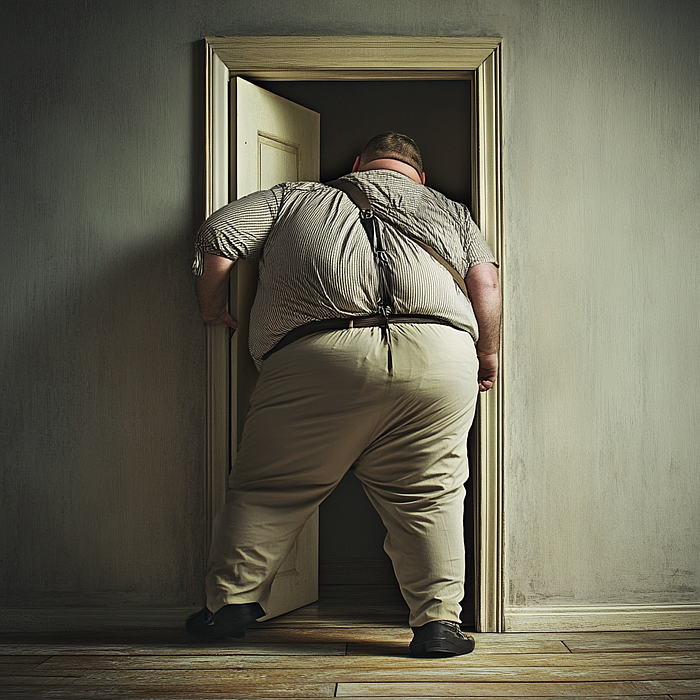
Well, here’s the problem. It’s kind of hard to be your best sexy self when you’ve got a hundred pounds of blubber wrapped over your frame like a sports mascot outfit.
Those statistics are not just for older adults who are well past the prime dating age. They’re nearly across the board for all adults. Male and female. Even young people in the hot spot of the mating zone.
Years ago when I went back to college to finish my degree I could not believe the number of overweight women I saw on campus. I’m not talking the “freshman 15” here. I’m talking both ass cheeks hanging over the side of the classroom chair. I’m talking pear-shaped plumpernutters. There were plenty of hefty guys, too. Guys with sagging beer bellies. It should be illegal to look like that until you’re at least 45 and have a mortgage and three kids.
At my job at the time, I worked on occasion with an 18-year-old girl whose legs were thicker than my waist. She would come in to work carrying bags of McDonald’s, slurping on Starbucks milkshakes, and then actually complain to others about her weight problems. One time I asked her if she needed help with something work-related, to which she replied, unprompted about the subject, “Yeah, how about you take some of my fat?” I then suggested maybe she should make nutritious food at home instead of always ordering Mcdonald’s. To which she laughed and looked at me like I was insane. I was actually sad, aghast, and brokenhearted inside. All of 18, and she was already hopelessly lost down a dark alley of Big Macs and Big Gulps.
Here’s the thing. Obesity and overweightedness is a (literally) big deal. It affects your health in every negative way. It gives you early diabetes, heart problems, cardiovascular problems, breathing issues, cancer, and wreaks havoc on your joints. Not to mention the most obvious one — it makes you look far less attractive.
Obesity also saps your libido and can harm your reproductive abilities, too.
No wonder the population is declining rapidly. No wonder young people aren’t banging each other anymore. No wonder dating apps are dead. Have you been on any dating app recently? Let’s be honest. How many people did you see on there who WEREN’T fat? Not that many, right? I’m not trying to be funny. It’s legit part of the reason I deleted my accounts a long time ago. It was Cellulite City on there. Gross, no thanks. I don’t need to spend $35 a month just to be flooded with the roundular daughters of the Michelin Man. I’ll wait for my Uma Thurman sexbot instead.
Everyone wants to blame feminism, the Red Pill, toxic masculinity, the disappearance of third places, the hectic modern lifestyle, the economy, the reduction of religion, eroding traditions, and many other reasons for the death of dating and mating. But I think it’s much simpler. People have turned into disgusting fatasses.
Look, I’ll be the first to admit I’m no Brad Pitt. I’m more a darker-complexioned Justin Long. I do make the effort to stay in shape, though. I do what I can with what I got. Being hot is not everything in a relationship. But letting yourself become a blimp will not help.
It’s hard to get out there and clap cheeks when you can barely squeeze your cheeks out the front door, you know?
I’m actually disappointed in myself. I used to really be into stuff like this when I was younger. You slap the words “obscene graphic violence” on a flick and I was there like a six-year-old kid jumping into a dark van with “FREE CANDY” written on the side.
I remember watching Peter Jackson’s ridiculously gory Dead Alive years ago and laughing my ass off. I used to watch Hellraiser on repeat. When I was a little kid I begged my mom to rent a scary movie one night. She picked Jagged Edge, which bored me. I used to run to the horror section of the video store so I could scope out any carnage shown on the backs of the video covers. The Nightmare on Elm Street series always had some gems.
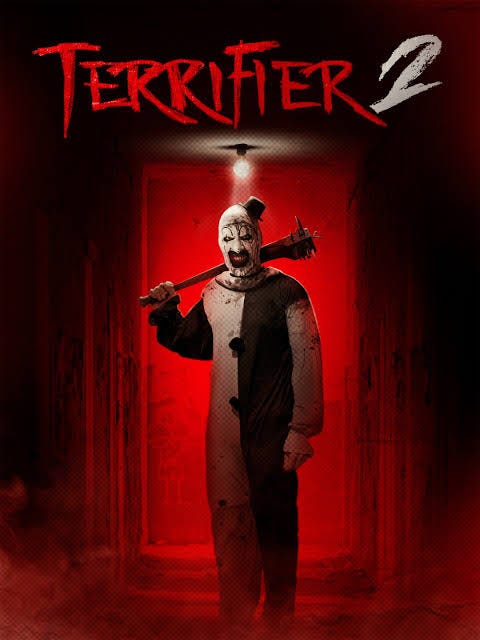
Lately, I’ve been hearing about the Terrifier films. A series I know nothing about other than it involves some kind of creepy blood-covered clown named Art the Clown. I kept hearing about how people were throwing up and passing out at premiers. The other day I passed a Hot Topic in a mall and I saw Art the Clownt-shirts. Now, as much as one can glean cultural impact from a store that serves the junior goth demographic, it’s clear this Art guy has some cachet with the youngins. I’ve got to keep up with the times, thought I. I’ve got to investigate this scary new phenomenon. I know all about Pennywise the Clown. But Pennywise is yesterday’s news, and I can’t fall behind on my killer clown mythology.
To my (at the time) delight, I saw that Terrifier 2 was offered on Amazon Prime. Oh, nice, here’s my chance to check this newfangled thing out. I looked it up on Rotten Tomatoes to gauge concensus, and to my surprise I saw it not only had a fresh rating, it was actually in the 80s.
What??? A critically praised ultra gory film? Now I definitely have to see this.
I clicked on the tab. Within minutes I was greeted with a silhouette of Art the Clown walking down an alley. Okay, that’s creepy but not too bad. Then it cut immediately to a medical office, and a one-eyed Art is stalking some doctor in an office who’s been stabbed in the stomach. The doctor tries to make a phone call, only for Art to come along and start beating him to death with a hammer. Then Art rips out the doctor’s eyeball and inserts it into his own eye socket to replace his missing eye.
And that was it. I was done. I clicked away, and actually turned to The Silence of the Lambs as a form of therapy. Yes, the flick about the cross-dressing murdering sadist and psychopathic cannibal was “easy watching” compared to the bloody eyeball-snatching clown.
Who the hell watches this ultra violent gory shit? Friday the 13th, Nightmare, and the Halloween series, all of which I grew up on, are tame and nothing anymore. Terrifier is like cinematic equivalent of a heroin junkie injecting the syringe in their last good vein trying to chase that dragon high of scares.
Man, there is some imagery I just don’t care or need to put into my brain anymore. Now there’s a third Terrifier coming out this weekend. Yeah, no thanks. Fuck off, Art the Clown.
Men occupy a strange Twilight Zone social status nowadays. On the one hand, we’re constantly barraged by charges of “toxic masculinity” while also many of us are simultaneously called “incels.” We’re both useless but also needed to serve as providers. Family courts see men largely as cash cows. The vast majority of divorces and child custody hearings favor women, at least in financial terms. Sometimes the child(ren) must stay with the mom because they are are still physically dependent on her. But most times it’s simply because men make the most money, and are therefore target-rich environments to scheming lawyers.
We’re a polarized, hierarchy-divided species. We’re either Alpha Male Chads (a small minority) or low-grade beta simps (the majority). Most of us are considered “ugly” by women, at least if reports from some dating app research are to be believed.
We’re a relic of the patriarchal past. Yet it is men who largely perform all the sweaty blue-collar labor that keeps society running. Who’s driving all those big rigs across the highways? It’s like 85% men. Same with plumbers, electricians, oilfield workers, etc. We do most of the work that keeps civilization humming.
And yet, despite performing so many essential functions in society, many men remain invisible, single, and alone these days. Relegated to acting as background code in the matrix of the universe, as it were.
Perhaps there are too many of us. In centuries past, many young men were sent off to war, where they died in battle or from disease. Or men went off to sea, encountering a variety of lethal dangers. China infamously enacted a one child policy years ago that favored male offspring. Now the country has a glut of men and not enough women to meet balanced mating needs, leading to a population crisis.
Most men in the past had to endure a culling process of some kind that thinned the herd a bit. Not now. The draft ended in the 1970s and there hasn’t been a war in the West since that’s required calling up millions of soldiers. At least not yet.
Meanwhile, women have made strides toward “equality,” if one believes such a thing can exist between the sexes. Women make more money and occupy more positions of authority. The result on the mating market has been seismic. Women are more selective on who they commit to long-term, and more prone to just staying single. Many are happy to wait until their 30s and even beyond for “Mr. Right.”
This new choice dynamic has favored high-status men, while often leaving many average men in the dust. It’s become like an arms race between the top-shelf men and women, with few winners, and many staying single and alone. Birth rates have dropped hugely, and as a result native populations around the West have declined. Even when people do get married today, they have far fewer children than before. Often only one or two, which barely keeps up the replacement rate.
No one wants to see a return to bloody wars and deadly maritime activities that saw the demise of millions of men over the centuries. But given the intense competition many young men face in the dating world, perhaps it’s better they turn their attention to leveling up financially and professionally before trying secure a long-term partner.
Men often go into the modern dating market completely unprepared for its harsh demands. They waste their time shooting their shot into the void of dating apps. Or they chase after women who just aren’t into them. Then they despair when they don’t gain traction.
It’s a costly blunder with often a net negative outcome, this ruthless pursuit of women in youth. Imagine if all that early to mid-20s energy were directed toward business enterprises, collegiate excellence, gymmaxxing, networking, hobby procurement, or at the least a fierce dedication to one’s job or industry. Instead, hours and dollars are wasted on chasing the siren call of “true love.”
Much time is wasted on other pointless things, too, of course. Things like video games, porn, binge drinking, TV, Netflix, movie marathons, and more. But much of the aforementioned is in the “blowing off steam” category. Often done after work or as a way to relieve stress. Not necessarily intentional with the end goal being a lifelong commitment to another person, offspring, and major lifestyle changes.
Though I disagree with the Red Pill’s often corrosive, schizoidal, and cynical outlook toward life and women in general, I do tend to affirm a lot of its generic be-your-best-isms and level-upping maxims for men. Men tend to do best when grouped in strict and clearly defined roles while directed by a forceful leader or “coach.” This is why men thrive on sports teams, military units, business squads, and other places that foster a brotherhood. The Red Pill sort of approximates this tribal dynamic.
You have to remember that most men today grew up with either absentee fathers or a limited fatherly presence, often while being raised by a single mother or by a dominant mother. All while going to school with most likely mainly female teachers. Women can complain all they want about men “sucking” today, but women by and large raised the current generation of men. So who’s to blame?
Anyway, back to the pursuit of marriage. Personally, I feel as a man that there are two best scenarios when it comes finding a partner. The most ideal is you find someone in your youth and stay together for life. I think it’s a shame that few people today have the opportunity, or even look for the chance, to find someone when they are really young. Instead they spurn that by screwing around, only to find themselves alone going into the dark early years of adulthood. Young love is the best kind, though it’s often not taken seriously. Granted, it’s rare for most people anymore. How many people meet their significant other in high school? Very few. I’m not embarassed to admit that as a teen I was a naive romantic myself, often dreaming of finding “the one.” Of course, like many male teens during that age period, I was a hot mess. I had neither the maturity nor means to manage such a situation. Nor was I ever seriously “in the game” to begin with, if we’re being honest. I never even had dates for the proms. But for those few who are and who find the right person, I say go for it.
The next ideal avenue is the ol’ seek your fame and fortune first before seriously seeking a mate option. This is actually the course many women choose today, though economics and the intense individualism of Western culture often forces the “choice” upon them. Often they forego marriage, children, even relationships in general, in favor of career and college. That leaves them with a much narrower reproductive window of opportunity.
But what is the alternative for women? Abandon their own careers for average schmucks who barely make $50,000 a year to be stay-at-homes with three and four kids? With today’s inflation? You can see the dilemma. Unless the guy is a real prize, he’s probably not worth lowering the drawbridge. Unless he’s just a rent-a-dick for the night.
I can’t speak to what women should or shouldn’t do, as I’m not a woman. But I think if you’re a man today the second option —become the best prize you can be — is the only practical route for most, really, as it provides the most optionality. Men may not go through a war or sea gauntlet today, but perhaps they need some kind of proving ordeal. Not in some fairy-tale-win-the-princess sense. But in a becoming a responsible adult person capable of dealing with the shit life throws at you sense.
The ugly alternative is this current “bottlenecking” of the mating market. I suspect my proposed male recession from the dating scene is actually already occurring. Except instead of self-improvement and leveling up, many men are regressing into an infantile state, playing video games, or substituting porn for human intimacy. Perhaps a gradual dawdling away into oblivion via mindless entertainment and distraction is the new war and sea gene filtering mechanism. Evolution does not seek sit-arounders, edible munchers, chronic masturbators, and button-mashers, but men with a plan. Heroes not zeroes.
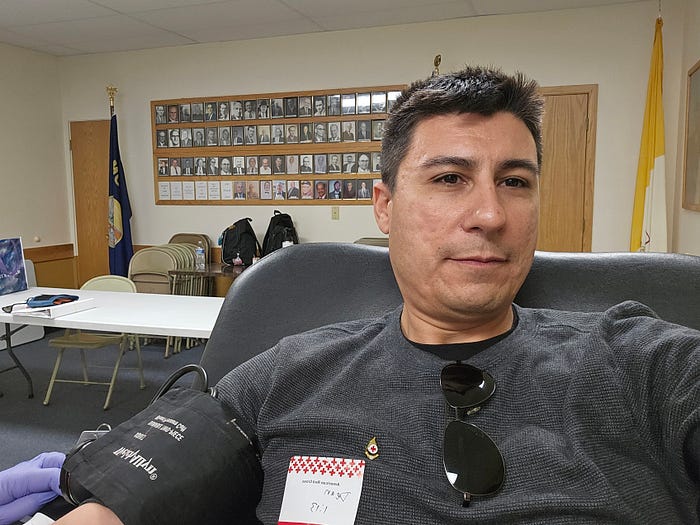
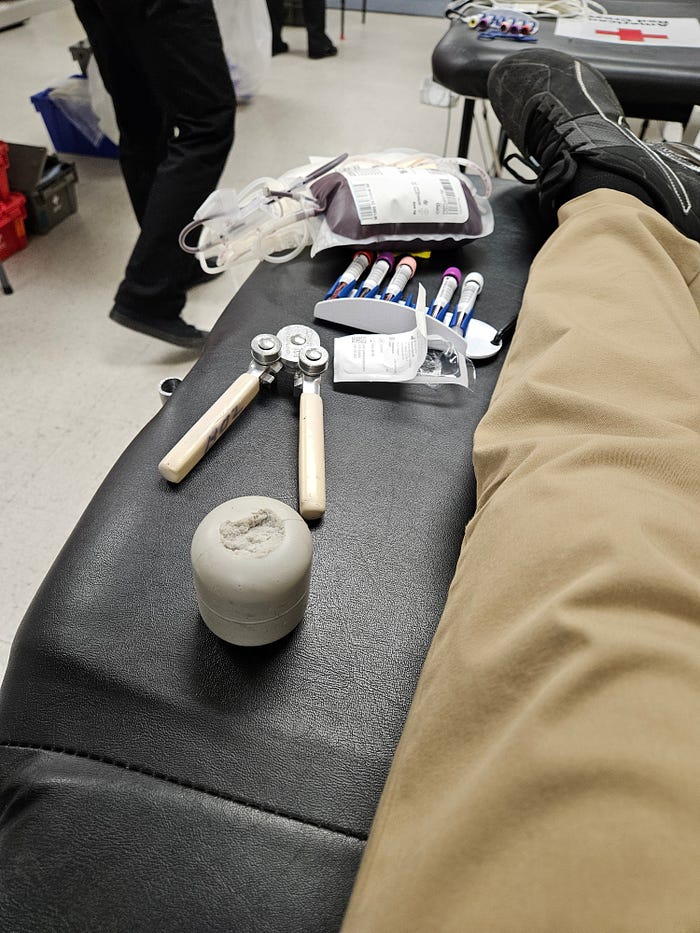
Yesterday marked my 32nd or 33rd lifetime blood donation to the Red Cross. I’ve lost count on the exact number. Most of my donations were whole blood. Others were double red cell donations. This is where an apheresis machine is used to collect your red cells, while returning your plasma and other fluids. So those visits count as two donations in one shot.
So far, my lifetime donation amount is over four gallons, which is almost the total amount of blood that’s in the human body (3.5–5 gallons).
I’ve been giving blood to the Red Cross since I was a junior in high school. I had just turned 17, and it just so happened my school was holding a blood drive in April right after my birthday. I didn’t need parental permission to donate. I did, however, need permission from my lifelong fear of needles.
My needle phobia probably goes back to a traumatic episode I encountered as a child. When I was four or five I was running around my chrch when I tripped and smacked my forehead right on the corner of a wall.
I don’t remember exactly what happened next. But I do recall waking up and being strapped to a hospital bed while doctors were trying to stitch my bleeding wound together, kicking and screaming, and trying to escape, while they held me down. This was the mid ’80s, so it was before they used tape. They had to sew my skin back together with a needle and thread. I’m not sure if I had to get any shots, but the experience with the needle so close to my eyes and skin certainly freaked me out.
The visit left a mark on me. Literally and psychologically. I still have a scar on my forehead. I was left with not only trypanophobia but with another fear. To this day I feel deeply uncomfortable in rooms or places where I feel trapped, especially if there are people I don’t know inside. Such as in small classrooms or office rooms. This is why I try to sit near the door. It’s not exactly claustrophobia. I do just fine in elevators and stairwells and other enclosed places. It’s more about fighting the irrational fear of suddenly becoming unable to escape. Or perhaps it’s more a social phobia.
When my high school had the blood drive, I saw it as an opportunity to overcome my decades-long fear of needles. So, I signed up. I’d never given blood before. I’d only had immunization shots and a tetanus shot. I’d had surgery twice. I was no stranger to medical places. But I’d certainly never had a syringe inserted into my arm of my own free will. I wasn’t terrified. But I wasn’t exactly in love with the idea either.
When my turn came I must have lucked out with a good phlebotomist, because I don’t recall there being much of a sting or any pain. Inserting a syringe into a vein is a delicate art. Sometimes if it’s done just right, it’s virtually painless, and leaves almost no mark. I’ve had good and bad experiences with needle sticks.
In my donation yesterday my vein was less cooperative than usual. Though it may have been a bad needle stick, too. In either case, a technician had to stand there and manually hold the syringe in place, sometimes moving it ever so slightly, in order to maintain my blood flow. A condition that would have been absolutely untenable for me previously when syringes filled me with wracking dread. Now it’s just more of an inconvenience.
Bottom line is that stepping out of our comfort zone is often the best way to overcome fears or flaws. While I still struggle with small rooms with people I don’t know, I have been able to give public presentations and participate as needed. It’s not as overwhelming a fear as it was before.
I’m glad I was able to cure my trypanophobia, especially by doing something that’s very good for society. Blood is constantly needed, especially during national emergencies. So, I encourage everyone to give if they can.
“A million was a lot of money in 1960. If money deflated at the rate that it has in my 65 years, money is worth 10% of what it was then. So, if a millionaire was rich in 1960, you need $10 million in 2024 to be considered rich.” According to him, if you’re still using the idea of $1 million as a benchmark for wealth, you’re behind the times.
Cardone is not the only uber rich guru sounding the alarm about the rapidly rising bar of what’s considered “wealthy.” Andrew Tate, Suzie Orman and others are repeatedly out here warning that even a few million is nothing anymore.
Michael Saylor, Mr. Bitcoin himself, has mentioned how the real rate of inflation is closer to 7%, not the traditionally lower figure of 2–3% that the government likes to quote.
The true rate of inflation is probably unknowable because it’s a constantly shifting figure. But Saylor’s not wrong. Things like college tuition and housing have gone up way more than 2–3% a year over the last few decades. As I’ve written about before, a base model Honda Civic (a popular middle-class car) was $13,000 back in 2004. Now it’s closer to $25k. That same model car, by the way, cost anywhere between $1,850 to about $5,000 back in 1984.
That’s an astounding rate of cost growth. Granted, Civics over the years have seen technical improvements and such that have inflated the costs. But a five-fold rise in 40 years for a basic set of wheels? That’s a lot.
Then you have housing. In some states the average cost of housing went up over 10% just between 2023 and this year. In some states like California such astronomical growth is a given pretty much every year. The Covid pandemic stimulus and money printing only made things worse. Prior to 2020, homes in the suburbs outside Philadelphia, where I went to high school, were routinely $300k-$500k to start. They were obtainable. Now the floor is $500k+, making housing in the area I consider home almost out of reach.
So, yes, the true rate of inflation is certainly higher than 2–3%. Seven percent is probably about right give or take.
Cardone, Tate, Orman, and Saylor are right to warn about the spiraling cost of living. But how useful or worthwhile is it for the average person to try to achieve a figure like $10 million? All this guru cauterwauling is kind of pointless when you consider that the median net worth for retirees is closer to $200,000.
Even if the average retiree net worth is closer to $1.2 million, that number is skewed by the ultra wealthy. And it’s still way, way behind the ten mil figure Cardone quotes.
Rather than being obsessed with making everyone try to get a bigger number, shouldn’t the focus be on what’s causing all this inflation? Why is our standard of living being rapidly eroded away? Why do we accept that tuition will just rise way beyond the rate of inflation? Or that things like real estate will just go up ridiculously higher no matter what? All while our wages stay stagnant relative to the cost of living? Why do we just accept those things as if they were cycles of the moon or river currents? Pure natural phenomena with no human element controlling them.
Just recently the longshoremen went on strike, giving the country a little scare for a few days. One of their demands was a pay rise of 61%, which evidently they’re going to get. Labor rights activists and other pro-union types may celebrate, except this pay rise is only going to trickle down into the cost of unloading stuff at port. This will increase costs for everyone else. Meaning you and me.
The longshoremen are not wrong to seek higher wages. Everyone wants to get paid more and be richer, obviously. But the pressure of all this inflation and the rising cost of living has created a rat race treadmill panic that virtually guarantees that most will lose out anyway.
I read an article on here a few days ago about how the American Dream is dead for Gen-Xers and beyond. And how the Boomers had it best. I left a comment about how most complaints that generations after the Boomers have about being “screwed” are related to the rising cost of tuition and housing. Without those twin cost threats, life becomes way more manageable. In the effort to make things “affordable” to more people, the government intervened in those two areas significantly, via low interest rates and government-backed student loans. That intervention has only driven up those costs way more than they would have otherwise.
Bad government policy and government spending have largely driven inflation. Inflation is not magic. While gurus like Cardone and others are not technically wrong, the focus shouldn’t be on more “toxic wealth accumulation.” That’s an unwinnable quest. The focus should be to rein in reckless government spending and irresponsible central bank lending, which only hurts the very people those institutions say they’re trying to help.
When you’re being told that even if you’re a millionaire you’re “broke” and essentially hopelessly behind the curve, that doesn’t mean it’s time to dig in and “grind harder.” That means it’s time to focus our efforts on examining the messed up system in which we live, and to figure out how to get it to stop screwing us so hard.
I’m not a Tarantino stan by any means, though like many, I admire his work and his unique voice. I was too young to see his early stuff like Reservoir Dogs and Pulp Fiction. Only years later did I appreciate True Romance and Jackie Brown.
The two-time Oscar winner and pastiche-r of genres is kind of the patron saint artist for college students. Or cult leader, if you prefer. I would hear about him all the damn time and how great his movies are when I was in school. I think that’s why I put off watching them for so long. They were so constantly hyped up like “You gotta see it, bro!” that it had the opposite effect on me. I actually fell asleep the first time I was made to watch Pulp Fiction. I’m still kinda neutral about that one. I see the appeal, but it just never captured me, as most films featuring race as a prominent theme generally don’t. I have a younger cousin who loves it and calls it his favorite film.
Tarantino dominated the 1990s. His turn-of-the-millenium output has seen equal critical and commercial success, though maybe not in the same generational-zeitgeisty way as his early stuff. Even now, I passively follow his work, which for me remains hit or miss. I only recently saw Inglorious Basterds. Miss. Never saw Death Proof. Saw Django Unchained once. Eh, it was okay. Hated The Hateful Eight. Enjoyed Once Upon a Time…In Hollywood, though it felt underdeveloped and indulgent.
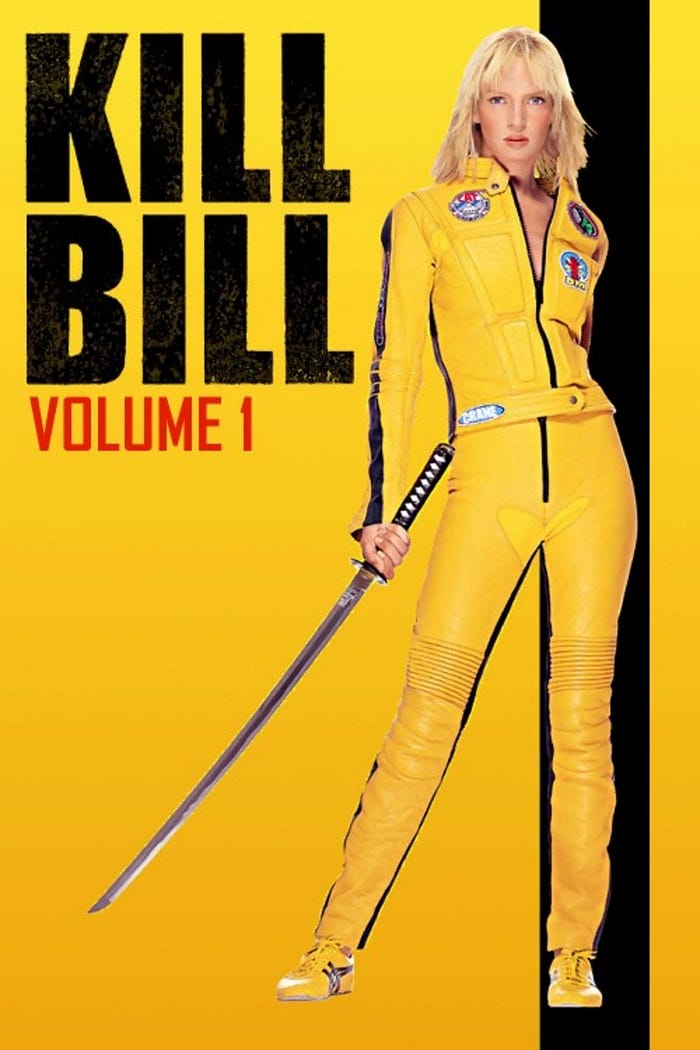
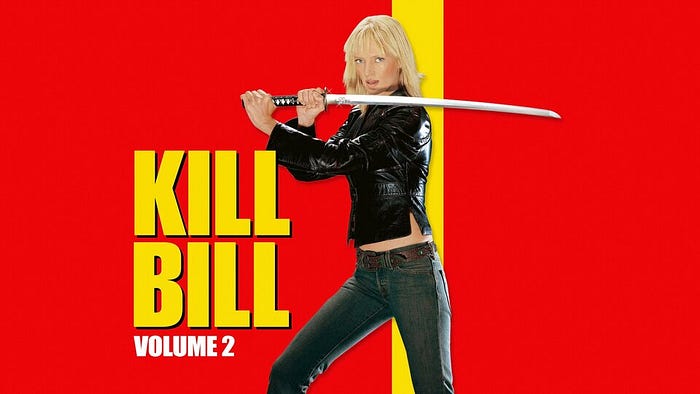
I do, however, fucking love Kill Bill Vol. I and II.
Credit: Miramax
Kill Bill holds a special place in my heart. Not just because I really like the story, but because of the memorable venue where I originally saw it. I was 21 and going to a private college in north Chicago in 2003. Loyola University sits wedged alongside Lake Shore Drive and Lake Michigan, and like many city schools, criss-crosses different neighborhoods of varying class levels. You’ve got your gentrified hipster streets, your more “ghetto” areas, your working class avenues, and your young professional couple cheapo condo building spots. Of course you have all the retail staples. Chinese food. Delis. Convenience stores. And bars. Lots of bars.
And you have the “ghettoplex.”
Chapter Two: The “Ghettoplex”
The “ghettoplex.” This was a tiny run-down old fashioned style theater on North Sheridan Road. Opened in 1913, it’s name was originally The Regent. In 1990 new ownership renamed it Village North Theater. Then it became the New 400 in 2009. Like many theaters, Covid punched it hard in the face. But it eventually reopened. Only to suddenly (and finally?) close in 2023.
I never knew the theater by any of its real names. It was just the ghettoplex around campus. The ghettoplex had only a few auditoriums. It attracted an eclective mix of people from all walks of life. Mainly broke college students. But also hipsters. Whites, Blacks, Hispanics. Uptight professionals. Homeless. Thugs. Everyone. Every screening was a melting pot and often chaotic, with people shouting at the screen, getting up and down, arguing, throwing food, amongst other activities. Even though I typically hate interruptions during movies, the ghettoplex was the one venue in which it seemed not just appropriate, but even welcome.
In other words, it was the perfect place to watch the vibrantly raucous Kill Bill: Vol I.
I was instantly attracted to Kill Bill from the trailer and all the advertising, as it looked unlike anything I’d ever seen. Which is ironic, considering it’s a blend of several classic film genres; namely spaghetti Westerns and ‘70’s Bruce Lee-style Martial arts flicks, combined with noirish crime and pulpy gangster revenge stories. Some people credit No Country for Old Men (2007) with starting the neo-Western trend that still continues today with The Last Stop In Yuma County (2023). But I think Vol. II of Kill Bill has an argument for being a bigger influence.
That Tarantino was splitting his new film into two parts felt audacious also. The Matrix Reloaded and Revolutions did that the same year. But they were both highly anticipated sequels to the beloved 1999 hit. It felt strange for even a respected artist like Tarantino to do the same with an original story that didn’t already have millions of built-in fans. Especially after a six-year hiatus from film making. His last film Jackie Brown (1997) didn’t exactly light the world on fire. There were even whisperings that Tarantino was just a ’90s man. That he wouldn’t make the jump to the new century with us coming-of-age Millennials.
I didn’t really care about Tarantino’s earlier works. I hadn’t even seen them at the time. All I knew was Kill Bill looked pretty badass. So, off to the ghettoplex I went the weekend of October 10, 2003.
Chapter Three: Ratatino, The Giant Rat
Movie theaters today are trying so hard to create immersive viewing experiences. There’s 3D, IMAX, 4DX, those D-Box seats that vibrate, stadium seating, and the latest and greatest in The Sphere in Las Vegas, NV, which has a near 360-degree wrap-around screen that’s so transportive it will give you anxiety. I highly recommend going. It’s mindblowing.
However, no theaters have considered the visceral experience that our good friends of the Rodentia order can freely provide during a film screening.
Kill Bill provoked hoots, hollers, “oh shits,” “fuck nawws,” and more from the get-go. The opening scene where The Bride surprises suburban homemaker Vernita Green (aka Copperhead) was a riot. “I should have been motherfucking Black Mamba,” brought laughs. The Kaboom cereal attack and its subsequent knife to the heart caused gasps. It was the kind of rare opening where you just knew you were in for a classic good time.
For me, the strongest reaction came at about the mid-point. It was right after when The Bride visits Hattori Hanzo to have a custom-made Samurai sword made and she’s off to Tokyo to deal with O-Ren when a giant rat ran across the bottom of the screen.
Now, for years I had often heard the legend of New York City’s giant sewer rats. As a new citizen of Chicago, it had not even occured to me that such massive cat-sized rodents could also live in the Midwest.
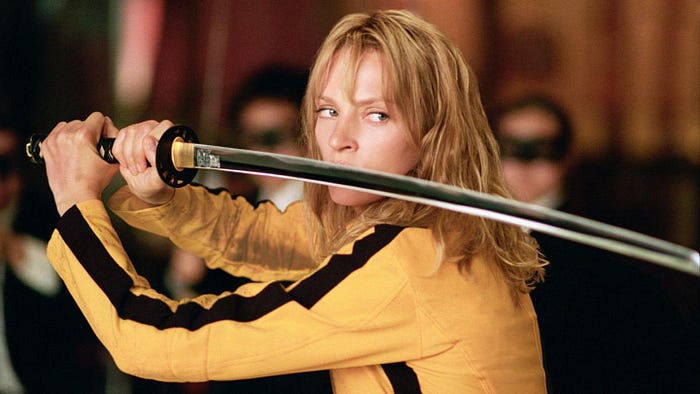
This rat was fucking huge. I’m not sure if it was in front of the screen or behind. It was a giant black shadow that scurried underneath Uma Thurman while she was determinedly seated on the airplane as The Green Hornet theme played. It ran across, its tail flopping behind it as thick as a coaxial cable, until reaching the other side and disappearing. The memory is burned into my brain. I’m not sure if anyone else even noticed it, as nobody reacted. I asked my friends that I’d gone with later about it, and they swear they never saw a rat. But given that the theater was called the “ghettoplex,” perhaps such gargantuan infestation was simply expected. Maybe this particular R.O.U.S. frequented the establishment and was well-known. I don’t know. But it freaked me out in kind of a good way.
What made it even better was that not long before, The Bride tells Hanzo about how she has a giant rat to kill (meaning Bill, of course). Did “Ratatino” (the name I gave him) hear Uma mention his species namesake, and take that as a cue to come out of hiding? Who knows. But I’m glad he did. God bless you Ratatino, wherever you are.
Chapter Four: Kill Bill and I
Have I mentioned how much I fucking love this movie? Good, I’ll jump into the many reasons why.
1. Uma
Credit: Miramax
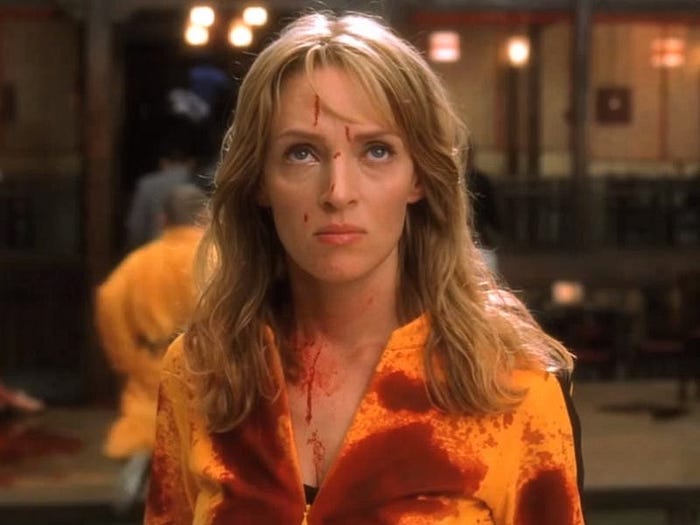
Okay, ngl, Uma Thurman became my movie crush for years after Kill Bill, displacing Katie Holmes’ solid four-year run, and knocking out an insurgent Jessica Alba. But aside from my own star-struck amore, Thurman really was perfectly cast for the role of The Bride/Beatrix Kiddo. I only found this out recently, but it was actually she and Quentin who conceived of the idea for Kill Bill while on the set of Pulp Fiction. This is why the credits for the story are “Q&U.” Tarantino refers to Thurman as his “muse.” It’s easy to see why. Uma’s tall, near-Amazonian figure ignites the screen, hacking and slashing away like a blonde supermodel Grim Reaper. The movie thrives on juxtapostion and irony — West meets East, red blood on snow, spaghetti Western meets Kung-fu flick — a killer ex-bride (and mom) on a bloody rampage is striking. Her big blue eyes are as close to “anime eyes” as one can physically get without CGI enhancement. The whole effect is instantly iconic.
Very often, whenever talk of “badass action heroines” comes up, the go-to examples are always Ellen Ripley or Sarah Connor. Sadly, The Bride seems to be constantly left out, and deserves to be placed atop that stage. Uma’s performance is also enhanced mightily by the character’s maternal qualities, which mirrored her own. She’d already had two children by filming, and her daughter Maya Hawke was almost the same age as her movie-daughter B.B.
Uma also deftly handles the film’s more darkly comedic elements. Tarantino flicks are known for their outlandish violence, but it’s their nuance, complexity, and subtext that make them endearing and memorable. During The Bride’s interactions with O-Ren, her attitude shifts across a range of channels — vicious determination, inside humor, cruel taunts, sharp retorts, respect, and even tenderness. There’s a sense the two women were once best friends before the falling out. A hard subtlety to pull off, which Uma does in spades. Her whole performance is solid throughout.
2. Soundtrack
It may be cliché to describe a film as a “symphony,” but in the case of Kill Bill, it’s apt, and largely because of its pitch perfect soundtrack. As we first saw in Reservoir Dogs with the “Stuck in the Middle With You” scene, Tarantino likes to pick ironic music during violent scenes. But many of the musical cues are also just traditionally fitting. And “original.” Not in the sense that all the music was written specifically for the film. In the sense that much of the music was comprised of lesser known hits that Tarantino dusted off and reused in surprising and dove-tailing ways.
Some of my favorites are “The Flower of Carnage,” which plays directly after The Bride gives O-Ren the worst haircut ever. The song bears significance, as it’s sung by Meiko Kaji, an icon of Japanese cinema, who famously played Lady Snowblood (1973), an inspiration for Kill Bill. “Crane/White Lightning” by RZA is another one I enjoy. “The Demise of Barbara and the Return of Joe” perfectly encapsulates the end of the climactic battle between Beatrix and Bill. “Battle Without Honor or Humanity” was a major hit from the soundtrack.
3. The Mythology
One of the ways a great film pulls you into the embrace is with its often implied but sometimes depicted mythology. Star Wars is the best example of this, of course. Who the hell is this Darth Vader guy? Why has this Ben guy been hiding out in the desert? What’s a Clone War? While its prequels and sequels filled in the details with mixed results, what makes the original special is all the mysterious backstory.
Kill Bill does a similar thing. Giving us just enough backstory through flashbacks to keep the main story going, but also digging into the classified files, so to speak, of many of its characters. There’s a whole animated sequence that shows O-Ren Ishii’s tragic childhood that lead her to taking over the Yakuza gang in Tokyo. Even O-Ren’s bodyguard Gogo Yubari gets a mini biopic.
My favorite is the chapter “The Cruel Tutelage of Pai Mei,” which shows us quite explicitly how The Bride became trained to what is practically a supernatural-level of martial arts expertise. Then there’s the sequence with Hattori Hanzo. If there’s one criticism I have, it’s that I wished we could have seen a little of Hanzo actually making the sword. But perhaps it’s better that it remains a mystery how a seemingly simple bar owner in Okinawa is able to craft a weapon that can “cut God.”
4. The Venn Diagram “Super Movie”
To go along with Number 3, Kill Bill is also a good example of what differentiates a great story from a pretty average one. It combines a number of narratives that could on their own be a movie, into a “super” movie— like a Venn diagram — with the main one in the middle. You could do a whole film just on Bill founding the Deadly Viper Assassination Squad, Pai Mei, O-Ren, even Gogo Yubari.
To say nothing of the some of the “loose ends.” What in the hell happened to Sofie Fatale? Actually, I don’t want to know. Did Elle Driver make it out of the desert after losing her eye? My vote is the Black Mamba snake eventually got her. Will Vernita Green’s daughter Nikki grow up seeking revenge on The Bride? More on that in Chapter Five. Here’s where editorial and artistic restraint are needed. Sometimes it’s better to leave people wondering. It’s not always best to fill in all the details, as some of the excessive and creatively bankrupt Star Wars spin-offs have shown.
5. The Subversive Humor
Credit: Miramax
The Pussy Wagon. Kaboom cereal. Much of the Bride and Elle’s fight. Budd’s shitty station in life as a bouncer at the titty bar. Beatrix Kiddo’s name reveal in the kid’s classroom. Boss Tanaka provoking O-Ren’s sensitivity about her mixed Japanese and Chinese heritage (a scene I always appreciated as a mixed-race person myself). I could go on and on.
Striking the right balance in tone for a movie about a woman going around cutting people’s heads off is tough. But necessary. Like much of Tarantino’s work, Kill Bill is very self-aware and post-modern. The bloody graphic kills in the Showdown at the House of Blue Leaves are cartoonishly but purposely over the top.
6. The Cliffhanger
The end of Kill Bill Vol I., where Bill reveals to the butchered Sofie that The Bride’s daughter is still alive elicited a few gasps from the rowdy audience at the “ghettoplex,” as I recall. It’s one of the first real film cliffhangers I remember that left me really wanting to know what happened next. As I was never a fan of the Star Wars sequels, the ending of The Empire Strikes Back never rustled my jimmies. The end of Matrix Reloaded was tepid and actually kind of confusing. The only other film ending that left me really wanting more was, oddly enough, The Blob. A film with a sequel tease that’s still not been paid off some thirty years later.
Making it all the better was that Kill Bill Vol. II premiered on April 16th, my birthday, the following year (2004). What a perfect birthday present.
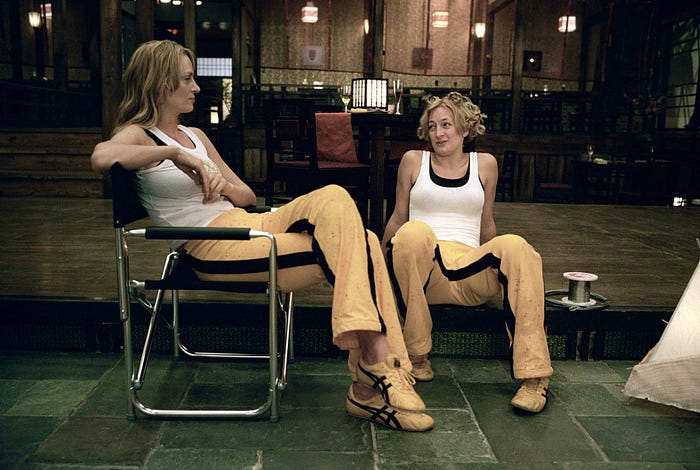
I’d be remiss not to mention the Herculean (or perhaps She-Hulkian) physical contributions made by the peerless and legendary stuntwoman Zoë Bell. Bell sustained serious injuries filming the scene where The Bride gets blown away by Budd’s shotgun blast. In addition to being a “crash and smash” double for Uma, Bell also doubled for her in the fight scenes, becoming trained on swordplay and combat moves herself. Stunt work is often underappreciated, but the work done in Kill Bill went above and beyond. Both Bell and Uma got put through the ringer for our entertainment.
There’s also this dark episode from the making of the movie that honestly hampers my enjoyment of the film. Tarantino pressured Thurman to perform a dangerous driving stunt that wound up leaving her hospitalized with neck and knee injuries that she still suffers from to this day. The accident led to a falling out between her and Tarantino for 15 years. Uma doesn’t blame him so much as she blames the film’s executive producer Harvey Weinstein — yeah, this fucker again — for trying to sweep the whole thing under the rug. Check out this link here detailing Thurman’s account of the ordeal, which also contains a frightening video of the car crash. It’s very sad and sickening for any actress to be forced into a stunt for which she is not trained or prepared. But to do it to the star of your movie who inspired the story itself, is grossly irresponsible and monstrous. This is on top of Thurman having had an encounter with the disgraced former Hollywood producer in which Weinstein allegedly assaulted her in hotel in the ’90s. You can read about that here.
Uma Thurman describes her experience after the crash as “dehumanization to the point of death.” It’s a stark and scary reminder that for all its glitz and glamour, Hollywood is at its core, a brutal business that has allowed some real abusive assholes to gain power. There is a human cost that sometimes takes place behind the camera that often goes unnoticed. The unseemly developments I’ve mentioned don’t ruin Kill Bill. They do, however, give me a recontextualized appreciation for all the literal blood, sweat, and tears that went into making it.
8. Poetic Fights And Fates
Perhaps Kill Bill’s most creative component are all the diverse and fitting ways in which members of the Deadly Viper Assassination Squad get their comeuppance for their role in Bill’s attack on The Bride. Vernita Green’s death is quick and brutal, hinting at the fact that likely the two women were never exactly close. As I mentioned earlier, O-Ren’s drawn-out “graceful” demise indicates that she and Beatrix were probably besties at one point.
As her former brother-in-law, it seemed The Bride was satisfied with giving Budd a quick and painless death by surprising him at his shitty trailer. But a Black Mamba still wound up getting him anyway due to the vicious one-eyed Elle Driver. Driver and Beatrix were clearly hated rivals of one another, both professionally, but also romantically over Bill. Elle tells Bill, “You need me baby, I’m there,” over the phone before her surprise confrontation with The Bride. Their duel is a messy cat fight, ending after Beatrix yoinks Elle’s eye. This after Elle sneeringly and proudly confesses to poisoning Pai Mei, who plucked out her eye for impudence during her training.
Then there’s Bill’s death, which is both cathartically satisfying, but also bittersweet and tragic. At its core, Kill Bill is about a serious marital spat, and all the fallout that ensues. Both sides can be blamed. I always got the sense that if Beatrix had explained her side to Bill about not wanting her daughter to grow up in the life rather than just running off, he’d have likely understood and made proper arrangements. A workable compromise probably would have been reached. But this is not a story about rational, level-headed people. This is a story about brutal killers who think impulsively. We’ll never know what could have been.
9. Even Side Characters Are Memorable
This kind of goes along with mythology in Number 3. One of Tarantino’s gifts is in creating very lived-in minor characters that look like they were breathing and eating long before being summoned for their short appearance. Take Esteban, for example, the Mexican pimp and father figure to Bill. There’s a whole history to this guy and and how he raised Bill, but he’s gone after all of five minutes of screen time.
And let’s not forget Buck. Who’s here to do what? Fuck. A rather simplistic and base behavioral drive. But an unforgettable one, for sure.
10. The Five Point Palm Exploding Heart Technique
It’s fucking awesome. ‘Nuff said.
Chapter Five: The Blood-Splattered Sequel Rumors And Conclusion
Credit: Miramax
This past October 10th, 2004, it’ll have been 21 years since the premier of Kill Bill Vol. I. It’s hard to believe that much time has passed. For me it’s a literal whole other lifetime ago.
Not long after the conclusion of Vol. II, rumors began to swirl about a possible third installment. All kinds of theories abounded regarding possible plots. The most popular being a grown-up Nikki Green seeking out Beatrix to get revenge for killing her mother, with an assassin-trained adult B.B. being in the mix.
As much as the fan in me would love to see a third Kill Bill, I’m not sure it should happen. I’m very much a “completionist.” When a story is done, let it be done. I feel that way, as do many others, about the first two Alien and Terminator films. I feel that way toward Kill Bill. It ends as perfectly as it could. Why ruin that with a sequel? The whole point of the two-part film is The Bride rescuing her daugher from her savage life for a peaceful one. Which she does. But perhaps Bill is right in his “Superman talk.” Maybe Beatrix Kiddo is a killer at heart. Maybe it’s just a matter of time before that deadly assassin life will pull her back in. We’ll just have to wait and see. But I’d much rather think of Beatrix and B.B. living happily ever after.
A few common sense tips to avoid some common pitfalls.
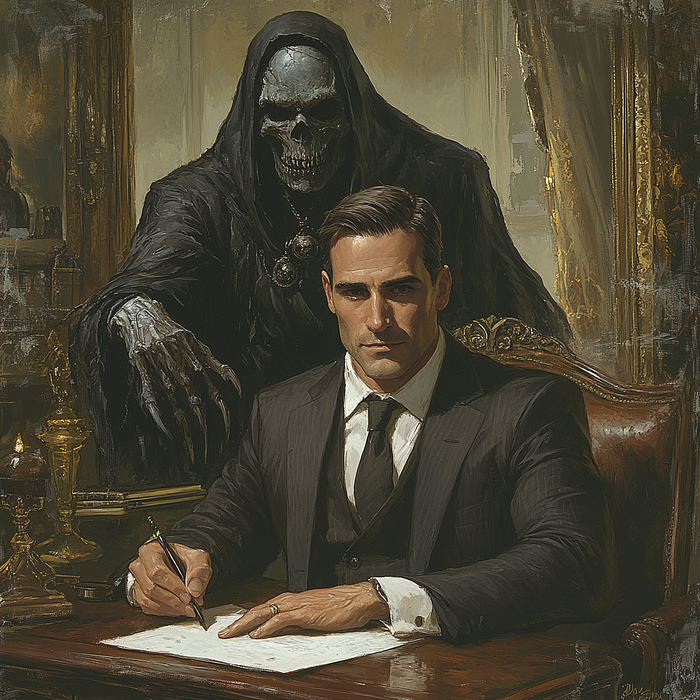
Made with Midjourney
I’m constantly seeing all kinds of articles about side hustles and other ways to make money and become wealthy.
While these are helpful, I’ve found that building your net worth is less about what you do and more about what you don’t do. Unfortunately, nobody hands you a guide called “How Not To Fuck Up” when you turn 18, that shows you the many spring-loaded bear traps laying about out there. In fact, it seems people are more apt to let you walk right into one and snap your leg off.
Nobody was there to tell me anything. So some of these pitfalls are ones I learned myself, the hard way. Others I was fortunate to avoid on my own.
Finish High School And Keep Your Fucking Legs Closed (meaning don’t have kids) Until You’re Married.
Made with Midjourney
I combined these two tips because they are common refrains from Dave Ramsey. It really is that simple. If you do these two things, you are virtually guaranteed NOT to end up in poverty. Do one of them, and your chances of one day becoming financially successful are very low. Do both and it’s almost impossible. The welfare register, the ghettos, and the trailer parks are filled with people who did both or either. I’ve met many single moms in my life who were not married before having a kid, and virtually all of them were in the poorhouse and on government assistance. I’ve met guys who had kids when they were super young, and nearly all of them were broke.
Guys are less threatened by this pitfall because young children are not physically dependent on us to live, obviously. We’re also expected to work regardless of our ejaculative accomplishments, too. But for women, this is a crucial, even life critical step. Having a baby with some lowlife dickbag loser who runs off, then not having the legal and financial support that a committed marriage provides, can seriously fuck you and the kid up for life.
Even in a good marriage having kids is tough. And yes, people divorce and go through hell. But trying to raise a kid while dealing with baby daddy or baby momma drama is a complete fucking nightmare and almost impossible to work through. Yet millions stumble into this pitfall every year. It may be funny to watch child support fights or paternity drama on Judge Judy or Maury Povich, but in real life this shit is tragic and often forms the basis for why our society is so fucked up. So, to be clear:
Keep it in you pants if you want to keep money in your wallet!
Don’t Take Out Student Loans For Stupid Bullshit Degrees. Let Me Repeat That. Don’t Take Out Student Loans For Stupid Bullshit Degrees.
Made with Midjourney
This is a BIG one. And it hits home because I fell into this pitfall myself, and it seriously screwed me up for years. I mean, I would be a completely different person today had I not borrowed money for college. I would not be living where I am. I would not have gone through hell as a result. I might even be in a better place. While I’ve since cleaned up the disaster I made for myself and am doing quite well now, I lost YEARS and therefore OPPORTUNITIES because I needlessly saddled myself with student loan debt.
Here’s the deal. For years, only the wealthy earned liberal arts college degrees for a “well-rounded education.” Then the banks, working with the government, came along and convinced everyone else they could and should too, even if that meant taking out vast sums of money. Now you have millions of college graduates stuck with trillions in student loan debts they can’t discharge through bankruptcy, while having no real employment prospects, and therefore no income. You have young people graduating with $100k+ in debt for fucking useless art degrees.
There’s a reason only the wealthy used to do this. Because they knew they had a job at daddy’s company when they graduated. They knew they’d end up on their feet. As harsh as this is to say, if you’re middle-class or lower, you’re almost certainly wasting your time and money by doing the same thing as the rich. Sorry, no, you don’t need a “well-rounded education.” You’ve been duped by banks and the government. What you need is fucking money. You’re not sophisticated and elite because you learned about the French Revolution and fill-in-the-blank-philosopher’s-name, you’re poor and broke. Unless your degree leads to a real career with real prospects and real money, do not waste one goddamn second on it.
I look back at my stupid idiot self. I took out over $25,000 in loans for a degree in political science from a private college that I had absolutely no business attending. I hated it there, too. Most of the students were, unsurprisingly, trust fund kids, or at least had big help from mommy and daddy toward paying tuition. I did not fit into the scene whatsoever being a broke mixed-race kid from the other side of the tracks. I left after one year without a degree. Obviously, I had no help myself other than what I could scrounge up through financial aid. I’m not even proud of the fact that I qualified to get in to this school. I’m ashamed, because going there left me in debt with no way to repay. I wound up working in a fucking department store afterward before getting back into the printing trade.
To say that student loan debt ruined my life would be an understatement. Robbing a bank would have fucked me up less. At least then I’d have a cool story and some prison tats.
Look, I get it. The allure of an “elite” institution is hard to overcome. Everyone wants the prestige of a four-year degree from a “top” college or university. But the reality is, especially in this day and age, it’s not necessary. And if you’re poor, it might even be financial suicide. If you want a “well-rounded education,” go to the library or watch YouTube. They’re both free.
The delusion over degrees is un-freaking-real. I could go on for hours. One time I met an obese broke single woman in her mid-20s who was a few months pregnant. She was convinced she was still going to get into a prestigious law school in New York City and become a lawyer and fight for “women’s rights” or some bullshit. I asked how she planned to do this with an infant, no money, while living in one of the most expensive places in the world, all to chase a profession in what was certainly low-paying non-profit work, to which I received only a derisive snort and nostril flaring in response. As though I were a complete idiot for even asking. I never saw this lady again, but I’d be willing to bet she ain’t hobnobbing with high-powered feminist do-gooders in Manhattan.
Drive A Shit Box You Paid In Cash For Because You Don’t Need A Luxury Vehicle To Pick Up Hungry Man Microwave Dinners At The Grocery Story.
I drive a 2006 Saturn Ion with over 180,000 miles despite having an above average networth for my age, and more than enough to pay for a premium new car in cash. I fucking love my “shit box.” At this point, I’m planning on keeping it and driving it for as long as possible, and giving it a Viking funeral for whenever that time comes. It’s a “grocery getter” at this point. It used to drive me back and forth between Philadelphia and New Jersey. Nowadays I don’t drive it more than 120 miles at a time. If I need to go on a road trip I rent a car or fly. If my life situation were to change and require me to upgrade vehicles, I’d still get something cheap and used and do the same damn thing that I’ve done with this car.
My “senior vehicle” only costs me $25 a month to insure, and very little to maintain. Because of the substantial savings I’ve made over the years, I’ve been able to put way more into my investment accounts. If I were instead one of those clowns who feels the need for a new shiny set of wheels just to drive to my crappy cubicle job, I’d not have been able to max out my 401k, my IRA, and build up a solid net worth that has put me on the path to financial independence and early retirement. The average car payment nowadays is around $700 a month, which means many people pay WAY more than that. That’s just the financing payments. There’s insurance and maintenance on top of that. You have people literally pissing away millions in potential compound gains because they need to sit in a metal box with a name brand logo on it. Absolutely ridiculous.
Once again, for many years, only the wealthy bought premium vehicles because only they could afford them. Then along came “easy” financing schemes and loose lending standards by the banks. Now everyone can “afford” to buy BMWs and Mercedes and SUVs that cost a gold brick to fill up at the gas station. This is why you see hot rods parked in the ghetto, and those giant monster “America-fuck-yeah!” trucks parked in the sticks. Isn’t “equality” great? Well, it’s not really equality, because those people still can’t afford those vehicles. They can only (barely) afford the $1000 monthly payments. At least until they lose their job. Then it’s the repo man laughing all the way to the bank. And the dealership, too, which just turns around and sells the car to another sucker who needs to compensate for his inadequacies by overpaying for a pile of plastic and sheet metal that can move 70 M.P.H.
All these tips basically boil down to “Don’t buy shit you can’t afford.” Which seems easy. But so much of money management has nothing to do with math, but emotion. People attach emotional value to things like college degrees or vehicles that they really don’t need, that they don’t realize will screw them for years to come. People get irresponsibly caught up in the passions of a relationship and wind up trapped with offspring they are not prepared for or capable of properly taking care of.
People have gross misunderstandings when it comes to money. Many think making big money is all about some big score or windfall. Winning the lottery. Making out on some stock or cryptocurrency. While a lucky few will hit those jackpots, for the most part, building wealth is a largely a “brick by brick” deal. It’s a stifling boring process, actually. People overcomplicate it. But it’s less about doing a bunch of things right, and more about simply not colossally fucking up with a few wrong decisions that are actually quite easy to control.
There’s a part of you that thinks you’ll live forever. It’s right next to the part that thinks you’ll never get old. Even though both parts are dwarfed by the rational side that says you certainly will on both accounts, what they don’t have in size they make up for in denial.
Recently, I’ve been trying to write my will through a free legal site called, appropriately enough, Free Will. But it’s proved a challenge. The website is easy to use. Almost too easy. I expected the whole will writing endeavor to be more formal. Like something you do in a suit and tie in a lawyer’s office.
I’d heard it’s a good idea to write a will out no matter your age. This is to prevent legal complications with family or beneficiaries following your expiration. Things can get messy without proper paperwork. Plus, you don’t know when it’ll be your time. As the Southern Baptist preachers at the churches I went to as a kid used to say, “Tomorrow is not promised.”
I don’t have insignificant assets. But I lack immediate kin. I’m not married and I do not have kids. If I did, this whole process of will writing would be much easier. My wife would get everything. Or if I was divorced I’d leave everything to my kid(s). Pretty simple. I encountered a similar issue with my life insurance beneficiary designation at work. If I eat it while on the job, my designee gets $100,000. That’s like winning Wheel of Fortune. But it all comes to nought if you don’t have anyone to hand that benefit off to. So I’ve had to just leave that section blank.
So, what the hell do you do when you’re a bachelor? I don’t even have a pet to leave my worldly belongings to the way this lady left $13 million to her cat. Legally, I suppose my assets would go to my family, meaning my mother and my half siblings, without a designated beneficiary of my choosing.
However, at the moment, I’m leaning toward leaving most of my assets to charity. The Red Cross, in particular. I donate blood and money regularly to that organization. In fact, I have a blood draw coming due shortly.
I’ve also considered leaving something for my alma mater. I like the idea of setting up a scholarship for writers, or maybe for older students trying to return to finish a degree, the way I did.
I’d also want to give something back to a few public libraries I’ve frequented over the years. Sometimes when you donate enough they honor you with a little brass plaque or a name plate on a donor wall. I like that idea. My name, shining and adorned, secured by two screws, hanging around for a few decades. People who randomly read the list will see my name, wonder who in the hell I was, not care, then go about borrowing Twilight for the millionth time.
I have two nieces and two nephews for whom I’d want to leave something. Like many, when I became an adult, I started with nothing. I was born into the lower-middle class. Only a small percentage of people ever receive an inheritance, much less a sizable one. I had nothing in early adulthood. Nobody paid for my college. My parents wouldn’t even fill out the FAFSA form. My grandmother was very supportive of me and some other members of my family were also very helpful. But I’ve been working since I was 14, and wherever I could, I always paid my own way. Cars, car insurance, gas, clothes, etc. Life is a lot easier when you’re given help at the starting line with big ticket items like college tuition. Many Millennials are only able to afford down payments for homes because their parents helped them. It can’t be overstated how far getting a leg-up when you’re young can go. I’d like to give my nephews and nieces something I never had. But they will likely have all the help they need anyway from their parents.
If I were to pass before my mom, I’d like to leave something for her as well.
There are a lot of options here. You can see how having to decide whom or what to leave your money to can lead to analysis by paralysis.
Then there’s the specific monetary designations. How much to give? Do I give that person or that organization $10,000? $50,000? $100,000? Free Will lets you divvy your estate by percentages. That’s a better option considering most of my assets are in mutual funds and ETFs that track the stock market, which can be volatile.
That’s only the money aspect. There’s also a section on Free Will for physical assets. Things like furniture, collectibles, cars, clothes, and anything else you can think of. Over the last few years I’ve been largely minimalist, abstaining from unnecessary consumer purchases. I rarely go clothes shopping. I’m not into bling like watches or other needless accessories. I’ve considered getting into collecting things like LEGO sets and NES video games I used to play. But at the moment I keep almost everything I value in a secure storage locker several states away. I want to have a proper place to display any collectibles before investing the time or effort into acquiring them. I do have a lot of books, though. While it pains me to think that most of them will likely end up at a garage sale, at Goodwill, or (God forbid) in the trash, that’s the likely outcome. I’ll have to designate that all my books are to be donated to my frequented libraries.
Then there’s my digital assets. Who gets my Medium account? It does generate money every month. Who gets my personal website? Or access to all my online accounts? My X? My email? What about my intellectual property? My books? Who gets the rights to them? As I’ve mentioned before, I’ve self-published three books, but have eight more in various stages of completion, including one I just finished.
Maybe I’ll be one of those posthumously famous authors, like Franz Kafka or John Kennedy Toole.
The whole process of will writing can be bewildering and stifling. The details are too much to think about. I’m only middle-aged. I’m not hooked up to a hundred machines in hospice care. I’ve not been given a terminal diagnosis. I’m fortunate to be in good health. I exercise and take care of myself. I don’t drink, smoke, do drugs, or engage in unhealthy habits. But like I said, anything is possible. People my age drop dead of heart attacks out of nowhere all the time. I hope I stick around as long as possible, but that’s largely not up to me.
Making a will feels pointless, even though I know it’s not. It’s even a bit scary. It’s tough to think of post-me life. Of me not existing. It’s not the most pleasant or fun thing to think about. The mind has trouble accepting that inevitable reality. It’s like going to the dentist for a cavity. I can see why so many people put off making wills, often until it’s too late. I do like the idea of my assets going to help others I care about after I’m gone. I’ll have to let that motivate me to get it done.
The other night I went on one of those fantastic once in a blue moon dates that started off perfectly. The kind where you’re finishing each other’s sentences, laughing uproariously at each other’s jokes, and looking into each other’s eyes with chemical attraction, both thinking “This is the one!”
I’m not sure how the floodgates of simpatico opened. Was it our mutual rizz? My confidence? Her charm? Or maybe my seductive sweet talk.
Her: You’re unusually confident. Most guys turn into jibbering idiots around a Mars, Inc. heiress and Miss America contestant like myself.
Me: It’s because I know you’re not mine, it’s just my turn.
Her: That’s the most romantic thing anyone’s ever said to me.
Me: Right? If you and I were to get together, eventually you’d leave me beause of hypergamy, also known as “monkey branching.”
Her (swooning): You know so much about female nature.
Me (taps head): I’m a Red Piller. I’m in the know, baby.
Her: But I really do like you! I swear!
Me: Oh, sure. You say that now. But in two years? Five? Ten? Fifty?
Her: No, I’m serious. I’ll marry you right now.
Me: Sorry, but I’m not going to be the sucker who gets his heart broken at some indeterminate point in the future. It’s better to not try at all than to risk that. Goodnight, Miss America.
Sadly, our true love was not to be.
Out of the many Red Pill dicktums that are out there, this one may be the most cynical and toxic. However, technically it is true. In every relationship there is a 100% chance it will end. It’s just a question of when and how. Death? Divorce? Due to cheating? Or simply “growing apart?” Obviously no relationship is forever. But is it productive to go into one already anticipating (if not expecting) its eventual failure and the ensuing potential heartbreak? Do football players who reach the Super Bowl go into the game expecting to lose? Fifty percent of them will not hoist the Lombardi at the end of the night, but such a loser mindset is destructive and can create its own self-fulfilling prophecy.
The Red Pill solution to this Gordian Knot of inevitable relationship obsolesence is to “spin plates.” That means to have a number of women on rotation that you sleep with and/or with whom you maintain a connection. This way if one has a “hypergamy-gasm” on you, you can counter by just ringing up the next bimbo in line. Putting aside the fact that for average men this is largely an unrealistic scenario, “plate spinning,” even for high-value Lord Cockuluses, is time consumptive, expensive, largely superficial, and leads to nothing but complications.
There’s no genuine social regard for such plate spinning behavior, either. Society does not view you as King Solomon and his many concubines. You’re just a dude who can’t keep it in his pants. Though the family court lawyers chasing you down for child support and paternity tests will love you, I’m sure.
As I’ve mentioned elsewhere, the Red Pill, aside from some generic be-your-best-isms, is just hedonism in disguise. Some are out there saying men should have sex with as many women as possible in preparation for marriage. Will these guys just start their own indy porn studios already? It’d be a lot more efficient.
“She’s not yours, it’s just your turn” best articulates the caustic outlook of the manosphere, which views relationships as inherently temporary and disposable. Interchangable, even. Like picking up used parts for a factory machine you expect to break down. On the surface it seems like good advice. The subtext is the admonition to not allow a relationship with a woman to consume you from succeeding in your life’s work and mission. Fair enough. I recall watching an animated series on Newgrounds decades ago centered on a bright young guy who gives up a scholarship to M.I.T. to pursue his high school girlfriend to some state college, only for the girl to abandon him so she can “explore” herself. That scene always stuck with me. What an idiot, I thought. Though there have been many such cases in the real world.
Making yourself an attractive quality partner and focusing on your unique gifts and your work so that you become the “prize,” is a worthwhile endeavour. In so far as the Red Pill espouses that doctrine, I’m on board. But then why the need for plate spinning? Why add all that unnecessary drama, not to mention the greater chance for STI infection or illegitmate children? I’m the bastard product of the kind of, shall we say, “excessive amorousness,” the Red Pill promotes, and let me tell you, it ain’t good being an infant football getting kicked around between two warring ex-lovers in family court, and losing one’s father in the fallout. To say nothing of being the proverbial redheaded step-child. Especially when you’re racially mixed.
You have to judge a philosophy or thought process based on the results as seen by the behavior of its followers, not entirely on whether it holds any real “truth.” The Communist Manifesto may have some worthwhile nuggets, but in practice communism is a ghastly inhumane system, as evidenced by virtually every country that’s tried it. The Red Pill is not waking men up from the Matrix of feminism, it’s demoralizing them and putting them to sleep, mainly. Most men aren’t even trying with women in the first place. Almost half of young men haven’t even approached a woman in person. They’re certainly not going to “spin plates.”
“She’s not yours it’s just your turn,” may seem like some a cold, hard truth to shield one’s heart from the cruelties of break-ups, but it functions as an install code for manwhorism, while devaluing potential quality relationships that might arise were one not seething 24/7 with pathological distrust. It’s less the war cry of a victor and more along the lines of Milton’s “Better to rule in Hell than serve in Heaven.”
I’ve been on a horror kick lately. I finally watched Barbarian. A film I wanted to see two years when it premiered, only to completely forget about until it resurfaced on Prime recently.
Barbarian is the latest in the “socially conscious” horror trend, which started with Get Out in 2018. Even our horror film franchises have to be woke nowadays. I recall a much simpler time. A time when all you needed was a mask, preferably a white one, and some maniac with a knife. A little cat and mouse. Some butchered coeds. And there you go, you had your movie.
Of course, the slasher tropes started by Halloween and Friday the 13th were tired and formularic even by the late 1980s. This is why Scream was such a refreshing hit back in 1996. It playfully toyed with the genre conventions in a fun, meta way, with characters using them as a “rulebook” to help ensure their own survival.
Don’t go off alone.
Never say you’ll be “right back.”
Never, ever have sex.
Scream was the shit back in the day. It not only kickstarted the teen slasher craze all over again, it helped director Wes Craven get back in the game. It was a mega jackpot win for screenwriter Kevin Williamson, who wrote the script on spec. It’s unlikely his record for most commercially successful spec script not written by a writer/director will ever be broken. The Scream franchise has scored nearly $1 billion at the box office alone. Imagine that. Being some rank nobody 31-year-old screenwriter and you have a pdf file on your rickety old PC computer that’s worth billions. It’s the stuff dreams are made of. And he wrote it in a weekend.
Two sequels quickly followed the original hit. Then the franchise went dormant for awhile. This is back before reboots and requels and prequels became a big thing in horror. In 2011 Wes Craven directed Scream 4. That was followed by another movie lull, though the TV series Scream ran from 2015–2019. Until finally Scream (the fifth film) and ScreamVI came out back to back in 2022 and ’23, with plans for a seventh on the way.
It isn’t just Scream’s almost 30-year longevity that’s amazing, but the relative high quality the franchise has maintained. Most horror series fall apart after the original. Some keep chugging along despite being objectively goddawful, i.e. Halloween, Saw, Hellraiser, etc. With the exception of Scream 3, every installment in the franchise is fresh on Rotten Tomatoes. Even Final Destination, with its clever teen-killing conceit, sits mainly in the sub-50s on RT.
So, what’s Scream’s secret? Why has it qualitatively lasted for so long while so many others have pathetically limped from one refresh to another?
Scream has some built-in requisite elements that act as quality control. Every Scream film has its gimmicks — mainly a twisty whodunnit plot with multiple meta references. A balanced measure of comedy, thrills, and melodrama. A tone that strays just outside the lines of realism into cartoonism. This precarious tight rope act isn’t easy. The latest two films are meta inside of meta; referencing the in-movie Stab series, which itself is a self-aware horror film that replicates scenes from the first Scream. The whole self-referential effect becomes like an MC Escher staircase, but with blood and knives.
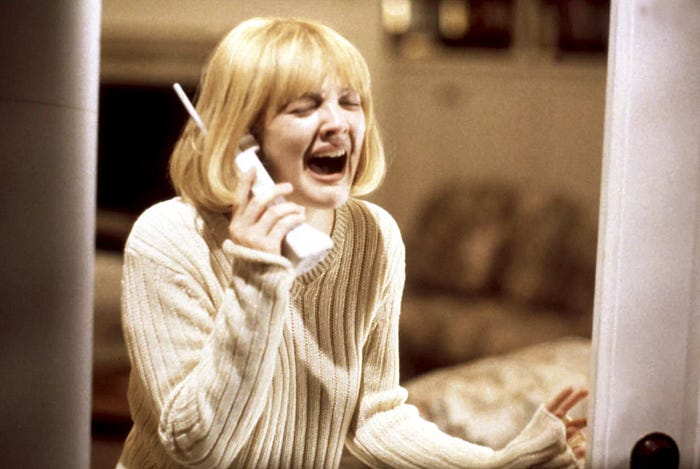
‘Scream’ (1996): Dimension films.
Scream has also served as a recurring mirror of the current state of horror, if not the cultural subtext influencing the genre. In 1996, it was quite innovative to introduce a beloved B-list sweetheart like Drew Barrymore, only to brutally kill her off in the opening. By 2011, the franchise had to adjust that formula with multiple twists, with mixed results. The latest two films have followed Hollywood’s latest diversity push, replacing the mainly White teen cast in the previous four with two leads of Hispanic origin — Jenny Ortega and Melissa Barrera — and assorted minority back-ups, with hardly a White male in sight (save for villainous roles, of course). All while letting OG Scream-ers like Neve Campbell, David Arquette, and Courtney Cox reenter on occasion.
It all makes for a nice adaptive organism of a franchise that can constantly reinvent itself to fit the times. I wonder what sort of State of the Horror Union address a Scream re-re-re-boot might make come the 2030s or even 2040s. The latest sequel already transplanted us to the Big Apple, à la Jason Takes Manhattan. Ghostface in Space is just a matter of time.
These days, it’s not enough to just throw another set of endangered teens out there and watch them get butchered in obscene ways. Scream films are a thinking man’s slasher flicks, dare I say. At the least they offer something a cut above your typical violent bloodletting. I find myself strangely looking forward to the next one.









 Dean Brooks