Unacceptably Stupid: My Bank Wants To Charge Me $15 To Use My Own Money

These stupid fees are getting out of control anymore.

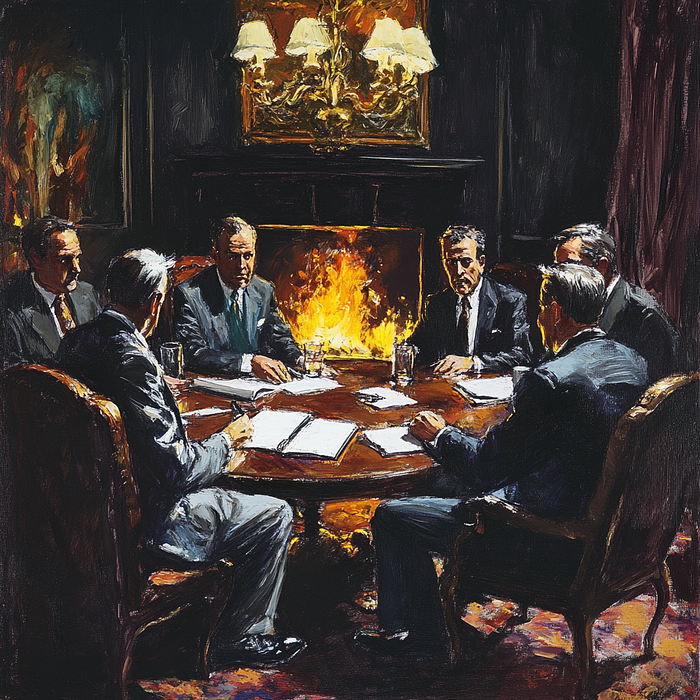
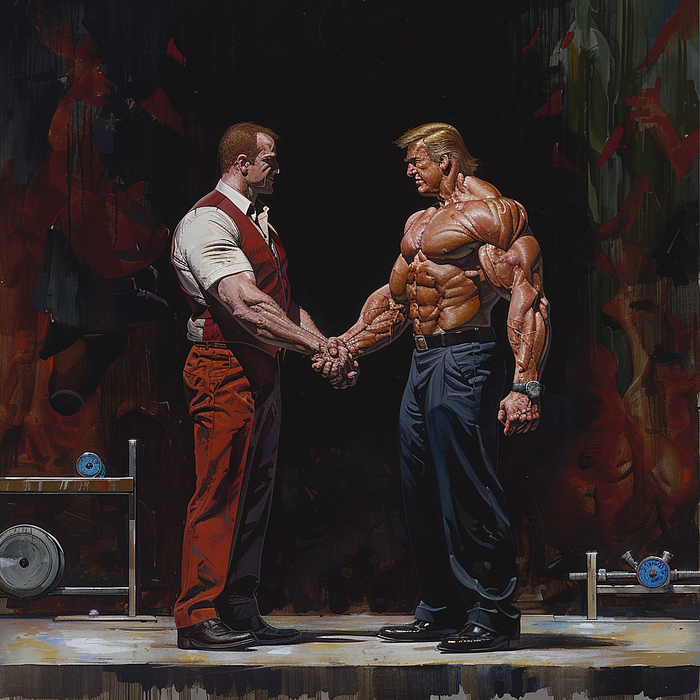
“Why fifteen bucks? Because fuck ’em, that’s why. Now, who wants another brandy?” (Source: Midjourney)

A few days ago I received a notice from my bank that the terms of my checking account are changing soon. In the bank’s own words:

A $15 monthly account fee will be charged, unless you maintain a $5,000 average monthly account balance¹. The first monthly fee will be charged on November 30, 2024 for monthly balances held during the month.

I’ve been banking with this place for over six years now. I use my checking account almost exclusively through them. I also have two of my IRAs, two personal brokerage accounts, and a savings account. Altogether, I have a six figure amount combined just with this one financial institution.

Previously, all I needed in order to avoid a $15 fee was to meet any of the following criteria:

You had set up a direct deposit of $200 or more per month to your account.

You maintained a $5,000 average monthly balance in your account.

You maintained a $50,000 average monthly balance in any of your linked (name of bank)) account(s).

You had a combined $50,000 or more in linked (name of bank) from (name of bank) brokerage accounts.

You had executed 30 or more stock or options trades during the prior calendar quarter in your linked (name of bank) from (name of bank) brokerage accounts.

The above criteria is not hard to fulfill, especially if you have direct deposit. However, the new rule that requires a minimum of $5,000 is stupid, ridiculous, and feels petty.

Now, I usually maintain $10,000 minimum in my emergency savings. My liquid savings can fluctuate between that and $20,000 or higher. It’s not that I can’t meet the criteria. I can. It’s the principle of the matter.

Many others also won’t be able to meet that minimum, and will now be forced to bank elsewhere.

I’m fortunate to be in a solid financial position now. It wasn’t always the case. I remember getting constantly hit with overdraft fees when I banked with Wells Fargo years ago. These fees started at $35, but would balloon even higher if you had multiple charges stacked up. Which I sometimes did because I was so broke at the end of every month. There were days where I’d end up with a negative account balance. Do you know how hellishly frustrating it is to get paid one day, only to end up negative the next, all to be told by customer service that Wells Fargo’s fees are done as a “courtesy?”

Least evil Wells Fargo executive. (Source: Midjourney)

Wells Fargo is well known for being a greedy pile of shit. The CFPD recently fined them $3.7 billion for widespread malfeasance. They’re part of the reason I swore off brick and mortar banks for good years ago and switched to my current bank.

I like my current bank for the most part. I can easily check all of my accounts on one screen. Their customer service has largely been good. They offer other benefits, including ATM fee refunds and no foreign transactions fees if made with my debit card. I’m not planning on switching to somewhere else just because of a stupid $15 fee.

But it’s pissing me off becaue I know my bank is likely making a KILLING off of me. My savings account currently earns a paltry 4.50% interest rate, while my checking pays 3.0%. That’s not too bad. It’s certainly way better than Wells Fargo with its absurd 0.01% interest rate for a “Way2Save” Savings account. Way to save? More like way to lose.

Good God, fuck Wells Fargo. Seriously.

Banks don’t just do nothing with your money. They lend it back out, of course, in the form of mortgages, business loans, and credit cards. All with interest rates that are way higher than 4.50%.

That’s only the beginning. Due to the fractional reserve lending system, banks can lend out your money while only keeping a small portion on reserve. Banks used to have to keep a certain amount in reserve. Then in March, 2020, the Federal Reserve reduced the required reserve ratio to 0%. Thanks Covid. Theoretically, my bank could lend out my entire $10,000+ that I’ve deposited in savings. If they’re charging an average of 10% or more on interest annually, that means my bank is making $1,000 off of me every year, not counting additional fees.

Then there’s the data. Evey transaction your make with your debit card represents valuable information to market research companies. Info that your bank and other places you do business with could sell for big money. Data = gold in today’s economy.

Point is, as a customer with a bank, you are an unwitting ASSET in their portfolio, either through your deposits, or with the spending data and other types of data you represent. And if you have significant holdings than you are especially valuable to a bank.

Bottom line: My bank should be paying ME $15 a month for the privilege of my continued loyalty. Likely they’ve made thousands off me over the years. Maybe even tens of thousands. I’m a net positive customer. And what do I get for my trouble? A $15 fee just for having a checking account.

To quote Ice Cube, “This is the motherfucking thanks I get?”

When Will You Disappear From Memory?

Calculating my “Moment of Oblivion.”

Source: Midjourney

They say you aren’t totally dead until your name is spoken for the last time.

For some it will take longer than others. Much, much longer. I can’t imagine we’ll stop saying Julius Caesar’s name anytime soon. He did pay a high price of admission into Club Immortality, though, what with all those knife wounds in the back.

Or Genghis Khan. Especially when he was such a prolific baby daddy that even today 1 in 200 men in the former Mongol Empire share a common male ancestor — which was almost certainly him. Guy must have had a hell of a Tinder profile.

Adolf Hitler will be hanging around for a bit. History is filled with noteworthy murderers. In fact, that seems to be your best bet for a ticket into the remembrance afterlife. We won’t soon forget Joseph Stalin or Mao Zedong either.

Most of your prominent dictators, kings, barbarians, and major leaders down through history, good or evil, beloved or reviled, will likely live on in the collective consciousness. Ozymandias’ statue may have crumbled in the desert, but hey, we’re still talking about him, aren’t we?

After that, the list starts to really narrow. It’s mainly inventors and scientists like Isaac Newton or Albert Einstein. Influential artists and thinkers like Shakespeare, Socrates, or Leonardo da Vinci. Explorers such as Christopher Columbus or Neil Armstrong. Religious figures like Jesus Christ or Muhammad. Then a smattering of other human highlights. Your Typhoid Marys (Mary Mallon), Rube Goldbergs, and Roland the Farters.

Yes, Roland the Farter was a real person, and apparently, he was gastronomically quite skilled.

Sadly, I don’t think many Medium writers will make the recall cut past even 100 years from now, except maybe Barack Obama and other big names who happen to have accounts here. Sure, some server in a cave somewhere will probably have all of us stored away. But how desperate will those of 2124 be to read through hot takes from the 2020s? How many bestselling books or films do you know of from the 1920s? I can think of one off the top of my head — The Great Gatsby by F. Scott Fitzgerald.

It’s a sobering thought experiment calculating your “moment of oblivion.” Mine is probably around the year 2135. I was born in 1982. The average male life span in the United States is 80. I’m currently childless. If I were to have two children in the next ten years, my kids might be in their 30s by the time I die.

Everyone remembers their parents and talks often about them. So, at the least, I’d be remembered by my own kids until they pass away, possibly sometime early next century.

If my kids have children of their own, my grandkids would certainly remember me, assuming I live long enough to get to know them. Everyone loves their grandparents. If my future grandkids are born while my kids are in their late 20s or early 30s, they would live until around 2135.

After that, it starts to get real murky. Very few people ever know their great grandparents personally. Often you just know their name and some basic biographical information. Maybe a few family members have stories about them. I have no idea who my great great grandparents even are.

So, that’s it then. 2135. My Moment of Oblivion.

I could improve on my date with nothingness by living longer. Maybe I add ten more years then. Or I could have more kids than just two. Working against me there is the fact that I’m starting late. But if I were to live to my 90s and have five kids, and my kids have a bunch of kids, then perhaps I could stretch my remembered self to the mid-2100s. I’d have to be a real prodigious procreater like Genghis Khan to make it past the next century via genetic legacy alone.

If I don’t have any kids, then I’d be reliant on my nieces and nephews to remember their favorite uncle. That would get me no farther past sometime early next century. Aunts and uncles are rarely remembered past one generation.

Aside from being remembered by family, I’m left with having to do something extraordinary to make a big enough impact. I’m not a king, scientist, or explorer. I’m just a writer. Even if I were to write a huge bestselling book — like the next Jaws or Gone Girl — that probably only buys me notoriety for a few decades. The only two authors living today that I could see still being remembered in 100+ years solely due to their writing and not counting their offspring are Stephen King and J. K. Rowling. I don’t see myself getting that lucky.

Of course, if I were to somehow manage to kill millions of people, that’d be sure to keep me in everyone’s thoughts for centuries to come. But I’d have to really raise the bar there. I’m competing with some heavy hitters. Hitler killed around 17 million. Stalin whacked 23 million. Mao had a whopping 49–78 million extinguished.

How many would I need to kill to ensure I stick around forever? 80 million? 100 million? I think I’d better shoot for 100 million just to be sure. That’s a nice round number.

No, I think I’m okay with 2135 being my final goodbye year. That’s still 153 years of being thought about and talked about. Not a bad run for an average person.

When do you think your Moment of Oblivion will be?

Some Context To Robert Downey Jr.’s Ridiculous $100 Million Paycheck

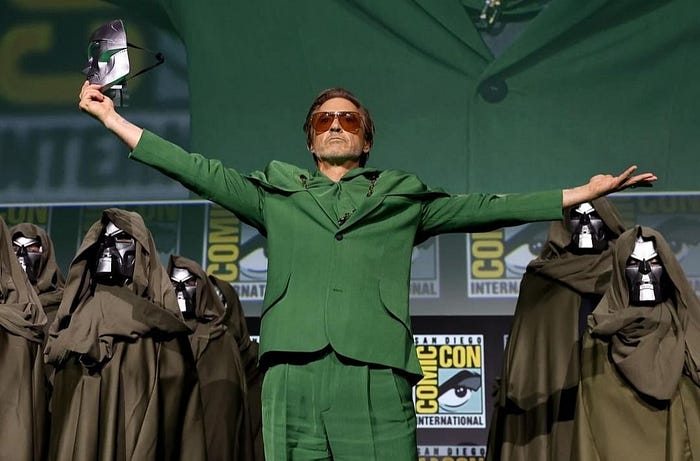
To the Victor Von Doom go the spoils.

Source: Instagram – @marvelstudios

It’s good to be Robert Downey Jr. these days. With a career and reputation left for dead by the mid-2000s, a role in Kiss Kiss Bang Bang helped reanimate the troubled ’80s star’s corpse back to life.

Famously, it was landing the role of Tony Stark/Iron Man for the newborn Marvel Cinematic Universe in 2008 that would send him back to A-list status. It’s hard to believe it, but Iron Man was considered a signficant risk to produce at one point. Nobody had heard of the character outside of comic book fans. Then there was the star himself, Downey Jr. who was an even bigger gamble with his prior arrests, DUIs and rehab visits. Dude was a hot mess.

Iron Man was a massive hit. The MCU completely (for better or worse) took over Hollywood for the next ten years. The mega franchise culminated in 2019’s Avengers: Endgame, which saw Downey Jr. finally retire Tony Stark in dramatic, sacrificial fashion.

Ever since then the MCU has been…well, shitty. It’s been bomb after bomb, basically.

Earlier this year Downey Jr. won the Oscar for Best Supporting Actor for his role as conniving politician Lewis Strauss in Christopher Nolan’s Oppenheimer. You may have heard of it. It won Best Picture and made nearly a billion dollars.

Now Downey Jr. is back in the MCU. Winning Oscars is so yesterday, apparently. Why win gold when you could win green? While wearing green. Lots and lots of green going on here. Kevin Feige just hired him back into the Marvel fold to play Victor Von Doom, aka Dr. Doom, in two upcoming Avengers movies. For $100 million.

Yes, $100 million. As in one tenth of a billion dollars. That’s an obscenely silly amount of money to pay someone just for playing dress up for a few months. However, a little perspective is in order. Some justification, even. I contend Feige might have gotten Downey Jr. CHEAP for the role.

You have to remember, an A-list star is an investment in the film’s success. This goes especially so in Downey Jr.’s case. No Downey Jr, Iron Man maybe isn’t a hit. No Iron Man hit, no MCU. No MCU, no billions of dollars.

Like Jules Winnfield said, “Personality goes a long way.”

The last Avengers film, Endgame, made nearly $3 billion. Infinity War made over $2 billion. Even if the next two Avengers films make “only” $4 billion combined, that means Downey, Jr. cost a mere 2.5% of the total revenue, not including merchandise sales and other downstream effects of two hit movies, like traffic to the upcoming Marvel Infinity Kingdom at Disneyworld.

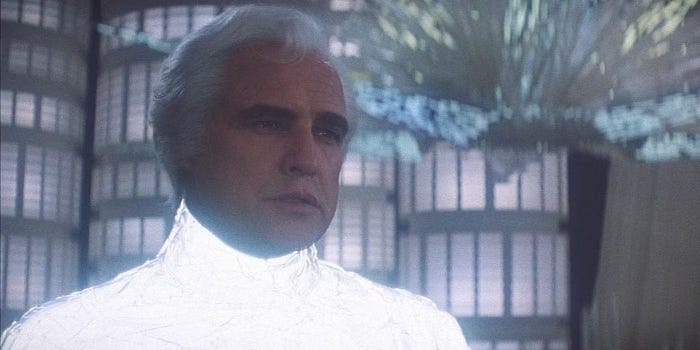
There’s also precedent for paying top talent a huge sum to help lend respectability (and most importantly, ticket sales) to a spandex flick. It all started when Richard Donner approached Marlon Brando to appear in Superman: The Movie as Supes’ dad, Jor-El. Brando agreed, but only for the princely sum of $3.7 million plus a cut of the profits. An utterly outrageous sum back then for what amounted to less than two weeks of work. But Donner needed a big star in addition to the great Gene Hackman already signed on as Lex Luthor, as newcomer Christopher Reeve wasn’t a big name at the time.

‘Superman: The Movie.’ Credit: Warner Bros. Pictures

Brando got his big payday. Superman grossed $300 million at the box office, making The Godfather’s upfront cut a mere 1% of the revenue. That’s not counting video sales, merch, broadcast rights, and other income sources over the last 45 years since the film’s release. If Superman has made $1 billion thus far, then Brando’s “outrageous” sum only cost about one third of one percent of the total revenue. I’d say Warner Bros. got their money’s worth out of him.

Of course, movies with big actors bomb all the time. It’s risky fronting enough cash to fill a Brink’s truck, even to charismatic, proven stars like Downey Jr. Time will tell whether this massive paycheck will prove a good investment or not. Either way, even $100 million will look small in four decades time, just like Brando’s $3.7 million does relatively-speaking today.

Inflation Nation – A Honda Cost $13,000 in 2004

Inflation is so scary when you really look at it.

Source: Midjourney

It feels weird, but I’m at the age where I’ve developed some perspective on the outrageous rising cost of living. I can finally say things like, “Back when I was young ____ used to cost so much less!”

Of course, everyone’s getting eaten alive by inflation these days. On TikTok, there are people comparing grocery receipts of today with that of just four or five years ago. With the exact same items and brand names, too.

I remember purchasing Old Spice Pure Sport 3.4 oz deodorant in Wal-Mart four years ago for about $2.99, or sometimes there’d be the two for $5.00 pack. That same size and brand currently costs $4.47 for just one according to the website. I live in North Dakota, so that price might be higher or lower elsewhere. But that’s almost a 50% increase in just four years. Ridiculous. But you can’t put a price on keeping B.O. at bay, right?

By the way, I don’t seem to recall my income going up by 50% over the last four years. Someone’s losing ground here, and I think it’s me.

I know, I know. Why didn’t I go all in on GameStop back in 2021? I could have so easily been a millionaire. How stupid was I?

Inflation is known as the “hidden tax.” But that kind of undersells its malicious and destructive presence. That’s like calling Michael Myers the “hidden prowler,” instead of, say, a terrifying homicidal phantom. Dr. Loomis hit the nail on the head by calling him “pure evil.” Which is something you could also call inflation.

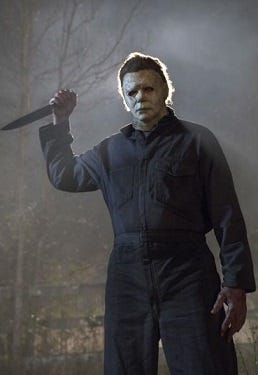
Even Michael can’t afford a new mask due to the rising cost of inflation. Credit: By IMDb — Photo taken by Ryan Green, Fair use, https://en.wikipedia.org/w/index.php?curid=65823405

Inflation is a result of money printing, government spending, and whatever those three witches were brewing up in Macbeth. Double, double toil and trouble, indeed!

What makes inflation so frustrating and demorializing is that it’s impossible to overcome or avoid. Watching it is like being tied to the railroad tracks and forced to wait for the locomotive to come barreling over you full steam ahead. All the while the sinister mustachiod villain who left you there gets away scot-free and cackling.

All you can do is invest and hope for the best to try and stay ahead of the “blast radius” of inflation as much as possible. But therein lies another problem. What do you invest in, and will it beat the real rate if inflation? According to the Federal Reserve and government reports, inflation is currently ticking back down to 2%, the desired annual target.

But Michael Saylor, the CEO of MicroStrategy, seems to think the “real” rate of inflation actually averages 7% a year. That means that even if you’re investing in the S&P 500, which averages a 10% growth rate every year, you’re only just keeping your head above water.

Saylor is known for loving Bitcoin, and sure, if you’d bought it five or more years ago you’d have realized massive gains. But who’s to say Bitcoin will keep providing such high returns, and how long it will take to get them?

Gold has risen nicely over the last 20 years, but the yellow metal has also had decades of sideways action and decline over its long history. And how practical or safe is it to store your nest egg in gold? I keep a little myself, but only it’s a small allocation.

Real estate has gone up big, too, especially in some states. Many northeastern and western states like California saw real estate grow by as much as 20% over just the last two years. But such a stratospheric growth rate also causes new and younger buyers from being locked out of the market.

Realistically, the average person is left with trying to escape Michael “inflation” Myers by investing in S&P 500 and Nasdaq index funds via retirement plans and personal brokerage accounts. That’s not the worst option. But that’s like only running from Michael on foot. A car would be much better. Or a V-2 rocket.

Michael “inflation” Myers, Source: Midjourney.

I remember 2004 like it was not that long ago. Bush was calling Kerry a “flip flopper” on the presidential campaign trail. The Red Sox won their first World Series since the Middles Ages. And a base model Honda Civic DX only cost about $13,000.

$13,000! That’s nothing! Peanuts! I could make that with a newspaper route. Well, actually, $13k is nothing to sneeze at, but it is managable and within reach.

What’s a base model 2024 Honda Civic LX sedan cost now? According to Car and Driver, $25,045.

$25,000! That used to be a GRAND prize on Wheel of Fortune back in the day. Now it barely gets you the quintessential middle-class starter car. Not counting taxes and other fees.

Honda Civics have nearly doubled in price over the last twenty years at an annual growth rate of about 3.32%. If they were to continue at that rate, then by 2044 they’ll cost like $50,000.

This is something you have to keep in mind when it comes to planning retirement and managing future expenses. If you retire with a million dollars in 2044 and plan to follow the 4% rule (meaning you take out 4% of your portfolio to live every year) that means you’ll only have $40,000, which won’t even be enough to buy a new Honda.

Sure, you could buy a used car. But remember, they’re all likely going to double in price, too. A used 2020 Honda Civic with 35,000 miles today might cost $20,000. But in 2044 that same four-year used vehicle will probably cost $40,000. So, you still have nothing leftover to live on in that scenario.

2044 may seem far away. But it’s not. It’s really not. The last twenty years went pretty fast to me. The next will go fast, if not faster. If there’s one thing we’ve all learned about inflation recently, it’s that it can get out of control very quickly and make life very difficult, unless you’re already rich.

Michael Myers has put on some good Nike running shoes the last few years, and if you don’t stay ahead of him, you’re going to feel his butcher knife in your wallet before long.

Seven More Great Novels That Are Under 200 Pages

Sometimes a short read is all you need.

Source: Midjourney

Are you daunted by door stop tomes like Larry McMurty’s Lonesome Dove? Intimidated by popular thick bricks like Stephen King’s It or The Stand? Just not ready to plunge into David Foster Wallace’s Infinite Jest (more like Infinite Pages)?

Sometimes a big epic story like War and Peace is what you need. I’m in the thick of The Caine Mutiny on a reread myself right now. But If you’d prefer your next read be more in line with Shakespeare’s ol’ “Brevity is the soul of wit” chestnut, then think about picking up one of these next seven titles.

(Inspired by Bobby Powers’ article My 10 Favorite Novels That Are Shorter Than 200 Pages.)

1.) The Invisible Man by H.G. Wells

Source: Midjourney

1897 was a banner year for sci-fi/horror classics, with both H.G. Wells’ brief but surprisingly brutal book being published, as well as Bram Stoker’s groundbreaking Dracula.

The Invisible Man tells the story of a mad scientist named Griffin who runs amok when his experiment in optics gets out of control. He turns himself invisible, as you might have guessed from the title. While being unseen is nice for awhile, when he can’t reverse the process despite his obsessive research, Griffin becomes homicidal. He terrororizes an inn, then threatens a town. After gaining a confidant named Kemp, he concocts a scheme to wreak havoc on the entire nation. But when Kemp betrays him to the police, a deadly vengeance-fueled cat and mouse game ensues.

The Invisible Man is definitely worch checking out, as is the 1933 Claude Raines-starring film adaptation. The 2020 film written and direct by Leigh Whannell is also pretty good.

2.) I Know What You Did Last Summer by Lois Duncan

Source: Midjourney

As someone who had to endure that hip teen slasher wave of the late 90s-early 2000s that started with Scream and ended somewhere around Wrong Turn, I never knew the micro franchise I Know What You Did Last Summer was actually based on a bestselling YA book from the early ’70s. A book that predates the original teen slasher wave that saw Halloween, Friday the 13th, A Nightmare on Elm Street, and all the clones that followed. I always thought of I Know as just “that movie poster that shows off Jennifer Love Hewitt’s breasts.”

While the movie shares the major conceit of the book, it diverges significantly by adding in a fish-hook using crazed killer into the mix. The book is actually more of a slow burn in the style of an Alfred Hitchcock Presents episode, or something like the 1988 Dutch film The Vanishing, as opposed to the film’s sexier, slashier counterpart. For some bizarre reason, author Lois Duncan decided to rerelease the book to update the characters with modern tech and center them in the present. The effect was jarring as I started reading a book I knew was written in the 70s when suddenly a character mentions texting their friend. Note to authors: Don’t ever try to update your classics for modern audiences. George Lucas is your cautionary tale there. And besides, everyone loves retro stuff these days. Barnes and Noble sells records now. Half the new shows out there are set in the ’80s anymore. Stories should be like time capsules.

I Know works okay as a YA thriller, except I think it would have served the story better, not to mention a sense of justice, had the teens been hunted down one by one and actually killed. It’s too soft as it is. Only one of the kids is ever actually endangered — the frat douche, who gets shot, but not enough to paralyze him permanently. The darling main character is exalted so much that her BF actually says that his punishment from the killer would have been to have to live in a world without her in it. Get the hell out of here with that. These four kids ran over a little boy while they were out partying, and then left him there to die without getting help. They formed a pact to keep the secret, and then went on about with their lives. Even after the would-be killer is revealed and stopped, we don’t even get to see the kids face justice for what they did.

3.) Who Goes There? by John W. Campbell, Jr.

Source: Midjourney

As a writer of novellas, and a sci-fi horror fan, I had to check this one out at some point. It comes with a pretty nice pedigree, being considered one of the most influential and important science fiction stories of all time. Who Goes There? certainly extends gravity in the pulp lit of sci-fi, having been adapted not once, not twice, but thrice to the big screen (or twice if you don’t count the latest 2011 adaptation, which I don’t).

Does Who Goes There? live up to expectations? It’s an unusual book in the sense that it relies mainly on lengthy dialogue exposition between the Antarctic researchers, only occasionally cutting to glimpses of the monster shape-shifting and running amok around the station. Nowadays you’d probably see a lot more graphical description, blood and guts, that sort of thing. So it came across more as a cerebral read. Like a clinical description of heart bypass surgery in a medical school lab.

Still, what makes this novella famous is the monster itself. I think Campbell does a great job of depicting the horror of what would happen were such a creature to reach the mainland, where it would have a whole population of flesh and blood to replicate. There’s one heart-stopping scene where an albatross, which Campbell uses in reference to The Rime of the Ancient Mariner, lands near the camp. The men are forced to shoot it to keep it away, preventing the monster from copying it and potentially flying away. I’ve seen the original Thing from Another World, and Carpenter’s masterful ’82 version, and neither takes advantage of such a threat, which makes it unique to the book.

It’s kind of funny though how Campbell constantly refers to the monster as the Thing, and yet he titles the novella something else. Really, the Thing is such a perfect and obvious title, you’d figure it would have HAD to have occurred to the writer to call his story that. He was a legendary sci-fi editor, in addition to being a writer. Perhaps this is case of writer myopia. Who Goes There? comes across more as a murder mystery than a sci-fi horror.

4.) A Boy and His Dog by Harlan Ellison

Source: Midjourney

You could place a colon at the end of the title and add: “A true love story.”

Reading this novella is like handling a Hattori Hanzo sword. Ellison’s genuine love story is less a string of prose than a glinting weapon you equally admire and fear for its supernatural sharpness. Ignoring the outrageous arguments against this short, beastly narrative for its misogyny and big wet dick slap in feminism’s face (it’s Ellison, for Christ’s sake, did you expect a PC automaton?), and you can admire Mr. Always In Hot Water’s cinematic prose, subtlety, and black humor that would certainly warm the cockles of Vonnegut or Burgess’ hearts.

I made the mistake of watching the film version before reading the story, but let’s just say I’m glad it was made in the mid-70s instead of, well, pretty much anytime afterward. This is a young adult dystopian story with big, hairy balls, where the monolithic evil, teenage-exploitative system doesn’t get overthrown by plucky coeds in latex. Nope, our hero simply escapes to live another day, and then makes the ultimate “bros before hos” decision ever made. Which really isn’t a decision. I mean really, who in their right mind would turn their back on their loyal, sarcastic, telepathic doggo for some downunder wacko?

5.) The Hellbound Heart by Clive Barker

Source: Midjourney

This is a nice companion piece to Fifty Shades of Grey.

This was such a dark, twisted modern fairy tale about a couple nasty people ultimately getting what they deserve. You wouldn’t think a novella about BDSM demons from another dimension would be an insatiable read, yet this is one you can’t put down once you start. Barker’s writing is spooky campfire story tone, with sentences that pulse with blood and desire. Is this one of those rare books where the movie exceeds the source material? Probably not. Hellraiser is a decent horror flick, but Barker’s true talent lies in his writing.

I like to revisit this book every year around Halloween, but it also makes for a good stocking stuffer.

6.) Altered States by Paddy Chayefsky

Source: Midjourney

Ever wanted to experience the psychedelic/swinging 60s/70s in book form? Now you can! Well, it’s not quite same as dropping a tab of acid, or swallowing a handful of mushrooms, but Chayefsky’s novel, which he adapted into the movie starring William Hurt, is like an adult version of Alice in Wonderland crossed with Frankenstein with a dash of The Electric Kool-Aid Acid Test. Or imagine if Michael Crichton had become a theoretical physicist with a wake and bake routine.

I mainly read this book just to check out how Chayefsky, already a legendary screenwriter, handled a novel. I’d say this represents a culmination of nearly all his writing efforts. His work generally contained existential themes like the meaning of life, humanity in the face of industry, and such heady topics. But Altered States explores the very nature of consciousness itself. At times it’s a little too jargon heavy. Chayefsky’s two years of intense research amongst the Boston-area medical intelligentsia certainly shows. This is not a book that attempts in any way to be relatable, reflecting the monastic traits of its main character. Nor is it a book that will necessarily put you off due to its way out there premise. I think Chayefsky actually left a lot on the table, and could have explored the transformative effects Jessup experiences in the isolation tank more thoroughly. Instead, plot is dispensed with in favor of scientific soliloquies. Not bad, overall, it just feels truncated.

This is one of those books that you will likely revisit several times in your life, drawing different meaning from it depending on which era you’re currently in. The movie is decent, but don’t expect it to offer any more answers than the novel.

7.) The Luck of Barry Lyndon by William Makepeace Thackery

Source: Midjourney

You’ve heard of the D.E.N.N.I.S. System from It’s Always Sunny in Philadelphia. Allow me to introduce you to:

The B.A.R.R.Y. L.Y.N.D.O.N. System

Be of noble birth.
Always be seducing wealthy and vulnerable heiresses.
Rogues are cool.
Really, rogues are super cool (especially Irish ones).
Yes, my great-grandaddy was an Irish king.

Lying? Me? Never.
Yes, I’ll have a fine brandy. All of them, in fact.
Nora, that bitch.
Destroy scheming step-sons at all costs.
Only bang sluts, never marry them (unless they’re rich).
Never surrender a chance to duel.

William Makepeace Thackeray’s Barry Lyndon is many things. It’s a picaresque confessional novel, a sort of 18th century American Psycho. It’s a satirical look at class and the aristocracy of England during a transformative time when the American colonists were overthrowing the rule of the monarch.

I found its greatest strength to be its cruelly honest depiction of an unhealthy and toxic marriage, in the form of the relationship between Redmond Barry, who becomes Barry Lyndon upon his marriage to Lady Lyndon (the wealthiest heiress in England, apparently). Despite being of low birth, through mostly violence and psychological warfare, Barry gains control over Lyndon’s entire estate, and promptly plunges it into near bankruptcy. He isolates his wife from society, abuses her in drunken black out rages, makes a mortal enemy of her son Lord Bullington; yet still produces a son with her to serve as his heir. As with everything Barry touches, it turns briefly to gold, only to crumble to dust. His son dies in a tragic horse accident, and he is ultimately undone through trickery just as he is ousted from his first love Nora at the beginning of the story.

Subtley, Thackeray seems to hint at the failure of English society, despite all its pomp and importance. All it takes is a mere “Irish rogue” with enough cunning to spearhead his way to the top of the heap (however briefly), to be undone only by the same vices that lead him initially to success. But perhaps Barry isn’t completely to blame. If one wanted to rise above his station in those days, in that part of the world, one had to be a force of nature. You had to be willing to do whatever it took. Only the few were born into the nobility, and so had the leisure of acting as “gentlemen.” For the rest, it was either through military service (risky, considering you had a high chance of death, disease, or dismemberment), or schemes. America had not yet been invented. There was yet very little means for one to climb upward.

Barry gambles compulsively, a habit that serves him mainly in youth, when with his uncle, he tours Western Europe separating fools from their money. Barry’s only chief skill is in fact “play,” (cards) a perfect metaphor for the arbitrary fate that falls on those who choose the criminal life of deception and violence. Though nowadays Barry’s means of creating wealth might be related to the casino dealings on Wall Street. A modern day Barry Lyndon would probably be a Silicon Valley fraud, a la Theranos’ Elizabeth Holmes. Someone psychopathically fixated on achieving status not so much because it’s fulfilling or it even satisfies some inner need, but simply because their brain seems wired in such a way. The world is filled with Barry Lyndons, just as the world is filled with horrible, shitty marriages that nevertheless go on.

The Luck of Barry Lyndon is worth a read, as is Stanley Kubrick’s film adaptation, it goes without saying. It’s a bit dry in spots, but the parts with Lord Bullington are worth waiting for.

Would You Pay $60,000 for a Photo With Trump?

The absurdity of the celebrity selfie racket.

A photorealistic rendering of me meeting The Donald. Cost: $0.

Yesterday, Donald Trump spoke at the Bitcoin Conference in Nashville, TN. While there, he held a private fundraising meeting, which had an $844,600 price for a seat at the table with the Republican nominee.

It also included the opportunity for a picture with the former president for the modest price of $60,000.

$60K! That’s almost the price of a Tesla Model X. That’s higher than the median annual wage in the United States. Or enough to buy 25 ounces of gold. That’s a pretty yuge price for a handshake and a selfie.

These ridiculously overpriced photo ops are of course meant for high-rollers to donate to their chosen political candidates’ campaign war chests. God forbid we don’t have wall-to-wall ads telling us if we don’t vote for that person or this person the sky will fall and earthquakes will swallow us into the earth’s core.

I mean, I like Trump, but not enough to give up a down payment on a decent house just to shake the guy’s hand. Even if I was a centimillionaire, I’d have to think long and hard before paying out almost a whole Bitcoin just for a few seconds in the Donald’s presence. Hell, if I was a centimillionaire, I’d probably have already hung out with him anyway at some point.

But hearing about that absurdly high price for a selfie got me thinking about how much celebrities charge for a meet and greet photo op. You often see these types of events at Comic-Cons, like the one Marvel just had in San Diego yesterday. They’re absolutely ridiculous. Grown adults paying good money just to snap a selfie with someone who once put a costume on for six weeks. And it’s expensive as hell just for a ticket to these events, much less transportation, lodging, and all the add-ons.

Salt Lake City has an event called Fan-X coming up in September with a load of celebrity photo ops. For a mere $300 you can get a selfie with Mel Gibson. Do you think an anti-semitic rant comes included, or do you have to pay extra for that?

If that’s too steep for you, you could check out Oscar winning actress Marisa Tomei for $125. For the same price you could meet Anthony Daniels. C-3PO himself! Or how about Elijah Wood for the discounted price of $100?

If $100 is too bougie, you could stick with budget-friendly celebs in the double-digit price range. Ever wanted to meet the T-1000 aka Robert Patrick? Now you can! $80 please. Or how about Levar Burton for some $70 Reading Rainbow and Geordi La Forge nostalgia? There’s Jon Heder for the same price. That’s worth 3.6 Napoleon Dynamite Blu-Rays. A bargain! Or how about Patty Guggenheim for the low low price of $50? Who is Patty Guggenheim? I have no effing idea.

I’ve never been able to understand why people shell out hundreds just to meet some actor or artist of some kind. There are very few artists I admire enough to even want to meet, much less pay good money for the privilege. I’ve met a few celebrities before. It’s nothing special. I met John Kerry in 2004 when he was running for president. And Jerry Springer, when he visited my university for a speech. Nice guys, I guess. But not ones I’d pay to see or hang out with a second. And I got to meet them for free.

How much would you pay to meet your favorite celebrity? Or are you a smart and attractive person instead with a life and things to do?

“I’ve Been in Therapy Since I Was Six”

The sad trend of becoming a weepy widget in the feelings factories of Big Therapy, Inc.

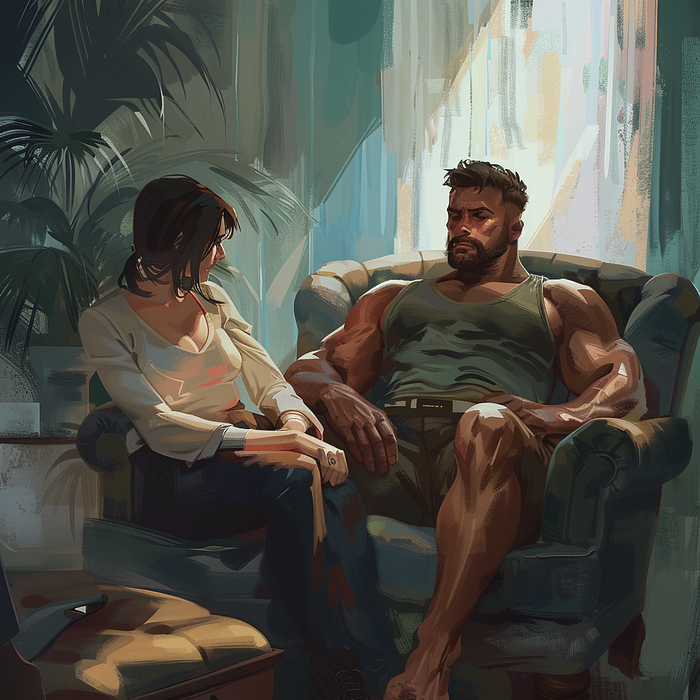
Me dismissing my therapist due to his total lack of physique.

Lately, YouTube has become stricter with accounts that use Adblock, preventing some videos from being played, or even slowing down performance. This happens sometimes even after you’ve disabled Adblock for a video and refreshed the screen, as for some reason Adblock will still default back to its ON setting.

It’s maddening, frustrating, and makes watching YouTube a painful process, as you’re forced to constantly reload videos. It’s a human rights violation as far as I’m concerned. Now I may end up having to subscribe to YouTube Premium, which is likely the ulterior intent of all this technical trip wiring.

In the meanwhile, I’m getting smacked around by tons of ads, including one for a therapy company called BetterHelp that really stuck out to me. It shows a young woman doing an amateur vlog-style video where she starts off saying, “I’ve been in therapy since I was six.”

I found this shocking and ridiculous. Why the hell would someone need to be in therapy at that young an age? I can barely remember when I was six. The only things I needed in life then were cartoons, frozen push-pops, my stuffed animals, hanging out with my friends and girlfriend (yes, I actually had one at that tender age and our first date was watching Pinocchio together at her house), and going to the video rental store to pick out a new movie every week. I don’t remember ever feeling the need to discuss my feelings with some v-sweatered stranger in a room with potted plants, and looking back on myself at that age as a mature adult, I’m glad I didn’t.

However, the young woman (whom I’ll call Therapy Lady) in the ad seems quite overjoyed to say she’s been in therapy for decades, and gives off a programmed happy vibe. She looks to be in her mid-twenties, probably college-educated, very conversant, almost certainly Westernized. White or possibly mixed, not that it matters. Likely from the middle-class. No visible handicaps or disabilities.

Therapy Lady doesn’t mention legit trauma, or some justifiable and/or understandable reason for why she’s been in counseling sessions since before smartphones existed. It’s not like she survived the Rwandan genocide as a little kid. She goes on to say how she’s always wanted to be “emotionally intelligent,” or something, because I guess that’s totally something a six-year-old would think. I was always telling my mom, whilst sipping my chocolate milk and reading the business section in the morning paper about how I wanted to be emotionally intelligent. I didn’t want to be like those other six-year-olds in the neighborhood, who were all uncivilized emotional ignoramuses. How embarrassing.

Me explaining to my therapist the subtle differences between “buff,” “ripped,” and jacked.”

What does “emotionally intelligent” even mean? It sounds like one of those stupid sciency buzz words that’s meant to come acrss as more sophisticated than it actually is. I take it to mean, “The ability to blather on about my feelings all the time,” given the enthusiasm with which Therapy Lady was mugging for the camera in her vlog.

(Sidenote: The “TikTok Face” and “TikTok Voice” trends need to die also. TikTok Face is when someone, usually an obnoxious female, but plenty of guys do this, too, bobs and weaves her face all over into the camera in a contrived and melodramatic way to make her points about whatever. TikTok Voice is when they use a spoiled brat tone so every statement sounds like a big deal. It makes me feel like I’m being talked to by a crazy person on the street as opposed to being calmly informed.)

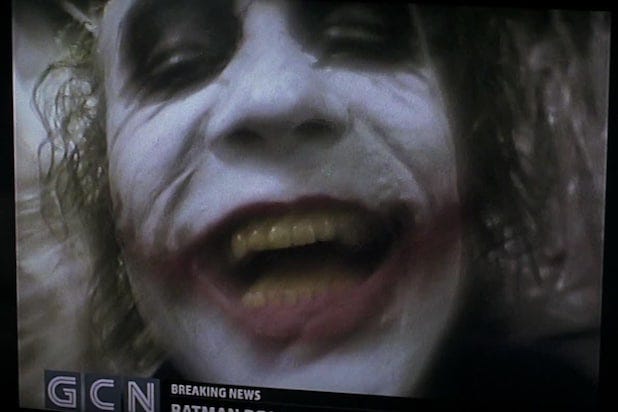
What TikTok chicks actually look like when they’re being “profound.” Source: The Dark Knight, Warner Bros. Pictures

When did therapy go mainstream? When did it become something people seem thrilled to admit they need? When did openly sharing one’s perceived mental health issues in public as though they were discussing the weather become the norm?

Years ago when I was in college we were doing introductions in class, and some young woman just started blabbing about her struggles with depression. Excuse me lady, but nobody cares. This isn’t a Thursday night group therapy session, it’s fucking Literary Analysis. Save your navel-gazing for the dorm room, please.

Looking back, Depression Chick was fat and always sipping on giant Starbucks milkshakes in class. She was loaded up on sugar and caffeine, out of shape, sedentary, and almost certainly glued to her smartphone all day. Gee, no wonder she was “depressed.” She didn’t need therapy. She needed to hit the gym and improve her diet.

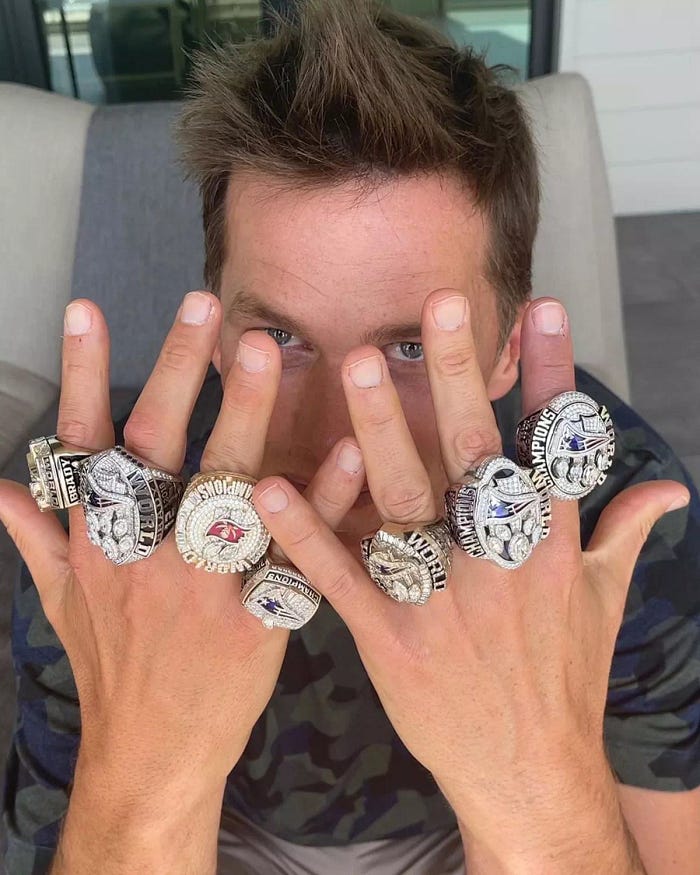
To make matters worse, Tom Brady partnered with BetterHelp for a promotion of one month of free therapy sessions for new customers. Brady says he’s been in therapy for 25 years, which would precede his time in the NFL.

Yeah, this guy clearly needs mental help. Source: Tom Brady’s Instagram.

Putting aside the fact that if a celebrity is touting something it’s almost always bullshit (I call this rule the Paltrow Constant), I just have to ask why in hell would someone like Tom Brady need to continue therapy for that long? I can see maybe using counseling at the early stages of his career, when he was just a fledgling athlete hoping for a shot at the draft and under all that pressure to perform. But why now still?

“Oh, God, I’ve won seven Super Bowls, made hundreds of millions, can date any supermodel I want, am in perfect health, am admired by millions, and am also extremely good looking, please someone help me!”

— Tom Brady (probably)

We’ll ignore the fact that Brady was probably paid north of $10 million for this promotional scheme, and ask this question: What exactly would someone like Brady need therapy for exactly? The guy is as close to being Superman as anyone could possibly get.

But let’s NOT ignore the elephant in the room. If you’ve been in therapy since you were a little kid like Therapy Lady, then clearly therapy is not working for you. That doesn’t even sound like therapy. It sounds like dependency. It sounds like you’re stuck in the subscription model of a business. Like Netflix. Only instead of shitty movies generated by an algorithm, you subscribe to a rent-a-friend who lets you verbally masturbate about your problems for a monthly fee. That’s not something to be proud of. That’s not something to make a TikTok video about praising yourself for doing. That’s like proudly announcing you have an STI. Not everything needs to be broadcast. Some things should be kept private.

On the surface therapy sounds like a positive trend. But I think it’s indicative of a decline in society. People may be more accessible due to social media and smartphones, but they are not truly connected. More and more people tend to have fewer and fewer friends and tend to live alone. Marriage rates have declined. Many families are atomized or broken due to divorce. People are having fewer children, who have them at all. More and more people are having to work more and more to make less and less. All the while the cost of living explodes higher everwhere. Less people are religious or live their life according to any meaningful doctrine outside of the “eat, sleep, consume media” cycle. Socialization is being substituted with screen time. On and on.

And while this observation is purely anecdotal, I couldn’t help but notice while browsing Better Help’s website of testimonials, that it seems to mainly be women who are all about this therapy thing. So it’s no suprise that Better Help recruited someone like Brady to be its spokesman. To give the impression that therapy is for guys, too, and that it’s not, you know, just for ladies to whine about their lives.

Therapy is clearly filling a void for some people. Therapy simulates what close friendships, religion, and the genuine connections of family used to freely provide. It’s become like a secular confessional.

But therapy has also become a social contagion, convincing otherwise normal people that they “need” it, with little reasoning other than nebulous terms like “emotional intelligence.” Or “trauma.” That’s another one. Everything and everyone has trauma these days.

Therapy may help some people. But it will always have an ick factor for me. If people have to remain in it for decades, how productive and useful can it really be? At a certain point a person has to accept that it’s up to them to deal with the world and fix themselves. You can’t outsource personal development. That can only come from within after overcoming struggle. What many people think they need therapy for is really just the natural process of maturity and aging. It’s just being an adult. It’s not supposed to be an easy or fun process. But that’s life.

“Why Don’t Men Attend Singles Events?”

Or, why speed dating blows.

Back in the late 2000s, early teens, when I cared about going to such things, I attended three speed dating events in Philadelphia.

I was in my late 20s, working full-time, lived in an apartment on my own, had my own (beater) car, and made a slightly below-average but above-median income for the time. I hadn’t finished college yet, having only around 72 credits towards a bachelor’s. I’m of mixed heritage, part White, part Hispanic. From the lower-middle class. Unremarkable looks. Thin, non-athletic. Six feet tall, though. I was just an average guy living in Philly.

Speed dating, if you’re unaware, is like playing Russian Roulette. But instead of a 1/6 chance you paint the walls with your brain matter, you have a near 100% chance of disappointment, frustration, awkwardness, some anger, relief when it’s over, maybe a few laughs, and a piercing sense of humiliation. And also dehydration.

I went through some outfit called Speed Dating Philly, which was/is I think a subsidiary of Speed Dating USA. I don’t know if they still operate.

Basically, you have a room filled with a bunch of guys and gals. The way Speed Dating Philly did it, the gals would sit in one spot, and the guys would get up and move. You’d get five minutes to talk to someone before moving onto the next. At the end of the night, you went home and filled out an anonymous survey filled with just the first names of each attendee. If you clicked on someone’s name and they clicked on yours, it was a match, and you’d get each other’s email addresses or phone numbers.

I went to three of these events over a two-year span or so. Enough to learn that speed dating blows. Lately, I’ve seen Tiktok videos reposted on YouTube of women bemoaning why men don’t attend singles events, and only women show up or guys who already have girlfriends.

So, I thought I’d share some brutally honest reasons from the perspective of a man about why men generally avoid these events. These are solely based on my experiences as a single average guy living in a major city.

1. It’s Not Fun. It’s a Pain in the Ass Just to Go and It Costs Money

At the time I went to these events, I wasn’t making much money. I worked from 4 PM to 12 AM Sunday through Thursdays. Speed Dating Philly only held events on Thursday nights, of course. Which meant if I wanted to go, I had to take the day off from work. I only had two weeks (ten days) of vacation a year.

The event organizer also charged around $40 to attend. I later found out that only the men paid. Women got to attend for free or at a severe discount if Speed Dating couldn’t fill enough slots (which they never could). That didn’t seem fair, but whatever. Chivalry and all.

These speed dating events were held downtown in the city, which meant I had to drive across town, and then look for a place to hide my scrap heap. Luckily, I was usually able to at least find free parking spots.

Thus far, I’m down one day off and out forty bucks, which was a lot to me then. But hey, that’s a small price to pay for the potential to find true love, right?

The events were always held in the cramped private upstairs room of some hot, stuffy bar, with loud music playing. Speed Dating Philly comped one free “drink.” I mean, it was liquid, yes, with a whole lot of ice, and hardly any flavor.

So, I’ve no sooner entered than I’m already sweating, dehydrated, can hardly hear anyone talk due to the shitty loud music playing, and having to crunch ice from my “drink” the whole night to keep my thirst at bay. Things that would make anyone annoyed and irritable. Not exactly a pleasant atmosphere for socializing.

2. The Boy/Girl Ratio is Out of Whack

I don’t know where some of these modern ladies are getting the idea that only women go to these singles events. Maybe that’s the case now. But back then, it was quite the opposite.

Speed Dating Philly tried to set up events with 15 men and 15 women in a similar age group. Well, there were ALWAYS 15 dudes there. But there were NEVER also 15 chicks. Often, there’d be just twelve. So, from the getgo the gender ratio is at a disadvantage for men.

From a customer perspective, I’m seeing this and getting even further annoyed, demoralized even. Granted, these kinds of public events are tricky to pull off. An equal number of women is not guaranteed. But I’ve paid money and taken the night off to come here. I at least want a shot at the maximum number of women possible.

It’s not a total dealbreaker, though. I’m here, so I might as well make the best of things. But mentally I’m already kind of checking out, and the night’s barely started. Not good.

3. Few if Any Viable Prospects

Okay, here’s where things get spicy. Sorry, not sorry.

After taking in the hot, sweaty, noisy ambiance, of course the next thing I do is scan the room to check out the potential partners who didn’t flake out. You know how in The Terminator when we see things from Arnold’s Terminator POV? It’s like that with the male gaze. I’m running calculations, checking odds, trying to determine realistic probabilities of an actual match.

Race, of course, plays a factor. These speed dating things were often White-dominant. But typically there’d be at least three, maybe four Black ladies. Let me be more specific. Black ladies from the city. Ladies whom for damn certain were not interested in a racially ambiguous guy like me, and whom I was likewise not interested in whatsoever. I’m not attracted to Black women in general, and in the case of these ladies from the city, there was also a clear difference in culture and background. In every five-minute chat session I had with them over the three events I attended, it was a waste of time for both sides. It is what it is.

As for others, there were maybe a few Asian or Hispanic women there once in a while. Maybe one woman who was mixed or biracial. Other than that, it was mostly White/Black.

Look, race matters in mate selection whether you agree or not. The majority of people marry within their own race. Something like 80% of White women marry White men. People can say whatever they want about being color-blind. But when it comes to making major life decisions — who they marry, where they live, where they work, and who they tend to freely associate with — they often stick with their own kind.

So, now we’re down to eight or nine potential prospects. Except, not really.

Typically, you could count on around 4–5 women at these events who knew each other, and were only there on a girl’s night out, and/or for their own amusement. You might have two besties yucking it up the whole time, and then a group of three being professionally ironic for the evening. Well, you could always write these fine ladies off, because they weren’t there to be serious. They were just there to pregame for a party.

So, what are we down to now on this awful reality show? Five prospects? That’s five remaining women that I now have to hope I find attractive, and for whom I’m potentially competing against fourteen other guys. We’re not quite in Hail Mary territory yet. But you know how in Super Bowl XLII, right after David Tyree caught the ball on his helmet, when he got the Giants on the Patriots’ 24-yard line and in position for the go-ahead score? That’s where we are now. The game’s not lost yet, but getting dangerously close.

With the five left, I could often count on at least one being a professional career woman with some advanced degree who was looking for her Mr. Big from Sex and the City. As I was not a doctor, lawyer, accountant, or some Ivy League grad with a hotshot job, I was not in her class.

That leaves four candidates left. Not matches, because remember I have to also find them attractive myself, and then hope they think likewise of me. These are just four in the maybe pile.

Well, now Plaxico Burress has scored and the Giants are up 17–14 with 35 seconds left. We are officially in Hail Mary territory.

4. Rudeness/Poor Attitudes

The last two reasons for why speed dating sucks have been centered around diminished numerical odds.

This reason has more to do with the sometimes poor, sarcastic, and rude attitudes many women had that I encountered. Some of these women were in the “not viable candidate” list anyway. Some were in the maybes, and so disqualified themselves on behavioral grounds.

For the most part, people were nice and polite at these things. But there was often this palpable awkward sense of sad resignation, resentment, and mild despair that I sensed from many of the women there. And if I’m being honest, from myself as well. A weird veil of hopelessness. An anxious sense that things went horribly wrong somewhere in life and that they should not be here. I can’t imagine these singles events are any less stressful for women than they are for men.

Then there were the rude and/or weird assholes. I had one lady who started complaining to me because some guy was there that she’d gone out with on a date before who’d ghosted her afterward. When it became clear I wasn’t going to serve as her temp therapist, she took her phone out and started texting while I was still sitting there. Disappointingly, she’d been in the maybe pile. Then there was the party girl who, between giggles with her bestie, asked me what my fetishes were.

Thankfully, the vast majority of my interactions at these events were forgettable. For the first two I clicked on a few names I liked in the follow-up survey. For the third and final, I clicked on all of them just as an experiment. I never got one match in any.

In short, speed dating, and singles events in general, hold no real advantage over any other form of “throw everything against the wall and see what sticks” style mate seeking. It’s no better than using dating apps, or going to a bar. So why bother paying extra or going out of your way for some “special” event, when there is no real statistical upside? Men are (at least they try to be) logical creatures. I suspect many men share my experiences, and so they’ve determined it’s just not worth their time or effort.

Speaking to the business model of speed dating, however, it’s just short the border of a scam or grift. You pay good money to get shafted with fewer women than advertised, in a crappy bar, with a piss poor free “drink,” music blasting, in front of a meager few candidates who look like they’d sooner step on your face than talk to you. Yeah, that sounds like a great evening.

Final Thoughts

I don’t think ALL singles events are a waste of time. Speed dating is a very specific kind of singles activity, and my experiences are limited to the mere three I attended. That’s not a large sample size, for sure.

However, I don’t think these types of contrived social situations are ideal if you’re looking for a potential mate. You should try to be in a relaxed, enjoyable, and healthy atmosphere. Some hot, stuffy bar with loud music, crammed in with 25 or so people is not that.

This is why college is often the best place for meeting someone. You’re around your peers and age group, you naturally group together based on common interests, and there is a diverse and ample variety of potential partners. Especially at big universities. Churches are also good, although hardly anyone goes to church anymore.

After that, the list of good meet market places starts to drop off pretty hard. The workplace? Hmmm, risky with today’s HR. Dating apps? If you’re a masochist. Grocery stores? Get real. Bars and nightclubs? Maybe if you’re a fuckboy (which I’m not).

I’m not even against going to singles events in the future, if solely for the entertainment value.

My experiences were not a total loss, either. They (and many others) were part of what inspired me to write my novel The Lek, a dystopian-set thriller set in a world where men have to compete for women in a deadly tournament. It’s a satirical X-Rated Hunger Games. Check it out.

But here’s another cold hard truth about why men don’t go to these things, and I suspect likely why many women don’t go either. If you’re at a singles event, especially post age 25, then most likely you missed your best chance to meet someone and find love. It probably wasn’t your fault. That’s just how it went. But you’re leftovers. You’re the weird-looking piece of chicken on the buffet no one wanted to eat. You’re not high value, because if you were, you wouldn’t be there. You know it. Everyone knows it. And everyone’s sour about it, even if unconciously. That kind of poisons the air. Who the hell wants to breath that in for two hours?

I Participated in the Reddit IPO. Here’s How I Did

Did my investment get an upvote?

Source: The Reddit logo: https://www.redditinc.com/brand

Let’s face it, virtually every website nowdadays amounts to a doom scrolling time suck meant to extract your soul one qubit at a time.

(Qubit is a “basic unit of information” in quantum computing. You’re very welcome for a great Scrabble world.)

Of course, I know about random trivia things like quantum computing because I am an avid Redditor, and therefore am very smart.

Actually, that’s what Reddit should have called itself — “random trivia things.” What is a “Reddit” anyway? And why is an alien involved somehow? I’ve never been able to figure that out.

But speaking of quantum computers, I’d need one to calculate how many hours I’ve wasted on that website over the years. If you were to rank sites according to their “time suckage,” Reddit would have to be up there pretty high, right behind InstaGlam, Musk’s Madhouse (aka X aka Twitter), and Zuckerberg’s Personal Data Clearinghouse (aka Facebook aka Meta).

Midjourney’s awful take on the Reddit logo.

So, when I suddenly received an email one day from Reddit telling me that I, as a member, had the unique opportunity to participate in the site’s upcoming IPO, I of course jumped at the chance. Finally, a shot to claim some compensation for all the years I’ve blown on such subreddits as r/interestingasfuck, r/wallstreetbets, and r/explainlikeimfive. I’ve been on Reddit since the old days, when it was the nerdier Digg alternative, back in the late 2000s.

This was exciting.

What, you mean I get to buy a stock BEFORE the dirty unwashed masses do? I get to be an insider? I get to be treated like the elite intellectual artistocrat I am thanks to your website’s guidance? Sign me up, Reddit. It’s about time my contributions were richly rewarded.

Screenshot of my IPO offer from Reddit.

Feeling like Warren Buffet, I took the first step. I won’t bore you with all the details about IPOs and the DSPs or the RMBs (that stands for Redditors Making Bank). But there were a few steps I had to follow after winning the golden ticket.

First, I had to pre-register for the IPO with Reddit by the March 5th deadline, and then wait to see if I was confirmed as a participant. As if I wouldn’t be. I expected to receive my confirmation in the form of a telegram or a gilded letter delivered by an owl at my window. Instead, on March 11th I received just a simple email stating that I was confirmed.

Screenshot of my confrmation letter rom Reddit.

Next, I had to set up a separate brokerage account just for the IPO. I’ve been with Morgan Stanley/E-trade for almost ten years now so this was an easy process. After getting a new account going, Morgan Stanley emailed asking me to confirm my order and deposit the necessary funds. Again, just an email. No complementary top hat or secret invite to an Eyes Wide Shut sex party in Bohemian Grove. So much for feeling like an elite.

Screenshot of my confirmation letter.

$34.00 seemed cheap but reasonable. Facebook debuted at $38. Uber at $45. Tesla started at $17. I generally only invest in index funds or ETFs like SPY, VTI, VOO, and QQQ, so I was used to stocks costing in the hundreds. Generally, for my individual brokerage account, I deposit $1000+ into my investments at a time. But this was an exciting albeit risky tech IPO based on a website famous mainly for fostering neckbeard outrage and degenerate Wall Street gambling. I decided to buy just 10 shares, and put in $350 to ensure the whole cost was covered should there be some small additional fee.

So, how’d I do? Right after Reddit launched on the NYSE on March 21 the stock nearly doubled to about $65 a share. It dipped to around $39 in mid-April before rising back up to $62 just last week. And as of now, at close on May 24th, 2024, it’s $54.72.

When Reddit’s stock (RDDT) hit around $56 earlier this week I sold five shares for about $280. The reason for that was I wanted to pull out nearly my initial investment ($340). That way going forward what I have left at stake is almost all profit. If Reddit continues to move up, I capture the upside. If it crashes down and ends up floundering, at least I’ll have just about broken even and not really lost anything.

In summary, participating in Reddit’s IPO was a fun and thus far profitable experience. Do I wish I had invested more into the IPO? In retrospect, of course. Dropping $10k in there would have put me up almost $16,000 before selling half my shares. But a big part of investing is risk mitigation, not just seeking out a high return. Reddit’s IPO could have been a big fat flop to start off. And who’s to say Reddit won’t get downvoted by investors eventually?

I don’t know how long I’ll hold onto my five remaining shares. Facebook went up 5x in the first six years after its IPO. It’s now up 12x. But then Uber is barely up 50% from its IPO price in 2019. You’d have done better just holding the S&P 500 than Uber over that same time span. Will Reddit even still be popular in ten years? That’s difficult to say. The internet is a fickle place. I know I’ll (probably) still be there.

What the Hell is Suze Orman Smoking?

Two million dollars is “pennies” according to the finance guru.

“Suze Orman.” Created by author with Midjourney.

Did you know you need anywhere from $5 million to $10 million to comfortably retire early? That’s according to Suze Orman, who spoke on the “Afford Anything” podcast.

She goes on to say:

“If you have $20 [million], $40 [million], $50 [million] or $100 million, be like me, okay. If you have that kind of money and you want to retire, fine.”

To which I have to politely ask of the lady with the ultimate “Can I speak to the manager?” haircut, what the hell is she smoking?

$20 million to retire early???

Are we retiring in a downtown Manhattan loft with a personal limo chauffeur service and a live-in butler named Yeevis? Are we settling down for the golden years in a gated mansion in Beverly Hills, with a private helicopter pad to avoid downtown rush hour traffic?

You have to be in the top 1% of wealth to buy a cheap condo in Tampa, FL and play shuffleboard in a pair of loafers? What kind of unexpected expenses might a senior citizen run into that they’d NEED $20 million plus for? A full T-Rex skeleton that’s suddenly become available on the black market? A Blue Origin trip to the moon? A cybernetic sex robot? A 24K gold toilet?

“A retirement necessity.” Made with Midjourney by the author.

Statistically, the bottom 99% cannot achieve $10 million or more by retirement. So Orman is basically saying to work until you die.

My issue here is not about working hard to become wealthy. Nor is this about hating the rich. I’m all about grinding to become Mr. Monopoly.

What I’m not about though is what I’d call toxic wealth accumulation due to uncertainty paranoia. A mindset rooted in chronic anxiety. Making money and building wealth should be an empowering process. Not one you do out of fear the sky is going to fall on you if you don’t have “enough.”

Interestingly, some in the finance community agree with Orman. The Yahoo Finance articles states:

This idea resonates with a segment of the financial community that sees the wisdom in ensuring a substantial financial buffer to address uncertainties in retirement, especially given potential long-term trends such as increasing health care costs and ongoing economic fluctuations.

I get it. Twenty-plus years of retirement is a long time. Anything could happen. A civil war. Meteor strike. Or just a good old-fashioned $58,000 heart surgery.

But how much calamity can one reasonably prepare for that justifies sacrificing your entire life working? Wealthy Cubans were turned into paupers overnight when Castro took over the country. All of John Jacob Astor IV’s millions couldn’t save him from the sinking on the Titanic.

Say you do get to $10 million or $20 million by the time you’re 85, and you’re finally ready for an Orman-approved retirement. So what? You’re fucking old. How much life do you even have left? What are you going to do then, climb Mount Everest? Yeah, right. You’re going to sit at home, watch TV, and bitch about politics like everyone else. You know how much that costs to do? Well, NOT $10 million, that’s for sure.

These kinds of click-baity pronouncements by Orman and others are meant to be “helpful.” Except they really come across more like hyperbolic sales talk from people trying to sell a pyramid scheme.

I’m all about chasing the money dragon to a reasonable extent. If you’re someone with a worthwhile career that’s put you on the path to the top percentile, great. CEO, Instagram influencer, entrepreneur, elite assassin, by all means keep riding that carousel. But if you’re like most, and slaving away at Dipshit, Inc., dont think you’ve got work till you drop just because Suze “Karen Hair” Orman says so. Go live your life.