I Recently Canceled Netflix, and I Don’t Miss It

Selectivity over saturation is the future.

Source: Made by the author in Midjouney

I’m no longer chilling with Netflix.

Up until last month I’d had an account for almost 15 years, starting with the DVD by mail thing that made the company famous. Giving it up was hard, even though I barely watched it anymore.

I found that increasingly there was less and less stuff on there that appealed to me. The tenth season of Stranger Things? GTFO. How old are those “kids” now anyway, like 30? Good lord, will they just get fucking eaten by a monster already and be done with it?

Netflix had its moments. Back in the day, I enjoyed Orange is the New Black. A show not exactly made for me, but one I looked forward to every year. But even then it became clear that the streaming model was built not on worthwhile storytelling, but on filling up space with “content” meant mainly to mildly appeal to different audiences. But it “appeals” only in the sense of a corny corporate joke that you laugh at out of politeness, not enjoyment.

The last straw might have been Rebel Moon, which is like the quintessential douchebag dudebro film, making 300 look like a Ken Burns documentary by comparison. Zack Snyder’s cringy Star Wars ripoff, following his 2021 Aliens ripoff Army of the Dead. Who the fuck thought that film merited a two-part release? What algo called for that? And for what audience? Lobotomy patients? Was it made for headless torsos stored in a medical school morgue waiting to be dissected? Or maybe Rebel Moon wasn’t even made for humans. Maybe it was actually meant for AI bots roaming the dead internet, to placate them from wiping out humanity.

I’m so done with some computer algo dictating how and when I watch something. Here are words that come to mind that describe what it feels like getting puppet stringed by some Silicon Valley dork’s coding: Unnatural, weird, uncomfortable, disappointing, unsettling, uncanny, unsatisfying, creepy, skeevy, and just plain wrong.

“Attention by algorithm” is such a strange thing. Letting some impersonal random code feed you “content” (hate that word) on some digital liminal space just feels bizarre. Dystopian, almost.

It’s not even how I’ve found some of the best movies I’ve watched over the years. Recently I discovered two solid thrillers, Eden Lake and Triangle, from reading posts of people I follow on X. That’s also how I found the trailers for the upcoming horror flicks Cuckoo and Longlegs, two releases I’m looking forward to seeing this year. X is where I first heard about Late Night with the Devil and last year’s Talk to Me.

I follow filmmakers I like, such as Sean Baker, and usually get the latest trailers or updates directly from the source when they post them.

I kept hearing positive things about Das Boot and Master and Commander: The Far Side of the World on Reddit before finally checking them out years ago.

It was coming across all the “Think, Mark!’ memes everywhere that got me into my new favorite show, Invincible.

Source: Invincible TV Show https://knowyourmeme.com/memes/think-mark

There have been exceptions. Netflix spotlighted Dragged Across Concrete last year. A great, gruesome little thriller starring Mel Gibson and Vince Vaughn as crooked cops trying to procure some ill-gotten gold. I would probably have never discovered that one had it not gone to the streaming afterlife. 

But for every Concrete or Spectral there’s a whole mess of uncanny valley-esque stuff that doesn’t even look like it was made for humans or by humans. Stuff like I Care A Lot or The Perfection. Or just unwatchable garbage in general, like Adam Sandler’s Netflix deal “comedies.”

Nearly every great movie I’ve ever seen I had reccomended to me from a friend or family member, or I sat down to watch it with them. In the past you might have stumbled across something on cable. But those days are mainly gone, replaced by whatever Netflix feels like throwing at you.

Lately, I’ve become a lot more selective about what I watch. It could be from getting older and becoming more conscious of the trickling sands in the hourglass. Maybe it’s due to getting tired of the endless inundation of “content” from the streaming factories. Or maybe the high junk-to-jewel ratio the streamers keep spitting out has just made it not worthwhile to sift through the silt.

Entertainment should feel more sociable, organic, and communal. Not programmable. It should feel like a fun process of discovery, not like having your head dunked in a bargain bin DVD pile at Wal-Mart.

Will James Patterson Be Remembered in 50 Years?

Or will his ghost writer cartel keep his name on the bestsellers lists until the sun explodes?

“James Patterson.” Made by the author with MidJourney.

If you’ve somehow never heard of prolific best-selling author James Patterson, head on down to your local library and just look for the Patterson Section. It’ll usually be its own wing, maybe a garage, or even a seperate building altogether.

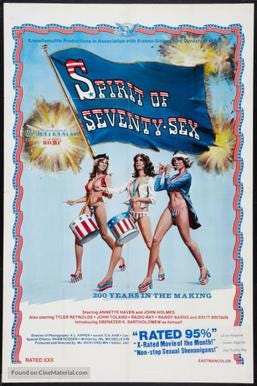
My local library used to be a video store, and they actually keep all of Patterson’s books back in what was once the adult video section. Complete with privacy curtain and sticky carpet. I always forget when I visit in my trench coat and sunglasses that this is no longer the place where I can rent my well-used copy of Spirit of Seventy Sex, but instead a respectable section offering cheap and sometimes titillating disposable literary entertainment. Certainly not porn.

‘Spirit of Seventy Sex.’ A ’70s classic. Source: https://en.wikipedia.org/wiki/Spirit_of_Seventy_Sex

In the Patterson Section you’ll find sophisticated, thought-provoking titles. Titles like Cat & Mouse, Jack & Jill, Pop Goes the Weasel, Roses are Red, Violets are Blue, Four Blind MiceMary Mary, and Rock-A-Bye Baby. Okay I made the last one up, but basically think of any nursery rhyme you can and it’s likely Patterson’s written a door-stop-sized thriller with it as the title. And that’s just in the Alex Cross series. That is Alex Cross, the cool black detective who bangs hot white women, written by Patterson, a white dude born during the Truman administration. They say to write what you know, but I guess there are exceptions.

The Alex Cross series also has numerous and very clever “cross”-themed titles. Such as Double Cross, Cross Country, I, Alex Cross, Cross Fire, Cross My Heart, Deadly Cross, and Triple Cross. Man that detective has some bad luck. He’s getting double-crossed AND triple-crossed. At least he has all those hot white women to compensate.

Source: 5 Black guys 1 blonde meme generator: https://imgflip.com/memegenerator/201802640/5-Black-guys-1-blonde

Patterson has a veritable smorgasbord of literature beyond the Alex Cross series. So much that it’s practically impossible to keep track of it all. He’s got The Women’s Murder Club, Maximum Ride, The Shadow Thrillers, NYPD Red, and a mess of standalone thrillers. His most famous work is Along Came a Spider, the 1993 bestseller made into the 2001 film starring Morgan Freeman and some lady who looks like Sharon Stone if you squint hard enough.

Along Came a Spider is actually a decent book, though it pales in comparison to what was obviously its inspiration — The Silence of the Lambs, the classic 1988 thriller by Thomas Harris. That and probably Basic Instinct (1992). I read Spider years ago when I suddenly became vexed by the question of when exactly James Patterson threw in the towel on being a real author and decided instead to become the book factory equivalent of Sysco, pumping out infantile titles with fill-in-the-blank plots and characters plucked out of ’80s soap operas. I gave up trying to find out, but I think it was somewhere between Kiss the Girls (2000) and Double Cross (2007).

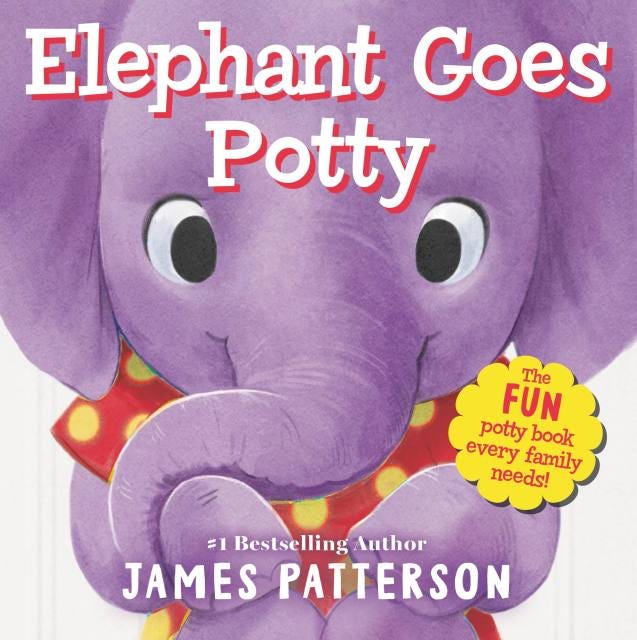
James Patterson is, of course, known for more than just his obsession with killing the Amazon rainforest to print his books. He’s famous for, or perhaps infamous for, his massive cartel of co-authors and ghostwriters. Not to mention his diverse breadth of literature. The man will literally write about anything. He’s got a book he just released in March, 2023 titled Elephant Goes Potty, which “captures the struggle — and delight! — of potty training.”

Elephant Goes Potty aside, nowadays it’s rare you ever see a title on the shelves with only his name on the cover. He’s teamed up with former president Bill Clinton to write not one, but two political thrillers. The President’s Daughter and The President is Missing. Also look for The Blue Dress Caper coming this fall, though I hear the plot for that one blows.

He’s written a book called Run, Rose, Run with Dolly Parton. Not to be confused with Rose Madder, by Stephen King, or Rabbit, Run, by John Updike. or Run Lola Run, the 1998 German film about some chick with red hair.

This June Patterson’s got a book coming out called Eruption, which he co-wrote with Michael Crichton. Which is amazing considering the Jurassic Park author died in 2008. But why stop there? Why doesn’t Patterson team up with H.P. Lovecraft next? Maybe write a title like Cthulu Joins Black Lives Matter. Or maybe a self-help motivational book with Ernest Hemingway, Life is Worth Living. Or maybe a fun family adventure about siblings with George Orwell. Big Brother and I, or something. The possibilities for collabs are endless.

There’s no question James Patterson knows how to pump out content. I don’t begrudge the man for having the same fevered enthusiasm for writing as a pervert lurking outside a sorority house and whacking it in the bushes. I don’t care that the guy writes like A.I. before A.I. writing was a thing. Good for him.

I do wonder, though, that for all his output, if he’ll be remembered in 50 years in the same manner as Charles Dickens, Ernest Hemingway, or F. Scott Fitzgerald. You may chuckle at such comparisons, but Dickens was dismissed in his day for churning out simplistic melodramas. Most commerically successful authors are looked at askew by the literary etablishment. And what about contemporaries of Patterson’s like Stephen King or J.K. Rowling? Both locks, I’d say, for standing the test of time. Patterson may have built an empire out of the literary equivalent of hot air, but will anything that he’s done be worth revisiting in half a century? Will his mountain of books add up to a molehill of memory?

Patterson’s prolificacy also brings up the age old struggle many artists have over quality versus quantity. Thomas Harris has only written six novels, but he’ll always be remembered for introducing the world to Dr. Hannibal “The Cannibal” Lecter. Ira Levin wrote only a handful of books mainly before middle-age, but he introduced the term “The Stepford Wife,” and Rosemary’s Baby will probably always be a timeless classic. Patterson has done nothing close to that. Will anyone be thinking about Alex Cross in even ten years?

Perhaps it doesn’t matter. Patterson is reviving Crichton himself, who died over 15 years ago. Perhaps someone else will come along and “co-write” a book with Patterson in 50 years, reintroducing him to future masses. Maybe the New York Times Bestseller’s List of 2074 will bear the illustrious title of Elephant Goes Potty, Again. One can only wish.

This Chart Taught Me Some Mindblowing Lessons About Wealth

Stocks and mutual funds won’t make you rich. Starting your own business will.

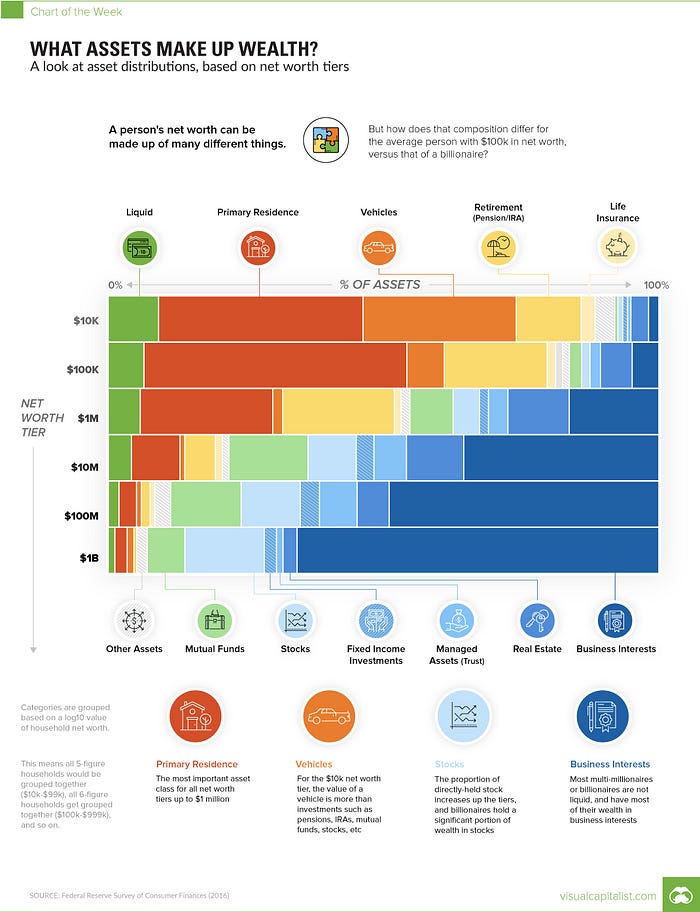
Source: https://www.visualcapitalist.com/chart-assets-make-wealth/

So, I discovered this chart by a post from James Camp, a guy I follow on X, who specializes in “nanoflips.” Check out his bio for info on those.

The graph comes from Visual Capitalist, a clever website that takes complex information and distills it into to easy to understand (and colorful) charts.

The chart displayed above is based on a Federal Reserve Survey of Consumer Finances from 2016, and it contains some illuminating aspects about how people in different net worth tiers manage their wealth.

Like many, I’ve always been under the impression that stocks and mutual funds are the best ways to build and maintain wealth for the average person. Over the last few years, I’ve diligently maxed out my 401(k) and IRA funds. I contribute regularly into a personal brokerage account. Even through the Covid Crash and the 2022 drawdown, I kept plugging away, dollar-cost averaging into the market like you “should.”

The returns have been solid, for sure. While I’m not close to retirement anytime soon, I’ve built up a decent net worth. I like to think I’ve “secured the bag.” Meaning that even if I never contributied another dime to my investment accounts from now until age 65, compound growth alone would get me to a comfortable retirement. And that’s NOT taking into account potential Social Security payments.

I say “potential” because who knows if Social Security will exist by then, or pay out what it’s supposed to. It’s never a good idea to bank your life on a government program, especially when the government is over 30 trillion dollars in debt.

However, the above chart has made me completely reevaluate my relationship with invesing and money in general.

Source: https://unsplash.com/photos/woman-in-gray-shirt-holding-fan-of-us-dollar-bills-OyDZRZOlENw

For starters, the chart shows that the higher a person’s net worth the more they have invested in “business interests.” These are businesses someone owns personally. They could be anything from a franchise, a laundromat, a service company, all the way up to a controlling stake in a Fortune 500 company.

Elon Musk has a 20.5% stake in Tesla, for example.

What’s surprising, however, is how little percentage-wise wealthy people are invested in stocks and mutual funds relative to their net worth. The chart combines net worths together and works out an average. So in the row where it says $10K, it’s grouping all the people with $10K through $100K together. Then in the $100K row, it’s everyone with a net worth between $100K and a million. So on and so forth.

People in the $1 million to $10 million range look to have close to 40% of their net worth in retirement accounts, stocks, and mutual funds. This makes sense give that most people in that range are retirees who spent years contributing to company 401(k) plans, pensions, and their own IRAs. About 30% of their net worth is in their primary residence.

However, going further up in net worth on the chart shows that the wealthy have increasingly less in stocks and personal homes, and vastly more locked up in their own businesses.

For those in the $10M+ group, stocks are no more than about 30% of their net worth, and their personal homes aren’t even 15%. Their wealth is mainly all in their own businesses.

This may seem obvious. But almost everywhere you turn, you only ever hear about the importance of investing in a diversified portfolio of mutual funds and ETFs.

Dave Ramsey touts mutual funds like a religion to his millions of listeners.

But are index funds and mutual funds really the best ways to build wealth?

If you were to ask most people how they think they can get rich through investing, most would probably say by getting lucky on a stock or cryptocurrency.

This is not impossible, of course. A mere $10K in Apple stock 20 years ago would be worth almost $5 million today. Buying Bitcoin or Ethereum just five years ago would have given you substantial returns.

People may remember the “meme stock” craze from just a few years ago with Gamestop and AMC. The whole internet was gripped with trying to ride the next big thing “to the moon.”

Let’s not even talk about the NFT nonsense.

Point is, everyone thinks stock investing = getting rich, except people who actually are rich. They know stocks and mutual funds won’t make you rich. They can make you financially secure. But if you want to become truly wealthy, you’re best bet is by starting your own business.

Think about it. Stock picking is unreliable unless you know what you’re doing. If you decide on the safer, diversified route of index funds, ETFs, or mutual funds, it could take decades to build anything substantial. It’s also highly unlikely you’ll break into the top 1%.

To get to $5 million, for example, you’d have to invest $18,000 a year every year for 40 years at an average annual return of 8%.

Wait, only $18,000 a year? That doesn’t sound too bad.

Well, according to the National Board of Labor Statistics as reported by USA Today, the average salary in the United States in Q4 of 2023 was less than $60,000. So, the typical person would have to stock away almost 1/3 of their income for basically their entire working life to get to that $5 million. That’s a pretty tall order considering they still have taxes and bills to pay.

This information may sound sobering, or even despairing. Especially to 401(k) and IRA maxers like myself, stock market junkies, or those in the FIRE (Financial Independence Retire Early) camp.

It’s important to keep some perspective. A $1 million net worth is still a lot more than most people will ever have. I’d argue you probably don’t even need half of that to retire, provided you manage your money well and are prepared to live modestly. And those are certainly attainable amounts for those who prefer the more traditional route of diversified index fund investing. Investing $3600 a year over 40 years at 8% gets you to a million.

But why cap your financial potential with just mutual funds?

What I’ve taken from this chart is that to become wealthy you’ve got to get creative and entrepreneurial. While I’m going to keep investing in stocks and my retirement accounts, of course, moving forward, I’d like to start thinking beyond them. I’m going to start allocating some of my income toward experimentation with businesses. This will prove a tough adjustment for me, as someone who’s never had his own business or been much of a risk taker. No doubt there will be some failures and surprises along the way. But I think it will be good mindset shift in the end, and hopefully a lucrative one, too.

Angry Single Man Rejected by ‘30 Million Women’ Goes on Shooting Rampage, Killing Three

Remembering the 2009 Bridgeville LA Fitness shooting committed by George Alfred Sodini.

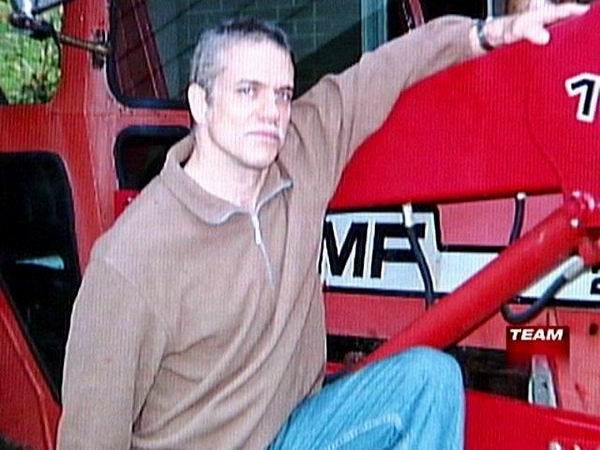
Sodini. Source: https://murderpedia.org/male.S/s/sodini-george-photos.htm

It’s awful to say, but there have been so many shootings over the last twenty-some years that it’s hard to keep track of them. They all seem to sadly blend together into one tragic ongoing blur.

There have been what I’d call “milestone shootings,” at least to me. Ones that really stand out. The Columbine High School Massacre on April 20, 1999, is the most memorable, and arguably one of the most impactful. I was in high school myself at the time, so naturally it hit home. In fact, earlier that year, a friend of mine had brought in his bow and arrows (minus the arrow heads) for a class presentation where we had to talk about our hobbies. Something he likely would have been arrested for doing just a few weeks later.

Then there’s the 2009 Collier Township shooting that took place at a Pittsburgh-area LA Fitness. Committed by lone nutjob George Sodini, who shot up a workout class filled with mainly middle-aged women, shooting nine, killing three, before putting a bullet in his head.

I remember this shooting particularly because of Sodini’s bizarre and disturbing online ramblings about his frustrations with women as the apparent source of his rage that led to his murderous actions. Here’s what he said in his blog from a December 24, 2008 posting, as sourced by ABC News:

Moving into Christmas again. No girlfriend since 1984, last Christmas with Pam was in 1983. Who knows why. I am not ugly or too weird. No sex since July 1990 either (I was 29). No — — ! Over eighteen years ago. And did it maybe only 50–75 times in my life.

Later on December 29th, he writes:

I actually look good. I dress good, am clean-shaven, bathe, touch of cologne — yet 30 million women rejected me — over an 18 or 25-year period. That is how I see it. Thirty million is my rough guesstimate of how many desirable single women there are. A man needs a woman for confidence.

At the time, Sodini was a systems analyst working at a law firm, with a net worth of about $225,000. An amount which in today’s dollars would be around $325,000. He had a lot of spare time to travel. He mentions in his blog about taking a trip to Los Angeles, and having several weeks off a year. He had by all accounts a successful career and a decent amount of money for his age (48). He lived in a densely populated area. This was a year after the 2008 Wall Street crash, when the tech industry was beginning its parabolic growth trajectory that would see companies like Apple reach trillion dollar valuations. He was in a high-end sector with lots of opportunities for meeting people.

Made with Midjourney by the author.

So why all the questionable failures with women? Why the isolation and loneliness? How could a guy go almost 25 years without a girlfriend? Almost twenty years without sex? I remember being equally disturbed and perplexed by this case. And thinking to myself, had this guy never heard of the brothels in Nevada? Had he not heard of escorts? Or places like Bangkok or Amsterdam? For a guy who’s hard up there’s all kinds of ways of finding release. Sex is easy to find. It’s love and quality relationships that are the needles in a haystack. For a guy with money like him there’s always sugar daddying, too. And there’s the traditional routes for meeting people. Churches and bars.

Of course, being married or in a long-term cohabitation doesn’t equal having a good relationship. Most marriages are teetering on collapse, while half ultimately do. Divorce court is filled with the bitter ends of what might have started as a fairy tale. Only the rarest couples seem destined for each other and stick it out for a lifetime. And good for them. The dark reality is the majority of relationships are business decisions with an unknown ticking clock until the unraveling.

I remember this shooting later being used as one of the first examples of “incel” rage and violence. Retroactively used as some kind of harbinger that was to come. A precurser to the much-needed “reckoning” during #MeToo, and the growing chasm between men and women seen now during this Red Pill phase. But is it really? As tempting as it is to accept the incel angle, I’ve never really bought it. A guy might go crazy and go on a rampage over being rejected by a particular woman, sure. Especially if it’s to a hated rival. People have done all kinds of insane things over jealousy. But to go on a rampage over not being married or accepted by women in general just seems a stretch. Especially in recent times, with marriage itself increasingly falling out of favor. This guy was not some knight in the Middle Ages owed a fair maiden for slaying a dragon. He was a computer dude in 2009, a time when you could ring up a blowjob for $150 off Backpage.com.

Sodini adds this in another entry dated December 31, 2008:

My dad never (not once) talked to me or asked about my life’s details and tell me what he knew. He was just a useless sperm doner. Don’t know why, find it fun talking to young kids when I visit someone.

As someone who did not have the opportunity to know his real father while growing up, I can understand the frustration, the anger, the sense of loss, and the humiliation. It’s very demoralizing, and can lead to a catastrophic loss of personal confidence and sense of identity during crucial developmental years. I don’t think modern society really gets that. I think society views men as interchangeable cogs. Widgets without feeling that need to be inserted into place to keep the machinery going. Cannon fodder. It’s even worse the farther down you go on the socioeconomic scale. Most people don’t even realize that most mass shootings take place in the inner city, and are committed by black teens shooting other black teens. Mass shootings committed by white gunmen, while obviously tragic, are actually rare, statistically speaking.

Is that to say that if Sodini had had a better relationship with daddy he would not have turned psycho and brutally gunned down three innocent women? I don’t think it’s that simple. But Sodini was certainly someone who felt disconnected and estranged from society. Caught in a feedback loop of negativity and failure with relationships. Lacking guidance. Point is, Sodini was likely damaged goods from youth, who was set adrift on a river of loneliness and never changed course. For most people they try different things until something swings their way. They try speed dating, hit the dating app lottery, go overseas, or give up altogether on love and just start a hobby or get a pet. They don’t kill. But then for some the frustration builds up with interest over a lifetime, until something snaps. And they do kill.

The LA Fitness shooting is a haunting one because on the surface it feels like Sodini had options. He had good money, a decent job, was physically fit, and seemed self-aware enough to understand his needs. But Sodini felt entitled to a life he did not have, and felt he never could. Who goes around thinking “30 million women” rejected them? That’s a hell of a lot of baggage to be carrying on your shoulders. It’s also ridiculous. Everyone has admirers. Even the Elephant Man.

But ultimately, Sodini hated women, and he hated himself. And unfortunately, there’s not really a cure for that kind of sickness and self-loathing.

Lowering the Drunk Driving Limit to 0.05 Percent is Unreasonable and Insane

It should be 0.00 percent. Anyone who disagrees is a potential homocidal maniac whose driver’s license should be permanently revoked.

Your average drunk driver. Made with Midjourney by the author.

According to Newsweek, the Hawaii state senate has just passed a bill that would lower the legal blood alcohol limit from 0.08 percent to 0.05 percent. The bill now moves to the state’s lower house for consideration.

Meanwhile, there’s a similar bill in committee in Washington State. Utah lowered the limit back in 2018, and remains the only state having done so. If the Hawaii and Washington bills pass, it could become a trend that spreads to other states.

To which I have to ask: Won’t someone please think of the poor drunk drivers?

Have Hawaii, Washington, and especially Utah no compassion? What are their state troopers called, the No Fun Police?

Do we need to hold a telethon for our inebriated driving brethren?

“For less than the price of one pint of Guinness, you can help these poor souls get intoxicated and behind the wheel of a giant automobile.”

Imagine if these bills were to pass. There’d be hardly any wiggle room whatsoever for those planning on “just having a few drinks” and then jetting down the road at 100 M.P.H.

Where is the humanity, I ask?

Look, it’s not like you need to be totally focused while controlling a 2,000 pound machine whizzing across the highway. People have shown that they are fully capable of checking their smart phones, jamming to tunes, arguing with a partner, being sleep-deprived, and eating and drinking, all while operating their vehicles, with no problems whatsoever. What’s a few martinis at lunch? You say that’s distracted driving. No, that’s multitasking, baby. We live in a hip new world where humans have adapted to splitting their attention toward fifty different things at the same time.

At best, driving is something you really only need to be paying attention to, oh, maybe 30% of the time. Have you even driven a newer Tesla? They practically drive themselves anyway. If anything, that’s an excuse to increase the blood alcohol content level.

Years ago, I had to go to traffic court in a little town called Gloucester City in New Jersey for a speeding ticket. Gloucester City, those not in the know, sits right by the Walt Whitman Bridge, which spans over the Delaware River from NJ into Philadelphia. The speed limit on the Walt Whitman is 45 M.P.H. Except NOBODY ever goes 45 M.P.H. More like anywhere from 55–75 M.P.H. Which means the Walt Whitman Bridge is a nice income generator for Gloucester City, as police pull people over all the time and hand them huge tickets. Mine was just under $300 for going 20 over. It’s basically a giant speed trap for the shitty little town of Gloucester City.

Anyway, putting aside my opinions of Gloucester City’s revenue collection schemes, while standing in line at traffic court so I could ask them to drop the points from my license, I got to witness a master beat the pants off some yuppie doofus wearing dress suspenders like Paul Allen from American Psycho. “Paul Allen’s” crime? Driving under the influence. Suspender Boy lost his license for a year, and got hit with a $10,000 fine, all while having to suffer the indignity of pleading his case in front of a hundred spectators. Afterward, I saw him standing outside the courthouse waiting for the bus, sleeves rolled up, smoking a cigarette, gel-soaked hair swept to one side. Paul Allen may have been some big shot business dude (he worked in sales, is all I remember him saying), but he’d be taking public trans for at least a year. It almost made me feel better about driving the shitbox I had at the time — a 1990 Toyota Corolla. Hey, at least I didn’t have to wait for the bus.

(BTW, I did get them to drop the points on my license, and I didn’t even have to ask. They did it almost automatically, but kept the fine intact, which just goes to prove the Walt Whitman is that crappy little town’s sugar daddy).

Not too long after my Gloucester City experience, a coworker of mine lost a family member due to a drunk driver. Not just any drunk driver, too. a police sergeant. While off duty, the cop was leaving some town fair drunk off his ass, where he proceeded to crash into a young kid on the side of the road. Last I heard, he wasn’t even charged with manslaughter. My coworker, a nice older lady, was obviously distraught and apoplectic. I remember feeling physically sick after hearing the news, and in shock over the fact that some asshole who had killed a kid was probably going to get away with a slap on the wrist.

Excuse me, but does drinking alcohol before you get behind the wheel of a car imbue you with some kind of magic power to avoid justice?

Does it make the loss of that child any less tragic for the family? Does it make the driver any less responsible because he had a few too many Bud Lights? People have known for THOUSANDS of years that alcohol impairs basic motor skills. I bet you there were chariot riders in ancient Rome that crashed because they were drunk on Caesar’s Finest Merlot, aged XIII years. Nowadays we have all the scientific research in the world that explicity shows you what alcohol does to the brain and body that make driving a car while sloshed dangerous as hell. This is old news.

Another coworker of mine years ago got a DUI during a vacation. He got fired over it because our company had a strict driving policy and he was no longer insurable. So he lost a $100k+ job because he had a few too many sips before driving from his hotel to a grocery store down the street. That’s got to be the most expensive bottle of beer anyone’s ever drank. Moron.

Lastly, my youngest half-brother was killed because of alcohol. He got into an argument with his girlfriend, got drunk, and then decided to go for a walk on the highway. A semi truck came along and crashed into him.

Fuck alcohol and fuck drunk drivers.

But despite the thousands of booze-related accidents and deaths every year in the United States, people seem disturbingly okay with keeping the BAC limit right where it is. Even though, according to the Hawaii Alcohol Policy Alliance, quoting a study from 2000:

Drivers with a blood alcohol level between 0.05 and 0.079 percent are around seven times more likely to be killed in a crash than if they had not had any alcohol.

That means they’re also seven times more likely to kill someone else in an accident they cause due to alcohol.

Would you go on a date with someone if they were seven times more likely to kill you than the average person? Would you invest in something that was seven times more likely to crash and go to zero (Bitcoiners don’t answer this)? Would you walk into a room if the chances of a trap door opening underneath you into a spike pit was seven times higher than your own cozy bedroom? Of course not.

Well guess what? You drive on the road everyday with drivers who are SEVEN times more likely to crash and/or kill you because of their socially “acceptable” and legal level of intoxication.

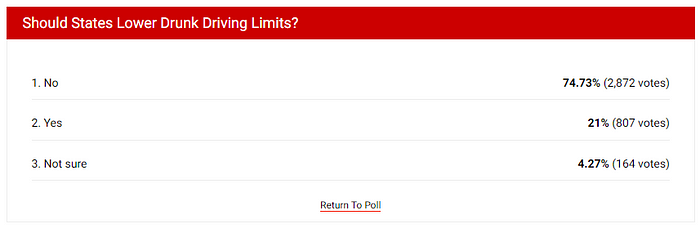
So imagine my surprise when, despite that 2000 study, this was the result of a poll posted in that Newsweek article:

Screenshot of survey from Newsweek article.

::shocked Pikachu::

The point of my Gloucester City speed ticket story is to show that no driver is perfect. I’ve had my share of tickets, like most people. But I’ve never gotten behind the wheel of a vehicle intoxicated on anything. Personally, I don’t drink anymore, except very rarely, as I wrote about in my article, “Why I Don’t Drink Alcohol.” Check it out. The last time I drank alcohol was the day after the Eagles won the Super Bowl in February 2018. I had one beer downtown to celebrate the accomplishment, and I wasn’t the one driving. My football team has to win the big one to get me consider to imbibe. That’s how rarely I drink.

No one’s perfect on the road. But when you drink even a little bit you exponentially increase your chances of causing a wreck. Why do that?

We live in an age where there’s this thing called a smartphone. And on this smartphone are buttons you can push that will summon a thing called Uber. Then bam! Some middle-aged dude will show up in front of you in a black Toyota playing reggae music to drive you wherever you want to go. You can save health and lives by simply gesturing with your fingers on a touch screen in fewer moves than a wizard conjuring a magic spell. It’s that easy. Or you can ride with a sober friend. Or walk. Or fucking crawl home on the sidewalk.

There’s really no excuse for getting hammered and turning your Honda CRV into a 90 M.P.H. death machine on the highway.

Going back to Mr. Paul Allen. His sentence for the DUI was severe. But in my book it didn’t go far enough. I think everyone convicted of a DUI or DWI should be forced to ride a tricycle for transportation. As in those little kid’s Hot Wheels tricycles. Like the one Danny rode around on in The Shining. I’m totally okay with my tax dollars going toward building separate roads or pathways for them to ride on, too. Because I’m not okay with these goddamn psychopaths staying on the road while I’m on it, even if they only had “a couple of drinks.”

Five Awesome Fiction Books I Read in 2023

Made with Midjourney by the author.

One thing I’ve found recently is that it’s getting harder to find fiction that appeals to me as a middle-aged man. This seems to apply to most mediums, though it’s most prominant in film. Rarely are films geared toward those male and older than 35. If it isn’t a superhero fantasy four-quadrant epic, it’s the latest mopey romance, or it’s a movie about a toy of some kind. I think this is why films like Top Gun: Maverick, Avatar: The Way of Water, and Oppenheimer did so well. They were actually able to pull in guys like me, who normally just bypass the theater because we know there’s rarely anything there for us.

The same holds true for the book publishing industry. During a stroll down my library aisles recently hardly anything caught my eye. The romance section is so massive it needs its own wing. Filled with iconic names like Danielle Steel and Nora Roberts. I’ve read Roberts in the past, and while she’s great, romance just isn’t my thing. What, you don’t expect me to read something like Fifty Shades, do you?

There’s your brand name male authors like David Baldacci, Dean Koontz, good ol’ King, John Grisham, James Patterson, and your high-concept thriller guys from the past — Michael Crichton and Tom Clancy. I’ve read most of Crichton’s stuff already, and hit a lot of Clancy’s highlights. And if I’m being honest, a lot of the murder mystery thriller stuff starts to sound repetitive. How many detectives investigating a conspiracy “bigger than they imagined” does one really need in life?

It’s understandable why studios and book publishers don’t care about us. Afterall, your typical 35+ dude is working all the time and/or married with kids, dealing with family stuff. Hey, we’re too busy trying to run the world here. We don’t have time to be wasting in fantasyland.

This is alarming as a novelist myself. Even though ironically many novelists don’t read themselves. Koontz can’t. There’s no way at the rate he pumps out his books. I’m pretty sure he wrote another Odd Thomas during the time I took to write this overly long intro.

Anyway, it sure wasn’t easy, but with some hard work I actually found a few books that appealed to me in 2023.

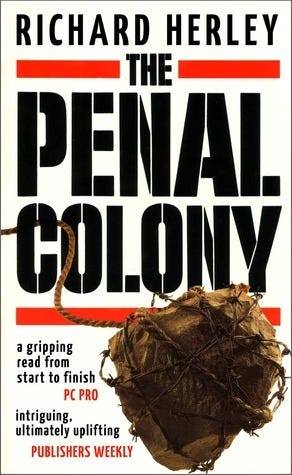
The Penal Colony by Richard Herley

Book cover for ‘The Penal Colony’ by Richard Herley

This book is sort of dystopian future adjacent. In the near future, criminals are sentenced to an island penal colony near the British Isles called Sert that is divided between two warring factions. One side lives in relative peace and order, while the other has reverted to primitive barbarism. A wrongfully convicted man sentenced to Sert tries to survive and earn his place within the peaceful side under a wise ruling Father. But first he must try and survive in the wilderness to prove himself. If he can succeed, he may just find a promise of escape.

This was an interesting concept. Sort of like an adult Lord of the Flies. Stylistically it was rather dry. Very gray and British, if that makes sense. The Penal Colony was made into the 1994 film No Escape starring Ray Liotta. An adaptation which is currently on Amazon Prime, and one which I was able to endure watching for all of five minutes or so. So just stick with the book, which is ultimately well worth the time.

Unwind by Neal Shusterman

Book cover for ‘Unwind’ by Neal Shusterman

YA dystopian. Dark YA dystopian, mind you. I heard about this one on Reddit, and it has the most bonkers concept ever. In the future, adults can have their delinquent teenaged children “Unwound,” which involves harvesting not just their organs but every fiber of their body. One kid must try to escape government agents trying to capture him before his 18th birthday, the final deadline before he becomes an adult and is independent from his parent’s whims. Bizarrely, the whole unwind deal is done as a tradeoff to making abortion illegal.

The premise of this series felt both odd and familiar, sounding like a concept from the ’80s. Like something David Cronenberg or Paul Verhoeven would have dreamt up in their heyday. Say what you will about YA novels being superficial or silly, but that genre has some of the most creative, if not outlandish plots you’ll find in all of popular literature. No ditzy navel-gazing box wine sipping bored housewives here whatsoever.

Unwind is part of a series. While I found the first book satisfying enough, I don’t know that I’ll return to finish the saga. So many of these YA writers need to just wrap things up in a single book. Not everything is meant to become a Netflix series or become another Hunger Games. I mean, David and Goliath is arguably the first “YA novel,” and it was all of half a page in the Bible.

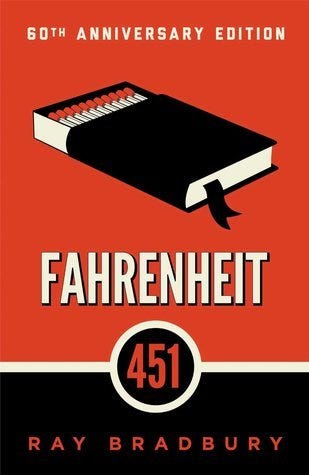
Farhenheit 451 by Ray Bradbury

Book cover for ‘Fahrenheit 451’ by Ray Bradbury

The classic novel about book burning, screen and media addiction, and censorship. Relevant, refined, though unsatisfyingly truncated. The endpoint feels more like a midpoint.

451 was unsurprisingly inspired by George Orwell’s 1984. It started off as a shorter story simply called The Fireman. Another point of trivia: the beginning originally featured Guy Montag having a dream where he’s captured for being in possession of books. Bradbury wisely scrapped this opening to instead start right in the middle of the action, with Guy burning a set of books, letting us see him in his element up close. It starkly marks his arc, which will ultimately take him into exile, where he will learn to become a “living book” in the woods.

If you were never assigned to read 451 in school like many are, you should absolutely add this one to your literary bucket list. I love reading books that have made a powerful cultural impact. Bradbury’s classic is referenced practically every day.

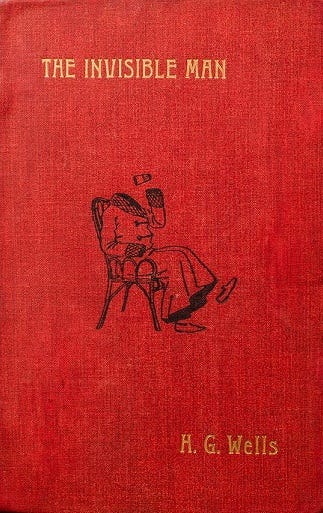
The Invisible Man by H.G. Wells

By Unknown author — https://www.abebooks.co.uk/servlet/BookDetailsPL?bi=30289720550, Public Domain, https://commons.wikimedia.org/w/index.php?curid=73629082

This was simply a pure delight. Every once in a while, it’s nice to go back and read an author who pioneered a genre, which Wells did in science fiction. In a pleasant surprise, there was ample dark humor to be found in this classic work of a mad scientist run amok. As was there also in the 1933 adaptation starring Claude Rains.

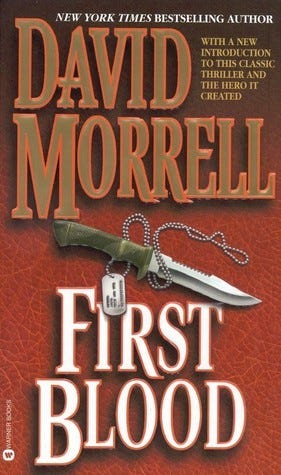
First Blood by David Morrell

Book cover for ‘First Blood’ by David Morrell

First Blood is basically The Godfather of action novels/films. The DNA of Die Hard, The Terminator, Jack Reacher, and Predator are rooted in Rambo’s inaugural adventure. The book also contains a moving and meaningful theme concerning our nation’s Vietnam War veterans. My dad served two tours in Vietnam doing recon in the Army, so this book felt personal to me, even as someone who was never in the military.

First Blood is about how sometimes conflicts don’t end on the battlefield, and what can happen when they’re taken home. A great read you won’t want to miss.

Hopefully 2024 will provide more great reading opportunities. Finding something that appeals to me sometimes feels like performing alchemy. But I have faith.

The Las Vegas Sphere Blew My Mind

The Neon City’s giant orb venue is a real game-changer in entertainment.


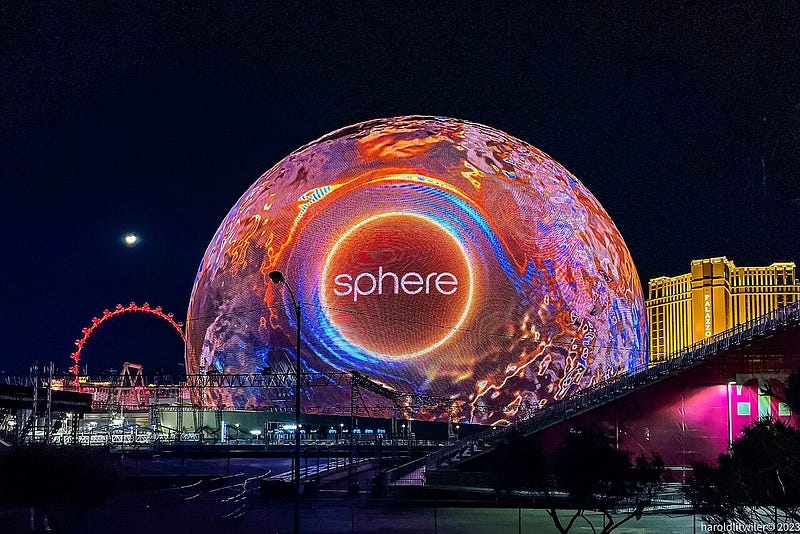
By Harold Litwiler from Orcutt/Istanbul, USA — The Las Vegas Sphere, Nevada, CC BY-SA 2.0, https://commons.wikimedia.org/w/index.php?curid=141409411

During a recent vacation to the Southwest, I had the opportunity to visit The Sphere in Las Vegas, the city’s newest and most social-media friendly attraction.

No doubt you’ve seen the countless videos uploaded on Tiktok and YouTube showcasing the outside of the Sphere. A complex network of LED light panels is what allows the exterior to show anything from a human eye to a smiling emoji. All viewable from large distances, including aircraft miles up in the sky, in crystal-clear HD. It’s basically an enormous highway billboard wrapped around a giant beach ball. Impressive enough, for sure.

But that’s only the outside. As for the interior, well, that’s where this orb becomes rather magical. Inside it boasts a massive 16K wraparound LED screen with 1,600 speakers, accomodating an 18,600 seat auditorium. The Sphere uses haptic, beamforming and wave field synthesis technologies. That’s just a fancy way of saying the imagery and sounds are set up to be as immersive as possible. It also uses 4D elements like wind and scent. 

However, the Sphere is really in a league of its own, and impossible to compare to any other theater system. Watching something in IMAX feels like looking at a postage stamp compared to the massive, nearly 360 degree interior wrap-around screen. Well, maybe that’s too severe. But the following night while watching Godzilla Minus One on an IMAX screen at the Red Rock Casino Resort, I couldn’t help but feel let down by the viewing experience compared to what I’d seen the previous night. 

Frankly, the Sphere is awe-inspiring, and represents a great leap forward in immersive entertainment. 

For my trip to the Sphere, I chose to attend Postcard from Earth, a 50-minute documentary directed by Darren Aronofsky. The band U2 also has an ongoing live concert residency exclusive to the Sphere through March of next year for their album Achtung Baby. Phish is scheduled in April. Having seen that band nearly 20 years ago I can attest their unique style of psychedelic rock will flow perfectly from that glorious screen. Pink Floyd would be another suberb fit. 

The Atrium

The Sphere Experience is a two-part journey that lasts two hours. The first hour is spent in the Atrium, where you are able to interact with several unique exhibits. I took several videos of the exhibits in the Atrium on my X account, which you can check out below.

https://x.com/deanmaxbrooks/status/1731921199012413593?s=20

The first video shows a humanoid AI robot named Aura that can interact with the audience, answer questions, and acts as a guide on a variety of futuristic topics. There are alternate versions of Aura within the Atrium, each covering different subjects, or orchestrating a different sort of interaction. The Aura in the video above shows the AI answering a woman’s question, “What is the meaning of life?”

The video below the one I took of Aura is just a simple pan of the Atrium ceiling, which contains some physical and holographic artwork. The blue lighting and overall ambience is meant to evoke a futuristic vibe. It did feel like I’d been transported to the 22nd century after standing outside in the cold Vegas air for twenty minutes in line. Sphere entry staff actually processed us rather quickly given the number of people attending. Like most venues, you still have to go through a metal detector and have your QR-code ticket scanned. 

There are other interactive exhibits, such as one that scans your whole body to make a digital avatar. Then for a fee it will email you your virtual copy to yourself as a keepsake. That one had a long line, so I avoided it to focus on the different Aura models. Aside from the attractions, there are concession stands. But be warned, all food and drink items are priced like you’ll find at any sports stadium. I paid almost $10 for a single hotdog and $5 for a bottle of water. It seems our 22nd century future still hasn’t cracked the problem of overpriced refreshments. Maybe the 23rd will take care of that. 

The Sphere 

After mulling around the Atrium for about an hour, the real event was finally ready to begin: Postcard from Earth. I’ve taken a short video of the auditorium as seats were filling, which you can check out below. 

You can get a real sense of the size of the Sphere from the video. I sat in the the 300 section, almost right in the middle. This, as I discovered, was pretty optimum seating. Though I don’t imagine there’s a bad seat anywhere in the house, really, with a screen that massive. My ticket ran about $178 after taxes, while “better” seats down closer to the screen were going for almost $300. However, I’m not sure it’s necessary to pay double what I did just to get closer. The Sphere also offers a Director’s Seat Package for their VIP experience. 

Postcard from Earth

Postcard from Earth by Darren Aronofsky (The Whale, Black Swan) is a 50-minute documentary set in the far future inside a space ship that’s just touched down on a distant habitable planet. Three astronauts emerging from cryo-sleep undergo a lengthy reawakening process in which a computerized voice orients them by helping them remember their place of origin. 

Over the next 45 minutes the characters, and by extension, us, the audience, are greeted with a series of images and scenes from all over the world. It’s a fun and creative means to invite the viewers into the world of the story. Aronofsky makes fantastic use of colors, textures and sounds, sweeping across virtually every form of geography, environmental condition and architecture, from just about every culture on the planet. There’s a transitional shot in the beginning where we leave the spaceship and descend from orbit onto earth that is so breathtaking it literally gave me anxiety. 

The Sphere is truly HD, giving unmatched crystal-clear imagery made even better by the naturalistic scnery in the documentary. All the while a soothing voice over speaks to the astronauts (and us). It’s like the most intense and visually stunning affirmation video ever made, and showcases the Sphere’s many immersive features. 

After the show ended, crowds were lead out through a wide corridor that took us through to the Palazzo at the Venetian Resort on Las Vegas Boulevard. 

By Cory Doctorow from Beautiful Downtown Burbank, USA — The Sphere as Mars, view from my hotel room at Harrah's, Las Vegas, Nevada, USA, CC BY-SA 2.0, https://commons.wikimedia.org/w/index.php?curid=136454844

Important Note: If you’re looking to get an Uber following a visit, you’re much better off going through the Palazzo and connecting with a ride on the Blvd rather than right by the Sphere. When I arrived in my Uber, there was a huge mass of people waiting for return rides at the drop off section. However, I was able to get a return ride from the Palazzo fountain in about five minutes. 

Overall, my experience at the Sphere was amazing. The only drawback is that right now it’s still in its experimental phase, with very limited selections. This is the first venue of its kind, afterall, though there are plans to build other spheres in London and Dubai. The structure was designed by an outfit called Populous backed by the Madison Square Garden Company.  

I see a great deal of potential in the Sphere. It supercedes IMAX and pretty much anthing else. Aronofsky’s documentary and concert films are perfect to start with, but a feature film custom-designed for the immense screen would be phenomenal. If it were up to me, I’d be moving heaven and earth to get Avatar 3 to premier in the Sphere when it comes out December 2025. I don’t doubt Populous has been in talks with top studios and directors for potential projects in the future.

If you live in the Southwest or are planning to visit, be sure to check out The Sphere in Las Vegas for an unforgettable experience. 

‘The Killer’: A Frigid (and Bloody) Portrayal of Middle-Aged Ennui

What do you value when nothing matters?

Source: By Netflix — https://twitter.com/netflix/status/1696175927942660584/photo/1, Fair use, https://en.wikipedia.org/w/index.php?curid=74688944

David Fincher’s newest film The Killer, starring the always great to watch Michael Fassbender, perpetuates the director’s ironic passion for neo-noirish nihilism. Fincher might be the only director to have achieved A-list status making essentially highly-stylized misery porn. Even Kubrick’s cold, clinical style often gave some light at the end of each cinematic dark tunnel he crafted. Whereas Fincher tends to suffocate his films in cynicism, reducing his characters to puppets of impulse, hormones, and the wretched post-modern world.

Though it’s not to say Fincher’s works aren’t insightful and stimulating. Indeed, he may very well be the best director working today. But in the sense of being an eye surgeon who’s the world’s preeminent cataract remover. Admirable, of course, even if their work is gut-wrenching to watch at times.

In the case of The Killer, however, our protagonist is not drawn to his deadly profession as a hired assassin out of a need, or even a real desire to kill, but more a matter of needing a profession in which to display his competency and allows him to channel his detachment from humanity. Or maybe it was the job itself that made him that way. Or perhaps it doesn’t matter. As he states in the opening sequence, “I don’t give a fuck.” No doubt an oft-heard refrain from anyone stuck in the conveyor belt of a career, especially in middle-age. Propelled forward through the corporate beast no longer by youthful ambition or hope for some brighter future, but out of unfeeling momentum. For lack of a better alternative. Because retirement is too far away. Because even sitting on a beach in “paradise” becomes maddening after a certain period. So you might as well keep slaving away.

Fassbender’s portrayal reminded me somewhat of famed Navy Seal sniper Chris Kyle, aka American Sniper, as seen in interviews. Frank, unassuming, speaking of his military exploits as though recalling seasons from an MLB career. His 160 confirmed kills discussed like a slugger’s batting average. The morality or even necessity of them dismissed basically because a few suits in government said it was okay to do. I guess there’s no alternative other than to depersonalize as much as possible with that kind of weight on one’s conscience. I still agonize over social faux pas I made decades ago. I couldn’t imagine 160 lives banging around in my mind.

Aside from the standard revenge plot after The Killer’s girlfriend is hospitalized as payback when an assignment goes wrong, the subtext of middle-aged doldrums and detachment run throughout. Tilda Swinton’s character, aka The Expert, states during her confrontation with her vengeful colleague how those in the business fool themselves into thinking they’ll reach a point of financial satiety. It becomes a lifestyle. Automatic. To refer to Kubrick again, it’s like they’ve become clockwork oranges.

To help illustrate how strange a film The Killer is, it’s helpful to compare it to one with a similar plot, but which is quite different in tone and style — Kill Bill Vol. I and II. In those films, The Bride, or Beatrix Kiddo, goes on her “rampage of revenge” up through the hierarchy of her former employer, the Deadly Viper Assassination Squad, in order to ultimately rescue the daughter ripped from her womb. It’s a story about motherhood, in which Kiddo has very much retained a normal if vibrant personality even after years of slaughtering targets. Tarantino’s sexed-up hitman rollercoaster ride would indicate life after being in such a nasty biz can still go on just fine. You can still be “Mommy,” as Uma Thurman is credited in the send off no matter how many heads and limbs you’ve sliced off.

Then you have the live-action anime-style of the John Wick universe, in which Keanue Reeves dispenses head shots with video game-style proficiency. A stark contrast to The Killer’s grounded, methodical take, where important tools are boringly ordered through Amazon, and our assassin flies coach.

Ennui is a strange sensation. It’s not really sadness or depression. It’s a sense of feeling automated. I imagine it as the possible mindset of a self-aware AI. All the knowledge and directives are there, but lacking any feelings whatsoever. While young adults may grapple with it during the opening innings of a career and maturity, it seems to take hold mostly in middle-age. It’s a side effect of routine, narrowing life options, a decrease in libido, and a reduction in hormones. An inner sense that change is becoming harder. Attitudes and beliefs decreasing in flexibility. A hardening of being itself. Adoption of status quo. It’s as if one becomes a judgmental Simon Cowell toward everything in life; perpetually unimpressed, bored, even resentful of having even to show up.

And yet, still blindly following rules for their own sake. Because rules matter. The Killer goes on his warpath of revenge almost as a matter of formality. We don’t see him spend any quality time with his beloved. Only a brief visit in a hospital after she’s been patched up, in a scene that feels inserted because it’s what all those screenwriting how-to books tell you to do. Quite unlike Tom Stall/Joey Cusack’s loving and well-established relationship with his family in A History of Violence, before his old mobster associates reemerge and he’s forced to defend the homestead.

The Killer doesn’t have much to say. It’s more about conveying that sense of listlessness that comes with a life that’s stuck in a rut. There’s no redemption. No arc, really. This isn’t Jules Winnfield trying to learn “to be a shepherd” in Pulp Fiction. Our protagonist’s final confrontation with the Client serves to reinforce the detachment theme, as the billionaire’s only interest was having the “mess” of the botched hit cleaned up. Assured of no further reprisals, The Killer relaxes with his healing girlfriend at their beachside estate. A man-eating shark lulled into a food coma. At least until the vocation of killing calls again.

In The Killer, man is less his will and desires, and more whatever work or habit has gotten into his blood, and compels him to act.

How Much Do Pop Stars Make From Their YouTube Channels?

Even world-famous entertainers need diversified income streams.

Photo by Szabó Viktor from Pexels: https://www.pexels.com/photo/hand-holding-smartphone-with-internet-access-to-youtube-3227986/

For many pop stars, most of their revenue comes from concert tours, album sales, and song streams. Taylor Swift’s Eras Tour, for instance, is estimated to have brought in $2.2 billion in ticket sales just in North America alone. Bad Bunny’s 2022 album Un Verano Sin Ti sold 3.398 million album-equivalent units in that year alone.

But what do these pop stars make from the Google Adsense ads on their YouTube channels? To find out, I used a helpful website called Social Blade, which provides estimated earnings reports on various social media sites. While it’s impossible to determine an exact number without seeing a channel’s actual analytics page, Social Blade can give you a good idea of the range.

For this article, I’ll post the range, using a number in the middle as the estimate, and provide a link to each Social Blade stat page so you can check it out yourself.

On to the list. In no particular order, but starting with the reigning pop queen herself:

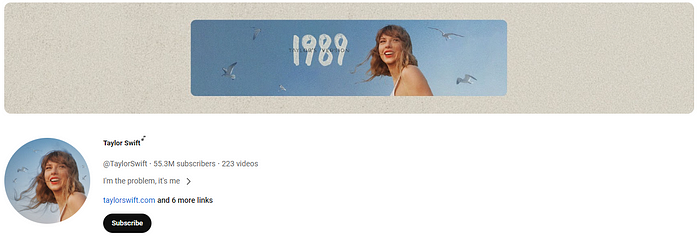
1.) Taylor Swift

Source: Screenshot of Taylor Swift’s YouTube channel

Social Blade stat page.

Monthly Revenue from YouTube: $1,381,500 ($163,300 — $2.6 million)

Annual Revenue from YouTube: $16,850,000 ($2M — $31.7M)

Sixteen million sure sounds like a lot. But to put that in perspective, it’s only .72% of the $2.2 billion in ticket sales she generated just in North America. Basically lunch money for Ms. Swift.

2.) Lady Gaga

Source: Screenshot of Lady Gaga’s YouTube channel

Social Blade stat page.

Monthly Revenue from YouTube: $345,200 ($40,600 — $649,800)

Annual Revenue from YouTube: $4,143,650 ($487,300 — $7,800,000)

Lady Gaga has gotten more into acting these days. Her last video upload was almost eight months ago. But at least she has a nice YouTube side hustle to fall back on, should Joker 2 not pan out.

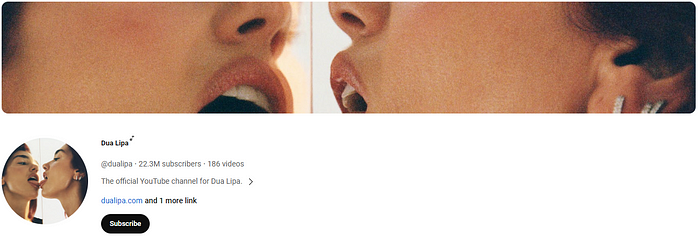
3.) Dua Lipa

Source: Screenshot of Dua Lipa’s YouTube channel.

Social Blade stats page.

Monthly Revenue from YouTube: $262,550 ($30,900 — $494,200)

Annual Revenue from YouTube: $3,135,300 ($370,600 — $5,900,000)

It’s tough to break through on YouTube. But it certainly helps when your music is used in the soundtrack to Barbie, the biggest film of the year. “Dance the Night Away” is a pretty alright jam.

4.) The Weeknd

Source; Screenshot of The Weeknd’s YouTube Channel

Social Blade stats page.

Monthly Revenue from YouTube: $523,800 ($61,600–$986,000

Annual Revenue from YouTube: $6,269,750 ($739,500 — $11,800,00)

Like Lady Gaga, The Weeknd has also made the jump into acting. But doing gigs like the halftime show for Super Bowl LV has also helped ensure he stays relevant in the YouTube algorithm.

5.) Miley Cyrus

Source: Screenshot of Miley Cyrus’ YouTube Channel

Social Blade stats page.

Monthly Revenue from YouTube: $179,250 ($21,100 — $337,400)

Annual Revenue from YouTube: $2,126,500 ($253,000 — $4,00,000)

Then you have Miley, who left acting to pursue singing full-time. Famous for twerking on Robin Thicke, Ms. Cyrus has done very well in 2023 with her album Endless Summer Vacation and a number one hit with “Flowers.”

6.) Rihanna

Source: Screenshot of Rihanna’s YouTube Channel

Social Blade stats page.

Monthly Revenue from YouTube: $497,600 ($58,500 — $936,700)

Annual Revenue from YouTube: $5,951,300 ($702,600 — $11,200,000)

Talk about getting the best bang for your buck. Rihanna’s channel only hosts 84 videos, but still makes almost $6M a year in ad revenue. Her last upload was eight months ago. Of course, it certainly helps when you’ve been a household name for almost twenty years.

7.) Harry Styles

Source: Screenshot from Harry Styles’ YouTube Channel

NOTE: These stats only include Harry Styles the solo artist, not as part of One Direction.

Social Blade stats page.

Monthly Revenue from YouTube: $127,400 ($15k — $239,800)

Annual Revenue from YouTube: $1,539,950 ($179,900–$2,900,000)

Harry Styles’ boy band days with One Direction may be over, but he’s still making a name for himself as a solid solo act, actor, and YouTuber.

8.) Selena Gomez

Source: Screenshot of Selena Gomez’ YouTube Channel

Social Blade stats page.

Monthly Revenue from YouTube: $286,800 ($33,700 — $539,900)

Annual Revenue from YouTube: $3,452,450 ($404,900 — $6,500,000)

Like Taylor Swift, Selena is one of the OG music YouTubers, uploading her first video fifteen years ago, when the singer was all of 16 years old. But now at 31, she’s still doing quite well for herself on stage, TV, and in the Google Adsense game.

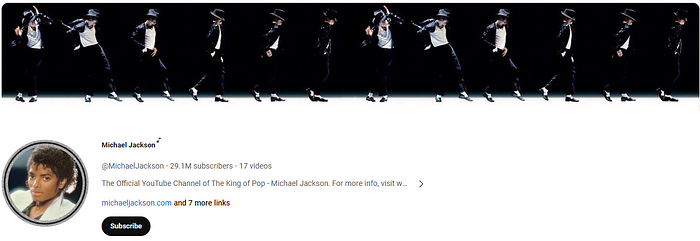
9.) Michael Jackson

Source: Michael Jackson’s YouTube Channel

Social Blade stats page.

Monthly Revenue from YouTube: $326,750 ($38,400 — $615,100)

Annual Revenue from YouTube: $3,930,650 ($461,300 — $7,400,00)

The King of Pop may have passed away in 2009, but his legacy lives on forever in the YouTube sphere.

10.) Britney Spears

Source: Screenshot of Britney Spears’ YouTube Channel

Social Blade stats page.

Monthly Revenue from YouTube: $187,050 ($22,000 — $352,100)

Annual Revenue from YouTube: $2,232,050 ($264,100 — $4,200,000)

Britney’s best days as a performer may be behind her, but that doesn’t mean she can’t rely on a generous revenue stream from her YouTube channel. In addition to being a top-selling artist, Ms. Spears can now add bestselling author to her lengthy list of accomplishments. Her memoir The Woman in Me sold 1.1 million copies in its first week.

Invest $3,000 and Two Weeks, Make $48k+ a Year for Life

Photo by Gustavo Fring from Pexels: https://www.pexels.com/photo/man-in-plaid-shirt-sitting-in-the-body-of-blue-truck-and-reading-papers-6720534/

Is a Class B CDL the most cost-efficient type of job skill with the best guaranteed ROI?

There’s a strong case to be made for it.

Yes, there are all sorts of free tutorials and courses on YouTube and elsewhere for things like copywriting, digital marketing, YouTube channels, blogging, coding, day trading, dropshipping, SEO, flipping, niche websites, and numerous other categories.

But none of those side hustles or online businesses offer much in the way of guaranteed results or job placement. Some of them have a steeper learning curve than many anticipate, tons of competition, and may require lengthy amounts of time before yielding any real income.

Frankly, many courses and tutorials are simply pie-in-the-sky scams that rely on outlier results to appear legitimate.

But suppose you’re broke, unemployed, or simply looking for a practical (and legit) new career path, and you need something that, you know, actually works, and you need it right now.

In that case, getting a Class B CDL might be your best option.

What can you do with a Class B CDL?

A Class B CDL enables you to drive vehicles weighing 26,001 pounds or less, such as:

  • Tow trucks
  • City busses
  • Drump trucks
  • Cement mixer trucks
  • Box trucks

Comparatively speaking, few jobs come close to the benefits a CDL B can offer in terms of length of training, training costs, and most importantly, return on investment (meaning income).

For instance, there are people who spend four years in college and graduate with $32,731 of student loan debt, but end up with few or no job prospects.

Nursing school or medical technician training for CT or MRI usually takes 2–4 years to complete, and may cost tens of thousands of dollars. Though the payoff can be huge, and almost anything in the medical field offers great job security.

The average income in the U.S. for a lawyer is $144,230. That’s fantastic income, obviously. But you generally only make the higher end of the scale by working in places where the cost of living and taxation are higher (NY and CA, for instance). Then there’s the costly tuition and the lengthy time commitment: Seven years between college and law school.

Professional graduate-level careers in law, medicine, and engineering are no doubt prestigious and offer great incomes. But they come with subtantial sacrifice. You trade almost 10% of your life away to obtain them, during which time you generally make no income and can incur massive debt. And frankly, few people are cut out to be lawyers, doctors, and engineers.

How Much Do CDL B Drivers Make?

By contrast, you can get a CDL B in as little as two weeks, for as little as maybe $3,000 (or even free with tuition reimbursment), and expect to make an average of $48,196 in annual income.

The salary ranges between $35,000 to about $65,000 depending on where you work, your level of experience, and your license endorsements (hazard, air brakes, tanker).

Photo by Braeson Holland from Pexels: https://www.pexels.com/photo/a-truck-on-the-asphalt-8995386/

In addition, with a Class B CDL, like nursing and other occupations that require specialized training, you have good job security. You can go virtually anywhere in any state and find places hiring truck drivers for above the median income for the US. Some states like Wyoming pay an average salary of $57,728 for drivers.

That’s a remarkable ROI for an “investment” of only two weeks, and maybe only $3,000 in total costs.

Some companies might even offer to pay for truck driving school as part of your overall job training. This is the case in currently worker-deprived fields like construction, petroleum, or mining, where you might be expected operate various forms of heavy equipment and machinery.

You can also obtain a Class B CDL when you’re as young as 18 years old. Which means that if you were to start driving right out of high school, by the time your college-bound peers graduated, you would likely have made over $200,000 in income. Meanwhile, your diploma-having peers are jobless or underemployed, and mired in student loan debt.

Is truck driving glamorous or prestigious? Of course not. Most jobs aren’t. But when it comes to offering practical, secure, and efficiently fast job training, a CDL B offers some of the best bang for your buck.

Resources:

How Much Does A Class B CDL Cost?

CLASS B DRIVER SALARY