My 2025 Bitcoin Experiment

Made with Midjourney

Bitcoin has been kind to me this year. Especially the last few months. It may not get me to early retirement this cycle, unless some of the uber moon boys are right about it hitting $250K-$400K next year. But it has made me a lot more comfortable than I was a year ago.

Like many, I first heard about Bitcoin back in 2017 during the peak of its bull run. I admit I really had no idea what it even was. I likened it to website credits or tokens you might win playing an online RPG like World of Warcraft.

I didn’t think about Bitcoin again for a few years until 2020 after the Covid crash. I bought my first in September, right when it was around $10K. I made regular buys thereafter before sinking in a sizable amount almost a year later following its initial peak in March, 2021. I saw my investment nearly double in a matter of months, before plummeting down hard the following year.

It was wrenching to watch my investment sink by almost 75%. But having watched Bitcoin rise and fall twice before in ’17 and ’21, there accompanied my dismay a slight reassurance in the fickle decentralized digital currency. I kept stacking sats, HODLed and hoped, until eventually it climbed back to even early last year. This last run-up has finally put it into the six-figure zone at $100,000. A momentous achievement.

Is Bitcoin going to climb higher and higher into next year? Or will there be another calamitous crash? Who knows. There are many positive signs lining up for the currency. The incoming Trump Administration is very crypto-friendly. Trump has expressed interest in starting a national strategic Bitcoin reserve, which may prompt other countries to do the same. Michael Saylor, the CEO of MicroStrategy, continues to buy Bitcoin by the billions with his stock sale scheme. Wall Street has opened up numerous ETFs for Bitcoin, which have seen billions of inflows. China has dropped its opposition to it. The digital asset has certainly gone mainstream. While it hits road blocks here and there — MicroSoft shareholders just rejected putting it on their balance sheet Saylor-style, for instance — for the most part it just keeps bouldering ahead.

Will it one day be worth $13 million a coin? Or even a million a coin? I have no idea. I don’t do predictions, projections, or prognostications. Bitcoin attracts far too many Punxsutawney Phils who see price targets in their shadows. But fundamentally, if there are more and bigger buyers over time, the asset should see a gradual rise in value. Here’s a simple thought experiment. As of now, MicroStrategy owns almost 2% of all Bitcoin that will ever exist. If the U.S. acquires 1 million Bitcoin as is intended for the proposed strategic reserve, that would mean a 5% stake. That’s 7% between just two entities. If other countries and major corporations follow suit, that will place enormous buying pressure on an asset with a fixed supply. What happens then? Number go up, of course.

I do believe in Bitcoin long-term as a tool to counter centralized banking and its widepsread currency debasement and inflation. I’m not a Bitcoin trader. I have no plans to sell my holdings, unless I’m moving the proceeds into another investment or an asset of some kind. But unlike before, when my buys were largely random or inconsistent, I want to set up a DCA system. Therein lies a problem, as many exchanges charge exorbitant fees. I’ve been with Coinbase since 2020, but their charges are excessive.

Recently, a finance Youtuber named Marko — Whiteboard Finance informed me about River in one of his videos. River is a Bitcoin-only exchange that allows you to set up recurring buys for no fee after a week.

(NOTE: I’m not affiliated with River. This is simply my own experiment. I’m not even going to provide a link to the exchange, but it is easy enough to Google. Also, do your own research on Bitcoin and crypto and whatever else you want to invest in with your own money).

Here’s my simple plan:

Starting this month and going forward next year, I’m going to DCA $20 into Bitcoin every day through the end of 2025.

Twenty bucks every day. That’s $7,300 in total over the next 365 days.

River also currently pays 3.8% in BTC on cash deposits you make on the exchange. Since I’ll be dropping a good bit of that $7,300 up front, I should also see gains from that annual rate as well.

I already made my first buy yesterday, Dec. 12th. So, one day down, 364 to go.

Hey, wait! Why not just smash buy Bitcoin with that money right now?

Well, I plan to buy chunks of Bitcoin in addition to this daily DCA over the next year and beyond. But part of why I’m setting up this experiment is to take the hand-wringing and guess work out of when to buy Bitcoin. I struggle with paralysis-by-analysis a lot when it comes to making investment decisions. Well, with most decisions in life, if I’m being honest. Mostly that comes from fear. Fear of losing money. Fear of uncertainty. But also fear of missing out (FOMO). So, this DCA strategy with River is a happy medium. It’s a sizable enough purchase over a year to make a difference. But it’s not so much where I won’t have reserve funds to make bigger purchases when I feel it’s warranted.

I’ll be providing updates over the next year, perhaps monthly, on my 2025 Bitcoin Experiment. We’ll see how it goes.

Made with Midjourney.

Desperate Middle-Aged Corporate Slave Bets His Family’s Life Savings On A Crypto Token And Then This Happens

The insane story of Dan Conway.

Source: Midjourney

You know those crazy videos where someone goes skydiving or performs parkour stunts on the edge of a skyscraper? The ones that give you sweaty palms just watching them?

That’s what it feels like reading about a middle-aged guy with a family who sank his entire fortune into a brand spanking new digital currency that just popped into existence.

But that’s exactly what Dan Conway, a former middle manager slaving away in corporate America did back in 2016. He put his family’s life savings into a new crypto called Ethereum.

Now, in retrospect, this may not seem like the absolute worst, most insane idea anyone’s every had to make a fortune. Since its inception at around $2 in 2015, Ethereum has climbed to as high as almost $4700 back in November, 2021. It currently sits at just over $2300.

But we’re talking almost ten years ago. When Bitcoin and the entire crypto market were still in its toddler years. It was the wild west.

Conway’s idea was partly inspired by Bitcoin’s shocking success in 2013, when it ran from under $100 to over $1000 in a matter of months. Could Ethereum perhaps replicate the same sort of mindboggling returns? That was the big question.

At the time, Conway was 45, “quietly desperate,” and slaving away as a corporate middle manger in San Francisco, making $150,000 a year. He was married with three kids, had about $100,000 in savings, and some built-up equity in his home. While not destitute by any means, Conway was like a lot of people willing to do anything to escape the 9–5 grind. Making matters worse (or better, depending on your POV), Conway had a somewhat addictive personality. He’d struggled with alcohol and drugs. He was even in a 12-step program.

But he was able to channel his “mania” into a new obsession — this strange new cryptocurrency. As he learned more, he became more confident that ETH could potentially replicate Bitcoin’s success from years earlier. His belief was partly due to his experience working for Macromedia in the ’90s, the company behind Flash. He was familiar with how a new tech product with the right developers can suddenly catch on and rapidly soak up market share.

Still, ETH was so new that even his friends in the San Francisco tech world didn’t believe in it.

“Most of my friends in tech — folks working at places like Google, Apple, and Uber — were dismissive of blockchain. Few of them had heard of Ethereum. When I told a buddy of mine that I was considering investing in cryptocurrency, he broke out in laughter, as if I’d admitted I was hedging my future on Smurfberries or Scooby Snacks.” (Source)

Nonetheless, in mid-2016, Conway went to his bank Wells Fargo and transferred his family’s entire life savings to the new crypto exchange Gemini (founded by the Winklevoss twins) for nearly $7,000 ETH tokens, at a price of about $14.

Then something catastrophic happened.

All of a month later an Ethereum project got hacked and Conway’s $100,000 investment sank to less than $40K. It was a harsh welcome to the world of crypto. While most people might have capitulated, the sudden reversal only cemented Conway’s belief in ETH’s potential. He doubled down. Big time. By sinking over $200,000 of home equity into the dip. Now he was all in at $300K but at an average price of about $11 a token.

As it turns out, the frightening flash crash was the pivot point. Over the course of the next year crypto saw a return of the bull market. Ethereum climbed from its bargain basement price of $8 to over $1,300.

By the time Conway cashed out in late 2017 into early 2018, his risky bet had turned into $10 million.

However, there was a huge personal toll to pay on the path to decamillionare status. Conway admits to a lot of emotional volatility, obsessively tracking ETH’s price, and late soul-searching nights worrying about his crypto account getting hacked. He was fired from his job. He even wound up in the emergency room with a “panic event.”

I find Dan Conway’s story equally thrilling and inspiring. Even somewhat relatable. I had some success with Ethereum, Bitcoin, and other cryptos myself back in 2020. It was reading stories like his that motivated me to finally step outside the comfort zone of my more conservative investing style, and take a little risk on this new asset class. I started with Bitcoin when it was under $10,000, and then Ethereum when it was sub-$500. While my returns aren’t nearly as high as Conway’s, I’ve still done okay. Time will tell whether the crypto market will undergo another face-melting run like before.

Conway is a unique personality. Very few people would be willing to go all in on something so unproven as a new crypto token like he did. Especially at 45, with three kids, a wife, and a mortgage, living in one of the most expensive areas of the country. There’s something very admirable about that. Reminscent of the Old West gold rush prospectors, or the family’s that traveled West on the Oregon trail.

However, Conway is very aware of his good luck:

“I banked everything I had on a relatively unproven technology and got out at the right time. For every story like mine, there are hundreds of others about people who lost it all. I know that could’ve easily been me.

At the same time, I’m no blackjack player. My investment wasn’t purely a blind gamble that came up aces. I was, and am, a true believer in crypto — and I had the right mix of courageousness and craziness to take a big risk.” (Source)

Since striking it rich in crypto, Conway has retired to a more normal life. He’s written a book called Confessions of a Crypto Millionaire. If you want to read more, you can also check out his first-person account of all the action in The Hustle.

Would you be willing to go all in on an investment you believe in? Was Conway crazy or ahead of the curve?

For Steady Returns, Consider Polkadot for Your Crypto Portfolio

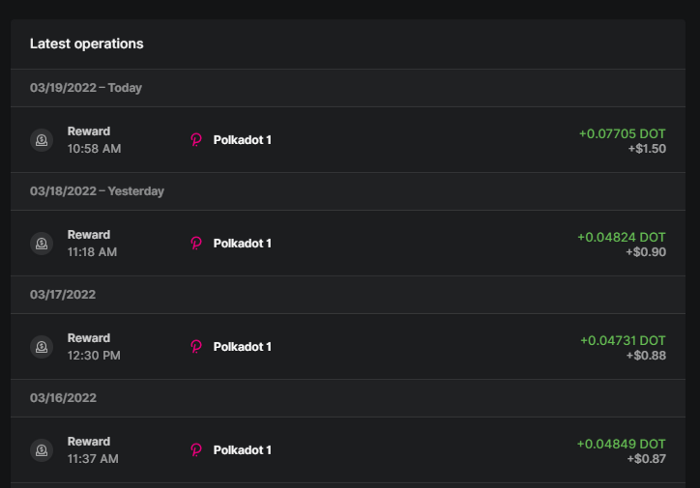
My recent Polkadot earnings.

If you’re more of a conservative investor (say, an index fund maximalist), you may feel put off or suspicious of any so-called “asset” in the crypto space.

You’ve no doubt noticed the wild price swings, rug pulls, and outright scams that have tarnished the crypto asset class over the last few years. And you’ve no doubt been put off by the hype mongering, and the constantly braying moon boys on YouTube and Twitter.

Even Bitcoin, the king of digital currencies, HODL’d by billionaires like Elon Musk and Michael Saylor, has seen its value soar to over $60,000 per coin, only to collapse by almost 50% in a matter of weeks, over the last year. I mean, yikes. You call Bitcoin an “investment?” More like a time bomb you stick down your pants and sit on until it explodes, only it doesn’t have a helpful digital counter like the ones in the movies always do.

You’ve looked at NFTs and probably wondered who in their right mind would spend millions on a ugly piece of “art” like a BoredApe. I know I have. Though far be it from me to criticise Justin Beiber’s digital token acquisition habits.

Or maybe you’ve looked askew at DeFi projects like UniSwap, PancakeSwap, and their many derivatives. SushiSwap. SundaeSwap. There’s even an ApeSwap, because why not. The crypto world seems to have a simian fascination. And a food obsession, apparently.

I consider myself more of a conservative buy-and-hold type investor, for the most part. There’s not a diversified index fund, mutual fund, bond/stock blend, Vanguard ETF, State Street ETF, etc. that doesn’t rustle my jimmies. You say safe, diversified S&P 500 fund, and I’m likely to respond like Jules Winnfield in Pulp Fiction, as you’ve put my fears of wild market fluctuations at rest.

As an investor who’s mainly stuck to the safer side of the risk curve over the years, it took me a long time to warm up to the idea of plunking down any money into crypto. I remember feeling guilty just setting up my Coinbase account back in August, 2020. Feeling like an ex-con with a passing cop looking my way as I bought my first bit of Bitcoin later in September. Bitcoin was around $10,000 at the time. God, how I wish I had bought more.

But then a funny thing happened. When I realized that my not exactly insignificant Bitcoin purchases weren’t oozing through my WiFi connection like some electronic demon, to strangle me while I slept at night, I began to experiment with other cryptocurrencies. Though I know now that there’s Bitcoin and then EVERYTHING ELSE, at the time, I didn’t exactly differentiate. I judged crypto assets rather informally, looking at market cap, and what was widely considered relatively “safe” to invest in. I went with Ethereum next, sometime around late December. It was around $700 or so per token then, though it quickly skyrocketed through March-April 2021. That was the first pump that showed me the potential for decent gains in the cryptoverse. Of course, crypto puked shortly after in May. But that first pump and dump only made me more intrigued.

Cryptocurrency is kind of like a drug. You’re always chasing that first high from your first buy.

Eventually, after accumulating more Bitcoin, Ethereum, and a small so-called “Ethereum killer” known as Algorand, I eventually discovered a little gem known as Polkadot (DOT).

Polkadot is often tagged as another “Ethereum killer,” just like Algorand, or Cardano, or Solana. Though it’s a bit more complicated than that. It’s basically a giant ecosystem containing numerous other tokens and projects, called “parachains.” It’s kind of like how the iPhone is a platform on which millions of apps (like the iBeer) operate. Polkadot helps enable other blockchains to “talk” to one another seamlessly. It was created by Gavin Wood, who co-founded Ethereum. But unlike other crypto tokens, where you buy, hold, and pray they go to the moon before your next shift at McDonald’s starts, Polkadot offers something unique in the way of staking rewards.

What is “staking?” That’s basically when a crypto pays you to hold it. It’s a bit more technical and complicated than that, I realize. But in essence, you’re paid rewards (in the form of the token you’re holding) for helping to maintain the blockchain. For Polkadot, the rewards work out to roughly 12–14% (give or take) APY. Check out this calculator here to see for yourself.

There are a few reasons why I, a more traditional type investor, found myself attracted to Polkadot. One, the lizard part of my brain interpreted the staking rewards as similar to opening up a high-interest rate CD at a bank. Or better yet, a stock dividend. You’d never see double-digit interest rates like that at a bank. We’ll likely never see such rates ever again in our lives. But you do see decent dividend yields like that in stocks. Particularly for Real Estate Investment Trusts (REITs). AGNC Investment Corp., for instance, pays a 10.90% annual dividend yield. And two, staking Polkadot is pretty easy, evenif you’re slightly technophobic. Polkadot offers the opportunity to gain in market cap, allowing for larger returns. Whereas in a dividend stock, sometimes the dividends themselves eat away at the value of the stock itself, causing your overall investment to slowly erode, offsetting any gains you might have made from the dividends. Look at AT&T for an example of this.

I bought my first bit of Polkadot back in July, 2021. It was trading around $10 at the time. Crypto had just crashed from their earlier spring highs. Similar to my first Bitcoin and Ethereum purchases, I only bought a little at a time. Gradually scaling up, and watching the price slowly appreciate. I learned that you can stake DOT on platforms like Kraken, and earn a reliable 12% annual APY. You can stake and unstake at any time. The only downside is you’re keeping your DOT on an exchange, under someone else’s custody, which for those who ascribe to the notion “Not Your Keys, Not Your Coins,” that would not be acceptable. But for most investors, staking on Kraken, or other exchanges, is going to be the simplest, fastest, and easiest way to getting the DOT gravy train rolling.

However, if you want to potentially earn a higher APY, and keep more control over your DOT tokens, you’ll have to stake them yourself directly onto the Polkadot network. DOT has “validators,” who are basically private individuals who run computer networks that monitor and secure the Polkadot network. Some of these validators manage networks comprised of millions of DOT tokens. By cutting out the middleman exchanges like Kraken, and going directly to the source, so to speak, you can increase your APY. To do this, you need a crypto wallet like a Ledger, which is set-up to allow you stake your DOT directly with a validator. Ledger is what I use, and even for a relative crypto newbie, it was pretty simple to set-up. After choosing a validator, you simply assign your tokens, and then let the rewards start to roll in.

IMPORTANT NOTE: You need a minimum of 120 DOT in order to stake directly with a validator. And once you stake, you won’t be able to unstake for 30 days. Kraken, on the other hand, does not require a minimum staking amount, and you can remove your DOT from staking at any time. There is also more risk to staking directly with a validator. You can be “slashed,” which is basically when a validator does not pay you fairly for your staking share. Be sure to do your own research.

As you can see from the screenshot I posted at the top of this article, my DOT validator sends me rewards everyday in exchange for me staking my tokens with their network. The rewards fluctuate. Sometimes it works out to 10%, while other times it’s gone as high as 20%. If you average it out, it comes to about 14%.

While 14% may not seem very high in our current WallStreetBets-ified culture of “To the moon, baby!” I find that seeing rewards trickle in like that to my account every day has a profoundly satisfying and even therapeutic effect. Even if it’s just a dollar, or a $1.50, it means progress. And remember, that 14% is of whatever the value of your DOT holdings currently are. So, let’s say you were to buy 120 DOT right now at around $20, and one year from now it doubles to $40. Then, instead of receiving roughly $.92 a day, you’d be getting almost $1.84. It works the other way, too. So if DOT is $10 one year from today, you’d be getting $.46 instead. Volitility is a two-way street, and higher returns almost always mean higher risk.

I find Polkadot a unique cryptocurrency in that it approximates the dividend payout you see with traditional stocks, with its staking rewards system. It’s as blue chip as you’re going to get when it comes to alt coins, with a current market cap of over $19 billion. And it has a growing, very active, and very diverse ecosystem of projects throughout its blockchain. Like with any tech-related investment, you want to see a lot of developer brain power working to take things to the next level. But also like with any crypto, it’s unpredictable, with sudden rapid price swungs. Be sure to do your own research. And as always, nothing in this article is intended as investment advice. This is simply my own experience with Polkadot.

What do you think of Polkadot? Would you invest in it, or have you already? What other sorts of cryptocurrencies have you found?