Virtue signaling or genuine longing to display the human rainbow?
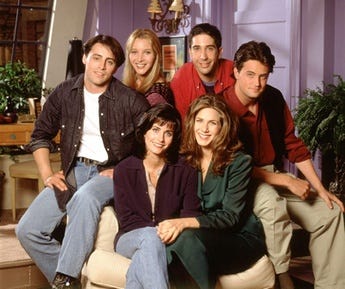
The title of this piece is in reference in part to some recent comments made by Adam Goldberg, who played a bit part on the show Friends back in the day. In an interview with Independent, when asked about modern criticism toward the show due its lack of diversity, he said:
And in terms of diversity, looking back, it seems insane. I’ve heard Black people speak about this and it’s like, you never expected to see yourself, so when you didn’t, it was not a surprise, and you ended up identifying to characters, irrespective of their race.
The ’90s was a weird time in TV history when it came to racial integration. Back then, TV shows were largely segregated, with little integration unless an episode was racially-themed. You had White shows like Full House and Married with Children. Then you had Black shows like Family Matters and The Fresh Prince of Bel-Air. There were no mainstream Latin or Asian shows to my knoweldge. Certainly no Native American ones. It was vanilla and chocolate, with hardly any mixing.
Friends was not unsual in its milk-colored casting choices. I never watched the show, nor did I ever care for it or find it funny. What little I’ve seen of it I find cringe and annoying. I’m a Seinfeld guy. But I do recall that Friends had a wide and ironically diverse audience despite its “insane” lack thereof.
In 2004 in college I was friends with a young African woman who loved the show and raved all week about seeing the anticipated series finale. In one of the lounges, people gathered around watching the last episode. To be clear, it most likely had a largely White audience, but the show’s humor (or what passed for it) seemed to catch on with all kinds.

Goldberg’s comments are rather innocuous. The show’s co-creator, Marta Kauffman, however, was more passionate in her response. Saying to the Los Angeles Times:
“I’ve learned a lot in the last 20 years,” Kauffman said in a Zoom interview. “Admitting and accepting guilt is not easy. It’s painful looking at yourself in the mirror. I’m embarrassed that I didn’t know better 25 years ago.”
She adds:
The series’ failure to be more inclusive, Kauffman says, was a symptom of her internalization of the systemic racism that plagues our society, which she came to see more clearly in the aftermath of the 2020 murder of George Floyd by Minneapolis police and the worldwide protest movement that erupted around it.
Kauffman felt so bad about her supposed “failures” that she donated $4 million to her alma mater, Brandeis University, to establish a professorship in the school’s African and African American Studies Department. A nice gesture on her part, I suppose. Perhaps the largest sum anyone’s ever paid to soothe their conscience for the crime of creating an insufficiently diverse hit TV show.
Though I would call it pathological. How sad and tragic that someone’s greatest accomplishment in life should be sullied by such pointless feelings of guilt over an imaginary transgression. This is the kind of remorse appropriate if you killed someone drunk driving. But casting six White people with good chemistry in a dumb sitcom? Please. It all seems performative and just a cynical attempt to pay off an angry mob.
It’s not the job of a TV show or movie to perfectly represent some fictious ideal image of a multicultual society. Or to live up to some hypothetical future standard. Sitcoms are notoriously tricky to cast for and rarely succeed. Many are canceled right out of the gate. The best ones all have a rare casting synergy, and for the most part have been homogenous. Comedy in general is largely a birds of a feather affair, save for some exceptional pairings like Gene Wilder and Richard Pryor. Or Lucille Ball and Desi Arnaz.
Even when a show injects some ethnic mixing, it often comes off as unconvincing, forced, or awkward. I always felt that the Indian character Raj in The Big Bang Theory was marginized and especially virginal compared to the better developed White characters. In the first season he hardly even speaks. But I suppose he represents “diversity,” or at least serves as an avatar of it.
I find myself agreeing somewhat with Lisa Kudrow, who said in the New York Post (emphasis mine):
“I feel like it was a show created by two people who went to Brandeis and wrote about their lives after college,” Kudrow said.
“And for shows especially, when it’s going to be a comedy that’s character-driven, you write what you know. They have no business writing stories about the experiences of being a person of color,” she added.
I think Kudrow’s comments make a very good point, and illustrate how we should not assume that a lack of diversity is due to malice or internalized racism, but an inability to be as authentic as the art requires. If you had primarily White friends in college and directly after, and then you proceed to make a hit show based on that life of yours, and that show goes on to get made with an all-White cast and becomes a cultural touchstone (however undeserving or absurd that is), then I say good for you. You have nothing to feel bad about.
I mean, at the end of the day, are we really going to take some overrated crap show like Friends and call that a mirror or summation of ’90s culture? No show could possibly encapsulate the ’90s. I lived in and remember that entire decade. Does that show reflect our society or just one woman’s experiences as a young person living in New York City with her stupid friends? Are people so desperate to see themselves in things that they’ll attack a show that’s been off the air for two decades over its lack of diverse casting? Especially now in the social media age we live in, where anyone can put themselves out there on a dozen platforms and find an audience no matter what race or ethnicity they are?
Attack Friends all you want for being unfunny and cringe as hell. But don’t waste your time bashing it for its lack of diversity. That’s actually insane.




 Dean Brooks