Sometimes a short read is all you need.

Are you daunted by door stop tomes like Larry McMurty’s Lonesome Dove? Intimidated by popular thick bricks like Stephen King’s It or The Stand? Just not ready to plunge into David Foster Wallace’s Infinite Jest (more like Infinite Pages)?
Sometimes a big epic story like War and Peace is what you need. I’m in the thick of The Caine Mutiny on a reread myself right now. But If you’d prefer your next read be more in line with Shakespeare’s ol’ “Brevity is the soul of wit” chestnut, then think about picking up one of these next seven titles.
(Inspired by Bobby Powers’ article My 10 Favorite Novels That Are Shorter Than 200 Pages.)
1.) The Invisible Man by H.G. Wells

1897 was a banner year for sci-fi/horror classics, with both H.G. Wells’ brief but surprisingly brutal book being published, as well as Bram Stoker’s groundbreaking Dracula.
The Invisible Man tells the story of a mad scientist named Griffin who runs amok when his experiment in optics gets out of control. He turns himself invisible, as you might have guessed from the title. While being unseen is nice for awhile, when he can’t reverse the process despite his obsessive research, Griffin becomes homicidal. He terrororizes an inn, then threatens a town. After gaining a confidant named Kemp, he concocts a scheme to wreak havoc on the entire nation. But when Kemp betrays him to the police, a deadly vengeance-fueled cat and mouse game ensues.
The Invisible Man is definitely worch checking out, as is the 1933 Claude Raines-starring film adaptation. The 2020 film written and direct by Leigh Whannell is also pretty good.
2.) I Know What You Did Last Summer by Lois Duncan
As someone who had to endure that hip teen slasher wave of the late 90s-early 2000s that started with Scream and ended somewhere around Wrong Turn, I never knew the micro franchise I Know What You Did Last Summer was actually based on a bestselling YA book from the early ’70s. A book that predates the original teen slasher wave that saw Halloween, Friday the 13th, A Nightmare on Elm Street, and all the clones that followed. I always thought of I Know as just “that movie poster that shows off Jennifer Love Hewitt’s breasts.”
While the movie shares the major conceit of the book, it diverges significantly by adding in a fish-hook using crazed killer into the mix. The book is actually more of a slow burn in the style of an Alfred Hitchcock Presents episode, or something like the 1988 Dutch film The Vanishing, as opposed to the film’s sexier, slashier counterpart. For some bizarre reason, author Lois Duncan decided to rerelease the book to update the characters with modern tech and center them in the present. The effect was jarring as I started reading a book I knew was written in the 70s when suddenly a character mentions texting their friend. Note to authors: Don’t ever try to update your classics for modern audiences. George Lucas is your cautionary tale there. And besides, everyone loves retro stuff these days. Barnes and Noble sells records now. Half the new shows out there are set in the ’80s anymore. Stories should be like time capsules.
I Know works okay as a YA thriller, except I think it would have served the story better, not to mention a sense of justice, had the teens been hunted down one by one and actually killed. It’s too soft as it is. Only one of the kids is ever actually endangered — the frat douche, who gets shot, but not enough to paralyze him permanently. The darling main character is exalted so much that her BF actually says that his punishment from the killer would have been to have to live in a world without her in it. Get the hell out of here with that. These four kids ran over a little boy while they were out partying, and then left him there to die without getting help. They formed a pact to keep the secret, and then went on about with their lives. Even after the would-be killer is revealed and stopped, we don’t even get to see the kids face justice for what they did.
3.) Who Goes There? by John W. Campbell, Jr.

As a writer of novellas, and a sci-fi horror fan, I had to check this one out at some point. It comes with a pretty nice pedigree, being considered one of the most influential and important science fiction stories of all time. Who Goes There? certainly extends gravity in the pulp lit of sci-fi, having been adapted not once, not twice, but thrice to the big screen (or twice if you don’t count the latest 2011 adaptation, which I don’t).
Does Who Goes There? live up to expectations? It’s an unusual book in the sense that it relies mainly on lengthy dialogue exposition between the Antarctic researchers, only occasionally cutting to glimpses of the monster shape-shifting and running amok around the station. Nowadays you’d probably see a lot more graphical description, blood and guts, that sort of thing. So it came across more as a cerebral read. Like a clinical description of heart bypass surgery in a medical school lab.
Still, what makes this novella famous is the monster itself. I think Campbell does a great job of depicting the horror of what would happen were such a creature to reach the mainland, where it would have a whole population of flesh and blood to replicate. There’s one heart-stopping scene where an albatross, which Campbell uses in reference to The Rime of the Ancient Mariner, lands near the camp. The men are forced to shoot it to keep it away, preventing the monster from copying it and potentially flying away. I’ve seen the original Thing from Another World, and Carpenter’s masterful ’82 version, and neither takes advantage of such a threat, which makes it unique to the book.
It’s kind of funny though how Campbell constantly refers to the monster as the Thing, and yet he titles the novella something else. Really, the Thing is such a perfect and obvious title, you’d figure it would have HAD to have occurred to the writer to call his story that. He was a legendary sci-fi editor, in addition to being a writer. Perhaps this is case of writer myopia. Who Goes There? comes across more as a murder mystery than a sci-fi horror.
4.) A Boy and His Dog by Harlan Ellison

You could place a colon at the end of the title and add: “A true love story.”
Reading this novella is like handling a Hattori Hanzo sword. Ellison’s genuine love story is less a string of prose than a glinting weapon you equally admire and fear for its supernatural sharpness. Ignoring the outrageous arguments against this short, beastly narrative for its misogyny and big wet dick slap in feminism’s face (it’s Ellison, for Christ’s sake, did you expect a PC automaton?), and you can admire Mr. Always In Hot Water’s cinematic prose, subtlety, and black humor that would certainly warm the cockles of Vonnegut or Burgess’ hearts.
I made the mistake of watching the film version before reading the story, but let’s just say I’m glad it was made in the mid-70s instead of, well, pretty much anytime afterward. This is a young adult dystopian story with big, hairy balls, where the monolithic evil, teenage-exploitative system doesn’t get overthrown by plucky coeds in latex. Nope, our hero simply escapes to live another day, and then makes the ultimate “bros before hos” decision ever made. Which really isn’t a decision. I mean really, who in their right mind would turn their back on their loyal, sarcastic, telepathic doggo for some downunder wacko?
5.) The Hellbound Heart by Clive Barker
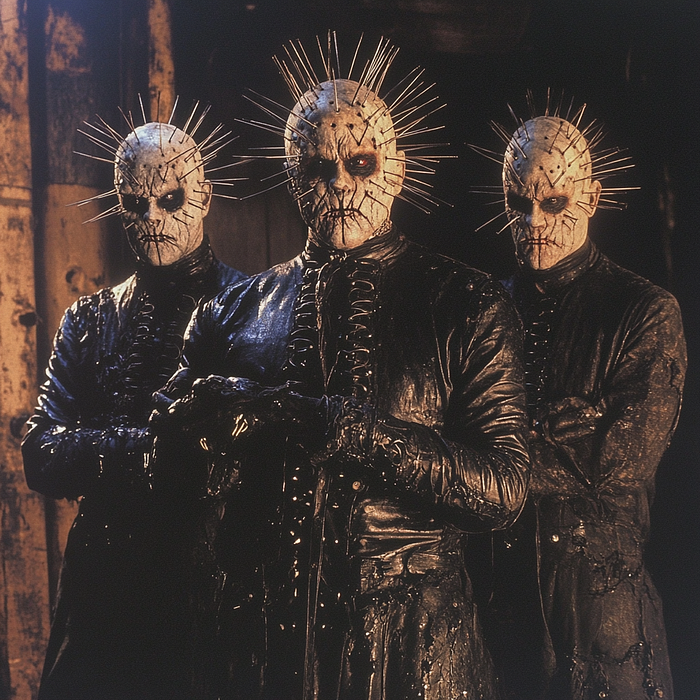
This is a nice companion piece to Fifty Shades of Grey.
This was such a dark, twisted modern fairy tale about a couple nasty people ultimately getting what they deserve. You wouldn’t think a novella about BDSM demons from another dimension would be an insatiable read, yet this is one you can’t put down once you start. Barker’s writing is spooky campfire story tone, with sentences that pulse with blood and desire. Is this one of those rare books where the movie exceeds the source material? Probably not. Hellraiser is a decent horror flick, but Barker’s true talent lies in his writing.
I like to revisit this book every year around Halloween, but it also makes for a good stocking stuffer.
6.) Altered States by Paddy Chayefsky

Ever wanted to experience the psychedelic/swinging 60s/70s in book form? Now you can! Well, it’s not quite same as dropping a tab of acid, or swallowing a handful of mushrooms, but Chayefsky’s novel, which he adapted into the movie starring William Hurt, is like an adult version of Alice in Wonderland crossed with Frankenstein with a dash of The Electric Kool-Aid Acid Test. Or imagine if Michael Crichton had become a theoretical physicist with a wake and bake routine.
I mainly read this book just to check out how Chayefsky, already a legendary screenwriter, handled a novel. I’d say this represents a culmination of nearly all his writing efforts. His work generally contained existential themes like the meaning of life, humanity in the face of industry, and such heady topics. But Altered States explores the very nature of consciousness itself. At times it’s a little too jargon heavy. Chayefsky’s two years of intense research amongst the Boston-area medical intelligentsia certainly shows. This is not a book that attempts in any way to be relatable, reflecting the monastic traits of its main character. Nor is it a book that will necessarily put you off due to its way out there premise. I think Chayefsky actually left a lot on the table, and could have explored the transformative effects Jessup experiences in the isolation tank more thoroughly. Instead, plot is dispensed with in favor of scientific soliloquies. Not bad, overall, it just feels truncated.
This is one of those books that you will likely revisit several times in your life, drawing different meaning from it depending on which era you’re currently in. The movie is decent, but don’t expect it to offer any more answers than the novel.
7.) The Luck of Barry Lyndon by William Makepeace Thackery
You’ve heard of the D.E.N.N.I.S. System from It’s Always Sunny in Philadelphia. Allow me to introduce you to:
The B.A.R.R.Y. L.Y.N.D.O.N. System
Be of noble birth.
Always be seducing wealthy and vulnerable heiresses.
Rogues are cool.
Really, rogues are super cool (especially Irish ones).
Yes, my great-grandaddy was an Irish king.
Lying? Me? Never.
Yes, I’ll have a fine brandy. All of them, in fact.
Nora, that bitch.
Destroy scheming step-sons at all costs.
Only bang sluts, never marry them (unless they’re rich).
Never surrender a chance to duel.
William Makepeace Thackeray’s Barry Lyndon is many things. It’s a picaresque confessional novel, a sort of 18th century American Psycho. It’s a satirical look at class and the aristocracy of England during a transformative time when the American colonists were overthrowing the rule of the monarch.
I found its greatest strength to be its cruelly honest depiction of an unhealthy and toxic marriage, in the form of the relationship between Redmond Barry, who becomes Barry Lyndon upon his marriage to Lady Lyndon (the wealthiest heiress in England, apparently). Despite being of low birth, through mostly violence and psychological warfare, Barry gains control over Lyndon’s entire estate, and promptly plunges it into near bankruptcy. He isolates his wife from society, abuses her in drunken black out rages, makes a mortal enemy of her son Lord Bullington; yet still produces a son with her to serve as his heir. As with everything Barry touches, it turns briefly to gold, only to crumble to dust. His son dies in a tragic horse accident, and he is ultimately undone through trickery just as he is ousted from his first love Nora at the beginning of the story.
Subtley, Thackeray seems to hint at the failure of English society, despite all its pomp and importance. All it takes is a mere “Irish rogue” with enough cunning to spearhead his way to the top of the heap (however briefly), to be undone only by the same vices that lead him initially to success. But perhaps Barry isn’t completely to blame. If one wanted to rise above his station in those days, in that part of the world, one had to be a force of nature. You had to be willing to do whatever it took. Only the few were born into the nobility, and so had the leisure of acting as “gentlemen.” For the rest, it was either through military service (risky, considering you had a high chance of death, disease, or dismemberment), or schemes. America had not yet been invented. There was yet very little means for one to climb upward.
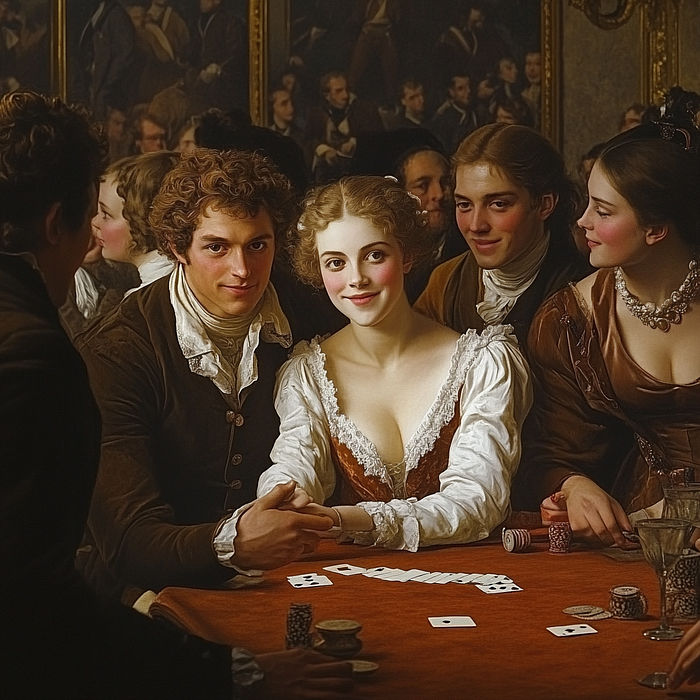
Barry gambles compulsively, a habit that serves him mainly in youth, when with his uncle, he tours Western Europe separating fools from their money. Barry’s only chief skill is in fact “play,” (cards) a perfect metaphor for the arbitrary fate that falls on those who choose the criminal life of deception and violence. Though nowadays Barry’s means of creating wealth might be related to the casino dealings on Wall Street. A modern day Barry Lyndon would probably be a Silicon Valley fraud, a la Theranos’ Elizabeth Holmes. Someone psychopathically fixated on achieving status not so much because it’s fulfilling or it even satisfies some inner need, but simply because their brain seems wired in such a way. The world is filled with Barry Lyndons, just as the world is filled with horrible, shitty marriages that nevertheless go on.
The Luck of Barry Lyndon is worth a read, as is Stanley Kubrick’s film adaptation, it goes without saying. It’s a bit dry in spots, but the parts with Lord Bullington are worth waiting for.




 Dean Brooks