I truly believe that in the year 2000 our timeline somehow got diverted into the Shithole Dimension in which we currently reside.
How? I blame Y2K. We were supposed to let that supposed “glitch” play out, not “fix” it. Instead, we collectively ctlr+alt+deleted our way into this nightmare world.
That, or the gods simply hated those stupid “00” New Year’s Eve glasses everyone was wearing celebrating the Millennium, and decided to punish us with two and a half gray mushy mash no identity decades. What is the difference between the year 2003 and now? Seriously. None. If you stuck me in a Delorean and sent me back, I’d hardly notice any changes. The clothes, the tech, the political scene — all virtually the same.
We left the “Go-Go 90s” or the “Gay 90s” or “The Decade of Peace,” for the “Oughties.” Or is it just the “Zeroes?” Or the “Two-Thousands?” Boring and WTF either way.
Even IN the ’90s, we used to say, “It’s the ’90s, baby.” On New Year’s Eve of 1999, I remember partying with some coworkers at a popular resort named after a Roman emperor to Prince’s song “1999” the moment the ball dropped. It was awesome. It was like we knew we’d reached an Apex of Cool and the universe had serendipitously rewarded us with our very own anthem for the year with a song written way back in 1982. How’s that for a pre-expectation of good times? People were excited for the ’90s already in the ’80s. Who the fuck was looking forward to 2009? 2013? 2017? 2023? The current year?
“This the ’80s and I’m down the ladies.”
Then just today I’m driving along and I hear the classic 1989 song “Funky Cold Medina” by Ton-Loc, which includes the line I quoted above. The previous seventies decade may have been the “Me Decade,” but even in Ronald Reagan’s America people were ready to get down. And that was with the Cold War still going on. The “Swinging Sixties” were turbulent, sure, but defined by great music, social changes, and apparently swinging. It was a decade marked by sexual experimentation and liberation. So like the ’70s, ’80s and ‘90’s, it had a certain sex appeal. Then before that you had the “Rockin’ Fifties.” Also known as the “Fabulous Fifties.”
It wasn’t all fun and fornication, of course. You had the “Fighting Forties,” due to WWII. The “Dirty Thirties” thanks to the Great Depression. But before them you had the “Roaring Twenties,” because of the skyrocketing stock market.
Meanwhile, the 2000s, or “Oughts” or “Zeroes” has no real nickname. The “War on Terror Decade?” Too negative. “The Age of Premptive Strikes?” No, too cynical. “The Bush Years.” Come on, man.
Okay, forget the 2000s. Onto the “teens.” Or “twenty-tens.” Or “twenty-teens.” This decade doesn’t even have a proper numerical designation. Can we hope for at least a halfway decent nickname? I’m drawing a blank here. The “Troublesome Teens?” The “Tiresome Tens?” Oh, I know. the “Transformative Teens.” Kind of a catch-all. Plus it subtly alludes to the whole transgender craze starting during the latter part of the decade. And it was a transformative decade, for sure.
Which finally brings us to this decade. The twenties. We’re halfway through and I’ve yet to hear any kind of a definitive nickname. I’ll refer you to my suggestions up at the very top. The “Terrible Twenties” sounds too dramatic. The “Trumpy Twenties” is too specific.
Besides —
We don’t yet know how the next five years will shake out. For all we know, we’re all of us gifted with unicorns that piss gold coins and shit Godiva chocolate in this decade’s latter half. In which case we’d be the “Enchanted Twenties.”
It could maybe be the “Twitter Twenties,” if it hadn’t become X. I like “The Spendy Twenties” best as it alludes to high inflation and the costs for everything getting completely out of control. I went to the supermarket recently and eight chicken wings cost $18. Eighteen dollars. Fuck it, I’ll just eat carpet.
I’m not ready to write off this entire decade just yet. I’m willing to give it a chance. But unlike the ’90s or ’80s, the twenty-twenties has got no vibe. It’s got no aura. No zip. No rizz, as the kids like to say. Frankly, I’m embarassed to be living in it. Especially when I’ve had better. Way better. That’s not good. We need to reset those computers back so they just read two digits again, so we can spring out of this bizarro pocket dimension of identity-less decades and back into our old reality. We should have had the “Duuude-Thousands,” then the “Terrific Teens,” before living smack dab in the middle of the “Friendly Twenties.” Instead, we are lost and adrift, and without a name.
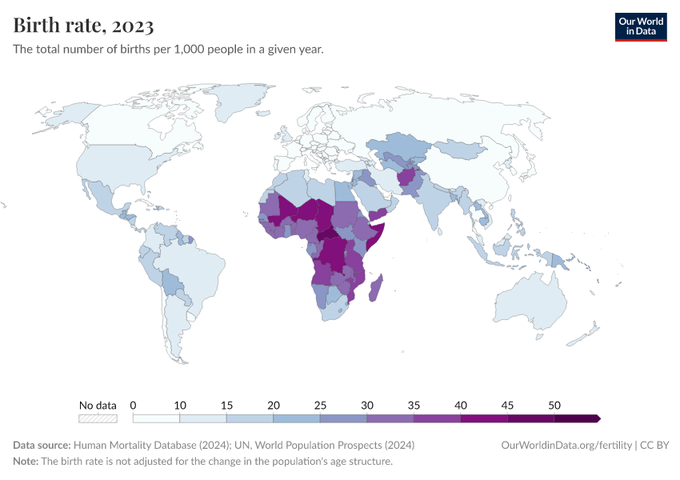
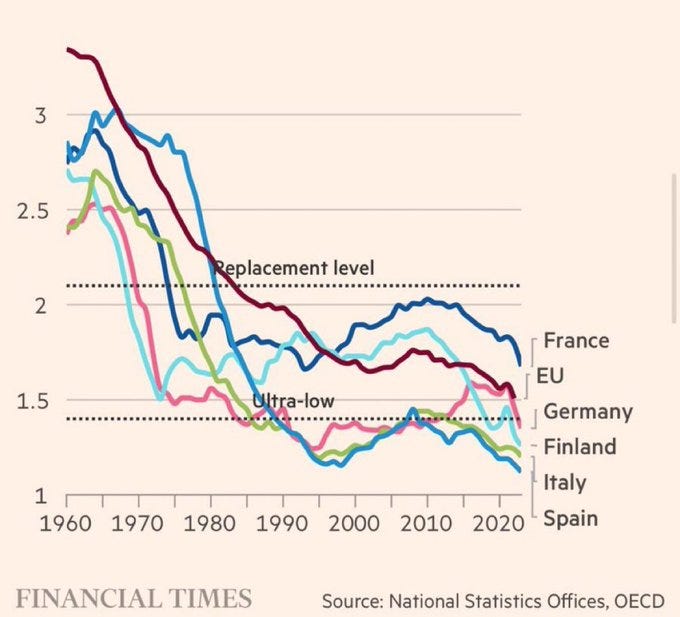
Despite not having any kids, I’ve become intrigued lately by all the doomsdayers out there raising alarms about birthrates and replacement rates. Elon Musk, who has 14 children with five different women himself, talks about it almost every day on X. Recently, he retweeted a user who shared some shocking graphs:
Source: OurWorldinData
Then there’s this one:
Source: National Statistics Offices
Wow. That is what’s called a precipitous collapse. The West will be extinct before long at this rate.
Anecdotally, my grandmother had eight kids. My biological father had seven. My mother had four. I have two half-siblings who have two kids each. My youngest half-sibling has none, as do I. Only a few of my cousins have more than one child. I’ve witnessed in my time a severe narrowing in the number of kids couples have over the generations. Marriage rates have also gone down. The average age people marry has gone up. And the number of children people have who happen to get married or cohabitate has shrunk across the board.
Not so in Africa, according to the graphs above. Especially countries like Nigeria, which actually has a population explosion that is projected to reach over 400 million by 2050, according to the World Bank. The United States’ population is currently 340 million for comparison.
So, what’s going on? Why can’t the West reproduce itself? I’ve heard all the excuses: expensive housing, cost of living, the job market, etc. However, according to a recent study that looked at the population trends in the African country, “income does not play any significant role in the demand for children in Nigeria.”
The 2022 study is titled “Fertility and Population Explosion in Nigeria: Does Income Actually Count?” You can check it out at this link here.
There are some key takeaways aside from the obvious ones involving increased life expectancy, declining death rate, and high infant mortality. Nigeria has seen improvements in both those areas over the last 59 years, though its infant mortality rate is among the highest in the world, and correlates with the higher number of births.
But if it’s not income or medical care that’s keeping the West from reproducing, what is? Culture, mainly. Take a look at Nigeria’s attitude toward children in general, and see if there’s a marked difference with the West’s.
From the study:
Children are viewed as a future investment and given the uncertainties of them having a brighter future, a poor household can produce more children to try their odds. That is, out of the very many children, some could have a chance to become prominent individuals in the society. Apart from that, some traditional Nigerian households views greater number of children as a strength to the family in terms of providing family labour at the subsistence level.
There are other cultural factors at play, which I’ve broken down here:
early marriage
universal marriage
prolonged childbearing
low contraceptive use
cultural emphasis on large families due to fear of lineage extinction.
I bold-faced the last one because it ties in with high infant mortality.
Fear of extinction fostered increased reproduction in the face of perceived high child mortality with the expectation that some of the births would survive to carry on the lineage.
It also is what most differentiates Nigeria from the West. Those few who procreate here in the U.S. do so within a bubble of relative security. It’s never been safer or easier to have kids from a medical point of view. Yet families in the U.S. remain largely fractured and small. Members are often adrift from one another. Who fears their family name dying out who isn’t named Trump or Musk?
Meanwhile, Nigerians reproduce as if they have a gun to their heads. Is it mostly due to the infant mortality rates? I don’t think it’s that simple. I get the sense that even if infant mortality were to suddenly incline here, it’d be met with indifference. Most women support abortion rights and put off having children until their 30s. Few men want to become fathers. Fertility and parenthood are not treated with celebration but looked at like nuisances. As obstacles to having fun or achieving life and career goals.
People are staunch individualists, focused intensely (selfishly, even) on their career and capital acquisition over reproductive relationships. We’re a culture obsessed with entertainment, dopamine fixes, and endless sensory distraction. To put it crudely, women would rather strip on OnlyFans or sip mimosas at the bar with their girlfriends on Friday nights, while men would rather play video games and jack off to internet porn, than do something as backbreaking like start a family. Much less a family above the replacement rate.
Sex education starts young, with a heavy emphasis on contraceptive use. We all remember the condom and banana demonstration in fifth or sixth grade. Sex ed also pounds on this idea that getting preggo is basically the end of the world. While out-of-wedlock teen pregnancy is obviously not ideal, that anti-natal sentiment carries on into adulthood. Fewer people marry, and hardly anyone marries young. In fact, the idea of getting hitched prior to age 25 is seen as absurd. Your twenties are supposed to be for “experimentation,” and screwing around, not getting serious with anyone.
None of this is to say Nigeria’s population explosion is an ideal to aspire to for the West. Severe poverty persists. Excess population is a drain on resources. In fact, the baby boom is considered a crisis in the country. The study states in its conclusion:
Population control is therefore sacrosanct to save the nation from peril.
Nigeria’s high infant mortality rate also continues to be a problem. By reducing that, in addition to better sex education, the country may be able to reign in its population.
In fairness to the West, medical technology may help extend life spans and quality of life far beyond what’s typical. Many people continue to work into their seventies and beyond, and not just our politicians, either. Plus, our infant mortality rates are extremely low (5.6 deaths per 1,000) compared to Nigeria’s (72.2 deaths per 1,000) and other African countries.
It is possible that a birth rate below replacement is a natural and inevitable byproduct of a modern, developed civilization. But it’s odd and disquieting that even in the face of imminent extinction, our collective response is nonchalance. At what point, if at all, does self-preservation kick in? For many Millennials and Gen-Zers, it will be their social media accounts that will serve as their final legacy, not their genetic progeny. A sad state of affairs.
I found this study fascinating because it helps dispel the myth that income and cost of living are the biggest factors in why few in the West want kids or want many of them. It’s not a financial issue, it’s a cultural one. I don’t see those trends reversing anytime soon, if ever. We’re never doing away with sex education. We’re never going to tell our teens to shack up young or put off college to have a family. We’re never going to be anything but workaholic, screen-addicted, materialistic pleasure-seekers who only seem to have families by accident instead of intention. What modern woman aspires to having kids period, much less four or five? What man would choose breadwinning over fantasy football and e-thots? Face it. We just hate kids.
To quote a meme I recently found on X: “We traded bedtime stories for higher GDP.”
Years ago, this was a taboo subject for me. If someone asked me, “What are you?” (which, by the way, is not really the most tactful way to ask someone about their ethnicity) I would freeze up. I’d get angry, but try not to show it. Sometimes I’d just ignore the question altogether as if it were clearly only asked by mistake, or uttered due to a Tourette tic, and therefore to be ignored so as not to embarass the asker. It would take me hours to calm down.
Nowadays, I don’t really care as much. I’ll usually answer with some generic version of, “I’m a lot of things.” If I’m feeling spicy, I’ll say something like, “What, are you a census taker?” It’s more a source of humor for me now. I can laugh at it. I don’t turn into some schizoid weirdo anymore when the subject of my race comes up. I can examine it detached, clinically, and somewhat neutrally. But it’s not exactly a subject I care to get into. I truly do wish we lived in a race blind world where it was no big deal. But people are curious. And like it or not, race is a fascinating and often contentious subject.
I should probably clarify what I mean when I say, “I hate being biracial.” That’s a pretty extreme statement. I don’t hate myself, to be clear. I hate my racial mixedness and my skin tone that implies it in the same way a 5’2″ guy might hate the fact that he’s short. Or a balding guy hates that he’s losing his hair. Or the way someone might hate that they struggle with their weight. I don’t view race as some “extra” thing about one’s identity. It’s just another physical attribute of one’s body. I hate that it’s a “conversation piece.” Something that it feels I have to justify or explain. It’s like missing an eye — you’ll invariably get that question of how you lost it. I also hate the size of my nose and my acne-prone skin too, for that matter. So, it’s purely in that vein.
I’m not saying being racially mixed is inherently a negative. Some people I’m sure love it or take “pride” in it. Me, not so much. It’s always felt like I was wearing clothes that don’t fit.
I tend to surprise people when I bluntly state how I don’t like being mixed. “What, OMG, but what about Tiger Woods or (fill in the blank racially mixed celebrity)?” Yeah, what about him? His race is Wealthy Celebrity Athlete, not whatever mix he is.
“Oh, but you have the best of both worlds. Whites tan at salons all the time so they can look like you.” If it’s so great, then everyone would be in an interracial relationship so they could have mixed kids. Except the vast majority aren’t because they don’t want that, because most people want their kids to look like them.
“But you look like the future.” What future? When? In two hundred years? Why should I give a fuck what people hypothetically may look like in two centuries?
“But Jesus was biracial” (yes, someone said that). What? No he wasn’t. He wasn’t even really human (assuming he existed). You see any ordinary people turn water into wine or rise from the dead? I didn’t think so.
::sigh::
Race carries with it more social baggage than most other physical characteristics. People tend to assume all kinds of different things about your race. One’s race can often result in far different life experiences and perspectives. I don’t subscribe to many of the left wing concepts about DEI, unconcious racial bias, and a lot of other race-themed stuff. It all seems to be targeted unfairly in one direction — at Whites. A lot of it is nonsense. And also because honestly, I just don’t care. So-called “bias” is often rooted in simple pattern recognition. If a woman by herself sees me walking down the street at night, she’s more apt to feel afraid of me than another woman. Well, duh. That’s because men commit like 99% of all assaults, and mostly they assault women. By the same token, if you had to guess who the majority of shooting victims in major cities are, and you thought Black youths, you’d be correct. Stats are not a form of “bias.” Self-preservation based on pattern recognition is not bias. But I get where the leftoids are coming from in some ways. Some genuine racism exists. Okay, got it.
I’m also not as extreme as, say, Jesse Lee Peterson, who refuses to acknowledge that racism even exists. But I also get where he’s coming from there, too. Racism is very overrated these days as a social ill. Most times if someone doesn’t like you, it has nothing to do with your race. They just don’t like you individually. Too many people are too quick to assume it’s all about race and racism. It really isn’t. I also don’t care for the right wing platitude, “There’s only one race — the human race.” Really, you sure about that? Because I’ve never seen a right winger (or anyone, for that matter) just blindly choose where to buy a house. Usually “the type of neighborhood” (i.e. how many Blacks/Browns live there) factors a great deal into where one intends to live, especially if they’re White.
Basically, I’m 64% European. Mainly a mix of Italian, Irish, English, Portugese, and other things. While also being about 25% Indigenous American due to my Mexican/Hispanic background. The small remainder is a mix of West Asian (4.9%) and Sub-Saharan African (2.7%). The precise genetic mixing is not that important. What’s important is that I’m dark and different looking enough to not just be “plain boring” White. Most people don’t really know what the hell I am just from looking, though many will guess Hispanic, as that part of me dominates my physical features.
For the fortunate, their race or ethnicity is not a contentious issue. For some it’s a total non-factor. For me, even the fact that I was racially mixed at all was a source of debate. Well, denial, really. My mother (White, mainly Italian and almost entirely European) always insisted that I too, was White, because “Hispanics are considered Caucasian.” That’s debatable in some ways depending on how closely related one is to the Spanish versus the native tribes the Spaniards and other Western nations colonized way back when. But few people will just lump Mexicans in with White unless they look totally White. Certainly not dark. I did not have “dark” skin, I had “Mediterranean olive skin,” according to my mom. Given that I am 64% European, I can see her point. But I think a lot of my mother’s beliefs were wishful projections on her part. She split from my father when I was barely an infant, and then the two fought a nasty two-year custody battle over me. My father is where I get my darker pigmentation, as he’s largely Mexican. My mother did not wish to have a Mexican-looking kid. She wanted a kid who looked more like her. So, therefore, I was “White,” darker complexion be damned.
It’s a tough thing for one’s mere conception to become the source of great conflict and drama between parents. When you add in the culture and racial clash, it can become pretty severe. Then when you also add in the fact that one parent denies that you’re even racially mixed to begin with, it can create a rather toxic identity-shattering brew. Making matters worse, I did not have the opportunity to know my biological father growing up. I never had any connection to my Mexican/Hispanic heritage. I did not get to know my many half-siblings on my father’s side. That whole part of my background was handwaved away and treated as though irrelevant. My mother later married a White guy whom I never cared for, and then had three more children. I was the lone mixed bastard offspring.
As a kid I adapted fine to the family dynamic. What other choice did I have? It was only as I got older that I realized what a shit deal it all was for me, and resented being the different one. I wasn’t even allowed to refer to my step-dad as “step-dad.” He was my “father,” which became a source of contention and conflict. My mother’s separation of me from my real father was never really explained and never justified. Making things worse, my mother became an extreme fundamentalist Christian in the Southern Baptist tradition. This was at the height of the “Moral Majority” and End Times stuff in the ’80s and ’90s. My mother viewed her past with my father as her old, “sinful” life. Now she was “saved.” This is not uncommon. Many women go out into the world, get pregnant by some dude they end up hating, then do the about face into the piety and religion thing. It’s practically a trope, which I call “whiplash conversion.”
This whiplash conversion trope is something White women excel at particularly. Get knocked up by a Brown/Black guy they were just “experimenting” with, then go running into the arms of a safe White guy provider and turn Christian and go to church three times a week. It’s become such a common thing that it’s mercilessly mocked on the racist side of X and other social media. It’s called “paying the toll,” “coal burning” or “mudsharking.” There are tons of memes about it which I won’t share here, but they’re easy enough to find. Having been the product of such experimentation and suffered as a result, I’d be lying if I said I don’t feel visceral anger when seeing such cataclysmic breakups happen to other children, especially boys. It’s not pleasant to know that most of society views you as the butt of a joke, even though they’d never admit it outloud. Sure, you can say it’s “only social media.” But social media reflects a lot of actual social thought.
For me, race mixing, and its consequence of racially mixed offspring, will always carry a negative taint, even though I myself am biracial. It will always be something that bears high risk. Like carrying nitroglycerine across a cobblestone road. It will always be something that represents pain and loss for me, due to the fallout between my parents and how it affected me. Divorce and parental strife is bad for children of all races, but for the biracial there is the added risk of losing touch with half their heritage, and potentially feeling lost and bearing an identity crisis later in life. Many biracial people report having conflicted identity issues no matter what.
Many biracial people would choose one side over the other if they could, and feel it isn’t themselves but society that chooses what they are. It’s that lack of having a choice about who you are that bothers me especially. I also have no choice but to perpetuate race mixing if I were to have kids. No matter what race my wife would be, my children will be mixed because of me. Do I risk potentially burdening them with the same issues I had?
Even in an ideal family situation, there’s a tendency to prefer association with those who look like you. Like tends to attract like. This is why Whites tend to buy homes in White neighborhoods. It’s why race tends to marry within race, even in supposedly multicultural America. Something like 80% of White women marry White guys. Black women and Asian women tend to be most open to marrying outside color lines. With Hispanic women, it’s more split. But then many Hispanics do pass for White or have some overlap (like myself).
Being biracial puts you at a statistical disadvantage when it comes to finding a partner, because you have to find one who is comfortable with both your backgrounds — something I’ve found is not often the case. You could, of course, try to find another biracial person. But we are actually few and far between, and depending on shade, we tend to go for our “dominant” side. Then there is the aspect of disappointing both sides. As I wrote about in the above-linked article, I’ve been told I’m “too White” by Hispanic women and not White at all by White women, or not White enough. Something I’ll always find sadly amusing.
You also have to watch out that you’re not just a “flavor of the month,” or that someone is only interested in you just because of your skin tone. Many years ago, a White lady at work tried to set me up with her only daughter because her daughter was “into Hispanic guys.” I politely told her no thanks. I have no idea what it means to be “Hispanic.” It’s just genetic happenstance to me. I’m just a man. I’d rather someone like me for me. This was a tough thing to do, because her daughter seemed nice and I did find her attractive, and I got along well with her mother. I sometimes think back to that encounter and think that had she approached me from a better angle, how it could have gone another way. But I didn’t have any idea what sort of expectations a girl who’s “into Hispanic guys” had, and it honestly made me uncomfortable. I get that race is a factor in attraction, but it’s usually not something that’s a first priority unless you’re fetishizing it. Oh well, it doesn’t matter now.
Being mixed is like living in a racial no-man’s land. Given the fact that virtually every social environment I grew up in was nearly 100% White, it’d have been far easier for myself to have just been White rather than only culturally White. Being Not Actually White but having to be surrounded by Actual Whites makes one feel like a fraud, as I suppose it would be for a “daywalker” of any other race. Half-Black, Half-Asian, whatever. I never really felt comfortable or fit in, even with my own half-siblings. It’s not exactly psychologically healthy to always feel alien, especially when living in your own house. Moving around as much as I did didn’t help things, either. And I moved a lot. You tend to feel more alone and isolated. It was increasingly harder to even relate to my own mother. I look very little like her, and in fact, look the most like my father out of all his kids. Had I grown up and lived in a largely Hispanic area, I would probably have felt the same alienness about my Whiteness.
It’s not all doom and gloom. Perhaps my experiences are what led to my self-reliant and highly individualist nature as an adult. Besides, virtually all kids have trouble fitting in in their own way. I knew a White girl in fifth grade who one day decided to stab herself in the side with a pencil because she didn’t like being in class. I remember the side of her t-shirt soaked with blood as she got up to go to the nurse. I wonder what kind of inner turmoil she must have been going through. For all my inner angst at the time, I mean, hey, I never stabbed myself or did any self-harm. It could have been worse, you know?
These days, mixedracedness and diversity are broadly celebrated. At least it would appear that way in the media. There is less cream cheese on TV and in movies in favor of caramel and chocolate. Racially ambiguous stars like The Rock and Vin Diesel are popular. Hell, we had a biracial president in Barack Obama. Doesn’t all of that mean we’re progressing? Surely we are on the cusp of a racially blind utopia. Daywalkers like myself should be rejoicing as we enter this new age. Except I think we’re more divided now than ever. I think a lot of diversity is forced, contrived for image, and not exactly genuine. Like I said before, people freely associate. We don’t exist in some hypothetical national narrative perpetuated by the media. We exist at the local level. In our own lives. Not in an NFL commercial. Racial and ethnic tensions still exist. But whether you’re one race or another, at least you know what team you’re playing on. When you’re mixed, you have no idea, and neither does anyone else.
My perspective has grown and matured over the years. In the end, you get handed the genetic cards you’re dealt, and you’ve got to play them however you can. Both my parents are short, and yet somehow I wound up six feet tall. Something like only 15% of men are six feet or higher. That’s a plus. Most of my family lived long healthy lives, even into their 90s. I’ve been healthy my whole life, knock on wood. I admit that a lot of my thinking about being biracial is colored negatively because of how my parent’s relationship fell apart. Had things gone better there I probably would feel rosier about it. But the chips fell as they did.
I don’t view any one race as inherently better or worse. But there’s no denying that being in a region where one race is the super majority that you’ll likely feel isolated and alien if you look different. However, it’s not like being White means you automatically fit in with other Whites. No race or ethnicity is a monolith. Still, I’ll probably go to my grave hating being biracial. For me it brough too many complications I’d just assume not have. But that doesn’t mean it’s not a good thing for someone else. Everyone is different in their own way.
The other night I went on one of those fantastic once in a blue moon dates that started off perfectly. The kind where you’re finishing each other’s sentences, laughing uproariously at each other’s jokes, and looking into each other’s eyes with chemical attraction, both thinking “This is the one!”
I’m not sure how the floodgates of simpatico opened. Was it our mutual rizz? My confidence? Her charm? Or maybe my seductive sweet talk.
Her: You’re unusually confident. Most guys turn into jibbering idiots around a Mars, Inc. heiress and Miss America contestant like myself.
Me: It’s because I know you’re not mine, it’s just my turn.
Her: That’s the most romantic thing anyone’s ever said to me.
Me: Right? If you and I were to get together, eventually you’d leave me beause of hypergamy, also known as “monkey branching.”
Her (swooning): You know so much about female nature.
Me (taps head): I’m a Red Piller. I’m in the know, baby.
Her: But I really do like you! I swear!
Me: Oh, sure. You say that now. But in two years? Five? Ten? Fifty?
Her: No, I’m serious. I’ll marry you right now.
Me: Sorry, but I’m not going to be the sucker who gets his heart broken at some indeterminate point in the future. It’s better to not try at all than to risk that. Goodnight, Miss America.
Sadly, our true love was not to be.
Out of the many Red Pill dicktums that are out there, this one may be the most cynical and toxic. However, technically it is true. In every relationship there is a 100% chance it will end. It’s just a question of when and how. Death? Divorce? Due to cheating? Or simply “growing apart?” Obviously no relationship is forever. But is it productive to go into one already anticipating (if not expecting) its eventual failure and the ensuing potential heartbreak? Do football players who reach the Super Bowl go into the game expecting to lose? Fifty percent of them will not hoist the Lombardi at the end of the night, but such a loser mindset is destructive and can create its own self-fulfilling prophecy.
The Red Pill solution to this Gordian Knot of inevitable relationship obsolesence is to “spin plates.” That means to have a number of women on rotation that you sleep with and/or with whom you maintain a connection. This way if one has a “hypergamy-gasm” on you, you can counter by just ringing up the next bimbo in line. Putting aside the fact that for average men this is largely an unrealistic scenario, “plate spinning,” even for high-value Lord Cockuluses, is time consumptive, expensive, largely superficial, and leads to nothing but complications.
There’s no genuine social regard for such plate spinning behavior, either. Society does not view you as King Solomon and his many concubines. You’re just a dude who can’t keep it in his pants. Though the family court lawyers chasing you down for child support and paternity tests will love you, I’m sure.
As I’ve mentioned elsewhere, the Red Pill, aside from some generic be-your-best-isms, is just hedonism in disguise. Some are out there saying men should have sex with as many women as possible in preparation for marriage. Will these guys just start their own indy porn studios already? It’d be a lot more efficient.
“She’s not yours, it’s just your turn” best articulates the caustic outlook of the manosphere, which views relationships as inherently temporary and disposable. Interchangable, even. Like picking up used parts for a factory machine you expect to break down. On the surface it seems like good advice. The subtext is the admonition to not allow a relationship with a woman to consume you from succeeding in your life’s work and mission. Fair enough. I recall watching an animated series on Newgrounds decades ago centered on a bright young guy who gives up a scholarship to M.I.T. to pursue his high school girlfriend to some state college, only for the girl to abandon him so she can “explore” herself. That scene always stuck with me. What an idiot, I thought. Though there have been many such cases in the real world.
Making yourself an attractive quality partner and focusing on your unique gifts and your work so that you become the “prize,” is a worthwhile endeavour. In so far as the Red Pill espouses that doctrine, I’m on board. But then why the need for plate spinning? Why add all that unnecessary drama, not to mention the greater chance for STI infection or illegitmate children? I’m the bastard product of the kind of, shall we say, “excessive amorousness,” the Red Pill promotes, and let me tell you, it ain’t good being an infant football getting kicked around between two warring ex-lovers in family court, and losing one’s father in the fallout. To say nothing of being the proverbial redheaded step-child. Especially when you’re racially mixed.
You have to judge a philosophy or thought process based on the results as seen by the behavior of its followers, not entirely on whether it holds any real “truth.” The Communist Manifesto may have some worthwhile nuggets, but in practice communism is a ghastly inhumane system, as evidenced by virtually every country that’s tried it. The Red Pill is not waking men up from the Matrix of feminism, it’s demoralizing them and putting them to sleep, mainly. Most men aren’t even trying with women in the first place. Almost half of young men haven’t even approached a woman in person. They’re certainly not going to “spin plates.”
“She’s not yours it’s just your turn,” may seem like some a cold, hard truth to shield one’s heart from the cruelties of break-ups, but it functions as an install code for manwhorism, while devaluing potential quality relationships that might arise were one not seething 24/7 with pathological distrust. It’s less the war cry of a victor and more along the lines of Milton’s “Better to rule in Hell than serve in Heaven.”
So a few years ago, for a summer school project, I had to travel to some middle-of-nowhere town in North Dakota for a ten-day project to help model and reorganize the town’s tiny museum from a junk drawer to a pristine attraction. It was for a Public History class, as part of my history minor. Not something I cared to do, but it was a credit requirement. I was half-way to finishing my long-delayed bachelor’s degree, having returned to college late in life. Needless to say, I was the oldest, most mature, and therefore, most level-headed of the students there.
Anyway, it just so happened this project occurred when Wonder Woman was premiering in theaters. And the whole time, this one young woman kept prattling on about how we all HAD to go watch it that Friday night. Now, at the time, I was somewhat into Marvel/DC stuff. But selectively. I enjoyed Captain America, Ant-Man and a few others. They were fun diversions with generally servicable stories and entertaining characters. Wonder Woman didn’t really appeal to me, but it seemed like an okay film from the trailers.
So check it out that Friday night we did. Afterward, we’re all huddled together in the lobby discussing what we’d seen. When it came to my turn, I said it was a decent film, somewhat enjoyable, with a disappointing climax. Well, this ruffled the Prattler’s feathers. Huffing and puffing, she wagged her finger and shook her head at me, scolding and scowling.
“What do you meeean you didn’t like it?” grumbled the Prattling Scowler.
She was, shall we say, a big girl, with a proportion not dissimilar to a beach ball. So when she shifted her position on the thin lobby carpet, I actually felt the floorboards undereneath me creak. I retierated my stance, which I felt was not exactly negative — I never said I “didn’t like it,” afterall. She huffed and puffed again, apparently stung. Then she quickly polled the rest of the group for their reactions. All quickly agreed it was “great.” Prattling Scowler then glared at me, turned her nose up, harrumphed, and turned away. We headed back to town.
But for the rest of the trip I was basically persona non grata. My “dislike” of Wonder Woman was the subtext of every reaction I had with the Prowling Scowler. It was as if I’d insulted her religion or family, or something.
The whole situation left me amused. Not just because I felt it was ridiculous for a 25-year old to get that butthurt over some stranger “not liking” her movie. It was that my neutrality was so unbearably intolerable for her. She demanded fealty. Glowing adulation. I had to like it, or else I was a terrible person.
Of course, I knew why. It was because Wonder Woman was a feminist avatar. And so not liking it obviously meant I hated women. I know that sounds like a weird tortured chain of reasoning. But it’s the only “logic” that makes sense. Why would anyone care whether some random dude likes their movie or not unless that movie validates some deeply-held belief or idology of theirs?
I don’t think Wonder Woman is a feminist avatar, personally. I think it’s kind of silly to import that kind of value to a comic book character. We’re talking about a character that runs around in her underwear all day and looks like a supermodel. She was obviously riginally made as eye candy for the masses of male comic book readers. But even if you think she is a feminist avatar, why would it matter what any man would think about her? Especially a guy in his mid-30s (which I was at the time)?
That would be like a dude-bro getting his Bud Light boxers all twisted because some random girl doesn’t like Dominic Toretto from The Fast and the Furious movies. Or take movies like Predator, Mad Max, Commando, and others. Macho movies I’ve enjoyed. But I would totally understand a chick thinking they’re just silly man flicks. I certainly wouldn’t get all bent out of shape because some random girl doesn’t like Arnold.
Which brings us to Captain Marvel, and the sequel The Marvels, which just released its trailer.
Wonder Woman seems a charming, positive role model, and her movies are harmless and fun. Gal Gadot is nearly perfectly cast. I can maybe see a woman-child feeling jilted at someone not liking the character.
Captain Marvel, on the other hand, is an objectively shitty movie character with an objectively shitty casting choice. Which is a shame because the character itself had a lot of potential. I’ve always liked Superman, and Captain Marvel is sort of the Avenger’s version of the Man of Steel. So I was ready for an honorable do-gooder type persona when I sat down to watch the 2019 film when it opened. Instead, I got an unlikable asshole.
It’s mostly due to the bad writing, but also Brie Larson, who is perhaps the worst casting decision in the entire history of Hollywood. Like, John Wayne as Genghis Khan was less outrageous. If you’re going to have a big, powerful super female who’s supposed to be a competent, inspirational leader, don’t you think you should cast someone who can exude those qualities on screen? Captain Marvel should have been portayed by someone like Charlize Theron or Emily Blunt. An obvious Alpha Female who doesn’t need to try hard to look like a boss onscreen.
Larson does NOT exude any of those above qualities. She’s very good at playing desperate, frustrated, beta characters who can scrap their way out of situations. She won an Oscar playing one, afterall, in Room. But as a charismatic, likable lead on the level of a Chris Hemsworth as Thor or Robert Downey, Jr. as Iron Man? Or Gal Gadot? Don’t be serious. If anything, she comes across more like a villain than a hero. Captain Marvel is supposed to be a US fighter pilot. As in, a very competent, very type A, driven sort of person, who’s also very cool. Not a cranky Karen. Captain Marvel the movie should have been like Top Gun: Maverick, but with aliens. Compare those two movies. Even some of the “asshole” pilot jocks in TG:M are cool and likable, because they’re competent and self-sacrificial. It makes up for their cocky assholery.
Anyway, I’m not going to itemize every little thing that turned me off from the first Captain Marvel. Nor am I going to explain why the latest trailer looks like a ridiculous mess. I know it’s not made for me. I am obviously not the target audience. Besides, enough “anti-woke” dorks on YouTube have already said all there is to say.
I couldn’t stop laughing when I read the headline because it reminded me so much of the meltdown I witnessed from the beach ball Scowling Prattler all those years ago. But I kept asking myself, why does this person care that I don’t like this obviously girl-power movie?
For the record, like I told beach ball about Wonder Woman, I don’t “hate” The Marvels trailer, or the idea of The Marvels, period. It’s not made for me. But don’t expect me to like it and act all pissed off I don’t want to run out the door to go see it. Doesn’t the writer of that article see how absurd that is? It would be like me scolding a five-year old for not liking The Silence of the Lambs.
If feminists want to hate on men, that’s fine. But I’m not going to participate in my own abuse by watching a movie that’s not targeted at my demo, number one, and number two, if it’s anything like the first film, will also be filled with snide and predictable feminist anti-male tropes.
Really, if there’s a guy out there who says he actually like The Marvels and can’t wait to watch it, that’s almost certainly a guy you shouldn’t trust. That’s a guy desperate for female approval. And guys like that are always losers, or turn out to be creeps.
Women, feminists too, should be thrilled men “hate” The Marvels. Assuming Captain Marvel IS a feminist avatar (or supposed to be), then her movies should be a party for feminists. Something to celebrate for the cause. And just like how you don’t invite people you don’t like to a party, you don’t care that men dislike or hate your party, ’cause they ain’t invited anyway.
I get why the dorks on YouTube are hate reviewing the trailer. Rage baiting the algo pays big money. Some of these dudes are pulling in six figs for their “anti-woke” whinnyings.
But why do feminists care so much what these men think? I don’t see any profit in that.
Could it be that feminists secretly need male validation? No, perish the thought. Or could it be that everyone knows that Captain Marvel, and its upcoming sequel, are actually kind of shit, and so this whole histrionic defensive reaction is just one big cope to paper over that reality?
Like I talked about in my article Representation is Bullshit, this why you don’t attach your self-value to fictional movie characters. You’ll never win, because only you can validate you.
It really is a mystery to me why I, as a man, apparently must like The Marvels. Certainly no one would care about whether others like their movie who isn’t an embarassing, childish person filled with self-doubt, and desperately seeking approval from others. We know feminists are strong, independent, mature, and never emotional. So clearly this need for my manly approval must be some kind of aberration. At least, that’s what I’m going with.
There will never be a part-Hispanic/part-White, devastatingly handsome, six foot tall, thin, modestly fit, straight, quite masculine, Colorado-born, PA to ND transplant, very late Gen-Xer like myself properly portrayed in film. Should I despair?
“Private Vasquez.” Source: 20th Century Fox
One of my favorite films as a kid, which still is to this day, is Aliens. James Cameron’s brilliant high-octane 1986 sequel to Ridley Scott’s 1979 classic horror Alien.
Set 57 years after the events of the first film, Aliens sees heroine Ellen Ripley return to face the terror that destroyed her crew and ship. This time with a platoon of badass Colonial Marines packed to the gills with awesome firepower, sent to rescue a remote colony that has been infiltrated by the monsters with acid for blood. “This time it’s war.”
This movie blew my six-year old mind when I first saw it. I loved everything about it. The sets and visuals. The story, which starts meaningfully slow, and builds up to become a runaway freight train. The mother-daughter relationship between Ripley and the only colony survivor, the 8-year old girl Newt. The unique and awesome firepower, including the pulse rifle, and the “steadicam that kills,” as Cameron describes in the script of the massive Smartgun. And of course, the flamethrowers. The memorable and very quotable lines of dialogue. “Game over, man! Game over!” “Nuke the entire site from orbit. It’s the only way to be sure.” The giant APC. The pulse-pounding score. The climactic battle between Ripley in the powerloader and the Queen Alien. The strongly written characters. Hicks, the mature corporal leader. Hudson, the smartass. Bishop, the stoic and self-sacrificial android. And especially Vasquez, the street tough Latina.
As I got older, and became more ethnically self-aware, I found myself particularly drawn to the Vasquez character. Though I was not exactly conscious of it, I was appreciative of the fact that one of my favorite movies prominantly featured someone who kind of looked like me. And, in fact, might even share some of my ethnicity. Vasquez’s precise ethnic background is never mentioned in the movie. In the screenplay, Cameron only mentions her as being from South Central Los Angeles. She could be Mexican, Colombian, Nicaraguan, etc. I didn’t really care. She was darker-skinned. That was good enough. I thought that was pretty cool, in a novel albeit trivial sort of way. Like when you meet someone who happens to have the same birthday as yourself.
Nonetheless, Vasquez was my cinema avatar. My Brown Sorta Sister. As I mentioned in another article, I’m part Mexican, Italian, English, Irish, and a host of other things. It doesn’t really matter. Point is, growing up, I was dark enough to clearly indicate that I was Not White for the most part. When you are Not White, you get Teasing Questions from other kids. To be fair, you get Teasing Questions if you look different in any way as a kid— ask most redheads or people who were “big-boned,” about their childhoods, and they’ll often get Vietnam-style PTSD flashbacks. But as a Not White, Teasing Questions take on a distinct Grand Inquisition style, with such probes as, “What are you?” and “Where are you from?” and others often hurled your way. Usually from peers, but sometimes even from random adults.
I moved around a lot, too. I averaged a new neighborhood about every 18 months. So I was always the new kid. This made it hard to become one of the Cool Not Whites. Instead, I was perpetually a Mystery Not White. This wasn’t really a big deal in grade school, where peers tended to be more concerned with your cartoon loyalties than your race. Once I got to high school, it became more pronounced, especially since one of the government daycare camps I went to was a Diversity High School. And generally speaking, most of the Not Whites didn’t exactly fit into the structure of the school. We had metal detectors. Gang fights. Rampant drug dealing and drug doing. Racial and ethnic divisions. And in the case of my school, a vocal, pronounced, and very proud Puerto Rican and Dominican presence.
An example of the racial tensions simmering under the surface of my Diversity High School: I once made the catastrophic mistake of categorizing Hispanics as White in a biology class, only for some Brooklyn-hailing Puerto Rican princess in hoop earrings and pink yoga sweats to start yelling at me about how “dat ain’t true,” in an obscenity-laced tirade. All while the biology teacher — some pudgy White beta male with an earring, wearing creased New Balance sneakers and dress shorts — did fuck all to keep order. It’s no fun being mixed in a Diversity High School. Or in life in general, for that matter.
My mother is White, and my father is Mexican. They split when I was an infant, as such inter-ethnic/racial pairings often go. She later married a White guy, and had three kids. This didn’t help me any, as now I stood out even more. Not just due to my Not Whiteness, but also because I was the oldest offspring by a good margin, and the only one from a different father.
Naturally, our family lived in White neighborhoods. I attended mainly White public schools (except for DHS). Went to all-White churches. Basically all of my friends were White. I often placed in those very special Advanced Placement classes due to my above average “smartness.” The ones with the kids who are all going to College. Maybe even (awed hush) Ivy League Universities. Those classes were always 99% White.
The notion of my “differentness” didn’t start to manifest until I was an adolescent/pre-teen. It wasn’t a big deal or anything. I was always treated nicely. I was a well-behaved lower middle class kid, and consequently well-liked. But still, I clung to my Brown Sorta Sister, Private Vasquez. And I couldn’t help but start to notice in my voracious media consumption, that there were hardly, if any, people my shade. Even though I admired many actors of all backgrounds, suddenly, inexplicably, I felt the uncanny need for a Representation Fix.
It was the late ‘80s/’90s, so the only “color TV” were shows like Family Matters, The Cosby Show, Hangin’ With Mr. Cooper, Kenan and Kel, and the ahead-of-its-time diversely cast Nickelodeon show All That. Television was still largely segregated back then, divided between White shows and Black shows, with little mixing outside of token characters or cameos. While I enjoyed some Black shows, I wasn’t Black myself, so there was no hope of getting my Representation Fix from them. There was little if any programming with Hispanic characters. Oddly enough, I had to watch I Love Lucy — a show made in the freaking ‘50s, starring Cuban-born Desi Arnaz —just to get a taste of Latin flavoring.
As for movies, they were mainly White affairs. Aryan Arnold, who was every ’80’s/’90’s kid’s idol at one point, and the Italian Stallion Stallone ruled the macho Alpha Male hero market, with Scotch/Irish-y Bruce Willis in tow. Pre-slap Will Smith was your go-to Black Guy. Keanu Reeves was your Half-White Half-Asian but White Enough to not be Not White and so therefore Basically White Guy action hero. If there were any leading Hispanic actors back then, I never saw them, or don’t recall any. Usually anyone who looked like they hailed south of the border was relegated to the sidelines, or just a random extra in the background. Gang Leader #4. Prison Cellmate #2. The darker the character, often the dirtier the character. Or if a character were actually Latin, they were whitewashed by someone with a milkier dermal disposition, or a different nationality altogether. Al Pacino as Scarface, for instance. That sort of deal. Even as recently as 2012, Christopher Nolan swapped Bane’s Latino identity for an Eastern European-hailing thug in The Dark Knight Rises. A disappointment to me not so much because of the whitewashing, but because I wanted a Bane more authentic to what I’d seen in Batman: The Animated Series.
Hey, that was alright, I thought back then. I had my Brown Sorta Sister Vasquez. She was all I needed to satisfy my Representation Fix.
And then one day I discovered that the actress who played Private Vasquez, far from being a Latina of any type, was actually a Jewish woman. And not just a Jewish woman, but a fair-skinned one at that, who essentially played Vasquez in brown face, darkened up with make-up to match the tone of the character’s possibly Mexican melanin-tinted heritage.
The actress’s name is Jenette Goldstein, a Cameron standby, playing roles in Titanic and Terminator 2: Judgment Day, amongst many others in a long and varied, on again off again TV/movie career.
This revelation wasn’t exactly earth-shattering. I was old enough to realize actors often played characters with ethnic backgrounds different from their real-life own. It was a somewhat numbing experience, however. Certainly, it was a teachable moment. It had all been a lie. My Brown Sorta Sister, like some imaginary childhood friend, never really existed. Even though it was the character that I had bonded with — which was and still is of a similar matching ethnicity — and not so much the actress herself, the fact that the actress’s ethnic background was distinctly not Not White like mine, and clearly White, nonetheless kind of ruined the suspension of disbelief. I had to make peace with the fact that this character that I had always loved was like something out of a minstrel show.
It’s bizarre to think about now, but there was a time when Hollywood had no idea what to do when it came to “ethnic” casting. There were no rules. At the least, it was much more (literally) Black and White. You had White characters and occasionally Black ones for a little spice. Rarely did they mix if it wasn’t for comedic or token effect. Or if the show or movie was racially themed, like set during the Civil War or the Civil Rights movement, or something. That was about it.
James Cameron cast and shot Aliens in England in 1985, right next door to the same lot Stanley Kubrick was filming Full Metal Jacket, in fact. The mid-’80s England theater/acting scene wasn’t exactly a huge melting pot. Goldstein came to audition for Vasquez dressed in a fancy gown she was wearing for a Victorian Age play she was in at the time. It’s not exactly surprising that Cameron was unable to find a legit Latina in merry old England in order to properly portray the tough and streety South Central L.A. character he had written for the Alien sequel. Michelle Rodriguez would have only been 7 years old at the time. Far too young to convincingly play a badass machine-gun wielding chica dura.
Now, if one were a racial grievance monger, or simply of a lesser mind (i.e. woke), they might be outraged and excessively butthurt at the fact that a movie character was portrayed in brown face as late as the late 1980s. But I am neither a monger nor of a lesser mind. (Remember, I was in all those Advanced Placement classes.) Even though “losing” Vasquez, my Brown Sorta Sister, was like losing a good friend, the conclusion that I eventually came to was not some self-righteous moral condemnation of Hollywood’s well-known history of White preferential casting. It was to realize that it had been foolish and immature of me to ever think I needed some kind of Representation Fix in the first place.
It was to realize that representation is bullshit.
Of course, nowadays, racial and ethnic representation is all the rage in Hollywood. The Big Thing to do now is swap popular, originally White lead characters, and replace them with Black actors. The Little Mermaid is the most recent example. A trend that’s been met with controversy on all sides of the debate. White nerds on YouTube decry it as “woke” and “White erasure,” or something. Proud wokesters declare it a form of “equity,” a reflection of the sensibilities of “modern audiences,” or something. And still some still call it “tokenism.” Or corporate virtue signaling to appeal to a broader market. Or something.
It’s all very silly and stupid to me. Though it does strike me as a cringy overcorrection. As if Hollywood were trying to make up for its past exclusionary casting sins by throwing in as many non-Whites as it can into lead roles. There are apparently diversity laws now that govern Hollywood, which necessitate that particular identity boxes be checked during casting before a movie can be greenlit. All in the effort to reflect the modern, diverse world in which we live in. Though it’s not as if astute observers like myself don’t see the subtext underlying the sudden good-hearted racially-minded castings— the violence wreaked in the summer of 2020 during the Black Lives Matter riots over the death of George Floyd. Amongst other supposed racially-motivated killings of Black Americans over the last decade and a half or so. And lest we forget #OscarsSoWhite, the viral hashtag denouncing the injustice of the 2015 Academy Awards nominating 20 all-White actors. The Blackening of Hollywood had been a long time coming. Whether adding more Blacks constitutes actual “diversity” or simply more tokenism to appease an activist mob is a subject for another article. For now, we’ll go along with it.
Personally, I often feel a quiet civil war within my mind over whether this latest diversifying trend is genuine or not, and by extension, good or bad. I’d like to think it’s my reasoning faculties weighing the trend impartially. But perhaps it’s just my middle-aged cynical side thinking it’s merely the actions of a few conglomerate entertainment companies attempting to hook a wider audience, while keeping themselves out of the crosshairs of the trigger-happy Twitter hashtag mafia.
There are two camps of thought on this, I’ve found. The Doomer “Who Cares It’s Just Entertainment” Camp, and the Crying Zoomer “No, What About Authenticity and the Author’s Intent!” Camp.
In the Who Cares It’s Just entertainment Camp, I ask myself why the hell do grown ass men care what color the little mermaid is? Or that Anne Boleyn is being portrayed by a dark-skinned Black actress? The former is fictional. The latter we all know was in reality a very White British lady. It’s not like seeing Boleyn portrayed by a Black actress is going to brainwash people into thinking the British monarchy was Black during the 1800s.
But then the Crying Zoomer wails that certain stories and characters are representations of ethnic history and culture. For instance, Lord of the Rings is Tolkien’s fantasy version of Middle Ages England, which is why all the characters are White. Or at least they were. Did Tolkien mean for his work to represent “modern audiences?” Or, was he making a contemplative statement on humanity’s temptation to abuse power, with a sort of Christian allegory, based off of a region that was 99.9% White up until about fifty years ago? As for The Little Mermaid, it’s a Danish fairy tale. Shouldn’t that mean it’s only meant for White characters?
There’s certainly a place for factoring in the ethnicity of characters, especially when historical accuracy is required. I’d be taken aback to see Abraham Lincoln being portrayed by Denzel Washington in an Oscar-level biopic. But if such a thing were to happen, so what? Hollywood can’t change history. Even if Denzel Washington played Lincoln, that wouldn’t suddenly change reality. He did just fine portraying Macbeth, afterall, and no harm subsequently befell the former King of Scots’ caucasian integrity. Lincoln would still be a White dude. Lincoln’s race is besides the point anyway. We discuss him to this day, and will continue to do so into the far future, because of his tremendous accomplishments, and his values as a man and as a president. That he was White is incidental in the grand scheme of things.
It’s taken me a lifetime to achieve what I believe is the highest and most enlightened mindset when it comes to this issue of representation. I speak as someone who overcame the false belief that it is in some way essential. Here’s the deal: If you are outsourcing your sense of self-worth and validation to casting agents in Hollywood, if you only feel “seen,” when people who happen to kind of match your ethnic background are on TV or in the movies playing pretend characters, then you are foolishly delusional and chasing a phantom.
What exactly is the concept of “you?” I think if you’re looking at yourself primarily, or in large part, in terms of race or ethnicity, you’re shortchanging yourself a great deal. You’re ignoring qualities or abilities that actually matter. But let’s say you can’t help but see yourself through the lens of race. And let’s say that seeing others that share your race/ethnicity on screen is of the utmost priority to your emotional well-being, or sense of “belonging,” or “being seen” within a culture or community. Ok, then, does that still apply if the person who shares your racial/ethnic identity on screen has a different nationality? Or comes from a different sub-culture or tribe within an ethnicity or race? Or has a different political persuasion? Or different religion? Why should things like race, sexuality, and gender get all the attention? Why not height, political affiliation, weight, or socio-economic class?
Besides, society likes to lump the races into big catch-all pots. But Russians are very different to the English, even if they share a similar skin tone. Just as South Africans or Nigerians are different from Haitians. Then you have very pale-skinned Whites, olive-skinned Whites, light and dark-skinned Blacks. You have white-skinned blue-eyed blonde Hispanics, and darker-skinned Hispanics. My Hispanic roots trace mostly to the Nuevo Léon territory of northeastern Mexico. I have no clue what side of the island my Irish and English roots are mostly from, or what side of the boot my Italian heritage hails. But I suppose if we’re going to take all this identity politics stuff seriously, it would make it impossible for me to feel “seen” if anyone outside of my territories of origin were to be on screen playing a character. Supposing Goldstein was actually Mexican, but hailed from Baja California. I guess that would rule her out for me.
When you start down the path of “validation by racial/gender/sexuality representation,” you begin to realize that it’s an unobtainable goal, especially taken to its granular extreme. All it does is set you up to fail, chasing some phantom snake oil elixir meant to supposedly cure your racial identity crisis and need for acceptance.
Representation, as far as what Hollywood produces, is no better than one of those useless scam products on late night TV. It’s the Shake Weight of racial reconciliation.
There are a million better ways to work your forearm muscles than one that makes it look like you’re jacking off Andre the Android. There are a million better ways to “fix” racial imbalances than sticking race-swapped characters on the boob tube and calling it good.
Supposed “identity validators” can be fluid and fall from grace anyway. Take J.K. Rowling, for instance. Once a shining feminist icon through which many young women ported their sense of value and pride. A single mom who rose up from poverty to become a billionaire author on her own power and create a mega franchise single-handedly. An inspiring story of grit and determination. During introductions at a literary analysis class in college, nearly half the room (all women) credited the Harry Potter books as their inspiration to study English and become writers. Nowadays, Ms. Rowling has fallen sharply out of favor, impaled on the social sword of “intolerance” and “bigotry” for her unacceptance of the trans community’s/activist’s interpretations of gender and sex. Former fans burn her books. Her Twitter is no longer a place of magic, but a bloody sparring ground of ideological clashes.
Perhaps I’m being a bit obtuse and simplistic here. But I’m trying to illustrate an argument by absurdity. My point is, the destination that you will ultimately arrive at in this long introspective quest for the validation of “you” is obviously yourself — you, the individual, which, as Snoop says, cannot be replicated by someone else, or duplicated.
And that’s just considering the racial/gender/sexuality angle. As implied at the very top with my laundry list of very accurate personal attributes, it would be impossible to find your exact equal anywhere on earth, much less on the screen. So why care so much? Who could be you but you?
For the record, I fall more into the Doomer camp from the aforementioned debate over diversifying casting changes. But with a twist. I don’t really care much about supposed casting diversity. If the actor is good and the story is written well, I’ll likely enjoy it no matter who’s playing what roles. I recently watched Sean Baker’s 2015 film Tangerine, about two transgender Black prostitutes living on the streets of Los Angeles. Even though I’m pretty far from the race and sexuality identities of the main characters, I still enjoyed the film, which was mainly about jealousy, jilted love, betrayal, forgiveness, repressed and closeted sexual desires, and friendship. Even if you can’t relate necessarily to the characters, or to every thread or idea in a film, a good story provides universal themes that anyone can relate to in some way. At the least, it was a fascinating look at an unusual subculture.
However, don’t sit there and expect me to believe we’re making social “progress” just because the little mermaid is Black. GTFO of here with that. And further, it’s okay to prefer actors of particular races to play certain characters, especially in stories or series you love. That doesn’t make you racist. It makes you a loyal fan. It’s okay to want to see people who look like you. But so do others who may not share your racial background. So it’s best not to get your ego and sense of identity too tied up with how fictional characters are portrayed on screen.
At the end of the day, I’m a representative of one. Myself. That’s it. I still love Vasquez. I hold nothing against the talented actress who played her. In fact, I think it’s incredible she was able to transform so effectively that she had me fooled for years. I still revere James Cameron. He’s still one of my favorite writer/directors. He’s part of the reason I’m a writer today. And, of course, I still love Aliens.






 Dean Brooks