A Pathological Obsession With Diversity

Virtue signaling or genuine longing to display the human rainbow?
By An article in The Baltimore Sun, Fair use, https://en.wikipedia.org/w/index.php?curid=20960240

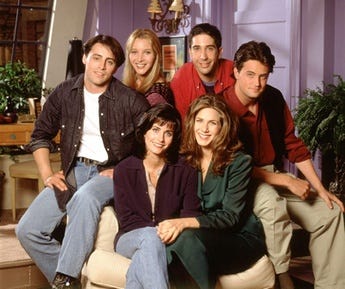
The title of this piece is in reference in part to some recent comments made by Adam Goldberg, who played a bit part on the show Friends back in the day. In an interview with Independent, when asked about modern criticism toward the show due its lack of diversity, he said:

And in terms of diversity, looking back, it seems insane. I’ve heard Black people speak about this and it’s like, you never expected to see yourself, so when you didn’t, it was not a surprise, and you ended up identifying to characters, irrespective of their race.

The ’90s was a weird time in TV history when it came to racial integration. Back then, TV shows were largely segregated, with little integration unless an episode was racially-themed. You had White shows like Full House and Married with Children. Then you had Black shows like Family Matters and The Fresh Prince of Bel-Air. There were no mainstream Latin or Asian shows to my knoweldge. Certainly no Native American ones. It was vanilla and chocolate, with hardly any mixing.

Friends was not unsual in its milk-colored casting choices. I never watched the show, nor did I ever care for it or find it funny. What little I’ve seen of it I find cringe and annoying. I’m a Seinfeld guy. But I do recall that Friends had a wide and ironically diverse audience despite its “insane” lack thereof.

In 2004 in college I was friends with a young African woman who loved the show and raved all week about seeing the anticipated series finale. In one of the lounges, people gathered around watching the last episode. To be clear, it most likely had a largely White audience, but the show’s humor (or what passed for it) seemed to catch on with all kinds.

Goldberg’s comments are rather innocuous. The show’s co-creator, Marta Kauffman, however, was more passionate in her response. Saying to the Los Angeles Times:

“I’ve learned a lot in the last 20 years,” Kauffman said in a Zoom interview. “Admitting and accepting guilt is not easy. It’s painful looking at yourself in the mirror. I’m embarrassed that I didn’t know better 25 years ago.”

She adds:

The series’ failure to be more inclusive, Kauffman says, was a symptom of her internalization of the systemic racism that plagues our society, which she came to see more clearly in the aftermath of the 2020 murder of George Floyd by Minneapolis police and the worldwide protest movement that erupted around it.

Kauffman felt so bad about her supposed “failures” that she donated $4 million to her alma mater, Brandeis University, to establish a professorship in the school’s African and African American Studies Department. A nice gesture on her part, I suppose. Perhaps the largest sum anyone’s ever paid to soothe their conscience for the crime of creating an insufficiently diverse hit TV show.

Though I would call it pathological. How sad and tragic that someone’s greatest accomplishment in life should be sullied by such pointless feelings of guilt over an imaginary transgression. This is the kind of remorse appropriate if you killed someone drunk driving. But casting six White people with good chemistry in a dumb sitcom? Please. It all seems performative and just a cynical attempt to pay off an angry mob.

It’s not the job of a TV show or movie to perfectly represent some fictious ideal image of a multicultual society. Or to live up to some hypothetical future standard. Sitcoms are notoriously tricky to cast for and rarely succeed. Many are canceled right out of the gate. The best ones all have a rare casting synergy, and for the most part have been homogenous. Comedy in general is largely a birds of a feather affair, save for some exceptional pairings like Gene Wilder and Richard Pryor. Or Lucille Ball and Desi Arnaz.

Even when a show injects some ethnic mixing, it often comes off as unconvincing, forced, or awkward. I always felt that the Indian character Raj in The Big Bang Theory was marginized and especially virginal compared to the better developed White characters. In the first season he hardly even speaks. But I suppose he represents “diversity,” or at least serves as an avatar of it.

I find myself agreeing somewhat with Lisa Kudrow, who said in the New York Post (emphasis mine):

“I feel like it was a show created by two people who went to Brandeis and wrote about their lives after college,” Kudrow said.

“And for shows especially, when it’s going to be a comedy that’s character-driven, you write what you know. They have no business writing stories about the experiences of being a person of color,” she added.

I think Kudrow’s comments make a very good point, and illustrate how we should not assume that a lack of diversity is due to malice or internalized racism, but an inability to be as authentic as the art requires. If you had primarily White friends in college and directly after, and then you proceed to make a hit show based on that life of yours, and that show goes on to get made with an all-White cast and becomes a cultural touchstone (however undeserving or absurd that is), then I say good for you. You have nothing to feel bad about.

I mean, at the end of the day, are we really going to take some overrated crap show like Friends and call that a mirror or summation of ’90s culture? No show could possibly encapsulate the ’90s. I lived in and remember that entire decade. Does that show reflect our society or just one woman’s experiences as a young person living in New York City with her stupid friends? Are people so desperate to see themselves in things that they’ll attack a show that’s been off the air for two decades over its lack of diverse casting? Especially now in the social media age we live in, where anyone can put themselves out there on a dozen platforms and find an audience no matter what race or ethnicity they are?

Attack Friends all you want for being unfunny and cringe as hell. But don’t waste your time bashing it for its lack of diversity. That’s actually insane.

What’s The Deal With Jerry Seinfeld? He’s A Billionaire Now, For One

The comedian has some life and financial advice.

Jerry Seinfeld’s a billionaire now. Which is no surprise given he produced one of the most successful and iconic TV shows in history. If you’ve ever met someone who couldn’t quote at least one line from the sitcom, you met a real live unicorn.

I always pay attention to what Seinfeld has to say, just because he usually has a unique take on things. The best comedians are also philosophers. Even his “show aboout nothing” was a hilarious commentary about social interactions and the endless quirks of humanity. It’s part of the reason why Seinfeld still feels fresh nearly 30 years after it ended.

Yahoo article recounts some of Seinfeld’s financial advice:

“I told a bunch of kids around the table last night,” he said, “If your work is unfulfilling, the money will be too.”

Good advice, but given enough pay, just about anything could become “fulfilling,” I suppose. You pay me a million dollars a year to paint telephone poles light gray, and I’ll be one deeply fulfilled guy, I assure you. I tend to agree with Mike Rowe of Dirty Jobs, who has a more practical, utilitarian outlook on life.

Work is not always meant to be “fun” or “fulfilling.” It’s called “work” for a reason, not “fun.” Sometimes even boring or unfufilling jobs can help ground you, and inspire you to focus your creativity into something as a counterbalance. Not everyone needs to become a Hollywood director, bestselling novelist, or secret agent. Even people who have achieved their dream jobs sometimes find the minutiae involved maddening. Fulfillment can come from all sorts of places, and looking to work to provide you with meaning can sometimes prove pointless. A paycheck is sometimes an end in itself.

What if fulfillment is making enough money from a boring, “unfulfilling” job that one day you’re able to be financial independent?

Jerry goes on to say:

“In the seventies, it was all about how cool your job was,” he said. “If your job was cooler than mine, you won.”

The article mentions that the attitude toward jobs changed in the ’80s, where the preoccupation became busting Benjamins over “coolness.”

I was not alive in the ’70s, so I can’t speak to that. But certainly work culture in the ’80s and onward became more coldly corporate and money-driven. Probably that’s due to automation, digitization, outsourcing, industrial consolidation, inflation, and the decline in the value of the dollar. No one’s got time for “coolness” anymore.

However, these days I’ve noticed that activism and social responsibility are bigger concerns with Millennials and perhaps Gen-Zers as well. Many young people I knew in college and other places expressed interest in working for non-profits, or for companies that seek to make the world a “better place.” Whatever that may mean (usually some left wing cause). For a while the company that represented this ideal was Tesla, but then Elon Musk started sticking his head out the Overton window and all, and has since fallen out of favor with many due to his thought crimes.

Maybe Notorious B.I.G. is the one who’s right here. “Get money, fuck bitches.”

The article goes on to mention:

A Harvard Study of Adult Development suggests that money can meet essential needs and provide security, but its ability to enhance happiness diminishes beyond a certain threshold. The study emphasizes that genuine happiness is more closely tied to relationships and meaningful work than financial success alone.

A Harvard study was needed to confirm that? That seems like common sense. Good to know an Ivy League institution is investing time and money into confirming things pretty much every blanket-knitting grandma on a porch will tell you.

Yeah, fulfillment is often a tricky, shifting goal line. Maybe you get it from clerking the midnight shift at 7/11. Or from a 24-hour Fortnite marathon. Or rewatching clips of Seinfeld. Or maybe nothing really fulfills you. Not that there’s anything wrong with that.

Some Context To Robert Downey Jr.’s Ridiculous $100 Million Paycheck

To the Victor Von Doom go the spoils.

Source: Instagram – @marvelstudios

It’s good to be Robert Downey Jr. these days. With a career and reputation left for dead by the mid-2000s, a role in Kiss Kiss Bang Bang helped reanimate the troubled ’80s star’s corpse back to life.

Famously, it was landing the role of Tony Stark/Iron Man for the newborn Marvel Cinematic Universe in 2008 that would send him back to A-list status. It’s hard to believe it, but Iron Man was considered a signficant risk to produce at one point. Nobody had heard of the character outside of comic book fans. Then there was the star himself, Downey Jr. who was an even bigger gamble with his prior arrests, DUIs and rehab visits. Dude was a hot mess.

Iron Man was a massive hit. The MCU completely (for better or worse) took over Hollywood for the next ten years. The mega franchise culminated in 2019’s Avengers: Endgame, which saw Downey Jr. finally retire Tony Stark in dramatic, sacrificial fashion.

Ever since then the MCU has been…well, shitty. It’s been bomb after bomb, basically.

Earlier this year Downey Jr. won the Oscar for Best Supporting Actor for his role as conniving politician Lewis Strauss in Christopher Nolan’s Oppenheimer. You may have heard of it. It won Best Picture and made nearly a billion dollars.

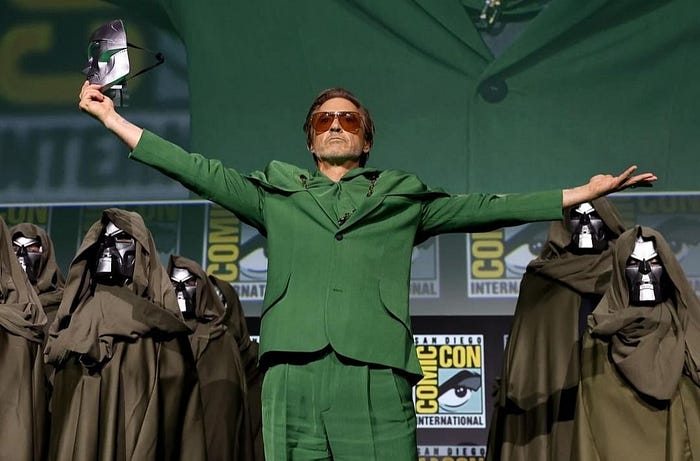
Now Downey Jr. is back in the MCU. Winning Oscars is so yesterday, apparently. Why win gold when you could win green? While wearing green. Lots and lots of green going on here. Kevin Feige just hired him back into the Marvel fold to play Victor Von Doom, aka Dr. Doom, in two upcoming Avengers movies. For $100 million.

Yes, $100 million. As in one tenth of a billion dollars. That’s an obscenely silly amount of money to pay someone just for playing dress up for a few months. However, a little perspective is in order. Some justification, even. I contend Feige might have gotten Downey Jr. CHEAP for the role.

You have to remember, an A-list star is an investment in the film’s success. This goes especially so in Downey Jr.’s case. No Downey Jr, Iron Man maybe isn’t a hit. No Iron Man hit, no MCU. No MCU, no billions of dollars.

Like Jules Winnfield said, “Personality goes a long way.”

The last Avengers film, Endgame, made nearly $3 billion. Infinity War made over $2 billion. Even if the next two Avengers films make “only” $4 billion combined, that means Downey, Jr. cost a mere 2.5% of the total revenue, not including merchandise sales and other downstream effects of two hit movies, like traffic to the upcoming Marvel Infinity Kingdom at Disneyworld.

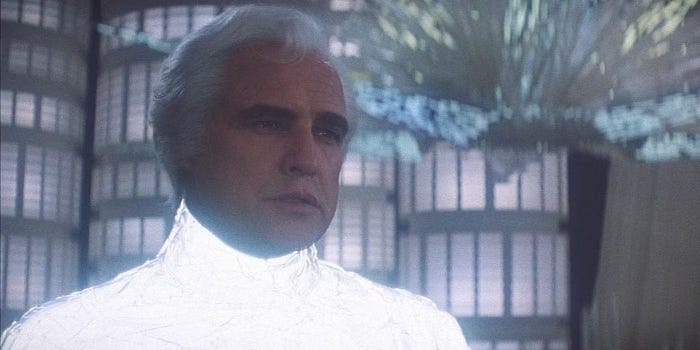
There’s also precedent for paying top talent a huge sum to help lend respectability (and most importantly, ticket sales) to a spandex flick. It all started when Richard Donner approached Marlon Brando to appear in Superman: The Movie as Supes’ dad, Jor-El. Brando agreed, but only for the princely sum of $3.7 million plus a cut of the profits. An utterly outrageous sum back then for what amounted to less than two weeks of work. But Donner needed a big star in addition to the great Gene Hackman already signed on as Lex Luthor, as newcomer Christopher Reeve wasn’t a big name at the time.

‘Superman: The Movie.’ Credit: Warner Bros. Pictures

Brando got his big payday. Superman grossed $300 million at the box office, making The Godfather’s upfront cut a mere 1% of the revenue. That’s not counting video sales, merch, broadcast rights, and other income sources over the last 45 years since the film’s release. If Superman has made $1 billion thus far, then Brando’s “outrageous” sum only cost about one third of one percent of the total revenue. I’d say Warner Bros. got their money’s worth out of him.

Of course, movies with big actors bomb all the time. It’s risky fronting enough cash to fill a Brink’s truck, even to charismatic, proven stars like Downey Jr. Time will tell whether this massive paycheck will prove a good investment or not. Either way, even $100 million will look small in four decades time, just like Brando’s $3.7 million does relatively-speaking today.