Recently, I completed the first draft of a slasher novella I’ve titled CUTTHROAT that I began in early September.
The premise is stupifyingly simple, though, like many of my works, it’s riddled with satiric malice and dark humor:
A group of job applicants arrive at a sleek highrise for a coveted position, but find themselves trapped and fighting for their lives against a psychopathic assessor known as Cutthroat, who wields a briefcase full of nasty weapons and is out to kill all of them.
This first draft clocked in at around 31,000 words, and it proved to be both exhausting and grossly liberating at the same time. This was one of those “cutting loose” sort of writing experiments, where I didn’t feel bound by the ordinary constraints of storytelling. Though there are two character arcs, a strong mid-point shift, a late reveal, and a twisty plot with some inventive kills. Thematically, it’s centered around the tortuous difficulties attendant with job hunting, with the whole ugly process personified in the form of a psychopathic killer known as Cutthroat, who poses as a job recruiter performing interviews, only to hack his unawares applicants apart. I really tried to go for the economic malaise zeitgeist’s jugular here that mainly desperate jobseeking Millennials and Gen-Zers are suffering through or at least might relate to. Armed with briefcases filled with all kinds of nasty weapons, Cutthroat sadisticallly plays his own twisted “assessment” games with the group of twenty-somethings, and it’s up to the protagonist to figure out a way to stop him, or at least escape with his life.
Writing a slasher is brutish work, to say the least. I’ve written my share of horrors, such as The Devil’s Throne, released a few years ago, but a slasher is another beast altogether. Slashers, obviously, are less known for their elegant exploration of human themes through a lens of supernatural or psychological chills like traditional horrors, and more about delivering a certain graphic and visceral effect on the reader/viewer.
Cutthroat is sort of “Terrifier in a business suit,” as I’ve come to refer to it as a means to sum up its ethos in a pithy “elevator pitch” manner. The slasher franchise set around Art the Clown is a real phenomenon for its cult following. Walk by any Hot Topic store in a mall and you’re bound to see Art T-shirts and other merch. He’s as big as Freddy Krueger or Jason Voorhees were in their day. I’ve only seen the second film and the first half of the first one. That’s literally all I could stomach. From a writer’s perspective, I found them shockingly bereft of any “story,” even for a slasher series. The Terrifier films are more a bunch of gory vignettes strung together. A bloody highlight reel of makeup and special effects. Even Friday the 13th, with all its clumsy and meandering “plots” had a semblance of mythology what with Jason and his mommy issues. Not so for Terrifier, which seems content to just freak out audiences with new methods of bodily mutilation. Hellraiser seems tame by comparison, which seems not possible.
Honestly, I found writing my first slasher disappointingly mundane. How many ways can you really butcher human beings on paper? I found myself straining to somehow “make it more interesting.” I did this by interjecting a backstory for the villain in order to make him believable, and by adding humor wherever possible. At one point I gave up for a few days, put off by the whole thing. Only to return days later determined to finish the task.
Now that it’s done, like often happens when I’ve finished a writing project, I find myself wracked with a post-partum malaise. Though there is always the long and tedious editing process.
I remember reading about how John Carpenter, while struggling to write Halloween II (1981) hit some bad writer’s block. I wondered how in the hell could that happen. We’re talking Michael Myers here. Pehaps the most simplistic masked killer there ever was. Just set him loose in a school so he can stalk another group of dumb horny teenagers. How hard could it be, right? But after writing my first slasher, I can see where he was likely coming from, and how unfulfilled he probably felt trying his hand at the sequel. It’s no wonder he wound up throwing in the bogus development about Laurie Strode being Michael’s sister as a way to liven things up and add motivation. Something he later regretted adding to Michael’s “mythology” due to its inherent silliness. The whole point of Michael Myers is that he doesn’t need a “motivation.” That’s what makes him scary. But I can see how sheer boredom probably drove Carpenter to want to throw in anything, no matter how nonsensical, to make the writing process more palatable for him. At least The Thing had the intricate puzzlebox mysteries of “Who’s the Thing and who’s not?” “Who can you trust?” With Halloween, it’s more just about coming up with new ways Michael can kill people.
On the surface, writing a slasher is “stupidly easy,” sure. Kind of. We’re not writing a dense Cormac McCarthian Western here, even if Anton Chigurh is like a Mexican Michael Myers with a shotgun. But it takes a piece of your soul. There are also the tricky mechanics of coming up with a bigger than life villain. Something iconic. A Nightmare on Elm Street, to me, is the gold standard when it comes to slashers. It’s probably the most intelligent of them. Certainly it’s the best high-concept horror idea. A killer that stalks you in your dreams. The kind of idea that makes you go, “Why didn’t I think of that?”
Overall, I enjoyed attempting the slasher genre, though it’s not one I’d quickly want to return to. Technically, it’s not actually my first stab at it. I handwrote a short story about a group of masked killers stalking a school way back when I was a teenager in high school. It was a story obviously ripped off of Halloween as I’d just seen that film on cable, though I added a “clever” twist by not having one, or two, but three killers. Genius, obviously. With this latest attempt decades later, I like to think I’ve grown and matured. I feel I made Cutthroat suitably gory and satisfied the demands of the genre with all the requisite tropes, while putting my own touch on things and bringing something new. If anything, it was a fun writing exercise that felt perfectly appropriate with Halloween right around the corner. 🙂
Medium continues to be a massive disappointment this year. Due to either an algorithm change or some kind of shift in how it distributes traffic, I barely get the engagement in years prior, and substantially smaller payouts and fewer followers, consequently. Though some of my articles caught on in Google’s rankings, I see zero money for non-Medium members who read my stuff. That’s really frustrating, as some of my “stories” (as Medium likes to call them) have caught tens of thousands of views.
It’s not that I soullessly write for money. It’s just that I would like to see commensurate compensation for when I do write something that lands.
Still, I’ve kept plugging away. Either foolishly or just out of stubborn persistence and the desire to maintain stasis. Medium is a solid platform, for sure. But it has a low ceiling. Whereas a platform like YouTube will (assuming you are monetized) at least pay you for ALL the views you get, not just Medium members. As such, YT has basically uncapped potential, though it too has its issues.
YouTube
As much as I love YouTube and the idea of being a YouTuber, I don’t know that it’s the right venue for me, either. Nor do I care to contort myself into the tortuous content creation pretzel shape that YT demands if you want to have a shot at gaining traction. YT seems to favor TikTok-style shorts anymore, and such snappy, soundbite quippings are not in my wheelhouse. The few videos I’ve posted this year are long, thoughtful, and reflective, which is not really conducive to YT’s dazzling discothèque guppy-attention-span content that seems to predominate on there.
I’m a writer at the end of the day. A fiction writer, specifically. I try to be. While I like dropping spicy op-eds from time to time, Medium and this whole “content game” thing often just proves a procrastinative distraction and a futilely unfulfilling endeavor. I get so little satisfaction out of writing even a “banger” article that gets a good traffic spike it’s not funny.
Whereas, a good fiction writing session puts me on cloud nine.
I don’t care to just crank out a bunch of noise, trying to surf the trend waves. I’d rather spend the time on my books. I have a lot of them in various states of editing, and I have a lot of ideas for more.
My latest will be out soon.
Conundrum
Which brings me to the conundrum. To be a successful fiction writer, you need a platform to help market your work. But to get a platform, you have to play the mind numbing algo/traffic/pretzel twist game I just talked about. A successful writer is a successful salesman, not just a good tapper of keystrokes. Like many writers, this rustles my introvert jimmies. I hate “putting myself out there,” though I’m not a wallflower by any means.
I see many other writers, especially self-published ones, market themselves via YouTube and social media, either by book or movie reviews, or by being (usually godawful) cultural critics and posting daily ragebait commentary on whatever headline caught their ire that morning. I don’t care to waste the time being a “culture warrior.” That’s very cringy to me. And there are frankly certain audiences I just don’t care to attract.
I will never be a fucking “writing coach.” I will never sell a fucking course or some bullshit consulting like so many of those hustlers out there do. No. Just no. I will never make “writing about writing” my thing. Never going to happen. I don’t care to waste the time, and I sure as hell don’t need to do it for the money.
I could see doing long form book or movie reviews, however.
And even though some of my finance-themed articles have actually performed the best, I think I’m done with that niche. Save and invest your money. Stay out of debt. Control your spending. Slow and steady (i.e. boring) compound gains will make you wealthy, not get-rich-quick crypto/stock/real estate/side hustle schemes. Stop listening to stupid influencers and their bullshit products. There, what the hell else needs to really be said?
Conclusion
As a compromise, I’ll keep posting non-fiction stuff, but likely just focusing on books, movies, and shows. Since Medium has proven near pointless to continue with, I may just go old school and post stuff on here exclusively instead. I blogged a lot way back in the day, and I see that era of the internet returning. Content has become far too siloed on digital slave farms like Facebook and other social media. It’s time for it to decentralize like it used to be. A.I. slop has ruined a lot of content sites also. In fact, I think A.I. is part of why the algo machine has completely broken down across the web.
I’ll invest more time interacting with social media in a qualitatively productive manner. I’ll also continue to experiment with YouTube. Perhaps there are actually people out there who’d rather look at my face and hear me talk than read my stuff. Hey, it’s possible.
If you made it this far, thanks for reading. I’ll have more updates for you soon, including my latest book. See you in the sun. 🙂
I’m a recovering “beat-em-up” fan. Back in the day as a teen I used to love those terrible Steven Seagal films like Above the Law and Marked For Death. Or Jean-Claude Van Damme stuff like Bloodsport and Death Warrant. They were constantly on rotation on USA and TBS and other freemium cable channels in the late ’90s. Films that were passably entertaining for immature adolescent minds, but in retrospect are ridiculously cheesy and absurd. But hey, if you haven’t seen Seagal break a Jamaican dude’s arm in half or Van Damme roundhouse kick a guy into a furnace, you haven’t lived.
Nowadays, Jason Statham is your go-to macho man face puncher and bad guy beater downer. Strangely, actors even higher up the talent totem pole have had a go at their own fistacuffs franchises. Bob Odenkirk is Nobody. A-lister Denzel Washingtonis The Equalizer. And of course Internet Jesus Keanu Reeves is John Wick.
Everyone wants to kick ass these days! Who can blame them? Have you seen the prices of things lately? Going to the grocery store anymore is like going to a Fuck Me in the Ass Parade.
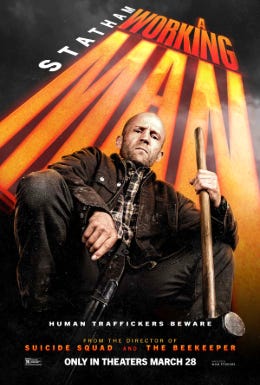
The latest is A Working Man, where Statham plays a former blacks ops soldier turned construction guy who has to return to his face-stomping roots when his boss’s daughter gets kidnapped or something. I’ve not seen it, nor will I ever. Just like I didn’t see Statham’s last flick The Beekeeper, which had pretty much the same plot. The latest edition of Statham Beats Up Some Guys interests me about as much as hanging around a bunch of backwards hat-wearing dude bros talking about their fantasy football picks.
(No man should have a hobby with the word “fantasy” in it. Like, are there sparkles involved? Pink glitter? GTFO of here with that.)
Anyway…
What is pretty cool (and surprising), is that A Working Man is based on a book. Which is part of a book series, actually. By a real author. Not some A.I. trained on Seagal and Van Damme flicks. Chuck Dixon is a prolific author known mostly for his work in the comic book industry. He co-created Bane, aka the villain who broke Batman’s back. So, this guy is well-experienced in creating characters that know how to kick the crap out of people.
Dixon’s series is called Levon Cade, and features the vigilante going on various quests involving revenge and likely crushing a few throats. There are twelve books in total. The first, titled simply Levon’s Trade, premiered in December, 2021. The others came in rapid succession, sometimes as little as three weeks apart, over the course of 2022. The eleventh published in August, after which Dixon took a sabbatical before dropping the twelfth and final (?) in February, 2024. Not bad. Guy banged it all out in roughly a calendar year.
Look, these are not labyrinthine literary feasts like A Game of Thrones. These stories are Fisher-Price simple and Neanderthal stupid. No shit. But when you get down to it, there are really only two genres — “Man with Gun” and “Girl Bangs Guy.” That’s about it. James Bond, for all his British sophistication, is just another “Man with Gun” story. Titanic is the ultimate “Girl Bangs Guy.” The classics usually combine the two in interesting ways. Double Indemnity, for instance. There are some exceptions, often seen in experimental or prestige award stuff, but nobody cares. People only pay attention when someone’s fucking or getting murdered. Can you name the book that won the Nobel Prize for Literature four years ago? No? Have you ever heard of Fifty Shades of Grey? My point exactly.
I am not a fan of simple vigilante series, in either book or movie versions. I read Killing Floor once, the first Jack Reacher book, a long time ago, and the experience was akin to tattoo gunning my eyeballs. I am a fan of writers, however. Especially ones who put in the effort to carve out their own success, in whatever genre they choose. A Working Man has likely done well enough at the box office to merit a sequel. Who knows. It could even be a franchise like John Wick. I have no idea. I’ll never see the films anyway. I outgrew the need for them a long time ago. But I do appreciate them and the writers who make them.
As an experiment, last night I created an account on Match.com. I know, I know. Why the hell would I do that in this day and age? Dating apps have gone the way of the dodo bird and all. Well, I like to think of myself as a sexy rogue scientist. I don’t have any credentials, degrees, or research papers to show for it. But so what? Edgar Allan Poe dreamt up black holes and the Big Bang theory (the theory itself, not that stupid show) while scribbling drunk off his ass decades before so-called “real scientists” confirmed them. If he can theorize things, I can too.
I says to myself, there’s just no way all these reports I hear of the shockingly low number of quality female matches on these apps can be correct. It has to be Red Pill Propaganda. Fake news designed to demoralize men so they don’t even bother trying in the first place. Disinformation to help juice the search algo for all those Andrew Tate “woman-hating” clones out there. I refused to believe any of that. I will remain an eternal optimist.
Anyway, I create my profile. It’s easy, and only takes a few minutes. I even uploaded a few hot pics of myself. I mean, all pics of me are hot, but just to clarify. After inputing all the necessary info, Match then confronted me with some criteria questions. Would you date a woman with kids? Since there’s not a “Fuck no, I’m not a step-sucker,” option, I had to contend with just clicking the box for “No.” Then there’s a tab you can click that says “must-have.” That means single mommies will be EXCLUDED from your results. Good riddance, says I. I’m not into funding some other man’s sperm bank. I mean, when you go into Mcdonald’s, do you start digging into the trash can for a leftover half-eaten Big Mac? No. You walk up to that counter and order a brand new one. Only degenerates, beggars, and the mentally ill eat out of trash cans. So, why would you treat your dating life any different?
Next came the age criteria. I’m 42 so I usually set the age between 27–35, but I was feeling magnanimous so I upped it to 37. I know super old Bill Belichick, 70s, is dating some hot chick in her 20s these days. But since I haven’t won any Super Bowls (yet) and I’m not worth $100 million+ (yet) I have to try to be realistic. It is what it is.
I live in the upper midwest, which is basically like living on Mars at a giant truck stop. So, usually on ANY dating app I have to expand the search zone out as far as reasonable in order to get any matches whatsoever. This time I set it to 350 miles. Though honestly, 345 miles of that is just me humoring the site. I don’t think I’d make the effort to even cross the street these days for a date, much less travel across an entire state. But you can’t just put five miles where I live, and even 50 miles wouldn’t be enough. Tree fiddy felt like a happy medium.
Then, it was off to the races. If by races, you mean a pitiful rogues gallery of candidates. Like, I’m pretty sure Batman fought some of the freaks I saw. Match doesn’t let you search by grid unless you have an upgraded account, so I was forced to inspect each profile one by one “swipe-’em” style. It took about as long to get through them as it does to read this paragraph.
How did I do, overall? It was absolutely awful, to be blunt. I ran into the same issue I had with speed dating, which I talk about in this article here. Out of about 20 or so candidates, realistically I’m left with only about 2–3 that are legit potentials. Meaning women who aren’t too old, aren’t fat, don’t exhibit a bad attitude toward men or have “trauma,” aren’t covered in sleeve tattoos, don’t have a list a mile long of necessary atttributes for the perfect man, and haven’t done the ol’ slut-to-born-again-Christian routine so many post-30 year-old ladies like to do these days.
Match has the gall to beg for pricey upgrades. Like I’m going to pay $40 for a meager 2–3 above average profiles that are most likely months old and long forgotten by their users, or are getting spammed by a hundred other dickheads on the daily.
Sometimes, Match would get clever and try to sneak one in from my reject list. I’d be swiping along and then suddenly see a half-decent female, click on their profile, only to see she had two kids at home, or see that she was 48 years old, or see some other disqualifying bullshit. LOL, nice catfish, Match, but this guy has standards.
It’s hard to understate how atrocious these results are. This is Match.com, which is basically the Wal-Mart of dating apps. The Match Group owns like half the online dating sites. I think Match itself is the biggest dating site on the planet. Yet by simply tweaking a few parameters over a massive region and adjusting for women in the PRIME dating/marriage range, I was met with nothing but slim pickens, though ironically few were actually slim. If Match results are total shit, I can’t even imagine what lesser sites might produce. Probably something from the Garbage Pail Kids. Gross.
It’s not really Match’s fault, I guess. They only show you whoever signs up. Dating apps aren’t as popular as they once were. The best people are typically not on or in need of dating apps. Or maybe they’re using Facebook, Instagram, or other sites.
Then it hit me. My eureka moment. What if I were to lower my standards? Or abandon them altogether? What if I tried removing ALL my previously set parameters. Surely that would open the floodgates of opportunity. Surely, by some chance, I’d happen across a nugget of gold in this landfill. Right?
Nah, fuck that, I thought, and deleted my account less than an hour after opening it. So long, Match. Burn in hell.
Years ago, when I was a little kid, I had this sudden weird urge to dig a hole in my backyard one day. Why? Hell if I know. It made sense at the time. So, I grabbed a shovel and started digging out behind a giant bush in the corner of the property. I dug and I dug and I dug until it was past nine o’clock. The sun was still out as it was summer. I had probably reached maybe three feet and had a nice heap of dirt beside me. My step-dad came out and asked me why I was digging the hole. I didn’t have an answer. What kid has a rational explanation for anything he does? I just kind of stood there, shrugged, and then went back to digging. He was wearing shorts and tube socks pulled all the way up. He was the kind of guy who needed his tube socks always pulled up past his calves. He stands there a bit. I keep shoveling with his stupid step-dad tube-socked feet in the corner of my eye. Finally, I hear him sigh and then walk away from me, leaving me in peace at last. Not long after my hole has become the shape of an upside-down tear drop as I couldn’t flatten the sides anymore. And that’s when I see something at the bottom.
A little piece of blue something. I reached down to pick it up, straining my shoulders against the top of the hole, until I am able to pinch it between my fingers. It’s a piece of plastic. Maybe from a shopping bag. Or perhaps the coating of a pipe that peeled away. Except there’s no pipe in my hole. It’s just this random tidbit that somehow got down in the dirt and stayed there until I rescued it from oblivion. I take this little blue “treasure” inside with me and store it away. I’ve since lost it. But it became a haunting metaphor for life about chance, timing, opportunity, and such, that I’ve thought about from time to time. I’ve applied the metaphor to job searches, school applications, business ideas, stories, and now of course dating websites. Dig and dig only to end up with a piece of trash. But who knows. Maybe if I’d dug just six feet to the right where my step-dad’s tube-socked feet were standing I might have dug up a wheat penny. Or maybe hit an electrical line and shocked myself to death.
I’ll often see people post on book review sites or forums marveling over an author who churns out multiple novels every year. Popular authors like Stephen King, Dean Koontz, Danielle Steel, and others who are well known for spinning doorstops with apparent ease.
How do these writers do it? It seems impossible.
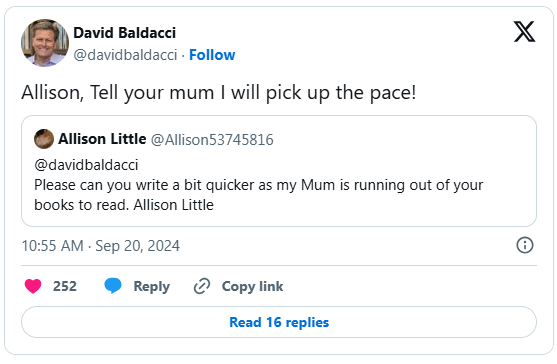
Some cast doubt that the authors actually wrote their novels on their own. Often they accuse them of using ghostwriters. For sure, some brand name authors, like James Patterson infamously, employ an army of co-writers for their many projects. But many actually do it all by themselves, braving the blank white screen every morning. As David Baldacci says on his X account:
I live to write and write to live.
I recently finished my 11th novel. A book I started on March 23rd of this year — after almost 18 months of false starts — finally completing the first draft on August 27th. That’s a little over five months, or 157 days. The first draft is about 90,700 words.
That comes out to only 577 words a day. Some days I only managed a few hundred. Those were usually the days I worked. Toward the end of the novel, I picked up the pace (as I usually do nearing the exciting conclusion of a book). I probably wrote about 5,000 words in just the last three days before finishing.
Still, my average daily output comes out to a mere 577 words. A simple email might be 500 words. The average person probably texts their friends more than 500 words a day. It’s about the length of a two minute Medium article. A few tweets. Five hundred words is not a lot. Yet 500 words a day comes out to two 90,000 word novels a year. One thousand words a day equals four adult novels. Writing a “little” can really add up fast.
Of course, there’s the editing process. It’s not like once you finish typing that 90,000th word you’re all done. Editing is sometimes a lengthy, complicated process with its own messy timeline.
Then there’s outlining and idea generation. This last novel of mine was a struggle, unlike others in the past. But I found that by sticking to my daily writing regimen, I was able to push through a lot of supposed blockages. It’s usually best just to keep ploughing ahead anyway, even if you think you’re “stuck.”
If you are a prolific writer, sometimes it’s not enough for fans. Baldacci recently had this exchange with a reader:
Baldacci publishes multiple books a year, some of which are well over 400 pages. He certainly writes thousands of words a day. But you don’t have to write that much to write a lot. Even “just” 250 words a day is 90,000 words. That’s an adult novel a year. Or two novellas a year. Which is not bad at all.
On August 26th I completed my 100th article on Medium. It’s not the biggest writing milestone ever. There are accounts on there with hundreds, even thousands.
I had a goal of reaching the century mark by the end of this year, only to end up blowing right past it. This one is №118. A pleasant surprise, especially given how I was consumed with another writing project of mine for most of the past year and a half.
My experience with Medium has been decent. I’ve found some success with a handful of articles that got thousands of claps, and earned me some money. I’ve survived not one, but two account suspensions. One just recently, and another back in 2022. Both occurring without any real reason other than somehow my account became caught in the “spam filter.” Okay, whatever. Never had that issue with Blogspot back in the day or WordPress now.
On the positive side, I have over 900 followers. The majority of whom I’d say subscribed due to my finance-related articles. My highest earning month so far was this past July with $291. I’ve had multiple $100+ months over the last few years. I don’t know that Medium will ever be, or even could be, a full-time gig. Not without insane commitment and a willingness to plunge into primarily the most lucrative subjects (personal development and finance). I have too many other writing projects going on and other interests to go that far with Medium. As I’ve stated previously, I have no desire to try to build a “brand” there. I sure as hell don’t do coaching. I don’t do freelance work. I will never sell a stupid course or membership of some kind. I realize that’s how a lot of top writers on here make their full-time income, but it’s just not me. There are enough “gurus” out there peddling their snake oil. I just write novels and on occasion scribble out a usually sarcastic editorial. And a finance article here and there.
Writing on Medium for money is not a primary concern for me. My earnings have paid for the Friend of Medium badge for a few years though. Which is nice. At the least, the site is a net positive.
Overall, I see Medium as a good place to practice daily writing and gradually build a platform.
The other milestone happened to take place the following day on August 27th. That is the completion of my 11th novel. A horror story with a dark and twisted romance at its core. This was a tough one to get through. I struggled with it for years. A sharp contrast to previous novels I’ve written, which largely flowed. The inception of the idea actually came way back in 1999, which makes it the oldest concept I’ve ever maintained and seen through to a completed work. It was just a tiny undeveloped spark of a thing. I didn’t know what to do with it then, so I wound up putting it on the backburner for a few decades.
It wasn’t until 2020 that the idea ignited further. Then in 2022 it started to really kindle. At times it felt like trying to hammer cooling iron into shape. I went down two blind alleys, and almost 50,000 words, before having to start over twice. Daunting and dismaying, for sure. But when I have an idea I’m passionate about, I like to stick with it.
This past March, after revising the outline, I began the third attempt. Six months later the first draft is finally finished, and stands at over 90,000 words. My first drafts tend to be strong. I don’t believe in doing “vomit drafts.” I try to get most of what is needed down on the page in a structured and coherent (more or less) fashion in the first go. Even still, it’s perhaps only 65% where it needs to be. As I typically do when finishing a novel, I let the first draft rest for a bit before returning for revisions.
Even though I’ve written 11 novels so far, I’ve only self-published three of them. This is largely because, while I love writing, I have no effing idea how to market or sell my work. Simultaneously, I have little faith in or concern to play the lottery with the traditional publishing side. I’ve read a lot of articles on here about publishing, and let’s just say it’s a sad state of affairs. Even if you land an agent or a publishing deal, the problem of selling your work remains the same. You have to do all of that yourself.
Few, if any, publishing houses, big or small, will put any money into some no-name like myself. I don’t begrudge the industry. It’s the way it is. Most publishing companies make money on their back catalogue of hits, or on “bread and butter” sales like the dictionary or something. Most authors only sell a few hundred copies of their work at best. Publishing in general is a boutique-style business driven by hits. Hits are random. Even celebrity books have totally bombed. So, until I can solve the marketing side of things and learn how to sell myself, I don’t see much of a purpose in putting my eight finished books out there. Perhaps that’s extreme and self-defeating, but I think it’s important to have a plan of execution and not just go out on a wing and a prayer. My books are like my children. I want to treat them right.
I do love my latest book a lot. I think if there’s one that will finally get me to solve the riddle of the Sphinx of Marketing, it’ll be this one. It’s tough to be a writer these days. You can’t just scribble away in a room and submit to publishing shops. You have to learn to do everything yourself. You have to build your own platform. I suppose that‘s part of why I stick around here on Medium. I probably should make YouTube more of a thing, too. That’s a fantastic digital ecosystem, and potentially, a money-making one.
I’ve also thought about posting some of my fiction on here, though I do like keeping the worlds apart. It’s strange. Even though I enjoy writing articles on Medium, non-fiction never makes me feel like I’m really “writing.” Only when I’m writing my novels do I feel like I’m actually really producing something. Fiction enables me to get into a flow state the best, which is my favorite head space. Nothing else comes close.
Anyway, since I don’t like to spend too much time navel-gazing about writing “successes,” I’ll just leave it at that for now. Two good milestones in the rear view mirror. Onto the next.
Probably the most sarcastic article you’ll read all year.
Source: Midjourney
When your franchise’s latest installment sounds like a brand of female sex toy, you might have a problem.
“Girlfriend, my Acolyte just came in the mail. My weekend is all set.”
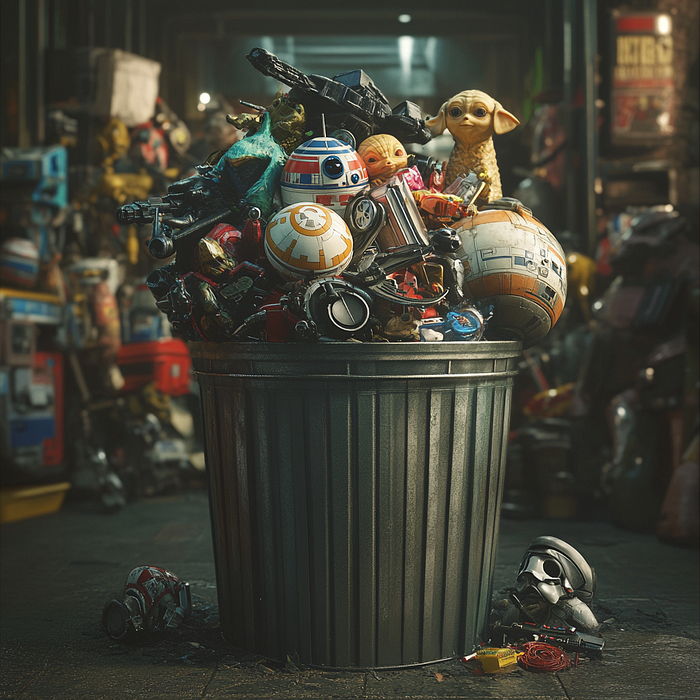
How do you keep up with the torrent of Star Wars content these days? I barely remember my own birthday anymore while there are whole YouTube channels and publications devoted to following this garbarge.
I’ll tell you one thing. None of this new stuff feels epic. It all puts off weird local hipster playhouse energy. As if the same cornballs behind Lesbian Interpretative Dance: The Musical, or My Vagina and Me, A Monologue, were suddenly put in charge of a billion dollar brand and told let ‘er rip.
The original Star Wars and even Empire Strikes Back felt on par with stuff like Lawrence of Arabia or Dune or Lord of the Rings. The new shit feels small and unimaginative, and so slick-looking it looks like it was shot inside an empty bag of potato chips. Really, go compare the recent Dune trailer, or Avatar: The Way of Water, to any new Disney+ Star Wars stuff. No contest.
I don’t give a shit about Star Wars. I never really did. I count myself lucky I never saw it as a young kid. There was a brief time when I was 15 or 16, after I’d seen the original ’77 release that I sort of got into it. I admired the storytelling and the special effects. But it was nothing really special to me. For me, the “saga” was contained to one very good film, end of story. I never cared for Empire because it was like a weird Muppet movie, and the “romance” between Leia and Han felt immature and highschoolish. The first half of Return of the Jedi was decent, then it became a wacky cartoon with teddy bears.
I will admit I was one of those suckers in 1999 who got swept up by the hype for Phantom Menace. Then I saw it, hated it, and realized the whole franchise was purely a cynical toy-marketing machine for baby-men. I skipped Clones, but did check out Sith out of morbid curiosity and because I was reassured it was “good.” It was not. It sucked, too.
I can trace back to the exact moment I lost all interest in Star Wars, and in fact, began to actively hate it. I was in some sports good store years ago, mid-2000s maybe, when I spotted a Jar Jar Binks fishing pole.
Even I knew Jar Jar Binks was the most hated character in Star Wars lore. And they’d made a line of fishing poles with his face on it? I couldn’t get over thinking about how at one point some lawyer had to have handed Lucas a form to sign to authorize the manufacture of a Jar Jar Binks fishing pole. And Lucas sat thinking yes, this is a great idea and a necessary thing for my legacy and franchise income stream. I saw that fishing pole as a symbol of the ultimate abandonment of art and storytelling and the selling of one’s soul in exchange for a few more pennies. From that point on, I began to despise anything and everything associated with this shitshow called Star Wars. It offended me on a deep level.
Then came the asinine sequels from Disney/Abrams and Rian Johnson. The Force Awakens, an obvious clone of A New Hope, only with an even bigger death star this time. It took me four nights to hate-watch Last Jedi, and believe me, it was paaaainful. That was the last I saw of the franchise. I recalled hearing about various Disney+ shows, but in the same sense as one hears in the news about a new virus discovered in the rainforest. Just something to be ignored while you hope you don’t get infected.
Having said all that, you might think I’d be the last guy in the world you’d want trying to save this sorry ass franchise. You’d be right, of course. But that doesn’t mean I don’t have some ideas.
1.) Make ‘Star Wars’ Bigger and Blacker
Source: Midjourney
There are apparently armies of Youtubing dorks crying about how Star Wars is “woke” now, which is why it sucks so hard. I’m not entirely sure what “woke” means anymore, other than it seems to often boil down to the intolerable presence of too many Black people and/or gay people and/or gay Black people in a show or movie. The YouTubing dorks are very quick to point out how that’s not the case, insisting that wokeness is purely about left wing messaging and poor storytelling or something, NOT race. Except it’s rare that I see the charge of “wokeness” levied against any show where Blacks/Gays-A-Plenty isn’t the demographic distinction. Meanwhile, the show creators bray on about diversity and inclusion and other virtue signal corporate buzzwords.
Hey, if you don’t like Blacks or gays or whoever in certain roles or movies or shows, just say so. It’s perfectly fine to prefer whoever you want. It’s like dating. No one’s obligated to like everyone. Freedom of association extends to whatever garbage you care to scroll through on the tube. It’s kind of painful and cringe watching people contort and twist themselves in knots trying to justify or lambaste particular people or groups, using meaningless words like “woke” or “diversity” or “inclusion.” The supporters of diversity acting all open-minded, as if they don’t have an online cancel mob gun to their head. The opposers trying hard to toe the line between reasonable criticism and outright prejudice. It’s all make believe anyway. Just be up front about it.
Now personally, I say fuck both sides. Why make some watered down half-ass “woke” compromise? I say commit all the way. Make the next Star Wars show or movie with ONLY Black people. And not just Black people, but Black women. You set the story on a planet populated entirely by a race of aliens who happen to look like Black women. Strong Black women, to be exact. Then you introduce a villain. A White guy. That’ll be the only White character in the entire show. What’s his motivation? Who cares. What’s his name even? Who gives a shit. He’s White, he’s evil, ‘nuff said. Then, after, say, half an episode of setting up the characters and showing how strong, Black, and female they are, the villain shows up. Then you spend the next seven episodes just having the strong Black women beating the shit out of the evil White guy until he dies or goes away. You know the famous hallway fights from the Daredevil series on Netflix? Just like that, only for seven episodes. That’s it, that’s the show. Anything less than that is racist and insufficiently woke, as far as I’m concerned.
Yes, I know I’m being ridiculous here. But I’m trying to illustrate a point by making an argument by absurdity.
A good example of the type of “post-racial-don’t-give-a-shit-about-offending-anybody” sort of vibe I’m going for is what you generally see in a Tarantino film. Like, say, Django Unchained. That movie pulls no punches. Django starts off as a downtrodden slave rescued by a White guy. But he ends the film blowing up a plantation and avenging the death of the White guy who saved him, and freeing his wife. All while looking badass doing it. That movie made over $400 million dollars and earned Tarantino his second Oscar for Best Original Screenplay.
Another good example is Avatar. That is an anti-colonialist, anti-imperalist, very pro-environmentalist-to-the-point-of-worshipping-nature-itself themed film. It’s very “woke,” technically speaking. One might even say anti-Western and anti-American. It’s made almost $3 billion. Conservatives and liberals all went to go see it and both came away loving it.
Point is, nobody really hates “woke” shit. What they really hate is weak, pandering shit that tries to do this halfway in, halfway out deal to please everyone. If your goal is to make a racially conscious Star Wars film, then fucking commit to that hard. Don’t just sprinkle in a bunch of minority actors as tokens of some half-baked rainbow messaging scheme, and then go around pattting yourself on the back. Don’t try to make the movie equivalent of that stupid We are the World singalong from the ’80s, or more recently, that ultra cringe Imagine singalong all those actors did during the Covid lockdown.
Moviegoers are thinking, conscious beings. They respect movies that STAND for things, even if they may disagree with the messaging. Even if the world is alien and strange and runs counter to their own natural experiences. Think about it. Imagine if these movies were like people. Does anyone like the guy with no identity who goes around desperately trying to get everyone to like him? No, everybody hates that guy because he’s a fraud. Don’t be that guy. Be yourself.
2.) ‘Star Wars’ is in Desperate Need of Butt Sex
Source: Midjourney
In an interview, Leslye Headland, the lesbian showrunner for The Acolyte crowed (kind of jokingly, to be fair) about the show being the “gayest Star Wars ever.” I’d link the original interview but I couldn’t find it due to there being a million YouTube videos of crybabies talking about it that I had to wade through.
Headland is now sort of passively walking back her statement, saying:
I don’t believe I’ve created queer, with a capital Q, content.
The Acolyte apparently has lesbian space witches who are able to summon the force somehow, or whatever. Again, I pick up most info about Star Wars these days through osmosis, as one hears about the latest sordid engagements of the pass-around slut in high school. I’m not watching any of this shit myself, as I have a life and things to do.
I will say, however, that I’m going to call Headland’s bluff here. She says it’s the “gayest” Star Wars ever? Well, I went back to watch the trailer, and I don’t see anything gay in it whatsover. No kissing between a same sex couple. No hand holding. Certainly no butt sex, either.
Again, what’s with all this half-ass compromise? You don’t run a race to come in second, to paraphrase the Apostle Paul. And I’m pretty sure Paul would also say that you don’t set out to make “queer content” unless you’re planning on earning that capital letter “Q.” So here’s my solution: Full-on close-up anal intercourse and lesbian grinding (I believe it’s called “scissoring”). That’s it, that’s the show. Just close-up shots of penis in ass and vaginas rubbing against other vaginas. Maybe you have a small part of the background just off to the side of a butt cheek or waist. That could be part of a compelling mystery every week. What planet are we on? Tatooine? Naboo? Vulcan? More importantly, who’s banging who? Then maybe at the end of each episode the camera finally pulls back and reveals who’s been fucking the whole time. Obi-Wan and Darth Maul? Or maybe it’s Yoda being a surprise power bottom to a vigorously thrusting Boba Fett. Maybe Leia had a lesbian phase in space college, and spent nights getting it on with Ahsoka. The possibilites are endless. Think of the viral memes when fans discover Lando liked to take a deep dicking from Greedo. Now we’ll know for sure who shot first.
A budget for a show like this I could see easily being $600 million or so for eight episodes. That’s money well spent. You might say it’s risky to show explicit raw gay sex in a franchise meant for the whole family, but you want to get people talking don’t you? I guarantee you that’ll happen when millions click on Disney+ and see Vice-Admiral Hodo butt fucking Jabba the Hut.
The underlying point here, is don’t misrepresent your show. Don’t do it to score some virtue signal points. Don’t do it because you’re just trying to impress your stupid woke friends in the office. Don’t do it, period. Not every piece of entertainment needs to be some activist content. You don’t get to go around saying how gay-friendly you are because you stuck some random same-sex couple in the blurry background kissing each other, or because your showrunner happens to be gay. What the fuck does that have to do with anything? What does you liking the same sex have to do with the character on screen swinging around a glowing plasma sword? If the answer is, “Well, nothing, I guess,” then kindly shut the fuck up. You don’t need to fill the air with a bunch of superfluous details about your sexual preferences. No one is looking at you like you’re some civil rights hero. You’re not being interned in a prison camp. You’re not self-immolating in front of the UN. You’re making a stage play about space wizards. For Christ’s sake, get over yourself.
3.) Dig Deep into Rey’s Sex Life
Source: Midjourney
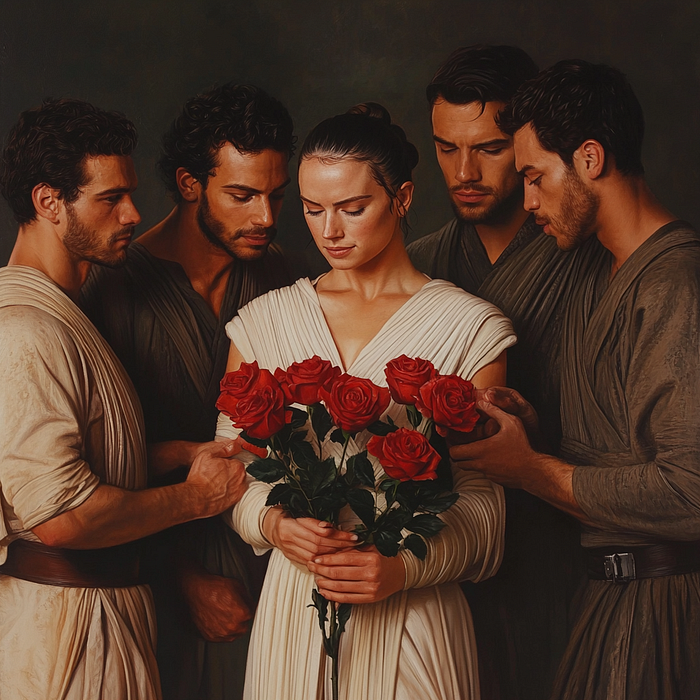
Rey Skywalker? More like Rey Sexworker.
I never saw the final installment in the last trilogy of films. I don’t even remember what it was called. The Force Wakes Up Again? Palpatine Has Somehow Returned? Oh, yes. The Rise of Skywalker. That’s it. Ugh. What a boring, predictable title.
I remember even less about the plot, except for a lot of people on the internet complaining about the mixedupedness of the romance. First Rey was with Kylo, obviously turned on by that sweaty shirtless moment with him in Last Jedi. Then they’re fighting for some reason. Then they’re back together again.
All the while Finn is trying or not trying to get Rey’s attention because he may or may not have a crush on her. And what ever happened with the thing between him and that Asian chick Rose? Or maybe Finn and Poe were supposed to be banging all along. Talk about a missed opportunity for a hot gay romance.
You see how frustratingly annoying and wishy-washy all that is? What a load of weak sauce bullshit. This is like the worst high school romance YA book ever written.
All of these people are grown adults fighting a fucking war. You think there aren’t times they don’t get lonely and desperate? You think they wouldn’t want some action on the side? Let’s be frank here. Rey’s hot. She’s young. She’s nubile. She’s got a cute British accent. The girl’s got it going on. You think she wouldn’t have a boyfriend or at least some admirers orbiting around her on Jakku? You think when Rey was a slave she never had to give her master Unkar Plutt a blowjob in exchange for a slightly less severe beating that day? Because I guarantee you she did. You don’t even want to know what happened between Leia and Jabba the Hutt when the camera wasn’t looking. You think Ms. Organa choked the like out of the fat slug just because he licked her once? Nah, look at her face when she kills him. That’s the look of a woman who got fucked in the ass raw, no lube. Sorry to break it to you.
What is with these big Disney spectacle films where every character must be utterly chaste and sexless and romanceless? Why must every character be as untouched and pure as an unboxed collectible Star Wars toy? Why must every potential romantic interaction be juvenilized and made a big joke? Star Wars and Marvel films are meant to be modern day versions of Greek myths. Remember how the Greeks and Trojans fought an entire war because some dude wanted to bang an uber hottie named Helen? Remember how those hot naked Sirens lured men off Odysseus’ ship with songs of sex and pleasure?
Some of the biggest films ever have had major romances at their cores. Titanic being a great example. It has a steamy sex scene and it still beat Star Wars in the all-time box office gross back in 1998! But even in other more family-friendly “four-quadrant” films passions have run high. Superman gives up his powers to bang Lois Lane in Superman II. In The Lion King Simba and Nala actually get it on. In an animated kid’s film, no less. The Justice League cartoon from the early 2000s had a number of romance subplots. Yet somehow a science fiction/fantasy war epic featuring battle-hardened adult warriors with magical powers can’t handle personal relationships beyond what you’d see at an awkward middle-school dance party. That’s just plain pathetic and weird.
I’m not saying you’ve got to have romance injected in every relationship. But these Star Wars characters feel like they were written by robots. They’re so sanitized. They lack warmth and humanity because the characters themselves are denied an entire component of human nature. You can call it the Game of Thrones-ification of Star Wars if you want. I call it writing as if actual adults are in your story and not pacifier-sucking toddlers in grown-up clothes.
4.) Make the New ‘Star Wars’ Movie a Bait and Switch Infomercial
Source: Midjourney
This is honestly such a cynically crass but also brilliant idea I can’t believe Disney hasn’t done it yet. It’s distilling decades of relentless Star Wars marketing into its purest form, while deceiving fans into thinking they’re getting a worthwhile adventure. So, what Disney has done the last ten years, basically.
First, you create the most exciting and epic trailer of all time for the next Star Wars movie. When I saw epic, I mean fucking EPIC. You hire A-listers. You steal all those CGI computers they’re using for Avatar and use them for the most mind-bending special effects ever made. You hire John Williams and Hans Zimmer to co-write the most unbelievable new score ever written. You spend $1 billion, if necessary.
Second, you hype the absolute shit out of this trailer. You buy every ad space possible. You send every actor onto every show to do nothing but talk about it. You stage viral moments. You show people fainting and having to be rushed to the hospital after watching it. You kidnap Mr. Beast and make him do a whole video just about the new Star Wars trailer. You buy TikTok if you have to and only allow Star Wars-themed videos in order to totally capture Gen Z. Then, when you’ve got every person on the planet foaming at the mouth, you’re ready for the final step.
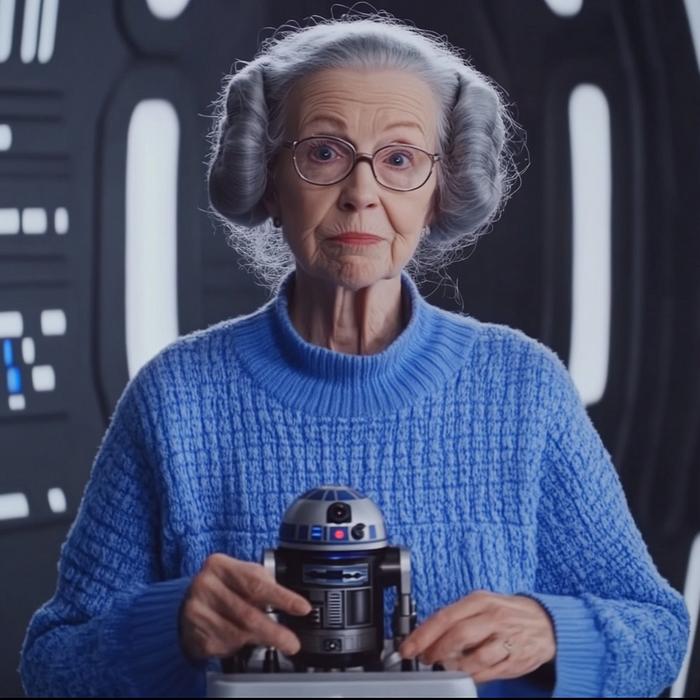
Step three, you premier the “movie,” only for it to just be a ten-hour long infomercial with some old lady in a blue sweater pitching Star Wars merch with a 1–800 number for people to call in and order. Star Wars Episode X: QVC. That’s it, that’s the movie. You could sell replica light sabers, original movie props, costumes, autographed portraits, and hey, maybe even Jar Jar Binks fishing poles, too.
If you’re going to commercialize your show up the ying-yang, then you might as well commit 100% to the bit. Just go all out. Stop pretending like you care more about crafting a good story than shoving the next pile of toys and dolls down our throats. There’d be more dignity in it. I’d have way more respect for Disney if during the next opening Star Wars crawl it just said, “Buy our shit or get out, suckers.” Rather than a bunch of silly exposition about the Empire still being a threat somehow.
Besides, you know at least every senior citizen in the country would sit for the whole ten hours of the infomercial “movie.” Oldsters go gaga for that QVC shit. You’d probably make a decent profit in the end.
—
Anyway, I hope these suggestions have helped, or at least shined a light on some of the B.S. plaguing what is stupidly but evidently the most popular epic saga in American cinema history. I’ll never understand why that is. But I get it. Sort of.
If none of this has helped, then oh well. I don’t give a shit either way. Fuck Star Wars.
It’s 11 p.m. Dark, no stars. Soft rain patters against the windows of the small town corner bookstore. The proprietor, a graying, middle-aged man, old and weary before his time, starts locking up.
Another bad day. Only one sale. To a little old lady who was looking for that “cute sparkly vampire” book for her granddaughter. He sold her Dracula instead. Maybe he could save just one Zoomer.
No else even came inside. All too busy staring down at their phones as they walked past. Doomscrolling TikTok, cat memes, and God knows what else. These glowing screens might as well be crack pipes, he thinks, wiping a distressed brow.
The proprietor lifts his tired eyes to the black abyss of a sky as he closes the shades. He used to be filled with optimism. He was going to change the world. He was going to be somebody. A bookseller. A real bookseller. He was going to nourish the world with the printed word. With physical books. Sure, they were dusty, old, and smelled funny. But they were real. Imprinted with human touch and ownership. A physical book is something that says, “I exist, I matter!”
Except nobody wants real books anymore. They just want their glowing screens. They want their Kindles with their “e-paper.” Ha! As if paper could be mimicked on a screen. What next? E-food? E-water?
Now the bills are piling up. Rent’s overdue. A utility company is howling at the door. Bankruptcy looms. It’s over, he thinks. Time to admit defeat once and for all. The glowing screens won. Damn them. Damn them all to hell.
Then he hears footsteps. A shadowy figure suddenly appears. It sort of reminds him of how Nick Fury came in at the end of the first Iron Man movie in the post-credits scene.
In fact, that’s exactly what it reminds him of.
“You think you’re the only bookseller struggling to keep the lights on? You’re part of a much bigger universe. You just don’t know it yet.”
“No, I’m fully aware bookstores are a failing business model,” he says. “My ex-wife reminded me everyday.”
I step fully into the light. A stack of books under my arm. An eye patch placed crookedly on my face.
“Is that eye patch real, or did you just put it on for effect?” he asks.
“Never mind that. I’m putting a team together. I mean, I’m putting a library together.”
The proprietor glances at my books. Lost Horizon. The Caine Mutiny. Is that really Fahrenheit 451? Asingle tear forms in his eye.
A small smile cracks his cynical, grim visage. His first one in ages.
Maybe there is hope, afterall.
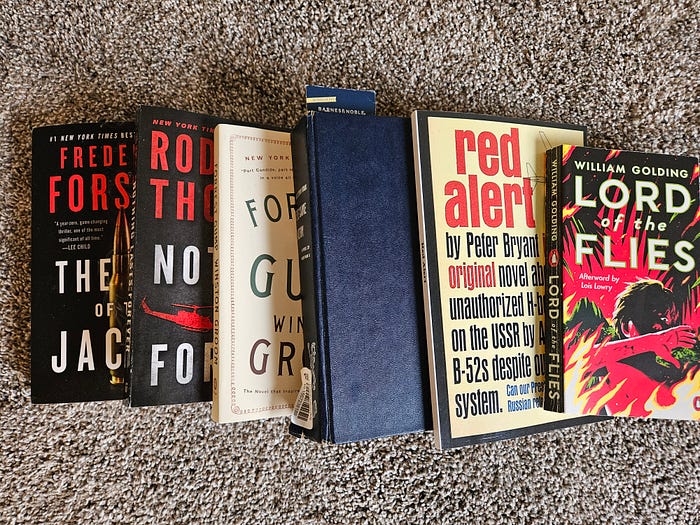
My books. Author’s photo.
Buying physical books may not be as dramatic as saving the world, but there’s nothing like actual “flesh and blood” print over e-books or words off a glowing screen.
Reading words off a screen feels more like scanning than actual reading. Though that’s probably just a generational bias. If you grew up staring into the pixelated prism of an iPad, you might prefer the digital version over the real thing.
I have a Kindle. It mainly sits there and collects dust. I only used it for a few digital books I bought. But the experience is not the same. Even if it is more convenient to hold a thin piece of plastic instead of a heavy, awkward book. Perhaps one I’ll finally get used to scanning the fake paper of an e-reader into my brain like a self-checkout machine.
I keep most of my books in storage these days. I like to keep things simple for the time being. Someday I’ll have a house to put them in. Someday I’ll have them properly displayed in my own library.
Jerry Seinfeld once joked that everything we own is just on an eventual jouney to the dumpster. Maybe having boxes and boxes of books like I do will one day prove a burden to family members. I have new books and old books from childhood. I’ve never thrown a book out. I’ve saved everyone I’ve ever had. One day after I’m gone they’ll be sitting on a plastic table at a garage sale. Donated to a library. Or just thrown in the dumpster. But they’ll have served their purpose, at least for me.
Are you daunted by door stop tomes like Larry McMurty’s Lonesome Dove? Intimidated by popular thick bricks like Stephen King’s It or The Stand? Just not ready to plunge into David Foster Wallace’s Infinite Jest (more like Infinite Pages)?
Sometimes a big epic story like War and Peace is what you need. I’m in the thick of The Caine Mutiny on a reread myself right now. But If you’d prefer your next read be more in line with Shakespeare’s ol’ “Brevity is the soul of wit” chestnut, then think about picking up one of these next seven titles.
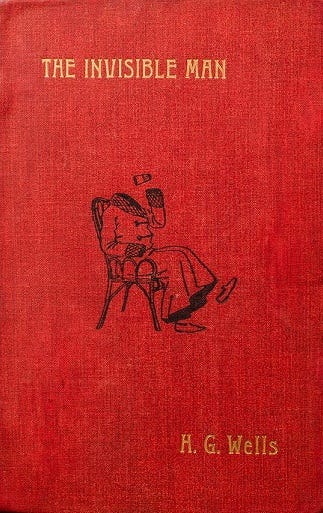
1897 was a banner year for sci-fi/horror classics, with both H.G. Wells’ brief but surprisingly brutal book being published, as well as Bram Stoker’s groundbreaking Dracula.
The Invisible Man tells the story of a mad scientist named Griffin who runs amok when his experiment in optics gets out of control. He turns himself invisible, as you might have guessed from the title. While being unseen is nice for awhile, when he can’t reverse the process despite his obsessive research, Griffin becomes homicidal. He terrororizes an inn, then threatens a town. After gaining a confidant named Kemp, he concocts a scheme to wreak havoc on the entire nation. But when Kemp betrays him to the police, a deadly vengeance-fueled cat and mouse game ensues.
The Invisible Man is definitely worch checking out, as is the 1933 Claude Raines-starring film adaptation. The 2020 film written and direct by Leigh Whannell is also pretty good.
2.) I Know What You Did Last Summer by Lois Duncan
Source: Midjourney
As someone who had to endure that hip teen slasher wave of the late 90s-early 2000s that started with Scream and ended somewhere around Wrong Turn, I never knew the micro franchise I Know What You Did Last Summer was actually based on a bestselling YA book from the early ’70s. A book that predates the original teen slasher wave that saw Halloween, Friday the 13th, A Nightmare on Elm Street, and all the clones that followed. I always thought of I Know as just “that movie poster that shows off Jennifer Love Hewitt’s breasts.”
While the movie shares the major conceit of the book, it diverges significantly by adding in a fish-hook using crazed killer into the mix. The book is actually more of a slow burn in the style of an Alfred Hitchcock Presents episode, or something like the 1988 Dutch film The Vanishing, as opposed to the film’s sexier, slashier counterpart. For some bizarre reason, author Lois Duncan decided to rerelease the book to update the characters with modern tech and center them in the present. The effect was jarring as I started reading a book I knew was written in the 70s when suddenly a character mentions texting their friend. Note to authors: Don’t ever try to update your classics for modern audiences. George Lucas is your cautionary tale there. And besides, everyone loves retro stuff these days. Barnes and Noble sells records now. Half the new shows out there are set in the ’80s anymore. Stories should be like time capsules.
I Know works okay as a YA thriller, except I think it would have served the story better, not to mention a sense of justice, had the teens been hunted down one by one and actually killed. It’s too soft as it is. Only one of the kids is ever actually endangered — the frat douche, who gets shot, but not enough to paralyze him permanently. The darling main character is exalted so much that her BF actually says that his punishment from the killer would have been to have to live in a world without her in it. Get the hell out of here with that. These four kids ran over a little boy while they were out partying, and then left him there to die without getting help. They formed a pact to keep the secret, and then went on about with their lives. Even after the would-be killer is revealed and stopped, we don’t even get to see the kids face justice for what they did.
3.) Who Goes There? by John W. Campbell, Jr.
Source: Midjourney
As a writer of novellas, and a sci-fi horror fan, I had to check this one out at some point. It comes with a pretty nice pedigree, being considered one of the most influential and important science fiction stories of all time. Who Goes There? certainly extends gravity in the pulp lit of sci-fi, having been adapted not once, not twice, but thrice to the big screen (or twice if you don’t count the latest 2011 adaptation, which I don’t).
Does Who Goes There? live up to expectations? It’s an unusual book in the sense that it relies mainly on lengthy dialogue exposition between the Antarctic researchers, only occasionally cutting to glimpses of the monster shape-shifting and running amok around the station. Nowadays you’d probably see a lot more graphical description, blood and guts, that sort of thing. So it came across more as a cerebral read. Like a clinical description of heart bypass surgery in a medical school lab.
Still, what makes this novella famous is the monster itself. I think Campbell does a great job of depicting the horror of what would happen were such a creature to reach the mainland, where it would have a whole population of flesh and blood to replicate. There’s one heart-stopping scene where an albatross, which Campbell uses in reference to The Rime of the Ancient Mariner, lands near the camp. The men are forced to shoot it to keep it away, preventing the monster from copying it and potentially flying away. I’ve seen the original Thing from Another World, and Carpenter’s masterful ’82 version, and neither takes advantage of such a threat, which makes it unique to the book.
It’s kind of funny though how Campbell constantly refers to the monster as the Thing, and yet he titles the novella something else. Really, the Thing is such a perfect and obvious title, you’d figure it would have HAD to have occurred to the writer to call his story that. He was a legendary sci-fi editor, in addition to being a writer. Perhaps this is case of writer myopia. Who Goes There? comes across more as a murder mystery than a sci-fi horror.
4.) A Boy and His Dog by Harlan Ellison
Source: Midjourney
You could place a colon at the end of the title and add: “A true love story.”
Reading this novella is like handling a Hattori Hanzo sword. Ellison’s genuine love story is less a string of prose than a glinting weapon you equally admire and fear for its supernatural sharpness. Ignoring the outrageous arguments against this short, beastly narrative for its misogyny and big wet dick slap in feminism’s face (it’s Ellison, for Christ’s sake, did you expect a PC automaton?), and you can admire Mr. Always In Hot Water’s cinematic prose, subtlety, and black humor that would certainly warm the cockles of Vonnegut or Burgess’ hearts.
I made the mistake of watching the film version before reading the story, but let’s just say I’m glad it was made in the mid-70s instead of, well, pretty much anytime afterward. This is a young adult dystopian story with big, hairy balls, where the monolithic evil, teenage-exploitative system doesn’t get overthrown by plucky coeds in latex. Nope, our hero simply escapes to live another day, and then makes the ultimate “bros before hos” decision ever made. Which really isn’t a decision. I mean really, who in their right mind would turn their back on their loyal, sarcastic, telepathic doggo for some downunder wacko?
5.) The Hellbound Heart by Clive Barker
Source: Midjourney
This is a nice companion piece to Fifty Shades of Grey.
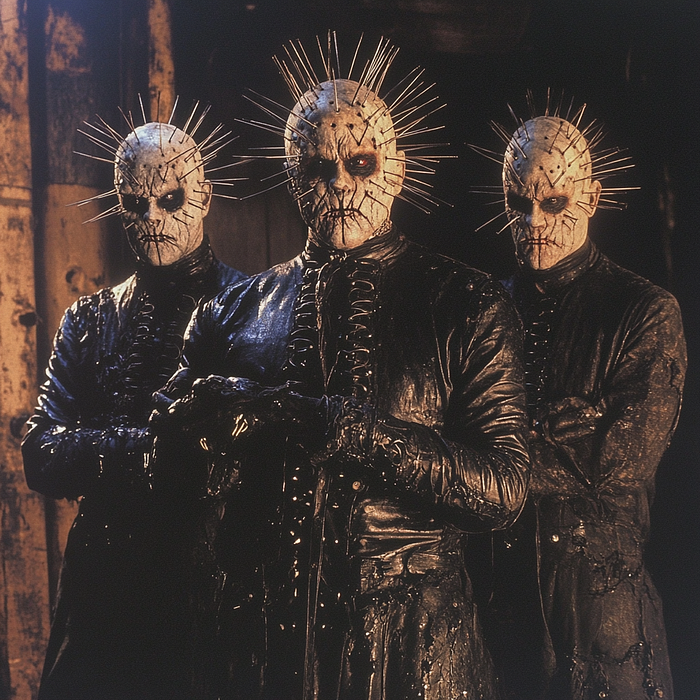
This was such a dark, twisted modern fairy tale about a couple nasty people ultimately getting what they deserve. You wouldn’t think a novella about BDSM demons from another dimension would be an insatiable read, yet this is one you can’t put down once you start. Barker’s writing is spooky campfire story tone, with sentences that pulse with blood and desire. Is this one of those rare books where the movie exceeds the source material? Probably not. Hellraiser is a decent horror flick, but Barker’s true talent lies in his writing.
I like to revisit this book every year around Halloween, but it also makes for a good stocking stuffer.
6.) Altered States by Paddy Chayefsky
Source: Midjourney
Ever wanted to experience the psychedelic/swinging 60s/70s in book form? Now you can! Well, it’s not quite same as dropping a tab of acid, or swallowing a handful of mushrooms, but Chayefsky’s novel, which he adapted into the movie starring William Hurt, is like an adult version of Alice in Wonderland crossed with Frankenstein with a dash of The Electric Kool-Aid Acid Test. Or imagine if Michael Crichton had become a theoretical physicist with a wake and bake routine.
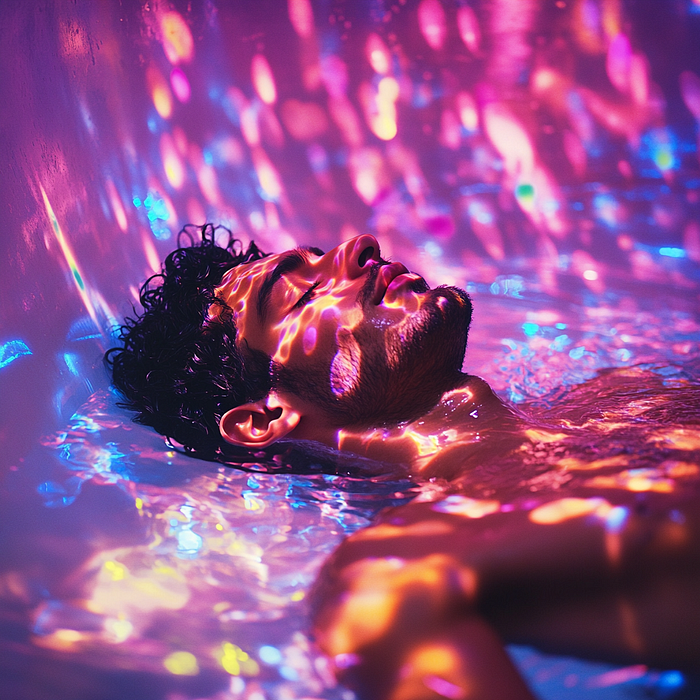
I mainly read this book just to check out how Chayefsky, already a legendary screenwriter, handled a novel. I’d say this represents a culmination of nearly all his writing efforts. His work generally contained existential themes like the meaning of life, humanity in the face of industry, and such heady topics. But Altered States explores the very nature of consciousness itself. At times it’s a little too jargon heavy. Chayefsky’s two years of intense research amongst the Boston-area medical intelligentsia certainly shows. This is not a book that attempts in any way to be relatable, reflecting the monastic traits of its main character. Nor is it a book that will necessarily put you off due to its way out there premise. I think Chayefsky actually left a lot on the table, and could have explored the transformative effects Jessup experiences in the isolation tank more thoroughly. Instead, plot is dispensed with in favor of scientific soliloquies. Not bad, overall, it just feels truncated.
This is one of those books that you will likely revisit several times in your life, drawing different meaning from it depending on which era you’re currently in. The movie is decent, but don’t expect it to offer any more answers than the novel.
7.) The Luck of Barry Lyndon by William Makepeace Thackery
Source: Midjourney
You’ve heard of the D.E.N.N.I.S. System from It’s Always Sunny in Philadelphia. Allow me to introduce you to:
The B.A.R.R.Y. L.Y.N.D.O.N. System
Be of noble birth. Always be seducing wealthy and vulnerable heiresses. Rogues are cool. Really, rogues are super cool (especially Irish ones). Yes, my great-grandaddy was an Irish king.
Lying? Me? Never. Yes, I’ll have a fine brandy. All of them, in fact. Nora, that bitch. Destroy scheming step-sons at all costs. Only bang sluts, never marry them (unless they’re rich). Never surrender a chance to duel.
William Makepeace Thackeray’s Barry Lyndon is many things. It’s a picaresque confessional novel, a sort of 18th century American Psycho. It’s a satirical look at class and the aristocracy of England during a transformative time when the American colonists were overthrowing the rule of the monarch.
I found its greatest strength to be its cruelly honest depiction of an unhealthy and toxic marriage, in the form of the relationship between Redmond Barry, who becomes Barry Lyndon upon his marriage to Lady Lyndon (the wealthiest heiress in England, apparently). Despite being of low birth, through mostly violence and psychological warfare, Barry gains control over Lyndon’s entire estate, and promptly plunges it into near bankruptcy. He isolates his wife from society, abuses her in drunken black out rages, makes a mortal enemy of her son Lord Bullington; yet still produces a son with her to serve as his heir. As with everything Barry touches, it turns briefly to gold, only to crumble to dust. His son dies in a tragic horse accident, and he is ultimately undone through trickery just as he is ousted from his first love Nora at the beginning of the story.
Subtley, Thackeray seems to hint at the failure of English society, despite all its pomp and importance. All it takes is a mere “Irish rogue” with enough cunning to spearhead his way to the top of the heap (however briefly), to be undone only by the same vices that lead him initially to success. But perhaps Barry isn’t completely to blame. If one wanted to rise above his station in those days, in that part of the world, one had to be a force of nature. You had to be willing to do whatever it took. Only the few were born into the nobility, and so had the leisure of acting as “gentlemen.” For the rest, it was either through military service (risky, considering you had a high chance of death, disease, or dismemberment), or schemes. America had not yet been invented. There was yet very little means for one to climb upward.
Barry gambles compulsively, a habit that serves him mainly in youth, when with his uncle, he tours Western Europe separating fools from their money. Barry’s only chief skill is in fact “play,” (cards) a perfect metaphor for the arbitrary fate that falls on those who choose the criminal life of deception and violence. Though nowadays Barry’s means of creating wealth might be related to the casino dealings on Wall Street. A modern day Barry Lyndon would probably be a Silicon Valley fraud, a la Theranos’ Elizabeth Holmes. Someone psychopathically fixated on achieving status not so much because it’s fulfilling or it even satisfies some inner need, but simply because their brain seems wired in such a way. The world is filled with Barry Lyndons, just as the world is filled with horrible, shitty marriages that nevertheless go on.
The Luck of Barry Lyndon is worth a read, as is Stanley Kubrick’s film adaptation, it goes without saying. It’s a bit dry in spots, but the parts with Lord Bullington are worth waiting for.
One thing I’ve found recently is that it’s getting harder to find fiction that appeals to me as a middle-aged man. This seems to apply to most mediums, though it’s most prominant in film. Rarely are films geared toward those male and older than 35. If it isn’t a superhero fantasy four-quadrant epic, it’s the latest mopey romance, or it’s a movie about a toy of some kind. I think this is why films like Top Gun: Maverick, Avatar: The Way of Water, and Oppenheimer did so well. They were actually able to pull in guys like me, who normally just bypass the theater because we know there’s rarely anything there for us.
The same holds true for the book publishing industry. During a stroll down my library aisles recently hardly anything caught my eye. The romance section is so massive it needs its own wing. Filled with iconic names like Danielle Steel and Nora Roberts. I’ve read Roberts in the past, and while she’s great, romance just isn’t my thing. What, you don’t expect me to read something like Fifty Shades, do you?
There’s your brand name male authors like David Baldacci, Dean Koontz, good ol’ King, John Grisham, James Patterson, and your high-concept thriller guys from the past — Michael Crichton and Tom Clancy. I’ve read most of Crichton’s stuff already, and hit a lot of Clancy’s highlights. And if I’m being honest, a lot of the murder mystery thriller stuff starts to sound repetitive. How many detectives investigating a conspiracy “bigger than they imagined” does one really need in life?
It’s understandable why studios and book publishers don’t care about us. Afterall, your typical 35+ dude is working all the time and/or married with kids, dealing with family stuff. Hey, we’re too busy trying to run the world here. We don’t have time to be wasting in fantasyland.
This is alarming as a novelist myself. Even though ironically many novelists don’t read themselves. Koontz can’t. There’s no way at the rate he pumps out his books. I’m pretty sure he wrote another Odd Thomas during the time I took to write this overly long intro.
Anyway, it sure wasn’t easy, but with some hard work I actually found a few books that appealed to me in 2023.
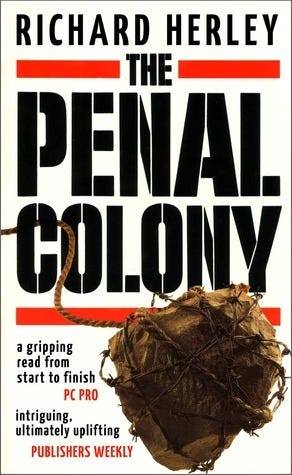
The Penal Colonyby Richard Herley
Book cover for ‘The Penal Colony’ by Richard Herley
This book is sort of dystopian future adjacent. In the near future, criminals are sentenced to an island penal colony near the British Isles called Sert that is divided between two warring factions. One side lives in relative peace and order, while the other has reverted to primitive barbarism. A wrongfully convicted man sentenced to Sert tries to survive and earn his place within the peaceful side under a wise ruling Father. But first he must try and survive in the wilderness to prove himself. If he can succeed, he may just find a promise of escape.
This was an interesting concept. Sort of like an adult Lord of the Flies. Stylistically it was rather dry. Very gray and British, if that makes sense. The Penal Colony was made into the 1994 film No Escape starring Ray Liotta. An adaptation which is currently on Amazon Prime, and one which I was able to endure watching for all of five minutes or so. So just stick with the book, which is ultimately well worth the time.
Unwindby Neal Shusterman
Book cover for ‘Unwind’ by Neal Shusterman
YA dystopian. Dark YA dystopian, mind you. I heard about this one on Reddit, and it has the most bonkers concept ever. In the future, adults can have their delinquent teenaged children “Unwound,” which involves harvesting not just their organs but every fiber of their body. One kid must try to escape government agents trying to capture him before his 18th birthday, the final deadline before he becomes an adult and is independent from his parent’s whims. Bizarrely, the whole unwind deal is done as a tradeoff to making abortion illegal.
The premise of this series felt both odd and familiar, sounding like a concept from the ’80s. Like something David Cronenberg or Paul Verhoeven would have dreamt up in their heyday. Say what you will about YA novels being superficial or silly, but that genre has some of the most creative, if not outlandish plots you’ll find in all of popular literature. No ditzy navel-gazing box wine sipping bored housewives here whatsoever.
Unwind is part of a series. While I found the first book satisfying enough, I don’t know that I’ll return to finish the saga. So many of these YA writers need to just wrap things up in a single book. Not everything is meant to become a Netflix series or become another Hunger Games. I mean, David and Goliath is arguably the first “YA novel,” and it was all of half a page in the Bible.
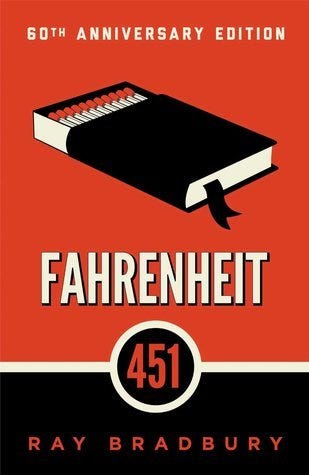
Farhenheit 451 by Ray Bradbury
Book cover for ‘Fahrenheit 451’ by Ray Bradbury
The classic novel about book burning, screen and media addiction, and censorship. Relevant, refined, though unsatisfyingly truncated. The endpoint feels more like a midpoint.
451 was unsurprisingly inspired by George Orwell’s 1984. It started off as a shorter story simply called The Fireman. Another point of trivia: the beginning originally featured Guy Montag having a dream where he’s captured for being in possession of books. Bradbury wisely scrapped this opening to instead start right in the middle of the action, with Guy burning a set of books, letting us see him in his element up close. It starkly marks his arc, which will ultimately take him into exile, where he will learn to become a “living book” in the woods.
If you were never assigned to read 451 in school like many are, you should absolutely add this one to your literary bucket list. I love reading books that have made a powerful cultural impact. Bradbury’s classic is referenced practically every day.
This was simply a pure delight. Every once in a while, it’s nice to go back and read an author who pioneered a genre, which Wells did in science fiction. In a pleasant surprise, there was ample dark humor to be found in this classic work of a mad scientist run amok. As was there also in the 1933 adaptation starring Claude Rains.
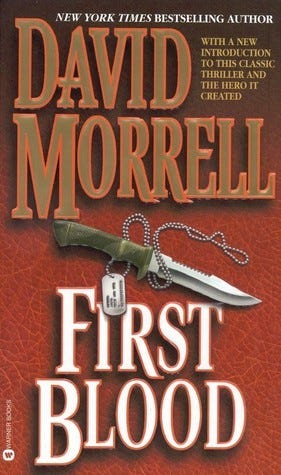
First Bloodby David Morrell
Book cover for ‘First Blood’ by David Morrell
First Blood is basically The Godfather of action novels/films. The DNA of Die Hard, The Terminator, Jack Reacher, and Predator are rooted in Rambo’s inaugural adventure. The book also contains a moving and meaningful theme concerning our nation’s Vietnam War veterans. My dad served two tours in Vietnam doing recon in the Army, so this book felt personal to me, even as someone who was never in the military.
First Blood is about how sometimes conflicts don’t end on the battlefield, and what can happen when they’re taken home. A great read you won’t want to miss.
Hopefully 2024 will provide more great reading opportunities. Finding something that appeals to me sometimes feels like performing alchemy. But I have faith.










 Dean Brooks