Should Rich Boomer Parents Help Their Struggling Millennial Kids?

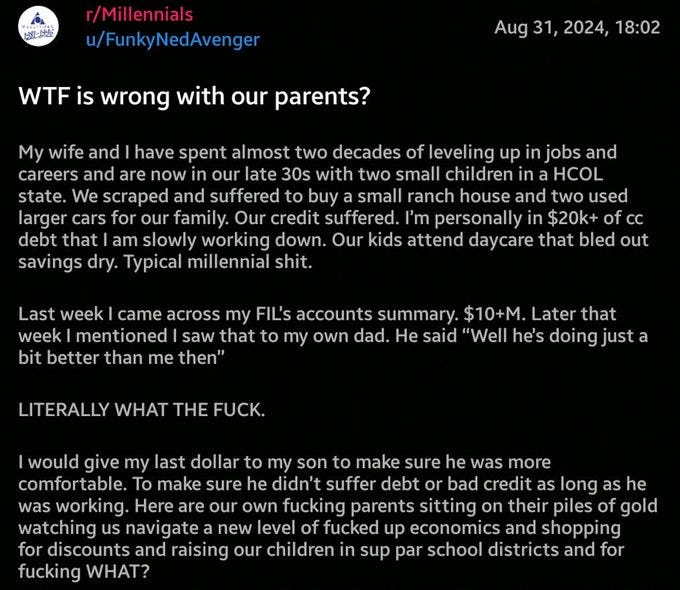
A post on Reddit took the internet by storm with a polarizing question.

Source: Reddit

Are rich boomers greedy assholes selfishly clinging to their lifelong gains, or prudent individualists responsibly preserving their wealth to endure the unknown storms of old age and life in general? Were they simply the beneficiaries of better economic times, cheaper cost of living, and a jobtopia American culture, who bootstrapped their way to financial security through their own gumption, or did they cruelly pull the ladder up behind them and say, “Suck it, kiddos!”

Are Millennials lazy, entitled brats looking for freebies from mommy and daddy instead of doing the hard work necessary to build their own lives? Or ar they the victims of “late-stage capitalism” and all its ills: high cost of living, obscenely high real estate prices, and high college tuition costs? Are Millennials truly just fucked by the economy they inherited from their boomer parents? Are they working their asses off and still getting nowhere through no fault of their own?

And what about Gen-Xers? Do they even still exist? Or did they all just become Millennials when grunge rock died?

I’ve been thinking about the screenshotted post above all week since I saw it reposted on X. I don’t generally puruse Reddit anymore, so I get most of my viral soap opera content from Musk’s Madhouse.

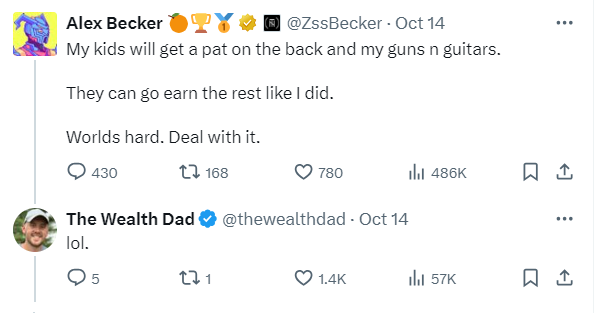
The post prompted a lot of feedback. Some outraged. Some insightful. Some hilarious.

Here’s what Alex Becker had to say:

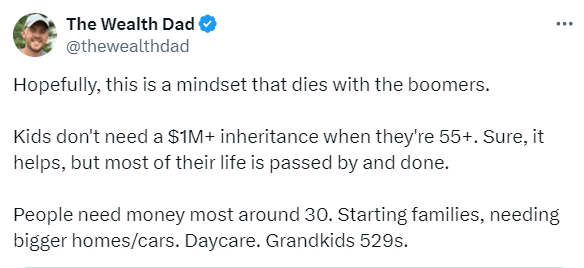
“The Wealth Dad” believes:

While others disagreed, and felt getting bags of money prematurely parachuted in from mom and dad would be a hinderance overall:

I don’t think anyone is entitled to anyone else’s money. Even their parents. Even if their parents are rich and it’s clear that when they die they are going to hand down millions, or tens of millions to their kids.

Are Millennials struggling these days? Yes. Many are. Are they having fewer children because of their struggling? Yes. Would a bailout from their parents help? Yes, it would. Money in your thirties, when many are building families or buying homes would serve much better than getting a bag of cash in your late 50s or 60s, after most of life has been lived. No doubt about that. And if rich boomers want to help, then by all means.

But let’s start with why so many Millennials are struggling today. For the most part, it’s largely due to student loans and real estate prices. And tons of bad debt. I myself had almost $35,000 of debt at age 30. Most of which was student loan related, but also credit cards and auto loans. I was truly fucked up. But unfortunately, I grew up in the lower-middle class, and while some extended members of my family, and ex-family, are quite well off, there was never anybody coming to lend me a hand.

I had to take the hard route. Packing up everything I owned in Philadelphia and moving to the frigid tundra of North Dakota. There, after some struggle, including brief homelessness and being reduced to one dollar to my name, I wound up securing a nice income in the oilfield. After two years, I had paid off all my debt, and built up a nice cushion of savings to finally go back to school and finish my bachelor’s degree. After checking off that box, I returned to work, and am now on the road to financial independence. I have zero debt, side income from investments, and basically have a “CoastFIRE” level networth. That means your retirement is secure via compound growth even if you don’t put another dime in of your own.

While I still have a ways to go until I’ve got that Holy Grail “Fuck you money” that everyone wants, I don’t think I’d have ever gotten off my ass and accomplished what I had if I thought mommy and daddy were going to help me out via inheritance or bailout. In fact, I’m way better off now than my parents are in retirement. I’m the rare Millennial who beat the odds and has done far better than his parents.

I rather like that. I like knowing I made it on my own without a handout. I won’t lie. Whenever I hear of Millennials who needed their parents to give them money for a house down payment, I look down on them. I think less of them. My mom and step-dad wouldn’t even fill out the FAFSA without giving me a hard time (a long story), despite apparently having “too much income” to qualify for it anyway. I paid for college entirely on my own. Hell, I moved out when I was 16. I did the best I could, fucked up along the way, but wound up course correcting big. On. My. Fucking. Own.

That’s not to say there have not been sacrifices. Real, killer sacrifies, on my part. For one, the oilfields of North Dakota is the place love goes to die. It’s virtually impossible to meet anyone up here. I had to sacrifice my prime dating years to pay off debt and secure my own financial future. Not an easy task, and not something every man is willing to do. It was very hard to try to have long distance relationships. It was demoralizing to make brief connections via dating apps, only to see them whither and die on the vine because of the distance, or because a girl I liked met someone else closer to her. Now in my 40s, I have to accept the fact that the optimal dating window has closed for me. Even if I am financially secure, that only goes so far once you’re past 35 as a man. I won’t accept garbage situations like single moms or women with baggage issues. I’ve never been sex-driven or needy or dependent on having a woman in my life. Again, a rare thing for a man. But then I’ve always been a loner and largely self-reliant. I was MGTOW before it was cool, baby.

I’d have loved to have met someone when I was younger and built a family with them. A financial bailout would have helped for sure. But what would have helped out a LOT MORE was the knowledge and training from my boomer parents about the perils and pitfalls of student loan debt, and some better financial education, overall. Both my mom and step-dad knew little about saving and investing, and so imparted no knowledge. I had to figure all that out on my own.

I think Boomers are highly overrated as “successful” or “lucky” because of the times they lived in. They had their own struggles, too. Be glad you didn’t have to worry about getting drafted into a war when you were a teenaged boy. My dad is a Vietnam vet. He joined the Army at 17 and later got sent over there in intel and recon. He was boots on the ground like the troops in Platoon. I’m very thankful I did not have go through something like that, and that all wars waged by our government since did not require a draft. I’m very appreciate and reverential of my father’s contributions. He is a war hero, and frankly, I’d be an unworthy asshole to act entitled to anything he earned from his Army pension or government pension due to his work as a probation officer for many decades. Same with my mom. She was in the Army also, and has worked as a teacher for many years, and gotten her own state pension and worked for her retirement. I love them both too much, and would much rather know they are secure in retirement than to think of them as piggy banks, to be used for my own needs. Again, maybe that makes me a rare kind.

Millennials have had opportunities that Boomers never did. The stock market has been far better, and more predictable, during our young adult lives than it ever was for Boomers. We’ve seen tech stocks like Apple 500X over the last twenty years. We’ve seen new asset classes like Bitcoin and crypto explode onto the scene. Broadband internet and smartphone apps have allowed us to navigate far more nimbly than landlines and payphones did for our parents. Real estate is way pricier in HCOL areas, sure. But the Midwest and South have offered cheap opportunities in areas that turned into boomtowns. The fracking boom saved my ass, and transformed West Texas and North Dakota into spectacular growth areas.

Even if you have rich parents, it’s never good to base your life on the idea that you’ll just get bailed out. At a certain point, you have to learn to rely on yourself. We’ve all met snobby trust fund pricks before. And we’ve all met helicopter parents who control every aspect of their adult children via money. Who the hell wants that?

Do some people have significant advantages from their parents because of money? Absolutely. But usually their success comes from their own intelligence and hard work. The money was just a tool. If I ever have kids, I’ll almost certainly leave something for them. But my real contribution will be to teach them how they can succeed on their own. Equipping them with the financial knowledge I never had. That’s a real inheritance.

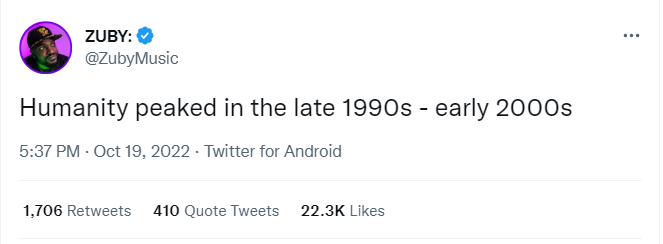
Did Humanity Peak in the Late ‘90s-Early 2000s?

Source: Screenshot of ZubyMusic Twitter.

Or is this just pedestalization of the past?

I’ve followed ZubyMusic on Twitter for almost three years now, at least since around 2019.

If you’re not familiar with the artist, “Zuby,” short for Nzube Olisaebuka Udezue, is a 36-year old English rapper educated at Oxford University, with a substantial and growing audience of worldwide fans. Known mostly for his music, he’s also a strong conservative voice, often criticizing identity politics, and is a Christian. He’s self-released three albums, and has a podcast and YouTube channel.

I’m not a Christian myself, nor do I listen to rap. In fact, I’ve never once even listened to Zuby’s music, as I think “Christian” and “rap” sounds about as cringe as almost anything the “Christian” world tries to attach itself to in the secular realm in order to be hip and relevant. Christian comedy. Christian rock. Christian movies. Ugh. No, thanks.

Still, I like Zuby because he often makes interesting and thought-provoking tweets. Even if I don’t always agree, it’s nice to get a different or unique perspective on current events, especially on Twitter. It’s funny how conservativism is actually quite maintream and common in everyday life, yet online it’s seen as odd and “alternative,” with liberalism and left-wing politics seen as the default. In reality, it’s much more evenly split.

Last October Zuby tweeted the above comment, which I frankly dismissed almost immediately. I think there’s a temptation to glamorize one’s youth, seeing it as some bygone golden age. Zuby, born in 1986, would have had his most formative childhood years in the ’90s, and been a teen for the first half of the ’00s. I remember John Stewart on The Daily Show saying something like “you don’t miss that era, you just miss being a carefree child,” in response to a pre-sex scandal disgraced Bill O’Reilly saying how he felt the decade of the 1950’s (O’Reilly’s youth) constituted Americas best years. Politically, Stewart and myself are quite opposed, though I have to admit the guy could be pretty insightful at times.

Nostalgia-gazing is something particularly characteristic of the right wing. And while it’s soothing and addictive, it’s also as pointless and counter-productive as the left’s own habit of future utopia fantasizing. Neither side seems to want to deal with the here and the now, preferring to longingly await a DeLorean to whisk them away to another timeline. No wonder things remains such a mess, when both sides abdicate their responsibility in the present.

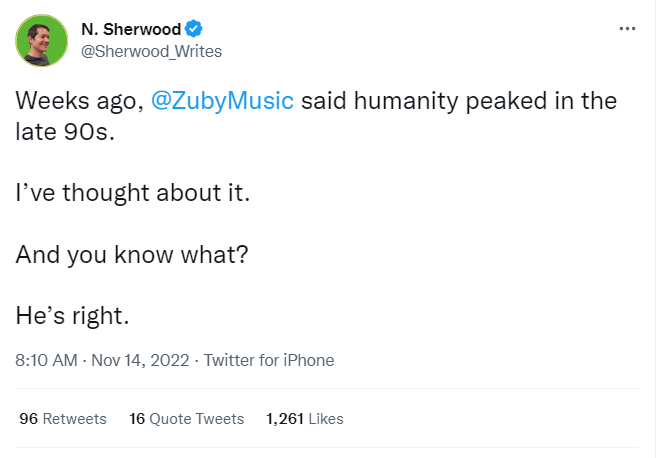
Then this morning I was reminded of Zuby’s tweet by Nick Sherwood, author of The Social Virus: Social Media’s Psychological and Social Impact on America (And What We Can Do About It). He posted a series of tweets articulating why he feels Zuby is correct.

Source: Screenshot of N. Sherwood’s tweet.

The above was followed by a long thread of reasons and supportive evidence, some of which I thought had credence. Others I found questionable. And by “others,” I mean most. And by “questionable” I mean mostly B.S.

To begin, I don’t think it’s possible to declare any particular era in human history a “peak” at all, given that so many cultures and nations around the world are undergoing vastly different experiences than others, both positive and negative.

If we’re talking strictly the Western world (America and Western Europe), one could make the argument the late ’90s to early 2000s certainly wasn’t a bad era. The Cold War had ended, and the economy and job market were strong. But that’s looking at things from the macro view. For someone working a cash register in a small town in Idaho, was their life any better or worse, or much different for that matter, than ten years prior?

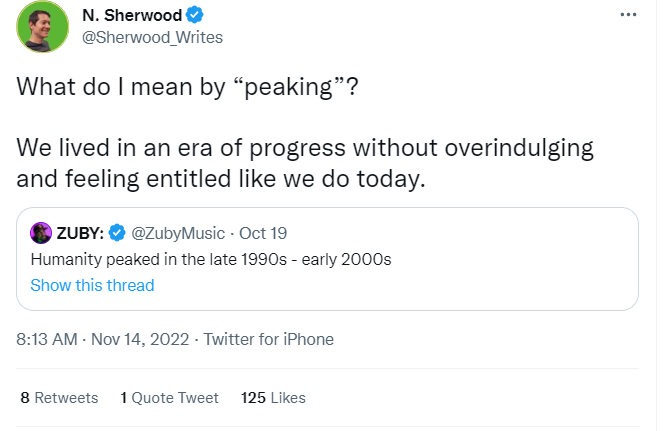
Sherwood continues:

Source: Screenshot of Sherwood’s Tweet.

I agree with the first half of the second sentence, if by “progress” we’re talking technologically and socially. No doubt the ’90s was an era of progress. But so was the ’80s, the ’70s, and almost every decade before. At least in America and other places in the world. “Progress” is also subjective. No doubt Lenin and Stalin would have considered their Communist Revolution in Russia “progress.” But was it? Big doubt.

The second half of the statement is basically meaningless. How do you even measure levels of overindulgence and entitlement? These are aspects of human nature, and I don’t think humanity has evolved much, if at all, in just the past 25 years. So I’d say there’s a good chance that we’re seeing the same levels of indulgence and entitlement now that we saw a quarter-century ago. Maybe now it’s just more visible due to social media.

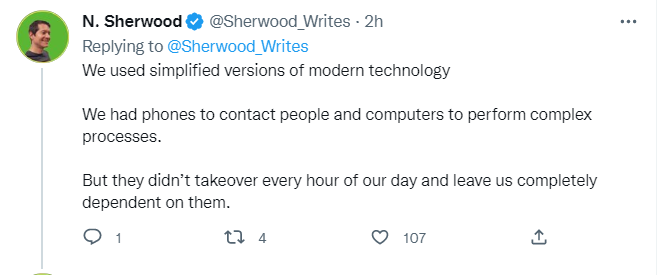
Moving onto his next points:

Source: Screenshot of N. Sherwood’s tweet.

Sherwood seems to posit that the late ’90s/early 2000’s comprised some kind of Goldilocks “sweet spot” era in which we had the just the “right amount” of technology. Not too much to where it became omnipresent, like the smartphone in everyone’s pocket, but just enough to where it acted in the background.

Again, this is highly subjective. One man’s too much technology is another man’s not enough. I can certainly remember people fixating on computers even as far back as the mid-90s, when the internet became more accessible to the mainstream.

Infrastructurally speaking, we’ve been dependent on computers probably since the 1960s. Almost all of our telecommunications, major medical equipment, civil defense systems, etc. all depend on computers and microchips.

If we’re talking about how the ’90s was the beginning of computers separating people into their own bubbles as everything went digital, there’s an argument for that. I do think people were more fluid socially back then than they are now. Younger generations today can’t seem to effectively communicate unless it’s through a screen. It was Millennials, afterall, who popularized “ghosting.” When people are reduced to simple online avatars, it’s much easier to dismiss their humanity and snap them out of your existence. People today shy from conflict more readily, and terms like “social anxiety” are prevalant.

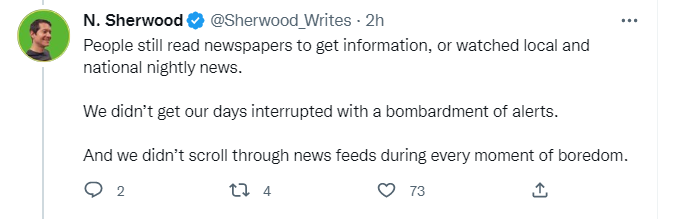
Source: Screenwhot of Sherwood’s tweet.

I wrote for a newspaper as a teen. Had my own column. I also worked in the printing industry for eight years as it transitioned into the digital age. Newspapers are cool, but I wouldn’t associate them specifically as being the best or even a good source of information necessarily. At least, not anymore than radio or TV. Local news hasn’t really changed in 25 years, either. Traffic on I-95. Some guy got busted for dealing drugs. A kindergarten teacher retires. New waffle restaurant just opened. The song remains the same.

It’s true we get hit way more with B.S. news alerts and app notifications. But that’s a simple fix. I either delete a misbehaving app, or don’t turn on notifications at all. The only alerts I get on my phone are from my Medium app, which is actually starting to get on my nerves.

But again, Sherwood is really making more of a case against smartphones, and by extension social media, and not so much a case for the ‘90s/2000s being some golden era. You can’t just argue in the negative. Smartphones didn’t exist during the Bubonic Plague in Europe either, and I don’t think anyone would argue those were good times. Not unless they’re some hardcore “survival of the fittest” Darwinist fanatic, or something.

Source: Screenshot of Sherwood’s tweet.

What?! Has this guy not heard of the John Birch Society, which handed out leaflets and pamphlets pandering to very specific and extreme right wing beliefs WAY back in the ’50s and ‘60s?

Or The Daily Worker newspaper, published by the Communist Party USA back in the 1920s?

Or Bop Magazine, delivering steamy servings of teen heart throbs like Jonathan Taylor Thomas, Johnny Depp, and Jonathan Brandis?

Hmmm…if the ’90s was peak anything, it was was Peak Hot Guys Named John.

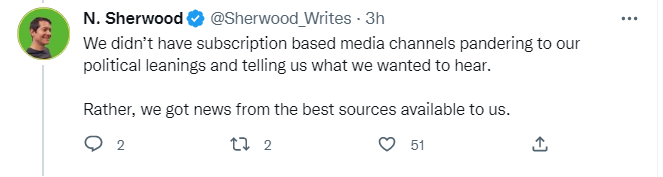
Source: Screenshot of Sherwood’s tweet.

No matter how many streaming or cable channel options exist, there are effectively only a small number that any one person will ever regularly watch, as there is only so much attention one can give, and limited time.

And why is the expansion of entertainment media necessarily a bad thing? You wouldn’t say the same about the millions of books that have been printed in the last few hundred years. So why would TV shows and movies be any different. There being five million Star Wars movies/shows/books/toys is annoying to me, yes, but it’s not like it ruins the quality of my life. I just ignore it, like anyone older than twelve and who possesses a frontal lobe should.

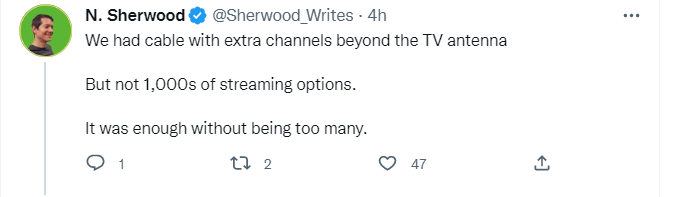
Source: Screenshot of Sherwood’s tweet.

Ah, so media is only “good” if EVERYONE is watching so they can dicuss it the next morning around the water cooler. Got it. That being the case, I guess the daily state broadcasts North Korea puts out to all its slaves, er, “citizens” must be of the highest excellence. I’m sure KCT fosters something a bit more than a “semblance of monoculture.”

It’s true that much of pop culture and media is fractured amongst varying demographics and audiences. But that’s always been the case. I can remember my friends and I discussing how freaking awesome the T-1000 was around the school cafeteria the year Terminator 2: Judgment Day came out, only to get blank stares from the girls, who themselves were talking about Beauty and the Beast. Then going home and my step-dad telling me to shut-up about “Turdinator” while watching a re-run of Welcome Back Kotter. Then running to my mom to whine that her husband insulted my hero Arnold, only for her to shut the door in my face so she could watch Knots Landing.

Like that South Park videogame, it’s always been a fractured but whole, Sherwood.

Monoculture is a myth. No matter how big a movie is, it’s likely not even three percent of the world population will even see it. Take Avatar, the highest grossing movie of all time not adjusted for inflation, at almost $3 billion in global ticket sales. In 2009, the year Avatar premiered, if the average movie ticket was $7.50, then that means a maximum of 400,000,000 saw James Cameron’s remake of Fern Gully in theaters, out of around 7 billion people. Except that number doesn’t count the people who went to go see the movie repeatedly. And it doesn’t count the fact that many people paid way more to see it in glorious 3D. If you cut that number in half to 200,000,000, that means only about 3% of the world population saw Avatar. Even if you double it to 6%, that’s still pitifully low in the grand scheme of things. And that’s the biggest movie ever released.

To put that in perspective, the biggest religion in the world, according to the Pew Research Center, is Christianity, and it hasn’t even cracked 1/3 of the global population with its 2.2 billion followers.

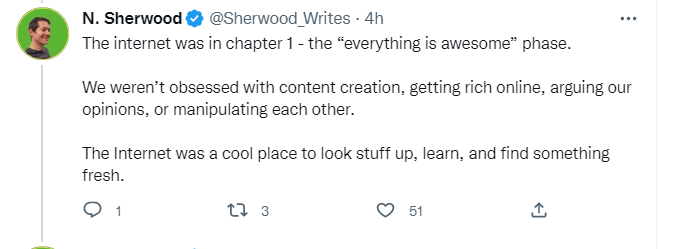
Source: Screenshot of Sherwood’s tweet.

No, Chapter 1 of the internet was “How Much Freaking Longer is This Thing Going to Take to Log On, Goddammit!” With the sub-chapter “Don’t Use the Phone I’m on AIM Right Now!” Chapter Two was “When Are We Getting Broadband, Everyone Else Has It Now!”

The internet sucked 98% of the time back in the ’90s. It wasn’t cool. It wasn’t aweome. You didn’t find anything “fresh.” It was where you IM’d your friends from school until some creep found your teen chat room and tried to have cybersex with you. There’s a reason why To Catch a Predator came out in the mid-2000s right after the supposed “golden age” of the internet. It’s because the world wide web, due to its anonymity and wild west novelty, empowered a lot of perverts in the early days.

The internet was also a place for piracy. Remember Napster, which single-handedly almost destroyed the entire music industry? “I Love the ’90s” my ass, especially if you played in a band named Metallica.

The internet was weird, distrusted, seen as a fleeting fad by some, buggy, slow, mostly useless, and the driver of the Dot Com meltdown. Saying the internet was “cool” back then before high-speed and regulation is like saying bloodletting was cool before modern medicine discovered viruses and bacteria.

Source: Screenshot of Sherwood’s tweet.

Ah yes, that wonderful period in the late ’90s and early 2000s when politicians never pandered for votes, didn’t treat those across the aisle like horrid zombies, and joined arms as fellow Americans. Back then we didn’t have contested elections, or impeachment trials, or “vast right wing conspiracies,” or third party presidential runs conducted by eccentric billionaires. Politicians didn’t lie. They never even used foul language. Certainly they didn’t have affairs with interns, or cheat on their cancer-stricken wives. Or invade countries based on false claims of weapons of mass destruction. None of that ever happened.

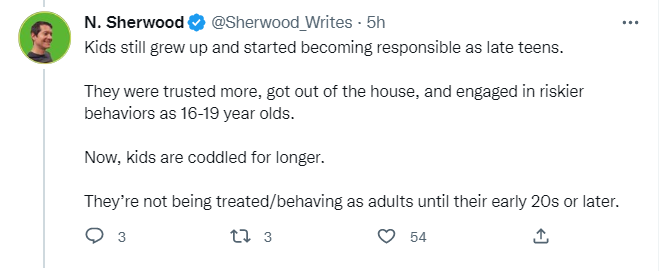
Source: Screenshot of Sherwood’s tweet.

If kids growing up and maturing sooner is your benchmark for the golden years, then you’d have to look way past the ’90s. Back to, say, during WWII, when kids lied about their age so they could go to war.

Take the case of Calvin Graham, for instance. Born in Canton, TX, Graham signed up for the U.S. Navy after the bombing of Pearl Harbor at 12 years old. He’d later get wounded by sharpnel at the Naval Battle of Gaudalcanal, for which he’d receive the Bronze Star and the Purple Heart. Graham would eventually get booted from the Navy after attending his grandmother’s funeral without permission. Get married at age 14. Become a father a year later. Divorced at 17. Then join the Marine Corps at 17 to serve in the Korean War. Then break his back in 1951 after falling off a pier.

Look at that. Two wars. Two branches of the military. Married and divorced. Has a kid. And even gets his first case of workman’s comp. All before most kids even learn how to shave.

Sorry, kids were not free-roaming Mad Max badasses in the ’90s. They were mostly soft, squishy, sticky bags of shit. Eating Lucky Charms, Pop Tarts, and Ellio’s Pizza. Capable only of Nintendo marathons, watching Saturday morning cartoons, remembering the Konami code, and making fun of Michael Jackson’s face.

I don’t know what causes people to glamorize and pedestalize the past. Nostalgia has practically become its own genre now, with Hollywood dumping ‘80s-inspired crap like Stranger Things on us constantly like Nickelodeon slime. I remember the ’80s, man. I was a kid then, too. Well, mostly I remember watching TV and movies during the late ’80s, and not having to worry about a whole hell of a lot. What do you mean the Russkies could drop a nuke on us any moment? I don’t care, I’m watching Inspector Gadget here and drinking chocolate milk.

For sure, sometimes I miss not having any responsibility other than deciding what kind of dinosaur I want to be for Halloween. But it’s kind of ridiculous and suspect to declare any particular era “humanity’s peak” when it just so happens to coincide with your childhood. It almost sounds like indulgence and entitlement, come to think of it.

Think of it this way. Right now there’s a horrible war going on in Ukraine. It’s the worst of times for anyone who lives there now. But somewhere in Colorado, Florida, Canada, or maybe even Japan, some kid somewhere is having the time of his life. He’ll grow up thinking it never got any better than the late teens and twenties. The ’90s and early 2000s will be as foreign to him as the ’60s and ’70s are to a Millennial or Gen Z’er.

And you know what? He’ll probably be right. At least he didn’t have to deal with the Macarena.

Why Guys Don’t Buy Furniture

For starters, it’s not because we don’t have money to buy furniture. At least, those of us who are still working these days and not just collecting Monopoly bills from Uncle J. Powell’s Magic Money Machine (the Fed) because our jobs got swallowed up by the Covid monster.

It’s not because we don’t enjoy using furniture. I love it, actually. There’s nothing better than going over to a friend’s house and quietly judging their marital relationship while seated in a plush leather loveseat or sofa on the other side of the room.

It’s not because we don’t know how to shop for furniture. These days, it’s easier than ever. You can furnish your whole house with just a few clicks on Amazon. Obviously, there’s IKEA, painted in that dark blue and yellow you can see from five miles down the highway. Even in small towns, there are usually a dozen furniture stores always having amazing inventory sales. Half the time you open your mailbox you’ll find glossy flyers spilling out, blaring about the Fourth of July/Black Friday/Christmas/Going out of Business sales coming up around the corner. We know all about the furniture world. We know it exists, how wonderful and comfortable it is, how we should get a protection plan for an additional $14.99, and how if we open a store credit card TODAY we can immediately get 15% off our purchase.    

And it’s not because we don’t like furniture or have some sort of agenda against it. When I see a nice plush, fabric sofa, my brain goes “I like sofa. Sofa good.” Whether we’re talking the ornate Louis XIV silk museum pieces, or whatever wacky designs Tim Burton uses in his movies, we’re pretty open-minded about all different sorts of furniture styles. I’m somewhat of a minimalist myself, which certainly doesn’t mean “cheapskate” or “tightwad.” I like simplicity. Practicality. I want furniture that just shuts up and does its job.    

Look, we all get it. You have a place where you live, you’re supposed to fill it with fabric and leather and other stuff. We understand the unwritten social rule. Here’s the deal though, at least for me until recently: We don’t care. 

Guys are by nature Anti-Furniturian. Probably, like so many other guy behaviors, it has to do with our caveman roots. Who has time to lug an 80-pound chaise lounge out of a cave when you’re being chased by a saber-toothed tiger? For hundreds of thousands of years, mankind was all about the hunter-gatherer life. We moved from place to place looking for food, not hot deals on matching bedroom packages.  

Now, I don’t pretend to speak for all guys. But I do know that for many years, as in for most of my adult life, I went without furniture beyond what was absolutely necessary: A bed, a desk, and a chair. I was an Anti-Furniturian without even realizing it. It’s only been very recently that I’ve started dabbling in the furniture dimension, slowly getting pieces for my apartment. It’s been tortuous, to say the least. Yesterday I agonized for hours over what reading lamp to buy until finally, my brow beading with sweat, I pulled the trigger on a black touch lamp with a white shade. Did I make the right life decision? Only time will tell. 

So having just gone through this recent metamorphosis/conversion, I decided to reflect on my former Anti-Furniturian past. What prevented me from buying furniture before? Why is it every guy friend I’ve ever had either has little to no furniture in their apartments, or if they have any, it literally looks like something they pulled off a curb in Tijuana? Why will a guy spend $2000 on a gaming computer that lights up like a disco ball if they blow up a Nazi, but won’t even spend as little as $199 (plus free shipping) for a bare bones sofa so they can at least pass for someone who’s partially civilized? And why is it every girl I’ve ever known has had a fully furnished apartment/house that looks like the “after” photo from a home makeover reality show? 

I don’t pretend to have all the answers. God knows the mindset of an Anti-Furniturian is rife with contradictions and self-righteous justifications. But I had my own reasons.

Firstly, I moved around a lot. I hate moving. Having lots of furniture makes moving suck even more than it already does. So by having as little as possible, I’m guaranteeing that I’ll be less-stressed in the future when I inevitably move again. I know we’re all hunkered down in our homes right now because of the rona, but it feels like these days people move around a lot more than they did in the past. The days where you’d “settle down” in one town forever to work and raise a family are pretty much gone. Everyone’s restless. It’s not unusual to pick up and move across the country for a new job. Even with today’s technology, video conferences, and such, I don’t see that trend changing. Who wants to live in one area forever? Things could be so much better in that cul-de-sac, or that street, or that neighborhood, or that other school district, or that place by the new Starbucks. It could always be better somewhere else. But you know what doesn’t make it easier to get to that other, better place? Having furniture! Who wants an oak dresser or recliner weighing them down and killing their wanderlust vibe? Not me. Plus, it’s expensive to move. So not buying furniture, and then not having to pay for it to be moved is a double savings. 

Secondly, indecision. I can’t even begin to describe the complex decision matrix that forms in my head when I start thinking about furnishing my apartment. If I get that piece, will it “match” that other piece? What does it even mean when something “matches.” Is it by color, style, or “feel.” What if I get one piece of this set, but when I go to buy the rest later it’s been discontinued and I’m stuck with an orphan piece? What’s in style these days? Modern? Retro? What is bonded leather? Leather’s leather, right? Yeah, but faux leather looks the same, doesn’t it? Will people notice the difference? What if I get this set, then I buy a house, and I need to get a bigger one? I’ll just be buying a set that’ll end up in my future basement, so why bother even getting it at all? 

You know that scene in Fight Club where the Narrator is pondering what sort of “sofa defines him as a person.” That’s basically what’s going on here. Going furniture shopping is like taking a journey into your own psyche.

Thirdly, the realization that most furniture sucks unless you spend a lot of money, and even then it’s probably a rip off. Having worked briefly in a furniture store, and made my fair share of deliveries, I can say with certainty that for the most part, whenever you buy furniture, you’re being totally screwed. Furniture these days is not furniture. Furniture only looks like furniture. Sure, it has the veneer of something you can sit in, lie on, put your feet on, or throw your jacket on when you come home from work. But furniture is fake news. It’s cheap. It’s compressed particle board. It’s something a factory spat out in 35 seconds. It’s something that might have shipped in a box that you have to assemble yourself. It’s a mirage made of wood, fabric, some metal, and maybe glass. It’s not that there is not good, quality furniture out there. Sure, everyone’s grandma has that one table built by Abraham Lincoln himself. It’s that the stuff produced for the masses is mostly overpriced junk. It’s junk! Even worse, it’s junk that they’ll try to get you to finance with a store card or line of credit. So you end up paying real interest and real money on make-believe furniture. 

Fourthly, and this goes along with the “We don’t care” reasoning posted above, it just never fit into my budget. It just didn’t compute. Even though you can reasonably furnish a whole apartment with as little as $1500 (more or less), and even though I make a decent salary, have good side income from investments, and can certainly afford to adequately fill my whole abode with all the bells and whistles like a normal person should, every time I got paid or made money, I just never made that critical, pro-furniture leap. And I honestly don’t know why. It’s just not something I ever cared to put much energy into. I don’t have a wife or kids, so I don’t need to be “domesticated” in that sense. It’s less for me to clean. It’s less for me to think about. Every time I made money I’d think to myself, “Save, invest, or spend on stuff?” and almost always I went with the first two options, unless I needed to pay bills. Not having furniture didn’t inhibit my life in any way. It’s not so much about minimalism–I think minimalists are really just lazy–it’s that when it came down to it, I’d rather buy more Bitcoin, or stocks, or put my money in a savings account for use later. Spending money on furniture, as opposed to a car, clothes, kitchen stuff, and other things, feels like such a waste because I don’t really “need” it. A bed, yes. A chair, sure. A computer desk, why not (though I used a kitchen counter for years before getting one). Anything else just feels excessive. I recently got a TV for the first time in almost 15 years. A TV that sits atop an entertainment center (!), which is something I’ve never had before. 

So, what prompted my big change? How did I finally turn away from my Anti-Furniturian past and see the light? I can’t point to a singular Road to Damascus moment. I just woke up one day and decided enough was enough. I’m tired of living this way. Though admittedly, it was a creeping sense of social pressure. I too feel the need to fit in by having sufficient quantities of faux leather, microfiber, and particle board in various states of compression, assembled in aesthetic shapes in my apartment. It’s society’s fault. It’s your fault. I blame you entirely. I hope you’re happy.  

Furniture is an inconvenience. It’s a hassle to shop for, even online. But especially in person. Has anyone ever gone into one of those furniture stores and actually had a good time? I worked in one and hated myself every day. I can’t even imagine what my poor customers were going through walking in those doors. 

Furniture sucks. I won’t say I’ll never backslide into my Anti-Furniturian ways ever again. But for now, bring on the particle board.