The Shockingly Little Amount I’ve Paid For Cars In My Life

A sentimental listing of my senior vehicles current and past.

My Saturn.

I’ve never been a car guy. Probably that’s due to growing up dirt poor. It’s not like I had a choice there anyway. But it’s more than that. A lot of guys connect their whole identity or sense of masculinity to a set of wheels. I never did that. Never cared.

Sometimes, I wish I could be a car guy. One of those guys who waxes eloquent about this engine or that engine. But for me, a car has always been a metal box with wheels meant to get me from one point to another.

I currently drive a “senior vehicle,” as I’ve written about in the past. Which is a nice way of saying it’s a beater. Even though I could easily afford a new car in cash, I choose to keep driving like I’m broke. I love my old Saturn. She’s a stick shift coupe with almost 200,000 miles. She’s semi-retired now. I’m fortunate to have a work truck I use to get to where I need to, you know, work. And because I live in a small town, I really just use my car for grocery store runs, and the occassional day trip across state. Even in brutally cold winters and burning hot summers, my senior vehicle has just kept chugging along on her minor assignments. Eventually the day will come when she’ll finally give out. When that day comes I’ll give her a Viking funeral for her many years of service. For now she just keeps hanging on like a loyal dog.

Just yesterday I calculated about how much I’ve spent on vehicle purchases over the course of my driving life so far, and I was shocked. I’ll itemize all of my car purchases in a moment, but I’ll just state the number up front here to get it over with. This is approximately how much I’ve spent on cars over 26 years of driving:

— — $12,500 — —

That’s it. From age 16, when I bought my first car, until now, at age 42. Not even thirteen grand. That wouldn’t even buy half of a new base model Honda Civic nowadays after taxes and fees. This absurdly low number is an aberration when you consider that most people are driving around with ginormous car payments and cars that cost as much as houses. I know a guy at work who got a raise, then immediately ran out and financed a $65,000 SUV. That’s more than 5x more than what I’ve paid for vehicles my whole life, just on ONE purchase. Insane.

My first car was a 1982 Buick Skylark. Cost — $200

The same make and model and year even of the car in My Cousin Vinny. I bought it from a mechanic who was a friend of the family. You always remember your first time. My Skylark had a weird tick where it needed to be warmed up for several minutes before it could be driven, or else it would stall out. So, everytime I started it I had to sit there and let it idle before I could go anywhere. Not the worst feature, really, as I used to smoke at the time, and I was a teen with not exactly the busiest of schedules. I’d sit there and smoke a Marlboro, then take off.

My Buick wasn’t exactly a hot rod. But it only cost two hundred. Eventually, when it became impractical to fix, I wound up donating it to some veteran’s charity. I wish I had taken some pictures of it, or at least appreciated it more while I had it. That car represented a big life transition for me. I moved out of my parent’s house at 17 and graduated high school in that car. I miss it sometimes, but I’m glad it was able to go to help people in need at the end of its life.

My second car was a 1987 Toyota Celica. Cost ~ $1,200.

Aw man, I was hot shit driving this around. This was an upgrade. ’82 to ’87. A whole five years! It was a coupe, too, which meant it was practically like a race car.

I kid, of course. I liked this car, but I was never under the illusion that it was anything other than a semi-reliable hunk of aluminum. This car’s tick was an issue with the flywheel. Every so often when I went to start the flywheel would SQUEAL loudly. This made it super embarassing to drive, of course. So, I used to always look around to see if anyone was around before cranking the ignition.

I remember this car more because of how I bought it. I found it in the paper (this was the year 2000, mind you), advertised by this wealthy Main Line physician. It had been his daughter’s college car, and he was just looking to offload it ASAP. After agreeing to buy it, we went to the title and registration, where he proceeded to lie about the price of the car, saying it was $200 instead of the agreed-upon $1,200. This was to save money on taxes and other fees. I was kind of a naive kid at the time, so someone blatantly doing this just to save a couple bucks was a surprise. You mean people LIE to save money? OMG.

This car helped get through a few years of community college. It wasn’t the worst vehicle to have. But it’s not really a car I miss.

My third and fourth cars were 1990 Toyota Corollas. Cost ~$2,200 (combined).

Madonna had her goth phase. Western Civilization had its Romantic Age. I had my Toyota Corolla Era. This was a gilded period where I happened to luck into two very reliable Corollas of the same year back-to-back. The first was a plucky automatic that safely manuevered me across the country in a move from Pennsylvania to Tennesse, and then back again 14 months later. That one was about $1,000.

The other was a stick shift that I didn’t even know how to drive when I bought it. I was a quick learner, though. I’d practiced previously in other vehicles, and so was able to get this back home, only stalling out a few times in the process. This one set me back about $1,200.

Toyota Corollas are perfect little economy cars. It was such a shame I lost both of them due to accidents, neither of which were my fault. The first one I was rear-ended by a lady on my way to work. The other I was side-swiped by a tow truck. The cars were totaled each time. I miss those two cars, and I sometimes think that if it hadn’t been for the accident, I might still be driving the stick shift one. Oh, well. As my boss at the time said, “You can replace a car, but you can’t replace you.”

My fifth car was a 1990(ish) Toyota Tercel. Cost: $400.

I hate to speak ill of any of my senior vehicles, but this thing really was a piece of shit. It didn’t have a muffler, so it sounded like a jet engine driving down the road. It was coming apart at the seams when I got it, but I needed a ride to work, and so I had to get it.

Do you have any idea how nerve-wracking it is to drive on Route 76 from Philadelphia into New Jersey everyday on a rusted bucket of bolts that sounds like it’s going to rattle loose any second, leaving you sitting in the highway holding a steering wheel in your hands? It’s Heart Attack City, man.

Mr. Tercel only made it a few months before shutting down and needing a tow to the big junkyard in the sky. Good riddance, too, as he probably would have wound up killing me at some point.

My sixth car was a 1997 Nissan Maxima. Cost~$1000.

This was another short-timer. It’s issue was an ongoing oil leak. Bad, I know. Cars kind of need oil to keep running. Except I didn’t have any money to fix it. You might have noticed a recurring theme of low-income issues here. Just buying these cars themselves was breaking the bank for me. At the time I had to squeeze every dollar I could. I couldn’t afford luxuries like properly running engines.

I liked this car a lot when I first got it. It was smooth, roomy, and finally got me out of the year 1990, where I’d been stuck for almost ten years. Then the oil issue finally caused the engine to seize up on the highway, where I had it towed away for good.

My seventh and current car is a 2006 Saturn Ion. Cost ~ $7,500.

That brings me to my present senior vehicle. This was the first car I bought through financing. I’d never bought a vehicle other than through a private party prior to this, and always in cash, so this was a new deal for me. I was desperate for a car. I wasn’t happy to have to take on monthly payments for a vehicle. The whole thing felt alien and just plain wrong to me. Still does, actually. But I had once been a car salesman for Saturn some years prior, and I knew they were generally reliable vehicles. I happened upon a good deal for one in 2011, a month or so after my Maxima died, and with trepidation, signed for the loan on the dotted line.

I actually hated this car at first. She gave me nothing but problems the first year. She had some electrical issues that made the doors unlock and lock constantly. When it rained a leak let water in through the passenger side door. So during bad thunderstorms I’d come out and find the floor filled with water. She needed a water pump that cost me over $1,200 to fix. And she was a stick shift, too, which was a pain in the ass to drive in bumper to bumper traffic on the highways into work.

But looking back, my Saturn was one of the catalysts that motivated me to change my life and seek out better economic opportunities. See, between the auto loan payment and the insurance, I was paying over $500 A MONTH just to drive the thing. That’s not counting the cost of repairs, the maintenance, the gas, and the PA/NJ tolls. I was literally working just to keep the car, so I could use it to go to work to continue to pay for the damn car. A vicious, demoralizing cycle, to say the least. Plus, everytime something broke, I’d end up maxxing out my credit cards to fix it. Then pay off the card. Only for something else to break on it again and have to start all over. It was madness.

My Saturn got me out to North Dakota, where I eventually found work in the oilfields. She took me on a West Coast Tour, when I decided to use some time off to drive all the way from North Dakota to Washington to Los Angeles, to back home in Philly, to back in ND. She got me through my two last years in college. All while bravely surviving the brutal cold and winds of this upper midwest hellhole.

I paid my Saturn off way back in 2013. Her purchase price was something like $6,995, but after interest payments and such, it comes out to around $7,500 total. I wound up paying her off early, and then vowing never to finance another vehicle. I’ll ride a bike or thumb a ride before doing that. Fuck debt.


My Saturn is semi-retired now. She still runs just fine when I need her on a day trip somewhere. I give her oil changes early. I never take her out in bad weather. Baby doesn’t get her shoes wet. If I were forced to take a job where I had to drive my own car back and forth to work, or if I were to move to a city, I’d have to upgrade vehicles. But for now I’m in a good and rare situation where I can keep her for as long as she’ll run. When I travel longer distances I usually rent a car or fly. My Saturn could blow up today, and she would have paid for herself many, many times over. Hopefully, whenever that day comes for her to finally give up the ghost, there will be a place I can park her in the Louvre, because that’s where she belongs. Frankly, I don’t think I could ever give her up. We’ve been through too much together at this point. She’s gray and unassuming. Her driver’s side window molding flew off a while ago. She doesn’t have anywhere near the pep she used to have. But she still starts when I turn the key. I love her a great deal. Perhaps I am a car guy, afterall.


Is It Worth Keeping Tons Of Cash On The Sidelines Waiting For A Stock Market Correction?

A thought experiment.

Made with Midjourney

Over a decade ago, after moving to North Dakota to work in the oilfield, I lived in a church basement that had been fitted with dorm-style units. One of my “basement mates” was a nice guy in his 50’s from Virginia named “Alan.” We got to talking one day and he told me how he had $50,000 saved up that he was planning on using in the next big stock market correction. This was only a few years after the 2008 Wall Street crash, so it was still fresh on everyone’s minds.

At the time, ND was undergoing a massive oil boom due to technological improvements in the fracking process. Everyone working in the industry was making huge amounts of money, and like a rising tide, that lifted other sectors as well. Cooks at fast food places were starting at $18 an hour and up. Wal-Mart was paying people $25 an hour. Rent skyrocketed, too. I paid $1000 a month for my tiny basement dorm.

Alan was a CDL treater truck driver. Basically, he drove around to well sites with a giant mobile furnace that could heat up oil and water, and flushed chemicals, water, or oil down well heads in order to keep the lines clear and lubicated. He was probably making around $160K a year with all the OT he was pulling in. So, it was no surprise he had piles of cash sitting around.

I remember asking Alan that if the market were to crash, at what point would he jump in with his war chest? When it was down 10%? 15%? 20%? He didn’t have an answer. Back then interest rates were super low. He was probably only getting around 2% max on a savings account. That’s losing out to inflation badly. The real rate of inflation is not 2–3% like the government likes to report. It’s more like 7% when you factor in everything like real estate, college tuition, cars, medical care — everything that goes into living a life.

Since my talk with Alan over a decade ago (around spring, 2013), the S&P has gone up 3.5x from 1680 to over 6,000. That $50,000 would be worth $175,000 today had it been invested in an ETF like SPY. Interest rates have increased modestly, going as high as 5.5% for some savings accounts when they were at their highest. But nowhere close to a 3.5x return like the S&P.

Worth noting: SPY was about $156 back then. The ETF paid out $1.97 per share in its last dividend distribution. Buying $50K worth of SPY then would pay you $630 per quarter now, and nearly $2,500 a year. That’s the same amount you’d get if you just stuck that $50k in the bank with a 5% interest rate. So, the dividends alone are matching savings accounts. To say nothing of the compound growth in dividend reinvestment, or employing other forms of income like selling covered calls.

Bottom line: Owning the S&P is going to likely give you 10%-15% returns every year over the long-term.

Also worth noting: the stock market hasn’t crashed like it did in 2008 since my talk with Alan. Even the brief Covid crash and the 2022 correction weren’t anywhere close to the near -50% drop seen in 2007 through 2009.

Here’s another way to think about it. Let’s say you have a million dollar stock portfolio in the S&P 500, and $100,000 in dry powder on the sidelines waiting to use for the next big crash. If stocks drop 10%, even if you timed the bottom perfectly, you’re only getting a 10% discount. How many years of dividend gains and compound growth did you give up for that “big” discount there? Obviously, you wouldn’t time the bottom perfect, either. No one can. Anything less than a 5% discount is only matching what you’d get in a high-interest savings account. So, it’d be a wash at that point.

But what about investors like Warren Buffett who keeps hundreds of billions in cash sitting around? What about individual stocks and investments outside the S&P?

Big investors like Buffett and others operate at such a high level that it’s hard to know their ultimate motives or aims. Buffett isn’t concerned with grabbing a mere 10% discount on the S&P. He wants to own entire companies or take controlling interests in things, like how he bought BNSF railroad in 2010. Accredited investors like him are also afforded “insider” opportunities on things that average investors are not, such as IPOs and such. An investor like him might keep cash sitting around waiting for an AirBnb to come along.

For the average “buy and hold” diversification-style investor, aka the one looking to retire at 60ish with one mil plus, it doesn’t make sense to keep tons of cash sitting around waiting on some big crash. Especially if you’re largely just buying the S&P 500 or the NASDAQ anyway. For someone like that, you really only need emergency savings PLUS “peace of mind.” Meaning whatever extra you need that helps you sleep at night. Five thousand, ten thousand, whatever.

For more active investors, more cash is going to be strategically optimal depending on their experience and timing. During market drawdowns, individual stocks afford better buy-in opportunities than the S&P, obviously. Buyers of META during Mark Zuckerberg’s Congressional hearings in 2022 could have bought the stock at near $100. It’s since gone up past $600. A fantastic return in only two years.

Last March, Reddit offered users the opportunity to invest in the company’s pre-IPO share price at $34. I bought some myself, as I talk about in this article here. Since the stock’s public listing, it’s gone up to $180, giving over a 5x return. That was a time when having some cash lying around proved a good idea for me. But remember, speculation is still speculation. Plenty of individual stocks that once looked like bargains have continued to crash.

I read articles saying you should keep 10–20% of your portfolio in cash sitting around for big opportunities. I don’t think you need quite that much. Ideally, you would simply take one investment’s profits to switch into another investment. After measuring the tax hit, of course. Then you’re kind of playing with house money. For instance, I sold a bunch of alt coins a few weeks back, some of which I’d made multiple x returns on over the last 18 months. I rolled most of the gains into my River exchange account where I get a 3.8% annual return paid in Bitcoin, while using the money toward my $20 daily DCA 2025 experiment. As Bitcoin hits certain benchmarks, I’ll likely ladder out some of my holdings into the S&P or into other assets. If I were to take, say, $50K out of my Bitcoin profit holdings for use as a down payment on a house, it’d be like I got that $50K for free. I also made that $50K way faster than it would have taken me if I tried saving it.

And that’s another thing to consider. It takes forever to save up cash even if you have a high income. Even if you make $100k a year, after taxes and expenses, it might take you a few years to save up a mere $50K. Meanwhile, the S&P is going up 10–15% a year, and other stocks or cryptos are going up big. Most likely, you’re better off just putting as much of your money to work as possible, and keeping enough on the side for emergencies and a little extra for peace of mind.

My Very Simple Investing Strategy For 2025

Keeping things easy and mostly automatic going into the new year.

Made with Midjourney

I love investing. I love saving. I love seeing my money grow over time without having to do anything other than sit and wait. I think it was Charlie Munger or Warren Buffett who said, “Compound interest is the eight wonder of the world.” He was quite right.

2024 delivered some fantastic gains across the board for virtually all assets — gold, Bitcoin, and US stocks, of course. Like many others, I’ve seen my networth grow substantially. At this rate, I’ll be semi-retired far earlier than I expected. All good.

While I love investing and watching markets, I hate all the hand-wringing and consternation that often goes along with it. It’s great to make money, but not if you’re going to obsess about it and be checking stock tickers and the Bitcoin price every five seconds. What kind of a life is that?

It stressed me out all year. As I get older, I’ve learned that nothing beats having peace of mind.

I’ve been burned in the past on bad investments that I put way too much time and thought into, while ironically doing quite well in ones I didn’t think much about because they were diversified and “boring.”

My ETFs and index funds? All in the green. But often I do poorly in individual stocks or options investing. I did do great with the Reddit IPO in 2024, nearly 5x-ing my small pre-public investment. Looking back, I wish I had put way more in than I did. But hindsight is 20/20 and all.

To help keep things simple and easy, I’ve decided on a very straightforward strategy. Basically, any money I use for investing after taxes, expenses, and my retirement account contributions will be apportioned like this:

60% equities — Meaning SPY and QQQ, the only two holdings currently in my main non-retirement brokerage account.

20% Bitcoin — This is in addition to my 2025 DCA experiment, which I outlined here. Bitcoin is volatile as hell, obviously, but I’m in it for the long haul. I’ve been in crypto since 2020, so I’m a weathered vet at the ups and downs.

10% precious metals (mainly gold)— I only buy bullion in one ounce increments to save on over spot mark-up, and I prefer the .9999 purity of the incomparable British Britannias. Such a lovely coin, and actually the cheapest way to buy gold over the American Eagles, Buffalos, Canadian Maple Leafs, or almost anything other than packaged gold bars. I also like to buy the silver Britannias every year, too.

10% cash savings — This is money I’ll be saving for pretty much anything. It could be for investing into any of the above categories, toward vacations, collectibles, something risky like options, or whatever. This is savings that sits on top of my emergency fund. Obviously, if I had to dip into my emergency savings for something I’d have to replinish that first before anything else.

What’s missing? Real estate. I don’t own a house or any property, and don’t have any plans to just yet. Housing is not really practical or even worthwhile where I live because of the harsh winters and the constant maintenance problems. So, I continue to rent, which I think is a better value overall for now. In the future, I’d like to own my own home. So when that happens my investment strategy would have to be adjusted accordingly.

Also missing, a side business. Medium provided a nice little side income for 2024, but not enough to make a big difference. I’m looking to get into YouTube in the new year, but that may take awhile to become monetized. I have considered buying businesses and such. It would have to be the right deal and the right situation. I’m not going to plunk down money into something just because it’s trendy or seems like a “sure thing.” There is no such thing as a sure thing in business.


Really, at the end of the day, I’m a writer. A “content creator,” to use that hated phrase that’s in vogue. I think I’d rather just focus on that gift. I’m only happy when I’m writing and creating something to entertain or inform people. I’ll look for ways to expand, improve, and monetize my writing skills.

Hopefully, this new investing strategy will help alleviate my mind. Looking back, I’ve spent way too much time thinking and worrying about money, while neglecting other areas of my life. Money is great and all, but it cannot give you a fulfilled life, necessarily. I love being in the game, don’t get me wrong. The process of making money is fun and fulfilling. But after awhile, it just becomes video game points.

Made with Midjourney

Have a happy New Year. 🙂

My 2025 Bitcoin Experiment

Made with Midjourney

Bitcoin has been kind to me this year. Especially the last few months. It may not get me to early retirement this cycle, unless some of the uber moon boys are right about it hitting $250K-$400K next year. But it has made me a lot more comfortable than I was a year ago.

Like many, I first heard about Bitcoin back in 2017 during the peak of its bull run. I admit I really had no idea what it even was. I likened it to website credits or tokens you might win playing an online RPG like World of Warcraft.

I didn’t think about Bitcoin again for a few years until 2020 after the Covid crash. I bought my first in September, right when it was around $10K. I made regular buys thereafter before sinking in a sizable amount almost a year later following its initial peak in March, 2021. I saw my investment nearly double in a matter of months, before plummeting down hard the following year.

It was wrenching to watch my investment sink by almost 75%. But having watched Bitcoin rise and fall twice before in ’17 and ’21, there accompanied my dismay a slight reassurance in the fickle decentralized digital currency. I kept stacking sats, HODLed and hoped, until eventually it climbed back to even early last year. This last run-up has finally put it into the six-figure zone at $100,000. A momentous achievement.

Is Bitcoin going to climb higher and higher into next year? Or will there be another calamitous crash? Who knows. There are many positive signs lining up for the currency. The incoming Trump Administration is very crypto-friendly. Trump has expressed interest in starting a national strategic Bitcoin reserve, which may prompt other countries to do the same. Michael Saylor, the CEO of MicroStrategy, continues to buy Bitcoin by the billions with his stock sale scheme. Wall Street has opened up numerous ETFs for Bitcoin, which have seen billions of inflows. China has dropped its opposition to it. The digital asset has certainly gone mainstream. While it hits road blocks here and there — MicroSoft shareholders just rejected putting it on their balance sheet Saylor-style, for instance — for the most part it just keeps bouldering ahead.

Will it one day be worth $13 million a coin? Or even a million a coin? I have no idea. I don’t do predictions, projections, or prognostications. Bitcoin attracts far too many Punxsutawney Phils who see price targets in their shadows. But fundamentally, if there are more and bigger buyers over time, the asset should see a gradual rise in value. Here’s a simple thought experiment. As of now, MicroStrategy owns almost 2% of all Bitcoin that will ever exist. If the U.S. acquires 1 million Bitcoin as is intended for the proposed strategic reserve, that would mean a 5% stake. That’s 7% between just two entities. If other countries and major corporations follow suit, that will place enormous buying pressure on an asset with a fixed supply. What happens then? Number go up, of course.

I do believe in Bitcoin long-term as a tool to counter centralized banking and its widepsread currency debasement and inflation. I’m not a Bitcoin trader. I have no plans to sell my holdings, unless I’m moving the proceeds into another investment or an asset of some kind. But unlike before, when my buys were largely random or inconsistent, I want to set up a DCA system. Therein lies a problem, as many exchanges charge exorbitant fees. I’ve been with Coinbase since 2020, but their charges are excessive.

Recently, a finance Youtuber named Marko — Whiteboard Finance informed me about River in one of his videos. River is a Bitcoin-only exchange that allows you to set up recurring buys for no fee after a week.

(NOTE: I’m not affiliated with River. This is simply my own experiment. I’m not even going to provide a link to the exchange, but it is easy enough to Google. Also, do your own research on Bitcoin and crypto and whatever else you want to invest in with your own money).

Here’s my simple plan:

Starting this month and going forward next year, I’m going to DCA $20 into Bitcoin every day through the end of 2025.

Twenty bucks every day. That’s $7,300 in total over the next 365 days.

River also currently pays 3.8% in BTC on cash deposits you make on the exchange. Since I’ll be dropping a good bit of that $7,300 up front, I should also see gains from that annual rate as well.

I already made my first buy yesterday, Dec. 12th. So, one day down, 364 to go.

Hey, wait! Why not just smash buy Bitcoin with that money right now?

Well, I plan to buy chunks of Bitcoin in addition to this daily DCA over the next year and beyond. But part of why I’m setting up this experiment is to take the hand-wringing and guess work out of when to buy Bitcoin. I struggle with paralysis-by-analysis a lot when it comes to making investment decisions. Well, with most decisions in life, if I’m being honest. Mostly that comes from fear. Fear of losing money. Fear of uncertainty. But also fear of missing out (FOMO). So, this DCA strategy with River is a happy medium. It’s a sizable enough purchase over a year to make a difference. But it’s not so much where I won’t have reserve funds to make bigger purchases when I feel it’s warranted.

I’ll be providing updates over the next year, perhaps monthly, on my 2025 Bitcoin Experiment. We’ll see how it goes.

Made with Midjourney.

Watch Out Your Bank Doesn’t Screw You “Accidentally”

’Cause mine just did.

Made with Midjourney.

If you ask me, the entire banking industry has still not recovered its reputation from the 2008 Wall Street crash.

You know, the crash that nearly brought the global economy to its knees. The crash they made that movie about where Margot Robbie explains mortgage backed securities in a bubble bath. The crash that saw millions laid off, small businesses destroyed, while the U.S. government rushed to save precious giant institutions that were “too big to fail.”

You know, that crash.

Has the banking industry EVER had a reputation that wasn’t ranked somewhere between a sewer rat and rattlesnake? That’s hard to say.

Anyway, a few months ago I wrote an article about how my stupid bank wants to charge me $15 to use my own money. Check it out here.

Basically, my bank changed their policy starting November of this year. In order to avoid a monthly service fee of $15, you must maintain a monthly average account balance of $5,000.

Prior to this policy change, it was pretty easy to avoid a monthly fee. As little as one monthly direct deposit of $200 or more was enough to prevent a tiny haircut worth a Lincoln and a Hamilton, plus a few other flexible options.

Obviously, the Federal Reserve has lowered rates recently, thus changing the financial landscape. Banks have to adapt to interest rate fluctuations, and many do by adjusting their rates. Fair enough. Business is business.

Anyway, after I received the email about the policy change, I made sure to move $5,000 into my checking account well before the deadline. The policy took effect November 1st. I moved my money over October 3rd. Plenty of time.

All’s good, says I, initiating the transfer with a few easy clicks. I was slightly annoyed by having to keep $5,000 in my checking, especially when it offers a slightly lower rate than my premium savings account (by about a percent or so). But whatever, first world problems and such, you know?

Then a week or so ago, right as my overseas vacation was winding down, I log onto my bank. And what do I find?

They’d charged me $15 anyway.

:::sad slide whistle:::

WTF? I carefully scrolled down the entire month. Had I accidentally dipped below the $5,000 average? Nope. Not one day did my account go below the big 5–0. In fact, my account fluctuated between $5K-$8K all month due to direct deposits, transfers, and such.

Of course, I immediately messaged customer servicce about this oversight. A task made impossible the first morning I tried due to their not being any “available agents.” My bank is one of the biggest brokerages in the world. They can’t afford an army of customer service warriors? Fine, whatever.

I tried later that night, and was finally able to get through. I expressed the problem. After some investigating, the agent came to the conclusion that yes, I had been accidentally charged.

But why, I ask? How did that happen? Is there another policy I’m unaware of that I transgressed? Did I miss something? What can I do to help ensure I don’t get charged again?

Their response? Absolutely no explanation. It was apparently a pure phenonomen that I was charged $15 erroneously. Like the Phoenix lights. Or the Bloop. Or the “Wow!” signal.

Hmmm, perhaps magic is real afterall. Perhaps an evil troll or gremlin snuck past my bank’s digital firewall and pilfered that $15 to buy magic beans to grow a beanstalk to the giant’s castle. It sure is a mystery.

However, the agent assured me that she “shared my frustration.” Well, thanks. I’m glad we’re all in this together. Just you, me, and a giant banking institution worth hundreds of billions. Yep, we’re arm in arm here, totally.

Long story short, my bank DID refund me the money. That fifteen dollars is now safely back in my hands, where it belongs.


Fifteen bucks is not a lot of money. In fact, I made almost as much as that in interest just in my checking account for November.

But that’s not the point. The point is to watch your bank carefully and anyone who manages or holds your money.

You know, not long ago Wells Fargo (aka Shithead, Inc.) got caught making fake accounts without customer approval, resulting in it having to pay $3 billion in damages. Almost every week I’m reading about some new scandal some bank somewhere committed.

Let’s not forget about FTX and Celsius. Let’s not forget about the millions of people who saw their savings wiped out after the 1929 stock market crash. Let’s not forget about the Cyprus banking crisis in 2012. On and on.

People, you have to watch these banks and other financial institutions like a hawk. You have to be ever vigilant. You can’t just trust them to do the right thing. They don’t know what the “right thing” is. They didn’t even know that they had taken my money without proper cause.

Think about that. Imagine if I stole $15 out of your wallet, and when you went to confront me my excuse was “I didn’t know I took it.” And then when you went to the cops to report me the cops do nothing. That’s basically the arrangement we have with these enormous banks. We trust them to guard our money. But they’re really just looking out for themselves.

Be careful with your money. Watch your bank. Especially nowadays. Things may be “okay” for now economically. But that can change in a hurry. Times can become tough. And when times get tough, institutions can be become dangerous, wreckless, and even more dishonest than usual.

You Don’t Really Want To Retire

You just hate working 9–5 for some dipshit.

Made with Midjourney

One of my biggest pet peeves in life is misrepresentation. It pisses me off. Considering I’m on the internet 24/7 like everyone else (gotta check X, bro, or I’ll die), that of course means I’m pissed off all the time.

I’m not alone. I had a pastor years ago back when I went to church regularly who would rage against scam charity drives that offer a “free product WITH a donation.” Oh God did that burn him bad. “It’s not free if you have to make a donation!” He went off more on that than he ever did the gays, backsliding, or any End Times rapture stuff.

(I went to a lot of Southern Baptist hellfire and damnation churches growing up; no, I’ll never recover my lost sanity.)

But I did happen to agree with him. About the misrepresenting charity drives. Not much of anything else.

I see it all the time in these “retire early” YouTube niches. Gurus all over the place claim to be retired, or encourage you to retire as soon as possible.

“You’re wasting you life, bro. Retire now, bro, and live with me in (fill in the blank shitty tropical developing country) right now, bro.”

And I don’t totally disagree with them. If you can feasibly and legitimately “retire” that early and everything checks out, then by all means. However, these gurus aren’t telling you the whole truth. A lot of them aren’t really retired. They’re just working online now.

NEWS FLASH: You’re not really retired if you’re still needing to make $3,000 a month from YouTube yammering about “retiring early.”

Retirement is such a misused, misrepresented word these days. It’s been bastardized. Often its spoken by cavalier glib hype masters trying to gain clicks. I just wrote an article about people shilling LEAPS to make $10,000 a month so they can “retire” early. News flash again. You’re not retired if you’re having to carefully trade the markets and you’re constantly putting your networth at stake under precarious market fluctutations. You’re a trader. You’re not kicking back on a beach relaxing. Having to watch the market everyday is frankly the opposite of relaxation for me.

People these days take these gurus to mean ACTUAL retirement, as in they don’t work at all anymore. But in actuality, retirement means something else in the online FIRE (financial independence retire early) dude bro finance space. It really means starting a business online, or starting a YouTube channel, “content creation” (hate that phrase) or doing some other ecommerce deal or whatever to make location-independent income, so that you can (hopefully permanently) leave the “9–5 grind.”

It’s not really retirement in the true sense of the word. It’s becoming an entrepreneur in the digital economy. A business owner, to make it simple. Or an investor/trader. It’s taking on a whole lot of other duties and knowledge and workload to make an income. It’s sticking your face on Tiktok or YouTube or Instagram or whatever all the time to sell either clicks or a product. But psychologically, it still kind of fools people into thinking it’s actual “retirement.”

It’s not. It’s “worktirement,” to coin an awkward term. Well, no. It’s really still just work.

Nobody really wants to “retire.” They don’t want to sit on the freeway everyday in bumper to bumper traffic just to go to an office where some MBA douche with a comb over tells them their budget report is two minutes late and how they need to be more mindful of the company timeline.

It’s really corporate wage slavery people hate and want to escape from. This is why these gurus get so popular. And more power to them, don’t get me wrong. I don’t mind people encouraging other people to free themselves from jobs or careers they hate. I just wish they would be more honest about it and represent the situation of their “retirement” better. Otherwise it sells people on a false dream. Not everyone will be able to or want to just quit a job and then mug for YouTube to make a living. YouTube might take years to work out. Or it doesn’t at all. YouTube is great. But it’s not the life for everyone.

What does retirement really mean anyway? Basically, just not working. It doesn’t have to imply that you’re financially independent enough to not need an income from anywhere else. You could be dead ass broke and just sit around not working. You could be worth a billion dollars and still grind every day.

Nobody wants to otally not work period unless they are exceptionally lazy sacks of shit with zero ambition and few functioning brain cells. They just want their lives back and the freedom to do what they want.

To paraphrase my pastor from decades past: “It’s not retirement if you still have to earn a living to keep from ending up on the street!”

Made with Midjourney

Can You Really Retire Early By Making $10,000 Per Month With LEAPS? It’s Not That Simple 

It’s happening again.

Made with Midjourney

You know you’re at frothy market highs when you start seeing videos about totally can’t fail easy shortcuts to early retirement by (fill in the blank with whatever financial trading scheme you want).

We saw this with crypto back in 2021. I remember arguing with a guy on X (then Twitter) who was out there telling people to retire early by staking their money on high interest earning liquidity pools. I got into another Twitter fight with some fresh MBA grad finance bro who was out there recommending random dividend shit stocks that were paying out 10%+ to his followers.

“Bro, you don’t understand. Every five grand you put in equals $500 a year for life. For life, bro!”

Mind you, I wasn’t being nasty or anything. I was simply asking what happens if stocks go down or those liquidity pools dry up? I was asking standard good faith due diligence type questions. But like the guy who pointed out that maybe the Titanic needed more life boats, I was ignored and ridiculed.

Then the Federal Reserve hiked interest rates and stocks fell into an 18 month bear market. Crypto plummeted back to Death Valley. Mysteriously, I didn’t see too many finance bros on Twitter soon after. Same with crypto bros.

But now markets are back at all time highs. The Fed just cut rates by half a point. Stocks are roaring. Bitcoin is back, baby! It’s all good. “Biggest bull market ever, yo!”

Which of course means gurus and finance experts and self-appointed wealth wizards are out there peddling their know-how for clicks.

The latest big idea I’ve seen involves buying LEAPS and then selling calls against those leaps.

What the hell am I talking about, you might be wondering? What’s a LEAP?

LEAPS

LEAPS are an option on a stock. It stands for Long-Term Anticipation Equity Securities — LEAPS. LEAPS are at least one year out from expiration, and sometimes they can go out as long as three years. An option, as you may know, is the right but not the obligation, to buy a stock within a certain time period. If I buy one option on Apple with a strike price of $200 that expires in one year, that means I have a year to exercise my right to buy 100 shares of that stock at $200. Option contracts are worth 100 shares each.

The appeal of options is they give you the ability to potentially control 100 shares without having to actually buy the 100 shares. The downside is that option contracts expire and they are more volatile than stocks.

Option contracts are also way cheaper than buying the shares. A $200 call option on Apple for December 19th 2025 as of this writing costs about $5,300 while 100 shares of Apple would cost roughly $23,000. If Apple goes up to $250 this time next year, the value of the option you hold on those shares would also go up. Let’s say our $200 option we paid $5,300 for becomes worth $7,000. That would mean you’ve made a profit of $1,700. That’s nearly a 25% return in one year. Had you bought 100 shares at $233 instead, you’d have also made $1,700, but you would have risked about $23,000 to do so. You would have also only made about a 7% return. You can see how options can give you enormous leverage on a stock.

The Strategy


However, there is a way to maximize your returns on that LEAP call. You could also sell calls against the stock. The key here is you want to sell calls that are high above the stock price (“out of the money”) and therefore unlikely to be exercised by the buyers.

And you want to sell calls with close expiration dates. Say, a week, or a month out. Right now, a November 1st, 2024 (one week from this writing) $240 call on Apple is going for about $200. Hypothetically, if you were to sell a $200 call like that every week, you could potentially make $10,400 a year. That’s with only one LEAP option that cost you a mere $5,300.

Now, imagine if you could buy 20 LEAPS. That would mean you could sell 20 calls against them, and make $208,000 a year, or over $17,000 a month. That’s a nice income stream. On top of that, you’ll also make $34,000 if Apple goes up to $250 and your LEAPS become worth $7,000 as mentioned earlier. That’s a grand total of $242,000 of profit in one year.

Sounds too good to be true? Well, that’s because it is, duh. What you see above is where the gurus all stop talking. They don’t mention the possibility that your calls might get assigned, forcing you to liquidate your LEAPS holdings.

They also don’t mention what happens if stocks slide into a bear market, which is the biggest threat. Even a strong bull market will see big dips and corrections. But what happens during a prolonged downturn, like what we saw in 2022 through late 2023? Or what happened after the Dot Com meltdown? Or after the 2008 financial crash? It took stocks years to get back to all time highs again after 2000. It took about five years for stocks to return to highs after 2008.

You can see the problem here if you have a bunch of financial assets that EXPIRE in a relatively short amount of time. Even if you have a three year LEAP option, it might take that long before stocks get back to even. Meaning you would likely lose your investment. Option values go down way harder than stocks during pullbacks.

Yes, you could buy put options to hedge your positions. But those may only limit your downside risk. You can still lose money. Lots of money.

I’m not saying this LEAPS strategy doesn’t work or can’t work. I’ve bought LEAPS myself and profited. I’ve also sold coverered calls and put options. I’m just saying that you need to get a fuller picture of what you’re getting into. You need to understand the substantial RISK you are taking on by doing this. Using a small part of your portfolio to trade might be okay depending on your networth and risk tolerance. This strategy could potentially offer some relativey steady returns if done prudently.

But is this LEAPS stategy something you could actually RETIRE on? I certainly wouldn’t bank my retirement on this. It would only “work” assuming you have significant assets to fall back on should the market crap out for 18 months. Thinking you’re going to make $10,000 or whatever a month every month no problem is foolish.


I really get tired of these so-called experts out there chasing clicks and ad revenue by misrepresenting trading strategies or whatever other financial schemes are in vogue. Actually, no. It pisses me off. Because the fact is trading is high risk and few people make regular money from it. At worst they offer half-baked schemes that only work in optimal markets. At best they’re not giving you all the facts.

Be on the lookout for these gurus and bull market snake oil salesmen. Do your own thorough research. Do not get sucked in by the hype. Do not just blindly follow some strategy because you think it’ll give you easy returns. Be careful out there.

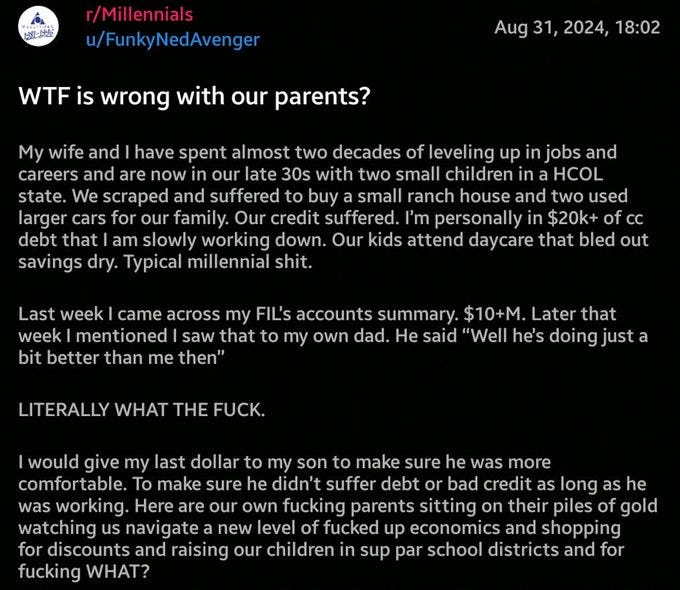
Should Rich Boomer Parents Help Their Struggling Millennial Kids?

A post on Reddit took the internet by storm with a polarizing question.

Source: Reddit

Are rich boomers greedy assholes selfishly clinging to their lifelong gains, or prudent individualists responsibly preserving their wealth to endure the unknown storms of old age and life in general? Were they simply the beneficiaries of better economic times, cheaper cost of living, and a jobtopia American culture, who bootstrapped their way to financial security through their own gumption, or did they cruelly pull the ladder up behind them and say, “Suck it, kiddos!”

Are Millennials lazy, entitled brats looking for freebies from mommy and daddy instead of doing the hard work necessary to build their own lives? Or ar they the victims of “late-stage capitalism” and all its ills: high cost of living, obscenely high real estate prices, and high college tuition costs? Are Millennials truly just fucked by the economy they inherited from their boomer parents? Are they working their asses off and still getting nowhere through no fault of their own?

And what about Gen-Xers? Do they even still exist? Or did they all just become Millennials when grunge rock died?

I’ve been thinking about the screenshotted post above all week since I saw it reposted on X. I don’t generally puruse Reddit anymore, so I get most of my viral soap opera content from Musk’s Madhouse.

The post prompted a lot of feedback. Some outraged. Some insightful. Some hilarious.

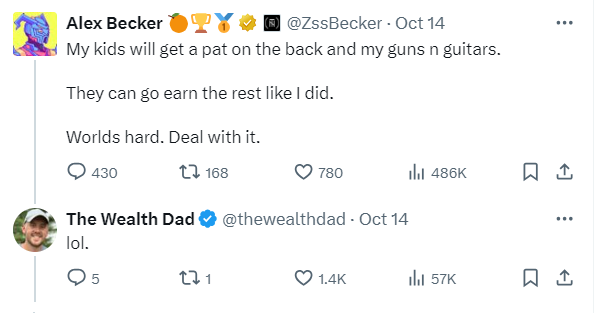
Here’s what Alex Becker had to say:

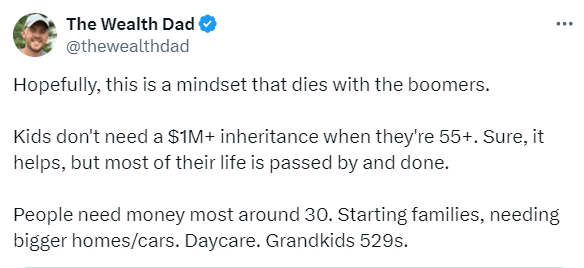
“The Wealth Dad” believes:

While others disagreed, and felt getting bags of money prematurely parachuted in from mom and dad would be a hinderance overall:

I don’t think anyone is entitled to anyone else’s money. Even their parents. Even if their parents are rich and it’s clear that when they die they are going to hand down millions, or tens of millions to their kids.

Are Millennials struggling these days? Yes. Many are. Are they having fewer children because of their struggling? Yes. Would a bailout from their parents help? Yes, it would. Money in your thirties, when many are building families or buying homes would serve much better than getting a bag of cash in your late 50s or 60s, after most of life has been lived. No doubt about that. And if rich boomers want to help, then by all means.

But let’s start with why so many Millennials are struggling today. For the most part, it’s largely due to student loans and real estate prices. And tons of bad debt. I myself had almost $35,000 of debt at age 30. Most of which was student loan related, but also credit cards and auto loans. I was truly fucked up. But unfortunately, I grew up in the lower-middle class, and while some extended members of my family, and ex-family, are quite well off, there was never anybody coming to lend me a hand.

I had to take the hard route. Packing up everything I owned in Philadelphia and moving to the frigid tundra of North Dakota. There, after some struggle, including brief homelessness and being reduced to one dollar to my name, I wound up securing a nice income in the oilfield. After two years, I had paid off all my debt, and built up a nice cushion of savings to finally go back to school and finish my bachelor’s degree. After checking off that box, I returned to work, and am now on the road to financial independence. I have zero debt, side income from investments, and basically have a “CoastFIRE” level networth. That means your retirement is secure via compound growth even if you don’t put another dime in of your own.

While I still have a ways to go until I’ve got that Holy Grail “Fuck you money” that everyone wants, I don’t think I’d have ever gotten off my ass and accomplished what I had if I thought mommy and daddy were going to help me out via inheritance or bailout. In fact, I’m way better off now than my parents are in retirement. I’m the rare Millennial who beat the odds and has done far better than his parents.

I rather like that. I like knowing I made it on my own without a handout. I won’t lie. Whenever I hear of Millennials who needed their parents to give them money for a house down payment, I look down on them. I think less of them. My mom and step-dad wouldn’t even fill out the FAFSA without giving me a hard time (a long story), despite apparently having “too much income” to qualify for it anyway. I paid for college entirely on my own. Hell, I moved out when I was 16. I did the best I could, fucked up along the way, but wound up course correcting big. On. My. Fucking. Own.

That’s not to say there have not been sacrifices. Real, killer sacrifies, on my part. For one, the oilfields of North Dakota is the place love goes to die. It’s virtually impossible to meet anyone up here. I had to sacrifice my prime dating years to pay off debt and secure my own financial future. Not an easy task, and not something every man is willing to do. It was very hard to try to have long distance relationships. It was demoralizing to make brief connections via dating apps, only to see them whither and die on the vine because of the distance, or because a girl I liked met someone else closer to her. Now in my 40s, I have to accept the fact that the optimal dating window has closed for me. Even if I am financially secure, that only goes so far once you’re past 35 as a man. I won’t accept garbage situations like single moms or women with baggage issues. I’ve never been sex-driven or needy or dependent on having a woman in my life. Again, a rare thing for a man. But then I’ve always been a loner and largely self-reliant. I was MGTOW before it was cool, baby.

I’d have loved to have met someone when I was younger and built a family with them. A financial bailout would have helped for sure. But what would have helped out a LOT MORE was the knowledge and training from my boomer parents about the perils and pitfalls of student loan debt, and some better financial education, overall. Both my mom and step-dad knew little about saving and investing, and so imparted no knowledge. I had to figure all that out on my own.

I think Boomers are highly overrated as “successful” or “lucky” because of the times they lived in. They had their own struggles, too. Be glad you didn’t have to worry about getting drafted into a war when you were a teenaged boy. My dad is a Vietnam vet. He joined the Army at 17 and later got sent over there in intel and recon. He was boots on the ground like the troops in Platoon. I’m very thankful I did not have go through something like that, and that all wars waged by our government since did not require a draft. I’m very appreciate and reverential of my father’s contributions. He is a war hero, and frankly, I’d be an unworthy asshole to act entitled to anything he earned from his Army pension or government pension due to his work as a probation officer for many decades. Same with my mom. She was in the Army also, and has worked as a teacher for many years, and gotten her own state pension and worked for her retirement. I love them both too much, and would much rather know they are secure in retirement than to think of them as piggy banks, to be used for my own needs. Again, maybe that makes me a rare kind.

Millennials have had opportunities that Boomers never did. The stock market has been far better, and more predictable, during our young adult lives than it ever was for Boomers. We’ve seen tech stocks like Apple 500X over the last twenty years. We’ve seen new asset classes like Bitcoin and crypto explode onto the scene. Broadband internet and smartphone apps have allowed us to navigate far more nimbly than landlines and payphones did for our parents. Real estate is way pricier in HCOL areas, sure. But the Midwest and South have offered cheap opportunities in areas that turned into boomtowns. The fracking boom saved my ass, and transformed West Texas and North Dakota into spectacular growth areas.

Even if you have rich parents, it’s never good to base your life on the idea that you’ll just get bailed out. At a certain point, you have to learn to rely on yourself. We’ve all met snobby trust fund pricks before. And we’ve all met helicopter parents who control every aspect of their adult children via money. Who the hell wants that?

Do some people have significant advantages from their parents because of money? Absolutely. But usually their success comes from their own intelligence and hard work. The money was just a tool. If I ever have kids, I’ll almost certainly leave something for them. But my real contribution will be to teach them how they can succeed on their own. Equipping them with the financial knowledge I never had. That’s a real inheritance.

How Much Do You Need To Be Considered“Rich?” Ten Million, Apparently

According to Grant Cardone, that is.

Made with Midjourney

Is he wrong? Technically, no. Based on inflation, a million dollars back in 1960 is equal to almost $10.6 million now.

Cardone and the article from Yahoo Finance add:

“A million was a lot of money in 1960. If money deflated at the rate that it has in my 65 years, money is worth 10% of what it was then. So, if a millionaire was rich in 1960, you need $10 million in 2024 to be considered rich.” According to him, if you’re still using the idea of $1 million as a benchmark for wealth, you’re behind the times.

Cardone is not the only uber rich guru sounding the alarm about the rapidly rising bar of what’s considered “wealthy.” Andrew Tate, Suzie Orman and others are repeatedly out here warning that even a few million is nothing anymore.

Michael Saylor, Mr. Bitcoin himself, has mentioned how the real rate of inflation is closer to 7%, not the traditionally lower figure of 2–3% that the government likes to quote.

The true rate of inflation is probably unknowable because it’s a constantly shifting figure. But Saylor’s not wrong. Things like college tuition and housing have gone up way more than 2–3% a year over the last few decades. As I’ve written about before, a base model Honda Civic (a popular middle-class car) was $13,000 back in 2004. Now it’s closer to $25k. That same model car, by the way, cost anywhere between $1,850 to about $5,000 back in 1984.

That’s an astounding rate of cost growth. Granted, Civics over the years have seen technical improvements and such that have inflated the costs. But a five-fold rise in 40 years for a basic set of wheels? That’s a lot.

Then you have housing. In some states the average cost of housing went up over 10% just between 2023 and this year. In some states like California such astronomical growth is a given pretty much every year. The Covid pandemic stimulus and money printing only made things worse. Prior to 2020, homes in the suburbs outside Philadelphia, where I went to high school, were routinely $300k-$500k to start. They were obtainable. Now the floor is $500k+, making housing in the area I consider home almost out of reach.

So, yes, the true rate of inflation is certainly higher than 2–3%. Seven percent is probably about right give or take.

Cardone, Tate, Orman, and Saylor are right to warn about the spiraling cost of living. But how useful or worthwhile is it for the average person to try to achieve a figure like $10 million? All this guru cauterwauling is kind of pointless when you consider that the median net worth for retirees is closer to $200,000.

Even if the average retiree net worth is closer to $1.2 million, that number is skewed by the ultra wealthy. And it’s still way, way behind the ten mil figure Cardone quotes.

Rather than being obsessed with making everyone try to get a bigger number, shouldn’t the focus be on what’s causing all this inflation? Why is our standard of living being rapidly eroded away? Why do we accept that tuition will just rise way beyond the rate of inflation? Or that things like real estate will just go up ridiculously higher no matter what? All while our wages stay stagnant relative to the cost of living? Why do we just accept those things as if they were cycles of the moon or river currents? Pure natural phenomena with no human element controlling them.

Just recently the longshoremen went on strike, giving the country a little scare for a few days. One of their demands was a pay rise of 61%, which evidently they’re going to get. Labor rights activists and other pro-union types may celebrate, except this pay rise is only going to trickle down into the cost of unloading stuff at port. This will increase costs for everyone else. Meaning you and me.

The longshoremen are not wrong to seek higher wages. Everyone wants to get paid more and be richer, obviously. But the pressure of all this inflation and the rising cost of living has created a rat race treadmill panic that virtually guarantees that most will lose out anyway.

I read an article on here a few days ago about how the American Dream is dead for Gen-Xers and beyond. And how the Boomers had it best. I left a comment about how most complaints that generations after the Boomers have about being “screwed” are related to the rising cost of tuition and housing. Without those twin cost threats, life becomes way more manageable. In the effort to make things “affordable” to more people, the government intervened in those two areas significantly, via low interest rates and government-backed student loans. That intervention has only driven up those costs way more than they would have otherwise.


Bad government policy and government spending have largely driven inflation. Inflation is not magic. While gurus like Cardone and others are not technically wrong, the focus shouldn’t be on more “toxic wealth accumulation.” That’s an unwinnable quest. The focus should be to rein in reckless government spending and irresponsible central bank lending, which only hurts the very people those institutions say they’re trying to help.

When you’re being told that even if you’re a millionaire you’re “broke” and essentially hopelessly behind the curve, that doesn’t mean it’s time to dig in and “grind harder.” That means it’s time to focus our efforts on examining the messed up system in which we live, and to figure out how to get it to stop screwing us so hard.

How Not To F*ck Up Your Chance At Becoming Financially Secure

A few common sense tips to avoid some common pitfalls.

Made with Midjourney

I’m constantly seeing all kinds of articles about side hustles and other ways to make money and become wealthy.

While these are helpful, I’ve found that building your net worth is less about what you do and more about what you don’t do. Unfortunately, nobody hands you a guide called “How Not To Fuck Up” when you turn 18, that shows you the many spring-loaded bear traps laying about out there. In fact, it seems people are more apt to let you walk right into one and snap your leg off.

Nobody was there to tell me anything. So some of these pitfalls are ones I learned myself, the hard way. Others I was fortunate to avoid on my own.

Finish High School And Keep Your Fucking Legs Closed (meaning don’t have kids) Until You’re Married.

Made with Midjourney

I combined these two tips because they are common refrains from Dave Ramsey. It really is that simple. If you do these two things, you are virtually guaranteed NOT to end up in poverty. Do one of them, and your chances of one day becoming financially successful are very low. Do both and it’s almost impossible. The welfare register, the ghettos, and the trailer parks are filled with people who did both or either. I’ve met many single moms in my life who were not married before having a kid, and virtually all of them were in the poorhouse and on government assistance. I’ve met guys who had kids when they were super young, and nearly all of them were broke.

Guys are less threatened by this pitfall because young children are not physically dependent on us to live, obviously. We’re also expected to work regardless of our ejaculative accomplishments, too. But for women, this is a crucial, even life critical step. Having a baby with some lowlife dickbag loser who runs off, then not having the legal and financial support that a committed marriage provides, can seriously fuck you and the kid up for life.

Even in a good marriage having kids is tough. And yes, people divorce and go through hell. But trying to raise a kid while dealing with baby daddy or baby momma drama is a complete fucking nightmare and almost impossible to work through. Yet millions stumble into this pitfall every year. It may be funny to watch child support fights or paternity drama on Judge Judy or Maury Povich, but in real life this shit is tragic and often forms the basis for why our society is so fucked up. So, to be clear:

Keep it in you pants if you want to keep money in your wallet!

Don’t Take Out Student Loans For Stupid Bullshit Degrees. Let Me Repeat That. Don’t Take Out Student Loans For Stupid Bullshit Degrees.

Made with Midjourney

This is a BIG one. And it hits home because I fell into this pitfall myself, and it seriously screwed me up for years. I mean, I would be a completely different person today had I not borrowed money for college. I would not be living where I am. I would not have gone through hell as a result. I might even be in a better place. While I’ve since cleaned up the disaster I made for myself and am doing quite well now, I lost YEARS and therefore OPPORTUNITIES because I needlessly saddled myself with student loan debt.

Here’s the deal. For years, only the wealthy earned liberal arts college degrees for a “well-rounded education.” Then the banks, working with the government, came along and convinced everyone else they could and should too, even if that meant taking out vast sums of money. Now you have millions of college graduates stuck with trillions in student loan debts they can’t discharge through bankruptcy, while having no real employment prospects, and therefore no income. You have young people graduating with $100k+ in debt for fucking useless art degrees.

There’s a reason only the wealthy used to do this. Because they knew they had a job at daddy’s company when they graduated. They knew they’d end up on their feet. As harsh as this is to say, if you’re middle-class or lower, you’re almost certainly wasting your time and money by doing the same thing as the rich. Sorry, no, you don’t need a “well-rounded education.” You’ve been duped by banks and the government. What you need is fucking money. You’re not sophisticated and elite because you learned about the French Revolution and fill-in-the-blank-philosopher’s-name, you’re poor and broke. Unless your degree leads to a real career with real prospects and real money, do not waste one goddamn second on it.

I look back at my stupid idiot self. I took out over $25,000 in loans for a degree in political science from a private college that I had absolutely no business attending. I hated it there, too. Most of the students were, unsurprisingly, trust fund kids, or at least had big help from mommy and daddy toward paying tuition. I did not fit into the scene whatsoever being a broke mixed-race kid from the other side of the tracks. I left after one year without a degree. Obviously, I had no help myself other than what I could scrounge up through financial aid. I’m not even proud of the fact that I qualified to get in to this school. I’m ashamed, because going there left me in debt with no way to repay. I wound up working in a fucking department store afterward before getting back into the printing trade.

To say that student loan debt ruined my life would be an understatement. Robbing a bank would have fucked me up less. At least then I’d have a cool story and some prison tats.

Look, I get it. The allure of an “elite” institution is hard to overcome. Everyone wants the prestige of a four-year degree from a “top” college or university. But the reality is, especially in this day and age, it’s not necessary. And if you’re poor, it might even be financial suicide. If you want a “well-rounded education,” go to the library or watch YouTube. They’re both free.

The delusion over degrees is un-freaking-real. I could go on for hours. One time I met an obese broke single woman in her mid-20s who was a few months pregnant. She was convinced she was still going to get into a prestigious law school in New York City and become a lawyer and fight for “women’s rights” or some bullshit. I asked how she planned to do this with an infant, no money, while living in one of the most expensive places in the world, all to chase a profession in what was certainly low-paying non-profit work, to which I received only a derisive snort and nostril flaring in response. As though I were a complete idiot for even asking. I never saw this lady again, but I’d be willing to bet she ain’t hobnobbing with high-powered feminist do-gooders in Manhattan.

Drive A Shit Box You Paid In Cash For Because You Don’t Need A Luxury Vehicle To Pick Up Hungry Man Microwave Dinners At The Grocery Story.

Made with Midjourney

I’ve written previously about my “senior vehicle” and how it only costs me $64 a month to drive.

I drive a 2006 Saturn Ion with over 180,000 miles despite having an above average networth for my age, and more than enough to pay for a premium new car in cash. I fucking love my “shit box.” At this point, I’m planning on keeping it and driving it for as long as possible, and giving it a Viking funeral for whenever that time comes. It’s a “grocery getter” at this point. It used to drive me back and forth between Philadelphia and New Jersey. Nowadays I don’t drive it more than 120 miles at a time. If I need to go on a road trip I rent a car or fly. If my life situation were to change and require me to upgrade vehicles, I’d still get something cheap and used and do the same damn thing that I’ve done with this car.

My “senior vehicle” only costs me $25 a month to insure, and very little to maintain. Because of the substantial savings I’ve made over the years, I’ve been able to put way more into my investment accounts. If I were instead one of those clowns who feels the need for a new shiny set of wheels just to drive to my crappy cubicle job, I’d not have been able to max out my 401k, my IRA, and build up a solid net worth that has put me on the path to financial independence and early retirement. The average car payment nowadays is around $700 a month, which means many people pay WAY more than that. That’s just the financing payments. There’s insurance and maintenance on top of that. You have people literally pissing away millions in potential compound gains because they need to sit in a metal box with a name brand logo on it. Absolutely ridiculous.

Once again, for many years, only the wealthy bought premium vehicles because only they could afford them. Then along came “easy” financing schemes and loose lending standards by the banks. Now everyone can “afford” to buy BMWs and Mercedes and SUVs that cost a gold brick to fill up at the gas station. This is why you see hot rods parked in the ghetto, and those giant monster “America-fuck-yeah!” trucks parked in the sticks. Isn’t “equality” great? Well, it’s not really equality, because those people still can’t afford those vehicles. They can only (barely) afford the $1000 monthly payments. At least until they lose their job. Then it’s the repo man laughing all the way to the bank. And the dealership, too, which just turns around and sells the car to another sucker who needs to compensate for his inadequacies by overpaying for a pile of plastic and sheet metal that can move 70 M.P.H.


All these tips basically boil down to “Don’t buy shit you can’t afford.” Which seems easy. But so much of money management has nothing to do with math, but emotion. People attach emotional value to things like college degrees or vehicles that they really don’t need, that they don’t realize will screw them for years to come. People get irresponsibly caught up in the passions of a relationship and wind up trapped with offspring they are not prepared for or capable of properly taking care of.

People have gross misunderstandings when it comes to money. Many think making big money is all about some big score or windfall. Winning the lottery. Making out on some stock or cryptocurrency. While a lucky few will hit those jackpots, for the most part, building wealth is a largely a “brick by brick” deal. It’s a stifling boring process, actually. People overcomplicate it. But it’s less about doing a bunch of things right, and more about simply not colossally fucking up with a few wrong decisions that are actually quite easy to control.