A Few Easy Ways I Automatically Make Extra Money Every Month

Who says side income has to be hard work?


Made wtih Midjourney

Everyone needs side income these days. Thanks to inflation and the rapidly rising cost of living, one income is too close to having none. Many people work two or even three part-time jobs if they don’t have a solid main source of income. Wealth “gurus” will sell you all sorts of complicated programs guaranteed to make you rich.

The effect of all this is PRESSURE. Pressure to make more. It can all seem complicated, difficult, and time-consuming. Luckily, there are some very simple, stupidly easy (and lazy) ways to supplement your income. Every little bit helps, even if it’s just a few dollars. Here some methods I use.

1. High Interest Savings Accounts

This one may seem obvious, but you’d be really surprised how few people take advantage of this. Even though the Federal Reserve just recently lowered rates by half a point, there are still opportunities to earn decent yields. Just go to an aggregate site like Bankrate and look under their high yield savings account section. As of now, October 2024, you can still find savings accounts with reputable FDIC-insured banks offering 4.00% to as high as 5.30% APY. Some banks even offer decent savings rates in their checking accounts, though this is not often.

Another key to taking advantage of this is to have multiple savings accounts. I do this with bank accounts in the interests of safety and diversification, should one of my accounts become compromised or I lose a debit card. But it’s also good to have at least one seperate account that you can transfer money to. This can even motivate you to save money, because you wont see it everyday in your regular bank. “Out of sight, out of mind,” as they say.

Right now, between all my accounts, I earn over $50 a month from interest. I expect to make at least $600 this year.

2. Credit Card Reward Points

This will bother the Dave Ramsey fanatics, I know. The money management radio host is famous for his devout stance against credit cards no matter what. I used to think the same way. But if you’re disciplined, and you use them for things you would be spending money on anyway, then there’s no reason not to take advantage of their cash back rewards.

My one card pays 1.5% cash back. I have a number of bills that automatically deduct from that card every month, that add up to anywhere between $300-$500. This means at the end of the month I can apply $5–$8 to my bill. I always pay my bill in full. I’m a proud “deadbeat,” as the credit card companies refer to those who never maintain a revolving balance. Even though $8 may not seem like a lot, that’s basically a free $96 or more every year, that you can make without having to really think about it. Put another way, if you saw $96 lying on the sidewalk, would you not bend down to pick it up? Of course you would.

Cash back can also help when you have a big purchase. If you were to spend $1,000 on something like a new computer, that would translate to a $15 “discount” due to the cash back feature. Some credit cards even offer higher cash back rewards with certain companies.

Again, the key here is to buy things you would anyway. Don’t just buy something to “get a discount.” That’s what gets people in trouble, and why Dave Ramsey is mostly right about avoiding credit cards altogether. But if you’re savvy and disciplined enough, there’s no reason not to look for ways to save even just a few dollars.

3. Dividends On ETFs/Index Fund Stocks

This one requires some clarification. I don’t personally buy dividend stocks. I stick to low-cost ETFs that track the S&P and Nasdaq. Namely SPY and QQQ. This goes for both my retirement accounts and my personal brokerage account.

Many people will recommend this dividend stock or that, looking only at the yield. I don’t really care. Many dividend stocks tend to go down in value over time, essentially making any gains you make from the dividends a wash. For example, AT&T (T) offers a nice 5.15% dividend, or about $.27 a share, but its stock has declined by almost 50% over the last five years. If you had bought 100 shares in 2019, you’d have made around $550 in dividends so far. But your position overall in terms of the value of the stock would be down almost $740. Meaning you’ve lost about $200 on paper. AT&T has gone up this year, but it’s long-term trend is down. This is not the case with every dividend stock, of course. Some may actually be good deals, but they’re just not for me. Do your own research here.

My personal brokerage allows me to see an estimate of future earnings from my dividends. As of now, I earn about $100 a quarter from my SPY and QQQ holdings. SPY offers a “low” 1.21% yield, while QQQ only gives a “measly” 0.61%. But these ETFs track the market, including the largest and most successful companies. SPY has gone up over 50% over the last five years. QQQ has more than doubled in the same time span. You have to look at the overall value of the asset and the risk involved in holding it, not just its annual yield. A dividend stock may offer a decent yield one year, then cut it the next. But even if SPY and QQQ were to cut their dividends entirely, they would still track their indexes. Whereas a dividend stock’s price might drop big because a flood of investors exit over its diminished yield.


Adding up these three brain-dead easy ways to make extra money comes out to almost $1,000. Or about $83 a month. That’s like getting an annual “performance bonus” from a job. A thousand may not seem like much. But it’s enough to pay rent for a month. Or get a “free” computer every year.

The best part is I don’t have to do anything really to get this $1,000. I consisently save money. I use credit cards to conveniently centralize monthly payments. I invest into my personal brokerage regularly. An extra thousand bucks is just a nice incentive for doing things I’d be doing anyway.

I Sure Hope I Don’t Catch ‘Sudden Wealth Syndrome’

You think being broke and destitute is bad? This is far worse.

Dollar sign lesions. One of the first symptoms of this horrible new disease. (Made with Midjourney)

Forget Covid. Forget Monkeypox. Don’t even think about H.I.V. or Ebola. There’s a new pandemic threatening to strike soon. It’s called ‘“Sudden Wealth Syndrome.” What’s that, you ask? A recent Yahoo Finance article explains:

Sudden wealth syndrome is a real challenge for people who suddenly get a lot of money. Children who inherit enormous sums or receive unexpected wealth may experience overwhelming anxiety and uncertainty about what to do with all of their newfound income.

I don’t know about you, but that sounds downright terrifying. I once found $200 on the ground as a kid and I had to be hospitalized for six weeks due to acute shock. I couldn’t even imagine the impact of a million dollar windfall on my fragile psyche. Surely, that would kill me. I’m no longer worried about bleeding blood from my eyes, losing my immune system, or being covered in puss-filled lesions, I’m worried about waking up every morning with eight figures in my bank account.

So, what’s driving this new epidemic? Is there anyway to avoid this scourge? Or are we all doomed?

Well, as it turns out, Sudden Wealth Syndrome, will likely only effect the super wealthy. More specifically, their kids. There’s a generous tax incentive for inheritance that’s set to expire at the end of 2025. Right now, individual parents can transfer up to $13.61 million tax-free to their children, while couples can transfer up to $27.22 million.

But that tax incentive is scheduled to end in a little over a year. Many wealthy people are worried that if Democrats retain control over the White House, they won’t renew the benefit, and may even increase taxes. This has prompted a stampede as parents try to hand down their wealth before the window of opportunity closes. If that happens, the amount that can be transferred down tax-free may drop by a whopping half.

The article goes on to state that over the next decade, 1.2 million people worth $5 million or more will pass down over $31 trillion. The vast majority will come from those worth more than $30 million.

My heart goes out to those poor people who will soon be suffering from this ravaging new disease. I’ve had the good fortune of associating with a few trust fund kids in my life, and let me tell you, it’s not their fault that they’re often entitled, condescending, lazy assholes who think the world revolves around them. Those traits are just symptoms of Sudden Wealth Syndrome. They’re helpless victims in all this, and this new scourge threatens to only make things worse.

Is there nothing that can be done for these poor souls? I sure hope the CDC is cooking up a vaccine or some kind of cure for them. Should we hold a telethon and ask for donations? Maybe not. More money would just make things worse.

Luckily for the super wealthy, I’m here to help. I’m starting a professional counseling service. For the low rate of $700 an hour (plus travel and lodging expenses), I’ll happily lend guidance and emotional support during this troubling time. Note: my services are only available to heiresses aged 18–25 with modeling contracts, and my counseling involves sensual massages and seductive pillow talk.

Get That Bag By Age 50 Or Get Screwed Hard By The Harsh Corporate World

After 50, ageism, competition, and health concerns become paramount. And that’s if you’re lucky.

By Movie Poster Shop, Fair use, https://en.wikipedia.org/w/index.php?curid=56498157

The other night I was rewatching Jackie Brown. Quentin Tarantino’s 1997 low-key urban crime classic based on the book Rum Punch by Elmore Leonard, stars Pam Grier, Samuel L. Jackson, Robert de Niro, and Robert Forster.

After the massive success of ’94s bombastic Pulp Fiction, audiences were left slightly jilted by the quiter, subtler Brown. Less discerning audiences, anyway. Brown is a great film with nuanced performances, a smart script, and a dark, twisty plot. If Pulp is a colorful cocktail, Brown is a whiskey neat.

The film, set in 1995, might have left some viewers sour because of its unsexy themes regarding the occupational and romantic desperations of middle-age. In the story, Jackie Brown (Grier) is a lowly 43-year-old flight attendant working for a “shitty” Mexican airline, making all of $16,000 a year, plus benefits. That’s only $33,000 in today’s money. On the side, she runs cash across the border for Ordell Robbie (Jackson) a smooth-talking low-level arms dealer thug who murders problematic subordinates the way one takes out the trash. When she’s caught by police with one of Robbie’s packages, and two baggies of cocaine, she’s forced into making a deal with the feds. But Jackie Brown concocts her own scheme to turn the tables on everyone. At stake is a half a million in cash.

About mid-way through the film, Jackie sums up her station in life and her motivations for risking everything by setting up her crime boss:

Well, I’ve flown seven million miles. And I’ve been waiting on people almost 20 years. The best job I could get after my bust was Cabo Air, which is the worst job you can get in this industry. I make about sixteen thousand, with retirement benefits that ain’t worth a damn. And now with this arrest hanging over my head, I’m scared. If I lose my job I gotta start all over again, but I got nothing to start over with. I’ll be stuck with whatever I can get. And that shit is scarier than Ordell. (Jackie Brown, 1997)

Goddamn, did that articulate a lot of fears and concerns that many middle-aged people have about work and life and just trying to survive. Jackie Brown might be classified under the crime genre, but it’s a horror story in some ways, too.

There are many people on YouTube 50+ talking about their struggles in the workplace, finding employment and meaning in life. Recently, I found a channel called TheFadingMan, which features a guy in his mid-50s talking about depression, getting laid off, and other older worker issues.

In other videos, TheFadingMan talks about getting the run-around in interviews, job scams, misrepresented job ads, trying to lose weight, getting ghosted by employers, and being broke. Recently, the guy finally got a job after almost a year of looking.

TheFadingMan is brave for putting himself out there and letting everyone know how bad things can get for gray hairs. Especially when you’re overweight, unhealthy, and don’t have particularly useful skills or an advanced degree or connections. People at all ages are struggling to find work these days. But for those over 50 it’s like gravity is three times harder on them.

TheFadingMan is not alone. There are tons of channels like his, run by both men and women, talking about the same things. They are a sobering reminder of a cold, hard truth. The modern corporate system is largely hostile and can be especially harsh toward older workers. While ageism is discriminatory and illegal, that doesn’t mean companies won’t find ways to sneakily work around it. Aging by itself is tough enough. Health problems begin to arise in your 50s, or earlier, depending on your genetics and overall fitness. Life often drags with family responsibilities, debt, expenses, and other things.

Which is why it’s important to try to make enough by 50 to secure the bag for retirement. What does it mean to “secure the bag.” Basically, it’s making enough to likely secure a comfortable retirement with the help of compound interest. Even if you’ve only saved up $100,000 in retirement accounts and investments by 50, if that compounds at 10% a year, that will grow to over $400,000 by the time you turn 65 without further contributions. Saving $200,000 by 50 means you’d have over $800,000 by 65. That combined with Social Security will likely keep your head above water.

Everyone means to keep contributing and investing, of course. But the reality is that after age 50 you might not have a choice. Your employment prospects might become shaky and unreliable. You might suddenly develop health problems. You might have to start over after a divorce. Or you simply might lose interest in a career and want to try something else. There are a number of disasters and disruptions that can occur as you get older.

Even though you may not have to finagle a bag filled with $500,000 like Jackie Brown does in the movie, you will have to come up with a scrappy masterplan to survive. You’ll have to outwit your own metaphorical Ordell Robbie.

Take advantage of your youth and your prime working years to set yourself up best not just for retirement, but when you’re older, and when employment and living itself might become a slog. Even if you’re one of the few who lands a dream job or obtains a high status gig, that doesn’t mean you can’t be knocked off your lofty perch with one stroke of a manager’s pen. It’s tough out there at any age. But old age, as Samuel L. Jackson might say, can be a real motherfucker.

Minimalizing Your Way to Wealth: Can It Work?

It’s possible, but requires discipline and commitment.

Source: Midjourney

Striving for a high income vs. cutting your spending and investing the maximum possible. Which strategy comes out on top?

It’s not easy to withold buying stuff. Especially when anything you could ever want is just a click or finger tap away. Dave Ramsey is known for making the point that credit cards help numb the “pain” of spending, making it feel like it’s not real money. Until the bill comes due.

Combined with the ease of e-commerce, credit cards make for a potent combination that can lead to fiscal disaster. Making matters worse is the current subscription trend. Not just streaming companies like Netflix, either. Even razor blade companies want you to subscribe for a monthly fee. Wal-Mart just tried to get me to start a toothpaste subscription. It’s getting out of hand.

Diligently investing a part of every paycheck into retirement accounts and personal investments, particularly into S&P 500 index funds/ETFs is probably the best and most assured path to wealth for the average person. The problem is most people in the United States don’t make a high income. The median individual income is only $37,000, while the national average wage index is only around $64,000.

If you live in a major city or have a family, those incomes hardly go far. This is why side hustle culture has become so necessary and so big today. Everyone has some kind of side gig or second or even third job. Because without one, it’s almost impossible to get ahead.

It’s easy to blame things like out of control cost of living expenses, greedy companies, competition, industry fluctuations, economic crises, and inflation. Those things are at fault in many cases. But very often people set themselves up to fail.

It’s not an income problem, it’s a spending problem.

Years ago I worked for a market research company. When our director got promoted to the Vice President level overseeing our facility, she immediately went out and financed a downtown condo and a new Cadillac Escalade. All while declaring openly she had “no idea” how she was going to pay for any of it. Her new “big” salary was all of in the $70,000 area.

Another guy I knew at another place did something similar. When he got a promotion he ran out and financed a new Ford SUV, justifying it as a “need” because he went on camping trips a lot and needed something to pull his camper. Oh, and he also bought a high-end camper, too. Something he was somehow convinced would actually save him money in the long run on lodging costs for his family. All on a salary of around $100,000.

I worked with one lady who was studying for a Masters in Psychology so she could get higher pay in the mental health field. She was already $40k in the hole in student loans, with more to come. When I asked her how much she stood to gain once she had this prestigious degree, she just smiled and shrugged her shoulders.

I’ve screwed myself, too. Twelve years ago I was drowning in debt. I had about $20,000 in student loan debt, $6,500 in an auto loan, and two credit cards maxed out. What was really sinking me was the student loan, as my payments were being garnished out of my paycheck. Garnishment is not a fancy side dish, by the way. It’s a horrible thing that allows your employer to extract money from your paycheck for repayment to the government. It sucks. Before my wages became garnished, I was actually doing okay, even though I was only making about $35,000 a year. I had extra money every month. I was contributing what I could to my retirement accounts. But that garnishment took the maximum allowable of 15% out of my income. A huge chunk.

On top of that, I had constant car troubles. Eventually, I was forced to finance a newer car since my beaters kept breaking down. That left me with a monthly auto payment and a much higher insurance rate. Between those and gas and tolls I was paying almost $750 a month just to drive a car back and forth to work. Mere existence became a living nightmare.

Looking back, my wounds were largely self-inflicted. I made the wreckless decision to take out student loans for a private college that was way out of my economic station. For a worthless liberal arts degree, too. I chose to keep working in a bad industry (printing) that was undergoing consolidation, that offered little real prospects for growth and promotion. Basically, I wandered onto a minefield and eventually got blown up.

Had I not hamstrug myself, even with my low income, I still would have been able to squeak out a win. I was investing something like 15% of my money until the garnishment hit. That was about $5,000 a year into my retirement accounts, including the company match. A mere $5,000 a year over 30 years earning an annual 10% comes out to almost $900,000. Not bad for a low salary.

As you can see, becoming wealthy is not all about just having a high income. You can make good money and cripple yourself with debt and high ticket purchases that lose value. You can also make a low income and still become a millionaire.

Nowadays, I invest close to 60% of my income. I live pretty simply. I still drive a beater car. I have zero revolving debt. Most importantly, I weigh spending options much more carefully. Generally, it’s not so much a lack of income that will get you. It’s making a few big mistakes that can set you up badly for years to come. Student loan debt. Car debt. Or something catastrophic like a nasty divorce or relationship issues.

As I’ve learned over the years, financial succes or failure very often comes down to making good or bad personal choices. Especially when you’re young. It doesn’t mean it’s all on you. Medical problems or family issues can make things very hard, and those struggles are not always anyone’s fault. But you should try to control what you can.

Unacceptably Stupid: My Bank Wants To Charge Me $15 To Use My Own Money

These stupid fees are getting out of control anymore.

“Why fifteen bucks? Because fuck ’em, that’s why. Now, who wants another brandy?” (Source: Midjourney)

A few days ago I received a notice from my bank that the terms of my checking account are changing soon. In the bank’s own words:

A $15 monthly account fee will be charged, unless you maintain a $5,000 average monthly account balance¹. The first monthly fee will be charged on November 30, 2024 for monthly balances held during the month.

I’ve been banking with this place for over six years now. I use my checking account almost exclusively through them. I also have two of my IRAs, two personal brokerage accounts, and a savings account. Altogether, I have a six figure amount combined just with this one financial institution.

Previously, all I needed in order to avoid a $15 fee was to meet any of the following criteria:

You had set up a direct deposit of $200 or more per month to your account.

You maintained a $5,000 average monthly balance in your account.

You maintained a $50,000 average monthly balance in any of your linked (name of bank)) account(s).

You had a combined $50,000 or more in linked (name of bank) from (name of bank) brokerage accounts.

You had executed 30 or more stock or options trades during the prior calendar quarter in your linked (name of bank) from (name of bank) brokerage accounts.

The above criteria is not hard to fulfill, especially if you have direct deposit. However, the new rule that requires a minimum of $5,000 is stupid, ridiculous, and feels petty.

Now, I usually maintain $10,000 minimum in my emergency savings. My liquid savings can fluctuate between that and $20,000 or higher. It’s not that I can’t meet the criteria. I can. It’s the principle of the matter.

Many others also won’t be able to meet that minimum, and will now be forced to bank elsewhere.

I’m fortunate to be in a solid financial position now. It wasn’t always the case. I remember getting constantly hit with overdraft fees when I banked with Wells Fargo years ago. These fees started at $35, but would balloon even higher if you had multiple charges stacked up. Which I sometimes did because I was so broke at the end of every month. There were days where I’d end up with a negative account balance. Do you know how hellishly frustrating it is to get paid one day, only to end up negative the next, all to be told by customer service that Wells Fargo’s fees are done as a “courtesy?”

Least evil Wells Fargo executive. (Source: Midjourney)

Wells Fargo is well known for being a greedy pile of shit. The CFPD recently fined them $3.7 billion for widespread malfeasance. They’re part of the reason I swore off brick and mortar banks for good years ago and switched to my current bank.

I like my current bank for the most part. I can easily check all of my accounts on one screen. Their customer service has largely been good. They offer other benefits, including ATM fee refunds and no foreign transactions fees if made with my debit card. I’m not planning on switching to somewhere else just because of a stupid $15 fee.

But it’s pissing me off becaue I know my bank is likely making a KILLING off of me. My savings account currently earns a paltry 4.50% interest rate, while my checking pays 3.0%. That’s not too bad. It’s certainly way better than Wells Fargo with its absurd 0.01% interest rate for a “Way2Save” Savings account. Way to save? More like way to lose.

Good God, fuck Wells Fargo. Seriously.

Banks don’t just do nothing with your money. They lend it back out, of course, in the form of mortgages, business loans, and credit cards. All with interest rates that are way higher than 4.50%.

That’s only the beginning. Due to the fractional reserve lending system, banks can lend out your money while only keeping a small portion on reserve. Banks used to have to keep a certain amount in reserve. Then in March, 2020, the Federal Reserve reduced the required reserve ratio to 0%. Thanks Covid. Theoretically, my bank could lend out my entire $10,000+ that I’ve deposited in savings. If they’re charging an average of 10% or more on interest annually, that means my bank is making $1,000 off of me every year, not counting additional fees.

Then there’s the data. Evey transaction your make with your debit card represents valuable information to market research companies. Info that your bank and other places you do business with could sell for big money. Data = gold in today’s economy.

Point is, as a customer with a bank, you are an unwitting ASSET in their portfolio, either through your deposits, or with the spending data and other types of data you represent. And if you have significant holdings than you are especially valuable to a bank.

Bottom line: My bank should be paying ME $15 a month for the privilege of my continued loyalty. Likely they’ve made thousands off me over the years. Maybe even tens of thousands. I’m a net positive customer. And what do I get for my trouble? A $15 fee just for having a checking account.

To quote Ice Cube, “This is the motherfucking thanks I get?”

Some Context To Robert Downey Jr.’s Ridiculous $100 Million Paycheck

To the Victor Von Doom go the spoils.

Source: Instagram – @marvelstudios

It’s good to be Robert Downey Jr. these days. With a career and reputation left for dead by the mid-2000s, a role in Kiss Kiss Bang Bang helped reanimate the troubled ’80s star’s corpse back to life.

Famously, it was landing the role of Tony Stark/Iron Man for the newborn Marvel Cinematic Universe in 2008 that would send him back to A-list status. It’s hard to believe it, but Iron Man was considered a signficant risk to produce at one point. Nobody had heard of the character outside of comic book fans. Then there was the star himself, Downey Jr. who was an even bigger gamble with his prior arrests, DUIs and rehab visits. Dude was a hot mess.

Iron Man was a massive hit. The MCU completely (for better or worse) took over Hollywood for the next ten years. The mega franchise culminated in 2019’s Avengers: Endgame, which saw Downey Jr. finally retire Tony Stark in dramatic, sacrificial fashion.

Ever since then the MCU has been…well, shitty. It’s been bomb after bomb, basically.

Earlier this year Downey Jr. won the Oscar for Best Supporting Actor for his role as conniving politician Lewis Strauss in Christopher Nolan’s Oppenheimer. You may have heard of it. It won Best Picture and made nearly a billion dollars.

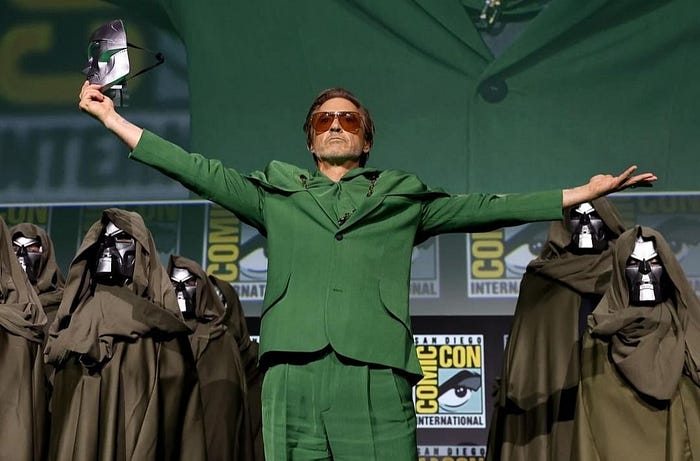
Now Downey Jr. is back in the MCU. Winning Oscars is so yesterday, apparently. Why win gold when you could win green? While wearing green. Lots and lots of green going on here. Kevin Feige just hired him back into the Marvel fold to play Victor Von Doom, aka Dr. Doom, in two upcoming Avengers movies. For $100 million.

Yes, $100 million. As in one tenth of a billion dollars. That’s an obscenely silly amount of money to pay someone just for playing dress up for a few months. However, a little perspective is in order. Some justification, even. I contend Feige might have gotten Downey Jr. CHEAP for the role.

You have to remember, an A-list star is an investment in the film’s success. This goes especially so in Downey Jr.’s case. No Downey Jr, Iron Man maybe isn’t a hit. No Iron Man hit, no MCU. No MCU, no billions of dollars.

Like Jules Winnfield said, “Personality goes a long way.”

The last Avengers film, Endgame, made nearly $3 billion. Infinity War made over $2 billion. Even if the next two Avengers films make “only” $4 billion combined, that means Downey, Jr. cost a mere 2.5% of the total revenue, not including merchandise sales and other downstream effects of two hit movies, like traffic to the upcoming Marvel Infinity Kingdom at Disneyworld.

There’s also precedent for paying top talent a huge sum to help lend respectability (and most importantly, ticket sales) to a spandex flick. It all started when Richard Donner approached Marlon Brando to appear in Superman: The Movie as Supes’ dad, Jor-El. Brando agreed, but only for the princely sum of $3.7 million plus a cut of the profits. An utterly outrageous sum back then for what amounted to less than two weeks of work. But Donner needed a big star in addition to the great Gene Hackman already signed on as Lex Luthor, as newcomer Christopher Reeve wasn’t a big name at the time.

‘Superman: The Movie.’ Credit: Warner Bros. Pictures

Brando got his big payday. Superman grossed $300 million at the box office, making The Godfather’s upfront cut a mere 1% of the revenue. That’s not counting video sales, merch, broadcast rights, and other income sources over the last 45 years since the film’s release. If Superman has made $1 billion thus far, then Brando’s “outrageous” sum only cost about one third of one percent of the total revenue. I’d say Warner Bros. got their money’s worth out of him.

Of course, movies with big actors bomb all the time. It’s risky fronting enough cash to fill a Brink’s truck, even to charismatic, proven stars like Downey Jr. Time will tell whether this massive paycheck will prove a good investment or not. Either way, even $100 million will look small in four decades time, just like Brando’s $3.7 million does relatively-speaking today.

Inflation Nation – A Honda Cost $13,000 in 2004

Inflation is so scary when you really look at it.

Source: Midjourney

It feels weird, but I’m at the age where I’ve developed some perspective on the outrageous rising cost of living. I can finally say things like, “Back when I was young ____ used to cost so much less!”

Of course, everyone’s getting eaten alive by inflation these days. On TikTok, there are people comparing grocery receipts of today with that of just four or five years ago. With the exact same items and brand names, too.

I remember purchasing Old Spice Pure Sport 3.4 oz deodorant in Wal-Mart four years ago for about $2.99, or sometimes there’d be the two for $5.00 pack. That same size and brand currently costs $4.47 for just one according to the website. I live in North Dakota, so that price might be higher or lower elsewhere. But that’s almost a 50% increase in just four years. Ridiculous. But you can’t put a price on keeping B.O. at bay, right?

By the way, I don’t seem to recall my income going up by 50% over the last four years. Someone’s losing ground here, and I think it’s me.

I know, I know. Why didn’t I go all in on GameStop back in 2021? I could have so easily been a millionaire. How stupid was I?

Inflation is known as the “hidden tax.” But that kind of undersells its malicious and destructive presence. That’s like calling Michael Myers the “hidden prowler,” instead of, say, a terrifying homicidal phantom. Dr. Loomis hit the nail on the head by calling him “pure evil.” Which is something you could also call inflation.

Even Michael can’t afford a new mask due to the rising cost of inflation. Credit: By IMDb — Photo taken by Ryan Green, Fair use, https://en.wikipedia.org/w/index.php?curid=65823405

Inflation is a result of money printing, government spending, and whatever those three witches were brewing up in Macbeth. Double, double toil and trouble, indeed!

What makes inflation so frustrating and demorializing is that it’s impossible to overcome or avoid. Watching it is like being tied to the railroad tracks and forced to wait for the locomotive to come barreling over you full steam ahead. All the while the sinister mustachiod villain who left you there gets away scot-free and cackling.

All you can do is invest and hope for the best to try and stay ahead of the “blast radius” of inflation as much as possible. But therein lies another problem. What do you invest in, and will it beat the real rate if inflation? According to the Federal Reserve and government reports, inflation is currently ticking back down to 2%, the desired annual target.

But Michael Saylor, the CEO of MicroStrategy, seems to think the “real” rate of inflation actually averages 7% a year. That means that even if you’re investing in the S&P 500, which averages a 10% growth rate every year, you’re only just keeping your head above water.

Saylor is known for loving Bitcoin, and sure, if you’d bought it five or more years ago you’d have realized massive gains. But who’s to say Bitcoin will keep providing such high returns, and how long it will take to get them?

Gold has risen nicely over the last 20 years, but the yellow metal has also had decades of sideways action and decline over its long history. And how practical or safe is it to store your nest egg in gold? I keep a little myself, but only it’s a small allocation.

Real estate has gone up big, too, especially in some states. Many northeastern and western states like California saw real estate grow by as much as 20% over just the last two years. But such a stratospheric growth rate also causes new and younger buyers from being locked out of the market.

Realistically, the average person is left with trying to escape Michael “inflation” Myers by investing in S&P 500 and Nasdaq index funds via retirement plans and personal brokerage accounts. That’s not the worst option. But that’s like only running from Michael on foot. A car would be much better. Or a V-2 rocket.

Michael “inflation” Myers, Source: Midjourney.

I remember 2004 like it was not that long ago. Bush was calling Kerry a “flip flopper” on the presidential campaign trail. The Red Sox won their first World Series since the Middles Ages. And a base model Honda Civic DX only cost about $13,000.

$13,000! That’s nothing! Peanuts! I could make that with a newspaper route. Well, actually, $13k is nothing to sneeze at, but it is managable and within reach.

What’s a base model 2024 Honda Civic LX sedan cost now? According to Car and Driver, $25,045.

$25,000! That used to be a GRAND prize on Wheel of Fortune back in the day. Now it barely gets you the quintessential middle-class starter car. Not counting taxes and other fees.

Honda Civics have nearly doubled in price over the last twenty years at an annual growth rate of about 3.32%. If they were to continue at that rate, then by 2044 they’ll cost like $50,000.

This is something you have to keep in mind when it comes to planning retirement and managing future expenses. If you retire with a million dollars in 2044 and plan to follow the 4% rule (meaning you take out 4% of your portfolio to live every year) that means you’ll only have $40,000, which won’t even be enough to buy a new Honda.

Sure, you could buy a used car. But remember, they’re all likely going to double in price, too. A used 2020 Honda Civic with 35,000 miles today might cost $20,000. But in 2044 that same four-year used vehicle will probably cost $40,000. So, you still have nothing leftover to live on in that scenario.

2044 may seem far away. But it’s not. It’s really not. The last twenty years went pretty fast to me. The next will go fast, if not faster. If there’s one thing we’ve all learned about inflation recently, it’s that it can get out of control very quickly and make life very difficult, unless you’re already rich.

Michael Myers has put on some good Nike running shoes the last few years, and if you don’t stay ahead of him, you’re going to feel his butcher knife in your wallet before long.

I Participated in the Reddit IPO. Here’s How I Did

Did my investment get an upvote?

Source: The Reddit logo: https://www.redditinc.com/brand

Let’s face it, virtually every website nowdadays amounts to a doom scrolling time suck meant to extract your soul one qubit at a time.

(Qubit is a “basic unit of information” in quantum computing. You’re very welcome for a great Scrabble world.)

Of course, I know about random trivia things like quantum computing because I am an avid Redditor, and therefore am very smart.

Actually, that’s what Reddit should have called itself — “random trivia things.” What is a “Reddit” anyway? And why is an alien involved somehow? I’ve never been able to figure that out.

But speaking of quantum computers, I’d need one to calculate how many hours I’ve wasted on that website over the years. If you were to rank sites according to their “time suckage,” Reddit would have to be up there pretty high, right behind InstaGlam, Musk’s Madhouse (aka X aka Twitter), and Zuckerberg’s Personal Data Clearinghouse (aka Facebook aka Meta).

Midjourney’s awful take on the Reddit logo.

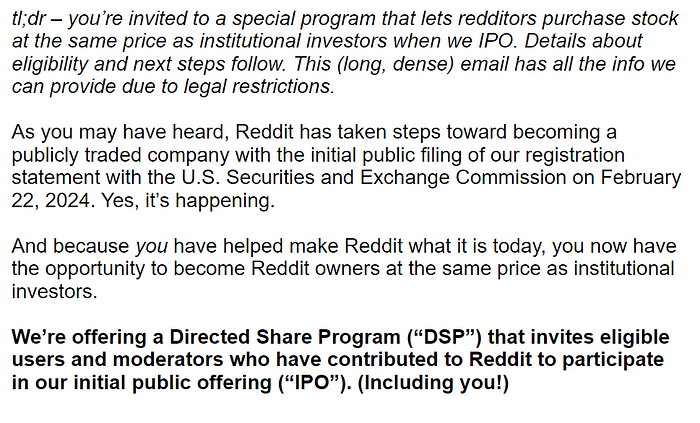
So, when I suddenly received an email one day from Reddit telling me that I, as a member, had the unique opportunity to participate in the site’s upcoming IPO, I of course jumped at the chance. Finally, a shot to claim some compensation for all the years I’ve blown on such subreddits as r/interestingasfuck, r/wallstreetbets, and r/explainlikeimfive. I’ve been on Reddit since the old days, when it was the nerdier Digg alternative, back in the late 2000s.

This was exciting.

What, you mean I get to buy a stock BEFORE the dirty unwashed masses do? I get to be an insider? I get to be treated like the elite intellectual artistocrat I am thanks to your website’s guidance? Sign me up, Reddit. It’s about time my contributions were richly rewarded.

Screenshot of my IPO offer from Reddit.

Feeling like Warren Buffet, I took the first step. I won’t bore you with all the details about IPOs and the DSPs or the RMBs (that stands for Redditors Making Bank). But there were a few steps I had to follow after winning the golden ticket.

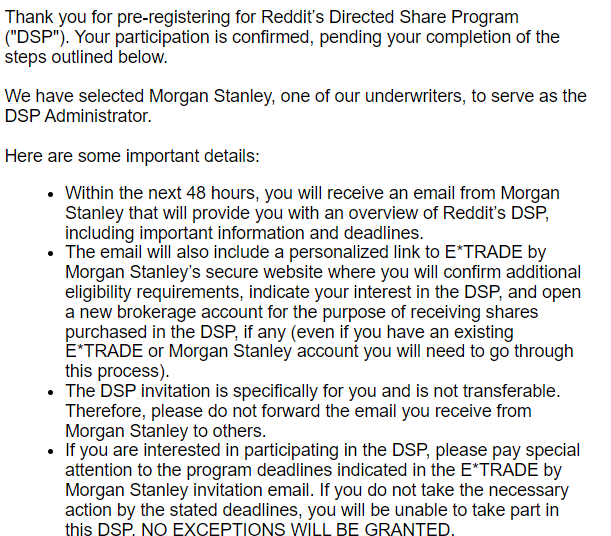
First, I had to pre-register for the IPO with Reddit by the March 5th deadline, and then wait to see if I was confirmed as a participant. As if I wouldn’t be. I expected to receive my confirmation in the form of a telegram or a gilded letter delivered by an owl at my window. Instead, on March 11th I received just a simple email stating that I was confirmed.

Screenshot of my confrmation letter rom Reddit.

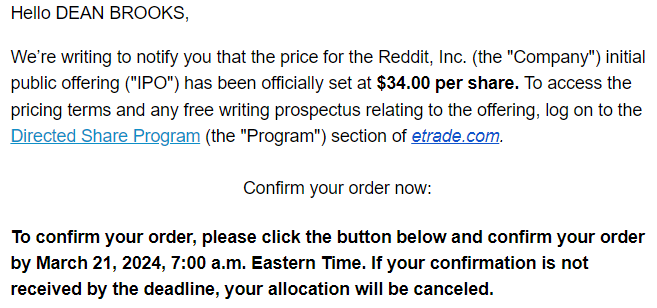
Next, I had to set up a separate brokerage account just for the IPO. I’ve been with Morgan Stanley/E-trade for almost ten years now so this was an easy process. After getting a new account going, Morgan Stanley emailed asking me to confirm my order and deposit the necessary funds. Again, just an email. No complementary top hat or secret invite to an Eyes Wide Shut sex party in Bohemian Grove. So much for feeling like an elite.

Screenshot of my confirmation letter.

$34.00 seemed cheap but reasonable. Facebook debuted at $38. Uber at $45. Tesla started at $17. I generally only invest in index funds or ETFs like SPY, VTI, VOO, and QQQ, so I was used to stocks costing in the hundreds. Generally, for my individual brokerage account, I deposit $1000+ into my investments at a time. But this was an exciting albeit risky tech IPO based on a website famous mainly for fostering neckbeard outrage and degenerate Wall Street gambling. I decided to buy just 10 shares, and put in $350 to ensure the whole cost was covered should there be some small additional fee.

So, how’d I do? Right after Reddit launched on the NYSE on March 21 the stock nearly doubled to about $65 a share. It dipped to around $39 in mid-April before rising back up to $62 just last week. And as of now, at close on May 24th, 2024, it’s $54.72.

When Reddit’s stock (RDDT) hit around $56 earlier this week I sold five shares for about $280. The reason for that was I wanted to pull out nearly my initial investment ($340). That way going forward what I have left at stake is almost all profit. If Reddit continues to move up, I capture the upside. If it crashes down and ends up floundering, at least I’ll have just about broken even and not really lost anything.

In summary, participating in Reddit’s IPO was a fun and thus far profitable experience. Do I wish I had invested more into the IPO? In retrospect, of course. Dropping $10k in there would have put me up almost $16,000 before selling half my shares. But a big part of investing is risk mitigation, not just seeking out a high return. Reddit’s IPO could have been a big fat flop to start off. And who’s to say Reddit won’t get downvoted by investors eventually?

I don’t know how long I’ll hold onto my five remaining shares. Facebook went up 5x in the first six years after its IPO. It’s now up 12x. But then Uber is barely up 50% from its IPO price in 2019. You’d have done better just holding the S&P 500 than Uber over that same time span. Will Reddit even still be popular in ten years? That’s difficult to say. The internet is a fickle place. I know I’ll (probably) still be there.

What the Hell is Suze Orman Smoking?

Two million dollars is “pennies” according to the finance guru.

“Suze Orman.” Created by author with Midjourney.

Did you know you need anywhere from $5 million to $10 million to comfortably retire early? That’s according to Suze Orman, who spoke on the “Afford Anything” podcast.

She goes on to say:

“If you have $20 [million], $40 [million], $50 [million] or $100 million, be like me, okay. If you have that kind of money and you want to retire, fine.”

To which I have to politely ask of the lady with the ultimate “Can I speak to the manager?” haircut, what the hell is she smoking?

$20 million to retire early???

Are we retiring in a downtown Manhattan loft with a personal limo chauffeur service and a live-in butler named Yeevis? Are we settling down for the golden years in a gated mansion in Beverly Hills, with a private helicopter pad to avoid downtown rush hour traffic?

You have to be in the top 1% of wealth to buy a cheap condo in Tampa, FL and play shuffleboard in a pair of loafers? What kind of unexpected expenses might a senior citizen run into that they’d NEED $20 million plus for? A full T-Rex skeleton that’s suddenly become available on the black market? A Blue Origin trip to the moon? A cybernetic sex robot? A 24K gold toilet?

“A retirement necessity.” Made with Midjourney by the author.

Statistically, the bottom 99% cannot achieve $10 million or more by retirement. So Orman is basically saying to work until you die.

My issue here is not about working hard to become wealthy. Nor is this about hating the rich. I’m all about grinding to become Mr. Monopoly.

What I’m not about though is what I’d call toxic wealth accumulation due to uncertainty paranoia. A mindset rooted in chronic anxiety. Making money and building wealth should be an empowering process. Not one you do out of fear the sky is going to fall on you if you don’t have “enough.”

Interestingly, some in the finance community agree with Orman. The Yahoo Finance articles states:

This idea resonates with a segment of the financial community that sees the wisdom in ensuring a substantial financial buffer to address uncertainties in retirement, especially given potential long-term trends such as increasing health care costs and ongoing economic fluctuations.

I get it. Twenty-plus years of retirement is a long time. Anything could happen. A civil war. Meteor strike. Or just a good old-fashioned $58,000 heart surgery.

But how much calamity can one reasonably prepare for that justifies sacrificing your entire life working? Wealthy Cubans were turned into paupers overnight when Castro took over the country. All of John Jacob Astor IV’s millions couldn’t save him from the sinking on the Titanic.

Say you do get to $10 million or $20 million by the time you’re 85, and you’re finally ready for an Orman-approved retirement. So what? You’re fucking old. How much life do you even have left? What are you going to do then, climb Mount Everest? Yeah, right. You’re going to sit at home, watch TV, and bitch about politics like everyone else. You know how much that costs to do? Well, NOT $10 million, that’s for sure.

These kinds of click-baity pronouncements by Orman and others are meant to be “helpful.” Except they really come across more like hyperbolic sales talk from people trying to sell a pyramid scheme.

I’m all about chasing the money dragon to a reasonable extent. If you’re someone with a worthwhile career that’s put you on the path to the top percentile, great. CEO, Instagram influencer, entrepreneur, elite assassin, by all means keep riding that carousel. But if you’re like most, and slaving away at Dipshit, Inc., dont think you’ve got work till you drop just because Suze “Karen Hair” Orman says so. Go live your life.

This Chart Taught Me Some Mindblowing Lessons About Wealth

Stocks and mutual funds won’t make you rich. Starting your own business will.

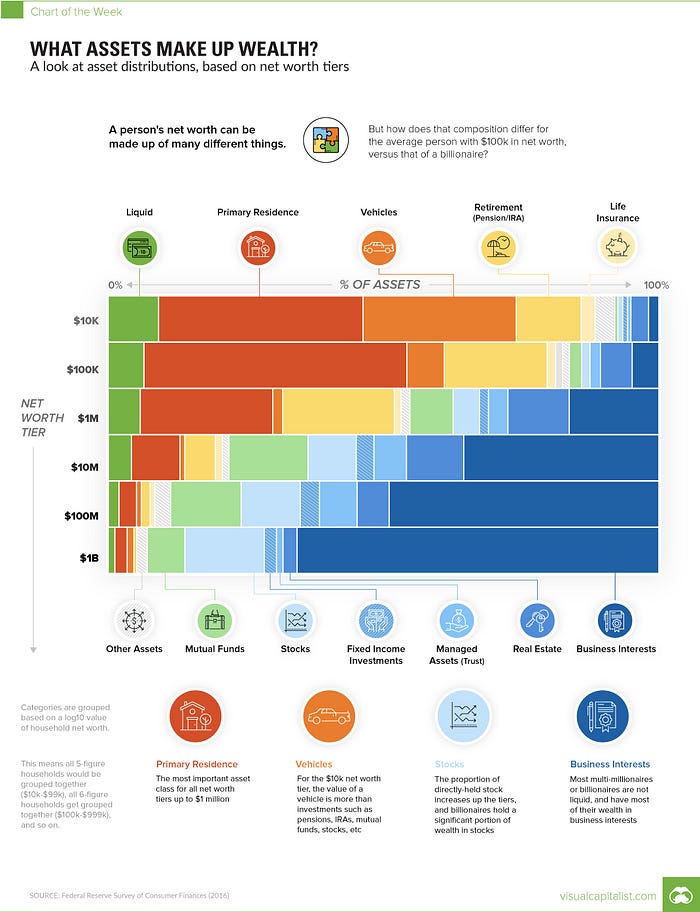
Source: https://www.visualcapitalist.com/chart-assets-make-wealth/

So, I discovered this chart by a post from James Camp, a guy I follow on X, who specializes in “nanoflips.” Check out his bio for info on those.

The graph comes from Visual Capitalist, a clever website that takes complex information and distills it into to easy to understand (and colorful) charts.

The chart displayed above is based on a Federal Reserve Survey of Consumer Finances from 2016, and it contains some illuminating aspects about how people in different net worth tiers manage their wealth.

Like many, I’ve always been under the impression that stocks and mutual funds are the best ways to build and maintain wealth for the average person. Over the last few years, I’ve diligently maxed out my 401(k) and IRA funds. I contribute regularly into a personal brokerage account. Even through the Covid Crash and the 2022 drawdown, I kept plugging away, dollar-cost averaging into the market like you “should.”

The returns have been solid, for sure. While I’m not close to retirement anytime soon, I’ve built up a decent net worth. I like to think I’ve “secured the bag.” Meaning that even if I never contributied another dime to my investment accounts from now until age 65, compound growth alone would get me to a comfortable retirement. And that’s NOT taking into account potential Social Security payments.

I say “potential” because who knows if Social Security will exist by then, or pay out what it’s supposed to. It’s never a good idea to bank your life on a government program, especially when the government is over 30 trillion dollars in debt.

However, the above chart has made me completely reevaluate my relationship with invesing and money in general.

Source: https://unsplash.com/photos/woman-in-gray-shirt-holding-fan-of-us-dollar-bills-OyDZRZOlENw

For starters, the chart shows that the higher a person’s net worth the more they have invested in “business interests.” These are businesses someone owns personally. They could be anything from a franchise, a laundromat, a service company, all the way up to a controlling stake in a Fortune 500 company.

Elon Musk has a 20.5% stake in Tesla, for example.

What’s surprising, however, is how little percentage-wise wealthy people are invested in stocks and mutual funds relative to their net worth. The chart combines net worths together and works out an average. So in the row where it says $10K, it’s grouping all the people with $10K through $100K together. Then in the $100K row, it’s everyone with a net worth between $100K and a million. So on and so forth.

People in the $1 million to $10 million range look to have close to 40% of their net worth in retirement accounts, stocks, and mutual funds. This makes sense give that most people in that range are retirees who spent years contributing to company 401(k) plans, pensions, and their own IRAs. About 30% of their net worth is in their primary residence.

However, going further up in net worth on the chart shows that the wealthy have increasingly less in stocks and personal homes, and vastly more locked up in their own businesses.

For those in the $10M+ group, stocks are no more than about 30% of their net worth, and their personal homes aren’t even 15%. Their wealth is mainly all in their own businesses.

This may seem obvious. But almost everywhere you turn, you only ever hear about the importance of investing in a diversified portfolio of mutual funds and ETFs.

Dave Ramsey touts mutual funds like a religion to his millions of listeners.

But are index funds and mutual funds really the best ways to build wealth?

If you were to ask most people how they think they can get rich through investing, most would probably say by getting lucky on a stock or cryptocurrency.

This is not impossible, of course. A mere $10K in Apple stock 20 years ago would be worth almost $5 million today. Buying Bitcoin or Ethereum just five years ago would have given you substantial returns.

People may remember the “meme stock” craze from just a few years ago with Gamestop and AMC. The whole internet was gripped with trying to ride the next big thing “to the moon.”

Let’s not even talk about the NFT nonsense.

Point is, everyone thinks stock investing = getting rich, except people who actually are rich. They know stocks and mutual funds won’t make you rich. They can make you financially secure. But if you want to become truly wealthy, you’re best bet is by starting your own business.

Think about it. Stock picking is unreliable unless you know what you’re doing. If you decide on the safer, diversified route of index funds, ETFs, or mutual funds, it could take decades to build anything substantial. It’s also highly unlikely you’ll break into the top 1%.

To get to $5 million, for example, you’d have to invest $18,000 a year every year for 40 years at an average annual return of 8%.

Wait, only $18,000 a year? That doesn’t sound too bad.

Well, according to the National Board of Labor Statistics as reported by USA Today, the average salary in the United States in Q4 of 2023 was less than $60,000. So, the typical person would have to stock away almost 1/3 of their income for basically their entire working life to get to that $5 million. That’s a pretty tall order considering they still have taxes and bills to pay.

This information may sound sobering, or even despairing. Especially to 401(k) and IRA maxers like myself, stock market junkies, or those in the FIRE (Financial Independence Retire Early) camp.

It’s important to keep some perspective. A $1 million net worth is still a lot more than most people will ever have. I’d argue you probably don’t even need half of that to retire, provided you manage your money well and are prepared to live modestly. And those are certainly attainable amounts for those who prefer the more traditional route of diversified index fund investing. Investing $3600 a year over 40 years at 8% gets you to a million.

But why cap your financial potential with just mutual funds?

What I’ve taken from this chart is that to become wealthy you’ve got to get creative and entrepreneurial. While I’m going to keep investing in stocks and my retirement accounts, of course, moving forward, I’d like to start thinking beyond them. I’m going to start allocating some of my income toward experimentation with businesses. This will prove a tough adjustment for me, as someone who’s never had his own business or been much of a risk taker. No doubt there will be some failures and surprises along the way. But I think it will be good mindset shift in the end, and hopefully a lucrative one, too.