What ‘Ghostbusters’ (1984) is Really About

The real theme is cynical and darkly hilarious.

Source: ‘Ghostbusters’ logo

So, a while back, I caught a video on good ol’ YouTube titled “Ghostbusters: A Movie About Nothing.” Basically, the video essay posits that the 1984 comedy classic lack a unifying theme. If you scroll down through the comment section, there are over 2,000 comments of people giving their own take.

As someone who watched this movie religiously as a kid for years, like many children of the ’80s, I was actually stymied by this video’s stance. Even rewatching the film as an adult some years ago, the idea of there not being a theme never caught my attention. To me, the film always just represented pure entertainment. A silly premise played straight by three comedians at the top of their game. A perfectly executed comedy, well-directed, with cutting edge special effects for the time.

Most comedies don’t have much of a theme, or much to say about anything, really. You think of the comedy classic Airplane! with its slapstick spoof absurdist humor. What social message or statement on the human condition is that movie trying to send? The plight of overcoming PTSD from war, as Striker eventually does? Or something like The Hangover, with its multiple gag sequences. The value of friendship?

Generally, when comedies do have a theme, it’s very safe and broad, and plays out in the background. You think of Caddyshack, another Bill Murray comedy hit, with it “slobs against the snobs” class warfare themes, pitting the young middle-class kid Danny and his nouveau riche allies (Ty and Al) against the uptight wealthy Judge Smails and his stuffy old money associates. Interestingly, Titanic has similar themes, but as a drama, is more upfront and systematic about the way it goes about exploring them.

The Wikipedia page on Ghostbusters has an intriguing section regarding the movie’s subtle statement on capitalism and private industry, weighing the film as a reflection of Ronald Reagan’s deregulatory pro-free market ideology. I don’t entirely disagree with this premise. I just think the real theme is much simpler.

Ghostbusters is about celebrity. More specifically, it’s about how one’s status and value to society is largely determined by one’s portrayal in the media. Even if you’re trying to save the world, you’re not a “hero” or “important” until the press says you are.

This theme is a subtlely handled. Background radiation, as it were, subordinate to the clever writing and memorable dialogue. But there’s plenty of evidence for the idea of how the media shapes reality and perception.

If ghosts existing like this were the case, this would be quite a terrifying reality. People would be demanding governments come up with some solution to deal with these afterlife visitors. And anyone involved in solving the problem would likely be getting millions, if not billions of government funding. It would be like the Manhattan Project.

In actuality, Egon Spengler, Ray Stantz, and Peter Venkman are apparently the only three scientists in the entire world working on the cutting edge of the supernatural, and they’re about to be thrown out of their jobs at Columbia University. This despite Egon and Ray having already invented the P.K.E. Meter, a tool that can track ghosts and other supernatural entities. Likely, the pair were also on the verge of building the proton packs, or even had a protoype designed and functional. Remember, the packs basically just appear later in the movie, with little explanation as to how to they work or how they were built, other than they are “nuclear accelerators.” Not to mention the ghost traps and the ghost storage unit used later. All technology that was likely very close to fruition or in different stages of design.

You’d think if two guys were actually building tools and weapons capable of ridding the world of a huge menace like free-roaming ghosts, they’d have the respect of the university, and certainly their peers. They’d be regarded like Einstein or Newton. Instead, Columbia Dean Yeager regards them all as a joke, and kicks them to the curb. They’re forced to set up shop on their own, using Ray’s family home as collateral for a massive high-interest business loan.

Even after the Ghostbusters catch the ghost at the hotel in their first job, how are they treated by the stuffy manager? Like overpriced bug exterminators. Ray almost threatens to put the ghost back when the manager intitially refuses to pay the bill. Mind you, the ghost problem is played 100% straight. The manager KNOWS the ghost is real. He knows it’s been harassing his guests for years. At issue is the bill.

As it turns out, the Sedgewick manager is the last person who treats the Ghostbusters with low regard. For immediately after, the movie goes into a montage sequence in which major media publications like The AtlanticTime, and others, turn the trio of scientists from unknowns into national celebrities, in a matter of weeks. Business booms, as evidenced by them leaving multiple buildings with freshly caught ghosts. They even seem to get groupies, as after dealing with a “pesky poltergeist” at a night club on New Year’s Eve, they stay behind to “dance the night away” with some of the ladies.

Another turning point in how the Ghostbusters are viewed is in Dana Barrett’s reevaluation of Peter Venkman as a suitor. This despite Venkman coming onto her earlier quite creepily when he visits her apartment to assess her refrigerator terror dog problem. Rather than being repulsed by him, after observing that he’s a “big celebrity now,” she agrees to a dinner date. This despite the interest of another romantic rival — the violinist, who Venkman calls a “stiff.” And not just any violinist, but one of the “finest in the world.” Something that doesn’t matter in the context of the scene because Venkman has high media status, and therefore greater “value” as a potential sexual partner.

Another thing to note is how the the montage sequence concludes — with Ray Stanz getting blown by a beautiful female ghost. Another example in addition to the Venkman one where sexual desirability is commesurate with your celebrity status. Even if the BJ Stantz gets happens in a dream or reality, it still serves to reinforce the theme. And don’t forget how the office secretary Janine gradually falls for Egon, even after he rebuffs her advances.

The Ghostbusters’ celebrity powers are enough to get them out of jail when the Mayor summons them to deal with the city’s spiraling ghost problem. This is where I part ways with the Wikipedia theories about the movie’s themes on free market capitalism versus government bureacracy. Because I don’t regard Walter Peck, the government inspector, necessarily as a true villain. He’s a dick, for sure. Dickless even, by some reports. But he’s doing his job. What the Ghostbusters are doing is akin to a bunch of guys trying to run a nuclear power plant on their own, without regulations or oversight. Farmers get fined all the time by state governments for not calling in line patrolers before digging into their own property. The SEC right now is trying to figure out how to crack down on the largely unregulated cryptocurrency market. So I’d think four guys using experimental technology that involves nuclear energy strong enough to vaporize matter (aka “total protonic reversal”) would warrant a stern look by government inspectors. While Peck shouldn’t have made them shut down the ghost containment unit until he knew fully what the hell was going on, it doesn’t necessarily make him malicious. Just stupid.

The Ghostbusters are also so beloved by the city that thousands of citizens show up to cheer them on when they arrive at Dana Barrett’s building for the film’s climax. Actually, “cheer them on” hardly does it justice. The New Yorkers are practically euphoric, with everyone from Orthodox Jews to punk rockers coming together in celebration. Even a powerful earthquake isn’t enough to send the people away. The masses are willing to endanger their lives just to watch their heroes enter a building. Even The Beatles couldn’t claim that level of worship at their height.

Such is the all-important power of celebrity in the world of the film. Even Gozer, the film’s villain, is not immune. What’s the first thing the androgynous demon spirit asks of them when they arrive at the rooftop? “Are you a god?” A status check. When Ray foolishly answers “No,” Gozer tries to kill them. Except the Ghostbusters are “gods,” in a way, by virtue of their celebrity, and their advanced technology.

After a show of power, Gozer evidently respects them enough that he/she selects the Ghostbusters to choose the “form of the destructor.” What villain allows the heroes that kind of consideration? And why them? Why not the collective consciousness of the city? Or why not a form that’s objectively terrifying, like the terror dogs? Why should the Ghostbusters get the ridiculous choice of the Stay Puft Marshmallow Man?

Another thing to note is Gozer’s initial appearance, looking like a supernatural David Bowie or Michael Jackson. Eerie and ethereal. Not as a scary-looking demon, as you might expect. But as the ultimate stage performer, or showbiz celebrity, as such.

The film memorably ends with the entire city seeing the Ghostbusters off, as the closing credits play over the theme song. Reminiscent of the kind of jubiliation seen in the New York City Victory Parade of 1946.

The 1989 sequel continues with the theme of celebrity, with the Ghostbusters having to rebuild their lost status after being dubiously relegated to sideshow freaks again. Even the Ghostbusters cartoon that ran from 1986–1991 incorporates it. The closing credits shows the Ghostbusters strutting down the street in a ticker-tape parade.

Now, you could argue that the Ghostbusters become revered heroes not so much due to the press but because of their unique services. Except police officers and firefighters save people all the time, and usually with very little fanfare. Remember, we come into the story with ghosts already present and a serious threat, but apparently not enough of one to warrant government intervention or interest by anyone other than three schlubby scientists working at Columbia. It isn’t until the media catches on, seeing them as a means to sell copy and get ratings that they’re catapulted into fame. From then on, the Ghostbusters are taken very seriously.

I find this theme relatable even today. Many people view their own value and self-worth through the lens of their social media status, which is today’s governing agency of celebrity. Gone are newspapers, magazines, and even talk shows. Now it’s all about clicks and likes on YouTube, Twitter, Facebook, and TikTok. Think about the last time you went to a concert. How many people WEREN’T experiencing it through their smartphones? Likely very few. It’s as if people can’t properly enjoy something unless others are also enjoying it with them online. A bizarre kind of feedback loop.

Anyway, what do you think? Is the 1984 Ghostbusters about how one’s worth is relative to their status as a celebrity? Or is just about busting ghosts and nothing more? Or about something else altogether?


People are Cashing in With This Controversial But Super Easy (and Still Growing)YouTube Niche

Photo by Andrea Piacquadio from Pexels: https://www.pexels.com/photo/collage-photo-of-woman-3812743/

Man, it’s 2022 and hustling a substantial side income has never been so easy.

How easy are we talking here? How about watching movies and TV easy? That’s not too hard to do, is it? I mean, it doesn’t get much easier than that, except maybe for sleeping. And no way would anyone catch big bucks while catching some big Zzzzs, right?

Oh, wait, nevermind. Someone did just that.

Anyway…this niche does not JUST involve watching movies and TV. It’s also about reacting and providing some commentary, and preferably doing so at least somewhat humorously, and maybe with a little personality.

That’s right. I’m talking about the Movie/TV Reaction niche on YouTube.

People are recording themselves reacting to everything from new episodes of TV shows like Better Call Saul, to classic action films like Terminator 2: Judgment Day, to even recordings of kid’s show hosts. Watch this young woman almost have a meltdown watching a message from Steve Burns, former host of Blues Clues.

By the way, if you prefer to watch someone else react to a video from a TV host who retired decades ago, there are a dozen others for your nostalgia-mongering pleasure. Seriously. And they all have thousands to even tens of thousands of views. That’s bonkers.

Really, just type in the title of any movie/TV show or any type of media into YouTube and then put “reaction” afterward, and there are bound to be tens to even hundreds of accounts. Many of which have tens of thousands to even hundreds of thousands of subscribers, and fresh uploads. That means they’re literally getting paid to watch movies and TV.

But wait. How come YouTube hasn’t banned reaction channels for posting copyrighted content?

Obviously you can’t just upload a whole movie or show to YouTube and throw in some occasional observations due to YouTube’s copyright rules. So reaction YouTubers skirt around this issue with good ol’ fair use. Shaun Poore, a popular blogger and software developer, provides some non-lawyerly guidance about fair use, which shows how these types of channels have proliferated in the last few years due to this loophole:

1. Playing an entire episode of Rick and Morty and videotaping yourself laughing isn’t fair use. At a minimum, you need to be providing serious commentary on the episode.

2. The video’s focus needs to be on you and your commentary, not the copyrighted material.

3. You should always be on the screen.

4. The copyrighted material shouldn’t be full screen or played in its entirety.

The reaction video racket is not without its risks. Which is why you’ll see YouTubers blur out the movie or TV show, or only show short segments, to avoid YouTube demonetizing them, or striking their account down altogether.

To be clear, if you’re interested in jumping into this reaction niche, make sure you do your own due diligence on copyright and fair use, and be sure to always follow all of YouTube’s rules.

Of course, this low-effort easy-peasy type of “content” creation has attracted its share of haters and controversy. Redditor KingLordship posted this in /r/NewTubers:

I just really hate the fact that people spend days to create something then a reaction channel sits there and says two words throughout the video, gets monetised, paid and gets a crap ton of views for no effort at all.

Far be it from me to argue with a guy named “KingLordship.”

Then there’s this dude Tanmay Pendse from Quora, a self-described “High Tier Cinephile,” who responds to the question, “Why are there so many ‘reaction channels’ on Youtube?” with this bit of blunt honesty:

This is the stupidest from these trends. “Reaction Videos” they suck.

It is literally someone sits in front of camera & recording the reaction of what they are watching.

“I REACT GOOD” ISN’T A TALENT.

And Tanmay said that three years ago in March, 2019. Poor guy must be raging 24/7 now, as the reaction video trend has only increased like ten-fold since.

Hey, no one said side hustling had to be hard or contribute to the advancement of society. Don’t hate the player, hate the game. Just make sure to record yourself reacting to the game with outrage, so you too can cash in on this still growing niche.

Besides, science says it’s not your fault you like reaction videos. This 2016 article says “mirror neurons” in our brains could be responsible for triggering empathetic feelings. So when you’re watching your favorite YouTuber react to Freddy Krueger ripping a teenager apart, it’s like you’re bonding. Well, sort of. These feelings help to give (or at least simulate) a sense of communal involvment, even acceptance. The idea that “You’re just like me,” because you like the same movie/TV show I do.

In other words, watching a reaction video gives the illusory sense that you’re watching and enjoying something right alongside someone else. A sort of self-induced hypnosis form of socialization. It’s no surprise that many reaction channels saw explosive growth during the Covid-19 quarantine. Many of the accounts I examined for this article started around 2020, or saw a hockey stick spurt in viewership around that time.

Reaction channels have been around almost since YouTube’s inception, afterall. Starting out with the infamous maze scare prank that was big stuff back in the day. But it goes back even farther than that. Remember America’s Funniest Home Videos? As host Tom Bergeron used to say, “If you get it on tape, you could get it in cash.” Words to live by.

Now that we understand the history, the science, and the controvery behind this reaction channel phenomenon, let’s get down to what’s most important here:

Money.

Do reaction channels make money? That’s a Kool-Aid Man-level “Oh, yeah!”

I examined five of these reaction channels, ranging in size from small to medium. From only a few tens of thousands of subs to a few hundred thousand. Making sure to pick ones that were concentrated solely on “reaction.” Many reaction channels incorporate lengthy reviews of the movies or shows watched. I tried to stick with ones that were more “spur of the moment.” Review channels like Red Letter Media or Chris Stuckmann are obviously a seperate niche altogether. I also did not include movie news-centric channels that only have some reaction aspect, like Beyond the Trailer.

I also tried to pick channels with “average” people, as opposed to people with colorful “YouTube personalities.” I wanted to see what kind of success a “typical” person might encounter with one of these channels. Of course, the more engaging and friendly you are on camera, the more likely you are to attract subs, even for a low-effort niche like reaction videos. And if you’re an attractive female, you’ll have an even bigger advantage. It’s not to say anyone can’t land pay dirt kicking back and watching flicks. As I found, this niche has a huge mix of different types. But the two keys I found are that being funny and genuine led to the best results.

Screenshot by author.

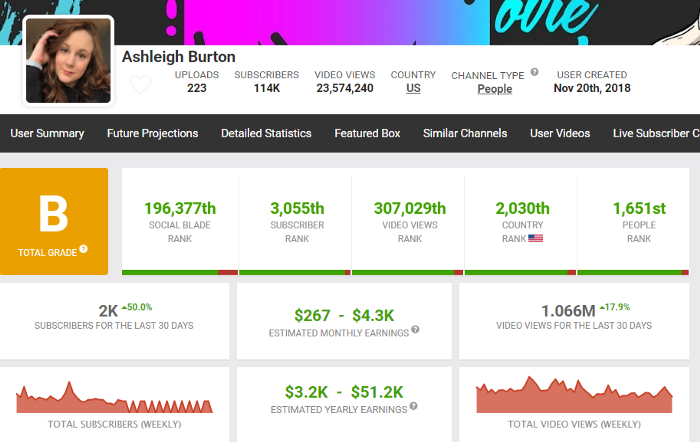
It’s even better if there’s a bit of a culture clash, or “fish out of water” angle in your reaction videos. Take Ashleigh Burton of Millennial Movie Monday, a “millennial who has been sheltered from every classic movie you can think of.” Ashley first started posting regularly in February, 2020, and offers lively reactions on her channel. Here’s a screenshot of her Social Blade details:

Screenshot by author.

For an active two-year old channel with very simple content, that’s not a bad haul from Google Adsense. But as I found, Adsense is hardly the best revenue stream for many of these reaction YouTubers. Check out what Ashley’s bringing in with Patreon:

Screenshot by author.

Patreon gives content creators a chance to earn an additional revenue stream by offering their fans a monthly membership. From what I found in my search, the most lucrative Patreon accounts offered exclusive perks, like behind-the-scenes insights, early access to new content, polls to vote on which movies to watch, or livestreams. Just looking at some of the Patreon accounts was very instructive. If you want the best results, you need to be active about not just producing new content regularly, but also building a community with your fans.

So, if we take the average of Social Blade’s estimated monthly earnings, $2,283, and add in the Patreon revenue, we come to $10,236 a month. That’s over $122,000 a year for watching movies. That doesn’t count any donations Ashleigh’s fans send to her P.O. Box. Ashleigh posts a Monthly Live Unboxing livestream where she opens up gifts fans have sent her. She’s received everything from shirts, scarves, cards, books, to Little Debbie Birthday Cakes. In adddion, I’ve seen fans pay as much as $200 for Super Chat donations in Ashleigh’s livestreams.

When you add in Adsense, Patreon, and the donations, it’s possible Ashleigh could be raking in close to $15k a month or more. Not a bad side gig.

Screenshot by author.

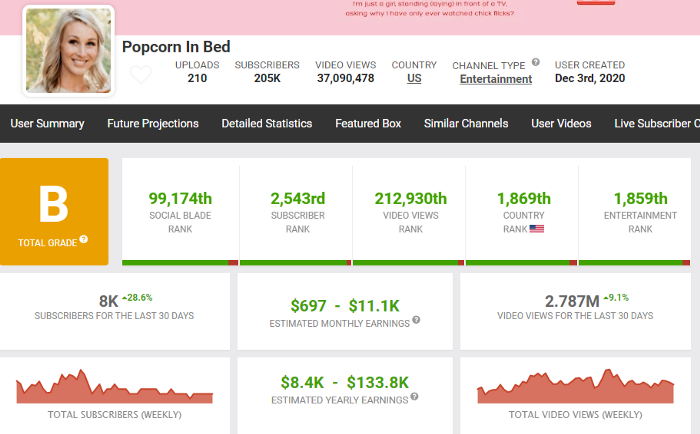
Next up we have Popcorn in Bed, whose husband one day pointed out to her that she’d been “hiding under a rock my whole life with how many ‘amazing’ movies I haven’t seen (according to him).” Cassie, who runs PiB, started just a little over a year ago, in January, 2021, but since then has racked up substantial subs, and has some decent monthly ad income:

Screenshot by author.

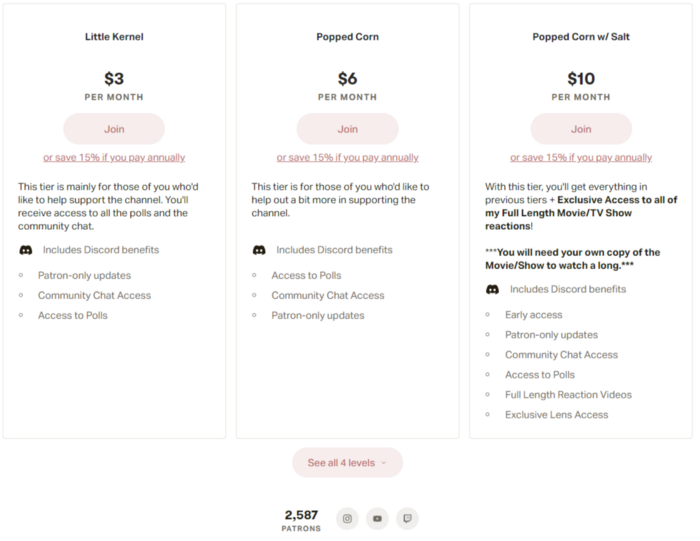
Like Ashleigh, Cassie has the Patreon hustle down to a science. Check her page out:

Screenshot by author.

While Cassie’s Patreon page above doesn’t show her exact monthly income, there’s a way to get a rough estimate. Going back to Ashleigh’s page, if you divide the number of monthly patrons into the amount she makes each month, you come to about $8.18 per person. Ashley has a membership tier of $3, $8, $10, $20, and even $100. The $100 one is actually sold out. So, at $8.18, it shows she has a pretty committed and engaged audience.

Now, looking at Cassie (Popcorn in Bed), she has four membership levels at $3, $6, $10, and $15. It’s reasonable to think each Patron might be in the average of those numbers, if Cassie’s results are similar to Ashleigh’s. That would mean each patron comes out to $7 a month. Seven bucks times 2,587 total Patrons comes out to $18,109. So, that plus the Google Adsense results (an average estimate of $5,897) equals $24,007 a month. Then you have donations and Super Chats. Cassie also does regular livestream gift unboxings. Oh, and then there’s PiB MERCH.

All told, Cassie could be getting paid $300k+ PER YEAR to watch movies.

Excuse me while I sit here with my mind blown for a minute or two.

To put that sort of income in perspective, according to Medscape Physician Compensation Report, 2019, Pathologists earn an average annual income of $308,000. According to U.S. News, the top 25 percent of lawyers in the U.S. make $189,250 a year. But unlike going to law school or medical school for years, being a movie reaction YouTuber doesn’t involve going into potentially hundreds of thousands of dollars of student loan debt.

Now, to be clear, individual results will vary when it comes to YouTube. Ashleigh and Cassie’s success with reaction videos may not be typical. But even doing a cursory glance through YouTube at the numerous reaction channels that exist out there, you’ll find dozens that have north of 100k subs. If you post regularly, engage with your audience, and leverage various revenue sources like Patreon or merchandising, you can make a substantial income with this niche.

But let’s look at a more “down to earth” example.

Screenshot by author.

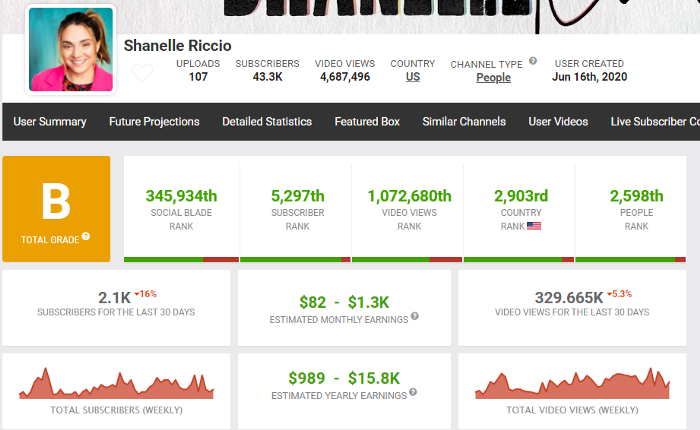
Shanelle started her channel two years ago in June of 2020, and like many other reaction YouTubers, saw some growth during the Covid lockdowns. Shanelle is also an actress and wants to work in comedy.

Screenshot by author.

But what accounts for the lower revenue and subscription numbers compared to Ashleigh Burton and Cassie of Popcorn in Bed? I suspect this may simply boil down to fewer postings. Shanelle’s updates average out to almost once a week for the last two years. Ashleigh has uploaded 223 videos in about the same time span. While Cassie has done 210 in almost 18 months. YouTube really does reward higher consistency, and this is also the case with reaction videos. This is a niche with a lot of increasing competition. So if you’re not posting heavily, it’s going to be harder to hold onto and build an audience.

But even if you want to pursue the reaction niche on more of a part-time basis, Shanell’s channel shows you can still make a decent side income. Hey, not everyone has the time or interest to sit around watching movies all day, even if it might pay ridicously well. She does not have a Patreon page, a P.O. Box for donations, and does few livestreams. However, in a recent livestream, I noticed she did make some high-dollar Super Chats.

But what if you and a friend want to do a reaction video? Or if you’re in a relationship, and both you and your partner want to score some sweet reaction video cash? You’re in luck, because there are plenty of profitable channels that do just that.

Screenshot by author.

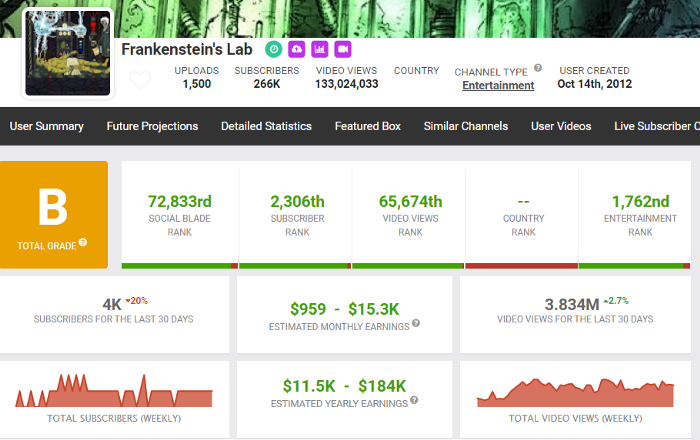
Frankenstein’s Lab is a reaction channel run by “Frankenstein” and his cousin Rondo, who react to “movie trailers, music videos, sports, tv shows, and everything in between.” The two cousins have been at it for almost five years, having started back in May, 2017, and have built up a decent following since then.

I included this account to show that some reaction channels stretch back from before the Dark Times, before the Covid-19 lockdowns. And also to show that starting a reaction channel is not always as simple as going for the obvious choices, like Marvel movies or Star Wars. You have to stretch out and diversify the types of content you’re covering. Frankenstein’s Lab started to get some traction about a year after starting. It still saw really inconsistent view counts, ranging anywhere from a few hundred to tens of thousands. Then they did really well with a few videos reacting to comedian Bill Burr, as well as other comedians like Theo Von.

What’s cool about these reaction channels is you’re potentially exposing people to a lot of content they might not have seen otherwise. So don’t be afraid to get really eclectic with your choices, and mix it up. Just because an entertainer or film may have a limited following, you might strike gold reacting to their videos because you’re introducing something different to a new audience. You can also ride the coattails of a new trend or person, too. It was around the late teens era when Theo Von was starting to get popular, so Frankenstein’s Lab rode some of that wave.

Screenshot by author.

Frankenstein’s Lab is a real “workman’s” channel, having consistenty posted for almost five years now. It didn’t seem to benefit much from a “Covid Bump” in popularity. It was already well on its way before then. The two cousins have a small Patreon following. But they do utilize PayPal and CashApp, so it’s hard to say what their channel’s income might be. It obviously pulls in enough to be worth it to keep going.

Screenshot by author.

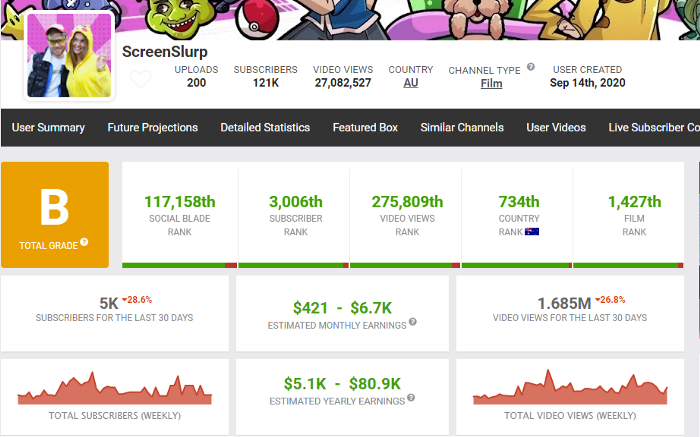
Finally, there’s ScreenSlurp, run by Australian couple Nick and Em. They started their channel in September, 2020, and have built up a pretty solid following.

Screenshot by author.

While the couple has been successful in monetizing their channel like many others in the reaction niche, and have a modest Patreon membership, Nick appears to be using their growing internet platform to help get a creative project of his off the ground. Their Instagram page has a link to a Kickstarter for an epic fantasy comic called “Creature Dwells” that Nick is trying to produce. As of now, the Kickstarter has already surpassed its funding goal. That’s a pretty cool double win there. You make a living watching movies, and help launch your own artistic career.

So, if you’re an artist or writer, and you’re looking to gain exposure or build a fanbase for your material, consider starting a YouTube channel.

Finally, these five channels are just a very small sampling of the vast number out there in the reaction video niche. Despite its controversy, there are no signs the trend is going away anytime soon. If anything, it’s growing and evolving.

If you’re considering getting into this lucrative niche, here are a few quick takeaways I learned in my research. Some of these tips overlap with what you’d need to do starting any YouTube channel, while others are specific to this niche.

  • Brush up on YouTube’s copyright and fair use policies, and be sure to follow the rules at all times. No sense in starting a channel if you’re just going to get banned.
  • Post regularly and often. Hey, you’re watching movies and TV. This shouldn’t be too hard, right? Yeah, I know, there’s this thing called the “outdoors” and “having a life.” But if you want to build an audience these days, you’ve got to rifle content out there like a World War II turret gunner.
  • Use Patreon! Make sure you offer plenty of extras and exclusives for your audience. You can post full-length movies on Patreon without having to cut them up to satisfy the fair use rule. Ashleigh and Cassie use that feature for their accounts, and it’s done great for them in raking in memberships.
  • Build a community with your subscribers. That means livestreams, lots of interaction, and maybe even tiny glimpses into your personal life. Remember “mirror neurons.” You want your subscribers to think of you as a cool friend they want to watch movies with. It’s all about building that sense of empathy and connection.
  • Don’t be afraid to cover stuff that’s not “popular.” You never know what might land. Or maybe your particular take on something is really unique and humorous, and that triggers the YouTube algorithm in your favor. Think of Frankenstein’s Lab when they did the Bill Burr and Theo Von videos. They went from a few thousand views on average, to millions, for those comedian-centered reactions.
  • Don’t forget about “Merchandising! Merchandising!” Every little revenue stream counts.

And that’s it. Good luck. I look forward to seeing your reaction channel, if I’m ever able to find it.