Amongst other reasons.
Chapter One: The Man From Knoxville, TN
I’m not a Tarantino stan by any means, though like many, I admire his work and his unique voice. I was too young to see his early stuff like Reservoir Dogs and Pulp Fiction. Only years later did I appreciate True Romance and Jackie Brown.
The two-time Oscar winner and pastiche-r of genres is kind of the patron saint artist for college students. Or cult leader, if you prefer. I would hear about him all the damn time and how great his movies are when I was in school. I think that’s why I put off watching them for so long. They were so constantly hyped up like “You gotta see it, bro!” that it had the opposite effect on me. I actually fell asleep the first time I was made to watch Pulp Fiction. I’m still kinda neutral about that one. I see the appeal, but it just never captured me, as most films featuring race as a prominent theme generally don’t. I have a younger cousin who loves it and calls it his favorite film.
Tarantino dominated the 1990s. His turn-of-the-millenium output has seen equal critical and commercial success, though maybe not in the same generational-zeitgeisty way as his early stuff. Even now, I passively follow his work, which for me remains hit or miss. I only recently saw Inglorious Basterds. Miss. Never saw Death Proof. Saw Django Unchained once. Eh, it was okay. Hated The Hateful Eight. Enjoyed Once Upon a Time…In Hollywood, though it felt underdeveloped and indulgent.
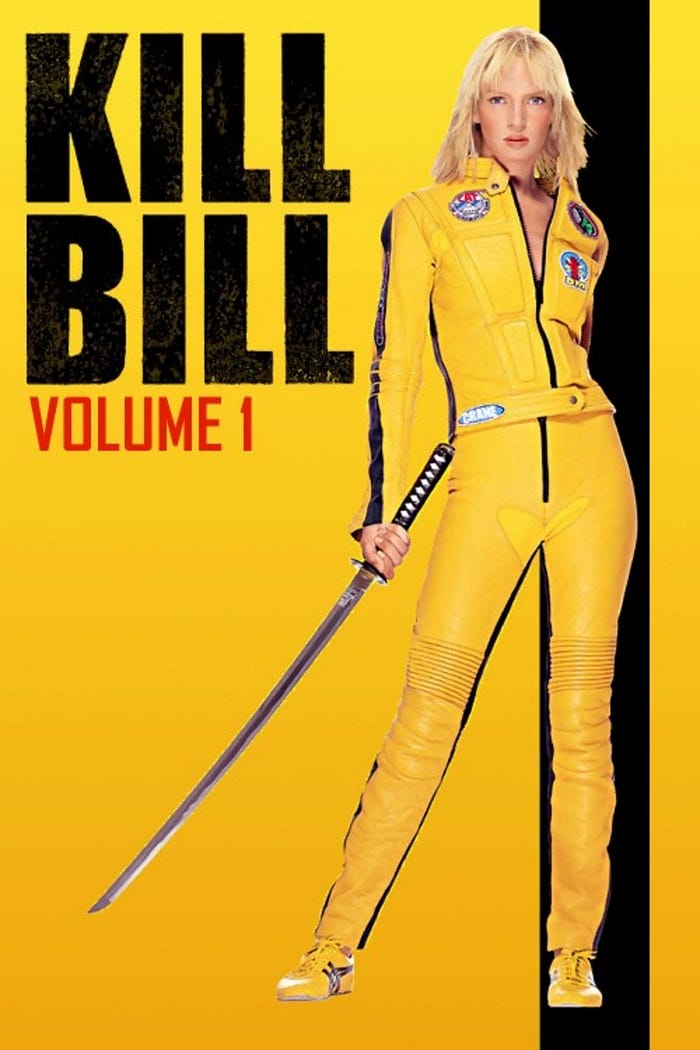
I do, however, fucking love Kill Bill Vol. I and II.
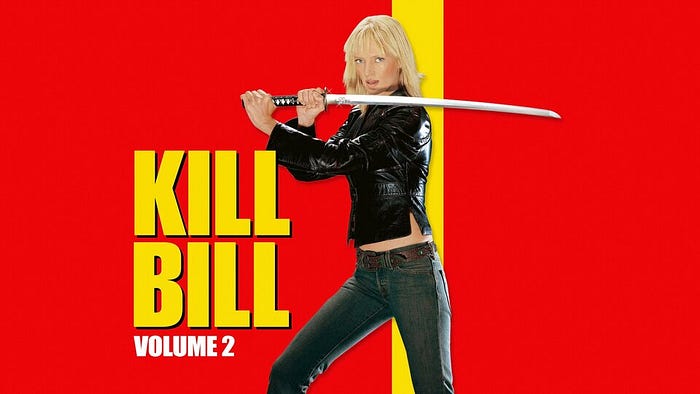
Kill Bill holds a special place in my heart. Not just because I really like the story, but because of the memorable venue where I originally saw it. I was 21 and going to a private college in north Chicago in 2003. Loyola University sits wedged alongside Lake Shore Drive and Lake Michigan, and like many city schools, criss-crosses different neighborhoods of varying class levels. You’ve got your gentrified hipster streets, your more “ghetto” areas, your working class avenues, and your young professional couple cheapo condo building spots. Of course you have all the retail staples. Chinese food. Delis. Convenience stores. And bars. Lots of bars.
And you have the “ghettoplex.”
Chapter Two: The “Ghettoplex”
The “ghettoplex.” This was a tiny run-down old fashioned style theater on North Sheridan Road. Opened in 1913, it’s name was originally The Regent. In 1990 new ownership renamed it Village North Theater. Then it became the New 400 in 2009. Like many theaters, Covid punched it hard in the face. But it eventually reopened. Only to suddenly (and finally?) close in 2023.
I never knew the theater by any of its real names. It was just the ghettoplex around campus. The ghettoplex had only a few auditoriums. It attracted an eclective mix of people from all walks of life. Mainly broke college students. But also hipsters. Whites, Blacks, Hispanics. Uptight professionals. Homeless. Thugs. Everyone. Every screening was a melting pot and often chaotic, with people shouting at the screen, getting up and down, arguing, throwing food, amongst other activities. Even though I typically hate interruptions during movies, the ghettoplex was the one venue in which it seemed not just appropriate, but even welcome.
In other words, it was the perfect place to watch the vibrantly raucous Kill Bill: Vol I.
I was instantly attracted to Kill Bill from the trailer and all the advertising, as it looked unlike anything I’d ever seen. Which is ironic, considering it’s a blend of several classic film genres; namely spaghetti Westerns and ‘70’s Bruce Lee-style Martial arts flicks, combined with noirish crime and pulpy gangster revenge stories. Some people credit No Country for Old Men (2007) with starting the neo-Western trend that still continues today with The Last Stop In Yuma County (2023). But I think Vol. II of Kill Bill has an argument for being a bigger influence.
That Tarantino was splitting his new film into two parts felt audacious also. The Matrix Reloaded and Revolutions did that the same year. But they were both highly anticipated sequels to the beloved 1999 hit. It felt strange for even a respected artist like Tarantino to do the same with an original story that didn’t already have millions of built-in fans. Especially after a six-year hiatus from film making. His last film Jackie Brown (1997) didn’t exactly light the world on fire. There were even whisperings that Tarantino was just a ’90s man. That he wouldn’t make the jump to the new century with us coming-of-age Millennials.
I didn’t really care about Tarantino’s earlier works. I hadn’t even seen them at the time. All I knew was Kill Bill looked pretty badass. So, off to the ghettoplex I went the weekend of October 10, 2003.
Chapter Three: Ratatino, The Giant Rat
Movie theaters today are trying so hard to create immersive viewing experiences. There’s 3D, IMAX, 4DX, those D-Box seats that vibrate, stadium seating, and the latest and greatest in The Sphere in Las Vegas, NV, which has a near 360-degree wrap-around screen that’s so transportive it will give you anxiety. I highly recommend going. It’s mindblowing.
However, no theaters have considered the visceral experience that our good friends of the Rodentia order can freely provide during a film screening.
Kill Bill provoked hoots, hollers, “oh shits,” “fuck nawws,” and more from the get-go. The opening scene where The Bride surprises suburban homemaker Vernita Green (aka Copperhead) was a riot. “I should have been motherfucking Black Mamba,” brought laughs. The Kaboom cereal attack and its subsequent knife to the heart caused gasps. It was the kind of rare opening where you just knew you were in for a classic good time.
For me, the strongest reaction came at about the mid-point. It was right after when The Bride visits Hattori Hanzo to have a custom-made Samurai sword made and she’s off to Tokyo to deal with O-Ren when a giant rat ran across the bottom of the screen.
Now, for years I had often heard the legend of New York City’s giant sewer rats. As a new citizen of Chicago, it had not even occured to me that such massive cat-sized rodents could also live in the Midwest.
This rat was fucking huge. I’m not sure if it was in front of the screen or behind. It was a giant black shadow that scurried underneath Uma Thurman while she was determinedly seated on the airplane as The Green Hornet theme played. It ran across, its tail flopping behind it as thick as a coaxial cable, until reaching the other side and disappearing. The memory is burned into my brain. I’m not sure if anyone else even noticed it, as nobody reacted. I asked my friends that I’d gone with later about it, and they swear they never saw a rat. But given that the theater was called the “ghettoplex,” perhaps such gargantuan infestation was simply expected. Maybe this particular R.O.U.S. frequented the establishment and was well-known. I don’t know. But it freaked me out in kind of a good way.
What made it even better was that not long before, The Bride tells Hanzo about how she has a giant rat to kill (meaning Bill, of course). Did “Ratatino” (the name I gave him) hear Uma mention his species namesake, and take that as a cue to come out of hiding? Who knows. But I’m glad he did. God bless you Ratatino, wherever you are.
Chapter Four: Kill Bill and I
Have I mentioned how much I fucking love this movie? Good, I’ll jump into the many reasons why.
1. Uma
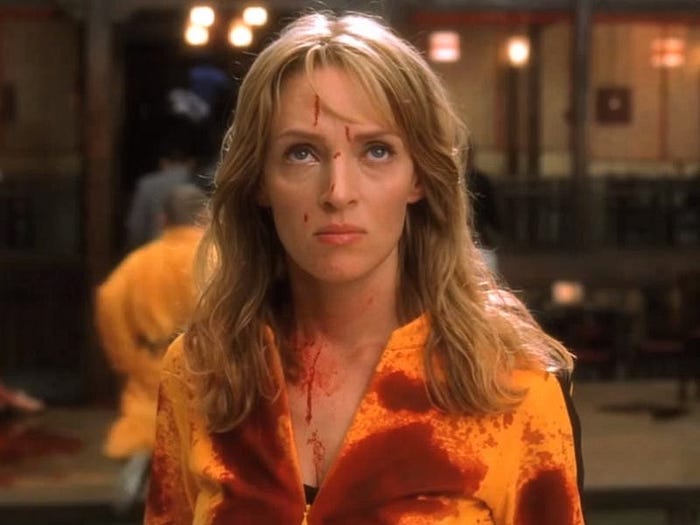
Okay, ngl, Uma Thurman became my movie crush for years after Kill Bill, displacing Katie Holmes’ solid four-year run, and knocking out an insurgent Jessica Alba. But aside from my own star-struck amore, Thurman really was perfectly cast for the role of The Bride/Beatrix Kiddo. I only found this out recently, but it was actually she and Quentin who conceived of the idea for Kill Bill while on the set of Pulp Fiction. This is why the credits for the story are “Q&U.” Tarantino refers to Thurman as his “muse.” It’s easy to see why. Uma’s tall, near-Amazonian figure ignites the screen, hacking and slashing away like a blonde supermodel Grim Reaper. The movie thrives on juxtapostion and irony — West meets East, red blood on snow, spaghetti Western meets Kung-fu flick — a killer ex-bride (and mom) on a bloody rampage is striking. Her big blue eyes are as close to “anime eyes” as one can physically get without CGI enhancement. The whole effect is instantly iconic.
Very often, whenever talk of “badass action heroines” comes up, the go-to examples are always Ellen Ripley or Sarah Connor. Sadly, The Bride seems to be constantly left out, and deserves to be placed atop that stage. Uma’s performance is also enhanced mightily by the character’s maternal qualities, which mirrored her own. She’d already had two children by filming, and her daughter Maya Hawke was almost the same age as her movie-daughter B.B.
Uma also deftly handles the film’s more darkly comedic elements. Tarantino flicks are known for their outlandish violence, but it’s their nuance, complexity, and subtext that make them endearing and memorable. During The Bride’s interactions with O-Ren, her attitude shifts across a range of channels — vicious determination, inside humor, cruel taunts, sharp retorts, respect, and even tenderness. There’s a sense the two women were once best friends before the falling out. A hard subtlety to pull off, which Uma does in spades. Her whole performance is solid throughout.
2. Soundtrack
It may be cliché to describe a film as a “symphony,” but in the case of Kill Bill, it’s apt, and largely because of its pitch perfect soundtrack. As we first saw in Reservoir Dogs with the “Stuck in the Middle With You” scene, Tarantino likes to pick ironic music during violent scenes. But many of the musical cues are also just traditionally fitting. And “original.” Not in the sense that all the music was written specifically for the film. In the sense that much of the music was comprised of lesser known hits that Tarantino dusted off and reused in surprising and dove-tailing ways.
Some of my favorites are “The Flower of Carnage,” which plays directly after The Bride gives O-Ren the worst haircut ever. The song bears significance, as it’s sung by Meiko Kaji, an icon of Japanese cinema, who famously played Lady Snowblood (1973), an inspiration for Kill Bill. “Crane/White Lightning” by RZA is another one I enjoy. “The Demise of Barbara and the Return of Joe” perfectly encapsulates the end of the climactic battle between Beatrix and Bill. “Battle Without Honor or Humanity” was a major hit from the soundtrack.
3. The Mythology
One of the ways a great film pulls you into the embrace is with its often implied but sometimes depicted mythology. Star Wars is the best example of this, of course. Who the hell is this Darth Vader guy? Why has this Ben guy been hiding out in the desert? What’s a Clone War? While its prequels and sequels filled in the details with mixed results, what makes the original special is all the mysterious backstory.
Kill Bill does a similar thing. Giving us just enough backstory through flashbacks to keep the main story going, but also digging into the classified files, so to speak, of many of its characters. There’s a whole animated sequence that shows O-Ren Ishii’s tragic childhood that lead her to taking over the Yakuza gang in Tokyo. Even O-Ren’s bodyguard Gogo Yubari gets a mini biopic.
My favorite is the chapter “The Cruel Tutelage of Pai Mei,” which shows us quite explicitly how The Bride became trained to what is practically a supernatural-level of martial arts expertise. Then there’s the sequence with Hattori Hanzo. If there’s one criticism I have, it’s that I wished we could have seen a little of Hanzo actually making the sword. But perhaps it’s better that it remains a mystery how a seemingly simple bar owner in Okinawa is able to craft a weapon that can “cut God.”
4. The Venn Diagram “Super Movie”
To go along with Number 3, Kill Bill is also a good example of what differentiates a great story from a pretty average one. It combines a number of narratives that could on their own be a movie, into a “super” movie— like a Venn diagram — with the main one in the middle. You could do a whole film just on Bill founding the Deadly Viper Assassination Squad, Pai Mei, O-Ren, even Gogo Yubari.
To say nothing of the some of the “loose ends.” What in the hell happened to Sofie Fatale? Actually, I don’t want to know. Did Elle Driver make it out of the desert after losing her eye? My vote is the Black Mamba snake eventually got her. Will Vernita Green’s daughter Nikki grow up seeking revenge on The Bride? More on that in Chapter Five. Here’s where editorial and artistic restraint are needed. Sometimes it’s better to leave people wondering. It’s not always best to fill in all the details, as some of the excessive and creatively bankrupt Star Wars spin-offs have shown.
5. The Subversive Humor

The Pussy Wagon. Kaboom cereal. Much of the Bride and Elle’s fight. Budd’s shitty station in life as a bouncer at the titty bar. Beatrix Kiddo’s name reveal in the kid’s classroom. Boss Tanaka provoking O-Ren’s sensitivity about her mixed Japanese and Chinese heritage (a scene I always appreciated as a mixed-race person myself). I could go on and on.
Striking the right balance in tone for a movie about a woman going around cutting people’s heads off is tough. But necessary. Like much of Tarantino’s work, Kill Bill is very self-aware and post-modern. The bloody graphic kills in the Showdown at the House of Blue Leaves are cartoonishly but purposely over the top.
6. The Cliffhanger
The end of Kill Bill Vol I., where Bill reveals to the butchered Sofie that The Bride’s daughter is still alive elicited a few gasps from the rowdy audience at the “ghettoplex,” as I recall. It’s one of the first real film cliffhangers I remember that left me really wanting to know what happened next. As I was never a fan of the Star Wars sequels, the ending of The Empire Strikes Back never rustled my jimmies. The end of Matrix Reloaded was tepid and actually kind of confusing. The only other film ending that left me really wanting more was, oddly enough, The Blob. A film with a sequel tease that’s still not been paid off some thirty years later.
Making it all the better was that Kill Bill Vol. II premiered on April 16th, my birthday, the following year (2004). What a perfect birthday present.
7. Zoë Bell’s Balls (And Uma’s Balls, Too)
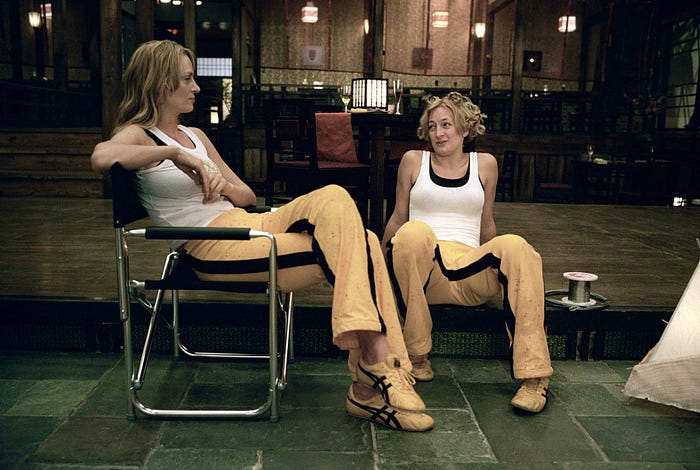
I’d be remiss not to mention the Herculean (or perhaps She-Hulkian) physical contributions made by the peerless and legendary stuntwoman Zoë Bell. Bell sustained serious injuries filming the scene where The Bride gets blown away by Budd’s shotgun blast. In addition to being a “crash and smash” double for Uma, Bell also doubled for her in the fight scenes, becoming trained on swordplay and combat moves herself. Stunt work is often underappreciated, but the work done in Kill Bill went above and beyond. Both Bell and Uma got put through the ringer for our entertainment.
There’s also this dark episode from the making of the movie that honestly hampers my enjoyment of the film. Tarantino pressured Thurman to perform a dangerous driving stunt that wound up leaving her hospitalized with neck and knee injuries that she still suffers from to this day. The accident led to a falling out between her and Tarantino for 15 years. Uma doesn’t blame him so much as she blames the film’s executive producer Harvey Weinstein — yeah, this fucker again — for trying to sweep the whole thing under the rug. Check out this link here detailing Thurman’s account of the ordeal, which also contains a frightening video of the car crash. It’s very sad and sickening for any actress to be forced into a stunt for which she is not trained or prepared. But to do it to the star of your movie who inspired the story itself, is grossly irresponsible and monstrous. This is on top of Thurman having had an encounter with the disgraced former Hollywood producer in which Weinstein allegedly assaulted her in hotel in the ’90s. You can read about that here.
Uma Thurman describes her experience after the crash as “dehumanization to the point of death.” It’s a stark and scary reminder that for all its glitz and glamour, Hollywood is at its core, a brutal business that has allowed some real abusive assholes to gain power. There is a human cost that sometimes takes place behind the camera that often goes unnoticed. The unseemly developments I’ve mentioned don’t ruin Kill Bill. They do, however, give me a recontextualized appreciation for all the literal blood, sweat, and tears that went into making it.
8. Poetic Fights And Fates
Perhaps Kill Bill’s most creative component are all the diverse and fitting ways in which members of the Deadly Viper Assassination Squad get their comeuppance for their role in Bill’s attack on The Bride. Vernita Green’s death is quick and brutal, hinting at the fact that likely the two women were never exactly close. As I mentioned earlier, O-Ren’s drawn-out “graceful” demise indicates that she and Beatrix were probably besties at one point.
As her former brother-in-law, it seemed The Bride was satisfied with giving Budd a quick and painless death by surprising him at his shitty trailer. But a Black Mamba still wound up getting him anyway due to the vicious one-eyed Elle Driver. Driver and Beatrix were clearly hated rivals of one another, both professionally, but also romantically over Bill. Elle tells Bill, “You need me baby, I’m there,” over the phone before her surprise confrontation with The Bride. Their duel is a messy cat fight, ending after Beatrix yoinks Elle’s eye. This after Elle sneeringly and proudly confesses to poisoning Pai Mei, who plucked out her eye for impudence during her training.
Then there’s Bill’s death, which is both cathartically satisfying, but also bittersweet and tragic. At its core, Kill Bill is about a serious marital spat, and all the fallout that ensues. Both sides can be blamed. I always got the sense that if Beatrix had explained her side to Bill about not wanting her daughter to grow up in the life rather than just running off, he’d have likely understood and made proper arrangements. A workable compromise probably would have been reached. But this is not a story about rational, level-headed people. This is a story about brutal killers who think impulsively. We’ll never know what could have been.
9. Even Side Characters Are Memorable
This kind of goes along with mythology in Number 3. One of Tarantino’s gifts is in creating very lived-in minor characters that look like they were breathing and eating long before being summoned for their short appearance. Take Esteban, for example, the Mexican pimp and father figure to Bill. There’s a whole history to this guy and and how he raised Bill, but he’s gone after all of five minutes of screen time.
And let’s not forget Buck. Who’s here to do what? Fuck. A rather simplistic and base behavioral drive. But an unforgettable one, for sure.
10. The Five Point Palm Exploding Heart Technique
It’s fucking awesome. ‘Nuff said.
Chapter Five: The Blood-Splattered Sequel Rumors And Conclusion
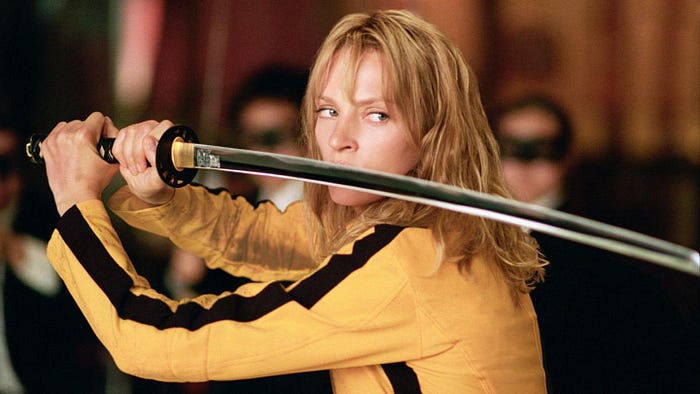
This past October 10th, 2004, it’ll have been 21 years since the premier of Kill Bill Vol. I. It’s hard to believe that much time has passed. For me it’s a literal whole other lifetime ago.
Not long after the conclusion of Vol. II, rumors began to swirl about a possible third installment. All kinds of theories abounded regarding possible plots. The most popular being a grown-up Nikki Green seeking out Beatrix to get revenge for killing her mother, with an assassin-trained adult B.B. being in the mix.
As much as the fan in me would love to see a third Kill Bill, I’m not sure it should happen. I’m very much a “completionist.” When a story is done, let it be done. I feel that way, as do many others, about the first two Alien and Terminator films. I feel that way toward Kill Bill. It ends as perfectly as it could. Why ruin that with a sequel? The whole point of the two-part film is The Bride rescuing her daugher from her savage life for a peaceful one. Which she does. But perhaps Bill is right in his “Superman talk.” Maybe Beatrix Kiddo is a killer at heart. Maybe it’s just a matter of time before that deadly assassin life will pull her back in. We’ll just have to wait and see. But I’d much rather think of Beatrix and B.B. living happily ever after.



 Dean Brooks