Jerry Seinfeld’s a billionaire now. Which is no surprise given he produced one of the most successful and iconic TV shows in history. If you’ve ever met someone who couldn’t quote at least one line from the sitcom, you met a real live unicorn.
I always pay attention to what Seinfeld has to say, just because he usually has a unique take on things. The best comedians are also philosophers. Even his “show aboout nothing” was a hilarious commentary about social interactions and the endless quirks of humanity. It’s part of the reason why Seinfeld still feels fresh nearly 30 years after it ended.
A Yahoo article recounts some of Seinfeld’s financial advice:
“I told a bunch of kids around the table last night,” he said, “If your work is unfulfilling, the money will be too.”
Good advice, but given enough pay, just about anything could become “fulfilling,” I suppose. You pay me a million dollars a year to paint telephone poles light gray, and I’ll be one deeply fulfilled guy, I assure you. I tend to agree with Mike Rowe of Dirty Jobs, who has a more practical, utilitarian outlook on life.
Work is not always meant to be “fun” or “fulfilling.” It’s called “work” for a reason, not “fun.” Sometimes even boring or unfufilling jobs can help ground you, and inspire you to focus your creativity into something as a counterbalance. Not everyone needs to become a Hollywood director, bestselling novelist, or secret agent. Even people who have achieved their dream jobs sometimes find the minutiae involved maddening. Fulfillment can come from all sorts of places, and looking to work to provide you with meaning can sometimes prove pointless. A paycheck is sometimes an end in itself.
What if fulfillment is making enough money from a boring, “unfulfilling” job that one day you’re able to be financial independent?
Jerry goes on to say:
“In the seventies, it was all about how cool your job was,” he said. “If your job was cooler than mine, you won.”
The article mentions that the attitude toward jobs changed in the ’80s, where the preoccupation became busting Benjamins over “coolness.”
I was not alive in the ’70s, so I can’t speak to that. But certainly work culture in the ’80s and onward became more coldly corporate and money-driven. Probably that’s due to automation, digitization, outsourcing, industrial consolidation, inflation, and the decline in the value of the dollar. No one’s got time for “coolness” anymore.
However, these days I’ve noticed that activism and social responsibility are bigger concerns with Millennials and perhaps Gen-Zers as well. Many young people I knew in college and other places expressed interest in working for non-profits, or for companies that seek to make the world a “better place.” Whatever that may mean (usually some left wing cause). For a while the company that represented this ideal was Tesla, but then Elon Musk started sticking his head out the Overton window and all, and has since fallen out of favor with many due to his thought crimes.
Maybe Notorious B.I.G. is the one who’s right here. “Get money, fuck bitches.”
The article goes on to mention:
A Harvard Study of Adult Development suggests that money can meet essential needs and provide security, but its ability to enhance happiness diminishes beyond a certain threshold. The study emphasizes that genuine happiness is more closely tied to relationships and meaningful work than financial success alone.
A Harvard study was needed to confirm that? That seems like common sense. Good to know an Ivy League institution is investing time and money into confirming things pretty much every blanket-knitting grandma on a porch will tell you.
Yeah, fulfillment is often a tricky, shifting goal line. Maybe you get it from clerking the midnight shift at 7/11. Or from a 24-hour Fortnite marathon. Or rewatching clips of Seinfeld. Or maybe nothing really fulfills you. Not that there’s anything wrong with that.
Is it possible to regrow your head after such a severe cancellation guillotine?
Source: Columbia Pictures Television
One of my latest distractions is watching old clips of Seinfeld on the ol’ YouTube.
Apparently, Steven Spielberg used to watch the show a lot during the production of Schindler’s List as a way to decompress from being steeped in depressing drama all day. Which is certainly understandabe, though that makes for a little meta joke in the episode where Jerry gets caught making out with a woman in the theater during a showing of the holocaust biopic.
Seineld will always be comfort food for me. I used to watch it in college a lot, too, as a way to destressify and as a distraction. There’s something wholesomely timeless about the show, in addition to its jampacked hilarity. It’s like a string of gut-busting parables from some comedy Bible. It’ll still be funny and quite watachable even in 50 years. One hundred, for that matter.
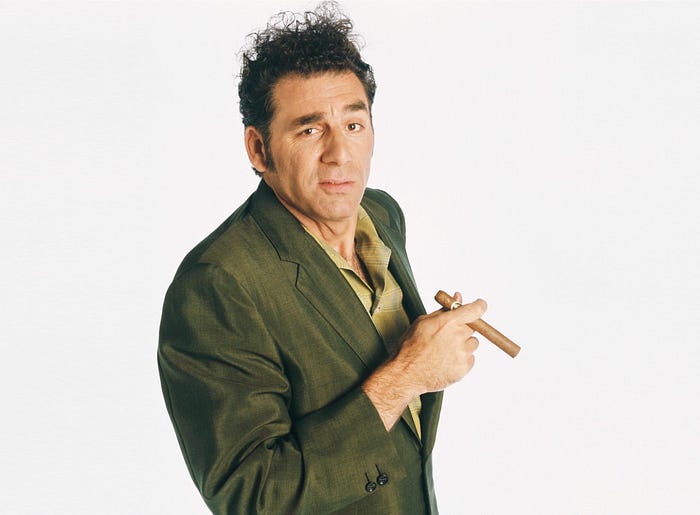
The character of Cosmo Kramer, played by Michael Richards, is one of the key ingredients to the show’s success. Kramer is like a classic slapstick goof from a Marx Brothers comedy, or TheThree Stooges, offsetting Jerry’s barbed sarcasm, George’s interpersonal insecurities, and Elaine’s faux pas-laden hijinks with a distinct physical comedy. He’s like a human cartoon. Roger Rabbit made flesh.
Of course, Michael Richards is infamous for his 2006 meltdown at the Laugh Factory in Los Angeles. Respondng to a heckler, Richards started slinging racial slurs around like a malfunctioning tennis ball launcher. You can check it out for yourself:
I remember this happening like it was yesterday. On the one hand, what Richards says is obviously horrible, though I’ll admit when I first heard about the whole thing I thought it was just an attempt at making really edgy comedy. Bill Burr once roasted the whole city of Philadelphia in an epic rant the same year as Richards’ ferocious prejudicial diatribe. Other comedians like Sam Kinison and Bill Hicks have gotten into it with bad faith folks in the audience. Dave Chappelle has gotten into hot water over his jokes about transgender people, and he’s still chugging along just fine.
I wasn’t even offended by the leaked cell phone recording because I considered the comedy scene akin to a gladitorial arena. It’s the one place you can let loose and go nuts. It’s live theater, and sometimes shit goes nuclear. You don’t go to a Tarantino film and freak out when a character says “nigger,” do you? You don’t get your panties in a bunch when South Park makes fun of a mentally challenged character, or calls a celebrity a pile of crap, right?
The whole thing was kind of over blown, and I still think a lot of the “outrage” was performative and opportunistic. It’s not like Richards accosted some random guy in the street and started yelling all that obscene stuff. He was throwing it back in the heckler’s face in the worst possible way he could. Anyone who’s ever gotten into a verbal spat with someone on the schoolyard or anywhere knows things can get pretty heated and stuff is often said that is not really meant.
Of course, Richards crossed over the line big time. His racist tirade went super viral and essentially destroyed whatever was left of his career at that point. He hadn’t had much success in anything since his Seinfeld days. Since then, he’s done some bit parts here and there. But lately, he showed up on the red carpet for Jerry Seinfeld’s premier of his Pop Tarts biopic Unfrosted. He’s also released a memoir called Entrances and Exits.
Richards expresses deep sorrow and remorse for his outburst at the Laugh Factory. It still haunts him badly. In an interview with People magazine, he says:
“I was immediately sorry the moment I said it onstage,” Richards, 74, tells PEOPLE. But he knows he doesn’t expect the world to forgive and forget. “I’m not looking for a comeback.”
“My anger was all over the place and it came through hard and fast,” he continues. “Anger is quite a force. But it happened. Rather than run from it, I dove into the deep end and tried to learn from it. It hasn’t been easy.” He adds, “Crisis managers wanted me to do damage control. But as far as I was concerned, the damage was inside of me.”
He goes on to add:
“I’m not racist,” Richard said when discussing the racial slurs he used that night. “I have nothing against Black people. The man who told me I wasn’t funny had just said what I’d been saying to myself for a while. I felt put down. I wanted to put him down.”
Richards’ reflective words are similar to what he said on The Late Show with David Letterman shortly after the outburst as an attempt at damage control. Though his appearance with Seinfeld virtually by his side didn’t help matters, as many at the time considered it insincere, especially with his “I said some bad things to some Afro-Americans,” line. Ugh. Who says “Afro-Americans” who isn’t a racist 1970s newscaster talking about crime in the projects? Total Ron Burgundy moment there.
Richards turned 75 this year. If he was ever going to make a comeback, he’d have done it by now. It’s likely too late for him to make any kind of return to acting in any meaningful way. But I do think it’s time to let him out of time out. Let it all go. People do change over time. Very few have ever been so publicly lambasted like he was. He was the first major celebrity cancellation I can remember. They’re much more common now. Public shaming on such a scale is worse than prison.
In the West, we basically equivocate racists with pedophiles. Richards more than paid the price for a few bad words. It’s not like his Laugh Factory blowout ruined Seinfeld. I still love the show and his character. I say let the guy have peace in his golden years.
Up until last month I’d had an account for almost 15 years, starting with the DVD by mail thing that made the company famous. Giving it up was hard, even though I barely watched it anymore.
I found that increasingly there was less and less stuff on there that appealed to me. The tenth season of Stranger Things? GTFO. How old are those “kids” now anyway, like 30? Good lord, will they just get fucking eaten by a monster already and be done with it?
Netflix had its moments. Back in the day, I enjoyed Orange is the New Black. A show not exactly made for me, but one I looked forward to every year. But even then it became clear that the streaming model was built not on worthwhile storytelling, but on filling up space with “content” meant mainly to mildly appeal to different audiences. But it “appeals” only in the sense of a corny corporate joke that you laugh at out of politeness, not enjoyment.
The last straw might have been Rebel Moon, which is like the quintessential douchebag dudebro film, making 300 look like a Ken Burns documentary by comparison. Zack Snyder’s cringy Star Wars ripoff, following his 2021 Aliens ripoff Army of the Dead. Who the fuck thought that film merited a two-part release? What algo called for that? And for what audience? Lobotomy patients? Was it made for headless torsos stored in a medical school morgue waiting to be dissected? Or maybe Rebel Moon wasn’t even made for humans. Maybe it was actually meant for AI bots roaming the dead internet, to placate them from wiping out humanity.
I’m so done with some computer algo dictating how and when I watch something. Here are words that come to mind that describe what it feels like getting puppet stringed by some Silicon Valley dork’s coding: Unnatural, weird, uncomfortable, disappointing, unsettling, uncanny, unsatisfying, creepy, skeevy, and just plain wrong.
“Attention by algorithm” is such a strange thing. Letting some impersonal random code feed you “content” (hate that word) on some digital liminal space just feels bizarre. Dystopian, almost.
It’s not even how I’ve found some of the best movies I’ve watched over the years. Recently I discovered two solid thrillers, Eden Lake and Triangle, from reading posts of people I follow on X. That’s also how I found the trailers for the upcoming horror flicks Cuckoo and Longlegs, two releases I’m looking forward to seeing this year. X is where I first heard about Late Night with the Devil and last year’s Talk to Me.
I follow filmmakers I like, such as Sean Baker, and usually get the latest trailers or updates directly from the source when they post them.
I kept hearing positive things about Das Boot and Master and Commander: The Far Side of the World on Reddit before finally checking them out years ago.
It was coming across all the “Think, Mark!’ memes everywhere that got me into my new favorite show, Invincible.
There have been exceptions. Netflix spotlighted Dragged Across Concrete last year. A great, gruesome little thriller starring Mel Gibson and Vince Vaughn as crooked cops trying to procure some ill-gotten gold. I would probably have never discovered that one had it not gone to the streaming afterlife.
But for every Concrete or Spectral there’s a whole mess of uncanny valley-esque stuff that doesn’t even look like it was made for humans or by humans. Stuff like I Care A Lot or The Perfection. Or just unwatchable garbage in general, like Adam Sandler’s Netflix deal “comedies.”
Nearly every great movie I’ve ever seen I had reccomended to me from a friend or family member, or I sat down to watch it with them. In the past you might have stumbled across something on cable. But those days are mainly gone, replaced by whatever Netflix feels like throwing at you.
Lately, I’ve become a lot more selective about what I watch. It could be from getting older and becoming more conscious of the trickling sands in the hourglass. Maybe it’s due to getting tired of the endless inundation of “content” from the streaming factories. Or maybe the high junk-to-jewel ratio the streamers keep spitting out has just made it not worthwhile to sift through the silt.
Entertainment should feel more sociable, organic, and communal. Not programmable. It should feel like a fun process of discovery, not like having your head dunked in a bargain bin DVD pile at Wal-Mart.
I’ve been lied to my whole life. Up until now, I’ve always thought being a serial killer was a tough gig. That you had to be some kind of mastermind in order to get away with murdering people. That it’s hard work, and involves obscene levels of manipulation, trickery, and craft to pull off.
As it turns out, you can be a total dithering idiot and get away with butchering people in your own neighborhood for a decade, without fear of getting caught.
This is a real eye-opener for me, as someone coming from the school of Silence of the Lambs. In that movie, Buffalo Bill is shown as a careful, calculating predator who prudently chooses his victims (young, naive women). In one scene he even uses a fake cast on his arm to garner sympathy. What a clever fellow.
Then you have Dr. Hannibal “The Cannibal” Lecter, a genius psychiatrist, who concocts perhaps the most brilliant prison break scheme in history.
You’ve got “John Doe” in Seven, an impassioned quasi-religious zealot, who engineers multiple murders across a city over several years, all while running a Frankenstein lab in his own apartment. Another super cerebral killer.
And of course you’ve got the fictional Jigsaw killer in the Saw franchise. A dude who designs elaborate deadly traps meant to teach people the meaning of life, or something. Also clearly a Mensa member.
Even made-up killers like Michael Myers, Jason Voorhees, and Freddy Kruger — they’re all potrayed as mental giants, always sneakily evading capture, and cornering prey, sometimes right out in the open.
Damn, I thought, watching all those guys. Good luck to any average Joe who aspires to make their own skin suit or eat fresh human liver. They’ll have their work cut out for them.
It’s the media’s fault for sensationalizing the career of serial killer, of course. They did the same thing for cops, computer hackers, and the whole concept of “true love.”
In reality, being a serial killer is much more down to earth. You don’t have to even be that smart. You just need a little gumption, and most importantly, to believe in yourself.
Monster proved that to me in only two episodes last night. Here are six dark, distrubing things I learned:
1.) You Don’t Need a House to be a Killer
Early in Silence of the Lambs, Clarice Starling makes the rather bold (though true) assumption that Buffalo Bill had to own a house because he’d need space to “skin his humps.” Yeah, maybe if you’re some elitist serial killer who can afford a house, Clarice. Jeffrey Dahmer murdered most of his victims in a shitty apartment in the ghetto. He didn’t let his lower socio-economic status get in the way of his dream of building a throne of human skulls. This is good news for Millennials (and Gen-Zers, too, I suppose) who can’t afford to buy a home, but who are still thinking of getting into the murder business. Especially in these times of rising interest rates.
2.) You Don’t Need “Game” to Attract Victims
Incels, rejoice!
Man, if there was ever anyone who obviously looked and acted like a serial killer, it was Jeffrey Dahmer. And yet, he was still able to get numerous young men and boys to come to his apartment alone, under the guise of “taking pictures” for money, or for romantic dalliances. In one scene he even gets an underage boy to follow him home with the promise of free cheap booze. That’s like one tiny step above painting “Free Candy” on the side of a creepy van and parking down by the elementary school.
Buffalo Bill was such a try-hard by comparison, with the cast trick and everything. He probably could have doubled his kill count if he’d just walked up to women and tried selling them Tupperware or magazine subscriptions.
3.) You Can Be a Slob All You Want
Imagine this. You’ve just freshly murdered someone. There’s blood on your mattress. A dead body on your bedroom floor. A distinct odor of decaying human flesh wafting throughout your apartment. And you’ve just put your victim’s decaptitated head in the fridge. You’d obviously want to clean that mess up as fast as possible so the neighbors don’t potentially complain about any foul odors in your apartment. Especially when you’ve got a vent that connects to the apartment next door. Right?
Actually, you’d be dead wrong. Don’t worry about that stench. Or the mess. Just make sure you have a story about how your relatives sent you meat, but it spoiled, and assure any nosy neighbors that you’ll take care of the smell A.S.A.P.
It’s even okay if cops come over to check out your apartment. Just ensure they can’t see the dead body from the doorway to your bedroom. Just tuck that body in close to the bed, right out of eye shot.
(That actually happens in the Netflix series, by the way.)
Just play it cool, baby. Tell the cops it’s just a lover’s spat. He was drinking. He got a little rough, and he ran off. He does that all the time. You know how these darn kids are these days, amiright?
You can even throw in some pictures you took of your victim (err, lover) as proof of your relationship. You may have to invite the cops into your apartment, but that’s okay. They’ll buy the “spoiled meat” story just like the neighbors.
See, here’s the deal. The more horrific and grotesque your crimes, the less likely people are to believe that it’s happening right under their noses. People, even cops, would rather live in denial than accept that someone as evil and twisted as Dahmer could possibly exist, much less do all the things he did. It seems too farfetched and impossible. It’s like saying Bigfoot is real. Use that power of deniability to your advantage. Be Bigfoot in a world of Bigfoot Deniers.
5.) It’s Okay To Be An Alcoholic
Think you need to be some lean, clean, sober machine before embarking on a career as the neighborhood psycho? Nope. Dahmer, like any good Wisconsinite, was a heavy drinker, having started sneaking beers in class back in high school. So many fictional killers have spread the propaganda that you must live like a dry monk while exercising like an Olympic champion. Think of John Doe from Seven, or Max Cady from Cape Fear. Those guys were like ripped missionaries ready to spread the Word (and by Word, I mean horrific murders).
But the reality is far less glamorous and physically demanding. What matters isn’t your body so much, it’s your mind. And how determined you are to make a murderous difference in this world. Don’t let that sagging beer gut or those twig arms of yours hold you back from the hack and slash career you deserve. You do you, and get out there and give it all you got, champ.
6.) Racism Will Protect You
In the series, Dahmer’s next door neighboor, a nice black woman, is constantly ignored by police, even as she reports him for possibly kidnapping an underage boy. She even reports the horrible smells from Dahmer’s apartment to the landlord, but to no avail. And what do the police do? Basically tell her to shut the f*ck up and mind her own business. You’d think this was during the 1950s or something. But, no. Most of Dahmer’s murders happened in the good ol’ 80’s, when A Flock of Seagulls was rocking the hit charts, and Marty McFly was going Back to the Future. And also still a time when most police were loathe to give your typical black citizen a fair shake on anything.
Good thing we’ve improved so much since then. That hardly ever happens now, right?
And if you were a moderately handsome blue-eyed blonde-haired dude, you might as well have had ten get out of jail free cards stuffed in your backpocket. One cop even politely and concernedly asks Dahmer at one point what’s a guy like him doing in such a rough neighbohood. To which Dahmer responds, “It’s easier killing here. Oops, I mean, it’s cheap to live here.” After which he and the cop high five and chug a beer.
Okay, just kidding on that last point, but the cop hardly even gives Dahmer a look after his neighbor accuses him of literal pedophilia and kidnapping. Literally all the cops do is tell that nice black lady to shut the f*ck up. Insanity.
To be fair, racism could have potentially worked in favor of a serial killer who happened to be black. Given how poorly those ghetto neighborhoods were (and still are) policed, a black butcher could have had himself a heck of a career stacking bodies back in Dahmer’s day. So long as none of his victims were white, I suppose.
In all seriousness, it’s rather disturbing and upsetting to know that Dahmer flew under the radar for so long because police basically ignored or downplayed all the suspicious complaints made about him. Even more disturbing is that because nearly all of Dahmer’s victims were minorities and/or gay, their disappearances went unnoticed, or were largely deprioritized by the authorities.
The fact is, an evil monster like Dahmer was able to thrive for as long as he did because he killed in a glaring blindspot of society. A blindspot that gave him cover to kill people who were not considered “important” enough to care about. And in addition to Dahmer’s existence, that blindspot is itself just as evil and monstrous.




 Dean Brooks