Why Western Birth Rates Have Collapsed

What population and fertility trends in Nigeria say about the West.

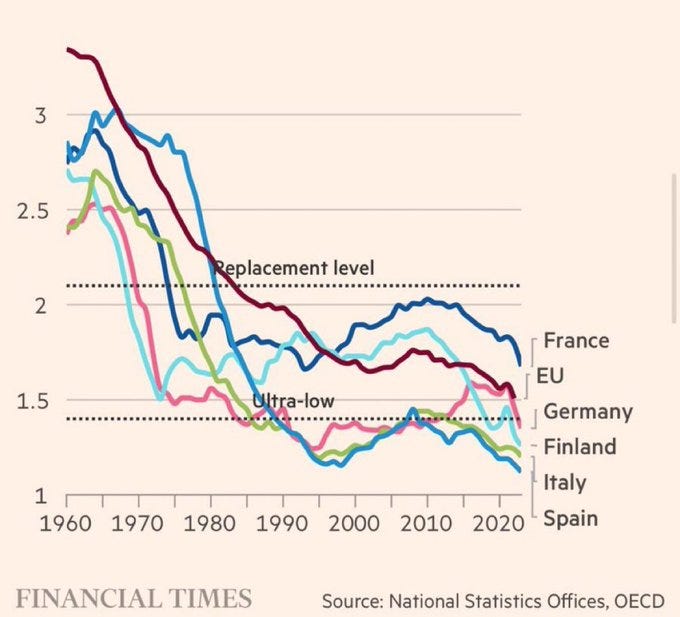
Despite not having any kids, I’ve become intrigued lately by all the doomsdayers out there raising alarms about birthrates and replacement rates. Elon Musk, who has 14 children with five different women himself, talks about it almost every day on X. Recently, he retweeted a user who shared some shocking graphs:
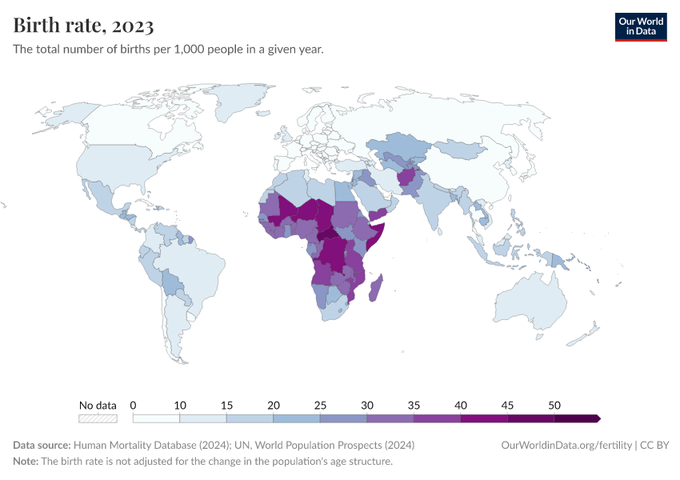
Source: OurWorldinData

Then there’s this one:

Source: National Statistics Offices

Wow. That is what’s called a precipitous collapse. The West will be extinct before long at this rate.

Anecdotally, my grandmother had eight kids. My biological father had seven. My mother had four. I have two half-siblings who have two kids each. My youngest half-sibling has none, as do I. Only a few of my cousins have more than one child. I’ve witnessed in my time a severe narrowing in the number of kids couples have over the generations. Marriage rates have also gone down. The average age people marry has gone up. And the number of children people have who happen to get married or cohabitate has shrunk across the board.

Not so in Africa, according to the graphs above. Especially countries like Nigeria, which actually has a population explosion that is projected to reach over 400 million by 2050, according to the World Bank. The United States’ population is currently 340 million for comparison.

So, what’s going on? Why can’t the West reproduce itself? I’ve heard all the excuses: expensive housing, cost of living, the job market, etc. However, according to a recent study that looked at the population trends in the African country, “income does not play any significant role in the demand for children in Nigeria.”

The 2022 study is titled “Fertility and Population Explosion in Nigeria: Does Income Actually Count?” You can check it out at this link here.

There are some key takeaways aside from the obvious ones involving increased life expectancy, declining death rate, and high infant mortality. Nigeria has seen improvements in both those areas over the last 59 years, though its infant mortality rate is among the highest in the world, and correlates with the higher number of births.

But if it’s not income or medical care that’s keeping the West from reproducing, what is? Culture, mainly. Take a look at Nigeria’s attitude toward children in general, and see if there’s a marked difference with the West’s.

From the study:

Children are viewed as a future investment and given the uncertainties of them having a brighter future, a poor household can produce more children to try their odds. That is, out of the very many children, some could have a chance to become prominent individuals in the society. Apart from that, some traditional Nigerian households views greater number of children as a strength to the family in terms of providing family labour at the subsistence level.

There are other cultural factors at play, which I’ve broken down here:

  • early marriage
  • universal marriage
  • prolonged childbearing
  • low contraceptive use
  • cultural emphasis on large families due to fear of lineage extinction.

I bold-faced the last one because it ties in with high infant mortality.

Fear of extinction fostered increased reproduction in the face of perceived high child mortality with the expectation that some of the births would survive to carry on the lineage.

It also is what most differentiates Nigeria from the West. Those few who procreate here in the U.S. do so within a bubble of relative security. It’s never been safer or easier to have kids from a medical point of view. Yet families in the U.S. remain largely fractured and small. Members are often adrift from one another. Who fears their family name dying out who isn’t named Trump or Musk?

Meanwhile, Nigerians reproduce as if they have a gun to their heads. Is it mostly due to the infant mortality rates? I don’t think it’s that simple. I get the sense that even if infant mortality were to suddenly incline here, it’d be met with indifference. Most women support abortion rights and put off having children until their 30s. Few men want to become fathers. Fertility and parenthood are not treated with celebration but looked at like nuisances. As obstacles to having fun or achieving life and career goals.

Photo by Janko Ferlic from Pexels: https://www.pexels.com/photo/pregnant-woman-1692050/

People are staunch individualists, focused intensely (selfishly, even) on their career and capital acquisition over reproductive relationships. We’re a culture obsessed with entertainment, dopamine fixes, and endless sensory distraction. To put it crudely, women would rather strip on OnlyFans or sip mimosas at the bar with their girlfriends on Friday nights, while men would rather play video games and jack off to internet porn, than do something as backbreaking like start a family. Much less a family above the replacement rate.

Sex education starts young, with a heavy emphasis on contraceptive use. We all remember the condom and banana demonstration in fifth or sixth grade. Sex ed also pounds on this idea that getting preggo is basically the end of the world. While out-of-wedlock teen pregnancy is obviously not ideal, that anti-natal sentiment carries on into adulthood. Fewer people marry, and hardly anyone marries young. In fact, the idea of getting hitched prior to age 25 is seen as absurd. Your twenties are supposed to be for “experimentation,” and screwing around, not getting serious with anyone.

None of this is to say Nigeria’s population explosion is an ideal to aspire to for the West. Severe poverty persists. Excess population is a drain on resources. In fact, the baby boom is considered a crisis in the country. The study states in its conclusion:

Population control is therefore sacrosanct to save the nation from peril.

Nigeria’s high infant mortality rate also continues to be a problem. By reducing that, in addition to better sex education, the country may be able to reign in its population.

In fairness to the West, medical technology may help extend life spans and quality of life far beyond what’s typical. Many people continue to work into their seventies and beyond, and not just our politicians, either. Plus, our infant mortality rates are extremely low (5.6 deaths per 1,000) compared to Nigeria’s (72.2 deaths per 1,000) and other African countries.

It is possible that a birth rate below replacement is a natural and inevitable byproduct of a modern, developed civilization. But it’s odd and disquieting that even in the face of imminent extinction, our collective response is nonchalance. At what point, if at all, does self-preservation kick in? For many Millennials and Gen-Zers, it will be their social media accounts that will serve as their final legacy, not their genetic progeny. A sad state of affairs.

I found this study fascinating because it helps dispel the myth that income and cost of living are the biggest factors in why few in the West want kids or want many of them. It’s not a financial issue, it’s a cultural one. I don’t see those trends reversing anytime soon, if ever. We’re never doing away with sex education. We’re never going to tell our teens to shack up young or put off college to have a family. We’re never going to be anything but workaholic, screen-addicted, materialistic pleasure-seekers who only seem to have families by accident instead of intention. What modern woman aspires to having kids period, much less four or five? What man would choose breadwinning over fantasy football and e-thots? Face it. We just hate kids.

To quote a meme I recently found on X: “We traded bedtime stories for higher GDP.”
Join A Class Action Lawsuit To Fight A Horrendous, Unimaginable, Unspeakable Evil

Should I join in this fight for “justice?”

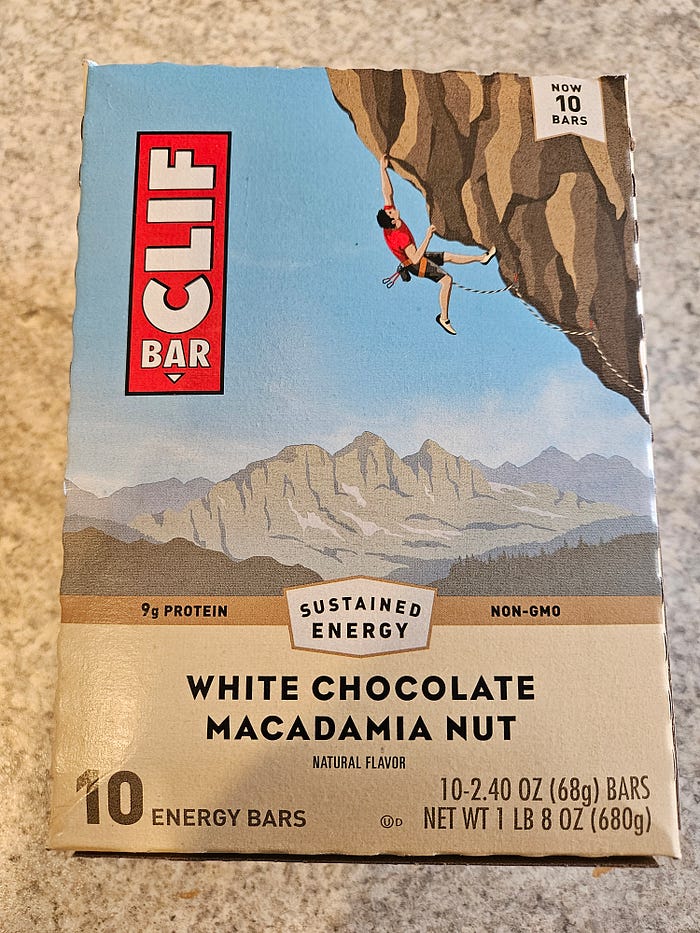
The vile culprit. Photo by author.

A few weeks ago I got an email from Amazon alerting me that I’m party to a class action lawsuit against Clif Bar & Company.

You know Clif Bars, I’m sure. Those little brown rectangular granola “sustained energy” bars that cost way too much. The bougie version of those super crumbly Nature Valley bars. The bars with the wrapper that shows some guy mountain climbing that makes you think, “Oh my God, if I eat these I could be a mountain climber, too.”

Well evidently, Clif Bars has gone and done something heinous. Something awful. Something so terrible that some guy named Ralph Milan went and filed a class action lawsuit against the company.

What did Clif Bars do? Did they fiendishly put fentanyl in select bars, hoping to cull part of the active granola-eating population like some mad comic book villain? Did they replace some bars with plastic explosive set to detonate when the wrappers were opened? Did they replace the raisins with the calcified bodies of cockroaches?

What devilishly malicious scheme did Clif Bars do to warrant the ire of Ralph?

Apparently, Clif Bars did this, according to the settlement website (bold face mine):

A proposed settlement has been reached against Clif Bar & Company (“Clif Bar”) in an action alleging that Defedant violated certain laws in labeling its Clif Bars and ZBars with claims that made the products seem healthy, when Plaintiffs allege they were unhealthy due to their added sugar content. Clif Bar denies any wrongdoing of any kind and maintains that its products are not unhealthy due to added sugar content and that the statements on its Clif Bars’ and ZBars’ labeling are true and not misleading.

Holy shit, this is worse than anything I previously mentioned. Clif Bars alleged on their packaging that their products were “healthy” when in fact they were not healthy because of added sugar content.

This is like a personal 9/11. I eat Clif Bars all the time at work!

I’m a victim of Clif Bar’s vile and evil masterplan to sell overpriced and oversugared granola bars. I too was swindled, deceived, hoodwinked, made a fool, and poisoned with slightly excess sugar, all while believing I was consuming a healthy snack. It’s a travesty. A disaster. A traumatic edible experience from which I’ll likely never recover.

Much to my alarm, I still had the toxic treats in my kitchen when I received this email. Luckily, I had a biohazard suit hanging nearby (it’s a long story) and was able to discard the dangerous packaged rectangles of doom into an outdoor dumpster. I just hope the raccoons don’t find them. What if they eat them and mutate like the ninja turtles and that green ooze? I’m not Splinter. I can’t train a pack of mutant trash pandas to fight crime! I don’t know the first thing about kung-fu.

Clif Bars has already made a settlement for their atrocious misdeed. They’re paying, get this, $12,000,000. All I have to do is file a claim and I too could get a slice of that (non-sugary) pie. That’s a lot of cheddar for a lot of improperly-advertised granola.

Should I join this class action lawsuit? Should I file a claim and take the fight to Big Granola? I feel like Luke Skywalker flying down that trench and getting ready to fire a proton missile into the ventilation shaft. I feel like Neo learning to control the Matrix. Jake Sully fighting the imperialist humans in Avatar. You get the idea.

Of couse, I still have the right to sue Clif Bars myself. And now that I think about it, maybe I should. Afterall, their packaging still says their bars offer “sustained energy.” Except whenever I’ve eaten them, I’ve never had what I would call “sustained” energy. Energy, yes. But NOT sustained. More like very fleeting energy. Sounds like I have grounds for a massive lawsuit right there. Shall we say, ten million to begin, to ease my pain and suffering?

Then there’s the packaging itself. Showing some guy mountain climbing. I’ve never once felt the need or ability to go mountain climbing while eating Clif Bars. In fact, I think if I did, I’d probably fall and kill myself, despite eating a Clif Bar beforehand. So is Clif Bar & Company trying to kill me? Sounds like attempted manslaughter right there, though I’m no lawyer. That’s another easy ten mil or so.

I’m glad Amazon alerted me to Clif Bar’s pure evil, and about my chance to cash in big on this wretched and outrageous criminal enterprise.

Have you eaten Clif Bars, too? Did you survive? Are you a sad victim and entitled to compensation? I’ll see you at the Rolls-Royce dealership when the settlement check clears.

Going Back To College In Your 30’s: Is It Worth The Trouble?

Is college worth it at all? Examining the time and opportunity cost vs. benefits of a diploma.


Photo by Stanley Morales from Pexels: https://www.pexels.com/photo/people-wearing-backpacks-1454360/

Nowadays, college is under fire. Enrollment overall is down. Fewer men are signing up, and instead choosing the trade route or just going to work. The value of a 4-year-degree is being challenged. The “uselessness” of liberal arts degrees (i.e. Himalayan Basket Weaving or Gender Studies) has become a meme.

But it doesn’t end there. Even business degrees, MBAs and Master’s degrees are getting excoriated anymore. We’ve reached our quota for finance bros.

You’ve got the extreme left wing culture that has permeated the college campus scene. 1960s UC Berkley looks like a GOP convention compared to today. Combined with the uber-feminized atmosphere, college is a weird place anymore. Many will charge that it’s no longer a place of free thought or learning, but an indoctrination camp. Yes, there is a strange preoccupation college has with turning students into activists. But to be fair, I think some of the right wing hysterics are overblown.

Above all, college is ridiculously costly anymore, and often it ends up just leaving graduates in serious debt with minimal employment prospects. Many end up working in jobs that have nothing to do with whatever degree they earned, if they find jobs at all.

College has become tainted by the S-word — SCAM. It’s grossly inefficient, too. Four years is a LONG time to invest into something, only to get little or nothing out of it. Apple went from its founding to IPO in four years. A presidential term is four years. Colleges takes as long all while making you learn a bunch of stuff you end up not needing in the “real world.” This is especially glacial in today’s fast-paced digital world where apps like TikTok have built up tens of millions of users in as little as a few months.

The college system seems antiquated today. Almost purposefully faulty. A lot of the reputational attacks against it are justified. But it helps to think of college not as an educational system, but just as big business. Everything makes sense when you understand that people are getting rich off a bad system. Billions are made from student loans and sports programs. School administration has swelled, giving an elite few cushy jobs and incomes protected from economic fluctuations through tenure and grants. All while parents and the culture at large reinforce the NEED to go to college.

Every year millions of psyopped young people zombie walk their way into freshman year, happily shackling themselves with undischargable student loan debt, while getting little in return, and giving four of their prime years they can never get back. College is like the modern day equivalent of selling indulgences, like the Catholic Church did centuries ago.

It’s not even a great place to meet anyone for a long term relationship anymore. Fewer students graduate with a partner, instead choosing to venture into the world single.

What about medical school, engineering, and STEM degrees? Those are surely valuable and necessary. No one’s arguing with them. But the modern college system would collapse if it were stripped down to just those essential components.


All that said, is it worth going to college at all, especially for a worthless degree? I think it depends on your goals and what you’re getting out of it. And how you’re paying for it and what it costs. Due to lack of money, but mostly a lack of drive and focus, I failed to finish college in my early 20s. I attended two community colleges to complete my general credits, working full-time and doing classes piecemeal as best I could. I was accepted into a decent private school I really had no business attending, but only managed to pay for one full year. I dropped out with around 72 credits, right in the no-man’s land before the required minimum of 120 to graduate.

After dropping out, I was forced to go back to work. This was tough and demoralizing. I took it as a real personal failure and it bothered me intensely for years. It wreaked havoc on my psyche and my sense of self-worth. You see, I had been one of the “smart kids” growing up. I was in all the advanced placement classes and so forth. I‘d graduated from one of the best high schools in the country. There were BMWs parked in the student parking lot, though I drove a troubled 1982 Buick Skylark at the time. Many of my peers went on to the Ivy Leagues. I simply had to keep up with them, even if I was from the lower middle class. I had fully bought into the cultural psyop that a college dgree was crucial to SUCCESS. Making matters worse, I saddled myself with over $20,000 of student loan debt for a degree I never finished.

For the longest time, I gave up on my dream of completing college. Trapped by debt and terrible job prospects, I consigned myself to failure. But eventually, I found my way to the North Dakota oilfield in 2012, determined to fix my financial problems and set things right. In a few years, I had paid down almost $35,000 in debt, all while living in a basement with five other guys. There was a severe housing shortage in the town I lived in during the mid-teens oil boom. I didn’t find an apartment until two years after I moved to ND. It was tough living, to say nothing of the harsh weather and isolative nature of the region.

The effort took a toll on my mental health, too. After almost four years I’d had enough of the oilfield and decided to finally go back and finish my college degree. I enrolled in the state school at age 35, choosing to attend most of my classes in-person. Even though I could have finished my degree through any number of online methods, I wanted to go back and “do it right.” Even if that meant giving up working in a lucrative industry and moving across the state.

I decided on English as my degree. Not because it offered any real economic utility, but because I liked writing, and it gave me the shortest route to finishing as quickly as possible. I was passionate about completing what I’d started, but I wasn’t about to invest anymore time than neccessary. I had built up some decent savings, and was largely able to pay the tuition out of pocket.

Is it awkward going to college in your mid-30s? Initially, it was. A lot people tell me I look younger than I am, which might have helped. But it is slightly uncomfortable sitting in classes with people who are 15 years younger than you. I largely kept to myself, though. For me, the biggest struggle was overcoming my own psychological limitations. I had tried several times before to restart my college degree, only to give up. Could I finally break through the invisible barrier? As it turns out, this was largely part of my rationale for returning. I needed to prove that I could do it. My failure to finish almost a decade and a half earlier had left me crippled with self-doubt, depression, and if I’m being honest, self-loathing. If I couldn’t even finish a “worthless” liberal arts degree, what good was I? I know that sounds harsh, but this is part of the pressure that is put on “smart” kids living in a culture where college attendance is akin to worship of the Almighty or else your soul is eternally condemned to hell.

For me, college was not really a practical “necessity.” It was more like therapy. It was a way to heal my damaged psyche and get the monkey off my back. After two years, I graduated with my degree with well over the 120 credits I needed. I had finally done it. Fifteen years later than I had planned. But it was done.

The experience reignited my love of writing and illuminated my outlook on life. It definitely changed me for the better. I’d spent my twenties and early 30s largely pessimistic and depressed. But after paying off my debt and finishing my degree — two things I’d once thought impossible — suddenly anything seemed possible. I felt like Neo finally breaking out of the Matrix at the end of the movie, as corny as that may sound. I saw life not as just a string of unstoppable misfortunes, or as something that was merely happening to me, but as something I could take ownership of. “No fate but what we make for ourselves,” as John Connor puts it in Terminator 2: Judgment Day.

After graduating in 2018, propelled by twin successes, I attempted completing a novel again. Something I had tried and failed at eleven years prior. I not only finished it, but went on to write another and another. I just completed my 11th.

Still, there was a severe time and opportunity cost to finishing my degree. Looking back, there were certainly ways of doing it that were more efficient and less costly. It did not cost me just the tution, but the income I would have made had I stayed working in the oilfield. At the time, I was making almost $90,000 a year. So, the decision to go back to school in-person, as opposed to online, really cost over $200,000 in income over the two years. That’s more than the cost of going to Harvard, for God’s sake. I could have bought a house for that instead of just a piece of paper with my name written in fancy font.

By every practical measure, returning to college like I did was not worth the cost. But you really can’t put a price on mental health and personal development. Finishing school helped transform my mindset. It helped me break a decade-plus-long negative feedback loop. Nothing succeeds like success. Paying off my debts kickstarted my “rebirth.” But finishing my degree permanently put me onto a better path. Even if my English degree has no real economic value, it means a lot to me.

After college, I returned to work in the oilfield. Using my reinvigorated mindset, I studied investing and personal finance. I’ve remained debt-free, and built up a solid net worth. Enough to know that in a few short years I’ll achieve another dream I never thought possible — becoming a self-made millionaire. And long before the statistical average for my age group. I’ll likely be able to retire before I’m 50.

College is not for everyone. College degrees, especially liberal arts ones, are overinflated in value and largely unneccessary. For most of history, the only people who went to college for liberal arts were rich kids whose parents could easily pay it. It’s only been relatively recent that anyone could “afford” to go via student loans. I don’t know that that’s a positive development. I think young people today are better served by staying out of debt, unless they are pursuing a degree with real economic value. You can learn most of what you need off YouTube and online for free. The future of education is not the grossly inefficient and costly system we have now, especially with the emergence of AI. It’s in learning specific, concrete skills with real utility. A monthly subscription to an online learning portal like Udemy is probably a better option than a four-year commitment. Way cheaper, too.

College is obsolete in many ways now unless you’re going for a high-value degree. It’s a dinosaur. It’s unnecessary for many. But so is climbing a mountain or putting a 1000 piece puzzle together. For me, going back in my mid-30s was expensive therapy, and a way to get back on the horse. Sometimes proving to yourself that you can do something hard can help motivate you to achieve other things as well. If college can help put you on a better path, then I say it’s ultimately worth it no matter how “worthless” the degree is that you’re obtaining. Not every decision will balance perfectly in an accountant’s ledger. Like with anything else in life, if it means something to you, then it matters.

There’s Never Been A Nice Time In Politics

The Mighty Mean Meme Machine Strikes Again

Made with Grok

Whenever I’m feeling masochistic, I like to visit r/Presidents on Reddit. That sub has a rule that won’t allow posting or references to current or very recent U.S. presidents. You can only mention up to Obama. The reason for this is to prevent fighting over modern day politics.

However, a side effect of that rule is that many posters have built the sub into a hazy idealized nostalgia feels zone. I’ll often encounter comments referring to the “dignity” and “respectability” of past presidents compared to the divisiness and nastiness of today (meaning Trump, basically). Particularly when it comes to old presidential debates.

Except how many people remember anything of substance from old debates? We really only recall the gaffes or the attacks. I remember “binders full of women” by Romney. “Please proceed, Governor,” by Obama. “Well actually, he forgot Poland!” said by George W. Bush to Kerry when the Massachusettes Senator happened to forget one of our allies in the global War on Terror. There was George H.W. Bush checking his watch in the 1992 three-way debate with Perot and Clinton. In the 1988 Vice Presidential debate Lloyd Bentsen delivered perhaps the G.O.A.T. comeback ever with his “You’re no Jack Kennedy,” to potato-mispeller Dan Quayle. Reagan had his humorous “youth and inexperience” line against a knew-he-was-going-to-lose Mondale. Then there was the famous Nixon vs. Kennedy debate, where the youthful JFK came across as dominant and likable on a newfangled invention called the TV, while those who listened by radio thought Nixon had won. Or so the legend goes.

Aside from all that, I can’t think of too many other presidential debate moments prior to Trump’s clomping and stomping foray into the modern day political arena.

The recent Trump vs. Harris debate did produce a couple of bangers. All by Trump. Most notably, in response to reports of Haitian migrants chowing down on family pets in Springfield, Ohio, “They’re eating the dogs, they’re eating the cats.” After the moderator informed the GOP candidate that a city official had not confirmed that, Trump followed up with, “Well, I saw it on TV.”

Hilarious. Hate him or love him, the man truly is a meme come true. The humorously visceral comment has caught on like a pop song ear worm. “They’re not sending their best,” and “Because you’d be in jail,” saw similar mileage.

Scott Adams puts it succinctly here:

Contrary to what Reddit intellectuals may think, there was never a golden age of agreeableness in American politics. Or politics in general. It’s comforting to paint the past in pleasing verdant green, when it’s mainly been a flame-red hellscape. The era of George W. Bush is even hailed as some better bygone age. How quickly people forget. I remember how viciously Bush was hated, in no small part due to his disastrous war of choice against Iraq. The man’s poor speaking skills were also routinely ridiculed. Reagan was called an “amiable dunce.” Lyndon Johnson hated Robert F. Kennedy. Andrew Jackson thought the people were a “beast” and hated the central bank with a passion. Nixon hated most and distrusted just about everyone.

Trump’s comments have gone viral on TikTok. AI photos of pets armed and wearing camo gear, ready to defend themselves against attackers have trended on X. In twenty years, cats and dogs and the threat of them being eaten will more than likely be the only thing remembered from that singular Trump/Harris debate. Is it “good” or “right” that a 90-minute discussion between two people who hold the keys to the nation’s future be ignored in favor of a silly soundbite? Maybe not. But that’s how it’s been down through history.

Make $500+ A Day Talking About Movies and Comic Books

Niche Knowledge #4: YellowFlash 2

Source: YellowFlash 2 YouTube Channel: https://www.youtube.com/channel/UCMrpRnyBJhgVBy3rm0K4P5w/join

Imagine if you could make a substantial living talking about Spider-Man, the Avengers, the latest adult cartoons, anime, or pretty much anything big in pop culture news.

We are truly living in the “Age of the Geek.” When it’s possible to make a six-figure income sharing news, gossip, not to mention a good bit of outrage over the latest movie and TV show news.

I’m talking about YellowFlash 2, a prominent YouTube channel in the pop culture news niche.

Overview

YellowFlash 2, named after the popular Flash villain, obviously, pumps out A LOT of daily videos about the latest developments in the entertainment industry. Specifically focusing on controversial, trending topics, and breaking news. Common subjects are Marvel movie updates, behind the scenes studio drama, celebrity meltdowns, casting shenanigans, trailer reactions, TV show ratings, and many other things.

Video updates are usually delivered with an acerbic style with a bit of sarcasm and attitude. YellowFlash 2 is very passionate about the subject matter he covers, and doesn’t shy away from speaking his mind very bluntly and honestly.

The videos are pretty simplistic. They are basically just a voice-over from the channel creator, with a slideshow-style presentation of web articles off his screen. The emphasis is more about quantity and volume, while staying on the cutting edge of the latest developments.

The channel averages about five uploads a day. Thumbnails are VERY click-baity, featuring bleeped expletives and photoshopped faces. Titles are generally meant to trigger outrage and other emotions.

Also, I’d be remiss not to point out that YellowFlash 2 generally comes from a center-right perspective, often criticizing “woke” productions, or targeting reviled figures such as Mindy Kaling or Meghan Markle, whenever they trend in the news.

At the time of this writing, YellowFlash 2 has 400,000 subscribers and over 3,400 videos uploaded to its channel.

Monetization

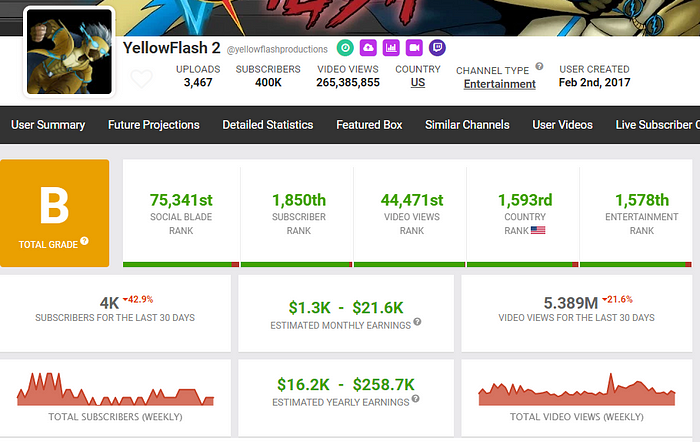
YellowFlash 2 has multiple streams of revenue. There’s Google Adsense revenue, of course. The chart below shows it makes anywhere from $1,300 to as high as $21,600 a month from Adsense. The entertainment niche doesn’t pay the most when it comes RPM (revenue per thousand impressions). It may only range from $2.00 to $4.00, which after YouTube takes its cut, may only amount to a few dollars or so.

Source: Screenshow from Social Blade: https://socialblade.com/youtube/channel/UCMrpRnyBJhgVBy3rm0K4P5w

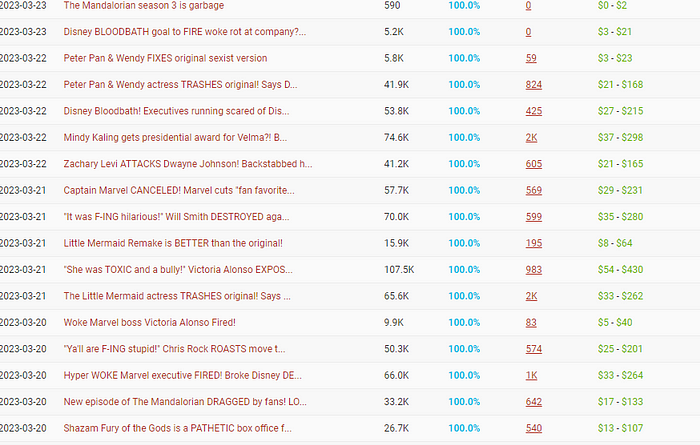
But for a channel like this, it’s better to look at it from a daily income perspective. Here’s a screenshot of its earnings by video over the last few days, from 3/20 up until its latest upload as of this writing:

Source: Social Blade: https://socialblade.com/youtube/channel/UCMrpRnyBJhgVBy3rm0K4P5w/videos

As you can see, YellowFlash 2 averages somewhere around $100+ per video. At five uploads a day, that’s $500+ per day in revenue. Just from Google Adsense. Not a bad haul for a one-man entertainment news operation.

Some videos do a lot better than others traffic and income-wise depending on the subjects and whether something is hot or trending. Some have even pulled in upwards of a few thousand dollars. Most of the videos tend to get a reliable 50k–70k views, showing the channel has a strong base of subscribers who regularly tune-in to watch.

Like many YouTubers with a strong following, YellowFlash 2 has an online merch store selling everything from t-shirts, coffee mugs, hoodies, stickers, to smartphone covers.

However, I want to point out something pretty important about this channel. It also has a channel membership, ranging from $1.99 to $9.99 a month. Channel memberships can be very valuable and lucrative. Especially for channels that have a strong community following. I couldn’t find any official revenue numbers for memberships. But it’s not hard to imagine this bringing in several thousand more dollars a month. Even if there are only 500 members, that’s a minimum of $1000 a month, and possibly more if some of those members are paying for the higher tier status.

YellowFlash 2 also had a Patreon page previously, but this seems to have gone offline, or been taken down.

Niche Deets

As indicated earlier, the news entertainment/gossip/outrage niche is all about quantity over quality. It’s about clickbait. It’s about following the latest breaking news and chasing the hottend trends. This is by no means a passive “hobby channel.” It’s a full-time job.

If this sounds like a niche you’d want to try, you’d better be prepared to hustle and pump out videos constantly. You need to stay on the pulse of what’s happening as it happens.

You also need to be able to present the news with a bit of style, and be willing to employ some emotional manipulation. YellowFlash 2 is not a popular Youtube channel just because it delivers the latest news. Anyone can do that. It’s also popular because it appeals to an audience of comic book and movie fans that agree with its “anti-woke” (whatever that may mean) ethos. That audience may interesect with the red pill community, MGTOWers, and other communities that generally skew younger and male.

I point this out not because I necessarily agree, follow, or are part of those communities. But because it’s important to understand the TYPE OF AUDIENCE you are trying to appeal to with your content. You have to think about your potential audience’s perspective. Ideally, you want to start a channel that matches your personality and beliefs, and hopefully find an audience of like-minded folks. As YouTube shows constantly, there’s a community out there for just about everything and everyone.

Summary

Click-bait news, controversy, and hot takes are not for everyone. But like YellowFlash 2 demonstrates, this can be a very lucrative niche to get into for the right personality. Given the tone and style you portray, it’s probably worth considering using a pseudonym and staying faceless.

Another thing to consider, is that whenever you are straying into the world of controversial topics and celebrities, you run the risk of attracting a lot of negativity and nastiness. Meaning things that can get your channel demonetized, suspended, or even outright banned. This is especially true if you are taking certain political or social stances. Even just sharing some types of news can bring out the haters, no matter how milquetoast you are. YouTube is getting increasingly strict about these sorts of things. But opposing sides have also been known to brigade enemy channels, getting them deleted, and their owners canceled or doxxed. So beware.

All the risks aside, news content of all stripes is only going to continue in the direction of video, especially from community-specific channels like this one. If this sounds like the type of niche for you, there’s certainly lots of room for more voices.