For some reason, this movie popped into my head recently, and I just had to rewatch it. I don’t know why. I seem to recall seeing it in theaters while on a beach vacation in Ocean City, Maryland back in the summer of 1998. Though the film actually stayed in theaters for over a year.
Films did that back then. Now they dip in and out in like two weeks before hitting streaming oblivion.
It’s weird watching something from the ’90s, as it is basically a period piece anymore. This film is nearly thirty-freaking years old! It is as ancient to modern audiences today as something from the mid-’60s would have been during its premier.
There’s Something About Mary is a screwball romantic comedy about a guy named Ted trying to reconnect with his old high school crush–the titual Mary. Mary Jensen, that is. Following a catalysmically awful prom date that goes sideways in the film’s second most memorable sequence when Ted gets his dick and balls stuck in his zipper after arriving at Mary’s house. Poor Ted spends the next 13 years still pining (borderline obsessing) over Mary, until he gins up a scheme to sick a private detective on her to hunt down her whereabouts. Finding her in South Florida, Ted takes off to reconnect with his old flame, encounting a series of mad-cap adventures along the way. But competing with him for Mary’s heart is the greasy private detective, an old college boyfriend, a slippery pizza delivery guy, and even a famous football QB star. Will Ted, the ultimate nice guy, win Mary’s heart in the end?
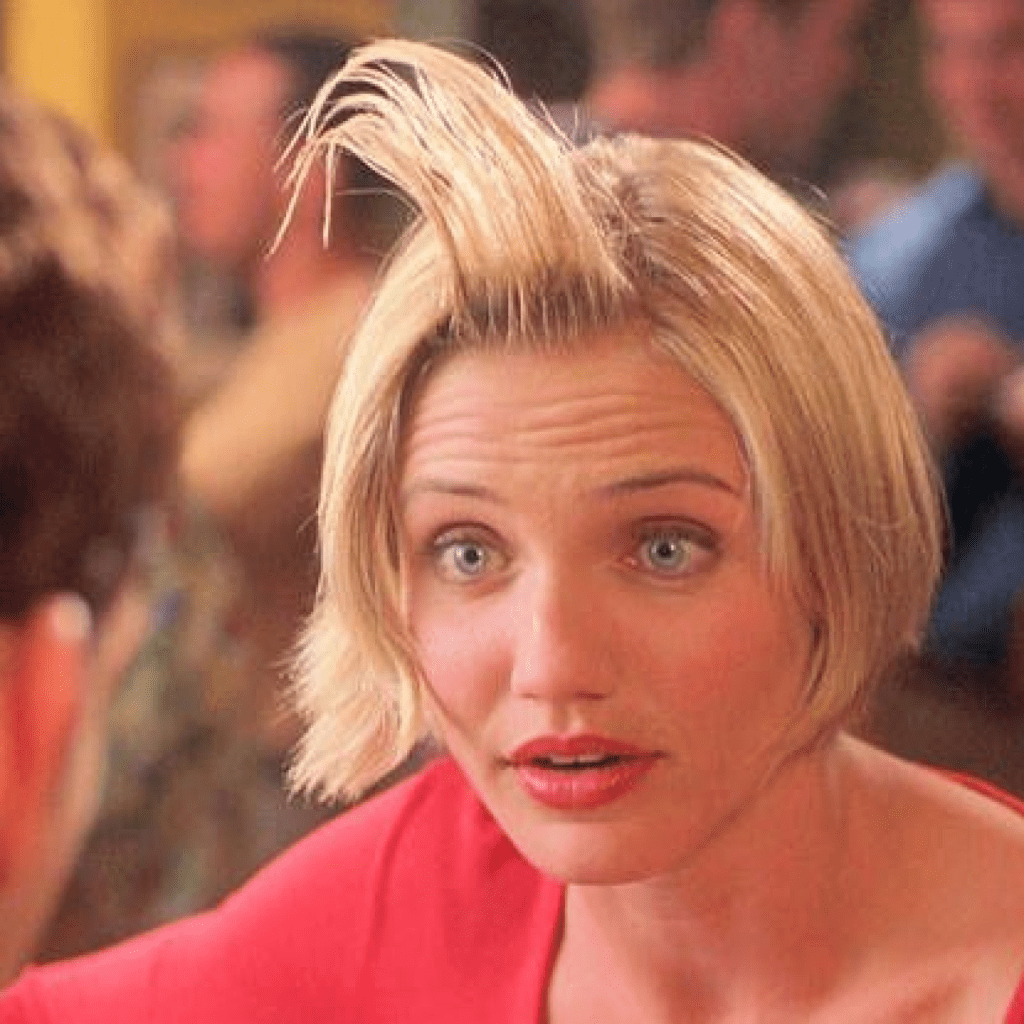
Of course, the film is BEST remembered for its “Is that hair gel?” scene when Ted and Mary are preparing to go on a date. Believe me, that line was the height of bawdy comedy in my high school during that year. Between that and the many Monica Lewinsky jokes flying around (and there were many), my junior year was beset with semen-based hilarity.
In fact, I’d say there has likely never been a time ever in human history when male ejaculation centered so prominently in the cultural psyche as it did in the year 1998.That’s all thanks to Monica and Mary.
There’s Something About Mary is beset with a hideous amount of ’90s anachronisms, both technologically and cultural. Things that just wouldn’t work in today’s self-aware uber ironic entertainment landscape. The ’90s was all about being okay with looking stupid. It was the decade of Dumb and Dumber, Jim Carrey, and wacky attitude-y cartoons like Animaniacs. Weird toys like Gak. Very stupid and cringey TV shows. And lots of bright neon colors.
People nostalgia-gazming hard on the decade often forget how damn silly the ’90s really was. And that’s probably the best way to describe Mary. Silly with a capital ‘S.’
The entire conceit of the film falls apart in the age of Facebook and Google. Now it’s not only easy to look someone up from high school, you likely can’t even get rid of them anyway if they follow you on Insta or Facebook.
Then there’s the whole stalking angle. What Ted does is technically kind of creepy. While he does sorta pay for it when he’s forced to confess at the film’s “All is Lost” beat, and is consequentially kicked to the curb, true love conquers all of course in the end.
There’s the idea of a bunch of men fixating on Mary as a sex object in a predatory way that would be seen as “problematic” now. The film gets away with it mostly due to its unflinching cartooniness. The Farrelly brothers were at their peak. The story has heart, though its punctured by a lot of slapstick nonsense.
There’s Something About Mary really is one of those films that wouldn’t be made today. It’s an odd time capsule of a film. A relic from a very niche era of cornball humor that couldn’t be replicated. A perfect representation of what the ’90s was all about.
It does have some classical elements, too. The recurring motif of the singers reminded me of the singing muses often seen in Shakespeare plays or Greek epics. The crude sexual humor harkens back to the stylings of the ancient Greek play Lysistrata. There are some borrowed elements also. The police interrogation misunderstanding feels lifted from 1992s My Cousin Vinny, for instance. But overall it’s a funny original story with a handful of memorable scenes beyond the hair gel one. The fish hook gag, as an example.
Ben Stiller stars in one of his early big roles. At the start of his early 2000s tsunami of comedy hits like Meet the Parents and Zoolander. Cameron Diaz plays the lovely and lanky Mary. And there is the adaptable Matt Dillon as the greasy private eye with the porn stache.
Need some ’90s flavor in your life? Who doesn’t, right? Check out There’s Something About Mary.
I truly believe that in the year 2000 our timeline somehow got diverted into the Shithole Dimension in which we currently reside.
How? I blame Y2K. We were supposed to let that supposed “glitch” play out, not “fix” it. Instead, we collectively ctlr+alt+deleted our way into this nightmare world.
That, or the gods simply hated those stupid “00” New Year’s Eve glasses everyone was wearing celebrating the Millennium, and decided to punish us with two and a half gray mushy mash no identity decades. What is the difference between the year 2003 and now? Seriously. None. If you stuck me in a Delorean and sent me back, I’d hardly notice any changes. The clothes, the tech, the political scene — all virtually the same.
We left the “Go-Go 90s” or the “Gay 90s” or “The Decade of Peace,” for the “Oughties.” Or is it just the “Zeroes?” Or the “Two-Thousands?” Boring and WTF either way.
Even IN the ’90s, we used to say, “It’s the ’90s, baby.” On New Year’s Eve of 1999, I remember partying with some coworkers at a popular resort named after a Roman emperor to Prince’s song “1999” the moment the ball dropped. It was awesome. It was like we knew we’d reached an Apex of Cool and the universe had serendipitously rewarded us with our very own anthem for the year with a song written way back in 1982. How’s that for a pre-expectation of good times? People were excited for the ’90s already in the ’80s. Who the fuck was looking forward to 2009? 2013? 2017? 2023? The current year?
“This the ’80s and I’m down the ladies.”
Then just today I’m driving along and I hear the classic 1989 song “Funky Cold Medina” by Ton-Loc, which includes the line I quoted above. The previous seventies decade may have been the “Me Decade,” but even in Ronald Reagan’s America people were ready to get down. And that was with the Cold War still going on. The “Swinging Sixties” were turbulent, sure, but defined by great music, social changes, and apparently swinging. It was a decade marked by sexual experimentation and liberation. So like the ’70s, ’80s and ‘90’s, it had a certain sex appeal. Then before that you had the “Rockin’ Fifties.” Also known as the “Fabulous Fifties.”
It wasn’t all fun and fornication, of course. You had the “Fighting Forties,” due to WWII. The “Dirty Thirties” thanks to the Great Depression. But before them you had the “Roaring Twenties,” because of the skyrocketing stock market.
Meanwhile, the 2000s, or “Oughts” or “Zeroes” has no real nickname. The “War on Terror Decade?” Too negative. “The Age of Premptive Strikes?” No, too cynical. “The Bush Years.” Come on, man.
Okay, forget the 2000s. Onto the “teens.” Or “twenty-tens.” Or “twenty-teens.” This decade doesn’t even have a proper numerical designation. Can we hope for at least a halfway decent nickname? I’m drawing a blank here. The “Troublesome Teens?” The “Tiresome Tens?” Oh, I know. the “Transformative Teens.” Kind of a catch-all. Plus it subtly alludes to the whole transgender craze starting during the latter part of the decade. And it was a transformative decade, for sure.
Which finally brings us to this decade. The twenties. We’re halfway through and I’ve yet to hear any kind of a definitive nickname. I’ll refer you to my suggestions up at the very top. The “Terrible Twenties” sounds too dramatic. The “Trumpy Twenties” is too specific.
Besides —
We don’t yet know how the next five years will shake out. For all we know, we’re all of us gifted with unicorns that piss gold coins and shit Godiva chocolate in this decade’s latter half. In which case we’d be the “Enchanted Twenties.”
It could maybe be the “Twitter Twenties,” if it hadn’t become X. I like “The Spendy Twenties” best as it alludes to high inflation and the costs for everything getting completely out of control. I went to the supermarket recently and eight chicken wings cost $18. Eighteen dollars. Fuck it, I’ll just eat carpet.
I’m not ready to write off this entire decade just yet. I’m willing to give it a chance. But unlike the ’90s or ’80s, the twenty-twenties has got no vibe. It’s got no aura. No zip. No rizz, as the kids like to say. Frankly, I’m embarassed to be living in it. Especially when I’ve had better. Way better. That’s not good. We need to reset those computers back so they just read two digits again, so we can spring out of this bizarro pocket dimension of identity-less decades and back into our old reality. We should have had the “Duuude-Thousands,” then the “Terrific Teens,” before living smack dab in the middle of the “Friendly Twenties.” Instead, we are lost and adrift, and without a name.
Man, I miss the 90s. Discovering the world wide web. Baggy skateboard jeans. TGIF. No smartphones. Alt rock. CDs. Neon-colored clothing. Polo Sport cologne. Nintendo. Going to the mall. Blockbuster. Pizza Hut. Going outside to play and disappearing most of the day with no way for parents to contact you (yes, that happened, and it was awesome).
Life before the internet became mainstream meant you had to get creative to have fun. You might have even had to go outside. Crazy, right? But there was a time — a much nicer time, if you ask me — before everything became digital and took place on a touch screen. There were also some pretty weird games and toys, too. Here are a few of them from the best decade ever — the 90s.
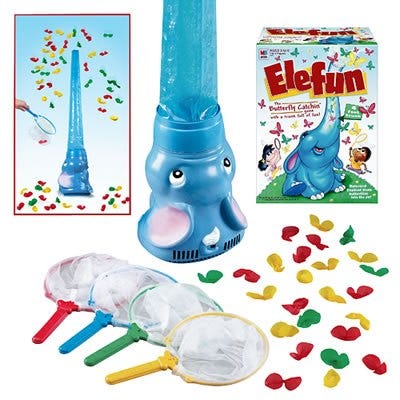
Props to whatever genius dropped acid and came up with this game. And for thinking this would actually occupy children’s attention for more than like ten seconds. It never did mine or my siblings. I think the record amount of time we spent playing it was five minutes.
Basically, the “game” was a mini leaf blower in the form of a cute elephant that blew plastic butterflies out of its long snout all over the place. The object was to catch as many butterflies as possible in your little net. Whoever caught the most was the winner.
I guess Elefun was meant to sound like “Hella fun.” Except it was mainly a big pain in the ass to clean up afterward. This game is still available somehow, and makes a great gift for parents you hate.
Mr. Bucket
You might remember Mr. Bucket from his catchy commercial jingle. “I’m Mr. Bucket. Buckets of fun!”
Mr. Bucket needs you to do one thing. Stick balls in his head so he can spit those balls back out of his mouth. This is something Mr. Bucket needs you to do a lot. He enjoys very much, you see, shooting balls out of his mouth. While rolling around on the floor. Yeah, that Mr. Bucket sure was a freak. Always wanting you to put your balls in him. So he could spit them right back out at you. It was totally a normal kid’s toy. Absolutely normal.
Even as an innocent non-innuendo-understanding kid, there was just something not quite right to me about Mr. Bucket. He just seemed off. A little too eager to have balls put in him. I mean, I liked playing with balls too. But not that much.
Mr. Bucket. Buckets of fun? More like buckets of repressed memories.
Fuck this “game.” Seriously. It wasn’t even a game. I’m convinced it was a psychological torture test some scientist invented to drive kids into therapy.
As the name implies, this “game” involved setting up plastic dominos in various patterns, and then knocking them down. Dominos is an old game, of course, but this game made the dominos cool and hip with neon colors. Some even glowed in the dark. There were various versions of this “game.” But they all only accomplished one thing — pissing you off, because no matter what, you’d always end up knocking down the dominos prematurely, thus ruining any chance at enjoyment. And this was before YouTube or social media where you could have at least uploaded a recording of a successful rally.
Making matters worse, the dominos would always go missing, forcing you to ask your parents to buy supplementary packs. The whole game concept itself was faulty from the get-go. The makers actually expected little kids to spend hours painstakingly setting up precariously-placed pieces of thin plastic that could be blown over with a whisper. Seriously. Hours of hard work could be derailed in seconds by an errantly-placed index finger, a troublemaking sibling, a clomping pet dog, or an oblivious shuffling adult on their way to make dinner or do laundry.
The ancient Greeks had Sisyphus and his boulder to learn about the horrors of futility. We 90s kids had Domino Rally.
I still have no idea what the hell this contraption even did. Was it some kind of trivia device? A sound effects machine? A tactile-learning tool that prompted hand-eye coordination? I don’t know and The Great Unsolved Mystery Of Bop It still bothers me to this day.
I do remember there were different variations of this toy thing. All in weird geometric designs that emitted wacky sounds. But the very few I ever saw in the wild as a kid were never used for their intended purpose, and instead were turned into play swords. Or as a baton kids would use to bop other kids over the head with. Hmmm…maybe that was the ulterior purpose of Bop It all along.
Okay, this was actually a really cool toy, although it was really more of an exercise device. It was really simple to use. You looped it around one ankle, and then spun it around, skipping over it with your other foot.
I like to think of Skip-It as the real foreunner to the Fit Bit, or any other kind of health-tracking wearable device. Skip-It cleverly had a counter on it that kept track of how many skips you made. This lead to competitions. All in all, a decent toy.
There was just one problem.
Skip-It was known as a girls toy. They came in pink. But many boys (including myself) were always trying to use because it looked like fun. And because it was a girl’s toy, it was easily broken, even when you used it delicately. The cheap plastic would snap apart. Or the counter would stop working and you had to count your skips yourself. Then you add roughhousing boys trying to show off in front of the girls and you can see where this tragicomedy is headed. Yep, a lot of Skip-Its met their demise at the hands (or feet) of careless young men, and a lot of young women were left bereft of their expensive proto workout trinkets.
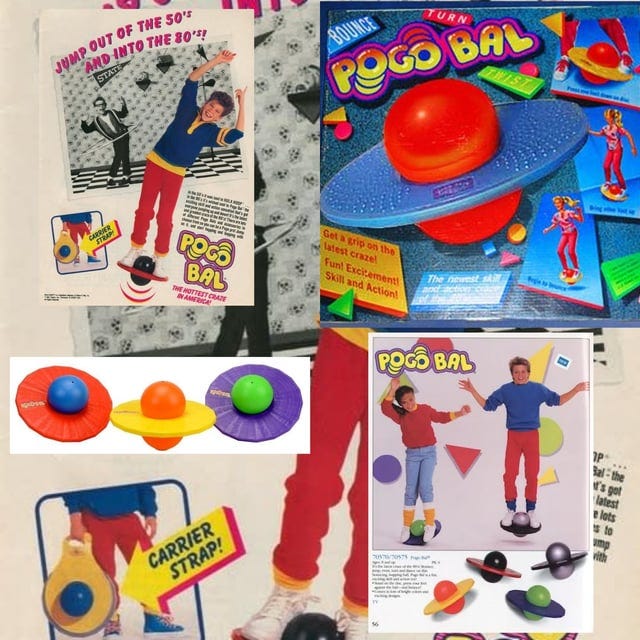
I actually had to look up what these were called as I never knew. I just always thought of them as the little Saturn-shaped balls you jumped on and hoped you didn’t break your ankle in the process. I’m convinced toy manufacturers in the 90s were in league with the medical establishment, and were just trying to get as many kids injured as possible to drive up insurance rates. It’s the only thing that makes sense.
It sounds insane even describing how you use a Pogo Bal. You step on a dinky little platform which surrounds a rubber ball. Then you try to balance on the ball and jump around on it. Like using a Pogo Stick. Except without a stick and without the fun and ability to balance. God, what a lame toy this thing was. They coudn’t even give the “ball” two proper letter “LLs.” They had to use one “L.”
Even as a kid these things looked dangerous to me. I might have tried using one once or twice, and that was it. I was fine going off ramps with my bike. I was fine crossing stranger’s yards as a shortcut to get home. I was totally fine riding off by myself for hours into different parts of town. But this thing. This bouncy ball of doom. It scared me.
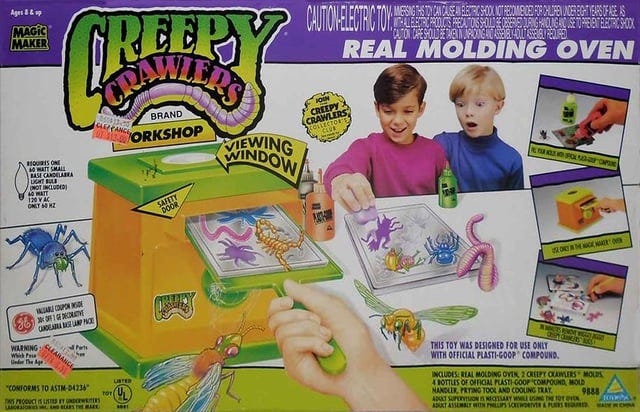
Girls had the Easy Bake Oven. Boys had Creepy Crawlers. Same idea. Both had a little oven. Both used recipes. Only difference was that instead of making delicious mini snacks, this contraption made groteque little rubber bugs that boys then left lying around to “scare” the girls. I’m not sure why the makers of Creepy Crawlers were trying to perpetuate a gender war. Especially after boys were out there destroying girl’s Skip-Its left and right already.
Overall, Creepy Crawlers was a clever way of making “science” fun, combining creative mold making with entomology. No doubt this game inspired some kiddos to go into biology, smelting, or 3D printing. This was probably my favorite 90s game. It wasn’t really a game, I guess. It was more of just a fun project. The best part was you could make a whole collection of bugs, swapping out different colors to make your own designs. The scorpion models were my favorite. Some rubber composites even glowed in the dark. Creepy Crawlers was that rare playtime activity that was even better than Nintendo (my addiction at the time) or watching TV (my second addiction).
Now that I think about it, I’ve been remembering a lot of these toys and games through a nostalgia haze. Turns out most playtime stuff from the 90s sucked. Did the manufacturers secretly hate kids? Their products were mainly cheap plastic and often got children hurt. Their real insidious purpose seemed purely to separate poor parents from their hardearned money via manipulative commercial campaigns. And putting children in the hospital. These toys and games weren’t fun. They were actually pure evil. Well, not Creepy Crawlers. Creepy Crawlers was solid.
I’ve followed ZubyMusic on Twitter for almost three years now, at least since around 2019.
If you’re not familiar with the artist, “Zuby,” short for Nzube Olisaebuka Udezue, is a 36-year old English rapper educated at Oxford University, with a substantial and growing audience of worldwide fans. Known mostly for his music, he’s also a strong conservative voice, often criticizing identity politics, and is a Christian. He’s self-released three albums, and has a podcast and YouTube channel.
I’m not a Christian myself, nor do I listen to rap. In fact, I’ve never once even listened to Zuby’s music, as I think “Christian” and “rap” sounds about as cringe as almost anything the “Christian” world tries to attach itself to in the secular realm in order to be hip and relevant. Christian comedy. Christian rock. Christian movies. Ugh. No, thanks.
Still, I like Zuby because he often makes interesting and thought-provoking tweets. Even if I don’t always agree, it’s nice to get a different or unique perspective on current events, especially on Twitter. It’s funny how conservativism is actually quite maintream and common in everyday life, yet online it’s seen as odd and “alternative,” with liberalism and left-wing politics seen as the default. In reality, it’s much more evenly split.
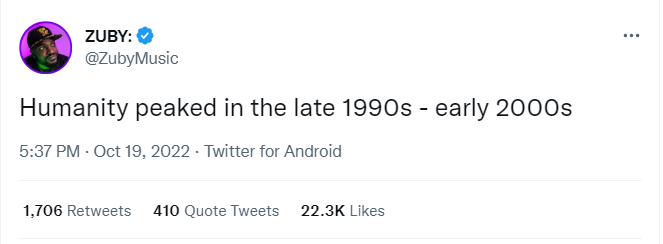
Last October Zuby tweeted the above comment, which I frankly dismissed almost immediately. I think there’s a temptation to glamorize one’s youth, seeing it as some bygone golden age. Zuby, born in 1986, would have had his most formative childhood years in the ’90s, and been a teen for the first half of the ’00s. I remember John Stewart on The Daily Show saying something like “you don’t miss that era, you just miss being a carefree child,” in response to a pre-sex scandal disgraced Bill O’Reilly saying how he felt the decade of the 1950’s (O’Reilly’s youth) constituted Americas best years. Politically, Stewart and myself are quite opposed, though I have to admit the guy could be pretty insightful at times.
Nostalgia-gazing is something particularly characteristic of the right wing. And while it’s soothing and addictive, it’s also as pointless and counter-productive as the left’s own habit of future utopia fantasizing. Neither side seems to want to deal with the here and the now, preferring to longingly await a DeLorean to whisk them away to another timeline. No wonder things remains such a mess, when both sides abdicate their responsibility in the present.
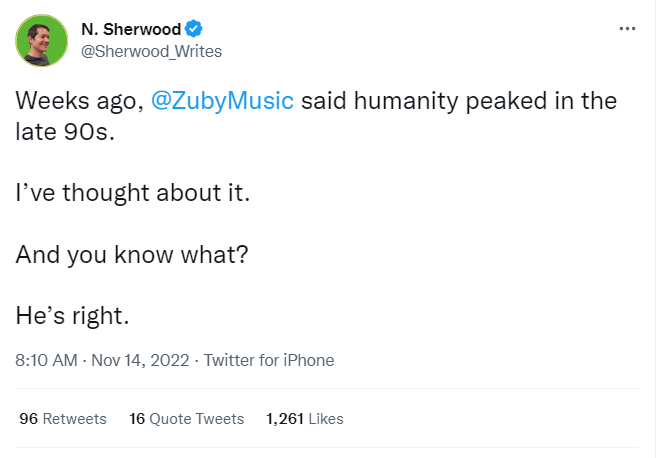
Then this morning I was reminded of Zuby’s tweet by Nick Sherwood, author of The Social Virus: Social Media’s Psychological and Social Impact on America (And What We Can Do About It). He posted a series of tweets articulating why he feels Zuby is correct.
Source: Screenshot of N. Sherwood’s tweet.
The above was followed by a long thread of reasons and supportive evidence, some of which I thought had credence. Others I found questionable. And by “others,” I mean most. And by “questionable” I mean mostly B.S.
To begin, I don’t think it’s possible to declare any particular era in human history a “peak” at all, given that so many cultures and nations around the world are undergoing vastly different experiences than others, both positive and negative.
If we’re talking strictly the Western world (America and Western Europe), one could make the argument the late ’90s to early 2000s certainly wasn’t a bad era. The Cold War had ended, and the economy and job market were strong. But that’s looking at things from the macro view. For someone working a cash register in a small town in Idaho, was their life any better or worse, or much different for that matter, than ten years prior?
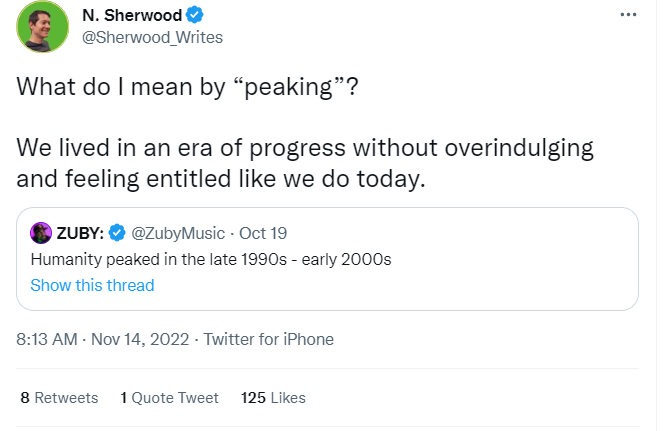
Sherwood continues:
Source: Screenshot of Sherwood’s Tweet.
I agree with the first half of the second sentence, if by “progress” we’re talking technologically and socially. No doubt the ’90s was an era of progress. But so was the ’80s, the ’70s, and almost every decade before. At least in America and other places in the world. “Progress” is also subjective. No doubt Lenin and Stalin would have considered their Communist Revolution in Russia “progress.” But was it? Big doubt.
The second half of the statement is basically meaningless. How do you even measure levels of overindulgence and entitlement? These are aspects of human nature, and I don’t think humanity has evolved much, if at all, in just the past 25 years. So I’d say there’s a good chance that we’re seeing the same levels of indulgence and entitlement now that we saw a quarter-century ago. Maybe now it’s just more visible due to social media.
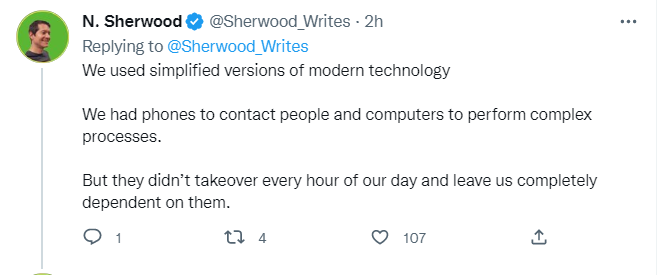
Moving onto his next points:
Source: Screenshot of N. Sherwood’s tweet.
Sherwood seems to posit that the late ’90s/early 2000’s comprised some kind of Goldilocks “sweet spot” era in which we had the just the “right amount” of technology. Not too much to where it became omnipresent, like the smartphone in everyone’s pocket, but just enough to where it acted in the background.
Again, this is highly subjective. One man’s too much technology is another man’s not enough. I can certainly remember people fixating on computers even as far back as the mid-90s, when the internet became more accessible to the mainstream.
Infrastructurally speaking, we’ve been dependent on computers probably since the 1960s. Almost all of our telecommunications, major medical equipment, civil defense systems, etc. all depend on computers and microchips.
If we’re talking about how the ’90s was the beginning of computers separating people into their own bubbles as everything went digital, there’s an argument for that. I do think people were more fluid socially back then than they are now. Younger generations today can’t seem to effectively communicate unless it’s through a screen. It was Millennials, afterall, who popularized “ghosting.” When people are reduced to simple online avatars, it’s much easier to dismiss their humanity and snap them out of your existence. People today shy from conflict more readily, and terms like “social anxiety” are prevalant.
Source: Screenwhot of Sherwood’s tweet.
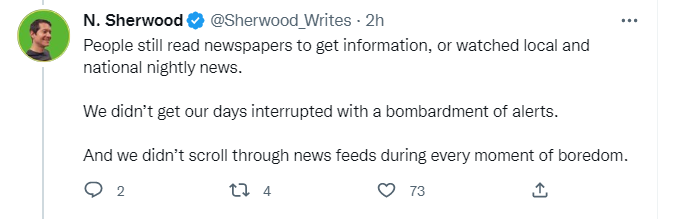
I wrote for a newspaper as a teen. Had my own column. I also worked in the printing industry for eight years as it transitioned into the digital age. Newspapers are cool, but I wouldn’t associate them specifically as being the best or even a good source of information necessarily. At least, not anymore than radio or TV. Local news hasn’t really changed in 25 years, either. Traffic on I-95. Some guy got busted for dealing drugs. A kindergarten teacher retires. New waffle restaurant just opened. The song remains the same.
It’s true we get hit way more with B.S. news alerts and app notifications. But that’s a simple fix. I either delete a misbehaving app, or don’t turn on notifications at all. The only alerts I get on my phone are from my Medium app, which is actually starting to get on my nerves.
But again, Sherwood is really making more of a case against smartphones, and by extension social media, and not so much a case for the ‘90s/2000s being some golden era. You can’t just argue in the negative. Smartphones didn’t exist during the Bubonic Plague in Europe either, and I don’t think anyone would argue those were good times. Not unless they’re some hardcore “survival of the fittest” Darwinist fanatic, or something.
Source: Screenshot of Sherwood’s tweet.
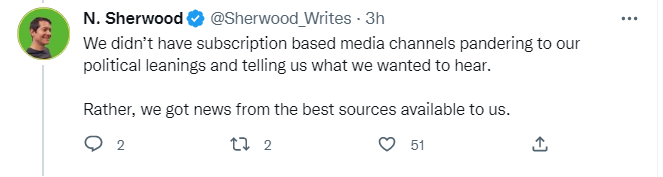
What?! Has this guy not heard of the John Birch Society, which handed out leaflets and pamphlets pandering to very specific and extreme right wing beliefs WAY back in the ’50s and ‘60s?
Or The Daily Worker newspaper, published by the Communist Party USA back in the 1920s?
Or Bop Magazine, delivering steamy servings of teen heart throbs like Jonathan Taylor Thomas, Johnny Depp, and Jonathan Brandis?
Hmmm…if the ’90s was peak anything, it was was Peak Hot Guys Named John.
Source: Screenshot of Sherwood’s tweet.
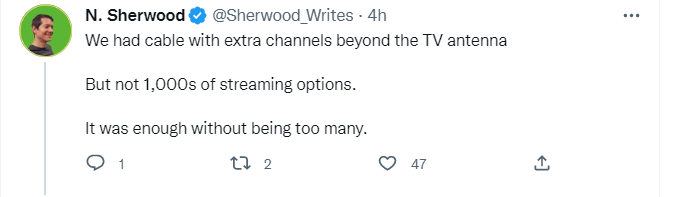
No matter how many streaming or cable channel options exist, there are effectively only a small number that any one person will ever regularly watch, as there is only so much attention one can give, and limited time.
And why is the expansion of entertainment media necessarily a bad thing? You wouldn’t say the same about the millions of books that have been printed in the last few hundred years. So why would TV shows and movies be any different. There being five million Star Wars movies/shows/books/toys is annoying to me, yes, but it’s not like it ruins the quality of my life. I just ignore it, like anyone older than twelve and who possesses a frontal lobe should.
Source: Screenshot of Sherwood’s tweet.
Ah, so media is only “good” if EVERYONE is watching so they can dicuss it the next morning around the water cooler. Got it. That being the case, I guess the daily state broadcasts North Korea puts out to all its slaves, er, “citizens” must be of the highest excellence. I’m sure KCT fosters something a bit more than a “semblance of monoculture.”
It’s true that much of pop culture and media is fractured amongst varying demographics and audiences. But that’s always been the case. I can remember my friends and I discussing how freaking awesome the T-1000 was around the school cafeteria the year Terminator 2: Judgment Day came out, only to get blank stares from the girls, who themselves were talking about Beauty and the Beast. Then going home and my step-dad telling me to shut-up about “Turdinator” while watching a re-run of Welcome Back Kotter. Then running to my mom to whine that her husband insulted my hero Arnold, only for her to shut the door in my face so she could watch Knots Landing.
Like that South Park videogame, it’s always been a fractured but whole, Sherwood.
Monoculture is a myth. No matter how big a movie is, it’s likely not even three percent of the world population will even see it. Take Avatar, the highest grossing movie of all time not adjusted for inflation, at almost $3 billion in global ticket sales. In 2009, the year Avatar premiered, if the average movie ticket was $7.50, then that means a maximum of 400,000,000 saw James Cameron’s remake of Fern Gully in theaters, out of around 7 billion people. Except that number doesn’t count the people who went to go see the movie repeatedly. And it doesn’t count the fact that many people paid way more to see it in glorious 3D. If you cut that number in half to 200,000,000, that means only about 3% of the world population saw Avatar. Even if you double it to 6%, that’s still pitifully low in the grand scheme of things. And that’s the biggest movie ever released.
To put that in perspective, the biggest religion in the world, according to the Pew Research Center, is Christianity, and it hasn’t even cracked 1/3 of the global population with its 2.2 billion followers.
Source: Screenshot of Sherwood’s tweet.
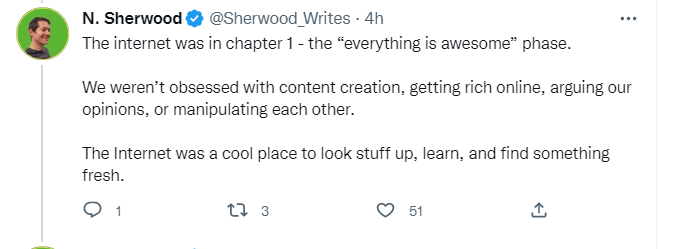
No, Chapter 1 of the internet was “How Much Freaking Longer is This Thing Going to Take to Log On, Goddammit!” With the sub-chapter “Don’t Use the Phone I’m on AIM Right Now!” Chapter Two was “When Are We Getting Broadband, Everyone Else Has It Now!”
The internet sucked 98% of the time back in the ’90s. It wasn’t cool. It wasn’t aweome. You didn’t find anything “fresh.” It was where you IM’d your friends from school until some creep found your teen chat room and tried to have cybersex with you. There’s a reason why To Catch a Predator came out in the mid-2000s right after the supposed “golden age” of the internet. It’s because the world wide web, due to its anonymity and wild west novelty, empowered a lot of perverts in the early days.
The internet was also a place for piracy. Remember Napster, which single-handedly almost destroyed the entire music industry? “I Love the ’90s” my ass, especially if you played in a band named Metallica.
The internet was weird, distrusted, seen as a fleeting fad by some, buggy, slow, mostly useless, and the driver of the Dot Com meltdown. Saying the internet was “cool” back then before high-speed and regulation is like saying bloodletting was cool before modern medicine discovered viruses and bacteria.
Source: Screenshot of Sherwood’s tweet.
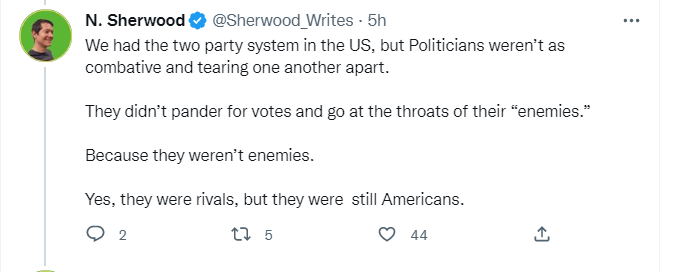
Ah yes, that wonderful period in the late ’90s and early 2000s when politicians never pandered for votes, didn’t treat those across the aisle like horrid zombies, and joined arms as fellow Americans. Back then we didn’t have contested elections, or impeachment trials, or “vast right wing conspiracies,” or third party presidential runs conducted by eccentric billionaires. Politicians didn’t lie. They never even used foul language. Certainly they didn’t have affairs with interns, or cheat on their cancer-stricken wives. Or invade countries based on false claims of weapons of mass destruction. None of that ever happened.
Source: Screenshot of Sherwood’s tweet.
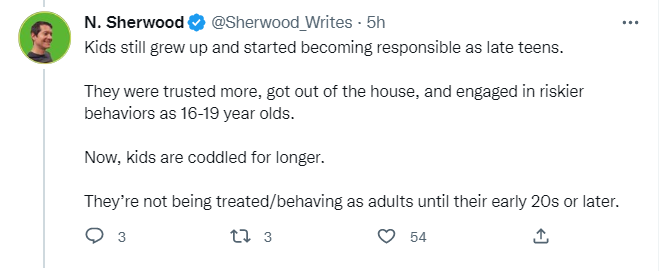
If kids growing up and maturing sooner is your benchmark for the golden years, then you’d have to look way past the ’90s. Back to, say, during WWII, when kids lied about their age so they could go to war.
Take the case of Calvin Graham, for instance. Born in Canton, TX, Graham signed up for the U.S. Navy after the bombing of Pearl Harbor at 12 years old. He’d later get wounded by sharpnel at the Naval Battle of Gaudalcanal, for which he’d receive the Bronze Star and the Purple Heart. Graham would eventually get booted from the Navy after attending his grandmother’s funeral without permission. Get married at age 14. Become a father a year later. Divorced at 17. Then join the Marine Corps at 17 to serve in the Korean War. Then break his back in 1951 after falling off a pier.
Look at that. Two wars. Two branches of the military. Married and divorced. Has a kid. And even gets his first case of workman’s comp. All before most kids even learn how to shave.
Sorry, kids were not free-roaming Mad Max badasses in the ’90s. They were mostly soft, squishy, sticky bags of shit. Eating Lucky Charms, Pop Tarts, and Ellio’s Pizza. Capable only of Nintendo marathons, watching Saturday morning cartoons, remembering the Konami code, and making fun of Michael Jackson’s face.
I don’t know what causes people to glamorize and pedestalize the past. Nostalgia has practically become its own genre now, with Hollywood dumping ‘80s-inspired crap like Stranger Things on us constantly likeNickelodeon slime. I remember the ’80s, man. I was a kid then, too. Well, mostly I remember watching TV and movies during the late ’80s, and not having to worry about a whole hell of a lot. What do you mean the Russkies could drop a nuke on us any moment? I don’t care, I’m watching Inspector Gadget here and drinking chocolate milk.
For sure, sometimes I miss not having any responsibility other than deciding what kind of dinosaur I want to be for Halloween. But it’s kind of ridiculous and suspect to declare any particular era “humanity’s peak” when it just so happens to coincide with your childhood. It almost sounds like indulgence and entitlement, come to think of it.
Think of it this way. Right now there’s a horrible war going on in Ukraine. It’s the worst of times for anyone who lives there now. But somewhere in Colorado, Florida, Canada, or maybe even Japan, some kid somewhere is having the time of his life. He’ll grow up thinking it never got any better than the late teens and twenties. The ’90s and early 2000s will be as foreign to him as the ’60s and ’70s are to a Millennial or Gen Z’er.
And you know what? He’ll probably be right. At least he didn’t have to deal with the Macarena.





 Dean Brooks