The sad trend of becoming a weepy widget in the feelings factories of Big Therapy, Inc.
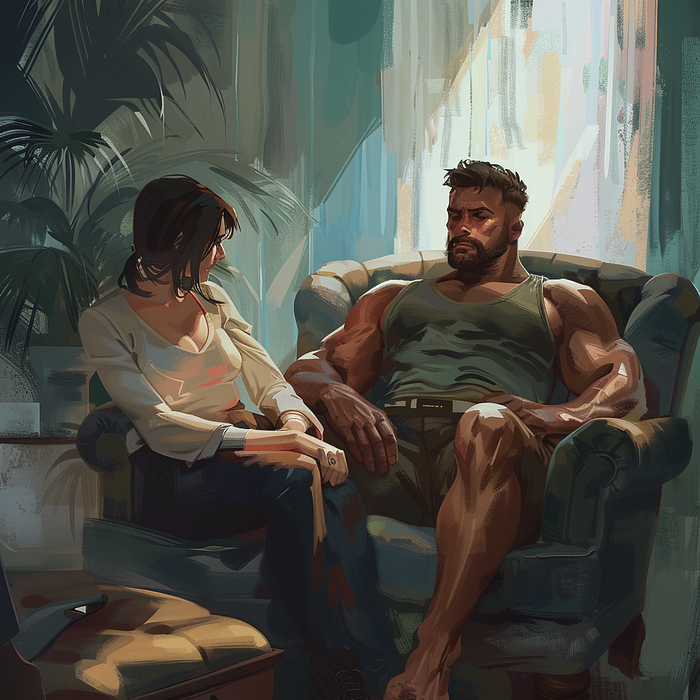
Me dismissing my therapist due to his total lack of physique.
Lately, YouTube has become stricter with accounts that use Adblock, preventing some videos from being played, or even slowing down performance. This happens sometimes even after you’ve disabled Adblock for a video and refreshed the screen, as for some reason Adblock will still default back to its ON setting.
It’s maddening, frustrating, and makes watching YouTube a painful process, as you’re forced to constantly reload videos. It’s a human rights violation as far as I’m concerned. Now I may end up having to subscribe to YouTube Premium, which is likely the ulterior intent of all this technical trip wiring.
In the meanwhile, I’m getting smacked around by tons of ads, including one for a therapy company called BetterHelp that really stuck out to me. It shows a young woman doing an amateur vlog-style video where she starts off saying, “I’ve been in therapy since I was six.”
I found this shocking and ridiculous. Why the hell would someone need to be in therapy at that young an age? I can barely remember when I was six. The only things I needed in life then were cartoons, frozen push-pops, my stuffed animals, hanging out with my friends and girlfriend (yes, I actually had one at that tender age and our first date was watching Pinocchio together at her house), and going to the video rental store to pick out a new movie every week. I don’t remember ever feeling the need to discuss my feelings with some v-sweatered stranger in a room with potted plants, and looking back on myself at that age as a mature adult, I’m glad I didn’t.
However, the young woman (whom I’ll call Therapy Lady) in the ad seems quite overjoyed to say she’s been in therapy for decades, and gives off a programmed happy vibe. She looks to be in her mid-twenties, probably college-educated, very conversant, almost certainly Westernized. White or possibly mixed, not that it matters. Likely from the middle-class. No visible handicaps or disabilities.
Therapy Lady doesn’t mention legit trauma, or some justifiable and/or understandable reason for why she’s been in counseling sessions since before smartphones existed. It’s not like she survived the Rwandan genocide as a little kid. She goes on to say how she’s always wanted to be “emotionally intelligent,” or something, because I guess that’s totally something a six-year-old would think. I was always telling my mom, whilst sipping my chocolate milk and reading the business section in the morning paper about how I wanted to be emotionally intelligent. I didn’t want to be like those other six-year-olds in the neighborhood, who were all uncivilized emotional ignoramuses. How embarrassing.
Me explaining to my therapist the subtle differences between “buff,” “ripped,” and jacked.”
What does “emotionally intelligent” even mean? It sounds like one of those stupid sciency buzz words that’s meant to come acrss as more sophisticated than it actually is. I take it to mean, “The ability to blather on about my feelings all the time,” given the enthusiasm with which Therapy Lady was mugging for the camera in her vlog.
(Sidenote: The “TikTok Face” and “TikTok Voice” trends need to die also. TikTok Face is when someone, usually an obnoxious female, but plenty of guys do this, too, bobs and weaves her face all over into the camera in a contrived and melodramatic way to make her points about whatever. TikTok Voice is when they use a spoiled brat tone so every statement sounds like a big deal. It makes me feel like I’m being talked to by a crazy person on the street as opposed to being calmly informed.)
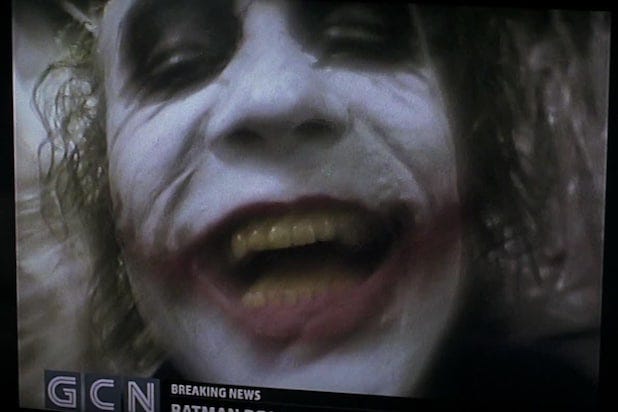
What TikTok chicks actually look like when they’re being “profound.” Source: The Dark Knight, Warner Bros. Pictures
When did therapy go mainstream? When did it become something people seem thrilled to admit they need? When did openly sharing one’s perceived mental health issues in public as though they were discussing the weather become the norm?
Years ago when I was in college we were doing introductions in class, and some young woman just started blabbing about her struggles with depression. Excuse me lady, but nobody cares. This isn’t a Thursday night group therapy session, it’s fucking Literary Analysis. Save your navel-gazing for the dorm room, please.
Looking back, Depression Chick was fat and always sipping on giant Starbucks milkshakes in class. She was loaded up on sugar and caffeine, out of shape, sedentary, and almost certainly glued to her smartphone all day. Gee, no wonder she was “depressed.” She didn’t need therapy. She needed to hit the gym and improve her diet.
To make matters worse, Tom Brady partnered with BetterHelp for a promotion of one month of free therapy sessions for new customers. Brady says he’s been in therapy for 25 years, which would precede his time in the NFL.
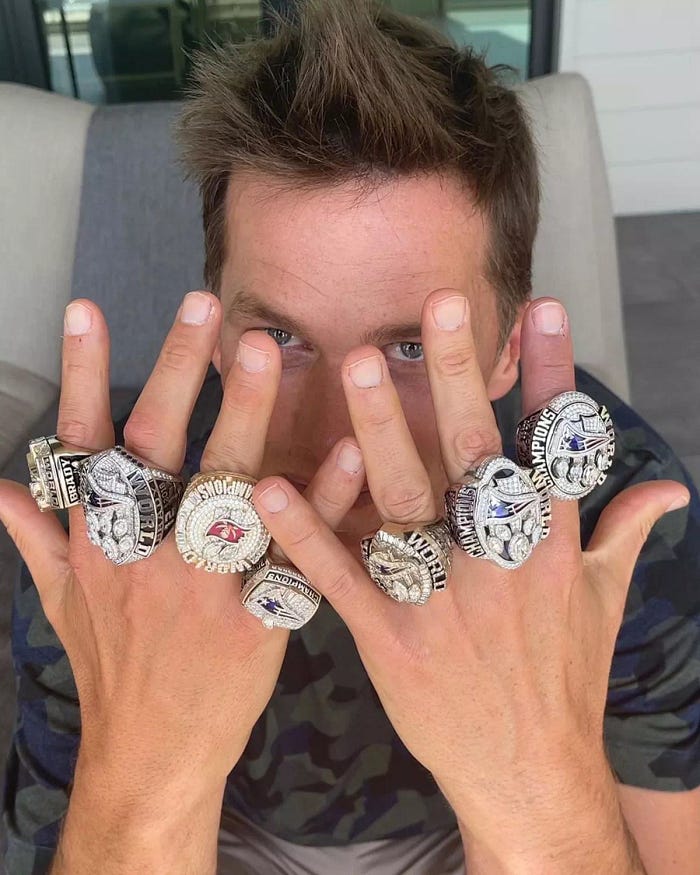
Yeah, this guy clearly needs mental help. Source: Tom Brady’s Instagram.
Putting aside the fact that if a celebrity is touting something it’s almost always bullshit (I call this rule the Paltrow Constant), I just have to ask why in hell would someone like Tom Brady need to continue therapy for that long? I can see maybe using counseling at the early stages of his career, when he was just a fledgling athlete hoping for a shot at the draft and under all that pressure to perform. But why now still?
“Oh, God, I’ve won seven Super Bowls, made hundreds of millions, can date any supermodel I want, am in perfect health, am admired by millions, and am also extremely good looking, please someone help me!”
— Tom Brady (probably)
We’ll ignore the fact that Brady was probably paid north of $10 million for this promotional scheme, and ask this question: What exactly would someone like Brady need therapy for exactly? The guy is as close to being Superman as anyone could possibly get.
But let’s NOT ignore the elephant in the room. If you’ve been in therapy since you were a little kid like Therapy Lady, then clearly therapy is not working for you. That doesn’t even sound like therapy. It sounds like dependency. It sounds like you’re stuck in the subscription model of a business. Like Netflix. Only instead of shitty movies generated by an algorithm, you subscribe to a rent-a-friend who lets you verbally masturbate about your problems for a monthly fee. That’s not something to be proud of. That’s not something to make a TikTok video about praising yourself for doing. That’s like proudly announcing you have an STI. Not everything needs to be broadcast. Some things should be kept private.
On the surface therapy sounds like a positive trend. But I think it’s indicative of a decline in society. People may be more accessible due to social media and smartphones, but they are not truly connected. More and more people tend to have fewer and fewer friends and tend to live alone. Marriage rates have declined. Many families are atomized or broken due to divorce. People are having fewer children, who have them at all. More and more people are having to work more and more to make less and less. All the while the cost of living explodes higher everwhere. Less people are religious or live their life according to any meaningful doctrine outside of the “eat, sleep, consume media” cycle. Socialization is being substituted with screen time. On and on.
And while this observation is purely anecdotal, I couldn’t help but notice while browsing Better Help’s website of testimonials, that it seems to mainly be women who are all about this therapy thing. So it’s no suprise that Better Help recruited someone like Brady to be its spokesman. To give the impression that therapy is for guys, too, and that it’s not, you know, just for ladies to whine about their lives.
Therapy is clearly filling a void for some people. Therapy simulates what close friendships, religion, and the genuine connections of family used to freely provide. It’s become like a secular confessional.
But therapy has also become a social contagion, convincing otherwise normal people that they “need” it, with little reasoning other than nebulous terms like “emotional intelligence.” Or “trauma.” That’s another one. Everything and everyone has trauma these days.
Therapy may help some people. But it will always have an ick factor for me. If people have to remain in it for decades, how productive and useful can it really be? At a certain point a person has to accept that it’s up to them to deal with the world and fix themselves. You can’t outsource personal development. That can only come from within after overcoming struggle. What many people think they need therapy for is really just the natural process of maturity and aging. It’s just being an adult. It’s not supposed to be an easy or fun process. But that’s life.
A systematic and actionable list that can help take you from stage fright to stage bright.
Made with Midjourney
A lot of “fear of public speaking” articles I’ve read are frankly worthless. And I’ve read a ton of them. The advice essentially boils down to telling you to just “psyche” yourself out of the fear of talking to a room full of strangers. Or some variation of “believe in yourself,” and the confidence will come.
That’s all nonsense. The fact is, it’s normal and natural to have a fear of public speaking. It’s the exceptionally rare personality that truly thrives off stepping into the spotlight. Even professional speakers like Tony Robbins get stage fright.
However, there are a variety of ways for handling the fear itself, and becoming more effective at speaking to a group.
The first step is understanding that it’s a problem like anything else. A clogged toilet. A stalled engine. There’s nothing special about being afraid of speaking in public. Learning to handle the fear is a process like learning how to throw a football or swing a baseball bat.
It’s something you must train your brain to handle. In fact, you have to somewhat reprogram your mind to deal with it in a constructive way. No, I’m not talking about praying or speaking daily affirmations to juice yourself up before a big board meeting. I’m talking about simple activities you can take that can retrain your brain.
Handling a fear of public speaking is not a psychological problem. It’s a biochemical one. It’s like overcoming a drug withdrawal.
It can only be accomplished by incremental exposure and physical confrontation. Meaning that you put yourself into smaller, more manageable situations that gradually build up your tolerance over time. Here are a few steps that have helped me, that I hope will help you.
1. Sit in the Front Row
I used to be someone who was terrified of even introducing myself in a classrom or group. If the speaker started off with that ol’ “Let’s go around the room and introduce ourselves” bit, my pulse went from 72 to 115 almost instantly. I wear a FitBit, so I know that’s accurate.
However, I realized one day that the main reason I felt unnerving dread just saying my name was because I was unconsciously sabotaging myself by always sitting in the back of the room. It’s like I was telling myself I had nothing to contribute to the group, nothing of value to say, and that I didn’t even want to be there. I was making it 10x harder on myself by positioning my body in a way to simulate hiding from the group.
Now, I’m someone who does have mild claustrophobia. I hate sitting in small rooms with the door closed, or any physical spaces where I feel trapped. So anytime I would go into a room, I would try to find a spot near the door or in the back, as that fed my lizard brain the sense that escape was possible should things get hairy. But acquiesing to that mild irrational phobia in turn made speaking up way more difficult, because I was already grappling with the fear of merely being in the room.
So, the way I dealt with that was by forcing myself to sit in the front row whenever possible. This accomplishes a few things. One, it puts you closer to the action. Being close to the speaker helps you see and become more comfortable with the mechanics of a public presentation.
Two, it helps you become more comfortable with everyone’s eyes being on you, even if they’re only staring at the back of your head. Unlike sitting in the back or on the side, when you’re sitting in the front everyone will likely be looking at you if you ask a question or make a statement, because they’re obviously already facing that way anyway. This will help you become more comfortable with what I call the “spotlight effect.” If you can handle fifty people looking at you for thirty seconds while you respond to a speaker inquiry, the idea of speaking in front of those people for five minutes, ten minutes, or more, starts to become more managable.
Three, by sitting in the front row you are unconsciously validating your presence in the group. You’re telling yourself that your opinions and thoughts matter. That you’re worth listening to. I’m not saying that by sitting in the back or middle it means you don’t think those things. I’m saying that forcing yourself up front can give you an unconscious edge if you’re lacking one. I find that when I sit up front I feel way more involved and “ready to jump in” if the speaker asks questions or wants participation.
Fourth, sitting in the front row has a strategic benefit. If the speaker cruelly does do the go around the room and introduce yourselves trick, you’ll likely be among the first to go. So you can get that out of the way sooner. This is where sitting in the back has its major downside. There’s nothing worse than sitting there for ten minutes with the fear compounding, as you are forced to wait your turn to say your name and your favorite hobby, or something. If you sit up front you meet the challenge head-on, rather than letting it come to you on its own terms.
I still get nervous introducing myself, by the way. But I’m way better now than I was before.
2. Speak Up More in Smaller Groups
The fear of public speaking is generally a function of shyness. So if you’re already introverted, or someone who doesn’t like to talk much to begin with, getting in front of a crowd is going to be a challenge. Your brain will chemically repel from that, because your brain interprets the activity as a threat to your well-being.
Human beings, even shy ones, are still tribal, by nature. We want to feel that we are contributing to the group in some way. We want to feel involved and validated. Well, it’s much harder to do that if you are constantly avoiding even just talking to people in the first place. The more you are able to speak up in front of of several people, the better you’ll work up the nerve to speak in front of dozens, or even hundreds.
This is easy to do if you are in college, and you’re in several classrooms everyday. Groups tend to form based on seating proximity, or if the teacher hands out a group assignment. When that happens, be the initiator, or at least help facilitate conversation in some way.
If you’re a working adult, this can be accomplished during meetings at work, or by joining an organization like Toastmasters. While I was in college years ago, I joined a Toastmasters group that met at a Microsoft facility. They were a great group of people. Toastmasters has structured meetings, formal scheduled presentations, and offers feedback for you on a speech. Generally they meet once a week, and are always welcoming to new members. Toastmasters ia great training ground for learning to communicate more effectively period, much less public speaking. They can also be beneficial for people who are trying to improve their English-speaking skills. The group I went to had several individuals from other countries who were there to help improve their diction and pronunciation.
Nowadays, I work a job that has plenty of meetings. So whenever I can, I try to take advantage of that and participate reasonably. I make it a goal to participate with an observation or respond to a question at least once. This has helped to delegitamize the fear I used to have of being in groups, and cut back on my natural shyness.
Additionally, you can help knock the fear of public speaking by talking to strangers. Even if it’s something as simple as asking the time, or complimenting a retail worker. The idea here is to help break out of the “shyness shell,” so that your brain does not interpret other people automatically as threats that causes your ability to speak effectively to get shut down. The goal is social fluidity. The ability to effortlessly mingle in a comfortable and confident manner. Not an easy task for a shy person like myself. I’ve always envied those that are socially graceful outgoing friend-makers by nature. But the reality is those types are actually pretty rare. Most people don’t operate too well outside their usual group of friends or associates. So the more you place yourself outside of your social comfort zones, the more you’ll be equipped to handle the big Power Point speech, or the best man’s speech at your next wedding, and so forth.
Believe it or not, you can also help break out of that shyness shell by doing activities like commenting online, posting on social media, or writing a blog post or article. Any little way that helps break the negative feedback loop of non-participation can help, even if you’re just sitting behind a computer screen. Even though I’ve been writing articles for either newspapers or the web since I was 12, I didn’t feel comfortable writing on Medium when I first discovered it. I lurked for awhile. Now I write freely, and that’s had a positive effect on me feeling more confident when speaking to people in real life.
Made with Midjourney
3. Improve Your Diet, Exercise, and Stop Drinking
Like I mentioned at the top, the fear of public speaking is not psychological, it’s more biochemical. That means it’s not something you can just trick yourself out of having. “Mind over matter” only goes so far. It’s a naturally-occurring phobia because it’s rooted in a fear of exposure and shame and loss of status within the tribe. That means your body is doing its job by reacting with nerves, elevated heart rate, sweating, etc. That’s all perfectly normal. Your body is a machine to some degree, and it will respond to things automatically.
And therein lies an opportuntity. The stronger and better nourished your body is, the better it and your brain will be able to handle fearful situations. I don’t mean you have to have a full stomach before a speech or presentation. Personally, I usually skip lunch or breakfast as I never have much of an appetite before one anyway. I’m talking about improving your diet so your body is healthy overall. That means cutting out junk food, fast food, foods loaded with sugar and carbs, and focusing on healthy, nutritional foods that will give your mind and body all the vitamins it needs.
Some foods, like sweet potatoes, can help lower blood pressure. And that can have a big effect on feeling “chill” when you have to give a speech. I have naturally low blood pressure already. Usually I’m around 100/60 at rest. But I’ve found that staying hydrated with water, cutting down on caffeine, and eating a balanced diet regularly helps immensely. But there are many dangerous foods that can elevate blood pressure or cause a spike in your mood, only for it to crash later. You don’t want to be on a chemical rollercoaster the day of a speech. You want to be as cool and in control as possible.
By the way, I’ve also heard that some people take beta blockers, prescription pills, and even things like Tylenol or Advil before giving a speech, as it helps to calm them down and can lower heart rate/pressure and such. I don’t advocate taking any chemical supplements like that. I’m not a doctor or health/nutrition expert. I believe in fighting a public speaking phobia naturally. But if it’s something that works for you, and the supplements are healthy and ethical to take, then that’s your prerogative.
Another good way to protect your nerves is to cut out drinking, or stop altogether. I used to drink regularly, and often heavily, until I finally quit and have only rarely drank since. Drinking dehydrates you, even if you try to offset alcohol with regular glasses of water. Alcohol obviously distorts your ability to think clearly. It makes it harder to function at your best. A hangover can kill any ability to be productive. And that can make giving a speech a more difficult and terrifying event than it ordinarily would.
One of the reasons I quit drinking years ago is because the aftereffects of a nightly binge made my nerves completely shot the next day. So this only compounded my fear of public spaces, speaking, or being in rooms filled with people. It got so bad that if I was in a meeting, I would suddenly get hit with a jolt of fear. And this jolt would escalate. I’d get dizzy. The walls would start to close in on me. Until finally I had to get up and leave. Then I’d have to come up with some excuse later, like feeling sick, or having to use the bathroom. That is no way to live, and it’s totally unacceptable if you’re trying to succeed in the workplace.
The human body is a vast chemical ecosystem. While it’s nice to pretend that you can just will yourself through anything, the fact is we are very susceptible to chemical manipulation. So the better you treat your body, the better prepared it will be to handle challenges.
Lastly, I found that working out right before a meeting or speech can do wonders, as it can help increase the sense of well-being and improve my mood overall. I always feel confident (albeit maybe tired) after a good pump, but certainly in better condition to handle a social engagement. Ask yourself, will you feel better walking into a room full of strangers if you’re in good shape or bad shape? I’m not saying you’ve got to be jacked and tan like a bodybuilder. But again, it’s all about unconsciously validating yourself. When you exercise and take care of your body, you are telling yourself that you matter, and that can pay huge dividends in the social arena.
You can enhance the exercise benefit if you join a gym, too. That way you’re putting yourself in a social environment, and giving yourself a chance to interact with strangers outside of your comfort zone. No matter what, exercise will make you feel better and healthier overall.
4. Record Yourself Talking on Camera
This is a neat trick I’ve recently learned while developing my own YouTube channel. In fact, one of the main reasons I decided to start a channel is to work on my communication skills. I am not a good “on the spot” talker, either in an informal conversation, or when delivering a presentation. I need a written speech, or prepared remarks. I’d carry around a teleprompter if I could, even for a five minute talk.
But if you want to really improve speaking on front of others fluidly, you have to learn to do it without notes. Which can really amp up the pressure. I tend to freeze up in those situations. I’m a writer, not a talker. But both activities involve bridging your unconcious with your conscious mind. And there’s no downside to being a more effective communicator.
Well, one way I’ve found that helps is simply by putting your smartphone camera on yourself, and just talking about whatever comes to mind, for however long you want. You don’t have to upload these recordings to YouTube, of course. I still read a script when making my videos. However, I have found that talking while the red light is on helps to simulate what it’s like to talk in front of a group. And that can do wonders to alleviating the stress invovled with having to give an actual speech.
I think this is because when you hit record, you have to be “on.” And there’s pressure there, even if it’s just you sitting in your car by yourself talking to your steering wheel. But it helps to see yourself talking. It helps make you more self-aware. And it gives your unconscious the impression that you can not only communicate, but maybe even do so quite well. Again, it’s all about overcoming this negative self-image. Replacing the unconsciously-held version of you that can’t talk with one that can.
I’ve recorded hours of myself in my car just rambling. After every session, I always feel better and more confident. It’s great practice for the real thing. And when you get really good at it, then you can think about making full-fledged YouTube videos. My goal is to get to the point where I can talk fluidly in front of the camera without needing any notes, or having to read a paper. Extemporaneous talk has never come easy for me, so to me this a challenge. But it’s one I hope to overcome with time. And it’s way better than just talking in front of a mirror.
If you want to take things an additional step, you could even make Youtube Shorts or TikTok videos. Personally, my style of content creation tends more formalistic and structured. Freestyle, randomized stuff is not really my thing. But for someone else it might be a great way to break out of the shyness spell.
5. Stop Using Past Trauma as an Excuse
It’s very challenging to break out of a personal identity mold or a reoccurring negative feedback loop. But it’s a necessary and important step toward personal development and self-improvement.
I theorize that a fear of public speaking is more about genetics than past trauma, or bad childhood experiences. This is why public speaking is such a universal fear. Most people have it to some degree.
That doesn’t mean past events can’t have a big impact that cripple your ability to communicate to crowds. I can think of two episodes that happened during my formative years. In fact, one happens to be one of my very first memories. When I was four or five I was running around the hallway of a church when I tripped and smacked my forehead into a corner. It must have been a serious injury, because I was taken to the hospital next. But what I mostly remember is hospital staff trying to hold me down, and then putting me in some kind of child restraint system to prevent me from moving. I vaguely recall squirming and fighting hard to get away, and then being coccooned and immobile in the straps or straight jacket, or whatever was used to tie me up. I think this is what may have triggered my claustrophobia and fear of physical entrapment that I mentioned earlier. It’s a very unpleasant memory, to say the least, and it no doubt left a negative impression on me. Whether that had anything to do with triggering a fear of public speaking I’m not sure. But it certainly gave me an aversion to being the center of attention, and a nagging sense of insecurity. Or at least it exacerbated a fear of being in the spotlight that might have already been present.
The second episode involved an invitation to give a speech to a group of second or third graders when I was twelve or thirteen about writing. It was a hot spring day. For some stupid reason, I wore a sweater and long pants that day. The meeting was held in a stuffy room with little ventilation. So by the time it was my turn to talk, I was sweating and ready to pass out. On top of that, my nerves were already shot just having to give a speech. So I froze up. It was a terrible, embarrassing situation that I wasn’t prepared for. Looking back, that moment undoubtedly cemented a lifelong fear of giving speeches. It made presentations for school assignments dreaded events. No matter how much I’d try to prepare, I’d always always end up bombing, because I couldn’t get past the nerves. It’s like my confidence had been shattered permanently. Making matters worse, I moved around a lot as a kid. So I rarely had friends or allies in the classroom. It was always strangers. I had severe acne, which itself can ruin any natural proclivities to socialize, robbing you of the chance to learn at a crucial stage in life. So it’s fair to say I was set up poorly from the start.
But none of that matters. One of the things I’ve learned as I get older is that a big part of life is fixing problems in yourself that you didn’t think you could, because you have to. Your survival in some ways depends on it. You can’t live life hiding under a rock. At some point you have to confront your fears. Just because bad childhood events hurt you, or put you in a negative feedback loop, doesn’t mean you can’t break out of them. It doesn’t mean you can’t redefine yourself as an adult, on your own terms. I know it may sound like pointless idealism, but understanding that you have the ability to reprogram yourself, is a vital mindset shift toward self-improvement.
I’m by no means a master public speaker, or some great stage performer. Overcoming the fear of public speaking is still an ongoing struggle for me. But I’ve found that the above steps have helped me immensely. I hope they help you as well. 🙂


 Dean Brooks