Unacceptably Stupid: My Bank Wants To Charge Me $15 To Use My Own Money

These stupid fees are getting out of control anymore.

“Why fifteen bucks? Because fuck ’em, that’s why. Now, who wants another brandy?” (Source: Midjourney)

A few days ago I received a notice from my bank that the terms of my checking account are changing soon. In the bank’s own words:

A $15 monthly account fee will be charged, unless you maintain a $5,000 average monthly account balance¹. The first monthly fee will be charged on November 30, 2024 for monthly balances held during the month.

I’ve been banking with this place for over six years now. I use my checking account almost exclusively through them. I also have two of my IRAs, two personal brokerage accounts, and a savings account. Altogether, I have a six figure amount combined just with this one financial institution.

Previously, all I needed in order to avoid a $15 fee was to meet any of the following criteria:

You had set up a direct deposit of $200 or more per month to your account.

You maintained a $5,000 average monthly balance in your account.

You maintained a $50,000 average monthly balance in any of your linked (name of bank)) account(s).

You had a combined $50,000 or more in linked (name of bank) from (name of bank) brokerage accounts.

You had executed 30 or more stock or options trades during the prior calendar quarter in your linked (name of bank) from (name of bank) brokerage accounts.

The above criteria is not hard to fulfill, especially if you have direct deposit. However, the new rule that requires a minimum of $5,000 is stupid, ridiculous, and feels petty.

Now, I usually maintain $10,000 minimum in my emergency savings. My liquid savings can fluctuate between that and $20,000 or higher. It’s not that I can’t meet the criteria. I can. It’s the principle of the matter.

Many others also won’t be able to meet that minimum, and will now be forced to bank elsewhere.

I’m fortunate to be in a solid financial position now. It wasn’t always the case. I remember getting constantly hit with overdraft fees when I banked with Wells Fargo years ago. These fees started at $35, but would balloon even higher if you had multiple charges stacked up. Which I sometimes did because I was so broke at the end of every month. There were days where I’d end up with a negative account balance. Do you know how hellishly frustrating it is to get paid one day, only to end up negative the next, all to be told by customer service that Wells Fargo’s fees are done as a “courtesy?”

Least evil Wells Fargo executive. (Source: Midjourney)

Wells Fargo is well known for being a greedy pile of shit. The CFPD recently fined them $3.7 billion for widespread malfeasance. They’re part of the reason I swore off brick and mortar banks for good years ago and switched to my current bank.

I like my current bank for the most part. I can easily check all of my accounts on one screen. Their customer service has largely been good. They offer other benefits, including ATM fee refunds and no foreign transactions fees if made with my debit card. I’m not planning on switching to somewhere else just because of a stupid $15 fee.

But it’s pissing me off becaue I know my bank is likely making a KILLING off of me. My savings account currently earns a paltry 4.50% interest rate, while my checking pays 3.0%. That’s not too bad. It’s certainly way better than Wells Fargo with its absurd 0.01% interest rate for a “Way2Save” Savings account. Way to save? More like way to lose.

Good God, fuck Wells Fargo. Seriously.

Banks don’t just do nothing with your money. They lend it back out, of course, in the form of mortgages, business loans, and credit cards. All with interest rates that are way higher than 4.50%.

That’s only the beginning. Due to the fractional reserve lending system, banks can lend out your money while only keeping a small portion on reserve. Banks used to have to keep a certain amount in reserve. Then in March, 2020, the Federal Reserve reduced the required reserve ratio to 0%. Thanks Covid. Theoretically, my bank could lend out my entire $10,000+ that I’ve deposited in savings. If they’re charging an average of 10% or more on interest annually, that means my bank is making $1,000 off of me every year, not counting additional fees.

Then there’s the data. Evey transaction your make with your debit card represents valuable information to market research companies. Info that your bank and other places you do business with could sell for big money. Data = gold in today’s economy.

Point is, as a customer with a bank, you are an unwitting ASSET in their portfolio, either through your deposits, or with the spending data and other types of data you represent. And if you have significant holdings than you are especially valuable to a bank.

Bottom line: My bank should be paying ME $15 a month for the privilege of my continued loyalty. Likely they’ve made thousands off me over the years. Maybe even tens of thousands. I’m a net positive customer. And what do I get for my trouble? A $15 fee just for having a checking account.

To quote Ice Cube, “This is the motherfucking thanks I get?”

What the Hell is Suze Orman Smoking?

Two million dollars is “pennies” according to the finance guru.

“Suze Orman.” Created by author with Midjourney.

Did you know you need anywhere from $5 million to $10 million to comfortably retire early? That’s according to Suze Orman, who spoke on the “Afford Anything” podcast.

She goes on to say:

“If you have $20 [million], $40 [million], $50 [million] or $100 million, be like me, okay. If you have that kind of money and you want to retire, fine.”

To which I have to politely ask of the lady with the ultimate “Can I speak to the manager?” haircut, what the hell is she smoking?

$20 million to retire early???

Are we retiring in a downtown Manhattan loft with a personal limo chauffeur service and a live-in butler named Yeevis? Are we settling down for the golden years in a gated mansion in Beverly Hills, with a private helicopter pad to avoid downtown rush hour traffic?

You have to be in the top 1% of wealth to buy a cheap condo in Tampa, FL and play shuffleboard in a pair of loafers? What kind of unexpected expenses might a senior citizen run into that they’d NEED $20 million plus for? A full T-Rex skeleton that’s suddenly become available on the black market? A Blue Origin trip to the moon? A cybernetic sex robot? A 24K gold toilet?

“A retirement necessity.” Made with Midjourney by the author.

Statistically, the bottom 99% cannot achieve $10 million or more by retirement. So Orman is basically saying to work until you die.

My issue here is not about working hard to become wealthy. Nor is this about hating the rich. I’m all about grinding to become Mr. Monopoly.

What I’m not about though is what I’d call toxic wealth accumulation due to uncertainty paranoia. A mindset rooted in chronic anxiety. Making money and building wealth should be an empowering process. Not one you do out of fear the sky is going to fall on you if you don’t have “enough.”

Interestingly, some in the finance community agree with Orman. The Yahoo Finance articles states:

This idea resonates with a segment of the financial community that sees the wisdom in ensuring a substantial financial buffer to address uncertainties in retirement, especially given potential long-term trends such as increasing health care costs and ongoing economic fluctuations.

I get it. Twenty-plus years of retirement is a long time. Anything could happen. A civil war. Meteor strike. Or just a good old-fashioned $58,000 heart surgery.

But how much calamity can one reasonably prepare for that justifies sacrificing your entire life working? Wealthy Cubans were turned into paupers overnight when Castro took over the country. All of John Jacob Astor IV’s millions couldn’t save him from the sinking on the Titanic.

Say you do get to $10 million or $20 million by the time you’re 85, and you’re finally ready for an Orman-approved retirement. So what? You’re fucking old. How much life do you even have left? What are you going to do then, climb Mount Everest? Yeah, right. You’re going to sit at home, watch TV, and bitch about politics like everyone else. You know how much that costs to do? Well, NOT $10 million, that’s for sure.

These kinds of click-baity pronouncements by Orman and others are meant to be “helpful.” Except they really come across more like hyperbolic sales talk from people trying to sell a pyramid scheme.

I’m all about chasing the money dragon to a reasonable extent. If you’re someone with a worthwhile career that’s put you on the path to the top percentile, great. CEO, Instagram influencer, entrepreneur, elite assassin, by all means keep riding that carousel. But if you’re like most, and slaving away at Dipshit, Inc., dont think you’ve got work till you drop just because Suze “Karen Hair” Orman says so. Go live your life.

This Chart Taught Me Some Mindblowing Lessons About Wealth

Stocks and mutual funds won’t make you rich. Starting your own business will.

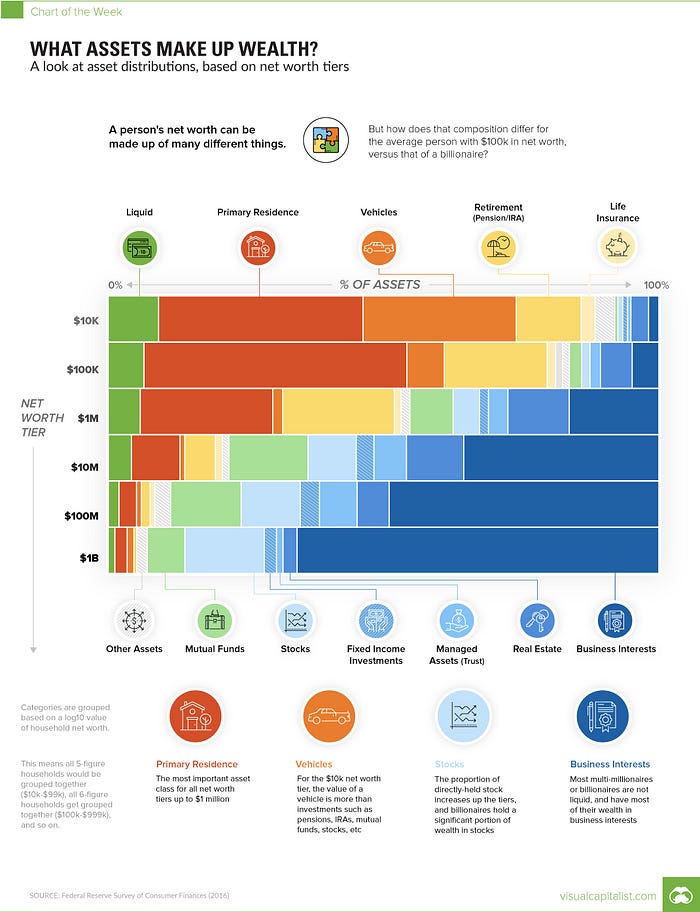
Source: https://www.visualcapitalist.com/chart-assets-make-wealth/

So, I discovered this chart by a post from James Camp, a guy I follow on X, who specializes in “nanoflips.” Check out his bio for info on those.

The graph comes from Visual Capitalist, a clever website that takes complex information and distills it into to easy to understand (and colorful) charts.

The chart displayed above is based on a Federal Reserve Survey of Consumer Finances from 2016, and it contains some illuminating aspects about how people in different net worth tiers manage their wealth.

Like many, I’ve always been under the impression that stocks and mutual funds are the best ways to build and maintain wealth for the average person. Over the last few years, I’ve diligently maxed out my 401(k) and IRA funds. I contribute regularly into a personal brokerage account. Even through the Covid Crash and the 2022 drawdown, I kept plugging away, dollar-cost averaging into the market like you “should.”

The returns have been solid, for sure. While I’m not close to retirement anytime soon, I’ve built up a decent net worth. I like to think I’ve “secured the bag.” Meaning that even if I never contributied another dime to my investment accounts from now until age 65, compound growth alone would get me to a comfortable retirement. And that’s NOT taking into account potential Social Security payments.

I say “potential” because who knows if Social Security will exist by then, or pay out what it’s supposed to. It’s never a good idea to bank your life on a government program, especially when the government is over 30 trillion dollars in debt.

However, the above chart has made me completely reevaluate my relationship with invesing and money in general.

Source: https://unsplash.com/photos/woman-in-gray-shirt-holding-fan-of-us-dollar-bills-OyDZRZOlENw

For starters, the chart shows that the higher a person’s net worth the more they have invested in “business interests.” These are businesses someone owns personally. They could be anything from a franchise, a laundromat, a service company, all the way up to a controlling stake in a Fortune 500 company.

Elon Musk has a 20.5% stake in Tesla, for example.

What’s surprising, however, is how little percentage-wise wealthy people are invested in stocks and mutual funds relative to their net worth. The chart combines net worths together and works out an average. So in the row where it says $10K, it’s grouping all the people with $10K through $100K together. Then in the $100K row, it’s everyone with a net worth between $100K and a million. So on and so forth.

People in the $1 million to $10 million range look to have close to 40% of their net worth in retirement accounts, stocks, and mutual funds. This makes sense give that most people in that range are retirees who spent years contributing to company 401(k) plans, pensions, and their own IRAs. About 30% of their net worth is in their primary residence.

However, going further up in net worth on the chart shows that the wealthy have increasingly less in stocks and personal homes, and vastly more locked up in their own businesses.

For those in the $10M+ group, stocks are no more than about 30% of their net worth, and their personal homes aren’t even 15%. Their wealth is mainly all in their own businesses.

This may seem obvious. But almost everywhere you turn, you only ever hear about the importance of investing in a diversified portfolio of mutual funds and ETFs.

Dave Ramsey touts mutual funds like a religion to his millions of listeners.

But are index funds and mutual funds really the best ways to build wealth?

If you were to ask most people how they think they can get rich through investing, most would probably say by getting lucky on a stock or cryptocurrency.

This is not impossible, of course. A mere $10K in Apple stock 20 years ago would be worth almost $5 million today. Buying Bitcoin or Ethereum just five years ago would have given you substantial returns.

People may remember the “meme stock” craze from just a few years ago with Gamestop and AMC. The whole internet was gripped with trying to ride the next big thing “to the moon.”

Let’s not even talk about the NFT nonsense.

Point is, everyone thinks stock investing = getting rich, except people who actually are rich. They know stocks and mutual funds won’t make you rich. They can make you financially secure. But if you want to become truly wealthy, you’re best bet is by starting your own business.

Think about it. Stock picking is unreliable unless you know what you’re doing. If you decide on the safer, diversified route of index funds, ETFs, or mutual funds, it could take decades to build anything substantial. It’s also highly unlikely you’ll break into the top 1%.

To get to $5 million, for example, you’d have to invest $18,000 a year every year for 40 years at an average annual return of 8%.

Wait, only $18,000 a year? That doesn’t sound too bad.

Well, according to the National Board of Labor Statistics as reported by USA Today, the average salary in the United States in Q4 of 2023 was less than $60,000. So, the typical person would have to stock away almost 1/3 of their income for basically their entire working life to get to that $5 million. That’s a pretty tall order considering they still have taxes and bills to pay.

This information may sound sobering, or even despairing. Especially to 401(k) and IRA maxers like myself, stock market junkies, or those in the FIRE (Financial Independence Retire Early) camp.

It’s important to keep some perspective. A $1 million net worth is still a lot more than most people will ever have. I’d argue you probably don’t even need half of that to retire, provided you manage your money well and are prepared to live modestly. And those are certainly attainable amounts for those who prefer the more traditional route of diversified index fund investing. Investing $3600 a year over 40 years at 8% gets you to a million.

But why cap your financial potential with just mutual funds?

What I’ve taken from this chart is that to become wealthy you’ve got to get creative and entrepreneurial. While I’m going to keep investing in stocks and my retirement accounts, of course, moving forward, I’d like to start thinking beyond them. I’m going to start allocating some of my income toward experimentation with businesses. This will prove a tough adjustment for me, as someone who’s never had his own business or been much of a risk taker. No doubt there will be some failures and surprises along the way. But I think it will be good mindset shift in the end, and hopefully a lucrative one, too.