Chuck Dixon’s ‘Levon Cade’ Series (‘A Working Man’) Is Inspiring

Eleven books produced in one year. Holy shit balls.
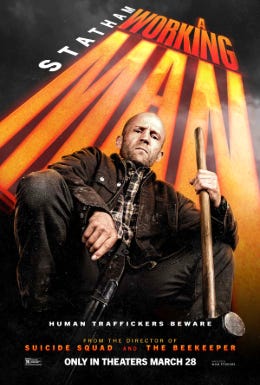
Source: By Amazon MGM Studios — https://www.vitalthrills.com/a-working-man-trailer-featuring-jason-statham/, Fair use, https://en.wikipedia.org/w/index.php?curid=78846003

I’m a recovering “beat-em-up” fan. Back in the day as a teen I used to love those terrible Steven Seagal films like Above the Law and Marked For Death. Or Jean-Claude Van Damme stuff like Bloodsport and Death Warrant. They were constantly on rotation on USA and TBS and other freemium cable channels in the late ’90s. Films that were passably entertaining for immature adolescent minds, but in retrospect are ridiculously cheesy and absurd. But hey, if you haven’t seen Seagal break a Jamaican dude’s arm in half or Van Damme roundhouse kick a guy into a furnace, you haven’t lived.

Nowadays, Jason Statham is your go-to macho man face puncher and bad guy beater downer. Strangely, actors even higher up the talent totem pole have had a go at their own fistacuffs franchises. Bob Odenkirk is Nobody. A-lister Denzel Washington is The Equalizer. And of course Internet Jesus Keanu Reeves is John Wick.

Everyone wants to kick ass these days! Who can blame them? Have you seen the prices of things lately? Going to the grocery store anymore is like going to a Fuck Me in the Ass Parade.

The latest is A Working Man, where Statham plays a former blacks ops soldier turned construction guy who has to return to his face-stomping roots when his boss’s daughter gets kidnapped or something. I’ve not seen it, nor will I ever. Just like I didn’t see Statham’s last flick The Beekeeper, which had pretty much the same plot. The latest edition of Statham Beats Up Some Guys interests me about as much as hanging around a bunch of backwards hat-wearing dude bros talking about their fantasy football picks.

(No man should have a hobby with the word “fantasy” in it. Like, are there sparkles involved? Pink glitter? GTFO of here with that.)

Anyway…

What is pretty cool (and surprising), is that A Working Man is based on a book. Which is part of a book series, actually. By a real author. Not some A.I. trained on Seagal and Van Damme flicks. Chuck Dixon is a prolific author known mostly for his work in the comic book industry. He co-created Bane, aka the villain who broke Batman’s back. So, this guy is well-experienced in creating characters that know how to kick the crap out of people.

Dixon’s series is called Levon Cade, and features the vigilante going on various quests involving revenge and likely crushing a few throats. There are twelve books in total. The first, titled simply Levon’s Trade, premiered in December, 2021. The others came in rapid succession, sometimes as little as three weeks apart, over the course of 2022. The eleventh published in August, after which Dixon took a sabbatical before dropping the twelfth and final (?) in February, 2024. Not bad. Guy banged it all out in roughly a calendar year.

Look, these are not labyrinthine literary feasts like A Game of Thrones. These stories are Fisher-Price simple and Neanderthal stupid. No shit. But when you get down to it, there are really only two genres — “Man with Gun” and “Girl Bangs Guy.” That’s about it. James Bond, for all his British sophistication, is just another “Man with Gun” story. Titanic is the ultimate “Girl Bangs Guy.” The classics usually combine the two in interesting ways. Double Indemnity, for instance. There are some exceptions, often seen in experimental or prestige award stuff, but nobody cares. People only pay attention when someone’s fucking or getting murdered. Can you name the book that won the Nobel Prize for Literature four years ago? No? Have you ever heard of Fifty Shades of Grey? My point exactly.


I am not a fan of simple vigilante series, in either book or movie versions. I read Killing Floor once, the first Jack Reacher book, a long time ago, and the experience was akin to tattoo gunning my eyeballs. I am a fan of writers, however. Especially ones who put in the effort to carve out their own success, in whatever genre they choose. A Working Man has likely done well enough at the box office to merit a sequel. Who knows. It could even be a franchise like John Wick. I have no idea. I’ll never see the films anyway. I outgrew the need for them a long time ago. But I do appreciate them and the writers who make them.
You Don’t Need To Write A Lot To Write A Lot

Consistent effort pays off with cumulative results.

I’ll often see people post on book review sites or forums marveling over an author who churns out multiple novels every year. Popular authors like Stephen King, Dean Koontz, Danielle Steel, and others who are well known for spinning doorstops with apparent ease.

How do these writers do it? It seems impossible.

Some cast doubt that the authors actually wrote their novels on their own. Often they accuse them of using ghostwriters. For sure, some brand name authors, like James Patterson infamously, employ an army of co-writers for their many projects. But many actually do it all by themselves, braving the blank white screen every morning. As David Baldacci says on his X account:

I live to write and write to live.

I recently finished my 11th novel. A book I started on March 23rd of this year — after almost 18 months of false starts — finally completing the first draft on August 27th. That’s a little over five months, or 157 days. The first draft is about 90,700 words.

That comes out to only 577 words a day. Some days I only managed a few hundred. Those were usually the days I worked. Toward the end of the novel, I picked up the pace (as I usually do nearing the exciting conclusion of a book). I probably wrote about 5,000 words in just the last three days before finishing.

Still, my average daily output comes out to a mere 577 words. A simple email might be 500 words. The average person probably texts their friends more than 500 words a day. It’s about the length of a two minute Medium article. A few tweets. Five hundred words is not a lot. Yet 500 words a day comes out to two 90,000 word novels a year. One thousand words a day equals four adult novels. Writing a “little” can really add up fast.

Of course, there’s the editing process. It’s not like once you finish typing that 90,000th word you’re all done. Editing is sometimes a lengthy, complicated process with its own messy timeline.

Then there’s outlining and idea generation. This last novel of mine was a struggle, unlike others in the past. But I found that by sticking to my daily writing regimen, I was able to push through a lot of supposed blockages. It’s usually best just to keep ploughing ahead anyway, even if you think you’re “stuck.”

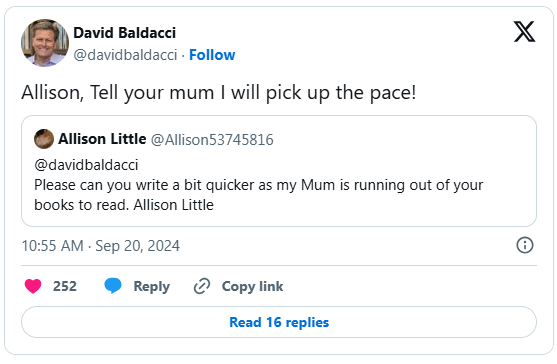
If you are a prolific writer, sometimes it’s not enough for fans. Baldacci recently had this exchange with a reader:

Baldacci publishes multiple books a year, some of which are well over 400 pages. He certainly writes thousands of words a day. But you don’t have to write that much to write a lot. Even “just” 250 words a day is 90,000 words. That’s an adult novel a year. Or two novellas a year. Which is not bad at all.

Observing Two Recent Writing Milestones

On August 26th I completed my 100th article on Medium. It’s not the biggest writing milestone ever. There are accounts on there with hundreds, even thousands.

I had a goal of reaching the century mark by the end of this year, only to end up blowing right past it. This one is №118. A pleasant surprise, especially given how I was consumed with another writing project of mine for most of the past year and a half.

My experience with Medium has been decent. I’ve found some success with a handful of articles that got thousands of claps, and earned me some money. I’ve survived not one, but two account suspensions. One just recently, and another back in 2022. Both occurring without any real reason other than somehow my account became caught in the “spam filter.” Okay, whatever. Never had that issue with Blogspot back in the day or WordPress now.

On the positive side, I have over 900 followers. The majority of whom I’d say subscribed due to my finance-related articles. My highest earning month so far was this past July with $291. I’ve had multiple $100+ months over the last few years. I don’t know that Medium will ever be, or even could be, a full-time gig. Not without insane commitment and a willingness to plunge into primarily the most lucrative subjects (personal development and finance). I have too many other writing projects going on and other interests to go that far with Medium. As I’ve stated previously, I have no desire to try to build a “brand” there. I sure as hell don’t do coaching. I don’t do freelance work. I will never sell a stupid course or membership of some kind. I realize that’s how a lot of top writers on here make their full-time income, but it’s just not me. There are enough “gurus” out there peddling their snake oil. I just write novels and on occasion scribble out a usually sarcastic editorial. And a finance article here and there.

Writing on Medium for money is not a primary concern for me. My earnings have paid for the Friend of Medium badge for a few years though. Which is nice. At the least, the site is a net positive.

Overall, I see Medium as a good place to practice daily writing and gradually build a platform.


Source: Photo by Pixabay from Pexels: https://www.pexels.com/photo/burning-tree-270815/

The other milestone happened to take place the following day on August 27th. That is the completion of my 11th novel. A horror story with a dark and twisted romance at its core. This was a tough one to get through. I struggled with it for years. A sharp contrast to previous novels I’ve written, which largely flowed. The inception of the idea actually came way back in 1999, which makes it the oldest concept I’ve ever maintained and seen through to a completed work. It was just a tiny undeveloped spark of a thing. I didn’t know what to do with it then, so I wound up putting it on the backburner for a few decades.

It wasn’t until 2020 that the idea ignited further. Then in 2022 it started to really kindle. At times it felt like trying to hammer cooling iron into shape. I went down two blind alleys, and almost 50,000 words, before having to start over twice. Daunting and dismaying, for sure. But when I have an idea I’m passionate about, I like to stick with it.

This past March, after revising the outline, I began the third attempt. Six months later the first draft is finally finished, and stands at over 90,000 words. My first drafts tend to be strong. I don’t believe in doing “vomit drafts.” I try to get most of what is needed down on the page in a structured and coherent (more or less) fashion in the first go. Even still, it’s perhaps only 65% where it needs to be. As I typically do when finishing a novel, I let the first draft rest for a bit before returning for revisions.

Even though I’ve written 11 novels so far, I’ve only self-published three of them. This is largely because, while I love writing, I have no effing idea how to market or sell my work. Simultaneously, I have little faith in or concern to play the lottery with the traditional publishing side. I’ve read a lot of articles on here about publishing, and let’s just say it’s a sad state of affairs. Even if you land an agent or a publishing deal, the problem of selling your work remains the same. You have to do all of that yourself.

Few, if any, publishing houses, big or small, will put any money into some no-name like myself. I don’t begrudge the industry. It’s the way it is. Most publishing companies make money on their back catalogue of hits, or on “bread and butter” sales like the dictionary or something. Most authors only sell a few hundred copies of their work at best. Publishing in general is a boutique-style business driven by hits. Hits are random. Even celebrity books have totally bombed. So, until I can solve the marketing side of things and learn how to sell myself, I don’t see much of a purpose in putting my eight finished books out there. Perhaps that’s extreme and self-defeating, but I think it’s important to have a plan of execution and not just go out on a wing and a prayer. My books are like my children. I want to treat them right.

I do love my latest book a lot. I think if there’s one that will finally get me to solve the riddle of the Sphinx of Marketing, it’ll be this one. It’s tough to be a writer these days. You can’t just scribble away in a room and submit to publishing shops. You have to learn to do everything yourself. You have to build your own platform. I suppose that‘s part of why I stick around here on Medium. I probably should make YouTube more of a thing, too. That’s a fantastic digital ecosystem, and potentially, a money-making one.

I’ve also thought about posting some of my fiction on here, though I do like keeping the worlds apart. It’s strange. Even though I enjoy writing articles on Medium, non-fiction never makes me feel like I’m really “writing.” Only when I’m writing my novels do I feel like I’m actually really producing something. Fiction enables me to get into a flow state the best, which is my favorite head space. Nothing else comes close.

Anyway, since I don’t like to spend too much time navel-gazing about writing “successes,” I’ll just leave it at that for now. Two good milestones in the rear view mirror. Onto the next.

Can’t Stop, Won’t Stop: The Work Ethic of These Best-Selling Writers is Insane

Photo by Kateryna Babaieva from Pexels: https://www.pexels.com/photo/man-standing-near-fire-3361235/

That’s no hyperbole, either. Some of these writers have downright ludicrous levels of dedication and focus. They’re not even human, and quite possibly superhuman.

You think you’re a hard working writer because you banged out a few articles on Medium last week? Get the f*ck out of here. You’re nothing compared to these uber authors.

So let’s get started. Prepare to feel inadequate.

First up is, without a doubt, a name you’ve seen, because her books usually take up a half mile of shelf space at the library.

Source: daniellesteel.com

(Pictured above: the TX-9000 Writernator emerging from its luxury tank to obliterate writer’s block).

Her name is Danielle “The Woman of” Steel. To date, this weapon of mass production has written 185 books, including 141 novels, over a career that’s spanned six decades, and sold over 800 million copies.

And the romance novel queen is still going strong. In the first half of this year alone, she’s pumped out three books, with four more planned for the rest of 2022, including one this June. She publishes seven books a year like clockwork.

Her secret? No sleep, apparently.

According to Glamour, she works practically non-stop, sometimes all 24 hours in a day if she’s pressed for a deadline. Says Steel, “Dead or alive, rain or shine, I get to my desk and I do my work.”

For a true writing workaholic, you’d think Steel would have never had time for a personal life. But she actually has nine children. Nine! She’s also been married five times, including one marriage to a man who was an inmate at a prison when she met him for a journalism assignment.

Steel often juggles multiple projects at a time, outlining one, researching another, while writing and revising others, in order to maintain her prodigious output. She hardly eats, abstains from caffeine, scoffs at the very idea of burnout. She writes on a 1946 Olympia standard typewriter. A freaking typewriter. As in that thing Jack Torrance went mad click-clacking away at in The Shining.

Steel also has no concept of so-called writer’s block. Like every writer, she has tough days, sure. But this powerhouse offers this advice for the days when the muse is slow,

“I keep working. The more you shy away from the material, the worse it gets. You’re better off pushing through and ending up with 30 dead pages you can correct later than just sitting there with nothing.”

That’s easy for you to say, Ms. Steel, you’re a literal Terminator.

Up next is a guy some people get mixed up with Stephen King. And that’s because, like the horror master from Maine, he writes a lot of thrillers, some with supernatural elements.

source: deankoontz.com

(Pictured above: Dean Koontz, who actually wrote a whole book with his left hand on a hidden typewriter while this picture was taken).

But to be clear, Dean Koontz has a style all his own. He mixes and matches with different genres, often blending them together into his own special recipe.

Koontz is best known perhaps for the Odd Thomas series, which is about a short-order cook who can see dead people. But he’s been writing novels since the late 1960s.

He’s sold somewhere around 400 million copies of his books. The Wikipedia entry credits him with 91 books, but at this point it’s likely at least 130 plus. That’s another sign you’re a Robo Writer. Articles can’t even keep up with how many books you’ve actually written.

Don’t dare ask Dean Koontz if he’s working hard or hardly working. The Koontz Express is always rolling.

So, what is Mr. Koontz’s recipe for earning consideration as one of the hardest working writer’s today?

Koontz writes on the FAQ section of his website about his daily work habit:

“I work 10- and 11-hour days because in long sessions I fall away more completely into story and characters than I would in, say, a six-hour day.”

But lest you think that Koontz regards his phenomenally successful writing career just any old 9–5, the suspense master also mentions something special that keeps him motivated to churn out the pages:

“I am enchanted by the English language, by its beauty and flexibility, also by the power of storytelling to expand the mind and lift the heart.”

In addition, the writer stays motivated by his charity, the Dean and Gerda Koontz Foundation, which contributes to the severely disabled, critically ill children, and dogs.

Like his romance novelist counterpart Steel, Koontz exhibits profound focus, eschewing TV, the internet, email, and other distractions. After first starting out on a typewriter, he eventually bought an IBM Displaywriter, which he used to write for most of his career. Though recently, in 2020, he upgraded with a newer HP computer and Microsoft Word.

The type of writing tools Koontz uses may seem just seem like trivia, but it actually highlights a way he stays on task. Especially today with social media and texting, it’s easy for a writer to get distracted. But with a machine like a Displaywriter, or a typewriter, that can only perform a single operation at a time, all you have to be “distracted” by is the writing itself.

In an interview with Harvard Business Review, Koontz says:

By 6:30, I’m at my desk, then I work until dinner. I rarely have lunch, because if I eat, I get furry-minded. I do that six days a week or, if I’m at the end of a book, seven. If it’s the last quarter of a book, where the momentum is with me, I’ve been known to work 100-hour weeks.

In addition, he credits his wife Gerda, his wife of 56 years, who helps manage all the practical concerns of life (money and other domestic issues), allowing him to focus on the fiction side of things.

Never underestimate the importance of a good, supportive spouse. That’s true for writing. Or for any career, for that matter.

Man, Koontz and Steel are Warrior Writers, without a doubt. Who could possibly top them?

It’s time to talk about the gran jefa, the queso grande, the grand campeona herself.

The grand prize for Ridiculously Prolific Writer for the Ages has to go to Spanish romance author Corín Tellado.

(Pictured above: Corín Tellado. You can call her “Boss”).

I found Senora Tellado’s output mind blowing. So much, I had to whip out the old calculator to try to crunch the numbers, and see just how much this mad scribbling machine did over her career.

Yes, Ms. Tellado got me, an English major, to actually reach for the dreaded calculator and do maths. That’s like Moses parting the Red Sea.

Tellado wrote over 4,000 books in her lifetime. Mainly novelas, that ranged around 100–150 pages each. But even sticking with steamy shorter-length books, at an average 125 pages for each book, times 4,000, that comes out to roughly 500,000 pages.

A typical MS Word page might be anywhere around 500–750 words, depending on the font and type of content (description or dialogue). But even if we’re taking the lower estimate at 600 words per page on average, that means Senora Tellado wrote about 300,000,000 words in her lifetime.

Tellado lived until age 81, and was an active writer from when she sold her first novel at age 18, until her death in 2009. Broken down by days (22,995), that means the Spanish author averaged about 13,046 words PER DAY.

Simply astounding. Even if you cut that number in half to 6,523 it’s still incredibly impressive. That’s like six average-sized Medium articles a day. Every day. For 63 years. It’s fair to say Tellado would have smoked Tim Denning.

All in all, she sold over 400 million books, and remains the second most read Spanish writer of all time, after Miguel de Cervantes (the Don Quixote guy).

And there you have it. Three superhuman uber authors. Don’t dare mention the words “ghostwriter” or “coauthoring” to them. All their books came from their own keyboard-hardened fingertips.

While it may seem these writers scale the literary equivalent of Mt. Everest every year like it’s no big deal, their big secret to word mastery is actually very simple.

Good old fashioned hard work. Yep, that’s it.

They sit down and punch letters. No matter what. Every day. For as long as it takes. Until the job gets done.

A sign hangs in Ms. Steel’s office that sums it up best: “There are no miracles. There is only discipline.”