Privileges That Actually Matter

Why does nobody ever talk about these?

I had no idea what picture to put for this, so here’s a bunch of cute kittens. Photo by Pixabay from Pexels: https://www.pexels.com/photo/assorted-color-kittens-45170/

Recently, I had the exquisite pleasure of telling a DEI proponent how much I think their ideology is trash.

So-called diversity, equity and inclusion is all about separating people according to supposed “privileges,” often based on race, gender, and ethnicity. But also background, economics, sexuality, physically able-bodiedness, among other things. Then trying to assemble people of all these various stripes into every situation for the purposes of “inclusion.” You see this most pronounced in the casting of movies and TV shows now.

The idea is to create a human mosaic of the modern world, I guess. It’s why Doctor Who became a lesbian, and is now a gay Black guy. It’s why virtually every White lead must be paired with a token Black best friend anymore. For example, I was just watching Inside Out 2 last night (which is a good movie, check it out), and wouldn’t you know it, the 13-year-old White chick Riley just so happens to have two “diverse” best friends, one Black, and one Mexican or something (not sure). Then there was that Chris Pratt movie The Tomorrow War where Pratt somehow has two Black friends despite being a White guy living in the suburbs. That still cracks me up.

You see this sort of colorful casting and mixing most glaringly in NFL commercials, where virtually every married couple is interracial, and quite often middle-aged uncool White guys play fools getting corrected by cool and wise minorities. A trope so common it’s become, well, a trope. There’s even an X account called White Men Are Stupid In Commercials that tracks the trope.

Now, personally, I don’t watch TV much, and I rarely watch the NFL anymore. I don’t care about 99% of DEI shit when it comes to entertainment, just because I don’t watch much of what’s out here. I don’t really care that Riley has two minority friends, or that White guys are idiots in NFL commercials. I had friends of all backgrounds when I was a kid myself. I don’t care that the Little Mermaid is Black. The actress who plays Ariel is actually very nice, and I think she was unfairly targeted with a lot of racist B.S. when she took that role. I’m simply pointing out the trend and noticing the differences. And laughing about it, of course.

DEI itself all sounds very nice on the surface. That’s why it’s been successful in wedging itself into politics and the corporate world (for now). In fact, “superficiality” is really its defining characteristic as a belief system. It puts all this emphasis on generally superficial things, ignoring what makes people truly unique — their thoughts and beliefs and accomplishments. But even worse, it makes one’s physical appearance assumptive of one’s beliefs and status within the culture. Surely you recall Joe Biden’s comment to Blacks that if they didn’t vote for him, they “weren’t Black.” Because the assumption there is that if one is Black they must automatically vote Democrat, and that by voting otherwise is to commit a sin against the Black community.

How terrible that must be. To think that because of your skin tone you should be beholden to some political party. How stupid and silly. And how is that working out, by the way? Democrat-run inner cities are shitholes. It’s not to say Republicans would necessarily do better. Some places are just going to be ghettos regardless of whatever party is in charge.

As a biracial person myself, I can’t even tell you how much I’ve been condescended to and pandered to and told how freaking awesome it must be to have the “best of both worlds.” Very often by White liberals or Whites who have bought into this DEI nonsense. Or Whites who seem to think it’s their duty to make sure I know that they know they’re totally comfortable around non 100% Whites or whatever. All the while, I hate being biracial, and largely because some people can’t help but make race one’s biggest defining characteristic and want others to join in on their fucking race-fest. And for a host of other reasons I go into in the article.

I will say, though, that if there’s one benefit to being biracial, it’s that I’m able to speak frankly about race matters while being insulated (somewhat) from criticism as a full White person would be. Though that shouldn’t be the case. Everyone should be able to talk freely about race.

DEI also runs counter against competency, favoring superficiality over qualifications that actually matter. DEI only “works” in areas where people are interchangeable and where the placement of diverse individuals is being done largely as a symbolic gesture. This is why it’s so predominant in entertainment. To me, it’s a meaningless gesture and just a way for companies to pat themselves on the back and feel good about themselves. It’s not like I’m going to buy a bag of Tostitos because a biracial White/Hispanic guy who looks like me is munching on some in a commercial. I don’t like chips much anyway. In fact, I may purposely NOT buy them just out of spite because Tostitos thinks I’ll fall for that pandering shit.

Anyway, I’m not going to get too deeply down the DEI rabbit hole. There are enough commentators out there arguing against it way better than I ever could. As a thought system, it’s a piece of shit. I’ll just leave it at that.

In my 42 years I’ve noticed that people, including myself, rarely if ever fail or succeed based solely on their race and ethnicity. In virtually all cases, it comes down to a merit or a meaningful characteristic of some kind that make a real difference. Some of which are earned, while others are purely happenstantial or genetic. Here are a few of them:

Pretty Privilege

This has to be one of the biggest and the best privileges one can have. I often joke with friends that if reincarnation is real, I just want to come back as a hot surfer dude who lives on the beach and gets laid all the time. I don’t care how dumb I am. I don’t care if I get eaten by a shark at 25. I don’t care how superficial it may be. I just want to be a hot guy who fucks hotties in my next life. I am so done with this fucking face of mine.

Do you know how easy life is for attractive people? Do you know how much more welcoming people are to attractive people versus ugly ones? It is life on easy mode. Even more so if you’re a guy, just because few men are considered hot by women.

You could be a convicted felon and still have women head over heels for you, just because you’re hot. The guy in the mugshot above is Jeremy Meeks, whose picture went viral. Now he’s a model. If the guy had not happened to be born with perfect bone structure, he’d have been ignored and probably rotting away in a jail cell by now. Instead, he’s got a career.

This may be an extreme case, but it’s indicative of a real form of privilege and power a person can have purely accidentally and through zero effort of their own. Is it fair? No. But life isn’t fair, as we all know.

Look, all this DEI shit is just a way of talking about social status. And attractiveness is something that grants a person instant status. I’m not saying being hot is everything. If you’re really dumb but hot, your dumbness may really work against you and cost you. But let’s not pretend being good-looking is not a huge key than can open a lot of doors to a better life. My life would be very different and certainly better if I looked more like Antonio Banderas than a slightly less-pockmarked Danny Trejo.

Intelligence/IQ Privilege

At the end of the day, this form of privilege is really the only thing that matters. Hotness may get all the attention, but intelligence and IQ are monolithically way bigger and matter way more for survival and long-term success.

For sure, you can level up in life. You can apply yourself. You can earn degrees. You can learn different skills and such. But your intelligence is very often your hardware, not your software. You either have the ability to become a brain surgeon, or you don’t. Not everyone is cognitively equipped to deal with strenuous material or certain kinds of material. I don’t think I could ever become an engineer or a math expert no matter how much I tried. I have zero knack for things like construction or mechanics. I like to write, and that’s about it. I’m probably above average in that area. But I’m no Hemingway or Tarantino. In school growing up and in college, I consistently ranked in the top fifteen or ten percent of my class. But I was never a top one percenter. I was never that kid who was really smart.

There’s a certain cynical side in me that believes that humanity largely serves at the whim of a very small intellectual elite. Not the wealthy. Not the “powerful.” The intelligent, because in most cases it is IQ that put someone in that lofty position. Take Jeff Bezos, for instance. The guy completely transformed how ecommerce is done, and his company Amazon has a virtual monopoly in the U.S. Or take Google, Microsoft, Meta, etc. Our lives are largely controlled by a handful of hyper-intelligent guys working in Silicon Valley. Or take J. Robert Oppenheimer and the Nolan film that came out last year about the scientist. That whole movie is about showing how we live in a world shaped by a smart guy who (with other smart guys) invented a device (the atomic bomb) that can wipe us all out in an instant.

DEI talks all day and night about “economic inequalities.” But the truth is wealth is often a symptom of intelligence. Bezos, Zuckerberg and others are not super wealthy by accident. They invented things that reshaped society. They mastered the game of capitalism. Money is just a reward system for smartness, really. We can debate all day about whether it’s fair or right that some random guy gets paid millions on Wall Street trading with a proprietary algorithm software he created, but the fact is financial firms and hedge funds are willing to pay top dollar for such people and their talents.

Physical Privilege (Height, Health, Athletic ability, etc.)

This is another big one, and I don’t just mean being able-bodied and so forth. Obviously not being paralyzed or being born with some incapacitating disease or disability is a big privilege to have. But good health is pretty much the best thing to have when it comes to winning the genetic lottery. High intelligence and good looks are rare. But most people are at least given a decent-enough body that if they take care of it they can be in optimum health. Having good eyes is a privilege, as many people need glasses or lose their sight as they age.

Mental health is especially valuable. I used to work with the mentally disabled, and I can tell you that NOT having a brain that sabotages you at every turn is a gigantic plus in life.

Then there are nice features to have, like height or athletic ability. I was usually on the taller side in my classes. I’m six feet now as an adult. But I was never much of an athlete. I could compete up through junior varsity soccer in high school. But there was always a huge divide between me and the bigger more athletic boys. I could just never keep up.

Youth Privilege

I have to laugh when I see these DEI activists crying on TV news shows or podcasts about inequities and inequalities and all sorts of unfair things in life, because usually they are young people in college or right out of college.

I’ll be sitting there thinking, sir or madam, do you not realize that you are in the prime of life? Do you not realize how you likely have decades before you need to worry about gray hair, back pain, heart problems, and many other age-related issues? How are you not appreciative of the fact that in fifty years you will likely still be here while many people will not be here even tomorrow? There are people in their 90s that are as you read this languishing on their death bed, with only days or hours to live. I think of my beloved grandmother’s last days with cancer. She spent almost six months in a hospital before finally passing away. I loved her deeply and wish I could have spent more time with her. Six months is a blink, really. It all went too fast, and now she’s gone.

The younger you are, the more time you likely have in life for everything. Time is itself a real privilege. We all have some it, we just don’t know how much.

Those are just a handful of big privileges that matter in life a lot more than race, ethnicity, gender, sexuality, and other things. Yet I never hear DEI people talk about them, because they’d rather focus on superficial bullshit that frankly, doesn’t matter all that much. They’d rather throw up tokens and symbolic castings on TV shows or movies and act like all that stuff equates to “progress.” I’m a little more concerned that we live in the Nuclear Age where we can destroy ourselves at the push of a button. I’m more concerned that half of humanity wants to blow the other half up because they don’t believe in the same sky daddy. But hey, at least the Little Mermaid is Black, right? We got that going for us.

It’s not to say racism and discrimination don’t happen and impact people’s lives. But one should be cognizant of the many tools they may have in their toolbox. Sometimes some privileges can be canceled out by deficiences elsewhere. Years ago as a teen I went to church and there was a White guy there I knew who was exceptionally good-looking. He was blonde and blue-eyed. I remember him because I was honestly jeolous of the guy’s looks when I first met him. He was what DEI weirdos would accuse of having White privilege. Except he had a rare immunity disorder that caused him to be sick a lot. Like every month he would end up bed-ridden and have to stay home for days. Imagine having to live with something like that? I woudn’t trade in my uggo face for a better one if it meant I’d be stuck in my house sick as a dog all the time. It just wouldn’t be worth it.

There are some privileges that cancel out other privileges. A healthy young Black guy is in a better spot overall than a 60-year-old White guy with heart problems. One’s got fifty some years to live. The other not so much. Wouldn’t youth and health privilege cancel out the supposed White privilege in that scenario?

DEI, like many race-obsessed thought systems, is divisive, demoralizing, and counterproductive to living a good life. It also trains people to ignore the many gifts they do have and should be thankful for and try to use for their own benefit and others. I count myself there, too. I agonize far too much over being biracial. I let it affect me when it shouldn’t. I should really just get over it and realize everyone’s an individual and not a semblance of features.

I Hate Being Biracial

Race mixing is not always ideal. Sorry, no, I will not serve as an avatar of sunshine rainbow diversity multicultural “success.”

Photo by Rachel Xiao from Pexels: https://www.pexels.com/photo/bare-tree-772988/

Years ago, this was a taboo subject for me. If someone asked me, “What are you?” (which, by the way, is not really the most tactful way to ask someone about their ethnicity) I would freeze up. I’d get angry, but try not to show it. Sometimes I’d just ignore the question altogether as if it were clearly only asked by mistake, or uttered due to a Tourette tic, and therefore to be ignored so as not to embarass the asker. It would take me hours to calm down.

Nowadays, I don’t really care as much. I’ll usually answer with some generic version of, “I’m a lot of things.” If I’m feeling spicy, I’ll say something like, “What, are you a census taker?” It’s more a source of humor for me now. I can laugh at it. I don’t turn into some schizoid weirdo anymore when the subject of my race comes up. I can examine it detached, clinically, and somewhat neutrally. But it’s not exactly a subject I care to get into. I truly do wish we lived in a race blind world where it was no big deal. But people are curious. And like it or not, race is a fascinating and often contentious subject.

I should probably clarify what I mean when I say, “I hate being biracial.” That’s a pretty extreme statement. I don’t hate myself, to be clear. I hate my racial mixedness and my skin tone that implies it in the same way a 5’2″ guy might hate the fact that he’s short. Or a balding guy hates that he’s losing his hair. Or the way someone might hate that they struggle with their weight. I don’t view race as some “extra” thing about one’s identity. It’s just another physical attribute of one’s body. I hate that it’s a “conversation piece.” Something that it feels I have to justify or explain. It’s like missing an eye — you’ll invariably get that question of how you lost it. I also hate the size of my nose and my acne-prone skin too, for that matter. So, it’s purely in that vein.

I’m not saying being racially mixed is inherently a negative. Some people I’m sure love it or take “pride” in it. Me, not so much. It’s always felt like I was wearing clothes that don’t fit.

I tend to surprise people when I bluntly state how I don’t like being mixed. “What, OMG, but what about Tiger Woods or (fill in the blank racially mixed celebrity)?” Yeah, what about him? His race is Wealthy Celebrity Athlete, not whatever mix he is.

“Oh, but you have the best of both worlds. Whites tan at salons all the time so they can look like you.” If it’s so great, then everyone would be in an interracial relationship so they could have mixed kids. Except the vast majority aren’t because they don’t want that, because most people want their kids to look like them.

“But you look like the future.” What future? When? In two hundred years? Why should I give a fuck what people hypothetically may look like in two centuries?

“But Jesus was biracial” (yes, someone said that). What? No he wasn’t. He wasn’t even really human (assuming he existed). You see any ordinary people turn water into wine or rise from the dead? I didn’t think so.

::sigh::

Race carries with it more social baggage than most other physical characteristics. People tend to assume all kinds of different things about your race. One’s race can often result in far different life experiences and perspectives. I don’t subscribe to many of the left wing concepts about DEI, unconcious racial bias, and a lot of other race-themed stuff. It all seems to be targeted unfairly in one direction — at Whites. A lot of it is nonsense. And also because honestly, I just don’t care. So-called “bias” is often rooted in simple pattern recognition. If a woman by herself sees me walking down the street at night, she’s more apt to feel afraid of me than another woman. Well, duh. That’s because men commit like 99% of all assaults, and mostly they assault women. By the same token, if you had to guess who the majority of shooting victims in major cities are, and you thought Black youths, you’d be correct. Stats are not a form of “bias.” Self-preservation based on pattern recognition is not bias. But I get where the leftoids are coming from in some ways. Some genuine racism exists. Okay, got it.

I’m also not as extreme as, say, Jesse Lee Peterson, who refuses to acknowledge that racism even exists. But I also get where he’s coming from there, too. Racism is very overrated these days as a social ill. Most times if someone doesn’t like you, it has nothing to do with your race. They just don’t like you individually. Too many people are too quick to assume it’s all about race and racism. It really isn’t. I also don’t care for the right wing platitude, “There’s only one race — the human race.” Really, you sure about that? Because I’ve never seen a right winger (or anyone, for that matter) just blindly choose where to buy a house. Usually “the type of neighborhood” (i.e. how many Blacks/Browns live there) factors a great deal into where one intends to live, especially if they’re White.

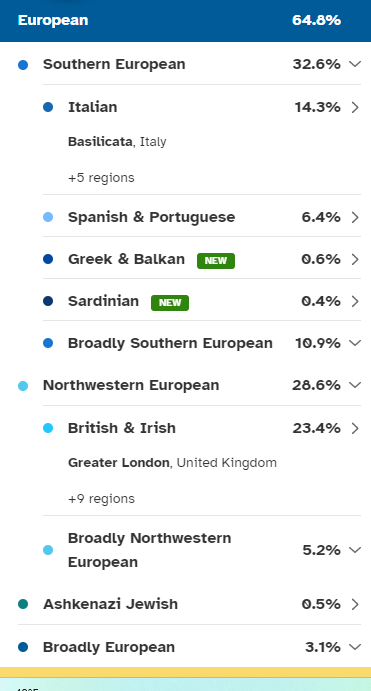
I’ve written elsewhere about my ethnic heritage. Here’s a link to an article where I display my exact genetic makeup from 23andMe.

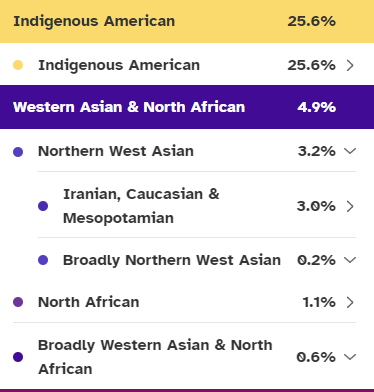
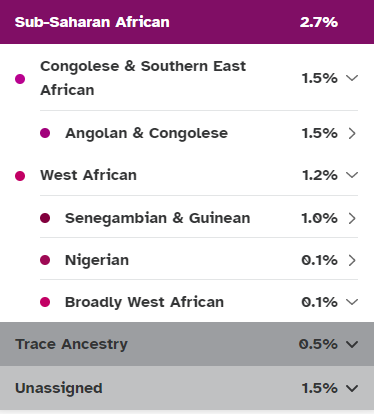
Basically, I’m 64% European. Mainly a mix of Italian, Irish, English, Portugese, and other things. While also being about 25% Indigenous American due to my Mexican/Hispanic background. The small remainder is a mix of West Asian (4.9%) and Sub-Saharan African (2.7%). The precise genetic mixing is not that important. What’s important is that I’m dark and different looking enough to not just be “plain boring” White. Most people don’t really know what the hell I am just from looking, though many will guess Hispanic, as that part of me dominates my physical features.

For the fortunate, their race or ethnicity is not a contentious issue. For some it’s a total non-factor. For me, even the fact that I was racially mixed at all was a source of debate. Well, denial, really. My mother (White, mainly Italian and almost entirely European) always insisted that I too, was White, because “Hispanics are considered Caucasian.” That’s debatable in some ways depending on how closely related one is to the Spanish versus the native tribes the Spaniards and other Western nations colonized way back when. But few people will just lump Mexicans in with White unless they look totally White. Certainly not dark. I did not have “dark” skin, I had “Mediterranean olive skin,” according to my mom. Given that I am 64% European, I can see her point. But I think a lot of my mother’s beliefs were wishful projections on her part. She split from my father when I was barely an infant, and then the two fought a nasty two-year custody battle over me. My father is where I get my darker pigmentation, as he’s largely Mexican. My mother did not wish to have a Mexican-looking kid. She wanted a kid who looked more like her. So, therefore, I was “White,” darker complexion be damned.

It’s a tough thing for one’s mere conception to become the source of great conflict and drama between parents. When you add in the culture and racial clash, it can become pretty severe. Then when you also add in the fact that one parent denies that you’re even racially mixed to begin with, it can create a rather toxic identity-shattering brew. Making matters worse, I did not have the opportunity to know my biological father growing up. I never had any connection to my Mexican/Hispanic heritage. I did not get to know my many half-siblings on my father’s side. That whole part of my background was handwaved away and treated as though irrelevant. My mother later married a White guy whom I never cared for, and then had three more children. I was the lone mixed bastard offspring.

As a kid I adapted fine to the family dynamic. What other choice did I have? It was only as I got older that I realized what a shit deal it all was for me, and resented being the different one. I wasn’t even allowed to refer to my step-dad as “step-dad.” He was my “father,” which became a source of contention and conflict. My mother’s separation of me from my real father was never really explained and never justified. Making things worse, my mother became an extreme fundamentalist Christian in the Southern Baptist tradition. This was at the height of the “Moral Majority” and End Times stuff in the ’80s and ’90s. My mother viewed her past with my father as her old, “sinful” life. Now she was “saved.” This is not uncommon. Many women go out into the world, get pregnant by some dude they end up hating, then do the about face into the piety and religion thing. It’s practically a trope, which I call “whiplash conversion.”

This whiplash conversion trope is something White women excel at particularly. Get knocked up by a Brown/Black guy they were just “experimenting” with, then go running into the arms of a safe White guy provider and turn Christian and go to church three times a week. It’s become such a common thing that it’s mercilessly mocked on the racist side of X and other social media. It’s called “paying the toll,” “coal burning” or “mudsharking.” There are tons of memes about it which I won’t share here, but they’re easy enough to find. Having been the product of such experimentation and suffered as a result, I’d be lying if I said I don’t feel visceral anger when seeing such cataclysmic breakups happen to other children, especially boys. It’s not pleasant to know that most of society views you as the butt of a joke, even though they’d never admit it outloud. Sure, you can say it’s “only social media.” But social media reflects a lot of actual social thought.

For me, race mixing, and its consequence of racially mixed offspring, will always carry a negative taint, even though I myself am biracial. It will always be something that bears high risk. Like carrying nitroglycerine across a cobblestone road. It will always be something that represents pain and loss for me, due to the fallout between my parents and how it affected me. Divorce and parental strife is bad for children of all races, but for the biracial there is the added risk of losing touch with half their heritage, and potentially feeling lost and bearing an identity crisis later in life. Many biracial people report having conflicted identity issues no matter what.

Many biracial people would choose one side over the other if they could, and feel it isn’t themselves but society that chooses what they are. It’s that lack of having a choice about who you are that bothers me especially. I also have no choice but to perpetuate race mixing if I were to have kids. No matter what race my wife would be, my children will be mixed because of me. Do I risk potentially burdening them with the same issues I had?

Even in an ideal family situation, there’s a tendency to prefer association with those who look like you. Like tends to attract like. This is why Whites tend to buy homes in White neighborhoods. It’s why race tends to marry within race, even in supposedly multicultural America. Something like 80% of White women marry White guys. Black women and Asian women tend to be most open to marrying outside color lines. With Hispanic women, it’s more split. But then many Hispanics do pass for White or have some overlap (like myself).

Being biracial puts you at a statistical disadvantage when it comes to finding a partner, because you have to find one who is comfortable with both your backgrounds — something I’ve found is not often the case. You could, of course, try to find another biracial person. But we are actually few and far between, and depending on shade, we tend to go for our “dominant” side. Then there is the aspect of disappointing both sides. As I wrote about in the above-linked article, I’ve been told I’m “too White” by Hispanic women and not White at all by White women, or not White enough. Something I’ll always find sadly amusing.

You also have to watch out that you’re not just a “flavor of the month,” or that someone is only interested in you just because of your skin tone. Many years ago, a White lady at work tried to set me up with her only daughter because her daughter was “into Hispanic guys.” I politely told her no thanks. I have no idea what it means to be “Hispanic.” It’s just genetic happenstance to me. I’m just a man. I’d rather someone like me for me. This was a tough thing to do, because her daughter seemed nice and I did find her attractive, and I got along well with her mother. I sometimes think back to that encounter and think that had she approached me from a better angle, how it could have gone another way. But I didn’t have any idea what sort of expectations a girl who’s “into Hispanic guys” had, and it honestly made me uncomfortable. I get that race is a factor in attraction, but it’s usually not something that’s a first priority unless you’re fetishizing it. Oh well, it doesn’t matter now.

Being mixed is like living in a racial no-man’s land. Given the fact that virtually every social environment I grew up in was nearly 100% White, it’d have been far easier for myself to have just been White rather than only culturally White. Being Not Actually White but having to be surrounded by Actual Whites makes one feel like a fraud, as I suppose it would be for a “daywalker” of any other race. Half-Black, Half-Asian, whatever. I never really felt comfortable or fit in, even with my own half-siblings. It’s not exactly psychologically healthy to always feel alien, especially when living in your own house. Moving around as much as I did didn’t help things, either. And I moved a lot. You tend to feel more alone and isolated. It was increasingly harder to even relate to my own mother. I look very little like her, and in fact, look the most like my father out of all his kids. Had I grown up and lived in a largely Hispanic area, I would probably have felt the same alienness about my Whiteness.

It’s not all doom and gloom. Perhaps my experiences are what led to my self-reliant and highly individualist nature as an adult. Besides, virtually all kids have trouble fitting in in their own way. I knew a White girl in fifth grade who one day decided to stab herself in the side with a pencil because she didn’t like being in class. I remember the side of her t-shirt soaked with blood as she got up to go to the nurse. I wonder what kind of inner turmoil she must have been going through. For all my inner angst at the time, I mean, hey, I never stabbed myself or did any self-harm. It could have been worse, you know?


These days, mixedracedness and diversity are broadly celebrated. At least it would appear that way in the media. There is less cream cheese on TV and in movies in favor of caramel and chocolate. Racially ambiguous stars like The Rock and Vin Diesel are popular. Hell, we had a biracial president in Barack Obama. Doesn’t all of that mean we’re progressing? Surely we are on the cusp of a racially blind utopia. Daywalkers like myself should be rejoicing as we enter this new age. Except I think we’re more divided now than ever. I think a lot of diversity is forced, contrived for image, and not exactly genuine. Like I said before, people freely associate. We don’t exist in some hypothetical national narrative perpetuated by the media. We exist at the local level. In our own lives. Not in an NFL commercial. Racial and ethnic tensions still exist. But whether you’re one race or another, at least you know what team you’re playing on. When you’re mixed, you have no idea, and neither does anyone else.

My perspective has grown and matured over the years. In the end, you get handed the genetic cards you’re dealt, and you’ve got to play them however you can. Both my parents are short, and yet somehow I wound up six feet tall. Something like only 15% of men are six feet or higher. That’s a plus. Most of my family lived long healthy lives, even into their 90s. I’ve been healthy my whole life, knock on wood. I admit that a lot of my thinking about being biracial is colored negatively because of how my parent’s relationship fell apart. Had things gone better there I probably would feel rosier about it. But the chips fell as they did.

I don’t view any one race as inherently better or worse. But there’s no denying that being in a region where one race is the super majority that you’ll likely feel isolated and alien if you look different. However, it’s not like being White means you automatically fit in with other Whites. No race or ethnicity is a monolith. Still, I’ll probably go to my grave hating being biracial. For me it brough too many complications I’d just assume not have. But that doesn’t mean it’s not a good thing for someone else. Everyone is different in their own way.

A Pathological Obsession With Diversity

Virtue signaling or genuine longing to display the human rainbow?

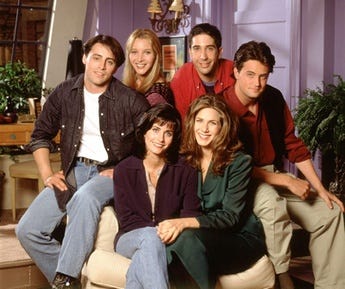
By An article in The Baltimore Sun, Fair use, https://en.wikipedia.org/w/index.php?curid=20960240

The title of this piece is in reference in part to some recent comments made by Adam Goldberg, who played a bit part on the show Friends back in the day. In an interview with Independent, when asked about modern criticism toward the show due its lack of diversity, he said:

And in terms of diversity, looking back, it seems insane. I’ve heard Black people speak about this and it’s like, you never expected to see yourself, so when you didn’t, it was not a surprise, and you ended up identifying to characters, irrespective of their race.

The ’90s was a weird time in TV history when it came to racial integration. Back then, TV shows were largely segregated, with little integration unless an episode was racially-themed. You had White shows like Full House and Married with Children. Then you had Black shows like Family Matters and The Fresh Prince of Bel-Air. There were no mainstream Latin or Asian shows to my knoweldge. Certainly no Native American ones. It was vanilla and chocolate, with hardly any mixing.

Friends was not unsual in its milk-colored casting choices. I never watched the show, nor did I ever care for it or find it funny. What little I’ve seen of it I find cringe and annoying. I’m a Seinfeld guy. But I do recall that Friends had a wide and ironically diverse audience despite its “insane” lack thereof.

In 2004 in college I was friends with a young African woman who loved the show and raved all week about seeing the anticipated series finale. In one of the lounges, people gathered around watching the last episode. To be clear, it most likely had a largely White audience, but the show’s humor (or what passed for it) seemed to catch on with all kinds.

Goldberg’s comments are rather innocuous. The show’s co-creator, Marta Kauffman, however, was more passionate in her response. Saying to the Los Angeles Times:

“I’ve learned a lot in the last 20 years,” Kauffman said in a Zoom interview. “Admitting and accepting guilt is not easy. It’s painful looking at yourself in the mirror. I’m embarrassed that I didn’t know better 25 years ago.”

She adds:

The series’ failure to be more inclusive, Kauffman says, was a symptom of her internalization of the systemic racism that plagues our society, which she came to see more clearly in the aftermath of the 2020 murder of George Floyd by Minneapolis police and the worldwide protest movement that erupted around it.

Kauffman felt so bad about her supposed “failures” that she donated $4 million to her alma mater, Brandeis University, to establish a professorship in the school’s African and African American Studies Department. A nice gesture on her part, I suppose. Perhaps the largest sum anyone’s ever paid to soothe their conscience for the crime of creating an insufficiently diverse hit TV show.

Though I would call it pathological. How sad and tragic that someone’s greatest accomplishment in life should be sullied by such pointless feelings of guilt over an imaginary transgression. This is the kind of remorse appropriate if you killed someone drunk driving. But casting six White people with good chemistry in a dumb sitcom? Please. It all seems performative and just a cynical attempt to pay off an angry mob.

It’s not the job of a TV show or movie to perfectly represent some fictious ideal image of a multicultual society. Or to live up to some hypothetical future standard. Sitcoms are notoriously tricky to cast for and rarely succeed. Many are canceled right out of the gate. The best ones all have a rare casting synergy, and for the most part have been homogenous. Comedy in general is largely a birds of a feather affair, save for some exceptional pairings like Gene Wilder and Richard Pryor. Or Lucille Ball and Desi Arnaz.

Even when a show injects some ethnic mixing, it often comes off as unconvincing, forced, or awkward. I always felt that the Indian character Raj in The Big Bang Theory was marginized and especially virginal compared to the better developed White characters. In the first season he hardly even speaks. But I suppose he represents “diversity,” or at least serves as an avatar of it.

I find myself agreeing somewhat with Lisa Kudrow, who said in the New York Post (emphasis mine):

“I feel like it was a show created by two people who went to Brandeis and wrote about their lives after college,” Kudrow said.

“And for shows especially, when it’s going to be a comedy that’s character-driven, you write what you know. They have no business writing stories about the experiences of being a person of color,” she added.

I think Kudrow’s comments make a very good point, and illustrate how we should not assume that a lack of diversity is due to malice or internalized racism, but an inability to be as authentic as the art requires. If you had primarily White friends in college and directly after, and then you proceed to make a hit show based on that life of yours, and that show goes on to get made with an all-White cast and becomes a cultural touchstone (however undeserving or absurd that is), then I say good for you. You have nothing to feel bad about.

I mean, at the end of the day, are we really going to take some overrated crap show like Friends and call that a mirror or summation of ’90s culture? No show could possibly encapsulate the ’90s. I lived in and remember that entire decade. Does that show reflect our society or just one woman’s experiences as a young person living in New York City with her stupid friends? Are people so desperate to see themselves in things that they’ll attack a show that’s been off the air for two decades over its lack of diverse casting? Especially now in the social media age we live in, where anyone can put themselves out there on a dozen platforms and find an audience no matter what race or ethnicity they are?

Attack Friends all you want for being unfunny and cringe as hell. But don’t waste your time bashing it for its lack of diversity. That’s actually insane.

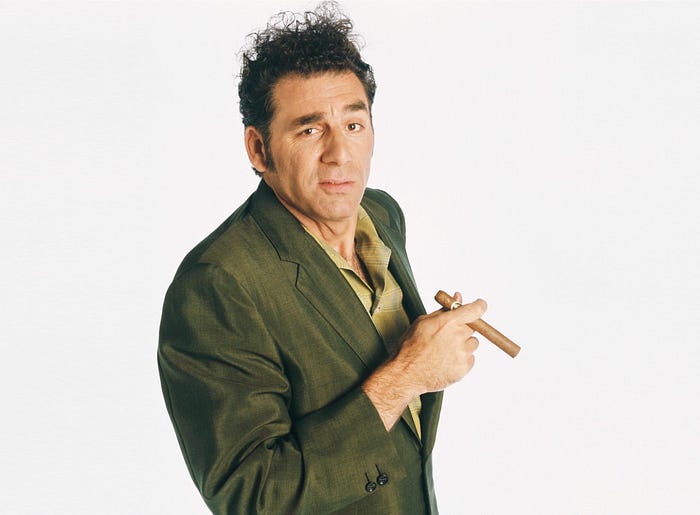
Time to Forgive Michael Richards (Kramer From ‘Seinfeld’) For His Racist 2006 Meltdown?

Is it possible to regrow your head after such a severe cancellation guillotine?

Source: Columbia Pictures Television

One of my latest distractions is watching old clips of Seinfeld on the ol’ YouTube.

Apparently, Steven Spielberg used to watch the show a lot during the production of Schindler’s List as a way to decompress from being steeped in depressing drama all dayWhich is certainly understandabe, though that makes for a little meta joke in the episode where Jerry gets caught making out with a woman in the theater during a showing of the holocaust biopic.

Seineld will always be comfort food for me. I used to watch it in college a lot, too, as a way to destressify and as a distraction. There’s something wholesomely timeless about the show, in addition to its jampacked hilarity. It’s like a string of gut-busting parables from some comedy Bible. It’ll still be funny and quite watachable even in 50 years. One hundred, for that matter.

The character of Cosmo Kramer, played by Michael Richards, is one of the key ingredients to the show’s success. Kramer is like a classic slapstick goof from a Marx Brothers comedy, or The Three Stooges, offsetting Jerry’s barbed sarcasm, George’s interpersonal insecurities, and Elaine’s faux pas-laden hijinks with a distinct physical comedy. He’s like a human cartoon. Roger Rabbit made flesh.

Of course, Michael Richards is infamous for his 2006 meltdown at the Laugh Factory in Los Angeles. Respondng to a heckler, Richards started slinging racial slurs around like a malfunctioning tennis ball launcher. You can check it out for yourself:

I remember this happening like it was yesterday. On the one hand, what Richards says is obviously horrible, though I’ll admit when I first heard about the whole thing I thought it was just an attempt at making really edgy comedy. Bill Burr once roasted the whole city of Philadelphia in an epic rant the same year as Richards’ ferocious prejudicial diatribe. Other comedians like Sam Kinison and Bill Hicks have gotten into it with bad faith folks in the audience. Dave Chappelle has gotten into hot water over his jokes about transgender people, and he’s still chugging along just fine.

I wasn’t even offended by the leaked cell phone recording because I considered the comedy scene akin to a gladitorial arena. It’s the one place you can let loose and go nuts. It’s live theater, and sometimes shit goes nuclear. You don’t go to a Tarantino film and freak out when a character says “nigger,” do you? You don’t get your panties in a bunch when South Park makes fun of a mentally challenged character, or calls a celebrity a pile of crap, right?

The whole thing was kind of over blown, and I still think a lot of the “outrage” was performative and opportunistic. It’s not like Richards accosted some random guy in the street and started yelling all that obscene stuff. He was throwing it back in the heckler’s face in the worst possible way he could. Anyone who’s ever gotten into a verbal spat with someone on the schoolyard or anywhere knows things can get pretty heated and stuff is often said that is not really meant.

Of course, Richards crossed over the line big time. His racist tirade went super viral and essentially destroyed whatever was left of his career at that point. He hadn’t had much success in anything since his Seinfeld days. Since then, he’s done some bit parts here and there. But lately, he showed up on the red carpet for Jerry Seinfeld’s premier of his Pop Tarts biopic Unfrosted. He’s also released a memoir called Entrances and Exits.

Richards expresses deep sorrow and remorse for his outburst at the Laugh Factory. It still haunts him badly. In an interview with People magazine, he says:

“I was immediately sorry the moment I said it onstage,” Richards, 74, tells PEOPLE. But he knows he doesn’t expect the world to forgive and forget. “I’m not looking for a comeback.”

“My anger was all over the place and it came through hard and fast,” he continues. “Anger is quite a force. But it happened. Rather than run from it, I dove into the deep end and tried to learn from it. It hasn’t been easy.” He adds, “Crisis managers wanted me to do damage control. But as far as I was concerned, the damage was inside of me.”

He goes on to add:

“I’m not racist,” Richard said when discussing the racial slurs he used that night. “I have nothing against Black people. The man who told me I wasn’t funny had just said what I’d been saying to myself for a while. I felt put down. I wanted to put him down.”

Richards’ reflective words are similar to what he said on The Late Show with David Letterman shortly after the outburst as an attempt at damage control. Though his appearance with Seinfeld virtually by his side didn’t help matters, as many at the time considered it insincere, especially with his “I said some bad things to some Afro-Americans,” line. Ugh. Who says “Afro-Americans” who isn’t a racist 1970s newscaster talking about crime in the projects? Total Ron Burgundy moment there.

Richards turned 75 this year. If he was ever going to make a comeback, he’d have done it by now. It’s likely too late for him to make any kind of return to acting in any meaningful way. But I do think it’s time to let him out of time out. Let it all go. People do change over time. Very few have ever been so publicly lambasted like he was. He was the first major celebrity cancellation I can remember. They’re much more common now. Public shaming on such a scale is worse than prison.

In the West, we basically equivocate racists with pedophiles. Richards more than paid the price for a few bad words. It’s not like his Laugh Factory blowout ruined Seinfeld. I still love the show and his character. I say let the guy have peace in his golden years.

“I Only Date White Guys,” She Said To Me, a (Mostly) White Guy

Is it racist to not date outside your own race? And why being biracial/biethnic sucks.

Photo by Robin Schreiner from Pexels: https://www.pexels.com/photo/arches-hallway-inside-building-2261166/

She had just broken up with her boyfriend, moved from a small town in Montana to North Dakota to live with a few friends of mine, and had small (almost baby) teeth. I don’t remember much else. She was cute, I guess, dirty blonde, blue or green-eyed, with an unremarkable personality. Though I had never shown interest in her, that didn’t stop a certain friend from trying to play Cupid.

“I only date white guys,” she said, my friend reported to me later.

I have to admit, even though I wasn’t attracted to her and had not expressed interest, that stung. We were living in the Martian landscape of the Bakken during the height of the oil boom. Women were few and far between, and usually taken. My friend had moved in with his girlfriend, an attractive and ambitious Philippina who worked at the local paper. I was 30, broke, in debt, having just started a new job. Not exactly in the market or mindset for a partner at the time, but it’s not like I would have turned the right one down had she come along.

Like any typical guy or girl, I’d been rejected for all kinds of reasons in the past. And most times, it never bothered me. Except this time it really did. It’s particularly rough to be rejected solely on race/ethnicity. I’d rather be called ugly, or told I have a boring personality. Those are things you can at least control. You can dress better, get fitter, even get plastic surgery if you think it’ll help. You can pick up a hobby, join an improv group, join Toastmasters, take dancing lessons, etc. There are all sorts of ways you can upgrade yourself in the dating marketplace. In fact, most criteria that determines your value to potential partners are things which you can improve.

But race/ethnicity? No changing that.

It’s such a superficial thing to be the sole reason for someone to dismiss you, romantic or otherwise. It’s like you could have a great personality, make high income, have all the features of a “good partner,” maybe even be attractive, and it’s all meaningless because you’re the wrong shade. Talk about demoralizing.

This rejection also bothered because it didn’t make much sense. It wasn’t even accurate. I mean, I am white. Mostly, anyway. About 65% Western European, mixed with about 25% Mexican/Native American, and 10% other regions. Most people guess I’m Italian because of my darker skin, while others pick up on the Hispanic part. But I don’t speak Spanish. I don’t “identify” with my Latino side, if that means anything. Being white isn’t really a culture. It’s more like a racial neutrality due to its majority in the U.S. So in that sense, “culturally,” I’m as white as the next guy. Really, I’m just American. Isn’t that enough? Or does the “one drop rule” still apply when it comes to defining “white guy,” and what is acceptably “white” in terms of partner selection?

Making matters worse, some time long before my encounter with the White Guy Rejection, I had an equally screwy talk-to-the-hand from another female. This one a Latina. My exact shade even, if you were to put a Sherwin-Williams color palette against our skin. I was going to college in Chicago at the time. We were working together at a market research company. She turned me down because I was “too white.”

Too white? Whaaat? Take a good look at me. I’m almost as equally tan as Ray Romano, and no one would say he’s “too white.” What does that even mean? Likely, it had to do with our different cultural and socio-economic backgrounds, I guess. She from the South Side of Chicago. Me, from lower-middle class Pennsylvania suburbia. I lacked the proper street cred probably. So alas, there’d be no West Side Story here.

Being biethnic or biracial sucks. I can’t say I’ve ever enjoyed looking mixed. It’s done nothing for me. If I could choose, I’d have just been plain white instead of “off-white.” It would have made things simpler.

I mean, which is it anyway? Am I too white, or not a white guy at all? Being mixed is like a racial version of Schrodinger’s Cat. I’m both too white and not white enough.

Being racially mixed is nothing but problems, unless you have some kind of “offsetting” quality, like being really attractive. Otherwise, it’s a shit deal. And no, I don’t give a fuck about supposed “multiracial beauty” or some “post-racial culture” fantasy people like to use to sell the idea.

But what about Tiger Woods? Or (insert random racially-mixed celebrity).

Tiger Woods is NOT black/white/asian. Tiger Woods’s race is ATTRACTIVE, RICH, and FAMOUS. Those things supercede race, and always have.

But going back to the White Guy Preferrer, it doesn’t stop there. Remember my friend, Cupid? He was part Mexican, too. More than me, actually. But he had fair skin and blue eyes, which some Mexicans have. So even though technically I was “whiter” culturally speaking (he could speak Spanish, for instance), that didn’t matter. All that mattered was the skin tone. He was a bona fide White Guy. I was nada.

Two years ago, I took one of those DNA tests through 23andMe. And like many other people who’ve taken them, the results were surprising. I found out I’m like 12-15% Irish, for instance. I took screenshots of my results, which I’ve displayed below.

Source: My DNA.
Source: My DNA
Source : My DNA

When I was younger, I struggled a great deal with my racial “identity.” But these days, I see myself only as an individual. The results above are just fun trivia. I don’t base my identity on race. Doing so is reductionist, and limits your ability to see yourself as whole person. I don’t believe in or accept “identity politics.” In fact, if there’s one benefit to being mixed, it’s like having the Uno reverse card to the race card. Yes, some of my ancestors were probably “oppressed.” So what? Don’t care. And some were likely “oppressors,” too. Also so what? And don’t care. Attempts to white guilt me have all fallen woefully short.

But at the same time, it’s not like you can go through life and pretend race doesn’t matter. You’ll be confronted with it one way or another. Even if it’s just in the mate selection game.

For the record, I don’t really care whether I’m a “White Guy” or not. The issue is purely academic to me now. As far as I’m concerned, I’m my own “race.” Just like I consider myself my own “generation,” refusing to align with Gen-Xers or Millennials. I’m Generation Dean. A lesser known but substantially greater era that started in 1982 and runs concurrent with the others like a multiverse dimension.

I kid, of course, but not really.

Anyway, getting back to the question posted below the title. Is it racist to not date outside your race?

No. I don’t think so. You can’t help who you’re attracted or not attracted to. I don’t hold it against the White Guy Preferrer or my South Side Latina, even if they have diametrically opposing definitions of “whiteness.” Whiteness can mean different things to different people, just as any race can, I suppose. Sometimes people use race as code for culture. Other times they actually do mean skin color specifically. Either way, I don’t really care. No one’s entitled to being liked or attracted to. And even if someone doesn’t like you for the most ridiculous of reasons, so what?

Personally, skin color by itself is not a big deal to me when it comes to potential mate appraisal. I’m much simpler. I ask women out if I think they’re hot, end of story.

Three People Who Destroyed Their Lives in Less Than 60 Seconds

Going from champ to chump at Ludicrous Speed. Three stories.

Photo by Pixabay from Pexels: https://www.pexels.com/photo/flare-of-fire-on-wood-with-black-smokes-57461/

They say it takes a lifetime to build a reputation, but only seconds to destroy one.

That’s especially true nowadays with the internet and social media. It’s almost impossible to just move to another town and start over in life. Bing knows all. And Google, too, I guess.

As we’ll see in the cases below, sometimes one little bad decision can lead to truly catstrophic (and even deadly) consequences.

Here are three such stories.

1.) Justine Sacco

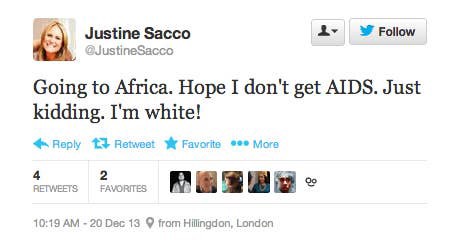
How long does it take to tweet? A few seconds? Maybe only one or two. That’s about as long as it probably took Ms. Justine Sacco, the former senior director of corporate communications at IAC to tweet this little “joke” out in 2013, and inadvertantly become global enemy number one online:

Source: Screenshot of Justine Sacco’s tweet via Buzzfeed News

At the time the 30-year old PR rep was traveling home to South Africa on the holidays to visit family. Right after she tweeted, her flight took off, and she went to sleep, unaware of the whirlwind she had just unleashed.

At first Sacco’s tweet went largely ignored, as she only had 170 followers. But then Sam Biddle, the editor of Gawker’s Valleywag, discovered the tweet via an anonymous tip, and retweeted it out to his 15,000 followers.

From there outrage and fury spread like a viral outbreak, and the hashtag #HasJustineLandedYet trended worldwide, as people eagerly awaited Ms. Sacco to land and get the nasty surprise of her life. There was the added dramatic irony component, as Ms. Sacco went the whole 11-hour flight unaware she was trending all over the internet as a virtual punching bag.

Ms. Sacco got sacked from her cushy PR job, naturally. Even while insisting that she didn’t mean for her joke to come across as insensitive and bigoted. Instead, she says she meant it as a commentary on Western privilege, stating in an interview with the NY Times:

To put it simply, I wasn’t trying to raise awareness of AIDS or piss off the world or ruin my life. Living in America puts us in a bit of a bubble when it comes to what is going on in the third world. I was making fun of that bubble.

Meanwhile, the bubble was unamused.

The internet, with all its collective wisdom of mankind, obviously disagreed with the intent behind Ms. Sacco’s ham-handed cultural musings. After losing her job, and becoming a worldwide hate magnet, she did eventually rebound. She volunteered in Addis Ababa in a PR job for a stint. Then landed a marketing and promotions gig at Hot or Not, a website used to rank stranger’s looks on a scale of 1 to 10, that was transitioning into a dating service.

Wait, Hot or Not? That site’s still around? I remember being a healthy 5.5 there back in the day.

:::sad slide whistle:::

Anyway, in a surprise twist, Ms. Sacco later returned to her former employer IAC, where she works in corporate communications for Match Group, the online dating company. According to her LinkedIn page, she’s still there.

Sacco’s experience at least proves it is possible to reconstitute yourself after being trampled to smithereens by a frenzied mob online, and get to a somewhat happy ending. I say good for her. Hopefully next time she decides to pop off irreverently about racy cultural stereotypes, she’ll remember she’s not a character on South Park.

2. Dr. Maurice Wolin (aka “talldreamy_doc”)

Source: Screenshot from “To Catch a Predator”

Ahh, To Catch a Predator, the gift that keeps on giving. That show, and the community of perv-busters it spawned, has proven a never ending source of entertainment.

Honestly, it was tough to decide which pervert to pick, as there is a cornucopia of creeps to choose from, all thanks to the hard work of giga chad Chris Handsome. But for me, Dr. Wolin stands head and shoulders (literally) above everyone else, given his high status and education, not to mention the staggering cost of his sick blunder. Most of the cretins caught on TCAP were already bottom-feeding low life losers anyway, with few prospects in life, who could barely even dress themselves.

Not Dr. Wolin. The year was 2006. The 48-year old was a prominent cancer research director in the San Fransisco area, married to a wife who was also a doctor, who had two daughters. Using the screen name “talldreamy_doc,” Dr. Wolin chatted online with a girl he believed to be 13 years old, but who was actually a decoy employed by an organization called Perverted Justice.

Wait — “talldreamy_doc?” Tall? Yes (Wolin was 6’2″). Doc? Yes. Dreamy? Oh, hell no.

After making a number of disgusting solicitations toward the decoy, Wolin made plans for a meet-up. Driving from Piedmont, CA to Peteluma, the affluent physician strolled inside the trap house, no doubt envisioning how he was about to indulge all his sick fantasies, only to be met by a camera crew and the police. Wolin desperately tried to fight the charges in a two-year legal battle. He even hired Blair Berk, a celebrity attorney who’d once represented Leonardo DiCaprio.

Guess that makes him the second person she’s represented who’s life got sunk like the Titanic for chasing some girl.

Eventually Wolin plead no contest. He was sentenced to two months of house arrest, three years probation, and lifetime registry as a sex offender. In addition, his license to practice medicine was revoked.

Out of all the TCAP cases, this particular one seriously amazes and disturbs me the most because of Dr. Wolin’s precipitous fall from grace, and the quickness of how his life unraveled. He’d only chatted with the decoy for a few days, maybe weeks, before visiting. Then it took all of a minute from the time he left his car, entered the backyard, to realizing he’d actually walked into a sex sting.

Imagine that. Throwing away a medical license you spent eight or more years in school to acquire, a high-paying, well-respected career, your reputation, and the respect of your family. All gone in less time than it takes to read the back of a Trix cereal box. And all for what? To be branded a sex offender forever. I mean, the guy could have cured cancer the next day at his lab and still nobody would ever think of him as anything other than a pedo. What a moron.

Dr. Wolin’s wife did later divorce him. And unlike Sacco’s story above, there is no happy ending here. Dr. Wolin recently committed suicide in January 2021, according to an offical coronor’s report as investigated by YouTuber “The Skip Tracer.”

3.) Garry Hoy

Source: https://commons.wikimedia.org/wiki/File:TD_Centre_View_from_Yonge_and_King.JPG

I have to admit, when I first heard about the tragic tale of Garry Hoy, I didn’t believe it. I thought it had to be a myth. There was just no way a lawyer could ever do something that wreckless and foolish. It seemed impossible.

But we’ve just seen a C-suite corporate ladder climber self-immolate, and a top cancer doc commit seppuku. Hey, why not an attorney, too? It sure seems these supposed “elite” types aren’t as bright as we’re led to believe.

Garry Hoy was a highly successful and regarded corporate and securities lawyer who worked at the Toronto-based law firm Holden Day Wilson. His office was located on the 24th floor of the Torono-Dominion Bank Tower Building (seen in the above pic).

Hoy liked to perform a little parlor trick on occassion. He would run into the office windows to show off their strength, surprising and shocking guests. On July 9, 1993, while showing some visiting law students around. Hoy decided to demonstrate his love of resilent window glass. He slammed into the glass the first time, bouncing off like he had so many times before. But when he tried a second time, he wound up crashing through and plunging 24 stories to his death. For sure he proved the toughness of the glass. It hadn’t shattered upon impact. Instead, it had popped out of its frame.

Police declared Hoy’s death “accidental self-defenestration,” which aside from sounding like a Jeopardy category, is a polite way of describing a dude accidentally killing himself in a stupidly avoidable way.

I mean, if you’re going to risk your life at high heights like that, at least do something cool like Philippe Petit did, the French high-wire artist who walked across the Twin Towers in 1974. Throwing yourself against a window? Kind of lame, really.

Hoy’s plummet may have even sunk his firm. Within three years of his lousy Peter Pan impression there was a mass exodus of attorneys, who evidently didn’t like working under the dark cloud of the Darwin Award-style death Hoy had left in his wake. In 1996, the firm finally closed for good.

Word on the street is the firm tried to sue gravity. And lost.

So, a good lesson there. If you’re a lawyer, please leave all the crazy antics to Saul Goodman. Chicago Sunroof, anyone?

As Nicolas Cage proved in the year 2000, you can steal almost any car in 60 seconds, not to mention Angelie Jolie’s heart. But as these poor people above proved, you can destroy your life just as quickly, if not faster. So be careful out there.

33 Disturbing But True Facts About Eugenics

What do the SAT, the Kellogg Company, Woodrow Wilson and Adolf Hitler all have in common? They are all connected by the practice of eugenics in the first half the 20th century.

From 1904 until shortly after the close of WWII, the United States aggressively engaged in a scientific quest to create a master race. This radical new science, dubbed “eugenics” by Sir Francis Galton in 1883, called for selective breeding between those deemed “fit” for existence (i.e. generally those of Nordic descent), with sterilization, marriage prohibition and even euthanasia aimed at those deemed “unfit.”

Based on an extreme view of social Darwinism, eugenics permeated the scientific and academic elite, securing funding through such notable organizations as the Carnegie Institute and the Rockefeller Foundation.  The Supreme Court eventually came to sanction eugenic practices, and 27 U.S. states enacted incredibly racist laws enforcing its doctrines. Overseeing these laws and heinous practices presided a virtual army of scientists and doctors steeped in the desire to eradicate anyone seen as a threat to society. These included immigrants flooding in from Europe, Native Americans, epileptics, alcoholics, Jews, Mexicans, Blacks, small-time crooks, the mentally ill, and even those unfortunate enough to be caught unemployed and homeless at the wrong time.

Spreading from Long Island to across the whole United States, from the Liberty Bell to the Golden Gate Bridge, eugenics wormed its way overseas to England and the whole of Europe before it ultimately landed, like a kind of lamp containing an evil genie, into the lap of Adolf Hitler.

Here are 33 disturbing but true facts about eugenics, a pseudoscientific belief that began in the cradle of the land of liberty and ended in the clutches of a genocidal regime:   

1.  Even with concentration camps, euthanasia campaigns and sterilization wards public knowledge in both Germany and America, early eugenic founders looked on with approval as Nazi Germany enacted brutal racial campaigns against its own citizens. Joseph DeJarnette, superintendent of Virginia’s Western State Hospital even complained in 1934, “Hitler is beating us at our own game.”

2. The term “social Darwinism” never came from Darwin himself. It was a term distilled around the notion that in the struggle for survival, some humans were not only less worthy but were actually more or less supposed to die away. Merely acting to help the weak and needy within society became itself an unnatural act. This thinking helped propel the eugenic movement forward during its embryonic stages at the start of the 20th century.

3. On July 15, 1911, the American Breeders Association, or ABA, an organization comprised of eugenic-minded scientists and doctors, met in Manhattan to identify ten groups classified as “socially unfit” and deserving of elimination. These included, in order of priority: the feebleminded, the pauper class, alcoholics, criminals of varying degrees such as petty thieves and those imprisoned for not paying fines, epileptics, the insane, the constitutionally weak class, those genetically predisposed to specific diseases, the deformed, and finally, the deaf, blind and mute.  

4. In 1907 Indiana became the first state to legalize forced sterilization on its mentally impaired patients and poorhouse residents. Known as Sharp’s Bill (named after a Dr. Harry Clay Sharp who was already sterilizing and castrating men and women in Indiana’s prisons well before it became legal) it passed the Indiana House 59 in favor, 22 opposed, and passed in the Senate with 28 ayes and 16 nays.  

5. New Jersey passed its own sterilization legislation in 1911. It allowed for the creation of a three-man board that would determine whether “procreation is inadvisable” for the reams of prisoners and children living in poor houses and other charitable organizations. The governor who signed the bill into law was Woodrow Wilson, who was elected president of the United States the following year.

6. The term “moron” comes from the eugenic movement. Coined by Henry Goddard, an early eugenic founder, it comes from the Greek word moros, meaning “stupid and foolish.” We use the term lightly these days as a kind of vague, almost teasing insult. For Goddard and the eugenic community, a “moron” was anyone deemed unfit for life and indeed a target to be eliminated.

7. The IQ Test also emerged from eugenics. In 1916, using an intelligence test created by a Dr. Binet of Stanford University, eugenic activist Lewis Terman devised a simple way to score an individual. By dividing mental age by chronological age and multiplying by 100, Terman created what he nicknamed “IQ” score, or “intelligence quotient.”     

8. In 1917, as America entered WWI, eugenic psychologists devised an intelligence test for the armed forces known as the Army Alpha Test. Carl Brigham adapted the test as part of a college entrance exam. The College Board later asked Brigham to create another qualifying test for other colleges in the country. Eventually, Brigham’s efforts produced the Scholastic Aptitude Test, or the SAT.

9. Dr. John Harvey Kellogg of Battle Creek, Michigan served as a member of the state board of health and operated a sanitarium known for its unorthodox food regimens. He developed for his patients a natural product made of wheat flakes. In 1898 his brother, Will Kellogg, invented the corn flake and began selling it commercially through a company that would ultimately become the cereal behemoth the Kellogg Company. In the same year as the founding of the company, Dr. Kellogg founded the Race Betterment Foundation to help stop the “propagation of defectives.”  

10. President Theodore Roosevelt long held eugenic views. After he left office, he wrote Charles Davenport, the man considered the father of the American eugenic movement, and said:

   Society has no business to permit degenerates to reproduce their kind.  Some day, we will realize that the prime duty, the inescapable duty, of the good citizen of the right type, is to leave his or her blood behind him in the world; and that we have no business to permit the perpetuation of citizens of the wrong type.

   Such a statement certainly takes the old snarky phrase “white man’s burden” a step further.

11.  Virginia may be “for lovers” these days, but shortly after WWI, the state was well known for sweeping its social outcasts into homes for the feebleminded and epileptic. While those two terms meant virtually the same thing in practice, they also equaled another kind of diagnosis: shiftlessness. Shiftlessness, a term that could easily be applied from unruly boys to legitimate mental patients, generally meant “worthless” or “unattached in life.”

12. On May 2, 1927, with only one justice dissenting, the Supreme Court officially sanctioned eugenic sterilization in the case of Buck v. Bell.  Justice Oliver Wendell Holmes, a man revered throughout the nation as a voice of reason and justice, wrote the opinion for the majority that could have sprung from the Third Reich:

   It is better for all the world, if instead of waiting to execute degenerate offspring for crime, or to let them starve for their imbecility, society can prevent those who are manifestly unfit from continuing their kind. The principle that sustains compulsory vaccination is broad enough to cover cutting the Fallopian tubes.

   Three generations of imbeciles are enough.    

13. The Beach Boys sang about the girls in California. The state is known for its pristine beaches and laid back populace. But the Golden State also is famous for something else: leading all states in the U.S. in eugenic sterilization. From 1907 to July of 1925, at least 4,636 sterilizations were performed. All mental patients and those deemed feebleminded were allowed to have their procreative powers removed. The threat of asexualization even included criminals found guilty of any crime three times, at the discretion of a consulting physician.

14. Although not wholly related to the eugenic movement, the birth control campaign as orchestrated by Margaret Sanger emerged from the conjoined spirits of women’s rights and population control. However, before the term “birth control” reached the American consciousness, it had many prior variations that included: voluntary parenthood, voluntary motherhood, the new motherhood, constructive generation, the new generation, Neo-Malthusianism, Family Limitation, Conscious Generation, population control, race control, and finally, birth rate control. It was only when someone suggested dropping the word “rate” from the previous term that “birth control” became the name of Sanger’s growing movement.  

   Is it any surprise that a campaign designed to eliminate the weakest within the population aborted so many undesirable names before finally choosing its correct moniker?

15. In its quest to find and identify anyone of mixed blood and separate them from those of pure, Nordic stock, the state of Virginia enacted the Racial Integrity Act on March 8, 1924. Falsely registering your race in the subsequent consensus and questionnaires was considered a felony and punishable by a year in prison.

16. Following the Racial Integrity Act, Virginia’s registrar encountered a problem. Some citizens of Indian descent were registering as white but actually had African ancestry in their genes as well. To remedy this intolerable snafu, the registrar devised used a highly scientific and accurate method to differentiate a person of Indian or African stock: a hair comb.  Walter Plecker, health officer of Elizabeth City County, wrote of the comb solution, “If it passes through the hair of an applicant he is an Indian. If not, he is a negro.” If those Guinness Ad guys had been around when Plecker devised his comb strategy, they would have surely declared “Brilliant!”

17. America was not alone in the growing field of eugenics. Britain passed its own legislation against the “unfit” in the form of the Mental Deficiency Act of April, 1914. The Act defined four classes of undesirables: idiots, imbeciles, the feebleminded and moral defectives. If you had the misfortune of having a doctor identify you as any one of those, you could then be carted off to a special colony, sanitarium, or hospital designed to house your kind.

18. Switzerland passed its own eugenically spirited law in 1928 that targeted a poorly defined class of “unfit.” While concrete numbers have never been ascertained concerning Switzerland’s eugenic conduct, some estimates say that 90% of sterilization procedures were performed on women. 

19. Norway had its own forced sterilization legislation on the books for 43 years. After passing a law legalizing it in 1934, it wasn’t until 1977 that the law was amended to make sterilization voluntary. In the interim, 41,000 operations we performed, with almost 75% done on women.

20. But even if you managed to escape Britain, Germany, and Norway, you still had Sweden to worry about. Known throughout the world for its mostly blonde-haired, blue-eyed populace, Sweden passed its own sterilization law in 1934 as well. Similar to laws in other countries at the time, the new law targeted pretty much anyone classified as having a mental illness or having mental defects in any way. It even targeted those who had an “anti-social way of life.” Again, as with Norway, the largest victim group was women, who suffered forced sterilization at the rates of 63% to 90% over their male counterparts. In all, over 63,000 government-approved sterilizations were performed on the “unfit” individuals who had the misfortune of living within Sweden’s borders.       

21. George Bernard Shaw, the renowned Irish playwright who has the distinction of being the only person to receive both a Nobel Prize for Literature and an Oscar, was also a eugenic extremist. Speaking at London’s Eugenic Education Society in 1910, the scribe had this to say regarding the use of lethal gas chambers on the unfit:

   A part of eugenics politics would finally land us in an extensive use of the lethal chamber. A great many people would have to be put out of existence, simply because it wastes other people’s time to look after them.

22. However, while lethal gas chambers weren’t employed on the weak until the rise of Nazi Germany, there were many instances of euthanasia performed by doctors of eugenic persuasion. On November 12, 1915, a woman named Anna Bollinger gave birth to a baby with severe intestinal abnormalities at German-American Hospital in Chicago.  But rather than fighting to keep the baby alive, the hospital chief of staff, Dr. Harry Haiselden, decided it was not fundamentally worth saving. A friend of the mother’s pleaded for him to save the baby’s life, but Dr. Haiselden only laughed and said, “I’m afraid it might get well.” The baby died shortly thereafter. A health commission investigation later questioned the doctor for his decision, but he was ultimately exonerated of any wrongdoing and allowed to continue practicing.

23. Haiselden persisted in his eugenic euthanasia over the years, and justified it by declaring that public institutions used to house the unfit in effect acted as lethal chambers anyway. He secretly visited the Illinois Institution for the Feebleminded where he discovered that windows were left open to allow the flies to cover the patients, and the inmates were given milk from a herd of cattle infected with tuberculosis.

24. Eugenics has its own movie. In 1917, Hollywood produced The Black Stork, a story about a mismatched couple who are counseled by a doctor against having children. However, the couple become pregnant anyway and the woman gives birth to a defective child that she allows to die. The deceased baby’s spirit then ascends into the arms of Jesus Christ.  Hailing it as a “eugenic love story” in publicity ads, the eugenic movement had its own propaganda film at last, and it promoted The Black Stork throughout the nation. It’s catch-phrase: “Kill Defectives, Save the Nation and See ‘The Black Stork.” Not quite “Save the Cheerleader, Save the World,” but close. Dr. Haiselden, then famous in eugenics circles for his baby-killing ways in Chicago, played himself as the doctor in the film.

25. Even during WWI the American eugenic movement strengthened its ties with Germany. The book credited with planting eugenics throughout Germany was Madison Grant’s The Passing of the Great Race. Published in 1916, Grant’s tome asserted that the white Nordic race was destined to rule the planet. It inspired thousands of German scientists, allowing them to mask their already racist feelings under the guise of objective science. It also galvanized the country’s future dictator, Adolf Hitler.

26. Not content to produce books and films extolling the virtues of eugenics, followers of the new pseudoscience in Germany introduced a series a race cards in 1927. Coming ten in a package just like baseball cards today, the cards profiled every racial variation from the Tamils of India to the Baskirs of the Ural Mountains.

27. Eugenic sterilizations began literally the moment Hitler assumed power in Germany. Starting on January 1, 1934, the Reich Interior Ministry’s eugenic expert declared that children as young as ten and men over the age of fifty were all able targets for the scalpel. Quickly, this mass program became known as Hitlerschnitte, or “Hitler’s cut.” In the first year alone, at least 56,000 Germans were sterilized, or almost 1 out of 1200 citizens.   

28. While Germany savaged Poland in the beginning of the Second World War, the Reich also committed euthanasia against elderly German citizens to conserve its valuable wartime resources. Starting in 1940, between 50,000 and 100,000 Germans were taken from old age homes, mental institutions, and other places and exterminated in gas chambers.

29. Dr. Edwin Katzen-Ellenbogen presided over the extermination practices at the concentration camp Buchenwald. He was also a founding member of the Eugenics Research Association and chief eugenicist of New Jersey under then-governor Woodrow Wilson.  

30. The rare brain disease Hallervorden-Spatz Syndrome is named after two Nazi doctors who discovered the condition in 1922. 

31. For years one of eugenics greatest crusaders, Harry Hamilton Laughlin, fought to sterilize the feebleminded and people diagnosed with epilepsy. He was well known for believing that people with epilepsy did not belong in society. Laughlin was also known among colleagues for his occasional seizures. It turned out the doctor kept a tightly held secret for most of his life: Harry Laughlin, the attacker of the “unfit” and eugenic co-founder, himself had epilepsy.

32. Even though they have not been used for years, eugenic sterilization laws are still officially on the books in North Carolina. Chapter 35, Article 7 permits the state to perform them for moral as well as medical improvement.

33. Despite post-war Germany denouncing its Nazi past, investigators discovered that some universities still house body parts taken from prisoners used in eugenic experiments and later killed in concentration camps. The University of Vienna’s Institute of Neurobiology still houses four hundred Holocaust victim’s brains. In addition, tissue samples and skeletons have also been found in Tubingen and Heidelberg. 

References

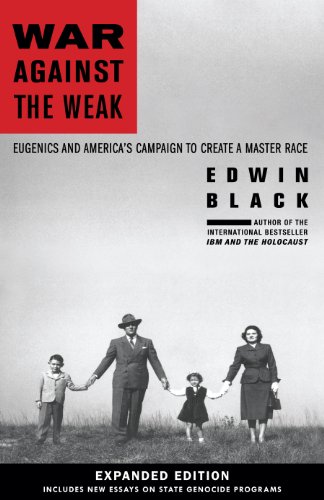
   For more information on the startling history of eugenics in America and other countries, I urge you to read War Against the Weak by Edwin Black. You can also visit the official site for the book.

   Black also wrote IBM and the Holocaust, and his book on eugenics is equally profound and revealing. I derived virtually all my data in the above article from his book, but what I’ve written only scratches the surface of the wealth of information contained in War Against the Weak.

   For a sampling of more diversified resources, the Wikipedia page on eugenics stands as a doorway to many informative sites and archives.

My novel Nemesis, a psychological thriller, is now available on Amazon.