For some reason, this movie popped into my head recently, and I just had to rewatch it. I don’t know why. I seem to recall seeing it in theaters while on a beach vacation in Ocean City, Maryland back in the summer of 1998. Though the film actually stayed in theaters for over a year.
Films did that back then. Now they dip in and out in like two weeks before hitting streaming oblivion.
It’s weird watching something from the ’90s, as it is basically a period piece anymore. This film is nearly thirty-freaking years old! It is as ancient to modern audiences today as something from the mid-’60s would have been during its premier.
There’s Something About Mary is a screwball romantic comedy about a guy named Ted trying to reconnect with his old high school crush–the titual Mary. Mary Jensen, that is. Following a catalysmically awful prom date that goes sideways in the film’s second most memorable sequence when Ted gets his dick and balls stuck in his zipper after arriving at Mary’s house. Poor Ted spends the next 13 years still pining (borderline obsessing) over Mary, until he gins up a scheme to sick a private detective on her to hunt down her whereabouts. Finding her in South Florida, Ted takes off to reconnect with his old flame, encounting a series of mad-cap adventures along the way. But competing with him for Mary’s heart is the greasy private detective, an old college boyfriend, a slippery pizza delivery guy, and even a famous football QB star. Will Ted, the ultimate nice guy, win Mary’s heart in the end?
Of course, the film is BEST remembered for its “Is that hair gel?” scene when Ted and Mary are preparing to go on a date. Believe me, that line was the height of bawdy comedy in my high school during that year. Between that and the many Monica Lewinsky jokes flying around (and there were many), my junior year was beset with semen-based hilarity.
In fact, I’d say there has likely never been a time ever in human history when male ejaculation centered so prominently in the cultural psyche as it did in the year 1998.That’s all thanks to Monica and Mary.
There’s Something About Mary is beset with a hideous amount of ’90s anachronisms, both technologically and cultural. Things that just wouldn’t work in today’s self-aware uber ironic entertainment landscape. The ’90s was all about being okay with looking stupid. It was the decade of Dumb and Dumber, Jim Carrey, and wacky attitude-y cartoons like Animaniacs. Weird toys like Gak. Very stupid and cringey TV shows. And lots of bright neon colors.
People nostalgia-gazming hard on the decade often forget how damn silly the ’90s really was. And that’s probably the best way to describe Mary. Silly with a capital ‘S.’
The entire conceit of the film falls apart in the age of Facebook and Google. Now it’s not only easy to look someone up from high school, you likely can’t even get rid of them anyway if they follow you on Insta or Facebook.
Then there’s the whole stalking angle. What Ted does is technically kind of creepy. While he does sorta pay for it when he’s forced to confess at the film’s “All is Lost” beat, and is consequentially kicked to the curb, true love conquers all of course in the end.
There’s the idea of a bunch of men fixating on Mary as a sex object in a predatory way that would be seen as “problematic” now. The film gets away with it mostly due to its unflinching cartooniness. The Farrelly brothers were at their peak. The story has heart, though its punctured by a lot of slapstick nonsense.
There’s Something About Mary really is one of those films that wouldn’t be made today. It’s an odd time capsule of a film. A relic from a very niche era of cornball humor that couldn’t be replicated. A perfect representation of what the ’90s was all about.
It does have some classical elements, too. The recurring motif of the singers reminded me of the singing muses often seen in Shakespeare plays or Greek epics. The crude sexual humor harkens back to the stylings of the ancient Greek play Lysistrata. There are some borrowed elements also. The police interrogation misunderstanding feels lifted from 1992s My Cousin Vinny, for instance. But overall it’s a funny original story with a handful of memorable scenes beyond the hair gel one. The fish hook gag, as an example.
Ben Stiller stars in one of his early big roles. At the start of his early 2000s tsunami of comedy hits like Meet the Parents and Zoolander. Cameron Diaz plays the lovely and lanky Mary. And there is the adaptable Matt Dillon as the greasy private eye with the porn stache.
Need some ’90s flavor in your life? Who doesn’t, right? Check out There’s Something About Mary.
I’m a recovering “beat-em-up” fan. Back in the day as a teen I used to love those terrible Steven Seagal films like Above the Law and Marked For Death. Or Jean-Claude Van Damme stuff like Bloodsport and Death Warrant. They were constantly on rotation on USA and TBS and other freemium cable channels in the late ’90s. Films that were passably entertaining for immature adolescent minds, but in retrospect are ridiculously cheesy and absurd. But hey, if you haven’t seen Seagal break a Jamaican dude’s arm in half or Van Damme roundhouse kick a guy into a furnace, you haven’t lived.
Nowadays, Jason Statham is your go-to macho man face puncher and bad guy beater downer. Strangely, actors even higher up the talent totem pole have had a go at their own fistacuffs franchises. Bob Odenkirk is Nobody. A-lister Denzel Washingtonis The Equalizer. And of course Internet Jesus Keanu Reeves is John Wick.
Everyone wants to kick ass these days! Who can blame them? Have you seen the prices of things lately? Going to the grocery store anymore is like going to a Fuck Me in the Ass Parade.
The latest is A Working Man, where Statham plays a former blacks ops soldier turned construction guy who has to return to his face-stomping roots when his boss’s daughter gets kidnapped or something. I’ve not seen it, nor will I ever. Just like I didn’t see Statham’s last flick The Beekeeper, which had pretty much the same plot. The latest edition of Statham Beats Up Some Guys interests me about as much as hanging around a bunch of backwards hat-wearing dude bros talking about their fantasy football picks.
(No man should have a hobby with the word “fantasy” in it. Like, are there sparkles involved? Pink glitter? GTFO of here with that.)
Anyway…
What is pretty cool (and surprising), is that A Working Man is based on a book. Which is part of a book series, actually. By a real author. Not some A.I. trained on Seagal and Van Damme flicks. Chuck Dixon is a prolific author known mostly for his work in the comic book industry. He co-created Bane, aka the villain who broke Batman’s back. So, this guy is well-experienced in creating characters that know how to kick the crap out of people.
Dixon’s series is called Levon Cade, and features the vigilante going on various quests involving revenge and likely crushing a few throats. There are twelve books in total. The first, titled simply Levon’s Trade, premiered in December, 2021. The others came in rapid succession, sometimes as little as three weeks apart, over the course of 2022. The eleventh published in August, after which Dixon took a sabbatical before dropping the twelfth and final (?) in February, 2024. Not bad. Guy banged it all out in roughly a calendar year.
Look, these are not labyrinthine literary feasts like A Game of Thrones. These stories are Fisher-Price simple and Neanderthal stupid. No shit. But when you get down to it, there are really only two genres — “Man with Gun” and “Girl Bangs Guy.” That’s about it. James Bond, for all his British sophistication, is just another “Man with Gun” story. Titanic is the ultimate “Girl Bangs Guy.” The classics usually combine the two in interesting ways. Double Indemnity, for instance. There are some exceptions, often seen in experimental or prestige award stuff, but nobody cares. People only pay attention when someone’s fucking or getting murdered. Can you name the book that won the Nobel Prize for Literature four years ago? No? Have you ever heard of Fifty Shades of Grey? My point exactly.
I am not a fan of simple vigilante series, in either book or movie versions. I read Killing Floor once, the first Jack Reacher book, a long time ago, and the experience was akin to tattoo gunning my eyeballs. I am a fan of writers, however. Especially ones who put in the effort to carve out their own success, in whatever genre they choose. A Working Man has likely done well enough at the box office to merit a sequel. Who knows. It could even be a franchise like John Wick. I have no idea. I’ll never see the films anyway. I outgrew the need for them a long time ago. But I do appreciate them and the writers who make them.
Fiction Affliction #3 — A review of spec screenplay Hen’s Teeth, by Krishan Patel
“Tara.” Made with Midjourney
Genre: Body Horror
Logline — A woman must escape the medical facility awakening reptilian traits recorded in her DNA from our distant evolutionary ancestors as a full scale transformation takes effect.
About — This is a screenplay a writer sent to me to review. The following review is an edited version of my feedback.
Writer — Krishan Patel
Length — 86 pages
For amateur screenwriters, or really for any type of writer, one of the best ways to learn the craft is to trade scripts with other writers, and provide critiques. Or at least read a lot of scripts and novels, both pro and amateur. As Stephen King said in On Writing, “Read a lot, write a lot.”
Hen’s Teeth is the second screenplay I’ve reviewed by Patel, and it inspired a good deal of feedback. That may be because it’s within a genre I enjoyed a lot in the past—body horror. Though nowadays, as I’ve gotten older, I’ve become more squeamish about things like gore, disease, and violence. But that doesn’t mean I can’t have an occassional glimpse at the grisly genre. So, here’s my review of Krishan Patel’s Hen’s Teeth.
—
Hen’s Teeth is basically a body horror thriller in the vein of Cronenberg’s The Fly, 2009’s Splice, or more recently, the 2019 horror film Eli. Stylistically, it leans more psychological and clinical instead of showing excessive gore/physical horror, though it certainly has its share of visual shocks and surprises.
The story is centered on a young woman named Tara Steventon, who since birth has suffered from an unusual affliction/illness that has made her different from other people. This difference is not necessarily readily apparent, but something people, including her own mother, pick up on more unconsciously. Due to this subtle strangeness, she’s shunned by schoolmates and peers. And even somewhat by her own mother, who keeps her distance, and doesn’t even have pictures of her daughter in her house. Tara’s one friend is the loyal and good-hearted Melanie Watkins, who grows up with Tara, and helps her to live a “normal” life. This includes going out clubbing, where in the beginning Tara is picked up by a male suitor. But prior to engaging in a one night stand, the male pulls away, and abruptly leaves, evidently put off by Tara’s uncanny different-ness. Tara vomits up something unnatural, and then ends up in the hospital. The medical staff can’t make heads or tails of her condition, and it becomes evident Tara has made her rounds in the hospital before.
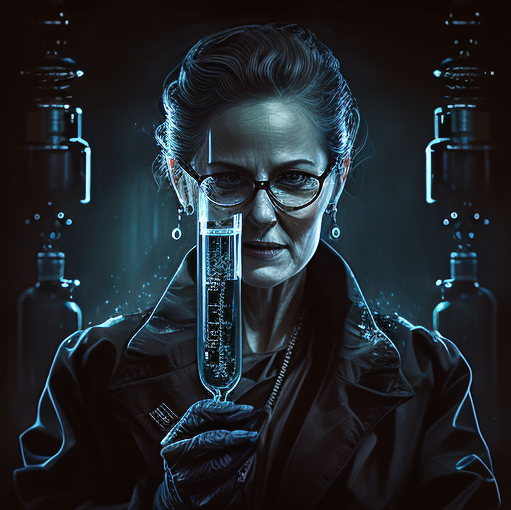
Desperate to fix, or at least understand her “illness,” Tara goes to a resort/medical facility advertised online (and seen earlier on her computer), with her best friend Melanie tagging along. Upon arrival, she is greeted by Eleanor, an elegant and dedicated scientist who runs the facility/“temple retreat,” who appears to know more about Tara’s condition than she lets on. Eventually, Tara comes to learn that she’s “suffering” a form of atavism, which is, as Eleanor puts it is a “reemergence of our biology of traits from our animal ancestors.” This has caused Tara to reclaim reptilian/lizard characteristics, such as vomiting up an inhuman fluid, having an unusually-shaped skull, and possessing traces or components of venom in her blood. But rather than “curing” Tara, Eleanor has the more sinister goal of perfecting or enhancing Tara’s specialized DNA. Through the use of treatments and medical therapy, Eleanor is able to induce a radical transformation in Tara’s body that seems to work in stages. At about the midpoint, Tara goes through a major transformation, losing her skin just like a snake. However, this is only partial progress, and Tara is left a human/snake/reptile hybrid inside a vivarium, awaiting Eleanor’s final phase. The eccentric doctor intends to take Tara’s transformation all the way, by turning her into a human-snake creature, including surgically removing her limbs and fixing her spine so that Tara can slither and function just like a real snake would. At the same time, Eleanor intends to transform (or become “realized”) herself alongside Tara.
Meanwhile, Melanie wanders around the temple, where she encounters various “patients,” who call themselves the “Brothers and Sisters of Hen’s Teeth.” A group of people who operate similarly to a cult, and who evidently are in various stages of transformation to mammalian, rat-like creatures. However, Eleanor sees these earlier experiments as mere stepping stones to her grand opus, Tara. After framing Melanie for torching the mammalian creatures, Eleanor tries to win Tara over by convincing her to go through with the transformation in accordance with the mad scientist’s grand vison. But Tara turns the tables, and outmaneuvers the doctor, leaving her to die, while using her reptilian abilities to save her friend, who is injured by the mammalian creatures. All the while, a young girl named Sian, a former test subect of Eleanor, and the doctor’s daughter, interviews Tara and Melanie’s family’s to gather information, and returns to the temple under the guise of needing lodging, while in reality trying to warn the two best friends of her mother’s sinister agenda.
Overall, I enjoyed Hen’s Teeth. Body horror and the medical thriller genres appear to be in Patel’s wheelhouse. Hen’s Teeth fits the type of tone you’d expect in a body horror type movie. Patel has mentioned being a big fan of Cronenberg and other similar directors. And this story is much in that style that the writer/director is so famous for. I’ve not seen his latest film, Crimes of the Future, though the synopsis for that movie dovetails with Hen’s Teeth somewhat.
In Hen’s Teeth, I could understand for the most part what Patel was going for. It has the requisite scares and visual horror elements that you want to see in something like this. It builds slowly. There is the initial glimpse of the hen with teeth, then the mother with the multiple rows of nipples. Finally working up toward Tara’s snake-like transformation at the midpoint. Then the mammalian attacks on Melanie where she’s forced to flee with the fire extinguisher. And finally the glimpses of Tara’s “final form,” as imagined by computer screens, at the end. In addition, I felt that Patel generally staged the different scenes pretty well, especially with the temple layout. Cleverly, he tied in the atavistic scientific component thematically with the visual design of the temple, which combines the old and the new.
But most importantly, he centered the story around two best friends looking out for another, whose relationship is nearly torn apart by Tara being seduced into Eleanor’s grand scheme.
Eleanor, by the way, is a good character, being deceptive, but also a maniacal “mad scientist” type. I also liked Sian, Eleanor’s sort of daughter, who wants to stop her mother, but is internally conflicted.
“Eleanor.” Made with Midjourney.
Where I struggled with Hen’s Teeth was chiefly in understanding Eleanor’s motivation, and the purpose of her experimentation. In Eli, for instance, Eli is being subjected to the procedures in order to (spoilers if you haven’t seen it) suppress his demonic side, as he’s the literal son of Satan. In effect, his parents and the facility are trying to save the world from him and his father. In Splice, the couple is trying to create new hybrids for medical use, and for fame. In The Fly, the fly transformation is accidental, of course. Seth is really trying to perfect teleportation. Seth later attempts to merge himself with the pregnant Veronica as a crude means to hold on to his lost humanity. “More human together than I am alone,” as he hauntingly says. Eleanor states that she wants to be “realized,” while preparing to conduct the final process on Tara. She clearly is obsessed with atavism and inducing old DNA to resurface in her subjects. But to what end? Does doing this enable these people to live longer? Does it give them any real benefit over remaining human? It appears her treatments actually hurt more than help. No matter how sinister her plan might be, there should be some underlying logic to what she’s doing. It appears she’s more doing it out of obsession and a kind of scientfic fetishism. Which wasn’t enough for me. It would make sense if atavism led to medical breakthroughs. Or added decades to someone’s life span. Or if Eleanor had some deeply personal motivation. Think of Dr. Frankenstein’s numerous encounters with death that drive him to understand the nature of death and dying, and how to overcome it. Without that needed dimension to Eleanor’s plan, the story loses a lot of substance.
Another aspect that hampered the story for me was Sian’s investigation into Tara and Melanie’s background by visiting their parents. These scenes added some important info about Tara’s childhood, yes, but in mostly an expositional manner that slowed down the narrative. Is there a more visual way to share this information? There was also something I found questionable. The story about Tara’s peers actually giving her vomit to drink, and Tara not noticing, was confusing. Why would Tara having suppressed reptlian DNA make her unable to detect that she was consuming human vomit? Reptiles and snakes eat bugs and small creatures like mice and rats. It would make more sense if Tara had been seen eating a bug or rodent by the others girls. And also, I would expand on exactly why the mother and the girls don’t like Tara. It’s stated that they sense something is off about her. Tara doesn’t have a normal “baby smell” to the mother, for instance. But if Tara has reptilian DNA that occassionally assets itself, this could be shown in a more explicit and understandable way.
Also, when introducing characters, it’s important to try and establish their relationships right away. I didn’t realize that Ruby was Tara’s mother when she visited her in the hospital. I initially thought Ruby was a nurse, or an aunt (due to her age). It wasn’t until later it’s revealed she’s her mother.
Even though there are some good visuals in this script, I don’t think it goes far enough. And that’s mostly because there are many instances where it falls back on exposition instead, or showing something on an iPad or computer. Going back to The Fly, that has a really shocking final sequence, where Seth fully transforms into his fly self. Or you think of An American Werewolf in London, where there’s the violent and climactic Piccadilly Circus sequence with the werewolf. In Eli, the boy eventually is able to defend himself, and fights back against his captors, and frees himself, though the ending in that one does peeter out somewhat. Hen’s Teeth ends rather anti-climactically, as well as ambiguously. I’m not sure what Tara and Melanie’s outcome is at the end.
Regarding the temple, I also wasn’t sure exactly why and how Tara came to know about it, and why she was drawn specifically there as a possible cure. Nothing is stated about it that would necessarily indicate that this is the place she should go. So it comes off as more as coincidental that it just happens Eleanor is running the place. It would make more sense if Eleanor is a widely known geneticist or something with a public reputation. A celebrity scientist, if you will, who is working on the cutting edge of biology research and such. Maybe Tara sees an interview with Eleanor on TV. Or perhaps Sian acts as Eleanor’s emissary, seeking out candidates for her mother’s research, and after recruitng Tara, the girl suffers a bout of conscience when she realizes her mother’s full agenda.
I would lean in more on the relationship between Melanie and Tara, which is the main emotional core of the story. I’d develop that relationship further, as well as the characters. The characters act more now as functionaries of the narrative. Existing to move the plot points along, or serve as exposition vehicles. But they should have their own motivations and background that fully flesh them out.
But overall, I’d encourage Patel to keep going with rewrites, and consider submitting this to contests or sites like Scriptshadow. Best of luck to him.



 Dean Brooks