Is It Worth Keeping Tons Of Cash On The Sidelines Waiting For A Stock Market Correction?

A thought experiment.

Made with Midjourney

Over a decade ago, after moving to North Dakota to work in the oilfield, I lived in a church basement that had been fitted with dorm-style units. One of my “basement mates” was a nice guy in his 50’s from Virginia named “Alan.” We got to talking one day and he told me how he had $50,000 saved up that he was planning on using in the next big stock market correction. This was only a few years after the 2008 Wall Street crash, so it was still fresh on everyone’s minds.

At the time, ND was undergoing a massive oil boom due to technological improvements in the fracking process. Everyone working in the industry was making huge amounts of money, and like a rising tide, that lifted other sectors as well. Cooks at fast food places were starting at $18 an hour and up. Wal-Mart was paying people $25 an hour. Rent skyrocketed, too. I paid $1000 a month for my tiny basement dorm.

Alan was a CDL treater truck driver. Basically, he drove around to well sites with a giant mobile furnace that could heat up oil and water, and flushed chemicals, water, or oil down well heads in order to keep the lines clear and lubicated. He was probably making around $160K a year with all the OT he was pulling in. So, it was no surprise he had piles of cash sitting around.

I remember asking Alan that if the market were to crash, at what point would he jump in with his war chest? When it was down 10%? 15%? 20%? He didn’t have an answer. Back then interest rates were super low. He was probably only getting around 2% max on a savings account. That’s losing out to inflation badly. The real rate of inflation is not 2–3% like the government likes to report. It’s more like 7% when you factor in everything like real estate, college tuition, cars, medical care — everything that goes into living a life.

Since my talk with Alan over a decade ago (around spring, 2013), the S&P has gone up 3.5x from 1680 to over 6,000. That $50,000 would be worth $175,000 today had it been invested in an ETF like SPY. Interest rates have increased modestly, going as high as 5.5% for some savings accounts when they were at their highest. But nowhere close to a 3.5x return like the S&P.

Worth noting: SPY was about $156 back then. The ETF paid out $1.97 per share in its last dividend distribution. Buying $50K worth of SPY then would pay you $630 per quarter now, and nearly $2,500 a year. That’s the same amount you’d get if you just stuck that $50k in the bank with a 5% interest rate. So, the dividends alone are matching savings accounts. To say nothing of the compound growth in dividend reinvestment, or employing other forms of income like selling covered calls.

Bottom line: Owning the S&P is going to likely give you 10%-15% returns every year over the long-term.

Also worth noting: the stock market hasn’t crashed like it did in 2008 since my talk with Alan. Even the brief Covid crash and the 2022 correction weren’t anywhere close to the near -50% drop seen in 2007 through 2009.

Here’s another way to think about it. Let’s say you have a million dollar stock portfolio in the S&P 500, and $100,000 in dry powder on the sidelines waiting to use for the next big crash. If stocks drop 10%, even if you timed the bottom perfectly, you’re only getting a 10% discount. How many years of dividend gains and compound growth did you give up for that “big” discount there? Obviously, you wouldn’t time the bottom perfect, either. No one can. Anything less than a 5% discount is only matching what you’d get in a high-interest savings account. So, it’d be a wash at that point.

But what about investors like Warren Buffett who keeps hundreds of billions in cash sitting around? What about individual stocks and investments outside the S&P?

Big investors like Buffett and others operate at such a high level that it’s hard to know their ultimate motives or aims. Buffett isn’t concerned with grabbing a mere 10% discount on the S&P. He wants to own entire companies or take controlling interests in things, like how he bought BNSF railroad in 2010. Accredited investors like him are also afforded “insider” opportunities on things that average investors are not, such as IPOs and such. An investor like him might keep cash sitting around waiting for an AirBnb to come along.

For the average “buy and hold” diversification-style investor, aka the one looking to retire at 60ish with one mil plus, it doesn’t make sense to keep tons of cash sitting around waiting on some big crash. Especially if you’re largely just buying the S&P 500 or the NASDAQ anyway. For someone like that, you really only need emergency savings PLUS “peace of mind.” Meaning whatever extra you need that helps you sleep at night. Five thousand, ten thousand, whatever.

For more active investors, more cash is going to be strategically optimal depending on their experience and timing. During market drawdowns, individual stocks afford better buy-in opportunities than the S&P, obviously. Buyers of META during Mark Zuckerberg’s Congressional hearings in 2022 could have bought the stock at near $100. It’s since gone up past $600. A fantastic return in only two years.

Last March, Reddit offered users the opportunity to invest in the company’s pre-IPO share price at $34. I bought some myself, as I talk about in this article here. Since the stock’s public listing, it’s gone up to $180, giving over a 5x return. That was a time when having some cash lying around proved a good idea for me. But remember, speculation is still speculation. Plenty of individual stocks that once looked like bargains have continued to crash.

I read articles saying you should keep 10–20% of your portfolio in cash sitting around for big opportunities. I don’t think you need quite that much. Ideally, you would simply take one investment’s profits to switch into another investment. After measuring the tax hit, of course. Then you’re kind of playing with house money. For instance, I sold a bunch of alt coins a few weeks back, some of which I’d made multiple x returns on over the last 18 months. I rolled most of the gains into my River exchange account where I get a 3.8% annual return paid in Bitcoin, while using the money toward my $20 daily DCA 2025 experiment. As Bitcoin hits certain benchmarks, I’ll likely ladder out some of my holdings into the S&P or into other assets. If I were to take, say, $50K out of my Bitcoin profit holdings for use as a down payment on a house, it’d be like I got that $50K for free. I also made that $50K way faster than it would have taken me if I tried saving it.

And that’s another thing to consider. It takes forever to save up cash even if you have a high income. Even if you make $100k a year, after taxes and expenses, it might take you a few years to save up a mere $50K. Meanwhile, the S&P is going up 10–15% a year, and other stocks or cryptos are going up big. Most likely, you’re better off just putting as much of your money to work as possible, and keeping enough on the side for emergencies and a little extra for peace of mind.


Can You Really Retire Early By Making $10,000 Per Month With LEAPS? It’s Not That Simple 

It’s happening again.

Made with Midjourney

You know you’re at frothy market highs when you start seeing videos about totally can’t fail easy shortcuts to early retirement by (fill in the blank with whatever financial trading scheme you want).

We saw this with crypto back in 2021. I remember arguing with a guy on X (then Twitter) who was out there telling people to retire early by staking their money on high interest earning liquidity pools. I got into another Twitter fight with some fresh MBA grad finance bro who was out there recommending random dividend shit stocks that were paying out 10%+ to his followers.

“Bro, you don’t understand. Every five grand you put in equals $500 a year for life. For life, bro!”

Mind you, I wasn’t being nasty or anything. I was simply asking what happens if stocks go down or those liquidity pools dry up? I was asking standard good faith due diligence type questions. But like the guy who pointed out that maybe the Titanic needed more life boats, I was ignored and ridiculed.

Then the Federal Reserve hiked interest rates and stocks fell into an 18 month bear market. Crypto plummeted back to Death Valley. Mysteriously, I didn’t see too many finance bros on Twitter soon after. Same with crypto bros.

But now markets are back at all time highs. The Fed just cut rates by half a point. Stocks are roaring. Bitcoin is back, baby! It’s all good. “Biggest bull market ever, yo!”

Which of course means gurus and finance experts and self-appointed wealth wizards are out there peddling their know-how for clicks.

The latest big idea I’ve seen involves buying LEAPS and then selling calls against those leaps.

What the hell am I talking about, you might be wondering? What’s a LEAP?

LEAPS

LEAPS are an option on a stock. It stands for Long-Term Anticipation Equity Securities — LEAPS. LEAPS are at least one year out from expiration, and sometimes they can go out as long as three years. An option, as you may know, is the right but not the obligation, to buy a stock within a certain time period. If I buy one option on Apple with a strike price of $200 that expires in one year, that means I have a year to exercise my right to buy 100 shares of that stock at $200. Option contracts are worth 100 shares each.

The appeal of options is they give you the ability to potentially control 100 shares without having to actually buy the 100 shares. The downside is that option contracts expire and they are more volatile than stocks.

Option contracts are also way cheaper than buying the shares. A $200 call option on Apple for December 19th 2025 as of this writing costs about $5,300 while 100 shares of Apple would cost roughly $23,000. If Apple goes up to $250 this time next year, the value of the option you hold on those shares would also go up. Let’s say our $200 option we paid $5,300 for becomes worth $7,000. That would mean you’ve made a profit of $1,700. That’s nearly a 25% return in one year. Had you bought 100 shares at $233 instead, you’d have also made $1,700, but you would have risked about $23,000 to do so. You would have also only made about a 7% return. You can see how options can give you enormous leverage on a stock.

The Strategy


However, there is a way to maximize your returns on that LEAP call. You could also sell calls against the stock. The key here is you want to sell calls that are high above the stock price (“out of the money”) and therefore unlikely to be exercised by the buyers.

And you want to sell calls with close expiration dates. Say, a week, or a month out. Right now, a November 1st, 2024 (one week from this writing) $240 call on Apple is going for about $200. Hypothetically, if you were to sell a $200 call like that every week, you could potentially make $10,400 a year. That’s with only one LEAP option that cost you a mere $5,300.

Now, imagine if you could buy 20 LEAPS. That would mean you could sell 20 calls against them, and make $208,000 a year, or over $17,000 a month. That’s a nice income stream. On top of that, you’ll also make $34,000 if Apple goes up to $250 and your LEAPS become worth $7,000 as mentioned earlier. That’s a grand total of $242,000 of profit in one year.

Sounds too good to be true? Well, that’s because it is, duh. What you see above is where the gurus all stop talking. They don’t mention the possibility that your calls might get assigned, forcing you to liquidate your LEAPS holdings.

They also don’t mention what happens if stocks slide into a bear market, which is the biggest threat. Even a strong bull market will see big dips and corrections. But what happens during a prolonged downturn, like what we saw in 2022 through late 2023? Or what happened after the Dot Com meltdown? Or after the 2008 financial crash? It took stocks years to get back to all time highs again after 2000. It took about five years for stocks to return to highs after 2008.

You can see the problem here if you have a bunch of financial assets that EXPIRE in a relatively short amount of time. Even if you have a three year LEAP option, it might take that long before stocks get back to even. Meaning you would likely lose your investment. Option values go down way harder than stocks during pullbacks.

Yes, you could buy put options to hedge your positions. But those may only limit your downside risk. You can still lose money. Lots of money.

I’m not saying this LEAPS strategy doesn’t work or can’t work. I’ve bought LEAPS myself and profited. I’ve also sold coverered calls and put options. I’m just saying that you need to get a fuller picture of what you’re getting into. You need to understand the substantial RISK you are taking on by doing this. Using a small part of your portfolio to trade might be okay depending on your networth and risk tolerance. This strategy could potentially offer some relativey steady returns if done prudently.

But is this LEAPS stategy something you could actually RETIRE on? I certainly wouldn’t bank my retirement on this. It would only “work” assuming you have significant assets to fall back on should the market crap out for 18 months. Thinking you’re going to make $10,000 or whatever a month every month no problem is foolish.


I really get tired of these so-called experts out there chasing clicks and ad revenue by misrepresenting trading strategies or whatever other financial schemes are in vogue. Actually, no. It pisses me off. Because the fact is trading is high risk and few people make regular money from it. At worst they offer half-baked schemes that only work in optimal markets. At best they’re not giving you all the facts.

Be on the lookout for these gurus and bull market snake oil salesmen. Do your own thorough research. Do not get sucked in by the hype. Do not just blindly follow some strategy because you think it’ll give you easy returns. Be careful out there.

I Participated in the Reddit IPO. Here’s How I Did

Did my investment get an upvote?

Source: The Reddit logo: https://www.redditinc.com/brand

Let’s face it, virtually every website nowdadays amounts to a doom scrolling time suck meant to extract your soul one qubit at a time.

(Qubit is a “basic unit of information” in quantum computing. You’re very welcome for a great Scrabble world.)

Of course, I know about random trivia things like quantum computing because I am an avid Redditor, and therefore am very smart.

Actually, that’s what Reddit should have called itself — “random trivia things.” What is a “Reddit” anyway? And why is an alien involved somehow? I’ve never been able to figure that out.

But speaking of quantum computers, I’d need one to calculate how many hours I’ve wasted on that website over the years. If you were to rank sites according to their “time suckage,” Reddit would have to be up there pretty high, right behind InstaGlam, Musk’s Madhouse (aka X aka Twitter), and Zuckerberg’s Personal Data Clearinghouse (aka Facebook aka Meta).

Midjourney’s awful take on the Reddit logo.

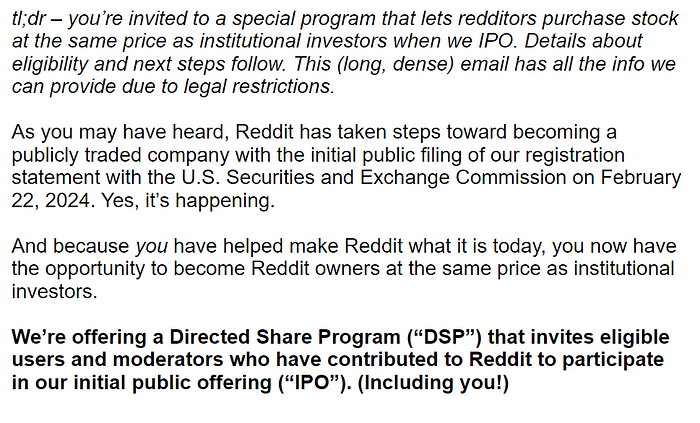
So, when I suddenly received an email one day from Reddit telling me that I, as a member, had the unique opportunity to participate in the site’s upcoming IPO, I of course jumped at the chance. Finally, a shot to claim some compensation for all the years I’ve blown on such subreddits as r/interestingasfuck, r/wallstreetbets, and r/explainlikeimfive. I’ve been on Reddit since the old days, when it was the nerdier Digg alternative, back in the late 2000s.

This was exciting.

What, you mean I get to buy a stock BEFORE the dirty unwashed masses do? I get to be an insider? I get to be treated like the elite intellectual artistocrat I am thanks to your website’s guidance? Sign me up, Reddit. It’s about time my contributions were richly rewarded.

Screenshot of my IPO offer from Reddit.

Feeling like Warren Buffet, I took the first step. I won’t bore you with all the details about IPOs and the DSPs or the RMBs (that stands for Redditors Making Bank). But there were a few steps I had to follow after winning the golden ticket.

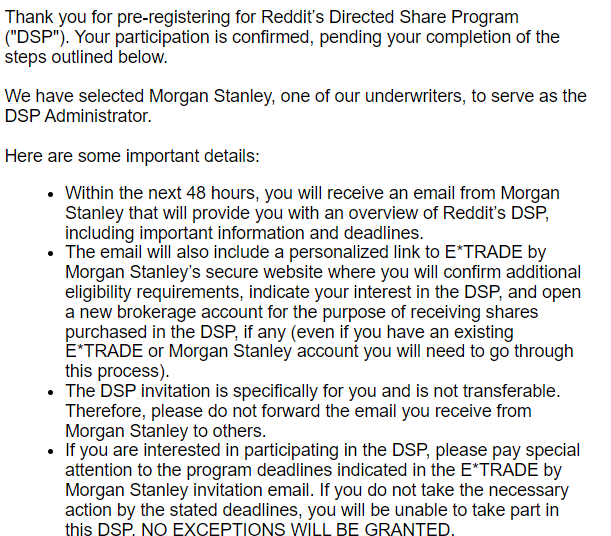
First, I had to pre-register for the IPO with Reddit by the March 5th deadline, and then wait to see if I was confirmed as a participant. As if I wouldn’t be. I expected to receive my confirmation in the form of a telegram or a gilded letter delivered by an owl at my window. Instead, on March 11th I received just a simple email stating that I was confirmed.

Screenshot of my confrmation letter rom Reddit.

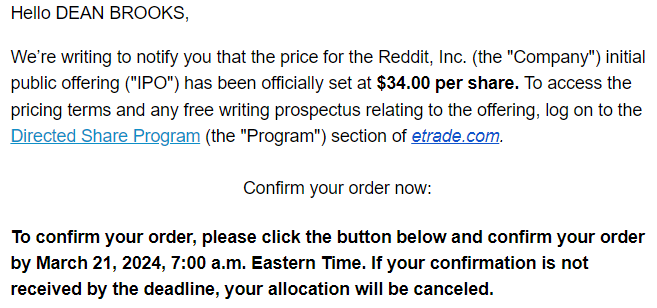
Next, I had to set up a separate brokerage account just for the IPO. I’ve been with Morgan Stanley/E-trade for almost ten years now so this was an easy process. After getting a new account going, Morgan Stanley emailed asking me to confirm my order and deposit the necessary funds. Again, just an email. No complementary top hat or secret invite to an Eyes Wide Shut sex party in Bohemian Grove. So much for feeling like an elite.

Screenshot of my confirmation letter.

$34.00 seemed cheap but reasonable. Facebook debuted at $38. Uber at $45. Tesla started at $17. I generally only invest in index funds or ETFs like SPY, VTI, VOO, and QQQ, so I was used to stocks costing in the hundreds. Generally, for my individual brokerage account, I deposit $1000+ into my investments at a time. But this was an exciting albeit risky tech IPO based on a website famous mainly for fostering neckbeard outrage and degenerate Wall Street gambling. I decided to buy just 10 shares, and put in $350 to ensure the whole cost was covered should there be some small additional fee.

So, how’d I do? Right after Reddit launched on the NYSE on March 21 the stock nearly doubled to about $65 a share. It dipped to around $39 in mid-April before rising back up to $62 just last week. And as of now, at close on May 24th, 2024, it’s $54.72.

When Reddit’s stock (RDDT) hit around $56 earlier this week I sold five shares for about $280. The reason for that was I wanted to pull out nearly my initial investment ($340). That way going forward what I have left at stake is almost all profit. If Reddit continues to move up, I capture the upside. If it crashes down and ends up floundering, at least I’ll have just about broken even and not really lost anything.

In summary, participating in Reddit’s IPO was a fun and thus far profitable experience. Do I wish I had invested more into the IPO? In retrospect, of course. Dropping $10k in there would have put me up almost $16,000 before selling half my shares. But a big part of investing is risk mitigation, not just seeking out a high return. Reddit’s IPO could have been a big fat flop to start off. And who’s to say Reddit won’t get downvoted by investors eventually?

I don’t know how long I’ll hold onto my five remaining shares. Facebook went up 5x in the first six years after its IPO. It’s now up 12x. But then Uber is barely up 50% from its IPO price in 2019. You’d have done better just holding the S&P 500 than Uber over that same time span. Will Reddit even still be popular in ten years? That’s difficult to say. The internet is a fickle place. I know I’ll (probably) still be there.