Is It Worth Keeping Tons Of Cash On The Sidelines Waiting For A Stock Market Correction?

A thought experiment.

Made with Midjourney

Over a decade ago, after moving to North Dakota to work in the oilfield, I lived in a church basement that had been fitted with dorm-style units. One of my “basement mates” was a nice guy in his 50’s from Virginia named “Alan.” We got to talking one day and he told me how he had $50,000 saved up that he was planning on using in the next big stock market correction. This was only a few years after the 2008 Wall Street crash, so it was still fresh on everyone’s minds.

At the time, ND was undergoing a massive oil boom due to technological improvements in the fracking process. Everyone working in the industry was making huge amounts of money, and like a rising tide, that lifted other sectors as well. Cooks at fast food places were starting at $18 an hour and up. Wal-Mart was paying people $25 an hour. Rent skyrocketed, too. I paid $1000 a month for my tiny basement dorm.

Alan was a CDL treater truck driver. Basically, he drove around to well sites with a giant mobile furnace that could heat up oil and water, and flushed chemicals, water, or oil down well heads in order to keep the lines clear and lubicated. He was probably making around $160K a year with all the OT he was pulling in. So, it was no surprise he had piles of cash sitting around.

I remember asking Alan that if the market were to crash, at what point would he jump in with his war chest? When it was down 10%? 15%? 20%? He didn’t have an answer. Back then interest rates were super low. He was probably only getting around 2% max on a savings account. That’s losing out to inflation badly. The real rate of inflation is not 2–3% like the government likes to report. It’s more like 7% when you factor in everything like real estate, college tuition, cars, medical care — everything that goes into living a life.

Since my talk with Alan over a decade ago (around spring, 2013), the S&P has gone up 3.5x from 1680 to over 6,000. That $50,000 would be worth $175,000 today had it been invested in an ETF like SPY. Interest rates have increased modestly, going as high as 5.5% for some savings accounts when they were at their highest. But nowhere close to a 3.5x return like the S&P.

Worth noting: SPY was about $156 back then. The ETF paid out $1.97 per share in its last dividend distribution. Buying $50K worth of SPY then would pay you $630 per quarter now, and nearly $2,500 a year. That’s the same amount you’d get if you just stuck that $50k in the bank with a 5% interest rate. So, the dividends alone are matching savings accounts. To say nothing of the compound growth in dividend reinvestment, or employing other forms of income like selling covered calls.

Bottom line: Owning the S&P is going to likely give you 10%-15% returns every year over the long-term.

Also worth noting: the stock market hasn’t crashed like it did in 2008 since my talk with Alan. Even the brief Covid crash and the 2022 correction weren’t anywhere close to the near -50% drop seen in 2007 through 2009.

Here’s another way to think about it. Let’s say you have a million dollar stock portfolio in the S&P 500, and $100,000 in dry powder on the sidelines waiting to use for the next big crash. If stocks drop 10%, even if you timed the bottom perfectly, you’re only getting a 10% discount. How many years of dividend gains and compound growth did you give up for that “big” discount there? Obviously, you wouldn’t time the bottom perfect, either. No one can. Anything less than a 5% discount is only matching what you’d get in a high-interest savings account. So, it’d be a wash at that point.

But what about investors like Warren Buffett who keeps hundreds of billions in cash sitting around? What about individual stocks and investments outside the S&P?

Big investors like Buffett and others operate at such a high level that it’s hard to know their ultimate motives or aims. Buffett isn’t concerned with grabbing a mere 10% discount on the S&P. He wants to own entire companies or take controlling interests in things, like how he bought BNSF railroad in 2010. Accredited investors like him are also afforded “insider” opportunities on things that average investors are not, such as IPOs and such. An investor like him might keep cash sitting around waiting for an AirBnb to come along.

For the average “buy and hold” diversification-style investor, aka the one looking to retire at 60ish with one mil plus, it doesn’t make sense to keep tons of cash sitting around waiting on some big crash. Especially if you’re largely just buying the S&P 500 or the NASDAQ anyway. For someone like that, you really only need emergency savings PLUS “peace of mind.” Meaning whatever extra you need that helps you sleep at night. Five thousand, ten thousand, whatever.

For more active investors, more cash is going to be strategically optimal depending on their experience and timing. During market drawdowns, individual stocks afford better buy-in opportunities than the S&P, obviously. Buyers of META during Mark Zuckerberg’s Congressional hearings in 2022 could have bought the stock at near $100. It’s since gone up past $600. A fantastic return in only two years.

Last March, Reddit offered users the opportunity to invest in the company’s pre-IPO share price at $34. I bought some myself, as I talk about in this article here. Since the stock’s public listing, it’s gone up to $180, giving over a 5x return. That was a time when having some cash lying around proved a good idea for me. But remember, speculation is still speculation. Plenty of individual stocks that once looked like bargains have continued to crash.

I read articles saying you should keep 10–20% of your portfolio in cash sitting around for big opportunities. I don’t think you need quite that much. Ideally, you would simply take one investment’s profits to switch into another investment. After measuring the tax hit, of course. Then you’re kind of playing with house money. For instance, I sold a bunch of alt coins a few weeks back, some of which I’d made multiple x returns on over the last 18 months. I rolled most of the gains into my River exchange account where I get a 3.8% annual return paid in Bitcoin, while using the money toward my $20 daily DCA 2025 experiment. As Bitcoin hits certain benchmarks, I’ll likely ladder out some of my holdings into the S&P or into other assets. If I were to take, say, $50K out of my Bitcoin profit holdings for use as a down payment on a house, it’d be like I got that $50K for free. I also made that $50K way faster than it would have taken me if I tried saving it.

And that’s another thing to consider. It takes forever to save up cash even if you have a high income. Even if you make $100k a year, after taxes and expenses, it might take you a few years to save up a mere $50K. Meanwhile, the S&P is going up 10–15% a year, and other stocks or cryptos are going up big. Most likely, you’re better off just putting as much of your money to work as possible, and keeping enough on the side for emergencies and a little extra for peace of mind.


My Very Simple Investing Strategy For 2025

Keeping things easy and mostly automatic going into the new year.

Made with Midjourney

I love investing. I love saving. I love seeing my money grow over time without having to do anything other than sit and wait. I think it was Charlie Munger or Warren Buffett who said, “Compound interest is the eight wonder of the world.” He was quite right.

2024 delivered some fantastic gains across the board for virtually all assets — gold, Bitcoin, and US stocks, of course. Like many others, I’ve seen my networth grow substantially. At this rate, I’ll be semi-retired far earlier than I expected. All good.

While I love investing and watching markets, I hate all the hand-wringing and consternation that often goes along with it. It’s great to make money, but not if you’re going to obsess about it and be checking stock tickers and the Bitcoin price every five seconds. What kind of a life is that?

It stressed me out all year. As I get older, I’ve learned that nothing beats having peace of mind.

I’ve been burned in the past on bad investments that I put way too much time and thought into, while ironically doing quite well in ones I didn’t think much about because they were diversified and “boring.”

My ETFs and index funds? All in the green. But often I do poorly in individual stocks or options investing. I did do great with the Reddit IPO in 2024, nearly 5x-ing my small pre-public investment. Looking back, I wish I had put way more in than I did. But hindsight is 20/20 and all.

To help keep things simple and easy, I’ve decided on a very straightforward strategy. Basically, any money I use for investing after taxes, expenses, and my retirement account contributions will be apportioned like this:

60% equities — Meaning SPY and QQQ, the only two holdings currently in my main non-retirement brokerage account.

20% Bitcoin — This is in addition to my 2025 DCA experiment, which I outlined here. Bitcoin is volatile as hell, obviously, but I’m in it for the long haul. I’ve been in crypto since 2020, so I’m a weathered vet at the ups and downs.

10% precious metals (mainly gold)— I only buy bullion in one ounce increments to save on over spot mark-up, and I prefer the .9999 purity of the incomparable British Britannias. Such a lovely coin, and actually the cheapest way to buy gold over the American Eagles, Buffalos, Canadian Maple Leafs, or almost anything other than packaged gold bars. I also like to buy the silver Britannias every year, too.

10% cash savings — This is money I’ll be saving for pretty much anything. It could be for investing into any of the above categories, toward vacations, collectibles, something risky like options, or whatever. This is savings that sits on top of my emergency fund. Obviously, if I had to dip into my emergency savings for something I’d have to replinish that first before anything else.

What’s missing? Real estate. I don’t own a house or any property, and don’t have any plans to just yet. Housing is not really practical or even worthwhile where I live because of the harsh winters and the constant maintenance problems. So, I continue to rent, which I think is a better value overall for now. In the future, I’d like to own my own home. So when that happens my investment strategy would have to be adjusted accordingly.

Also missing, a side business. Medium provided a nice little side income for 2024, but not enough to make a big difference. I’m looking to get into YouTube in the new year, but that may take awhile to become monetized. I have considered buying businesses and such. It would have to be the right deal and the right situation. I’m not going to plunk down money into something just because it’s trendy or seems like a “sure thing.” There is no such thing as a sure thing in business.


Really, at the end of the day, I’m a writer. A “content creator,” to use that hated phrase that’s in vogue. I think I’d rather just focus on that gift. I’m only happy when I’m writing and creating something to entertain or inform people. I’ll look for ways to expand, improve, and monetize my writing skills.

Hopefully, this new investing strategy will help alleviate my mind. Looking back, I’ve spent way too much time thinking and worrying about money, while neglecting other areas of my life. Money is great and all, but it cannot give you a fulfilled life, necessarily. I love being in the game, don’t get me wrong. The process of making money is fun and fulfilling. But after awhile, it just becomes video game points.

Made with Midjourney

Have a happy New Year. 🙂

Can You Really Retire Early By Making $10,000 Per Month With LEAPS? It’s Not That Simple 

It’s happening again.

Made with Midjourney

You know you’re at frothy market highs when you start seeing videos about totally can’t fail easy shortcuts to early retirement by (fill in the blank with whatever financial trading scheme you want).

We saw this with crypto back in 2021. I remember arguing with a guy on X (then Twitter) who was out there telling people to retire early by staking their money on high interest earning liquidity pools. I got into another Twitter fight with some fresh MBA grad finance bro who was out there recommending random dividend shit stocks that were paying out 10%+ to his followers.

“Bro, you don’t understand. Every five grand you put in equals $500 a year for life. For life, bro!”

Mind you, I wasn’t being nasty or anything. I was simply asking what happens if stocks go down or those liquidity pools dry up? I was asking standard good faith due diligence type questions. But like the guy who pointed out that maybe the Titanic needed more life boats, I was ignored and ridiculed.

Then the Federal Reserve hiked interest rates and stocks fell into an 18 month bear market. Crypto plummeted back to Death Valley. Mysteriously, I didn’t see too many finance bros on Twitter soon after. Same with crypto bros.

But now markets are back at all time highs. The Fed just cut rates by half a point. Stocks are roaring. Bitcoin is back, baby! It’s all good. “Biggest bull market ever, yo!”

Which of course means gurus and finance experts and self-appointed wealth wizards are out there peddling their know-how for clicks.

The latest big idea I’ve seen involves buying LEAPS and then selling calls against those leaps.

What the hell am I talking about, you might be wondering? What’s a LEAP?

LEAPS

LEAPS are an option on a stock. It stands for Long-Term Anticipation Equity Securities — LEAPS. LEAPS are at least one year out from expiration, and sometimes they can go out as long as three years. An option, as you may know, is the right but not the obligation, to buy a stock within a certain time period. If I buy one option on Apple with a strike price of $200 that expires in one year, that means I have a year to exercise my right to buy 100 shares of that stock at $200. Option contracts are worth 100 shares each.

The appeal of options is they give you the ability to potentially control 100 shares without having to actually buy the 100 shares. The downside is that option contracts expire and they are more volatile than stocks.

Option contracts are also way cheaper than buying the shares. A $200 call option on Apple for December 19th 2025 as of this writing costs about $5,300 while 100 shares of Apple would cost roughly $23,000. If Apple goes up to $250 this time next year, the value of the option you hold on those shares would also go up. Let’s say our $200 option we paid $5,300 for becomes worth $7,000. That would mean you’ve made a profit of $1,700. That’s nearly a 25% return in one year. Had you bought 100 shares at $233 instead, you’d have also made $1,700, but you would have risked about $23,000 to do so. You would have also only made about a 7% return. You can see how options can give you enormous leverage on a stock.

The Strategy


However, there is a way to maximize your returns on that LEAP call. You could also sell calls against the stock. The key here is you want to sell calls that are high above the stock price (“out of the money”) and therefore unlikely to be exercised by the buyers.

And you want to sell calls with close expiration dates. Say, a week, or a month out. Right now, a November 1st, 2024 (one week from this writing) $240 call on Apple is going for about $200. Hypothetically, if you were to sell a $200 call like that every week, you could potentially make $10,400 a year. That’s with only one LEAP option that cost you a mere $5,300.

Now, imagine if you could buy 20 LEAPS. That would mean you could sell 20 calls against them, and make $208,000 a year, or over $17,000 a month. That’s a nice income stream. On top of that, you’ll also make $34,000 if Apple goes up to $250 and your LEAPS become worth $7,000 as mentioned earlier. That’s a grand total of $242,000 of profit in one year.

Sounds too good to be true? Well, that’s because it is, duh. What you see above is where the gurus all stop talking. They don’t mention the possibility that your calls might get assigned, forcing you to liquidate your LEAPS holdings.

They also don’t mention what happens if stocks slide into a bear market, which is the biggest threat. Even a strong bull market will see big dips and corrections. But what happens during a prolonged downturn, like what we saw in 2022 through late 2023? Or what happened after the Dot Com meltdown? Or after the 2008 financial crash? It took stocks years to get back to all time highs again after 2000. It took about five years for stocks to return to highs after 2008.

You can see the problem here if you have a bunch of financial assets that EXPIRE in a relatively short amount of time. Even if you have a three year LEAP option, it might take that long before stocks get back to even. Meaning you would likely lose your investment. Option values go down way harder than stocks during pullbacks.

Yes, you could buy put options to hedge your positions. But those may only limit your downside risk. You can still lose money. Lots of money.

I’m not saying this LEAPS strategy doesn’t work or can’t work. I’ve bought LEAPS myself and profited. I’ve also sold coverered calls and put options. I’m just saying that you need to get a fuller picture of what you’re getting into. You need to understand the substantial RISK you are taking on by doing this. Using a small part of your portfolio to trade might be okay depending on your networth and risk tolerance. This strategy could potentially offer some relativey steady returns if done prudently.

But is this LEAPS stategy something you could actually RETIRE on? I certainly wouldn’t bank my retirement on this. It would only “work” assuming you have significant assets to fall back on should the market crap out for 18 months. Thinking you’re going to make $10,000 or whatever a month every month no problem is foolish.


I really get tired of these so-called experts out there chasing clicks and ad revenue by misrepresenting trading strategies or whatever other financial schemes are in vogue. Actually, no. It pisses me off. Because the fact is trading is high risk and few people make regular money from it. At worst they offer half-baked schemes that only work in optimal markets. At best they’re not giving you all the facts.

Be on the lookout for these gurus and bull market snake oil salesmen. Do your own thorough research. Do not get sucked in by the hype. Do not just blindly follow some strategy because you think it’ll give you easy returns. Be careful out there.

A Few Easy Ways I Automatically Make Extra Money Every Month

Who says side income has to be hard work?


Made wtih Midjourney

Everyone needs side income these days. Thanks to inflation and the rapidly rising cost of living, one income is too close to having none. Many people work two or even three part-time jobs if they don’t have a solid main source of income. Wealth “gurus” will sell you all sorts of complicated programs guaranteed to make you rich.

The effect of all this is PRESSURE. Pressure to make more. It can all seem complicated, difficult, and time-consuming. Luckily, there are some very simple, stupidly easy (and lazy) ways to supplement your income. Every little bit helps, even if it’s just a few dollars. Here some methods I use.

1. High Interest Savings Accounts

This one may seem obvious, but you’d be really surprised how few people take advantage of this. Even though the Federal Reserve just recently lowered rates by half a point, there are still opportunities to earn decent yields. Just go to an aggregate site like Bankrate and look under their high yield savings account section. As of now, October 2024, you can still find savings accounts with reputable FDIC-insured banks offering 4.00% to as high as 5.30% APY. Some banks even offer decent savings rates in their checking accounts, though this is not often.

Another key to taking advantage of this is to have multiple savings accounts. I do this with bank accounts in the interests of safety and diversification, should one of my accounts become compromised or I lose a debit card. But it’s also good to have at least one seperate account that you can transfer money to. This can even motivate you to save money, because you wont see it everyday in your regular bank. “Out of sight, out of mind,” as they say.

Right now, between all my accounts, I earn over $50 a month from interest. I expect to make at least $600 this year.

2. Credit Card Reward Points

This will bother the Dave Ramsey fanatics, I know. The money management radio host is famous for his devout stance against credit cards no matter what. I used to think the same way. But if you’re disciplined, and you use them for things you would be spending money on anyway, then there’s no reason not to take advantage of their cash back rewards.

My one card pays 1.5% cash back. I have a number of bills that automatically deduct from that card every month, that add up to anywhere between $300-$500. This means at the end of the month I can apply $5–$8 to my bill. I always pay my bill in full. I’m a proud “deadbeat,” as the credit card companies refer to those who never maintain a revolving balance. Even though $8 may not seem like a lot, that’s basically a free $96 or more every year, that you can make without having to really think about it. Put another way, if you saw $96 lying on the sidewalk, would you not bend down to pick it up? Of course you would.

Cash back can also help when you have a big purchase. If you were to spend $1,000 on something like a new computer, that would translate to a $15 “discount” due to the cash back feature. Some credit cards even offer higher cash back rewards with certain companies.

Again, the key here is to buy things you would anyway. Don’t just buy something to “get a discount.” That’s what gets people in trouble, and why Dave Ramsey is mostly right about avoiding credit cards altogether. But if you’re savvy and disciplined enough, there’s no reason not to look for ways to save even just a few dollars.

3. Dividends On ETFs/Index Fund Stocks

This one requires some clarification. I don’t personally buy dividend stocks. I stick to low-cost ETFs that track the S&P and Nasdaq. Namely SPY and QQQ. This goes for both my retirement accounts and my personal brokerage account.

Many people will recommend this dividend stock or that, looking only at the yield. I don’t really care. Many dividend stocks tend to go down in value over time, essentially making any gains you make from the dividends a wash. For example, AT&T (T) offers a nice 5.15% dividend, or about $.27 a share, but its stock has declined by almost 50% over the last five years. If you had bought 100 shares in 2019, you’d have made around $550 in dividends so far. But your position overall in terms of the value of the stock would be down almost $740. Meaning you’ve lost about $200 on paper. AT&T has gone up this year, but it’s long-term trend is down. This is not the case with every dividend stock, of course. Some may actually be good deals, but they’re just not for me. Do your own research here.

My personal brokerage allows me to see an estimate of future earnings from my dividends. As of now, I earn about $100 a quarter from my SPY and QQQ holdings. SPY offers a “low” 1.21% yield, while QQQ only gives a “measly” 0.61%. But these ETFs track the market, including the largest and most successful companies. SPY has gone up over 50% over the last five years. QQQ has more than doubled in the same time span. You have to look at the overall value of the asset and the risk involved in holding it, not just its annual yield. A dividend stock may offer a decent yield one year, then cut it the next. But even if SPY and QQQ were to cut their dividends entirely, they would still track their indexes. Whereas a dividend stock’s price might drop big because a flood of investors exit over its diminished yield.


Adding up these three brain-dead easy ways to make extra money comes out to almost $1,000. Or about $83 a month. That’s like getting an annual “performance bonus” from a job. A thousand may not seem like much. But it’s enough to pay rent for a month. Or get a “free” computer every year.

The best part is I don’t have to do anything really to get this $1,000. I consisently save money. I use credit cards to conveniently centralize monthly payments. I invest into my personal brokerage regularly. An extra thousand bucks is just a nice incentive for doing things I’d be doing anyway.

This Chart Taught Me Some Mindblowing Lessons About Wealth

Stocks and mutual funds won’t make you rich. Starting your own business will.

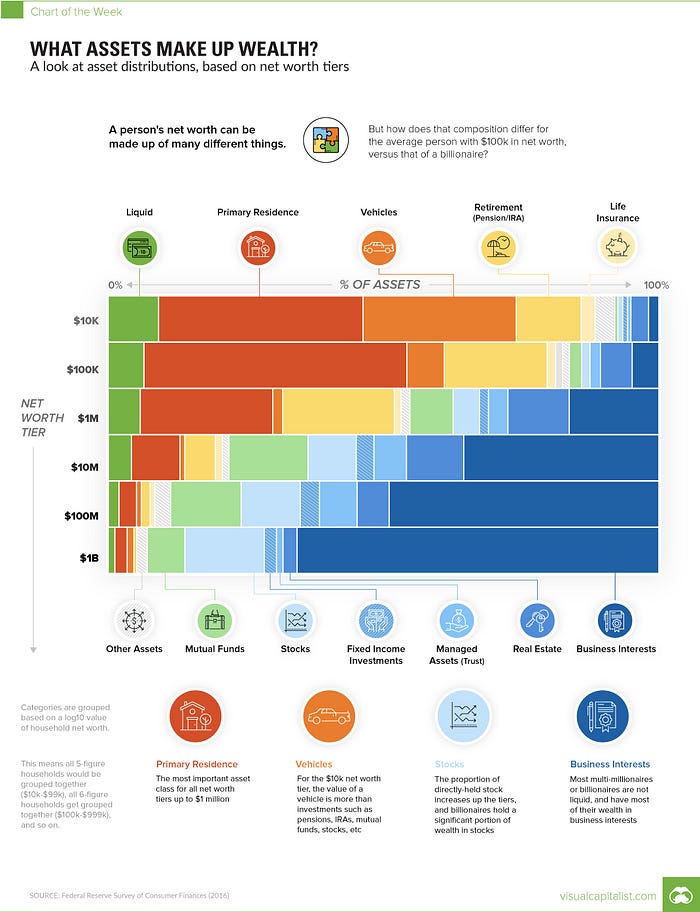
Source: https://www.visualcapitalist.com/chart-assets-make-wealth/

So, I discovered this chart by a post from James Camp, a guy I follow on X, who specializes in “nanoflips.” Check out his bio for info on those.

The graph comes from Visual Capitalist, a clever website that takes complex information and distills it into to easy to understand (and colorful) charts.

The chart displayed above is based on a Federal Reserve Survey of Consumer Finances from 2016, and it contains some illuminating aspects about how people in different net worth tiers manage their wealth.

Like many, I’ve always been under the impression that stocks and mutual funds are the best ways to build and maintain wealth for the average person. Over the last few years, I’ve diligently maxed out my 401(k) and IRA funds. I contribute regularly into a personal brokerage account. Even through the Covid Crash and the 2022 drawdown, I kept plugging away, dollar-cost averaging into the market like you “should.”

The returns have been solid, for sure. While I’m not close to retirement anytime soon, I’ve built up a decent net worth. I like to think I’ve “secured the bag.” Meaning that even if I never contributied another dime to my investment accounts from now until age 65, compound growth alone would get me to a comfortable retirement. And that’s NOT taking into account potential Social Security payments.

I say “potential” because who knows if Social Security will exist by then, or pay out what it’s supposed to. It’s never a good idea to bank your life on a government program, especially when the government is over 30 trillion dollars in debt.

However, the above chart has made me completely reevaluate my relationship with invesing and money in general.

Source: https://unsplash.com/photos/woman-in-gray-shirt-holding-fan-of-us-dollar-bills-OyDZRZOlENw

For starters, the chart shows that the higher a person’s net worth the more they have invested in “business interests.” These are businesses someone owns personally. They could be anything from a franchise, a laundromat, a service company, all the way up to a controlling stake in a Fortune 500 company.

Elon Musk has a 20.5% stake in Tesla, for example.

What’s surprising, however, is how little percentage-wise wealthy people are invested in stocks and mutual funds relative to their net worth. The chart combines net worths together and works out an average. So in the row where it says $10K, it’s grouping all the people with $10K through $100K together. Then in the $100K row, it’s everyone with a net worth between $100K and a million. So on and so forth.

People in the $1 million to $10 million range look to have close to 40% of their net worth in retirement accounts, stocks, and mutual funds. This makes sense give that most people in that range are retirees who spent years contributing to company 401(k) plans, pensions, and their own IRAs. About 30% of their net worth is in their primary residence.

However, going further up in net worth on the chart shows that the wealthy have increasingly less in stocks and personal homes, and vastly more locked up in their own businesses.

For those in the $10M+ group, stocks are no more than about 30% of their net worth, and their personal homes aren’t even 15%. Their wealth is mainly all in their own businesses.

This may seem obvious. But almost everywhere you turn, you only ever hear about the importance of investing in a diversified portfolio of mutual funds and ETFs.

Dave Ramsey touts mutual funds like a religion to his millions of listeners.

But are index funds and mutual funds really the best ways to build wealth?

If you were to ask most people how they think they can get rich through investing, most would probably say by getting lucky on a stock or cryptocurrency.

This is not impossible, of course. A mere $10K in Apple stock 20 years ago would be worth almost $5 million today. Buying Bitcoin or Ethereum just five years ago would have given you substantial returns.

People may remember the “meme stock” craze from just a few years ago with Gamestop and AMC. The whole internet was gripped with trying to ride the next big thing “to the moon.”

Let’s not even talk about the NFT nonsense.

Point is, everyone thinks stock investing = getting rich, except people who actually are rich. They know stocks and mutual funds won’t make you rich. They can make you financially secure. But if you want to become truly wealthy, you’re best bet is by starting your own business.

Think about it. Stock picking is unreliable unless you know what you’re doing. If you decide on the safer, diversified route of index funds, ETFs, or mutual funds, it could take decades to build anything substantial. It’s also highly unlikely you’ll break into the top 1%.

To get to $5 million, for example, you’d have to invest $18,000 a year every year for 40 years at an average annual return of 8%.

Wait, only $18,000 a year? That doesn’t sound too bad.

Well, according to the National Board of Labor Statistics as reported by USA Today, the average salary in the United States in Q4 of 2023 was less than $60,000. So, the typical person would have to stock away almost 1/3 of their income for basically their entire working life to get to that $5 million. That’s a pretty tall order considering they still have taxes and bills to pay.

This information may sound sobering, or even despairing. Especially to 401(k) and IRA maxers like myself, stock market junkies, or those in the FIRE (Financial Independence Retire Early) camp.

It’s important to keep some perspective. A $1 million net worth is still a lot more than most people will ever have. I’d argue you probably don’t even need half of that to retire, provided you manage your money well and are prepared to live modestly. And those are certainly attainable amounts for those who prefer the more traditional route of diversified index fund investing. Investing $3600 a year over 40 years at 8% gets you to a million.

But why cap your financial potential with just mutual funds?

What I’ve taken from this chart is that to become wealthy you’ve got to get creative and entrepreneurial. While I’m going to keep investing in stocks and my retirement accounts, of course, moving forward, I’d like to start thinking beyond them. I’m going to start allocating some of my income toward experimentation with businesses. This will prove a tough adjustment for me, as someone who’s never had his own business or been much of a risk taker. No doubt there will be some failures and surprises along the way. But I think it will be good mindset shift in the end, and hopefully a lucrative one, too.