What is Midjourney? It’s an AI program that basically creates anything you ask it to create. Dream is another similar program. There are a bunch of these AI art programs out there. Just recently, Microsoft also released Visual ChatGPT.
I’ve begun using it for making pics for my articles on here and Medium.
I even got a monthly subscription for Midjourney after I surpassed the trial limit on pics. You can use the service for free to make about twenty visuals. After that, the subscription has different tier levels. I went for the cheapest one for now, at $10 a month. That allows me to make 200 visuals a month. But the rate I’m going, I might need to upgrade my subscription at some point.
Rather than being afraid of AI, as I’ve noticed many writers and artists have become, I think it’s best to embrace the new technology. It’s similar to the rapid growth of the internet. Even though the web has obviously displaced a lot of print publications, it still made enormous opportunities for digital publications. Those companies and people who adapted survived. I used to work in the printing industry, so I’m well aware of how that entire industry consolidated, and then shrank to its current state, under the power of the internet.
New tech is always scary at first. And who knows, maybe ChatGPT displaces a lot of writers on the web. But I don’t think so. I don’t think any computer program can fully replace a unique human voice that offers value and insight. Pointless listicle articles and Buzzfeed-style nothingburger content that adds little but obnoxious ploys for clicks? Yes, I can see that getting turfed out the door. As it deserves. But valuable human-to-human interaction is never going away.
There are a bunch of advantages to using Midjourney for pictures on Medium, also. One, there’s no copyright issues. Two, you can make pictures that are more unique, and reflect the theme or subject of your article better. Three, it’s very cheap with a monthly Midjourney subscription. You could even get them for free if you are able to stick with the trial. And finally, it’s freed me from having to use generic photos from sites like Pexels, which I often found unsatisfactory.
I’m not saying I won’t ever use real photos again. A good (human-made) photo is still a marvelous thing. I just like having more control over how I present the look and tone of my articles. Midjourney and Dream, my two AI sites of choice at the moment, give me that sense of control. And the results are actually really good. As I stated in a tweet some time ago, AI art is sometimes like extracting abstract imagery out of someone else’s consciousness while they’re dreaming, of particular objects. It can be strange and surreal. But AI visuals can also be realistic and striking.
Except for human hands. For some reason, AI hasn’t nailed the intricacies of the human hand.
Anyway, here’s a video/slideshow I made with Midjourney photos. The prompts I used involved portraying different famous Hollywood directors as classic Disney characters as hand drawn illustrations. I think Tarantino turned out the best. Though Spielberg is a close second.
In case you didn’t know, AI art reimaginings has become a popular niche on YouTube. People are posting things like Family Guy characters in real life. Or Batman as a dark ’80s fantasy. And many other variations. I wanted to test out my own idea.
As a lover of random trivia, and as someone who fantasizes about producing an animation myself one day, I’ve lately become fascinated by the production costs of popular cartoons.
Some of the numbers are pretty mind blowing, as are the production schedules. A typical episode of Rick and Morty, for instance, takes upwards of a year to produce. That seems a pretty short amount of time considering some of the crazy worlds and dimensions that show involves.
While you’d think most of the production costs in cartoons goes to the actual animation itself — which is often time-consuming and intricate— sometimes the lion’s share actually goes to the voice talent, as is seen on many network shows.
Starting at the high end and working down, a look into the costs of cartooning:
According to various sources, it costs about $2 million to produce an episode of Seth MacFarlane’s long-running cartoon sitcom. Or roughly $100,000 per random cutaway per episode. There were many different websites that reported this number, though they all seemed to link back to a singular source — an article titled “Cutting Costs” hosted by Penn State, about how TV anime is produced.
Digging deeper, I found out some of the reasons why the budget is so freaking high for Peter Griffin’s shenanigans. The answer is somewhat obvious. It has an all-star voice cast that’s been making serious bank the last 10+ years of the show’s run.
Hollywood Reporter reports that the top four cast members each make between $175,000 to $225,000 per episode. That article is from 2013. It could be even higher now. But multiple searches, even ones dated more recently, kept pointing back to those figures. If they’re still accurate, that means half the budget for Family Guy is taken up by payroll for the top voices. That’s a huge slice of the pie for talent, even considering that Seth McFarlane does the voices for a number of characters. But not exactly surprising. Talent often requires a big pay out for entertainment. The Rock made $30 million from Red Notice, for instance.
Trying to find specific budget numbers for Justin Roiland and Dan Harmon’s popular Doc Brown and Marty McFly-inspired cartoon proved tricky. But you can tease out an estimate by looking at another popular edgy animation — South Park — and then compare production styles. For that, I found a thread on the Rick and Morty subreddit addressing the inquiry “Why does it take so long to make Rick and Morty episodes?” A user who has since deleted their handle makes the observation:
South park uses Maya, a 3d animation software, to create their episodes. This means they can reuse most of their assets (even animations) without the need to remake anything…Rick and Morty uses Toonboom Harmony, which speeds the process up in comparison to old-fashioned hand-drawn animation, but is still much slower than South Park.
The user goes on to compare how South Park sacrifices “story” for “topicality” whereas Rick and Morty favors the opposite approach. According to Inverse via director Erica Hayes, a single episode of Rick and Morty takes anywhere between nine and twelve months from idea to completion. South Park is famously written, animated, and voiced all in a single week. But as the mysterious unknown Redditor pointed out, the Colorado-set raunchy cartoon thrives on churning out content that captures the immediate zeitgeist, over mulling complex narratives or long story arcs.
So, if Family Guy, a major network cartoon, costs $2 million per episode, as previously stated, while South Park, with all its cost-cutting and technological efficiencies, still runs somewhere between $500k and $1 million per episode, then it’s possible that Rick and Morty costs somewhere in-between, but probably on the lower end. Say, maybe around $1.2–$1.5 million per episode. Unlike Family Guy or The Simpsons, Rick and Morty doesn’t have an all-star cast that eats up half the show’s budget. Most of the show’s costs probably goes into the animation itself.
So basically, your popular, highly-quoted cartoons that have wedged themselves into the American public consciousness are going to run upwards of a million per episode or more. That’s not surprising. The Simpsons cost as much as $5 million per episode back in 2011.
What’s more interesting are the shockingly low budgets of anime shows like One Piece, a popular Japanese cartoon that’s been running since 1999. Medium writer, and researcher of Japanese culture, Jason Muell, in his article, “How Much Does it Cost to Produce an Anime Episode?” writes that in 2002 it cost 10.75 million yen to make one episode. That’s roughly $74,280 in pre-Wall Street bailout, pre-COVID, pre-QE infinity dollars.
According to the CPI Inflation Calculator, that means an episode of One Piece would run to about $122,287.84 in today’s Fed-pumped Monopoly money. That’s $5,095 per minute, and almost $85 per second. Still not bad for a 24-minute cartoon with over 1,000 episodes and counting.
In case you weren’t aware, Japan is a powerhouse in the animation industry. So it makes sense that it would have cracked the code on how to profitably churn out cartoons in a cost-efficient manner. TMS Entertainment, one of the most famous and prominant production studios, and a subsidiary of Sega Sammy Holdings since 2010 (yes, as in the Sega gaming system) basically made ALL of the popular 1980s/’90s cartoons Millennials know and love. Shows like Inspector Gadget, The Real Ghostbusters, and Batman: The Animated Series, and many more.
YouTube Cartoons or Ultra Low-Budget Animation
How much would it cost to make your own independent cartoon?
Okay, so for the average person, the above budgets are obviously way out of reach. But let’s say you wanted to make something super cheap that was only a few minutes long. Like those corporate explainer videos, or a funny short.
Well, unless you’re able to do all the drawing yourself, it’s still going to cost you anywhere between $3,000 and $7,000 for simple 2D animation. That’s according to ProductionHUB, which also points out that those numbers DON’T include other important things like the screenplay, voiceover, or music. For higher quality animation, ProductionHub notes that you could pay $10,000 to as much as $1,000,000 a minute for animation.
One million dollars per minute? Wow. That’s Pixar movie territory.
You can see why Seth MacFarlane wears so many hats as a writer, director, producer, and voice talent on Family Guy. You’ve got to cut costs anywhere you can in cartooning.
Even those “low” numbers ProductionHUB quoted are ridiculous. It makes me wonder how animated channels like Kurzgesagt — In A Nutshell or The Infographics Show on YouTube get by, despite having tens of millions of subscribers.
Let’s say you were still determined to make a simple cartoon of your own. This seems doable, despite the heavy costs at even the low-end of the scale. Back before YouTube became dominant, amateur animators made all kinds of shorts and even long-running series on the site Newgrounds. Salad Fingers, a creepy viral animation created by David Firth, initially appeared on Newgrounds in 2004, and has since built up a cult following.
But supposing you’re not able to draw. Or you don’t have the time or talent to master the intricacies of digital animation programs like Adobe Animate or Blender. And you’re on a tight budget. Well then, you’re pretty much relegated to finding freelance artists on a site like Fiverr.
I looked under the Video & Animation section at the popular freelance marketplace for an idea of what creating an animation might potentially cost. For professional 3D character animation, Pakistan-based provider rocky_shane charges between $2,000 and $5,500 for 60 seconds. That higher price includes 3D modeling, rigging, detailed movements, and four characters. The provider doesn’t mention anything about voiceover work, scripting, or music, so it’s likely you’d have to provide that yourself. That might mean then hiring an editor to mix all the seperate components together seamlessly, which would incure further costs, assuming you’re not doing all of that yourself.
So, if you were trying to make a cartoon with a story narrative, you’re looking at minimum of $55,000 for a ten-minute short, not including all the extra stuff mentioned. Or $132,000 for a full 24-minute episode. Pretty steep, but that’s actually right in line with One Piece’s almost $122,000 cost per episode.
U.S.-based provider gallywix offers a more comprehensive animation service that includes full backgrounds, editing, consultation, and syncing supplied voicover and royalty-free music. But only for two characters. For the advanced quality package, all of that will run you $12,500 per minute in “basic style.” That’s your typical generic-looking cartoon. For something more complex like Futurama, the provider charges $25,000 per minute. And then for even higher quality, like Adventure Time, $75,000 per minute.
There are certainly cheaper alternatives on Fiverr. I screened out for “professional” services only, as that is where you’d realistically want to go if you were serious about making a legit (albeit low-budget) cartoon. If you just wanted something really simple and basic, there are likely plenty of artists you could find at a lower cost. But probably not by much.
Given those still-pretty-high costs savings for freelancers, you’re probably better off paying for a course to learn an animation software yourself, in addition to taking art lessons. Even if you end up with something really crude-looking, if people like the story or characters, you could still potentially build up a good following. For example, there are a ton of amateur “Wojak” animations on YouTube that use clip art, static backgrounds, and automated voiceovers. And they’re actually super popular. Low Budget Stories has 335,000 subscribers, for instance, and that channel only started a year ago.
Animation is not cheap, to say the least. Most of your successful YouTube/independent productions are made by the artists themselves, who likely spent years honing their craft. If that sounds daunting, remember that Stan Lee, the founder of Marvel Comics, couldn’t draw. He was a writer/editor. And he did pretty well in the end.
That’s no hyperbole, either. Some of these writers have downright ludicrous levels of dedication and focus. They’re not even human, and quite possibly superhuman.
You think you’re a hard working writer because you banged out a few articles on Medium last week? Get the f*ck out of here. You’re nothing compared to these uber authors.
So let’s get started. Prepare to feel inadequate.
First up is, without a doubt, a name you’ve seen, because her books usually take up a half mile of shelf space at the library.
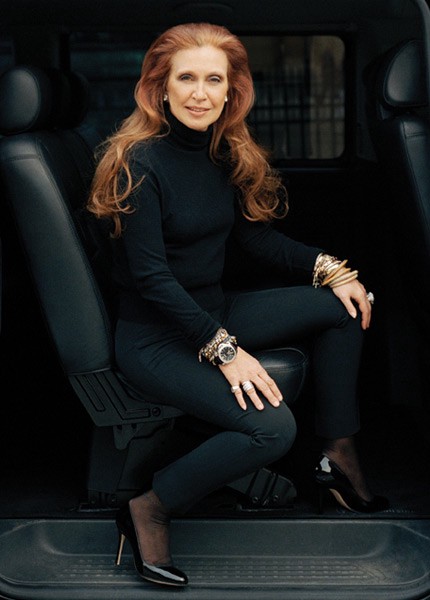
Source: daniellesteel.com
(Pictured above: the TX-9000 Writernator emerging from its luxury tank to obliterate writer’s block).
Her name is Danielle “The Woman of” Steel. To date, this weapon of mass production has written 185 books, including 141 novels, over a career that’s spanned six decades, and sold over 800 million copies.
And the romance novel queen is still going strong. In the first half of this year alone, she’s pumped out three books, with four more planned for the rest of 2022, including one this June. She publishes seven books a year like clockwork.
Her secret? No sleep, apparently.
According to Glamour, she works practically non-stop, sometimes all 24 hours in a day if she’s pressed for a deadline. Says Steel, “Dead or alive, rain or shine, I get to my desk and I do my work.”
For a true writing workaholic, you’d think Steel would have never had time for a personal life. But she actually has nine children. Nine! She’s also been married five times, including one marriage to a man who was an inmate at a prison when she met him for a journalism assignment.
Steel often juggles multiple projects at a time, outlining one, researching another, while writing and revising others, in order to maintain her prodigious output. She hardly eats, abstains from caffeine, scoffs at the very idea of burnout. She writes on a 1946 Olympia standard typewriter. A freaking typewriter. As in that thing Jack Torrance went mad click-clacking away at in The Shining.
Steel also has no concept of so-called writer’s block. Like every writer, she has tough days, sure. But this powerhouse offers this advice for the days when the muse is slow,
“I keep working. The more you shy away from the material, the worse it gets. You’re better off pushing through and ending up with 30 dead pages you can correct later than just sitting there with nothing.”
That’s easy for you to say, Ms. Steel, you’re a literal Terminator.
Up next is a guy some people get mixed up with Stephen King. And that’s because, like the horror master from Maine, he writes a lot of thrillers, some with supernatural elements.
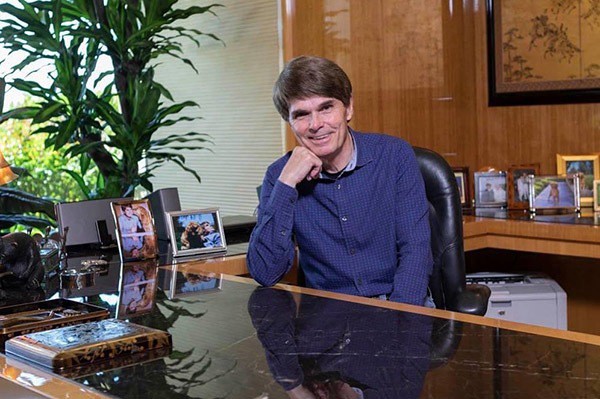
source: deankoontz.com
(Pictured above: Dean Koontz, who actually wrote a whole book with his left hand on a hidden typewriter while this picture was taken).
But to be clear, Dean Koontz has a style all his own. He mixes and matches with different genres, often blending them together into his own special recipe.
Koontz is best known perhaps for the Odd Thomas series, which is about a short-order cook who can see dead people. But he’s been writing novels since the late 1960s.
He’s sold somewhere around 400 million copies of his books. The Wikipedia entry credits him with 91 books, but at this point it’s likely at least 130 plus. That’s another sign you’re a Robo Writer. Articles can’t even keep up with how many books you’ve actually written.
Don’t dare ask Dean Koontz if he’s working hard or hardly working. The Koontz Express is always rolling.
So, what is Mr. Koontz’s recipe for earning consideration as one of the hardest working writer’s today?
“I work 10- and 11-hour days because in long sessions I fall away more completely into story and characters than I would in, say, a six-hour day.”
But lest you think that Koontz regards his phenomenally successful writing career just any old 9–5, the suspense master also mentions something special that keeps him motivated to churn out the pages:
“I am enchanted by the English language, by its beauty and flexibility, also by the power of storytelling to expand the mind and lift the heart.”
In addition, the writer stays motivated by his charity, the Dean and Gerda Koontz Foundation, which contributes to the severely disabled, critically ill children, and dogs.
Like his romance novelist counterpart Steel, Koontz exhibits profound focus, eschewing TV, the internet, email, and other distractions. After first starting out on a typewriter, he eventually bought an IBM Displaywriter, which he used to write for most of his career. Though recently, in 2020, he upgraded with a newer HP computer and Microsoft Word.
The type of writing tools Koontz uses may seem just seem like trivia, but it actually highlights a way he stays on task. Especially today with social media and texting, it’s easy for a writer to get distracted. But with a machine like a Displaywriter, or a typewriter, that can only perform a single operation at a time, all you have to be “distracted” by is the writing itself.
By 6:30, I’m at my desk, then I work until dinner. I rarely have lunch, because if I eat, I get furry-minded. I do that six days a week or, if I’m at the end of a book, seven. If it’s the last quarter of a book, where the momentum is with me, I’ve been known to work 100-hour weeks.
In addition, he credits his wife Gerda, his wife of 56 years, who helps manage all the practical concerns of life (money and other domestic issues), allowing him to focus on the fiction side of things.
Never underestimate the importance of a good, supportive spouse. That’s true for writing. Or for any career, for that matter.
Man, Koontz and Steel are Warrior Writers, without a doubt. Who could possibly top them?
It’s time to talk about the gran jefa, the queso grande, the grand campeona herself.
The grand prize for Ridiculously Prolific Writer for the Ages has to go to Spanish romance author Corín Tellado.
(Pictured above: Corín Tellado. You can call her “Boss”).
I found Senora Tellado’s output mind blowing. So much, I had to whip out the old calculator to try to crunch the numbers, and see just how much this mad scribbling machine did over her career.
Yes, Ms. Tellado got me, an English major, to actually reach for the dreaded calculator and do maths. That’s like Moses parting the Red Sea.
Tellado wrote over 4,000 books in her lifetime. Mainly novelas, that ranged around 100–150 pages each. But even sticking with steamy shorter-length books, at an average 125 pages for each book, times 4,000, that comes out to roughly 500,000 pages.
A typical MS Word page might be anywhere around 500–750 words, depending on the font and type of content (description or dialogue). But even if we’re taking the lower estimate at 600 words per page on average, that means Senora Tellado wrote about 300,000,000 words in her lifetime.
Tellado lived until age 81, and was an active writer from when she sold her first novel at age 18, until her death in 2009. Broken down by days (22,995), that means the Spanish author averaged about 13,046 words PER DAY.
Simply astounding. Even if you cut that number in half to 6,523 it’s still incredibly impressive. That’s like six average-sized Medium articles a day. Every day. For 63 years. It’s fair to say Tellado would have smoked Tim Denning.
All in all, she sold over 400 million books, and remains the second most read Spanish writer of all time, after Miguel de Cervantes (the Don Quixote guy).
And there you have it. Three superhuman uber authors. Don’t dare mention the words “ghostwriter” or “coauthoring” to them. All their books came from their own keyboard-hardened fingertips.
While it may seem these writers scale the literary equivalent of Mt. Everest every year like it’s no big deal, their big secret to word mastery is actually very simple.
Good old fashioned hard work. Yep, that’s it.
They sit down and punch letters. No matter what. Every day. For as long as it takes. Until the job gets done.
A sign hangs in Ms. Steel’s office that sums it up best: “There are no miracles. There is only discipline.”





 Dean Brooks