Today, April 16th, is my birthday. And I don’t care what anyone says. Your birthday always feels special, no matter what your age. Even if you didn’t plan anything special. Or if you’re at work on your birthday, which I am today.
Forty-one isn’t exactly a milestone year like 40. At this point in life you start to only celebrate in ten-year increments. But like my article last year mentions, death does move in a little closer. Now it’s out there watering its grass, waving to me. It hasn’t asked to come over for a barbecue, or tried to borrow anything yet. But I’m sure that time will come.
Getting older past 40 is like walking around with a sniper targeting you, not knowing if the guy will pull the trigger, or turn his attention to bigger fish. And that’s because you’ve reached the Age of Sudden Heart Attacks.
Of course, people drop dead of heart attacks and other ailments all the time at all ages. But it’s kind of rare it happens to people in their 20s and 30s. It’s really your 40s when you start hearing about it. Even though I’ve been careful and conscious about my health, stayed in shape, maintain a good diet, and avoid health-busting vices like drinking, drugs, and smoking, and don’t have a family history of early heart attacks, it doesn’t mean I’m not in the crosshairs of that Sudden Death Sniper Bulls-Eye.
But I’m not going to sit here all preoccupied with death, like in my turning 40 article. I’d rather spend the time reflecting on things. Not just “getting older” reflections, but reflections on life in general.
So here they are, by category.
Love/Marriage/Relationships/Situation-ships/Etc.
I’ve avoided the black hole of marriage or a long-term committment at this point largely by choice, but also by the nature of my location and occupation. I work in a rural area in a position related to the energy sector. Not exactly the most conducive environment to meeting people, much less finding relationships. Where I live is where relationships go to die.
Though lately, that seems like almost everywhere. Even in major cities and denser population areas, it’s become problematic to find a long-term partner for everyone. People get married later, start families later, or don’t even start ones in the first place. And half or more of those that do end up divorced or in bad relationships anyway. I’d like to think I’ve dodged the bullet of a nasty divorce or failed marriage, but the reality is I actually have a lot of respect and optimism for the institution itself. I refuse to give into cynicism as so many do nowadays, dismissing the idea of a long-term commitment as some silly pipe dream. Even seeing a lot of people in my family go through the tortuous drudgery of divorce, I won’t give up hope in the practice itself.
It’s certainly not too late to find “love” at 41. But I maintain that the most ideal time to do so is in your youth. As in late teens or early 20s. Even as young as 16. Call me a romantic, but I’d always wished I could have met someone special as a teenager, and then been able to spend my life with that person. It may have been my Christian upbringing (I’m an agnostic now), a juvenile fantasy, or just my own naivete that made me long for that, but not being able to find someone when I was in that age group remains a disappointment.
It’s not as if modern life helps any in that department. Most people would scoff at the very idea of teenagers staying together past high school. Or even in college. The world wants young people dedicated to corporate needs. It brainwashes them into attending college for mostly worthless degrees, then advanced degrees, to find jobs that many don’t even find meaningful anyway, so they can buy shit they don’t really need. The Western world may have its technological wonders and materalism, but it’s a callous, heartless place. You don’t see it when you’re young — you don’t see how mindlessly the world wants to suck you in to become just another consumer cog. I see so many young people today just get swept up on the conveyor belt. They don’t realize that colleges are businesses first, that are more than happy to stick you with an enormous debt you’ll be left paying off for years. They don’t care about you. You are just a number.
It’s a tragedy, really. So many young people trading in some of the best years of their lives for a worthless degree, tons of debt, poor job prospects, or an unfilling job anyway. Just to overpay for an apartment, or even be unable to afford a house. Society expects, even encourages, young people to screw around. Enjoy a few flings. Not to be concerned with finding a serious relationship because who cares. But the truth is you don’t have as much time as you think. And high school/college are generally your best years to find someone with whom you are compatible. It only gets tougher as you age. Mistakes begin to compound. And it’s harder and harder to meet people you connect with. Then there’s all the energy expended on finding a mate. Trust me, it’s not something you want to do in your late 20’s or 30s. It’s really best to do that as early as possible, then build from there. Before it starts to feel more like a business transaction. But I suppose there’s no stopping the social trends in the West.
Money/Finance/Getting “it” done/Etc.
This is an area I’ve focused on a lot in recent years, and I’m proud to say I’ve made some good strides. The stock market crash of ’22, the crypto winter, and some learning experiences in a few trades have set me back. But I’m back on track. Even if the economy undergoes a recession this year or next, I’m still on the upward trajectory.
I still have zero debt. No mortgage. No credit cards, except one I use for a few subscriptions that I pay off every month. No back taxes. I took the Dave Ramsey approach to all of my student loans and other debts years ago, and now I’m a giant zero in that department. Which is exactly what everyone should do. I don’t accept the idea that we have an equity crisis in this country. Most financial problems are self-inflicted, the result of bad choices, or due to tragic health events. Not because Jeff Bezos and others are “too rich” or some crap. Generally speaking, if you don’t have children out of wedlock, and can manage to finish high school, you’ll stay out of poverty. You may not become rich, but you’ll survive. And even if you can’t finish high school, there are so many free educational sources on the internet or in your local library. There are tons of government programs and loans for college or assistance. Everyone gets stuck in a bind here and there. I’ve been there myself. But there are many tools to work through any issues you have. Much of the poverty and crime you see is due to drugs, alcoholism, poor culture, or mental illness, not the “evil capitalist system.” The capitalist system is what enables welfare and other government programs to survive in the first place. I’m not against having a social safety net. But I do believe that people need to try their best to pilot their own lives.
Diet/Exercise/Fitness/Etc.
As I’ve mentioned before in other articles, I absolutely detest the middle-aged pot belly look that so many dudes seem way too comfortable having. We have an obesity epidemic not just in this country, but globally, in many developed countries. The older I get, more of a premium I put on having a healthy diet and staying fit. I don’t mean you have to be jacked. But you should have a proper BMI for your height. You should be able to feed yourself properly without having to run to the fast food place on the corner. I find myself increasingly disgusted and filled with contempt toward the increasing number of irresponsible and slovenly fat asses who take up more and more space. Especially young people. How is it okay to not even be out of your teens and both your ass cheeks are sticking out on either side of your chair? I understand a 50-year old mother of three not having the best body shape. Or an older guy with lots of responsibilities. Fatness is sometimes justifiable. But if you’re young and in the prime of life? Totally unacceptable.
Many people just don’t realize or don’t care about the health hazards that obesity and a poor diet can cause. Diebetes, joint problem, heart disease, etc. Fatness has become socially acceptable. And if no one else will say it, I certainly will. That’s fucking disgusting.
Which brings me to one very positive benefit of getting older — you care less and less what others think. You become more concerned with obtaining and speaking the truth. Traditionally, it was the job of the elders in the tribe to impart their wisdom, or at least provide a more mature perspective. But no one listens to anyone outside their social media echo chamber, which is dominated largely by political and social activists with their own axes to grind. I’m not an elder yet. I’ve got a ways to go. But I’d like to think I do a better job now of thinking things through than I did at 20.
As I write this, it is almost exactly 41 years ago to the second that I was born. It’s been a fast four decades and one year. If I’m fortunate to get another four decades and one year (or more), I’m sure they will go even faster. I guess now’s the time to think of what I’d say to my younger self. What amazing “words of wisdom” would I impart? I’d say to my younger self to worry less about what the world wants from you, and more about what you want, and what will make you happy. I’d say to not be afraid to prioritize love and relationships, even it puts you “behind the curve.” Fuck that curve. I’d say that there’s a brief time when everything is light and magic, and afterward it starts to become increasing shades of dark. Especially when you’re alone. That the world wants to isolate you, and put you on the hamster wheel, so you can keep buying junk. But that’s really no way to live.
So a few years ago, for a summer school project, I had to travel to some middle-of-nowhere town in North Dakota for a ten-day project to help model and reorganize the town’s tiny museum from a junk drawer to a pristine attraction. It was for a Public History class, as part of my history minor. Not something I cared to do, but it was a credit requirement. I was half-way to finishing my long-delayed bachelor’s degree, having returned to college late in life. Needless to say, I was the oldest, most mature, and therefore, most level-headed of the students there.
Anyway, it just so happened this project occurred when Wonder Woman was premiering in theaters. And the whole time, this one young woman kept prattling on about how we all HAD to go watch it that Friday night. Now, at the time, I was somewhat into Marvel/DC stuff. But selectively. I enjoyed Captain America, Ant-Man and a few others. They were fun diversions with generally servicable stories and entertaining characters. Wonder Woman didn’t really appeal to me, but it seemed like an okay film from the trailers.
So check it out that Friday night we did. Afterward, we’re all huddled together in the lobby discussing what we’d seen. When it came to my turn, I said it was a decent film, somewhat enjoyable, with a disappointing climax. Well, this ruffled the Prattler’s feathers. Huffing and puffing, she wagged her finger and shook her head at me, scolding and scowling.
“What do you meeean you didn’t like it?” grumbled the Prattling Scowler.
She was, shall we say, a big girl, with a proportion not dissimilar to a beach ball. So when she shifted her position on the thin lobby carpet, I actually felt the floorboards undereneath me creak. I retierated my stance, which I felt was not exactly negative — I never said I “didn’t like it,” afterall. She huffed and puffed again, apparently stung. Then she quickly polled the rest of the group for their reactions. All quickly agreed it was “great.” Prattling Scowler then glared at me, turned her nose up, harrumphed, and turned away. We headed back to town.
But for the rest of the trip I was basically persona non grata. My “dislike” of Wonder Woman was the subtext of every reaction I had with the Prowling Scowler. It was as if I’d insulted her religion or family, or something.
The whole situation left me amused. Not just because I felt it was ridiculous for a 25-year old to get that butthurt over some stranger “not liking” her movie. It was that my neutrality was so unbearably intolerable for her. She demanded fealty. Glowing adulation. I had to like it, or else I was a terrible person.
Of course, I knew why. It was because Wonder Woman was a feminist avatar. And so not liking it obviously meant I hated women. I know that sounds like a weird tortured chain of reasoning. But it’s the only “logic” that makes sense. Why would anyone care whether some random dude likes their movie or not unless that movie validates some deeply-held belief or idology of theirs?
I don’t think Wonder Woman is a feminist avatar, personally. I think it’s kind of silly to import that kind of value to a comic book character. We’re talking about a character that runs around in her underwear all day and looks like a supermodel. She was obviously riginally made as eye candy for the masses of male comic book readers. But even if you think she is a feminist avatar, why would it matter what any man would think about her? Especially a guy in his mid-30s (which I was at the time)?
That would be like a dude-bro getting his Bud Light boxers all twisted because some random girl doesn’t like Dominic Toretto from The Fast and the Furious movies. Or take movies like Predator, Mad Max, Commando, and others. Macho movies I’ve enjoyed. But I would totally understand a chick thinking they’re just silly man flicks. I certainly wouldn’t get all bent out of shape because some random girl doesn’t like Arnold.
Which brings us to Captain Marvel, and the sequel The Marvels, which just released its trailer.
Wonder Woman seems a charming, positive role model, and her movies are harmless and fun. Gal Gadot is nearly perfectly cast. I can maybe see a woman-child feeling jilted at someone not liking the character.
Captain Marvel, on the other hand, is an objectively shitty movie character with an objectively shitty casting choice. Which is a shame because the character itself had a lot of potential. I’ve always liked Superman, and Captain Marvel is sort of the Avenger’s version of the Man of Steel. So I was ready for an honorable do-gooder type persona when I sat down to watch the 2019 film when it opened. Instead, I got an unlikable asshole.
It’s mostly due to the bad writing, but also Brie Larson, who is perhaps the worst casting decision in the entire history of Hollywood. Like, John Wayne as Genghis Khan was less outrageous. If you’re going to have a big, powerful super female who’s supposed to be a competent, inspirational leader, don’t you think you should cast someone who can exude those qualities on screen? Captain Marvel should have been portayed by someone like Charlize Theron or Emily Blunt. An obvious Alpha Female who doesn’t need to try hard to look like a boss onscreen.
Larson does NOT exude any of those above qualities. She’s very good at playing desperate, frustrated, beta characters who can scrap their way out of situations. She won an Oscar playing one, afterall, in Room. But as a charismatic, likable lead on the level of a Chris Hemsworth as Thor or Robert Downey, Jr. as Iron Man? Or Gal Gadot? Don’t be serious. If anything, she comes across more like a villain than a hero. Captain Marvel is supposed to be a US fighter pilot. As in, a very competent, very type A, driven sort of person, who’s also very cool. Not a cranky Karen. Captain Marvel the movie should have been like Top Gun: Maverick, but with aliens. Compare those two movies. Even some of the “asshole” pilot jocks in TG:M are cool and likable, because they’re competent and self-sacrificial. It makes up for their cocky assholery.
Anyway, I’m not going to itemize every little thing that turned me off from the first Captain Marvel. Nor am I going to explain why the latest trailer looks like a ridiculous mess. I know it’s not made for me. I am obviously not the target audience. Besides, enough “anti-woke” dorks on YouTube have already said all there is to say.
I couldn’t stop laughing when I read the headline because it reminded me so much of the meltdown I witnessed from the beach ball Scowling Prattler all those years ago. But I kept asking myself, why does this person care that I don’t like this obviously girl-power movie?
For the record, like I told beach ball about Wonder Woman, I don’t “hate” The Marvels trailer, or the idea of The Marvels, period. It’s not made for me. But don’t expect me to like it and act all pissed off I don’t want to run out the door to go see it. Doesn’t the writer of that article see how absurd that is? It would be like me scolding a five-year old for not liking The Silence of the Lambs.
If feminists want to hate on men, that’s fine. But I’m not going to participate in my own abuse by watching a movie that’s not targeted at my demo, number one, and number two, if it’s anything like the first film, will also be filled with snide and predictable feminist anti-male tropes.
Really, if there’s a guy out there who says he actually like The Marvels and can’t wait to watch it, that’s almost certainly a guy you shouldn’t trust. That’s a guy desperate for female approval. And guys like that are always losers, or turn out to be creeps.
Women, feminists too, should be thrilled men “hate” The Marvels. Assuming Captain Marvel IS a feminist avatar (or supposed to be), then her movies should be a party for feminists. Something to celebrate for the cause. And just like how you don’t invite people you don’t like to a party, you don’t care that men dislike or hate your party, ’cause they ain’t invited anyway.
I get why the dorks on YouTube are hate reviewing the trailer. Rage baiting the algo pays big money. Some of these dudes are pulling in six figs for their “anti-woke” whinnyings.
But why do feminists care so much what these men think? I don’t see any profit in that.
Could it be that feminists secretly need male validation? No, perish the thought. Or could it be that everyone knows that Captain Marvel, and its upcoming sequel, are actually kind of shit, and so this whole histrionic defensive reaction is just one big cope to paper over that reality?
Like I talked about in my article Representation is Bullshit, this why you don’t attach your self-value to fictional movie characters. You’ll never win, because only you can validate you.
It really is a mystery to me why I, as a man, apparently must like The Marvels. Certainly no one would care about whether others like their movie who isn’t an embarassing, childish person filled with self-doubt, and desperately seeking approval from others. We know feminists are strong, independent, mature, and never emotional. So clearly this need for my manly approval must be some kind of aberration. At least, that’s what I’m going with.
To say that this latest niche I stumbled across blew my mind would be a massive understatement. If you work a dreadful 9–5, prepare to be downright demoralized after finding out how this guy makes giant gobs of money with this clever, simple niche.
Or perhaps you’ll be inspired instead. 🙂
Whether you loathe or love Andrew Tate, the fact is, the man gets ATTENTION. And attention equals dollars.
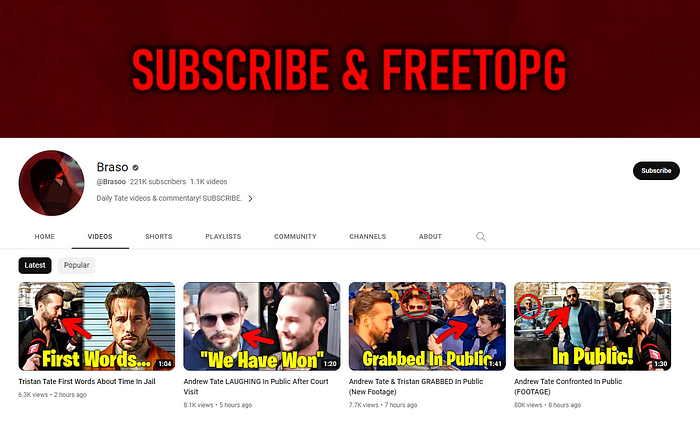
Enter a simple little YouTube channel called “Braso,” devoted entirely to “Daily Tate videos & commentary!”
Yep, that’s pretty much it. Let’s dig in.
Overview
Braso uploads micro vids of and about Andrew Tate multiple times a day. As in about every 2–3 hours. In just the last 24 hours, the channel has put up 9 videos.
These are NOT YouTube shorts, mind you. These videos are posted on the main channel. They’re just really short and to the point.
Each video is generally only about 1–2 minutes long, with some as long as six minutes or more. Footage is cut up from news clips and videos from Tate’s social media, with a sprinkling of voice over commentary.
Thumbnails are clickbaity, emphasizing even the slightest bit of Tate news as ultra controversial. Often focusing on ONE particular news item or development.
What’s most interesting about Braso is how the channel can take one tiny bit of video of Tate and essentially recycle it endlessly.
The brief clip of Tate walking around shirtless in his house right after release from prison, for instance, has been used in DOZENS of uploads. Clips of Tate and his brother Tristan leaving the jailhouse surrounded by media has also been “churned” endlessly.
Monetization
Now for the mind blowing part. Check out this screenshot from Social Blade and prepare to be gobsmacked.
That’s right. This “little” channel of only 220,000 subscribers rakes in somewhere between $5k and an eye-popping $80k a MONTH posting about Andrew Tate. Even if that estimate were closer to the lower end, say, about $20k a month, that’s still a staggering number.
Broken down even further, that comes to anywhere between a few hundred to a few thousand dollars PER DAY.
Views range in the few thousands all the way up to the millions. Comments are in the hundreds, even for videos that are only a few hours old, proving that the Tate Army remains an active, growing community.
Braso IS monetized through Google Adsense. I checked myself in an icognito browser, getting a brief six-second ad for Purdue Global, an online university.
Video uploads also contain what may possibly be an affiliate link to a Tate-related website called Jointherealworld.com that purports to teach “how to make money in the digital age.”
Clearly, the Braso channel acts as a sales funnel into the Tate universe.
Niche Deets
Braso certainly benefits from the controersial figure of Andrew Tate. Especially in the wake of his recent release from jail in Romania.
But like any figures of controversy, Braso gets additional traffic bonuses anytime Andrew Tate trends in the news. Which is kind of often.
Even if you’re a Tater Hater, it’s worth studying this channel and gleaning insights on digital marketing. It takes advantage of waning attention spans and increasing competition on YouTube by making very SHORT to-the-point videos. Braso is all about quantity, not quality.
This “micro-video” strategy has several advantages. It allows for faster uploads. More uploads overall. And it constantly feeds the YouTube algorithm. Which means the likelihood of a video landing and getting virally spread increases faster.
It’s the shotgun method, so to speak. Eventually, when enough videos start to hit, the subscriber count begins to balloon. Then most videos get thousands of views regardless of the algo. Then it’s off to the races. And now this channel is making close to the average annual income in the United States in ONE month.
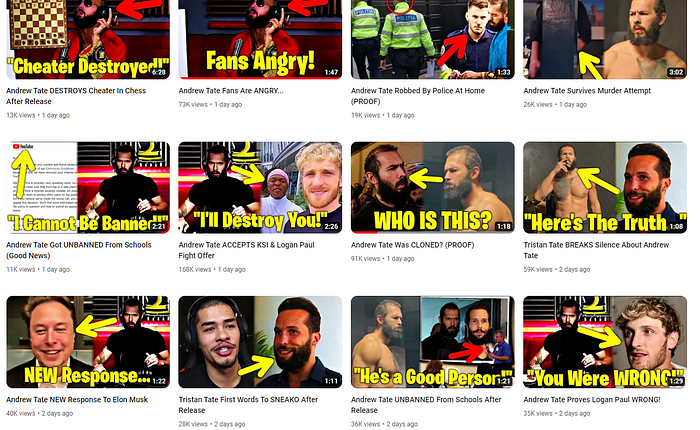
Another thing this channel does very smartly, is center itself around a very SPECIFIC topic — Andrew Tate, of course. Take a look at how the videos are titled in this snapshot:
ALL of them contain “Andrew Tate” in the title. It may seem like a small thing, but repeating the subject constantly can help you “hack” the YouTube algo, and make you rank better for a particular keyword.
You could do the same thing with other figures, or other topics, and likely achieve better results, no matter your niche of choice.
Summary
Braso provides an effective goldmine of a model to study and learn from for how to create a viral video platform around a given topic. Even when the niche is already crowded. Tate is only one of the most popular people on the internet. You’d think there’d be no way to break in on a channel about him. Yet Braso did, by utilizing a smart strategy:
Pick a popular/trending topic
Make ultra-short videos about the topic
Write highly focused titles that always name the topic
Reuse clips and news footage (churning)
Make simple clickbait thumbnails
Upload constantly and regularly
Could this clever and very strategic YouTube model work on other popular and trending topics, and get similar, highly lucrative results? Could you do this on, say, Elon Musk, Donald Trump, Tom Cruise, or others? I’d say there’s a good possibility. What do you think?
There will never be a part-Hispanic/part-White, devastatingly handsome, six foot tall, thin, modestly fit, straight, quite masculine, Colorado-born, PA to ND transplant, very late Gen-Xer like myself properly portrayed in film. Should I despair?
“Private Vasquez.” Source: 20th Century Fox
One of my favorite films as a kid, which still is to this day, is Aliens. James Cameron’s brilliant high-octane 1986 sequel to Ridley Scott’s 1979 classic horror Alien.
Set 57 years after the events of the first film, Aliens sees heroine Ellen Ripley return to face the terror that destroyed her crew and ship. This time with a platoon of badass Colonial Marines packed to the gills with awesome firepower, sent to rescue a remote colony that has been infiltrated by the monsters with acid for blood. “This time it’s war.”
This movie blew my six-year old mind when I first saw it. I loved everything about it. The sets and visuals. The story, which starts meaningfully slow, and builds up to become a runaway freight train. The mother-daughter relationship between Ripley and the only colony survivor, the 8-year old girl Newt. The unique and awesome firepower, including the pulse rifle, and the “steadicam that kills,” as Cameron describes in the script of the massive Smartgun. And of course, the flamethrowers. The memorable and very quotable lines of dialogue. “Game over, man! Game over!” “Nuke the entire site from orbit. It’s the only way to be sure.” The giant APC. The pulse-pounding score. The climactic battle between Ripley in the powerloader and the Queen Alien. The strongly written characters. Hicks, the mature corporal leader. Hudson, the smartass. Bishop, the stoic and self-sacrificial android. And especially Vasquez, the street tough Latina.
As I got older, and became more ethnically self-aware, I found myself particularly drawn to the Vasquez character. Though I was not exactly conscious of it, I was appreciative of the fact that one of my favorite movies prominantly featured someone who kind of looked like me. And, in fact, might even share some of my ethnicity. Vasquez’s precise ethnic background is never mentioned in the movie. In the screenplay, Cameron only mentions her as being from South Central Los Angeles. She could be Mexican, Colombian, Nicaraguan, etc. I didn’t really care. She was darker-skinned. That was good enough. I thought that was pretty cool, in a novel albeit trivial sort of way. Like when you meet someone who happens to have the same birthday as yourself.
Nonetheless, Vasquez was my cinema avatar. My Brown Sorta Sister. As I mentioned in another article, I’m part Mexican, Italian, English, Irish, and a host of other things. It doesn’t really matter. Point is, growing up, I was dark enough to clearly indicate that I was Not White for the most part. When you are Not White, you get Teasing Questions from other kids. To be fair, you get Teasing Questions if you look different in any way as a kid— ask most redheads or people who were “big-boned,” about their childhoods, and they’ll often get Vietnam-style PTSD flashbacks. But as a Not White, Teasing Questions take on a distinct Grand Inquisition style, with such probes as, “What are you?” and “Where are you from?” and others often hurled your way. Usually from peers, but sometimes even from random adults.
I moved around a lot, too. I averaged a new neighborhood about every 18 months. So I was always the new kid. This made it hard to become one of the Cool Not Whites. Instead, I was perpetually a Mystery Not White. This wasn’t really a big deal in grade school, where peers tended to be more concerned with your cartoon loyalties than your race. Once I got to high school, it became more pronounced, especially since one of the government daycare camps I went to was a Diversity High School. And generally speaking, most of the Not Whites didn’t exactly fit into the structure of the school. We had metal detectors. Gang fights. Rampant drug dealing and drug doing. Racial and ethnic divisions. And in the case of my school, a vocal, pronounced, and very proud Puerto Rican and Dominican presence.
An example of the racial tensions simmering under the surface of my Diversity High School: I once made the catastrophic mistake of categorizing Hispanics as White in a biology class, only for some Brooklyn-hailing Puerto Rican princess in hoop earrings and pink yoga sweats to start yelling at me about how “dat ain’t true,” in an obscenity-laced tirade. All while the biology teacher — some pudgy White beta male with an earring, wearing creased New Balance sneakers and dress shorts — did fuck all to keep order. It’s no fun being mixed in a Diversity High School. Or in life in general, for that matter.
My mother is White, and my father is Mexican. They split when I was an infant, as such inter-ethnic/racial pairings often go. She later married a White guy, and had three kids. This didn’t help me any, as now I stood out even more. Not just due to my Not Whiteness, but also because I was the oldest offspring by a good margin, and the only one from a different father.
Naturally, our family lived in White neighborhoods. I attended mainly White public schools (except for DHS). Went to all-White churches. Basically all of my friends were White. I often placed in those very special Advanced Placement classes due to my above average “smartness.” The ones with the kids who are all going to College. Maybe even (awed hush) Ivy League Universities. Those classes were always 99% White.
The notion of my “differentness” didn’t start to manifest until I was an adolescent/pre-teen. It wasn’t a big deal or anything. I was always treated nicely. I was a well-behaved lower middle class kid, and consequently well-liked. But still, I clung to my Brown Sorta Sister, Private Vasquez. And I couldn’t help but start to notice in my voracious media consumption, that there were hardly, if any, people my shade. Even though I admired many actors of all backgrounds, suddenly, inexplicably, I felt the uncanny need for a Representation Fix.
It was the late ‘80s/’90s, so the only “color TV” were shows like Family Matters, The Cosby Show, Hangin’ With Mr. Cooper, Kenan and Kel, and the ahead-of-its-time diversely cast Nickelodeon show All That. Television was still largely segregated back then, divided between White shows and Black shows, with little mixing outside of token characters or cameos. While I enjoyed some Black shows, I wasn’t Black myself, so there was no hope of getting my Representation Fix from them. There was little if any programming with Hispanic characters. Oddly enough, I had to watch I Love Lucy — a show made in the freaking ‘50s, starring Cuban-born Desi Arnaz —just to get a taste of Latin flavoring.
As for movies, they were mainly White affairs. Aryan Arnold, who was every ’80’s/’90’s kid’s idol at one point, and the Italian Stallion Stallone ruled the macho Alpha Male hero market, with Scotch/Irish-y Bruce Willis in tow. Pre-slap Will Smith was your go-to Black Guy. Keanu Reeves was your Half-White Half-Asian but White Enough to not be Not White and so therefore Basically White Guy action hero. If there were any leading Hispanic actors back then, I never saw them, or don’t recall any. Usually anyone who looked like they hailed south of the border was relegated to the sidelines, or just a random extra in the background. Gang Leader #4. Prison Cellmate #2. The darker the character, often the dirtier the character. Or if a character were actually Latin, they were whitewashed by someone with a milkier dermal disposition, or a different nationality altogether. Al Pacino as Scarface, for instance. That sort of deal. Even as recently as 2012, Christopher Nolan swapped Bane’s Latino identity for an Eastern European-hailing thug in The Dark Knight Rises. A disappointment to me not so much because of the whitewashing, but because I wanted a Bane more authentic to what I’d seen in Batman: The Animated Series.
Hey, that was alright, I thought back then. I had my Brown Sorta Sister Vasquez. She was all I needed to satisfy my Representation Fix.
And then one day I discovered that the actress who played Private Vasquez, far from being a Latina of any type, was actually a Jewish woman. And not just a Jewish woman, but a fair-skinned one at that, who essentially played Vasquez in brown face, darkened up with make-up to match the tone of the character’s possibly Mexican melanin-tinted heritage.
The actress’s name is Jenette Goldstein, a Cameron standby, playing roles in Titanic and Terminator 2: Judgment Day, amongst many others in a long and varied, on again off again TV/movie career.
This revelation wasn’t exactly earth-shattering. I was old enough to realize actors often played characters with ethnic backgrounds different from their real-life own. It was a somewhat numbing experience, however. Certainly, it was a teachable moment. It had all been a lie. My Brown Sorta Sister, like some imaginary childhood friend, never really existed. Even though it was the character that I had bonded with — which was and still is of a similar matching ethnicity — and not so much the actress herself, the fact that the actress’s ethnic background was distinctly not Not White like mine, and clearly White, nonetheless kind of ruined the suspension of disbelief. I had to make peace with the fact that this character that I had always loved was like something out of a minstrel show.
It’s bizarre to think about now, but there was a time when Hollywood had no idea what to do when it came to “ethnic” casting. There were no rules. At the least, it was much more (literally) Black and White. You had White characters and occasionally Black ones for a little spice. Rarely did they mix if it wasn’t for comedic or token effect. Or if the show or movie was racially themed, like set during the Civil War or the Civil Rights movement, or something. That was about it.
James Cameron cast and shot Aliens in England in 1985, right next door to the same lot Stanley Kubrick was filming Full Metal Jacket, in fact. The mid-’80s England theater/acting scene wasn’t exactly a huge melting pot. Goldstein came to audition for Vasquez dressed in a fancy gown she was wearing for a Victorian Age play she was in at the time. It’s not exactly surprising that Cameron was unable to find a legit Latina in merry old England in order to properly portray the tough and streety South Central L.A. character he had written for the Alien sequel. Michelle Rodriguez would have only been 7 years old at the time. Far too young to convincingly play a badass machine-gun wielding chica dura.
Now, if one were a racial grievance monger, or simply of a lesser mind (i.e. woke), they might be outraged and excessively butthurt at the fact that a movie character was portrayed in brown face as late as the late 1980s. But I am neither a monger nor of a lesser mind. (Remember, I was in all those Advanced Placement classes.) Even though “losing” Vasquez, my Brown Sorta Sister, was like losing a good friend, the conclusion that I eventually came to was not some self-righteous moral condemnation of Hollywood’s well-known history of White preferential casting. It was to realize that it had been foolish and immature of me to ever think I needed some kind of Representation Fix in the first place.
It was to realize that representation is bullshit.
Of course, nowadays, racial and ethnic representation is all the rage in Hollywood. The Big Thing to do now is swap popular, originally White lead characters, and replace them with Black actors. The Little Mermaid is the most recent example. A trend that’s been met with controversy on all sides of the debate. White nerds on YouTube decry it as “woke” and “White erasure,” or something. Proud wokesters declare it a form of “equity,” a reflection of the sensibilities of “modern audiences,” or something. And still some still call it “tokenism.” Or corporate virtue signaling to appeal to a broader market. Or something.
It’s all very silly and stupid to me. Though it does strike me as a cringy overcorrection. As if Hollywood were trying to make up for its past exclusionary casting sins by throwing in as many non-Whites as it can into lead roles. There are apparently diversity laws now that govern Hollywood, which necessitate that particular identity boxes be checked during casting before a movie can be greenlit. All in the effort to reflect the modern, diverse world in which we live in. Though it’s not as if astute observers like myself don’t see the subtext underlying the sudden good-hearted racially-minded castings— the violence wreaked in the summer of 2020 during the Black Lives Matter riots over the death of George Floyd. Amongst other supposed racially-motivated killings of Black Americans over the last decade and a half or so. And lest we forget #OscarsSoWhite, the viral hashtag denouncing the injustice of the 2015 Academy Awards nominating 20 all-White actors. The Blackening of Hollywood had been a long time coming. Whether adding more Blacks constitutes actual “diversity” or simply more tokenism to appease an activist mob is a subject for another article. For now, we’ll go along with it.
Personally, I often feel a quiet civil war within my mind over whether this latest diversifying trend is genuine or not, and by extension, good or bad. I’d like to think it’s my reasoning faculties weighing the trend impartially. But perhaps it’s just my middle-aged cynical side thinking it’s merely the actions of a few conglomerate entertainment companies attempting to hook a wider audience, while keeping themselves out of the crosshairs of the trigger-happy Twitter hashtag mafia.
There are two camps of thought on this, I’ve found. The Doomer “Who Cares It’s Just Entertainment” Camp, and the Crying Zoomer “No, What About Authenticity and the Author’s Intent!” Camp.
In the Who Cares It’s Just entertainment Camp, I ask myself why the hell do grown ass men care what color the little mermaid is? Or that Anne Boleyn is being portrayed by a dark-skinned Black actress? The former is fictional. The latter we all know was in reality a very White British lady. It’s not like seeing Boleyn portrayed by a Black actress is going to brainwash people into thinking the British monarchy was Black during the 1800s.
But then the Crying Zoomer wails that certain stories and characters are representations of ethnic history and culture. For instance, Lord of the Rings is Tolkien’s fantasy version of Middle Ages England, which is why all the characters are White. Or at least they were. Did Tolkien mean for his work to represent “modern audiences?” Or, was he making a contemplative statement on humanity’s temptation to abuse power, with a sort of Christian allegory, based off of a region that was 99.9% White up until about fifty years ago? As for The Little Mermaid, it’s a Danish fairy tale. Shouldn’t that mean it’s only meant for White characters?
There’s certainly a place for factoring in the ethnicity of characters, especially when historical accuracy is required. I’d be taken aback to see Abraham Lincoln being portrayed by Denzel Washington in an Oscar-level biopic. But if such a thing were to happen, so what? Hollywood can’t change history. Even if Denzel Washington played Lincoln, that wouldn’t suddenly change reality. He did just fine portraying Macbeth, afterall, and no harm subsequently befell the former King of Scots’ caucasian integrity. Lincoln would still be a White dude. Lincoln’s race is besides the point anyway. We discuss him to this day, and will continue to do so into the far future, because of his tremendous accomplishments, and his values as a man and as a president. That he was White is incidental in the grand scheme of things.
It’s taken me a lifetime to achieve what I believe is the highest and most enlightened mindset when it comes to this issue of representation. I speak as someone who overcame the false belief that it is in some way essential. Here’s the deal: If you are outsourcing your sense of self-worth and validation to casting agents in Hollywood, if you only feel “seen,” when people who happen to kind of match your ethnic background are on TV or in the movies playing pretend characters, then you are foolishly delusional and chasing a phantom.
What exactly is the concept of “you?” I think if you’re looking at yourself primarily, or in large part, in terms of race or ethnicity, you’re shortchanging yourself a great deal. You’re ignoring qualities or abilities that actually matter. But let’s say you can’t help but see yourself through the lens of race. And let’s say that seeing others that share your race/ethnicity on screen is of the utmost priority to your emotional well-being, or sense of “belonging,” or “being seen” within a culture or community. Ok, then, does that still apply if the person who shares your racial/ethnic identity on screen has a different nationality? Or comes from a different sub-culture or tribe within an ethnicity or race? Or has a different political persuasion? Or different religion? Why should things like race, sexuality, and gender get all the attention? Why not height, political affiliation, weight, or socio-economic class?
Besides, society likes to lump the races into big catch-all pots. But Russians are very different to the English, even if they share a similar skin tone. Just as South Africans or Nigerians are different from Haitians. Then you have very pale-skinned Whites, olive-skinned Whites, light and dark-skinned Blacks. You have white-skinned blue-eyed blonde Hispanics, and darker-skinned Hispanics. My Hispanic roots trace mostly to the Nuevo Léon territory of northeastern Mexico. I have no clue what side of the island my Irish and English roots are mostly from, or what side of the boot my Italian heritage hails. But I suppose if we’re going to take all this identity politics stuff seriously, it would make it impossible for me to feel “seen” if anyone outside of my territories of origin were to be on screen playing a character. Supposing Goldstein was actually Mexican, but hailed from Baja California. I guess that would rule her out for me.
When you start down the path of “validation by racial/gender/sexuality representation,” you begin to realize that it’s an unobtainable goal, especially taken to its granular extreme. All it does is set you up to fail, chasing some phantom snake oil elixir meant to supposedly cure your racial identity crisis and need for acceptance.
Representation, as far as what Hollywood produces, is no better than one of those useless scam products on late night TV. It’s the Shake Weight of racial reconciliation.
There are a million better ways to work your forearm muscles than one that makes it look like you’re jacking off Andre the Android. There are a million better ways to “fix” racial imbalances than sticking race-swapped characters on the boob tube and calling it good.
Supposed “identity validators” can be fluid and fall from grace anyway. Take J.K. Rowling, for instance. Once a shining feminist icon through which many young women ported their sense of value and pride. A single mom who rose up from poverty to become a billionaire author on her own power and create a mega franchise single-handedly. An inspiring story of grit and determination. During introductions at a literary analysis class in college, nearly half the room (all women) credited the Harry Potter books as their inspiration to study English and become writers. Nowadays, Ms. Rowling has fallen sharply out of favor, impaled on the social sword of “intolerance” and “bigotry” for her unacceptance of the trans community’s/activist’s interpretations of gender and sex. Former fans burn her books. Her Twitter is no longer a place of magic, but a bloody sparring ground of ideological clashes.
Perhaps I’m being a bit obtuse and simplistic here. But I’m trying to illustrate an argument by absurdity. My point is, the destination that you will ultimately arrive at in this long introspective quest for the validation of “you” is obviously yourself — you, the individual, which, as Snoop says, cannot be replicated by someone else, or duplicated.
And that’s just considering the racial/gender/sexuality angle. As implied at the very top with my laundry list of very accurate personal attributes, it would be impossible to find your exact equal anywhere on earth, much less on the screen. So why care so much? Who could be you but you?
For the record, I fall more into the Doomer camp from the aforementioned debate over diversifying casting changes. But with a twist. I don’t really care much about supposed casting diversity. If the actor is good and the story is written well, I’ll likely enjoy it no matter who’s playing what roles. I recently watched Sean Baker’s 2015 film Tangerine, about two transgender Black prostitutes living on the streets of Los Angeles. Even though I’m pretty far from the race and sexuality identities of the main characters, I still enjoyed the film, which was mainly about jealousy, jilted love, betrayal, forgiveness, repressed and closeted sexual desires, and friendship. Even if you can’t relate necessarily to the characters, or to every thread or idea in a film, a good story provides universal themes that anyone can relate to in some way. At the least, it was a fascinating look at an unusual subculture.
However, don’t sit there and expect me to believe we’re making social “progress” just because the little mermaid is Black. GTFO of here with that. And further, it’s okay to prefer actors of particular races to play certain characters, especially in stories or series you love. That doesn’t make you racist. It makes you a loyal fan. It’s okay to want to see people who look like you. But so do others who may not share your racial background. So it’s best not to get your ego and sense of identity too tied up with how fictional characters are portrayed on screen.
At the end of the day, I’m a representative of one. Myself. That’s it. I still love Vasquez. I hold nothing against the talented actress who played her. In fact, I think it’s incredible she was able to transform so effectively that she had me fooled for years. I still revere James Cameron. He’s still one of my favorite writer/directors. He’s part of the reason I’m a writer today. And, of course, I still love Aliens.
Fiction Affliction #4: E.T. was actually a botantist all along. Meanwhile, Elliott and Michael are casually assumed to be molesting their younger sister Gertie by their mother, who desperately wants to get laid.
“‘E.T. phone home my motherfuckin’ ass, bitch.” Made with Midjourney AI
E.T. and Me, a Brief History
E.T. The Extra-Terrestrial and I have some history. It was actually the very first movie I ever saw in the theaters. It was summer of 1982. I, along with pretty much everyone on planet earth, got swept into the theaters to see the story about the creepy raisin-wrinkled, potato-shaped alien puppet played by a 12-year old with no legs befriend some other annoying 12-year old boy who screams a lot.
I fell asleep. Not because the story was boring. Far from it. But because I was a newborn baby. I apparently conked out in my mother’s lap. She took me to the theater (I didn’t get in myself, of course). And you’re very welcome to all the adults who attended that viewing, who were no doubt worried about an infant screaming and crying and ruining their Steven Spielberg-directed experience, when in actuality I was quiet and took a nap the whole time. I was the best baby, by all reports.
Coincidentally, this is the very first movie adaptation book I’ve ever read. And the fact that it’s of E.T., the first movie I ever saw, just makes that perfect. I might start reading more movie adaptation books in the future. They’re never things I’ve been drawn to read before, as they seem redundant, and even pointless. If a story has first been presented in a visual medium (and presented really well), what’s the point of reading the movie in a book? Unless you’re desperate for more details about the movie.
Overall, this “movie book” (“mook?” “boovie?”) was, let’s say reliable. Except for some weird spots, which I’ll get to in a moment.
“Cute cartoon E.T.” Made with Midjourney AI
E.T., A Somehow Cute Butt Nugget Jesus
If you are one of the five people who never saw E.T., or think E.T. is actually some annoying show for morons about entertainment news, then let me refresh your memory. E.T. is about a little alien who looks like a mishappen turd, who gets stranded on our planet, befriends a lonely adolescent kid, and then must escape evil government scientists who want to probe his anus, or do some kind of ghastly experiments on him, before finally getting picked up by his people in a giant spaceship that looks like a Boston album cover. The alien has a magic finger that glows and heals things, he can levitate objects, and has a “heart-light” in his chest that glows when he gets emotional. He’s E.T. The exact kind of grotesque, creepy butt nugget-monster you envision as the perfect alien hero in a kids movie.
Seriously, it’s crazy to me how something as ugly as E.T. ever worked on screen. He looks like he belongs in Eraserhead. You think of recent kiddie-friendly movie characters like Sonic the Hedgehog (after the VX artists fixed his face, of course), or Baby Yoda. Those are all certifiably adorable and very huggable alien creatures. Then you have E.T. Good lord. I guess Melissa Mathison was going for irony, or subverting expectations? I don’t know. But E.T. will never not look like nightmare fuel. It’s a testament to Steven Spielberg’s directorial powers that he was able to take a monster turd baby and turn it into Jesus Christ.
Anyway, Kotzwinkle’s mook/boovie expands on some of the mythos of the mysterious E.T., while adding in a little bit of weirdness and outright creepiness. For starters, E.T., or the “space traveler,” or the “voyager,” — he’s given a dozen different nicknames in the book — is a botanist by trade. His species visits different planets to explore plant life when it blossoms. He’s ten million years old, and appears plugged into the cosmic energy source. He can communicate telepathically. Or, at least he can send wavelengths of energy like a rod of plutonium to people around him. He’s immensely intelligent. And evidently, he doesn’t need to use the bathroom.
A Word on E.T.’s Diet and Magical Colon
Oh, yes. A word on E.T’s apparently magical digestive system. The three-foot tall alien spends a minimum of a few weeks in Elliott’s bedroom closet, and not once does the issue of him needing to expend bodily waste ever arise. So either E.T. teleports his organic refuse away from himself, or he expels it through his breathe, similar to how we humans expel fat.
Additionally, E.T. seems capable of subsisting off of a diet of Reese’s Pieces, Oreo Cookies, Coke, and beer. You’d think a creature aged in the millions of years would have developed very specific and not-very-adaptable dietary needs. I mean, I’m only 40, and if I eat Mcdonald’s, my insides swell up like balloon animals, and I become racked with self-loathing for three days. But E.T. is able to adapt to a “balanced” diet of sugar and carbs that only a 12-year old human kid could tolerate. That may work in the movie, but in the book, I expected more info about E.T.’s alien physicality. Both in the interests of realism, and filling in the gaps of disbelief suspension that the movie effortlessly glides over. I’m not saying it had to be Michael Crichton-level, complete with a visual guide of E.T.’s insides. But more details would have been nice.
E.T., a Swiss Army Knife Character Who Talks to Plants
E.T.’s mysterious bowel and bladder operations aside, the tiny alien can also harness enough energy to destroy the planet. When E.T. is captured by government scientists after falling sick, he has a kind of transfiguration with “dragon forces” at the edge of the cosmos, which threaten to not only kill him, but channel enough power through him to destroy the earth. But E.T. stays his hand (or glowing finger) due to Elliott, the boy he has bonded with at that point.
All of that is fine and dandy. Until you get to E.T.’s Deus ex machina resurrection in the government lab. An event largely unexplained, save for a few lines about the life force of the universe or earth or something shining through, and reinvigorating the pint-sized alien back to health.
Earlier in the story, E.T. overhears Mary reading Gertie the scene from Peter Pan when Tinker Bell drinks poison and must be brought to life via audience participation. This serves as foreshadowing to E.T.’s later Lazarus moment, sure. But not really a satisfying explanation. You can have science or magic. But not both.
And here again, more details would have been beneficial. Like perhaps E.T. possesses the biochemical ability to synthesize sunlight into “energy packets” that he can store within his body and use later. Similar to a solar battery. That would explain his heart-light, his glowing finger, and his uncanny ability to survive off of junk food with no ill effects. It would also tie in thematically with E.T’s job as a botanist. Maybe the reason his species studies plants is beacause they share similar DNA. Or are creatures that descended from plants, evolving a higher consciousness over millions of years.
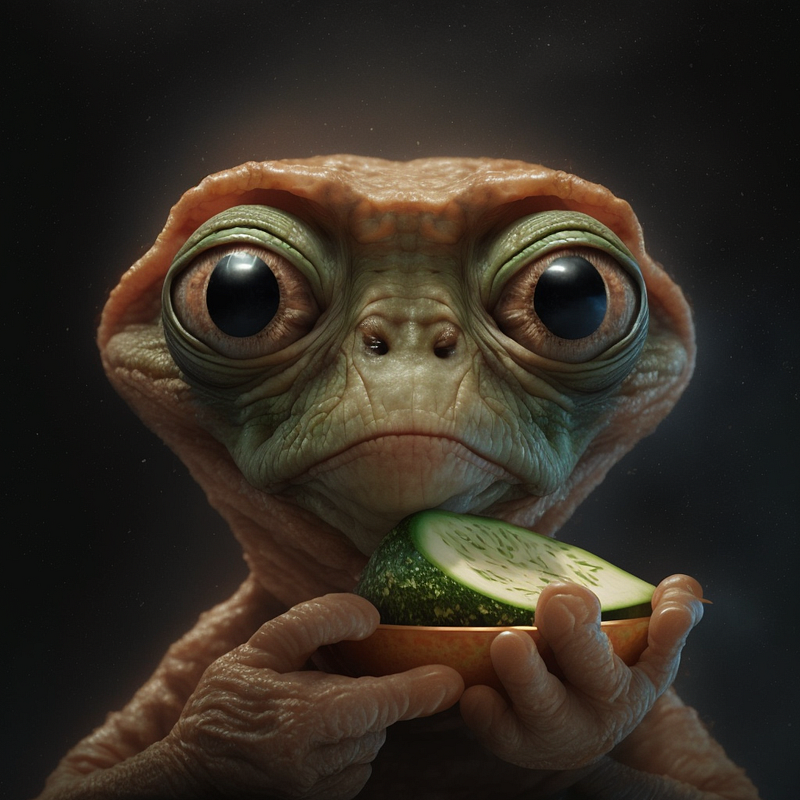
Plants even talk to E.T.. And not just the famous potted geranium he takes with him. Grass and cucumbers, too, who even share with him gossip on the strange human family he stays with.
There are some subtle environmentalist themes in E.T. that predate the Na’vi in Avatar. Except the E.T. alien species are deeply connected to nature on a wavelength level, rather than through USB hair plugs. They can commune with plants and animals, though not necessarily control them. E.T. hides from the family dog Harvey early on, grabbing a cucumber for use as weapon.
Here to sex you up. “E.T. with a cucumber.” Made with Midjourney AI
E.T., and the Strange Undercurrent of Perverse Sexuality
Speaking of firmly gripped stiff cucumbers, E.T. strikes up an amorous attraction to Mary, Elliott’s mom. The “willow creature,” as he calls her. Fantasizing himself as the man in her life, having honed in on the middle-aged mother’s poor romantic prospects. Even suffering a bout of self-doubt and incel inferiority when he considers how grotesque and ugly he is compared to the divine form of Mary.
If only he had a chance to show her what he could do with that magical glowing finger of his. Oh, how a steamy interspecies affair might have blossomed!
E.T.’s cougar wet dreams aside, I couldn’t help but notice (and be put off by) the bizarre hints of molestation and sexual impropriety throughout a book derived from a corny family movie. As I mentioned at the top, Mary seems to think it’s only a matter of time before her boys do something godawful to their little sister Gertie. And by godawful, I don’t mean stealing her dolly. The poor mother constantly frets about sex perverts in general. Sexual molesters and molestation are, in fact, mentioned multiple times. Here are just a few passages:
Page 35:
Either that, or a shy sex fiend had selected her vegetable garden in which to perform unnatural acts.”
Why? she wondered
Why me?
Page 53:
She dried off — and a dream of the recent night rose out of her morning fog: a dream about a man, but a very short man, with an enormous potbelly and a funny, waddling walk.
Must be the pervert.
Page 73:
“Oh, God…” She arose from the kitchen table. What savage ritual was her family enacting now? It sounded like they were pulling Gertie’s pants down. In twenty years, Gertie’d be trying to recollect it, on a psychiatrist’s couch.
Then, later, after Elliott kisses the girl in class, and gets brought into the principal’s office, there’s this little tidbit on page 194:
His predecessor [the principal’s] in the office had been a sexual offender, retired early after several private incidents in the supply closet became public.
What??? Why include such a random, sordid, and unnecessary detail like that? Especially in a scene in which an adolescent boy is left alone with an adult male in a school office? Why make the reader think about that when it has no context within the story?
By the way, the scene with the principal was originally shot for the movie, and even featured a cameo by Harrison Ford, before ultimately being cut. While Elliott was being lectured on the importance of good behavior, E.T. was supposed to telekinetically make the boy float up to the ceiling, shocking the principal.
Hey, enough movie trivia, let’s get back to sex perverts, please →
So, what the hell is the deal with the sexual molestation themes and mentions rife through the book? Even to the point of accusing main characters of perversions? It’s so out of place and odd. This is a story about a little alien befriending a kid and trying to get home. There’s nothing in that that would suggest the need, or signify the appropriateness, of a kiddie diddler theme. This isn’t Les Misérables, or something. A deep, profound, dramatic work exploring the dark underbelly of human nature.
The movie itself, of course, is glib, sunshiny, and corny as all get out, possessing nothing in its construction that would indicate even a subtle hint of a filthy molester theme. Maybe some of the teen kids joke about it. I don’t remember every line. But this sexual deviance aspect strikes me as something added by the adaptive author.
And its presence constitutes a mind-plaguing mystery.
Might it have been added in a crude attempt at dark humor? Perhaps. Sexual molestation maybe wasn’t taken quite as seriously in ’82 as it was later, and certainly is now. Hell, it wasn’t uncommon for grown men to date high schoolers back in the ’60s and ’70s. College professors sometimes openly dated their students. Sexuality back then was a wild thing, compared to today’s more puritanical, woke environment. You can thank AIDS, STDs, and social movements like the Moral Majority, and its left wing counterpart, #MeToo, and others, for the brick walling of America’s sexual energy. But back then, people were more relaxed and laissez-faire about lasciviousness.
It’s to the point where I have to wonder if Steven Spielberg and Melissa Mathison even looked at this book adaptation, and whether or not they gave the OK on its publication. Did they know about the added sexual molestation themes? If so, were they copacetic with the whole deal? Or did the studio just see the adaptation as another big wad of money, and didn’t give a flying fuck what the hell else might have been thrown in for some extra spice? Remember, at one point E.T. the Extra-Terrestrial was the highest grossing film of all time. Even today, when factoring in inflation, it’s still in the top five releases ever. It was in theaters for a WHOLE year, for Christ’s sake. Who watches that film, and then goes, “Man, you know what would richly expand this finely woven nolstagic tapestry about the innocence of childhood and friendship? Sexual molestation.”
It truly boggles the mind.
Summary
So, what is verdict on the E.T. book adaptation as a whole? Hmmm…it’s a mixed bag. As a mostly faithful screen-to-text version of the hit movie, it’s kind of what you’d expect. As a book unto itself, lacking the context of the movie, it kind of sucks.
We jump around constantly between different character POVs, for instance. We’re in E.T.’s head, then Mary’s, then Elliott’s, then Harvey’s, then a whole bunch of other minor or far less interesting characters we don’t really care about. We also jump briefly into Keys’ (the antagonist) POV. Yes, I’m aware that sort of narrative is 3rd person “omniscient” POV. But for a story like this, I think it would have made more sense if we had been in Elliott’s perspective the whole time. Or perhaps E.T.’s. I think that would have grounded the story more in the realm of childhood, where it belongs.
Further, and this is my biggest issue with this book adaptation (aside from the molestation innuendos), is that it hardly expands on the mythology that the movie only hints at. A movie only has 120 minutes to convey a world. But even a short book may have 200+ pages. I wanted to learn more about E.T.’s background. We could have seen his childhood, or middle-age. Learned more about his species. We could have delved more into Keys and the government agency he runs that tracks extraterrestrial intelligence, which is a sort of precursor to Men In Black. Or at least learned the guy’s real name. We could have even seen Mary and her ex-husband when they were married. What caused the split in their marriage after so many years, and three children together? We also could have seen more from the perspective of the aliens still on the Mother Ship that left earth. What were they doing the whole time? When did they receive the signal from E.T.? Does E.T. have family of his own? Parents? Children? Cousins? Siblings? Like mentioned previously, we could have learned about what makes E.T.’s biology tick, instead of ascribing every one of his powers to essentially magic.
Not that E.T. ever conveyed much of a world beyond the boundaries of the titular alien and Elliott’s relationship. We don’t really have to know, of course. The whole experience is all about simulating the feelings of childhood in the viewers. But if you’re going to take the time with a book adaptation, why not go all out and at least come up with something clever?
E.T. the Extra-Terrestrial the book adaptation doesn’t really add anything, so you’re best just sticking to the movie.





 Dean Brooks