They say it takes a lifetime to build a reputation, but only seconds to destroy one.
That’s especially true nowadays with the internet and social media. It’s almost impossible to just move to another town and start over in life. Bing knows all. And Google, too, I guess.
As we’ll see in the cases below, sometimes one little bad decision can lead to truly catstrophic (and even deadly) consequences.
Here are three such stories.
1.) Justine Sacco
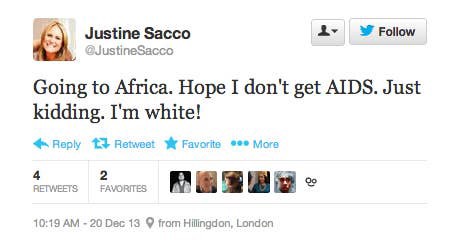
How long does it take to tweet? A few seconds? Maybe only one or two. That’s about as long as it probably took Ms. Justine Sacco, the former senior director of corporate communications at IAC to tweet this little “joke” out in 2013, and inadvertantly become global enemy number one online:
Source: Screenshot of Justine Sacco’s tweet via Buzzfeed News
At the time the 30-year old PR rep was traveling home to South Africa on the holidays to visit family. Right after she tweeted, her flight took off, and she went to sleep, unaware of the whirlwind she had just unleashed.
At first Sacco’s tweet went largely ignored, as she only had 170 followers. But then Sam Biddle, the editor of Gawker’s Valleywag, discovered the tweet via an anonymous tip, and retweeted it out to his 15,000 followers.
From there outrage and fury spread like a viral outbreak, and the hashtag #HasJustineLandedYet trended worldwide, as people eagerly awaited Ms. Sacco to land and get the nasty surprise of her life. There was the added dramatic irony component, as Ms. Sacco went the whole 11-hour flight unaware she was trending all over the internet as a virtual punching bag.
Ms. Sacco got sacked from her cushy PR job, naturally. Even while insisting that she didn’t mean for her joke to come across as insensitive and bigoted. Instead, she says she meant it as a commentary on Western privilege, stating in an interview with the NY Times:
To put it simply, I wasn’t trying to raise awareness of AIDS or piss off the world or ruin my life. Living in America puts us in a bit of a bubble when it comes to what is going on in the third world. I was making fun of that bubble.
Meanwhile, the bubble was unamused.
The internet, with all its collective wisdom of mankind, obviously disagreed with the intent behind Ms. Sacco’s ham-handed cultural musings. After losing her job, and becoming a worldwide hate magnet, she did eventually rebound. She volunteered in Addis Ababa in a PR job for a stint. Then landed a marketing and promotions gig at Hot or Not, a website used to rank stranger’s looks on a scale of 1 to 10, that was transitioning into a dating service.
Wait, Hot or Not? That site’s still around? I remember being a healthy 5.5 there back in the day.
:::sad slide whistle:::
Anyway, in a surprise twist, Ms. Sacco later returned to her former employer IAC, where she works in corporate communications for Match Group, the online dating company. According to her LinkedIn page, she’s still there.
Sacco’s experience at least proves it is possible to reconstitute yourself after being trampled to smithereens by a frenzied mob online, and get to a somewhat happy ending. I say good for her. Hopefully next time she decides to pop off irreverently about racy cultural stereotypes, she’ll remember she’s not a character on South Park.
2. Dr. Maurice Wolin (aka “talldreamy_doc”)
Source: Screenshot from “To Catch a Predator”
Ahh, To Catch a Predator, the gift that keeps on giving. That show, and the community of perv-busters it spawned, has proven a never ending source of entertainment.
Honestly, it was tough to decide which pervert to pick, as there is a cornucopia of creeps to choose from, all thanks to the hard work of giga chad Chris Handsome. But for me, Dr. Wolin stands head and shoulders (literally) above everyone else, given his high status and education, not to mention the staggering cost of his sick blunder. Most of the cretins caught on TCAP were already bottom-feeding low life losers anyway, with few prospects in life, who could barely even dress themselves.
Not Dr. Wolin. The year was 2006. The 48-year old was a prominent cancer research director in the San Fransisco area, married to a wife who was also a doctor, who had two daughters. Using the screen name “talldreamy_doc,” Dr. Wolin chatted online with a girl he believed to be 13 years old, but who was actually a decoy employed by an organization called Perverted Justice.
After making a number of disgusting solicitations toward the decoy, Wolin made plans for a meet-up. Driving from Piedmont, CA to Peteluma, the affluent physician strolled inside the trap house, no doubt envisioning how he was about to indulge all his sick fantasies, only to be met by a camera crew and the police. Wolin desperately tried to fight the charges in a two-year legal battle. He even hired Blair Berk, a celebrity attorney who’d once represented Leonardo DiCaprio.
Guess that makes him the second person she’s represented who’s life got sunk like the Titanic for chasing some girl.
Eventually Wolin plead no contest. He was sentenced to two months of house arrest, three years probation, and lifetime registry as a sex offender. In addition, his license to practice medicine was revoked.
Out of all the TCAP cases, this particular one seriously amazes and disturbs me the most because of Dr. Wolin’s precipitous fall from grace, and the quickness of how his life unraveled. He’d only chatted with the decoy for a few days, maybe weeks, before visiting. Then it took all of a minute from the time he left his car, entered the backyard, to realizing he’d actually walked into a sex sting.
Imagine that. Throwing away a medical license you spent eight or more years in school to acquire, a high-paying, well-respected career, your reputation, and the respect of your family. All gone in less time than it takes to read the back of a Trix cereal box. And all for what? To be branded a sex offender forever. I mean, the guy could have cured cancer the next day at his lab and still nobody would ever think of him as anything other than a pedo. What a moron.
Dr. Wolin’s wife did later divorce him. And unlike Sacco’s story above, there is no happy ending here. Dr. Wolin recently committed suicide in January 2021, according to an offical coronor’s report as investigated by YouTuber “The Skip Tracer.”
I have to admit, when I first heard about the tragic tale of Garry Hoy, I didn’t believe it. I thought it had to be a myth. There was just no way a lawyer could ever do something that wreckless and foolish. It seemed impossible.
But we’ve just seen a C-suite corporate ladder climber self-immolate, and a top cancer doc commit seppuku. Hey, why not an attorney, too? It sure seems these supposed “elite” types aren’t as bright as we’re led to believe.
Garry Hoy was a highly successful and regarded corporate and securities lawyer who worked at the Toronto-based law firm Holden Day Wilson. His office was located on the 24th floor of the Torono-Dominion Bank Tower Building (seen in the above pic).
Hoy liked to perform a little parlor trick on occassion. He would run into the office windows to show off their strength, surprising and shocking guests. On July 9, 1993, while showing some visiting law students around. Hoy decided to demonstrate his love of resilent window glass. He slammed into the glass the first time, bouncing off like he had so many times before. But when he tried a second time, he wound up crashing through and plunging 24 stories to his death. For sure he proved the toughness of the glass. It hadn’t shattered upon impact. Instead, it had popped out of its frame.
Police declared Hoy’s death “accidental self-defenestration,” which aside from sounding like a Jeopardy category, is a polite way of describing a dude accidentally killing himself in a stupidly avoidable way.
I mean, if you’re going to risk your life at high heights like that, at least do something cool like Philippe Petit did, the French high-wire artist who walked across the Twin Towers in 1974. Throwing yourself against a window? Kind of lame, really.
Hoy’s plummet may have even sunk his firm. Within three years of his lousy Peter Pan impression there was a mass exodus of attorneys, who evidently didn’t like working under the dark cloud of the Darwin Award-style death Hoy had left in his wake. In 1996, the firm finally closed for good.
Word on the street is the firm tried to sue gravity. And lost.
So, a good lesson there. If you’re a lawyer, please leave all the crazy antics to Saul Goodman. Chicago Sunroof, anyone?
As Nicolas Cage proved in the year 2000, you can steal almost any car in 60 seconds, not to mention Angelie Jolie’s heart. But as these poor people above proved, you can destroy your life just as quickly, if not faster. So be careful out there.
America. Land of the Lard Asses. Home of the Whopper and the Starbucks early morning milkshake. One nation, under obesity, with corndogs and Big Gulps for all.
I’m talking about SUGAR, of course. America’s original white powder addiction, which makes crack cocaine look like Stevia.
And that’s putting it lightly.
A little while ago I was at Wal-Mart and I had quite possibly the worst experience I’ve ever had in my life.
It was mid-morning. Around 9:30 AM. I forget exactly what I was there for, but I know I had to return something. So I was standing in line at customer service.
Ordinarily, I’m as focused as a stagecoach Clydesdale wearing blinders when I go to Wally World. I make a point to maintain precise tunnel vision. I won’t risk having my eyesight sullied by the likes of what you’ll see at a typical Flaw-Mart.
It started off no different that morning. I’d made it inside, blissfully unaware of any bothersome surrounding entitites.
Then I noticed the kid.
Or more precisely, this tubby, oozing, sluggish, pasty-skinned, hair-a-mussed, jelly-bellied, fat body of an adolescent hanging off his pear-shaped big-bootied mother. His cherry-red lips flapping as he whined and moaned for a snack. His voice like a buzzing mosquito. His sock-sandled feet clacking on the shiny tile floor in tune with his incessant dribblings for something to eat.
The mother, a beleaguered blimp in a floral-printed dress that looked like the print design from a ’70s sofa, huffed, and reached down into her cart. And what did she pull out?
A box of ice cream sandwiches.
The fatty pustule of a boy tore open the one side of the box, eagerly stripping the waxy paper from the sugary treat. Stuffing the black and white rectanglar sugary dessert in his maw, he oozed across the floor, toward a bench, on which he sprawled his spongy carcass. One hand securing the sandwich for steady bites, the other pulling out a massive smartphone. One grubby thumb activating some colorful mobile game with a lot of jangling sounds.
And there he sat. Slouched like some self-satisfied grotesque Buddha, kicking his feet in infantile glee, vanilla and chocolate lining his lips clownishly. His sweat clothes stuck to his round body like the plastic on those individual cheese slices.
“Sir, I can help you now,” some voice said from afar. I’d heard, but I was too in shock to move.
I couldn’t believe what I was seeing. It seemed impossible. And a whole number of implications were ping ponging around my head.
Firstly, this kid obviously had not had breakfast before he and his mother left the house that morning. Given the state of his hair, clothes, and sloppy demeanor, he’d likely rolled out of bed, and hopped in the car to go with mommy. Only for his hunger pangs to kick in after arriving.
Secondly, it was evidently acceptable in this kid’s household to eat ice cream for breakfast. And not just acceptable, but regularly occurring. The way the mom had offered this kid the sandwiches with an indulgent “there-he-goes-again” grin on her face made it obvious this wasn’t the first time.
Thirdly, it was acceptable for this kid to whine like a baby for food in public. Mind you, this kid wasn’t five or six. He looked about twelve.
Fourthly, it was okay to dress like a slob, and slouch around furniture. While loudly playing a stupid mobile game. And as if he wasn’t in public but at home in his living room.
And lastly, this kid had ZERO self-awareness of how ridiculous and pathetic he looked.
I tried to rationalize. Maybe this kid was disabled, or mentally ill, or had some kind of frontal lobe damage that explained his behavior.
But, no. He seemed lucid. Clearly dexterous enough to handle sucking on dessert while playing Candy Crush simultanenously. His eyes were clear. Everything about him looked normal, other than the flabbiness.
He was just a piece of sh*t, that’s all. And to say I hated that disgusting child is an understatement.
I wanted to punt that kid across the room.
But then I felt a smothering wave of sympathy for the boy, spiked with a righteous anger.
It wasn’t actually the kid I hated. Or even the mother, for allowing the kid to become a junior Blob. Though she certainly bears the blunt of the blame.
It was the growing trend of FAT ACCEPTANCE and widespread SUGAR INTAKE in this country, and all its unpleasant side effects on human behavior and thinking. A trend that prizes sloth. Swaps fitness and health for the dopamine pleasure high only sugar in factory-concentrated form can give. A trend that steals youth and energy, giving in its place sedentary cellulite. A trend that puts adolescents in the prime of puberty on a path to a life of early on-set diabetes, weakened joints, respiratory problems, heart disease, and a host of other ailments. A trend that turns ordinary human beings into shuffling, sliming, slouching, globular, sugar-addicted insects.
Growing up in the late ’80s and early ’90s, when I was the same age as this poor Wal-Mart kid, I remember that for every class of about 30 students, there was usually about one or two “fat” kids. But they werent even really fat. They were just “husky.” Big, but not looking like over inflated balloon animals.
Well, that ain’t the case anymore.
Recently, I was stopped at a crosswalk by a high school, and I had to wait for the river of kids to walk past the intersection. If I had to guess, I’d say up to half the teens were overweight.
A few years ago I returned to college to finish my degree. I was in an English class that was roughly two thirds female. Probably about half of them were obese. And I don’t mean a little junk in the trunk. I’m talking an ass cheek hanging out on both sides of the seat level of fatness. All slurping down their Starbucks milkshakes. Always complaining about their “anxiety” and “depression” out in the open, as if the classroom was their personal therapy session. I asked one of them — a chipmunk-cheeked chubbo — how often she exercised, and what her diet was like, as those two things have A LOT to do with your mental health. She looked at me like I had three heads. Then went back to listing off her preferred prescription psyche meds to her equally gelatinous girlfriend.
Silly me. I thought everyone knew a bad diet and no exercise can lead to poor physical and mental health. Who knew subsisting entirely on McDonald’s and Krispy Kreme doughnuts could turn you into a squishy, nerve-wracked mess?
I’ve known people who literally lived off of fast food. And I don’t mean that admitted grabby-handed weirdo Morgan Spurlock from Super Size Me. Real, actual people I’ve worked with, who never failed to have a Big Gulp soda gripped in hand. Men used to holster six-shooters on the Western frontier. In Medieval times, men carried swords and daggers. Nowadays, the only “weapons” people pack are shiny cola cans and Ding Dongs. The only dangerous “enemy” they’re concerned with — mild, momentary hunger.
When it comes to fast food, if I had to choose between swallowing nothing but Big Macs or a MAC-10, I’d say squeeze that trigger till it goes click.
We don’t need an annual State of the Union by the president. We need an Annual State of the Nation’s Waistline, which is forever expanding. We don’t need a nuclear Doomsday Clock, we need a Body Fat Caliper “Clock.” And by the way, we’re one minute to midnight.
Are people aware the Aviom Humans in Wall-E aren’t models to emulate?
Look, I can understand putting on a few pounds when you’re older. Women frequently pack on extra weight during and after childbirth that never quite goes away. Most middle-aged men get that typical pot-belly look if they’re not careful. Sometimes life’s responsibilities make it hard to follow a balanced diet and exercise the way you should. We can’t all be super jacked and hitting the gym like Patrick Bateman from American Psycho. I get it.
But when you look in the mirror and all you see is the Stay-Puft Marshmallow Man, wouldn’t some alarm bells go off? When you can barely fit in an airplane seat without rolls of fat spilling into the aisle and onto the next person, wouldn’t you think that that’s a little strange?
At one point does someone just accept that they’re going to cosplay as Violet Beauregarde after she chewed the three-course gum from Willy Wonka forever?
Are people confused about what foods are healthy or not? Here’s a little tip: If there’s a cartoon character on the box, it’s probably not good for you.
Meanwhile, that culturally acceptable fatness “trendline” seems to keep expanding outward. Before long, those walking signs on street corners are all going to have to be changed to the shape of beach balls in order to accurately reflect the typical human form.
And that’s a travesty, and totally unacceptable.
If people want to be fat, or are apathetic about fatness, that’s their prerogative. But I will never accept fatness as some kind of virtue or value in need “acceptance,” when it is actually destructive in every way to your health, and to society at large. I will not equivocate fatness with the civil rights movement, as so many causes are wont to do these days.
What is actually a travesty is that twelve-year old Wal-Mart boy, whose health has likely been destroyed for life, and all because of parental negligence, and food corporations that inject ungodly amounts of sugar into everything. It is very hard to undo the damage of obesity when you’ve been fat from youth. Not impossible, but very difficult.
The fatness trend and sugar consumption in this country are tantamout to self-abuse and slow suicide. No different than the smoking and casual day drinking seen in the ’50s and ’60s.
George W. Bush fretted about imaginary “weapons of mass destruction.” Except he wasn’t totally wrong. They exist. They’re sitting on the shelves at your local supermarket.
The original 1987 Hellraiser was never an upper-tier horror film. It lacked the craft of Halloween, the dramatic intensity of The Exorcist, and the inventive charisma of The Nightmare on Elm Street.
Still, it stood ahead of derivative dreck like Friday the 13th, Critters, and a host of ’80s flicks largely forgotten or relegated to the cultural graveyard.
But where I always thought the original Hellraiser exceeded expectations as a gory B-movie was in its moral messaging. An odd thing to say, perhaps, about a story where deformed demons from hell torture people with chains and hooks. But Clive Barker’s story — based on his novella The Hellbound Heart — had the trappings of Catholicism’s divine retribution. The original is like a Victorian Gothic crossed with a hardcore BDSM porno, but anchored with the thematic strength of a fairy tale.
The main theme being that obsession with pleasure leads to self-destruction. In the first film, Frank, a low-life deviant always trying to push the boundaries of self-gratification through sexual experimentation, gets more than he bargained for when the Cenobites give him an experience “beyond limits.” Hell by overstimulation, if not excruciating pain. While we’re perhaps initially somewhat sympathetic to Frank’s plight — he all but assaults his brother’s wife when he comes to visit for the wedding — he quickly condemns himself when he conspires with his married lover to bring him fresh bodies to murder so he can reconstitute his flesh and return to the living. Even going so far as to murder his own brother so he can steal his skin.
Frank is deservedly recaptured by the Cenobites when he’s tricked into confessing his presence by his niece Kirsty, to be ripped apart again and sent back to hell. Kirsty, the “Snow White” of the tale, is saved, and through her ingenuity, is able to defend herself from the Cenobites, who then attempt to claim her soul for themselves after harvesting Frank’s.
As messy and dirty as the original Hellraiser is graphically, the moral is pretty tidy and clean. Perversity and deviance — explicitly sexual violence — are punished. Virtue and chastity are rewarded. And while one innocent is killed — Kirsty’s father — she avenges him by bringing the killer, Frank, to justice at the hands of the Cenobites.
I only ever saw the first two sequels, Hellbound and Hell on Earth, which seemed to largely capture the essence of that theme by degrading degrees. The rest of the sequels, which were direct-to-video, honestly looked too godawful to even warrant a glance.
Which brings us to the latest installment, starring Jamie Clayton as the iconic Pinhead.
The new Hellraiser (2022) is mostly a return to “form,” if you considered the original, and maybe the first two sequels solid B-classics. Visually, it appears more loyal to Barker’s concept of the gender ambiguous Cenobite demons as depicted in his source novella. Their bodily desecrations are also much more sexually explicit. Gone is the bondage leather of the ’80s. In its place flesh gruesomely woven and ribboned with decorative beaded pins and jewerly. Hey, you gotta keep up with modern fashion, even in hell.
The new gang of Cenobites are freakishly cool, though lacking perhaps some of the menace of the OG four. The new Chatterer feels a step down from the first, which bore the unforgettable wide-open maw secured by tightened barbed wire. Pinhead’s grid-hammered nails receive a shiny upgrade. It’s hard to top Doug Bradley’s portrayal. He’s sort of the “T-800” Terminator model of the Hellraiser universe. All brute force and physicality. Whereas Clayton’s presence is more like the T-1000 — scary in a Portuguese man-of-war gliding under the waves sort of way. But with her synthetically-enhanced voice and gleaming black eyes, combined with a slippery seductive sadism, she makes for a refreshing and satisfying new look from from Bradley’s stolid, detached-to-almost-bored manner as the reigning Hell Priest.
Where this new Hellraiser loses bite is the puzzling abandonment of the clear morality tale that anchored the first two (and somewhat the third).
The Lament Configuration was always about man’s obsession with pleasure, with those seeking to satisfy their unholy perversions getting their comeuppance. In this new one, even innocent people can be ripped apart by pure accident, and all just because the box sticks them, in effect “marking them” for death. Even the villain Roland Voight — a sort of Jeffrey Epstein — is (apparently) given some great final reward for his maliciousness. Turned into a kind of god, merging with the Leviathan entity as an angel/Cenobite. His flesh flayed open, his cheeks stripped to resemble an X-rated version of The Joker smile, yet seemingly enjoying, or at least tolerating, his unholy transfiguration. It makes for a strong final image, yes. But a woefully unsatisfying conclusion for such a disreputable character. Whereas Frank in the original, sleazy deviant that he is, gets what’s coming to him, and by no short measure.
This makes the theme of the movie muddled and problematic, to say the least. What is the overall message here? Suffering is random, so why bother trying to be a good person? The first Hellraiser bore the markings of a twisted Christian allegory. Like an extreme reimagining of The Rich Man and Lazarus. Or a deep cut side quest from the Sodom and Gomorrah tale. This new one teased at a “corrupting nature of power” theme, but was too timid to commit. What is it with so many new films afraid to take a stand outside of obvious politically fashionable convictions?
Then you have the main character, Riley. A boozing, drug-addicted trampy human blight who, with the help of her hunky two-faced boyfriend, steals the infamous puzzlebox, wreaking havoc on everyone around her. What consequences does she face, even after indirectly causing the death of her brother Matt— the one person who cared about her, and who allowed her to live in his apartment? None, other than some half-assed idea about lifelong regret, as stated by Pinhead. Riley is even given the opportunity to reject the rewards the Cenobites offer, when she realizes their “gifts” are actually horrifying mutilations of one form or another.
Then you have her other murdered or endangered friends. Nora, brutally slain for no other reason than tagging along with Riley, and just as quickly forgotten. And Colin, Matt’s boyfriend, gashed and almost killed. For sure, Trevor, Riley’s double-crossing man candy, faces a final deserved judgement. But only because Riley happens to stick him with the pointy puzzlebox. Even the Cenobites themselves are strangely not immune from random fate, with the new Chatterer getting poked, and facing a Frank-style chain-and-hook-ripping end. Which left me wondering how a soul already condemned to hell can be targeted again by the box. I guess the concept of double jeopardy doesn’t apply to the realm of Leviathan.
In the first two Hellraiser films, and for some of the third, there was a sense of fairness. Of rules. A distinct moral line between good and evil. The Cenobites themselves occupied a gray area. Not necessarily “bad,” as they only targeted souls who asked for pleasures beyond reasonable mortal constraints, showing up to give them (more or less) what they asked for. Summoned by “desire,” not hands, as Pinhead states in the first sequel.
But in this new one nihilism and chaos apparently rule the day. Innocents are butchered. And the guilty and disreputable allowed to manipulate the levers of fate over others. Perhaps this new Hellraiser best serves as an allegory for social media than drug addiction, as it’s purported to be. Riley is no sooner flopped over brain dead from pills than suddenly up solving ancient puzzles and outwitting demons from another realm. The whole drug addiction theme goes by the wayside soon after.
If there’s a “moral” in this new Hellraiser other than the hopeless “the universe is random and cruel,” perhaps it’s to carefully mind the company that you keep. The weakest link in your group may just snap back at you with a hook on the end.
Lots of hills and bridges in a well-kept, industrious city. Six observations.
View from Grandview Ave. Photo taken by author.
Recently, I’ve moved from the oil patch of western North Dakota back to my home state of Pennsylvania. Even though I was actually born in Colorado, I consider PA my home, particularly the Main Line Philly suburbs. I grew up and lived in the eastern part of the state for most of my life, leaving a few times for brief sojourns in Chicago and Memphis, until my 2012 self-abduction to North Dakota to work in the Bakken.
I’ve spent the last ten and a half years living in ND, which has been akin to completing a lengthy prison sentence. While the Great White North is a burgeoning “Jobtopia” — the oil boom is still entrenched and virile with high-paying opportunities , FYI— it lacks in many other categories. No one moves to ND for the culture, community, infrastructure, education, or social life. You move there to work. That’s it.
Oh, and freeze. As it’s winter there for about eight months of the year.
Other than a brief visit to Pittsburgh back in 2011 for a role as an extra in The Dark Knight Rises stadium explosion scene, and driving through the region to get somewhere else, I never spent much time, or gave much thought to Philly’s coal-covered steely sibling city.
It’s only been a few days since I’ve arrived, but here are a few first impressions:
1a.) The Cost of Living Seems Manageable
This was one of my reasons for moving to western PA in the first place. As much as I love the Philly area, it’s become far more costly to successfully live there on even a decent salary than when I finally left in 2012. Then I had a one-bedroom off Germantown Avenue in West Philly that went for $495 a month. It was in a lower-middle class working neighborhood, but it wasn’t a totally bad set-up. I doubt you’d be able to find something anywhere close to that price range now. I also lived in University City before, right near Baltimore Pike. I think my rent back then (mid-2000s) was also around $600 for a studio apartment with a shared bathroom. Nowadays that same dwelling is likely going for closer to $1,000.
In all of my apartment/housing searches of the Pittsburgh area, I kept finding a range between $800-$1400 a month for apartments within the city limits. This is actually pretty good relative to what you would find in Philly, or almost any other major city near the coasts. You can even find nice high-rise apartments right downtown for as low as $1300-$1400, though there are plenty past the $2000 mark. To put that in perspective, in Center City Philadelphia, you’d probably pay about double that. And forget about NYC, Boston, L.A. or most other places.
For even more perspective, my old apartment in ND was almost $900 for a nice two-bedroom. Decent apartments also go for about that in Fargo. So even in the far less populated Dakotas you’re still getting hit with higher rent costs, while not getting nearly the comprehensive quality of living (and therefore the value for your money) as you would get in a more developed region.
Lower rent is especially important these days, as living costs have skyrocketed in most places due to inflation and rising demand. Expensive states like California, New York, and Illinois have obviously seen an exodus in favor of less costly places like Texas, Florida, and Tennesse in recent years. But I’m sure the trend is there at the intra-state micro level, such as between Philadelphia and western PA.
I haven’t yet switched my car insurance yet to PA. But from what I’ve seen in the estimate, it’s not substantially higher than what I was paying in ND. Gas is higher in PA. Taxes will likely be higher here. And then there’s the famous Pennsylvania Turnpike charges.
Food costs are right in line with ND. Really, if you shop at Wal-Mart or Amazon Whole Foods you’re likely paying similarly no matter where you live. Where bigger cities can kill you is if you’re a big restaurant-eater. I am not, so for me, the cost of food is unlikely to change much.
It’s not all roses, but from a value perspective, the cost of living appears appropriately fair and not “rapey” in the Pittsburgh area.
To go along with the overall cost of living:
1b.) You Can Actually Buy a Decent House Here
This isn’t so much a Pittsburgh thing as it is a western PA/eastern Ohio/midwest thing.
I was pleasantly surprised to see that there are a wide variety of attractive homes available in the general region for under $250,000. And I don’t mean cheaply-made factory-assembly-line “shoeboxes,” as you’ll generally find in ND or other upper midwest places. I mean homes made of real wood, brick, and stone fit for human occupancy. In most of ND, the choices are polarized between overpriced hamster houses that are 100 years old, or shoddily-stuck-together new construction suburban cages (that are also overpriced).
Even if I’m not quite in the market for a house at the moment, like many others, I enjoy ogling at my share of “house porn.” Even screening for 3-bedroom/two-bathroom houses starting at $100k+, Zillow shows a lot of individual suburban homes for sale. Standalone houses, not twins. With yards. Off-street parking. And right in the sweet-spot range of $250,000-$300,000. By contrast, the Philly suburbs generally starts at about $300,000-$350,000 for a twin home, with $400,000-$450,000 and up generally your price range for an individual home. Even still, the Main Line Philadelphia region offers the best value for your money for high-end living compared to pricier suburbs in Boston , D.C. or L.A.
With interest rates rising, and housing becoming more and more in demand in most parts of the country, it’s nice to see an “oasis” of affordability and availability. I’ve also heard that house-flipping is still in vogue and profitable in the western PA/Ohio region. That’s not surprising. Outside the city limits, there are a lot of fixer-uppers going for well under $200k.
2.) It’s Mostly Clean and Well-Kept
Like any major city, you’re going to see your fair share of flicked cigarette butts, discarded McDonald’s wrappers, and tossed water bottles. But there’s a big difference between “tolerable littering” and a city that seems more like a dumping ground than a habitable zone. Pittsburgh citizens seem to really care for and respect their city.
Even for a town that’s been around since the 1700s, there’s a glossy Windex-sheen to the surface that you don’t see in other places of equal population or history. Even the graffiti under bridges and in discreet spots is minimal. I took a hiking detour through the woods near one of the rivers, and what trash and gang markings I found seemed more like afterthoughts than nefarious types staking their claim.
3.) It’s Hilly as Hell
At least in some areas. I thought San Francisco was supposed to be the famous “hill zone,” but Pittsburgh measures up also. The photo at the top of this article is from a vantage point on Grandview Avenue, a fantastic place for sight-seeing that more than earns its namesake
North Dakota is almost entirely flat. So going from that to Pittsburgh is somewhat of a shock to the system. Especially when you drive a stick shift vehicle like myself. No joke, some of the inclines I’ve seen give me anxiety just thinking about trying to drive up them with my car.
I am not a fan of hills for driving on or walking, so for me —
No, let me rephrase that —
I f*cking hate hills.
And they constitute a ding on the city overall.
Hills are good for getting a good view of your surroundings, yes. But they’re a pain to traverse, and visually unsightly. I prefer a less dramatic topography with more symmetry and evenness than land that looks like it’s sitting on top of a stormy ocean. But that’s just me.
4.) It’s Walkable
Pittsburgh might be nicknamed the Steel City. But it could also be called the City of Ripped Thighs and Calves.
Moving past my hill-hostility, it’s nice to finally live in a major city that’s easy and inviting to walk through. In North Dakota, as in most parts of the remote upper midwest, everything is miles apart. But downtown Pittsburgh is easy to get to even if you live on the other side of the rivers. I walked from almost one side to the other yesterday in about three hours, stopping in the direct center at Point State Park Fountain.
And yes, my calves, glutes, abductor magnus, sartorius, and pretty much every muscle group in my lower body are all singing like a mega church choir this morning.
5.) Bridges Everywhere
Not exactly surprising when you have three major rivers intersecting right next to your city’s downtown. The Allegheny and Monongahela rivers merge to make the Ohio at the confluence at Point State Park. So naturally this necessitates having a ton of bridges stretching across the rivers in order to connect the three pieces of the city. It’s an unusual set-up, but visually striking.
I’ve never been in a place that requires so many bridges. And other than ones meant solely for trains, they’re all walkable as well. So you can stop in the middle and get a good look at all the river traffic below. Or maybe have the chance to try to talk someone out of jumping off. I saw a good bit of inspirational “don’t jump” — themed messages in permanent black marker on the railings and girders on several bridges. Now, I’m no expert on how high a bridge needs to be in order to be lethal to jump from, but Pittsburgh doesn’t exactly have the Golden Gate Bridge. And I say if you’re going to make that final swan leap to oblivion, why not do it from a place with some brand name recognition? I think a jump from Liberty Bridge would just result in you getting soaked and embarassing yourself.
6.) Traffic Isn’t Completely Soul-Destroying
If you want a demoralizing, frustrating experience that will makae you hate your fellow man, hop on either route 95 or 76 during rush hour in the Philadelphia-area.
Or better yet, just drive anywhere in New Jersey. I still have PTSD and flashbacks from some of the vicious soccer moms whipping around me at 90 MPH in their Chevy Suburbans and Dodge Minivans, just to be ahead by five seconds at the next red light.
East coast driving is not for the faint of heart. Thankfully, Pittsburgh seems just far enough away from the teeth of the Traffic Monster.
Yeah, it’s still bad sometimes. There’s still rush hour. It’s a major city, afterall. And coming from the Martian landscape of ND back to PA you’re bound to feel throttled by all the extra cars and drivers.
But some perspective here, please. Pittsburgh traffic is not nearly as bad as Philly traffic. It’s still bordering the midwest, so drivers, while impatient and rambunctious, don’t have the same murderous devil-may-care nature you only find in cities like Philly, L.A., and elsewhere.
I’ve driven around here during multiple times. Morning, afternoon, night, etc. And rarely did I see a lot of red on my Google map direction app.
Were there on occassion some nasty acidents? Yes. It’s a city, so they’re bound to happen. But unlike the sadomasochism you’ll find in Philly or New York, traffic doesn’t feel like a big part of Pittsburgh’s DNA.
In Conclusion
I’m only a new resident here. Maybe some of these first impressions aren’t entirely “big picture.” But they’re are all honest.
Pittsburgh overall seems like a decent, practical city.
In fact, “practical” is probably the word I’d best use to decribe it. As picturesque as much of the city is, that’s more due to the landscape than the architecture. The buildings and bridges possess more of a functional aesthic. They get the job done. None of the skyscapers are particuarly stand-out. Most have a plain grid pattern. The parks near the river fronts are magnificent. And I like how both the football and baseball stadiums are placed right by the river. It’s fall right now. But it’ll be interesting see this city during the snowy winter.
Will Pittsburgh ever be “home.” No. I don’t see myself staying here for life, if even for a year. But it makes for a decent stop.
As a lover of random trivia, and as someone who fantasizes about producing an animation myself one day, I’ve lately become fascinated by the production costs of popular cartoons.
Some of the numbers are pretty mind blowing, as are the production schedules. A typical episode of Rick and Morty, for instance, takes upwards of a year to produce. That seems a pretty short amount of time considering some of the crazy worlds and dimensions that show involves.
While you’d think most of the production costs in cartoons goes to the actual animation itself — which is often time-consuming and intricate— sometimes the lion’s share actually goes to the voice talent, as is seen on many network shows.
Starting at the high end and working down, a look into the costs of cartooning:
According to various sources, it costs about $2 million to produce an episode of Seth MacFarlane’s long-running cartoon sitcom. Or roughly $100,000 per random cutaway per episode. There were many different websites that reported this number, though they all seemed to link back to a singular source — an article titled “Cutting Costs” hosted by Penn State, about how TV anime is produced.
Digging deeper, I found out some of the reasons why the budget is so freaking high for Peter Griffin’s shenanigans. The answer is somewhat obvious. It has an all-star voice cast that’s been making serious bank the last 10+ years of the show’s run.
Hollywood Reporter reports that the top four cast members each make between $175,000 to $225,000 per episode. That article is from 2013. It could be even higher now. But multiple searches, even ones dated more recently, kept pointing back to those figures. If they’re still accurate, that means half the budget for Family Guy is taken up by payroll for the top voices. That’s a huge slice of the pie for talent, even considering that Seth McFarlane does the voices for a number of characters. But not exactly surprising. Talent often requires a big pay out for entertainment. The Rock made $30 million from Red Notice, for instance.
Trying to find specific budget numbers for Justin Roiland and Dan Harmon’s popular Doc Brown and Marty McFly-inspired cartoon proved tricky. But you can tease out an estimate by looking at another popular edgy animation — South Park — and then compare production styles. For that, I found a thread on the Rick and Morty subreddit addressing the inquiry “Why does it take so long to make Rick and Morty episodes?” A user who has since deleted their handle makes the observation:
South park uses Maya, a 3d animation software, to create their episodes. This means they can reuse most of their assets (even animations) without the need to remake anything…Rick and Morty uses Toonboom Harmony, which speeds the process up in comparison to old-fashioned hand-drawn animation, but is still much slower than South Park.
The user goes on to compare how South Park sacrifices “story” for “topicality” whereas Rick and Morty favors the opposite approach. According to Inverse via director Erica Hayes, a single episode of Rick and Morty takes anywhere between nine and twelve months from idea to completion. South Park is famously written, animated, and voiced all in a single week. But as the mysterious unknown Redditor pointed out, the Colorado-set raunchy cartoon thrives on churning out content that captures the immediate zeitgeist, over mulling complex narratives or long story arcs.
So, if Family Guy, a major network cartoon, costs $2 million per episode, as previously stated, while South Park, with all its cost-cutting and technological efficiencies, still runs somewhere between $500k and $1 million per episode, then it’s possible that Rick and Morty costs somewhere in-between, but probably on the lower end. Say, maybe around $1.2–$1.5 million per episode. Unlike Family Guy or The Simpsons, Rick and Morty doesn’t have an all-star cast that eats up half the show’s budget. Most of the show’s costs probably goes into the animation itself.
So basically, your popular, highly-quoted cartoons that have wedged themselves into the American public consciousness are going to run upwards of a million per episode or more. That’s not surprising. The Simpsons cost as much as $5 million per episode back in 2011.
What’s more interesting are the shockingly low budgets of anime shows like One Piece, a popular Japanese cartoon that’s been running since 1999. Medium writer, and researcher of Japanese culture, Jason Muell, in his article, “How Much Does it Cost to Produce an Anime Episode?” writes that in 2002 it cost 10.75 million yen to make one episode. That’s roughly $74,280 in pre-Wall Street bailout, pre-COVID, pre-QE infinity dollars.
According to the CPI Inflation Calculator, that means an episode of One Piece would run to about $122,287.84 in today’s Fed-pumped Monopoly money. That’s $5,095 per minute, and almost $85 per second. Still not bad for a 24-minute cartoon with over 1,000 episodes and counting.
In case you weren’t aware, Japan is a powerhouse in the animation industry. So it makes sense that it would have cracked the code on how to profitably churn out cartoons in a cost-efficient manner. TMS Entertainment, one of the most famous and prominant production studios, and a subsidiary of Sega Sammy Holdings since 2010 (yes, as in the Sega gaming system) basically made ALL of the popular 1980s/’90s cartoons Millennials know and love. Shows like Inspector Gadget, The Real Ghostbusters, and Batman: The Animated Series, and many more.
YouTube Cartoons or Ultra Low-Budget Animation
How much would it cost to make your own independent cartoon?
Okay, so for the average person, the above budgets are obviously way out of reach. But let’s say you wanted to make something super cheap that was only a few minutes long. Like those corporate explainer videos, or a funny short.
Well, unless you’re able to do all the drawing yourself, it’s still going to cost you anywhere between $3,000 and $7,000 for simple 2D animation. That’s according to ProductionHUB, which also points out that those numbers DON’T include other important things like the screenplay, voiceover, or music. For higher quality animation, ProductionHub notes that you could pay $10,000 to as much as $1,000,000 a minute for animation.
One million dollars per minute? Wow. That’s Pixar movie territory.
You can see why Seth MacFarlane wears so many hats as a writer, director, producer, and voice talent on Family Guy. You’ve got to cut costs anywhere you can in cartooning.
Even those “low” numbers ProductionHUB quoted are ridiculous. It makes me wonder how animated channels like Kurzgesagt — In A Nutshell or The Infographics Show on YouTube get by, despite having tens of millions of subscribers.
Let’s say you were still determined to make a simple cartoon of your own. This seems doable, despite the heavy costs at even the low-end of the scale. Back before YouTube became dominant, amateur animators made all kinds of shorts and even long-running series on the site Newgrounds. Salad Fingers, a creepy viral animation created by David Firth, initially appeared on Newgrounds in 2004, and has since built up a cult following.
But supposing you’re not able to draw. Or you don’t have the time or talent to master the intricacies of digital animation programs like Adobe Animate or Blender. And you’re on a tight budget. Well then, you’re pretty much relegated to finding freelance artists on a site like Fiverr.
I looked under the Video & Animation section at the popular freelance marketplace for an idea of what creating an animation might potentially cost. For professional 3D character animation, Pakistan-based provider rocky_shane charges between $2,000 and $5,500 for 60 seconds. That higher price includes 3D modeling, rigging, detailed movements, and four characters. The provider doesn’t mention anything about voiceover work, scripting, or music, so it’s likely you’d have to provide that yourself. That might mean then hiring an editor to mix all the seperate components together seamlessly, which would incure further costs, assuming you’re not doing all of that yourself.
So, if you were trying to make a cartoon with a story narrative, you’re looking at minimum of $55,000 for a ten-minute short, not including all the extra stuff mentioned. Or $132,000 for a full 24-minute episode. Pretty steep, but that’s actually right in line with One Piece’s almost $122,000 cost per episode.
U.S.-based provider gallywix offers a more comprehensive animation service that includes full backgrounds, editing, consultation, and syncing supplied voicover and royalty-free music. But only for two characters. For the advanced quality package, all of that will run you $12,500 per minute in “basic style.” That’s your typical generic-looking cartoon. For something more complex like Futurama, the provider charges $25,000 per minute. And then for even higher quality, like Adventure Time, $75,000 per minute.
There are certainly cheaper alternatives on Fiverr. I screened out for “professional” services only, as that is where you’d realistically want to go if you were serious about making a legit (albeit low-budget) cartoon. If you just wanted something really simple and basic, there are likely plenty of artists you could find at a lower cost. But probably not by much.
Given those still-pretty-high costs savings for freelancers, you’re probably better off paying for a course to learn an animation software yourself, in addition to taking art lessons. Even if you end up with something really crude-looking, if people like the story or characters, you could still potentially build up a good following. For example, there are a ton of amateur “Wojak” animations on YouTube that use clip art, static backgrounds, and automated voiceovers. And they’re actually super popular. Low Budget Stories has 335,000 subscribers, for instance, and that channel only started a year ago.
Animation is not cheap, to say the least. Most of your successful YouTube/independent productions are made by the artists themselves, who likely spent years honing their craft. If that sounds daunting, remember that Stan Lee, the founder of Marvel Comics, couldn’t draw. He was a writer/editor. And he did pretty well in the end.
Every once in a while, I try to calculate how many jobs I’ve had in my life. It’s never easy, because every time I think I’ve nailed the number, I remember two or three more. My last count was around 30+.
This is a high number, apparently. Most people I’ve talked to haven’t worked that many jobs. I’ve been accused of being a “job hopper.” And it’s true, to an extent. But that’s largely due to moving around a lot, and never being fully satisfied staying in one spot for too long doing any one thing.
Eventually, I’d like to make the jump to being a full-time writer. That’s the only type of work that truly makes me happy, and gives me a sense of purpose. But every writer should have a cross-section of experiences in life to draw from. Some of the best writers in history had interesting jobs that likely fed their creativity and shaped their unique voices. Hemingway was an ambulance driver in WWI. George Orwell was a journalist and a working writer all the way up until he wrote 1984. Ian Fleming was practically a real-life James Bond before creating the iconic character. Rod Serling served in the Pacific front during WWII. In fact, during a patrol, his unit was hit by enemy fire. The men in front and behind him were killed. But Serling was left alive, miraculously. I can’t help but think that experience colored much of his worldview, and might have fed into his philosophy behind The Twilight Zone: Life isn’t always fair, and can take sudden, unpredictable, macabre turns.
So whenever I encounter doubts about my erratic job history, I think of the authors above. Of course, I’ve not had the level of experiences they’ve had, and I’m nowhere near as good a writer as any of them. But it’s still oddly encouraging to know that some of the best to ever do it still had to take a long, winding path to the Promised Land.
This will be a long, long article. My hope is to try to show how a job, however minor, can shape and develop a person in life. I’m going to attempt to list every job I’ve had, write about any interesting highlights from it, as well as what I might have learned from doing it. It’s a mixed bag. Some jobs were pretty cool. Others absolutely sucked. I won’t hold back either way. But I also won’t be naming any companies or individuals I worked with.
We spend so much of our lives working, yet many people consider their job as this “other” aspect of their life. When in reality, it really is your life. Or at least the biggest part of it. Almost everything we do revolves around where and how we work. It affects where we live, who we might marry, befriend, and our socio-economic status. Yet work is still often relegated to being some nuisance. Like a commercial between the real story. And while that may be true for a part-time gig or a short-term college job, they can still be impactful in their own ways.
So here they are all (for the most part), as best as I can recall (probably all of) them:
1.) My First Job Ever — Door-to-Door Candy Salesman (aka Kiddo Candy Hustler)
While technically this was not an official “job,” it counts because I got paid. Well, technically, I won a prize. I was six-years old. In first-grade. And my school was holding a fundraising contest. The top prize was a bicycle. As we all know, getting a bike when you’re 6 or 7 is like getting a car when you turn 16. It’s a status-raiser. It allows you to stay mobile with your friends. It’s a must-have. So I was pretty keen on winning that bike. It had white tires and a gray frame. I think the brand was Huffy, which is like the Ford of little kid bikes.
Equally determined for me to win that bike was my mom. Our family didn’t have a lot of money, and so me winning it was the best chance of having a bike at all. So off we went every afternoon. Me in the back seat of our car, deploying out at every gas station, garage, office building, and even individual homes, like a junior Starship Trooper, hitting up every adult with a wallet. One dollar for a box of M&Ms, Snickers, Skittles, KitKat, or Reece’s.
I won the top prize, of course. In no small part thanks to my maternal driver. And I rode that bike until I was sixteen.
What I Learned: Family relationships are invaluable in the workplace, and to keep your eye on the prize. For me, it was that bike or bust. Second prize was a teddy bear. Third was a crappy gift certificate, or something. And I wasn’t having any of those.
Selling candy door-to-door is also a great way to introduce kids to business, marketing, sales and entrepreneurism. So many people fall into the employment mindset trap, without ever realizing that there are other, far better ways to create an income. Learning sales and presentation skills as a kid is also great. Especially nowadays, as it’s easy for kids to become absorbed by video games or smartphones, or anything with a screen. Being able to communicate with people effectively is still the foundation for virtually every business and political transaction. So the sooner a kid learns that, the better and more equipped he’ll be for the “real world.”
2.) Kids Column Writer
Even as a young kid, I always knew I wanted to be a writer. I used to wake up early and bang out stories on my mom’s typewriter, eventually moving my way up to a computer with the DOS program (the one with the green letters on the black screen). I wrote mainly short stories. I even wrote a short kids book when I was as young as eight. As I became obsessed with movies and cartoons, much of my writing became influenced by whatever was popular in media at the time (‘80s-early ‘90s). I wrote out an unintentionally hilarious knock-off of The Terminator, for instance. I also wrote an epic episode of Darkwing Duck, one of my favorite cartoons as a kid. I nursed fantasies of becoming a screenwriter or novelist, as I tried to hone my voice.
At around age 12, my mom was working for a local newspaper as a photographer. Likely wanting to give my fledgling writing talent more structure, and wanting the best for me either way, she was able to convince the editor of the newspaper she worked at to give me a shot at being a kids advice columnist.
A paid kids advice columnist, mind you. I think it was something like $25 an article, which was big stuff for me as an adolescent. It marked the first time someone ever paid me for my writing. Now, at the time, I wasn’t exactly the most disciplined writer. I was used to the freestyle ebb and flow of my fiction. I used to trance out in front of the tyepwriter/computer. Writing for me was more about it being an escape. Not because my reality was bad. I had a great home life and lived in a nice neighborhood with a lot of friends. But more because I enjoyed the transportive experience. It was like a fun ride. It’s the same reason I beame addicted to playing the original NES. It’s why even today I find myself struggling with always checking my smartphone. Writing was like a portal to anywhere. Who’s going to stop jumping through that?
But I managed to put together a professional-esque column as best I could, with some guidance from my mom, and my tolerant and longsuffering editor. Basically, I’d write about broad kids issues like self-esteem, bullying, chores, and schoolwork, then finish with a few interesting facts, or a couple of jokes/riddles. It was all pretty G-rated, easy stuff. At one point, I even put together a comic strip with my cousin, though that only made it for a few issues. My column “Kids Korner” lasted about 9 months to a year or so, and was published roughly every two weeks. It was a informative and eye-opening foray into professional writing. Sadly, it would be the last time I’d be paid for my writing for quite a while.
What I Learned: In retrospect, I wish I had stuck with writing a regular column, or at least some form of structured, professional writing, from that point forward. Kids Korner may have been a bit simple and messy at times, but it was my first real writing job. Again, I was not exactly a disciplined writer. I enjoyed fiction a lot more. Still do. But having a strict deadline, and ongoing feedback from an editor, at that young an age, would have shaped me into a much stronger, and likely more successful writer, than now. Even though I suppose I was technically “good” at being a column writer, I didn’t appreciate the opportunity or the value of having such a job at such a young age. Though I kept writing, I wrote mostly for my own amusement, which is not the best path toward developing a wordsmith career. Had I stuck with writing a local newspaper column or something similar, I might have graduted into bigger and better things. So the overall lesson there is to recognize opportunities when you have them, and try to make the best of them.
3, 4, 5.) Dishwasher/Busser/Waiter
I’ve lumped these three together as they’re obviously in the same industry, and I worked them during my high school years. So like a lot of things that happen during the crazy growth spurt/hormonal wacky ride that is being a teen, they’re all a blur.
There’s not much to say for being a dishwasher. I worked at a Greek restaurant owned by actual Greek immigrants. And they ALL smoked unfiltered Pall Mall cigarettes. It was like working inside a giant ash tray in that kitchen. I was still a young kid then, only 15, and the whole idea of smoking seemed ridiculous and silly. I can still remember the owner hacking up a lung every morning behind me, spitting up God knows what into the trash can, then lighting up another cig, and going back to work on scrambled eggs and bacon. I generally worked the early morning breakfast shift, which was always busy. I developed a good system of dish cleaning. So good that I usually had extra time to help out behind the cook counter. So if I learned anything there, it was to try create a system to make your job more efficient and easier.
Of course, none of my efforts at streamlining the dishwashing department went noticed or cared about. In fact, I was unceremoniously fired one morning when they decided to randomly hire some older kid who had worked there previously. So actually I learned two other things. You can be replaced at any time, and not to count on employer loyalty.
Undismayed from my undeserved termination in the restaurant biz, I simply headed down the road for a “promotion” to busser at an Italian ristorante. A dark, stuffy, dusty place that served “family-sized” portions of food spilling out over the sides of their eggshell-colored porcelain plates. It was probably here I picked up my lifelong distrust and dislike of eating out at restaurants (which I mention in an article here), as the place was dank and filthy. Yet it was always packed on busy nights like Friday and Saturday. I managed a few months working there, until, thoroughly grossed out, I finally left, taking my “talents” to South Beach.
And by “South Beach,” I mean a nearby honeymoon resort chain that’s based on a popular Roman emperor, where I worked as a waiter for about six months.
And good lord, what a “fun” disaster that was. Resort jobs tend to attract broke college students who need money for books and partying in equal measure. So you’re not really taking on one job, you’re taking two, because you’re expected to party just as hard as you work on the clock. Of course, the fact that I was sixteen and underage meant nothing. Being naive, easily persuaded, and in desperate need of validation from strangers, I got swept up in the nonstop party world of my co-workers, who ranged in age from 18 all the way up to mid-twenties. So after work on Friday nights, I usually tagged along for whatever festivities they had planned all through the weekend. Not the wisest move, for sure. But I had boundless energy back then. So it wasn’t a big deal to party until 3 AM, work the morning shift at six, take a brief break in the afternoon before heading back for the evening shift at 5 PM, only to start all over soon as work ended around 10 PM.
But it wasn’t just the staff partying. During breakfast delivery, I frequently delivered to hung over resort guests, and sometimes had to politely ignore lines of cocaine set up on coffee tables for the morning “bump.” God knew they needed it, too, as most of the guests at the resort were unpleasant and hostile, even the ones who were just recently “happily married.” I think this was because the resort was just a low-level place in upstate Pennsylvania. It didn’t have the glamour of Las Vegas or the upscale romantic allure of a Paris or Milan, or something. It was just the shitty Poconos. A kind of blue-collar low-rent poor man’s resort. Yet it still cost a lot. Like upwards of $400 a night. So a lot of guests were understandably resentful, as they likely felt cheated out of hard-earned money for a crappy half-ass honeymoon “exprience.”
Of course, it didn’t help that their waiter was a stoned/hungover tenth-grader going on a cumulative three hours of sleep for the whole weekend, who frequently forgot orders, and frankly, didn’t give a shit for anything other than where the next party was being held.
What I Learned: Nothing. Absolutely nothing. In fact, these restaurant experiences, especially the resort one, if anything, retarded my personal growth, and made my life worse off. While I needed the money (again, my family was poor), I’d have been better off not working, or maybe doing something more honest, like lawn work. I hung out around a lot of bad influences and bad people. So, for those who think every teen should have to work a crappy job so they can learn the “value of a dollar,” get bent. That is not true. You have to also think about the element and the environment that teen is working around while he’s supposedly “learning” a valuable lesson in life. For me, it was nothing but underage drinking, drugs, and petty crime like loitering, speeding, and noise complaints. All bad shit that no teen should be around, even if money is tight. Frankly, I’m embarrased even talking about all this. But it’s necessary to share, so hopefully others don’t make the same mistake. I made it through alright, but that doesn’t mean someone else may not keep going down that bad choice road.
6.) Supermarket Shelf Stocker
Like the waiter job up above, this was a brief occupation in which I learned more about life than the actual work itself. What is there to say about stocking shelves at a discount supermarket anyway? Vegetables like lettuce come in wax-coated cardboard boxes that smell and are sickening to handle. Cans are a pain in the ass to re-stock, and you’re guaranteed to bust your knuckles on the metal shelf lips while stacking them. The worst part about working in a supermarket is having to empty the cardboard compactor. That involves wrangling wire through narrow slots, securing it around the block of compressed material, and then hoping the damn thing doesn’t roll out on top of you when you pop the release handle.
Actually, no. The worst part about working in that supermarket was worrying about my co-worker — a white dude from the ghetto with dyed-blonde hair, who kept a 9mm in his personal locker. Think low-budget Eminem (it was the late ’90s, afterall). I made an alliance with him though by paying him to buy me cigarettes at the Rite Aid next door. I was only 16 or 17, so not old enough to buy them on my own. So I guess if I learned anything, it was to try to buy off the guy with the gun and stay on his good side. In all seriousness, Discount Eminem was a good guy for the most part. He lived in a rough neighborhood, was in his early twenties or late teens, and seemed to be at that part of life where he was either going to choose to fly right, or end up dealing drugs or something. I never knew what came of him, as I only worked there a few months part-time on Saturdays.
There was also this nice girl-next-door type with blonde hair and bluish-green eyes I liked. She was in her early 20’s, and like Mr. Pseudo Eminem, was at the critical fork in the road moment in life. She had a boyfriend. Some dude who drove a Ford Thunderbird. She was waffling between college and maybe something better in life, versus sticking it out with Thunderbird Dude, which almost certainly meant getting pregnant and starting a family. Guys who drive Thunderbirds aren’t out to play checkers on a date, FYI. Even as a dumb teen at the time, I remember trying to talk her into at least trying college and leveling up in life as best she could. Though I was probably just crushing on a cute, older chick. I don’t know what came of her either. Hopefully she took my advice, however wrapped in “simpery” it was.
What I Learned: I’ve already mentioned several life lessons. But this was probably the first I became acquainted with the pallet jack, which is not only a useful tool for lifting massive food deliveries, but a fun (and dangerous) way to “skateboard” down long concrete hallways.
7.) Lithographer/Pre-Press Technician/Stripper
This job has several names, and I’ll try to explain each one. “Lithographer” is the technically correct one I think, as you’re working in the printmaking process. “Pre-Press Technician” is generally used more, as it designates what department you’re working in. And “stripper” is humorous vernacular, as it relates to stripping mylar off of film negatives in order to prepare it for application on a metal plate.
What the hell kind of industry am I referring to with these three oddball terms? The printing industry, of course. The greatest industry in the universe.
This was probably my first “big boy” job, in the sense that it was an industry that I wound up falling into as a legit “career” for many years. I worked at a large printing company based out of Southwest Philadelphia that has since gone out of business. It was both my “college job,” aka the part-time gig I did to help pay for community college. And it was my “real job,” a full-time one I did during summers to save up money and pay for my limited responsibilities. I was 17, still in high school when I started. Printing was utterly foreign to me, coming mainly from the restaurant biz, but it was something I picked up rather quickly. Lithography is/was an informally learned trade. You pick it up on the job, with the help of others more experienced.
This was 1999, so the digital revolution and the internet hadn’t fully taken hold just yet in the media and print world. Things were really different back then, and I had the opportunity to witness the transition and complete transformation of an entire industry due to a technological shift.
Here’s how it went back then. A customer, say, a large publication like Metro News or an automobile flyer (like those you used to see outside supermarkets all the time before Cars.com and Craigslist came along) would submit film negatives of their weekly edition. Yes actual film negatives. We would cut up those negatives into individual pages. Following a “pagination” guide, we would tape those pages onto a rectangular grid on mylar (thick clear plastic). Sort of like arts and crafts from kindergarten. Then we’d place those clear grids taped up with film onto a printing plate — a thing rectangular sheet of metal coated in special chemicals. Using a blue UV light or something, we’d transmit the film image onto the plate. If the publication was only meant to be in black and white, you only needed to make one plate per mylar sheet. If it was in color, you had to make four plates — black, magenta, cyan, and yellow. After making the plates, we’d stack them outside the pre-press room, where the press guys would eventually take them. Each set of plates would then get wrapped up on giant press printers. These are giant machines the size of small houses that are fed with huge rolls of paper. As the paper passes through, the plates “press” the image onto it, creating the images and text. It all comes together magically in the end, in the form of a nice booklet or magazine or newspaper. I’ve oversimplified things, but you get the idea.
This was a great job, actually. I met a lot of interesting characters. Mostly disgruntled but persevering adults trying to provide for their families. Printing used to be worth getting into. Nowadays, because of the digital purge, jobs are scarce, and far fewer workers are needed to operate a pre-press department. Customers don’t send negatives in by FedEx or hand anymore. They sent their files digitally, and those files are actually printed directly out onto the plates themselves, cutting out a large middle step that used to require a bunch of people. Sometimes we even had to shoot our own film negatives based on “paste-ups” customers had sent in. We did that by literally taking a picture of the paste-up with a giant mechanical camera, and then developing the film ourselves in the dark room. That was a job I did often on Saturdays, and it became a fun routine for me. Blasting the camera, spinning through the revolving dark room door, sticking the negative through the processing slot, and feeding the “strippers” waiting on the other side. Those big cameras are all probably in museums now. Or landfills.
What I Learned: Lots, actually. As I mentioned above, this job gave me a bird’s-eye view of an industry undergoing massive disruption. It taught me to be mindfull of things like technological innovation and how it can change an occupation’s employment make-up. The pre-press department where I worked used to require up to twelve people to manage a busy day. Nowadays, that same workload would only necessitate about three or four workers at most. One person sitting on a Mac computer can outproduce what used to require a room full of people. Working in printing made me mindful of a job’s future prospects. How insulated or not it may be to automation. While local printing jobs can’t really be outsourced to foreign labor, most of that local stuff has all gone 100% digital anyway. So printing is getting caught at both ends here. Jobs are drying up, while the technology decreases the hands needed to perform what work remains. I don’t recommend getting into the business at either end, as it’s still undergoing consolidation and shrinkage. Even the company I worked for — once a behemoth in the Philadelphia area for over 50 years, has since gone extinct.
Then there’s working in Southwest Philly, which is an endless source of instruction. My printing company was located smack dab in the middle of the ghetto. The real ghetto. Over my four years working there, we had two seperate car bombings occur on our street. As in, people drove by and threw Molotov Cocktails through windows of cars parked on the street. We had numerous car break-ins. Often men would escort women who worked there to their cars, even though we parked behind a barbed wire fence. One time our surveillance video recorded a guy walking up to a car parked behind the plant, jimmy the door lock, hot wire the ignition, and drive off. All in less than two minutes. Impressive timing, to say the least.
Drugs were rampant, and I don’t just mean outside the company. We had three shifts, and we liked to joke that first shift was filled with potheads, second shift was filled with alcoholics, and third shift was filled with cokeheads. We joked, yes, but there was also a lot of truth to that.
Working in printing also exposed me to another sordid fact of life. That of illegal immigration. The owners made use of workers from Africa, mainly from Nigeria, I think. Not all of whom were legit visa workers, and may or may not have been in the country legally. Looking back, it was pretty corrupt what the owners were doing. And it furthered a lot of blight and poverty in the surrounding area. Imagine what it’s like to have a giant company literally right next door to you, but you can’t get hired on because it can hire foreign workers at a fraction the cost of what it would cost to hire you. It makes it much harder for folks who live in the surrounding community to get starter jobs, and then progress upward. They’re being turfed out on their own soil. Nothing against the foreign workers at the plant. They were all hard working. You can’t blame them for taking advantage of an opportunity to come to America to make money. But this is an example of how illegal (possibly) migrant workers can have negative systemic effects on city neighborhoods, which can lead to continued poverty, and therefore crime.
To be clear, the problem is government policy and bureaucrats, not the workers. The workers are just trying to survive. And it’s not entirely the company’s fault, either. Printing was then and still is a fiercely competitive business with low profit margins. Businesses are compelled to look for any advantage possible to survive, even if that means exploiting a cheaper labor pool illegally. If they don’t cut operating costs, however unscrupulously, somene else will, and they’ll soon find themselves out of business. I don’t pretend to know what the answer is to this problematic riddle. But I do know it’s a massive problem in the U.S. that certainly ain’t going anyway anytime soon.
8.) Photographer Assistant
This job started out as an internship during my senior year in high school. I was 17, and I needed to pick an internship for a career-oriented class. Though I didn’t have a lot of interest in photography per se, I did have an interest in the movies and possibly pursuing a profession in entertainment. Since I lived in the Main Line area (the suburbs of Philadelphia), there weren’t a lot of Hollywood jobs readily available. So, I went with something adjacent instead.
I pretty much just randomly picked out a local photographer that was close to my high school, and then called to inquire about starting an internship program. The photographer I worked with was well-established and prominant in the area. He specialized in weddings and portraits, but was proficient in all other photography niches. He’d never had an intern before. And while he seemed reluctant at first, I was able to convince him. Afterall, I was agreeing to work for free. What’s not to like?
A photographer’s assistant is somewhat of a clerk/lighting technician. I helped archive a lot of his jobs, both physically and digitally. I also attended a number of photo shoots around the area. Including a ball at City Hall in Philadelphia where Mayor Ed Rendell was speaking. It was a strange event, looking back. All the city high rollers and political elite were there. The event was sumptuously catered. And for some reason, they also had two naked girls painted and adorned to look like birds sitting in giant bird cages in the main room. I found this out by accidentally stumbling into one of the rooms while one of the girls was being made-up to look like a parrot.
The whole event reminded me of the orgy scene from Eyes Wide Shut, minus the orgy, which I’d had seen earlier that year. It was one of the few times I got to “party” with the mythical elite, even though I was just a wagie. And it made me wonder that if the city’s most powerful and brightest were okay with dangling naked chicks where they could be seen and photographed, what might they be doing behind closed doors?
I also got to attend some upper-class weddings over the course of my internship, which had morphed into a part-time gig. Including a wedding between some socialite and a dentist at a mountain lodge where the bride and groom skied down a slope the morning after the ceremony in their tux and gown.
What I Learned: Elites and the upper-class are freaky. Maybe having all that money and power makes you crave weird and different experiences. I also learned that photography wasn’t for me. As much as I admired the photographer I worked with for being a successful self-made and highly networked professional in a tough business, his occupation seemed to be isolative and borderline depressing. He was 50, had never married, had no children, and mostly seemed to roam alone when he wasn’t on a job. It just didn’t seem like the kind of life I wanted to have. I’d rate my job performance as satisfactory, but nothing exceptional. Though I did find out later that he established an ongoing relationship with my high school for regular internships. All thanks to my pioneering efforts started from a random look through the yellow pages. It’s nice to know I started a trend.
9.) Telemarketer
I did this gig so briefly I hardly remember it. Except it was terrible, horrible, and I felt dirty and ashamed at the end of every day for the three (?) days or so of the nightmare I managed to endure.
The job was for some dramatically-named sales company selling financial newsletters to rich people. A lot of your fly by night telemarketing sales outfits have ridiculous names like Explosive Communications. Or they’ll go the patriotic route and call themselves Eagle Enterprises, or something stupid. They then hire these silly boiler room clone hype-men as managers to stock seats, who try to brainwash unsuspecting college students and desperate job seekers into thinking harassing strangers to buy their B.S. is “hip” and “cool” and “fun.” One of the big selling points was “casual Friday.” The day where the handful of obviously suburban-bred white guys running the joint gave themselves permission to show up dressed like late ’90s Jay-Z, complete with fake chains, puffy Nautica jackets, baggy jeans, and Air Jordans. It was f*cking hilarious to see.
And we weren’t out there selling the Financial Times or Bloomberg. I’m talking about newsletters that were going for $400+ a year.
Now, you try to convince a rich tightwad to spend four-hundred bucks on a pamphlet designed to supposedly help him get richer than he already is. Good luck with that. Especially if you’re just some 20-year old who doesn’t even own any stocks or savings himself. To make matters worse, we were packed tightly together in the call room like slaughterhouse pigs, making it impossible to hear anything due to all the overlapping voices. So you’re sitting there with a stupid headset on, covering your exposed ear, regurgitating a script you’re reading off a screen to a sales prospect whose voice sounds like a whisper echoing off the Grand Canyon, all while trying to keep your sanity.
But hey, at least it’s Casual Friday, right?
I left after two and a half days, slipping away right in the middle of a post-lunch hype rally. This is where they’d review company sales targets, celebrate any closes made that morning, and then have us jump up and down and shout like we were at a rock concert. If that sounds embarassing or cringe, believe me, it was.
What I Learned: I’d rather be homeless and living under a bridge than be a telemarketer.
10.) Pharmaceutical Test Subject (aka guinea pig)
At some point pretty much everyone gets suckered into doing this. For me, it was summer, 2003. I’d just been fired from the printing company in Southwest Philly. Long story short, my uncle, who had gotten me hired there in the first place, had recently suddenly quit, and management threw me out next because I was a “college kid.” And I guess to get back at my uncle for leaving without notice. Who knows. It was a petty move. And it marked the second time I got fired without justification. But I was still a stupidly optimistic kid then, so it didn’t really bother me.
Anyway, it was June, and I needed some quick money, as I’d just been accepted to a private college in Chicago. So when I saw the ad for test subjects for a research facility dontown, I jumped at the chance. The testing was to take place over several weeks, including a few overnight stays in a hospital for observation, and paid almost $3,000.
Now, if you ask me what the hell they tested on me, I couldn’t tell you. I think it had something to do with diabetes research. Maybe I only got the placebo. Or maybe I got whatever turned Ted Kaczynski into the Unabomber, and I’m actually in a padded cell right now only imagining writing this gargantuan article. Kaczynski was a test subject himself for MK Ultra, the CIA’s mind control program, while at Harvard.
Of course, it was nothing as dramatic as an evil government scheme (I hope). I was in and out in a few weeks, and $3k richer.
What I Learned: You can sell your body to science, and the pay isn’t half bad. Especially if you’re desperate. You don’t have to do commit to a weeks-long experiment, though. You can sell your plasma and blood as well.
11.) Paint Store Cashier
This was a brief pit stop part-time gig I did while at that private Chicago college. It was located close to one of the El stops, paid a paltry sum, and I pretty much hated every second of it. It even started off on the wrong foot. The manager who hired me had promised a certain wage and schedule, only to immediately reverse course after I’d accepted the position. What made it worse was that it had been a toss-up between this and an office job in Evanston in market research.
I went with the paint store job, and immediately regretted it. I had to work late until closing on weekends. The wait at the El stop to return to campus was always cold and long. I don’t know why, but for some reason Chicago streets feel the creepiest out of all the major cities in the U.S. I’ve been to. It might have something to do with the constant wind blowing, the slapping of Lake Michigan nearby, the pervasive smells of sewer and B.O., the abstract mural art mixed with graffiti, and the giant spiders that would spin these elaborate webs on the support columns under the train tracks. It’s like walking through the haunted woods in The Wizard of Oz. To say nothing of the moaning bums, the shuffling drug fiends, and the random shambling psychos muttering and punching the air.
It could have also been from breathing in paint fumes all evening, too. Part of my job was to mix paint to match color palettes for customers. It’s all done electronically. You simply punch in the code for Elvis Purple or something, set out a can of white paint, and let the magic happen. Just make sure you hammer down the lid real good before putting the can in the shaker. Unless you want to clean up a giant mess.
What I Learned: Don’t trust management. At least, verify everything or get it in writing before verbally comitting to an offer. Oh, and don’t rely on co-workers to hold up their end of work. My “trainer” was a young woman who was in school for nursing. Her only concerns were studying and blasting me with random facts trivia in the effort to feel superior. She was nice, though, and flagrantly liberal. So much so that she regarded my budding conservatism as an oddity. Like I were some kind of strange fungus. People like to act as if it’s back country hillbillies who are close-minded or aghast that someone might possibly think different than them. But in my experience, city folks are just, if not more, narrow-minded and intolerant.
12.) Market Research Focus Group Recruiter
By Jove! Have we surpassed a third of the way? If you’re still reading, let me first commend you for sticking it out as long as you have. Kuddos to you.
Anyway, this job marked my second major career shift, after my stint in the printing industry. I don’t count the restaurant biz, as that never became serious.
Market research would also prove a dreadful downfall and a dead end ultimately. Are you starting to notice a loopty-loop pattern to my occupational dabblings? Plenty more of that to come.
But back to market research. What do Coca-Cola, Nike, Nabisco, Disney, and pretty much any major company ALL have in common?
They all heavily employ market research for their products. To do that, they need everyday people like you and me to participate in focus groups, and give detailed feedback. This is how many companies tailor their marketing and advertising campaigns. It’s how they choose which commercials to air. It’s how they choose even which products they’ll even put out in the first place.
Market research is not only the domain of private enterprise. Politicians use it as well so they can craft the perfect vote-getting message, and hopefully get elected to office.
Market research is like the grease in the gears and pistons of the capitalism machine. It’s necessary for the whole dang mechanical operation to work. Without it, companies are flying blind, with no idea how to best serve their customers.
To get those people to those focus groups, companies need market research companies to recruit them. That’s where I came in, as a market research recruiter. Basically, I would call people that might fit the profile of a certain type of customer that a company was looking for, and then read a list of screener questions. If a prospective caller answered all the questions the right way, they might be selected for a paid focus group. Most times, the questions related to their use of a certain type of product related to the client. So, for instance, let’s say Gillette wanted to gauge feedback on their latest six-razor Ultra Laser Dynamo Super Cut 5000 Shaver. They might gather ten men, ages 18–65, who all shave at least three times a week.
These focus group meetings were almost always paid, and sometimes quite well. The meetings were often for only two hours or so. So if you got paid $50 for a focus group, it’s like you were making $25 an hour.
A focus group recruiter is not a telemarketer, as we’re not actually selling anything. This was usually something I had to explain quickly after getting somebody on the phone. Instead, we’re there to pay people if they qualify according to the screener. That distinction helped make the job a little more palatable. Though it was still draining having to constantly make calls all day.
I got this job through a friend from college, who knew the manager (who also went to my college) of the office. I worked over the summer close to full-time.
What I Learned: How pervasively market research is used, and how essential it is to so many businesses. Think of it as intelligence reconnaissance. Without it, you’re in the dark. With it, you have a much better chance of knowing how to position your products. Market research determines how billions in advertising will be spent. And in many ways it determines a company’s bottom line. A company can live or die based on the quality of its market research.
13.) Pre-Press Technician (Part II)
This was for another printing company located in New Jersey that just so happens to have also gone out of business since. I’m beginning to think I’m the printing industry’s albatross. You hire me, and you’re destined for bankruptcy in the near future.
There’s not much to add here that I haven’t already said before. Except by now (around 2004–05), the industry had gone fully down the digital rabbit hole. Instead of cutting up film negatives, we received them over the FTP site. And instead of pasting up mylar sheets, we simply sent the images directly onto the plates themselves. We weren’t a qualitative shop. We were all about volume, baby. We printed major publications like Metro Philadelphia, Metro New York, and Women’s Wear Daily, as well as your specialty niche publications, such as Catholic or gay-themed periodicials.
The only thing of note was that for this company I happened to work the graveyard shift (11 PM to 7 AM), in which I quickly realized the deplorability of working nights. You eat dinner for breakfast, and breakfast for dinner. You have to constantly suck down coffee because your internal clock is telling you to sleep, but you actually have to work eight hours. You’re fighting exhaustion no matter what. You jolt awake constantly during the day. You start to lose track of days and hours. You live like a vampire. And I’m convinced that from the moment you take a job at nights some hidden clock starts counting down the seconds until you go insane. At least, that’s how it felt for me. Like everyday was one step closer to Doomsday.
The lone benefit was being able to drive into work without traffic. The ride home was a differerent matter, as it ran smack in the middle of morning rush hour.
This was a job I somewhat enjoyed, if not for the godawful hours. I wound up leaving after only 11 months.
What I Learned: Avoid overnight shifts at all costs. The extra pay differential or lighter traffic benefits pale in the face of the toll it tends to take on your health and mental well-being.
14. Market Research Call Center Manager/Project Manager/Database Manager/Whatever the Hell Else I Was Needed to be At Any Given Point
Friends, we’ve finally reached it. The absolute worst job I ever had or will ever have in my entire life. I can say that with certainty. I could be wrongfully convicted of manslaughter and sentenced to break up tiny rocks in a quarry, and it still wouldn’t be half as bad as this job. I could dig ditches, empty porta-potties, wipe the behinds of nursing home residents, and they’d all be cake compared to this. Hell, I’d have been better off as the gimp from Pulp Fiction.
And yet strangely, as a lot of bad jobs sometimes do, this one started off as a seemingly great opportunity.
There’s a lot to unpack here. But let’s start off with the fact that I made one of the biggest blunders you can make when accepting a job offer: Not fully understanding your explicit role in the company. I initially accepted a job as an Assistant Project Manager/Call Center Manager, but my job title was soon to change almost by the hour.
Oh, another big blunder there. Never, ever, under any cirumstances accept a “/” job. Meaning a job where you technically have two job titles, divided by a neat little “/” mark. You’ll be doing not just two jobs for the price of one, but probably three or four, or your particular job assignment will shift constantly as your boss makes up their mind with the reliability of a weather vane in a hurricane.
To say it was a shit job is an understatement. It paid all of $29k a year with little to no benefits. But like any naive kid not long out of college, I was bound and determined to work my way up from the bottom. Hey, we’ve all got to start somehwere, right? Who knows, maybe one day I’ll be running the whole joint.
The job had its perks, at first glance. An office overlooking Love Park in Center City, Philadelphia. All the cheesesteaks you could eat from the corner food cart. A business casual environment. Free parking for my senior vehicle (a black 1990 Toyota Corolla). On the surface, everything seemed great. I even had a cool mentor, this business grad/part-time musician guy. Then all of a sudden the senior staff all quit around the same time, and my mentor guy was suddenly and inexplicably fired. And I found myself suddenly “promoted” from my challenging but manageable entry-level job to a Project Manager/Call Center Manager job. I was both managing a call center of about a dozen or so full-time focus group recruiters, and five to ten part-time callers, AND managing my own roster of client projects. Which meant I was the point man for literally every problem on the call center floor. I had to hire and fire, and sometimes train new employees. I had to settle disputes. Keep track of call outs and days off. Act as a liasion between recruiters and management and management and clients. I was a one-man HR department, often having to stop to explain inquiries about the company insurance plan directed my way. As if I even know what the hell I was talking about. This was on top of dealing with clients and their neverending phone calls and emails demanding updates about their projects.
Ostensibly, the job was supposed to be a typical 9–5, with occassional Saturdays. Except it often became 50 and 60-hour weeks, with me staying late until dark to catch up on everything. I was poorly trained, as my mentor had been fired. Mostly everyone was new, so it was the blind leading the blind. We had no one to look to for guidance. It was chaos. On the plus side, I did get a substantial raise when I accepted my new “/” offer. A whole two grand a year raise. Now I was a baller, making a cool $31k a year.
I should have just walked the hell out. Every day I fell further and further behind. Every night I went home and tossed and turned in my bed with anxiety about going into work the next day. Every morning I’d make the pit stop to Dunkin Donuts, suck down a Lucky Strike (I was a smoker then), feeling my heart pound in my chest as I took the elevator up to the Hellscape. It was what’s known as a “digital sweatshop.” A low-wage prison that pays you just enough to keep a crappy apartment in the city so you can keep trudging your way back in every day.
And if the work itself wasn’t monotonous and tedious enough, you had the clients. Monstrous, passive-aggressive, backstabbing, verbally abusive venom-tossers who’d run right to upper management to complain at the slightest sign that a project was turning south to try to post you up on the firing line. Our instructions were often to just lie to the clients. Oh wait, excuse me, “humor” them, is what I mean. Beef up out numbers. Do whatever it took to make everything look good. I’m not a finesser. I’m not a good liar. I’m not a con man. Sometimes I wish I could be Saul Goodman, but it just ain’t me, man. So instead of smoothly laying on syrupy lies on my clients, I’d stumble and stutter and stammer and babble and give up the goods. I’m just not one for subterfuge or chicanery. And this was a job where one needed to understand the art of politicking and ass kissery and tomfoolery. You want to manage high-ticket clients, you’d better be a good bullshit artist.
To be fair, these focus group projects weren’t cheap. And like I mentioned, a company’s bottom line — and by extension the fate of its employees — depends on good market research. These were high stakes projects we were all managing. And in the Big Boy World, you’d better be able to deal with things as they are or get out. I was ill-equipped, inexperienced, in over my head, and whatever other term you can think of. And after nine months, I was out on my ass. Fired. For the third time in my life. And unlike the first two, this one was (mostly) justified.
What I Learned: I could go on and on about the horrors of this job experience. Except in retrospect it was an invaluable experience. It gave me a life-long aversion to office work. It made me unconcerned with fancy job titles and fancy offices in big buildings. It made me realize the supposed “cush” jobs you see people have in those high risers aren’t all that glamorous, and probably don’t even pay that well. It made me understand Sartre’s famous quote, “Hell is other people.” There’s a reason why people still jump off those buildings from time to time. It made me realize the culture and environment of a job is more important than the pay and the supposed prestige. It made me realize traditional corporate culture is not for me, to say nothing about trying to climb the corporate ladder. It made me realize how petty and hollow some people can be over nothing. I once had a nasty fight with a co-worker over a stapler. A damn stapler. See, I was in charge of ordering supplies. And this chick had lost the first one I ordered for her — a nice shiny stainless steel top of the line stapler that cost $35 bucks. So I ordered a cheap plastic one as a replacement, trying to be a good steward of the company’s money and all. Well, she went ballistic. She wanted the nice stainless one again. It got pretty heated, until management came in and told me to just order her the one she wanted. So I did. Then she wound up quitting before it even arrived. And that just about sums up the corporate life. A colossal petty conflict all for nothing.
It also taught me that it’s far better to just exit than try to stay and fight on in an unwinnable situation. There are millions of jobs out there. Millions of opportunities. And if one doesn’t work out, go get another. I wasted nine months at that hell hole. Nine months that I could have spent going back to school to finish my degree. Nine months learning a trade. Even nine months couch surfing and bumming on the streets would have been more productive. At least it would have given me better stories.
15.) Grocery Store Bagger/Cashier
Moving right along. Now, you see a job title like this and no doubt you’re thinking, “Wow, what a step backward from your plum office job.” Except that wasn’t the case. Considering the nightmare I’d just left, bagging groceries was not only oddly therapeutic, but actually would have paid better if it had become a full-time gig. I only worked part-time, eventually leveraging my “skills” stuffing groceries into plastic and loading them into people’s cars, up to cashiering. A noble profession. You’re the gateway through which people must pass to obtain their nutrional sustenance. You’re the guardian of tobacco products, scrupulously checking state IDs to ensure only those 18+ can buy cigarettes and dip. You’re the discount king or queen, doling out deals and freebies per the grocery flyers and coupons. You’re the keeper of the produce codes. The operator of the conveyor belt. The pusher of keys and buttons on the computer consul, which you play like a London Symphony Orchestra member.
Actually, there’s something about working in a supermarket that’s profoundly depressing. This wasn’t my first time. If you’ll recall, I’d been a stocker in my teens. You’d think being under bright fluorescent lights, colorful produce and fruits, all the cartoon characters on the cereal boxes, and the eclectic mix of characters you meet would make for a fun, festive environment. Except the whole experience dulls and blends together into a kind of gray mess. Little things start to irritate you. Like people who insist on paying with checks. Or the elderly person who, despite being a regular, and someone who has certainly bought groceries a million times before, is still befuddled by the workings of the credit card swiper.
It wasn’t a bad job, per se. It was a placeholder job. It’s what you do when there’s nothing better to do. Or you just don’t have many better options.
What I Learned: Grocery stores have razor thin magins. As in like 1%. So theft is a big problem, and seriously hurts not just the store, but the employees. Given how close to the edge supermarkets run, it makes me wonder how they stay in business at all. Government subsidies? I mean, supermarkets have to keep existing no matter what, as people need to eat, right? It makes me question the whole business model. It can’t even be an enjoyable business to operate, as you have a million different products to stock, all of which barely make you money.
16. Car Salesman
Technically, this is another career pivot. But I’ve never counted it, as my sojourn as a “lot lizard” was all of a brief two and a half months. Barely a blip on my job radar screen, so to speak.
This was a job I did over a summer, taking its origins in an ad that touted a “$5000 GUARANTEE.” If you’ve ever seen these types of ads, they almost certainly come from a sales recruting agency hired by a dealership to do the ol’ shake and bake. Meaning to find bodies from the general public they can stick out on the sales floor. In my case, the ad came from a guy named John Priest. Priest is a very successful former car salesman turned recruiter. He travels the country, contracting with car dealerships to screen out applicants. Basically, he brings in about 20 or so people, “trains” them in three days to mimic some sales tactics. Afterward, you have an “audition” in front of the dealership brass. If you pass, you get hired. If you don’t, good luck next time. I passed, and got sent to a Saturn dealership. One of the first ones to open in the country, in fact. Sadly, Saturn is long defunct, as the brand suffered extinction after GM took huge losses in the 2008 Wall Street crash.
Hmmm…or maybe I’m Saturn’s albatross, too.
What I Learned: I actually enjoyed this job in many ways. It was fiercely competitive, but in a fun way. I worked with some cuttthroats, including one guy who threatened to “jack me up” if I tried poaching one of his potential customers. I manned several marketing events, representing the brand to the public. I met all kinds of interesting characters, including a nasty old guy I had to turn over to another salesman because he kept snapping at me. People can be weird when they’re shopping for cars. I learned the term “lay down,” which refers to an easy customer who just walks in and buys without needing any sales pressure.
And I learned how ridiculously corrupt, thuggish, but lucrative, the used car side of the business is. To give you an idea of the corruption, here’s all you need to know: The bank representative who has to sign off on loans to prospective buyers, works in the dealership, and gets a cut of the profits. That’s right. So they’re financially incentivized to fudge the numbers on the loan applications. Used cars pay better margin than new cars. By a lot. So there’s big money at stake here for the players involved. Which is all great when the greasy, flawed system works. But one day I came in and found out the used car side had been flushed out. The banking rep was gone. The senior manager there had left, as had one of the salesmen. It became a ghost town. I never knew the details, but it’s safe to say the scam didn’t last.
As for new cars, they hardly pay you a commission unless you do add-ons. Meaning warranties, maintenance plans, and stuff like Diamond Fusion Windshield Protection. That was a special coating the dealership would put on your windshield that not only toughened up the glass, but made rain clear away so you didn’t even need windshield wipers. A nifty little invention that was only $700 or so extra. I think I only ever sold one. But if you’ve ever had a car salesman try to pressure you into buying extra stuff like that, it’s because that’s how he gets bonus commission. I think I only made like $200 in straight commission when I sold cars. By contrast, used cars pay way better, as the spread between what the dealer paid for the car and what they might end up selling it for tends to be far wider.
17.) Bookseller
I won’t provide the name of the popular chain book seller I worked for, but you can probably guess. It’s the only one in existence anymore, as its sole competitor went out of business years ago.
Working as a cashier at a bookstore is largely a thankless job, but an easy one. You’re expected to hawk membership cards, ask a hundred questions about the customer’s shopping experience, try to upsell promotions and deals, all while ensuring a positive experience for the exiting consumer. Unlike the grocery store cashier side of things, it’s not monotonous. And you do meet your share of characters. I remember one guy angrily denouncing the fact that our store displayed the title The No Asshole Rule, a new self-help book, because of its obscene title. Luckily, our manager came along to explain that we don’t censor stuff at the book store. Bookstores seem to attract an odd mix of sorta intellectuals and malcontents. To say nothing of your fellow employees, who tend to polarize between aloof liberal arts students (like myself) and goose-stepping corporate jackboots. It makes for a weird culture.
What I Learned: Some jobs don’t care about your ambition. For whatever reason, I became driven one week to sell as many store memberships as I could. They aren’t that cheap, either. It costs $25 a year, but represents substantial savings if you’re a heavy book buyer. I wound up selling around 17, beating out everyone else by a substantial margin. When this was brought to the attention of the manager at the next meeting, did it bring an earnest thank you or even a handshake? Nope. My efforts barely warranted a grunt of approval. In some places, you’re just a cog in a wheel. In others, you can be a rainmaker if you really crush it. The key is to go where your efforts will be rewarded, and where you talents can yield the best results, both financially and personally.
18.) Website Content Creator/Web Page Manager
Hey, finally something right up my alley. This would have been a dream job, for sure, if it had actually paid enough to live off of. I was living in Tennessee at the time, in a real cheap part of town. My expenses were low. It was the ideal time to experiment with the burgeoning ecosystem of entertainment websites popping up all over the place at the time. While I had written articles on such sites as College Humor and Retro Junk previously, I’d never actually gotten paid for spitting out words on a screen.
I took a job briefly writing short news articles for a new movie/TV site called Cinema Blend (which is still going strong, I’m glad to see), but eventually moved on to a fast growing pop culture website directed toward men. It’s since closed down or been sold off/absorbed into other online properties, but imagine a sort of poor man’s Gawker. Or an even poorer man’s GQ. Male-centric websites were all the rage back then, as that web-surfing demographic tended to waste the most time endlessly surfing, and spend the most money. It was the height of raunchy male humor link aggregate and content sites like Gorilla Mask, eBaum’sWorld, Tucker Max, and Fark, among many others.
The men’s website I worked for paid about $500 a month to manage the front page, and chipped out $50 per article. Running a daily entertainment site is a blast, though it requires a lot of attention to detail. You’ve got to properly load affiliate codes into links, maintain the steady flow of traffic, constantly be on the lookout for fresh content, look for ways to trend surf on popular topics, all while brainstorming new article ideas. This was before video became the dominant mainstay for web content. It was even before Facebook became the monster content aggregator that it is now. Facebook is basically what drove a lot of those early to mid-2000s websites out of business, like College Humor, for instance. This was the days of Delicious, StumbleUpon, MSN Messenger, and Digg.
This job was a lot of fun. But like I said, it just didn’t quite pay enough to become long-term career sustaining. So I wound up having to duck out to work “real jobs” like the car salesman and bookseller listed above, in order to survive.
What I Learned: This job gave me an inside peek on how content sites game link-sharing resources. Here’s an example. You write an article. After posting it to the website, you and your whole team upvote it on Digg. Digg was the big linking site then, as Reddit was just a tadpole at the time. If a post got enough Diggs, there was a good chance it’d make the front page, and you’d score tons of free traffic. That meant huge returns for your PPC or PPM advertising. More traffic meant $$$, and also meant more potential followers, which meant more ad $$$. You get the picture.
This is certainly still done now by content creators now with sites like Reddit or Twitter. Google was also pretty easy to fool into giving you front page status, too, back then. But Alphabet’s engineers have improved the search engine’s “brain” so much that it’s infinitely harder now. But a lot of spammy, shady sites back then took advantage of any loopholes they could find. Similar to how many fake news outrage news sites exploited Facebook’s lackadaisical editorial standards during the 2016 election.
19.) Pre-Press Technician (Part III)
Unsurprisingly, my dabblings as a part-time bookseller, grocery store bagger/cashier, overly idealistic car salesman, and raunchy men’s site manager/writer didn’t do much for me financially. Who knew spreading yourself thin and being unable to focus on any one field long enough to yield real results is a bad strategy? I didn’t, apparently.
Broke and jobless, with few legit prospects, I made a third and final (?) return to the printing industry. In fact, to the same company and job I’d left to take the Market Research Manager debacle position almost two years prior. Except this time I was able to score a spot on second shift (3 PM to 11 PM), the busiest period.
It was a welcome and necessary return to form. For the first time in a long time I had steady paychecks, a regular work schedule, and an agreeable job environment. Things were looking up.
And then the 2008 Great Financial Crisis started in September of that year, which nearly destroyed the company. Our owner had recently secured massive loans in order to open up a new plant near New York City. A decision that went about as well for him as Napoleon’s invasion into Russia during winter went for the great Italian monarch.
We limped along for a number of years. To the company’s credit, it did all it could with a giant financial millstone tied about its neck. But the burden of the loans proved too much, and soon the owner was ousted, and in its place came the cold, miserly investment bank that had provided the expanionary debt.
What I Learned: Let me tell you, working for an investment bank as an aquisition is no fun. You’re treated like the unwanted step-child. Our new owner was this Mitt Romney look-a-like who actually stood up on a milk box crate to lecture us in company meetings. No joke. He gathered us together and then stood up like some vulture speading its wings to talk down to us about the new management, which was made up entirely of fast-talking New York automatons. The new CFO wouldn’t even look our direction when he passed my department. He’d turn away, shuffling past as though ashamed to even breath the same air. Lower-level management became stingy and nasty. My supervisor constantly tried to pick fights with me and others.
Then you had the recurring layoffs. Every day you were looking over your shoulder, worrying about job security. Might this day be your last? Did that joke you made last night land, or did someone take offense, and now maybe you’re on the chopping block? Were you pulling your weight? Or maybe you were dispensible. Meanwhile, our pay kept getting cut. We had mandatory furloughs. Though the company did cover our annual health insurance premium increases.
Naturally, the office workers took the ax first, including my own uncle, who had been working there for some time. The technicians and the pressman largely remained intact, save for some in reduntant roles.
This was the job that became the last straw for me, personally. Even though I was working full-time, including overtime, I was still falling behind. I still had thousands in student loans I couldn’t repay. In fact, my wages were being garnished at the time by the fedeal government due to my overdue loans. I was maxing out my credit cards every month, just to barely make the minimum monthly payments, only to start the whole cycle again. I had no savings, and barely any investments to speak of. Just a smidgen in a 401(k).
Many people don’t remember how hard the 2008 Wall Street crash hit everyone, and for how long. Even if you were working full-time like me, you were barely scraping by. The whole situation proved untenable. So in March of 2012, I made the difficult decision to leave Pennsylvania for North Dakota, which at the time was enjoying massive prosperity due to the fracking oil boom that had started in the mid to late 2000s. That decision proved pivotal, as it changed the fortunes and trajectory of my entire life. But it came at a cost.
20.) Farming Equipment Assembly Technician
Moving is never easy. Especially not to different states, in a different region of the country you’ve never been to. Although I’ve done it five times myself.
I moved to North Dakota in 2012 with little more than a general plan to find a better-paying job than what I had, and then pay off all of my debt. It was a move done largely out of necessity and desperation. I didn’t know anyone in the state. I’ve never even been to the upper midwest region. The closest was my year-long stint in Chicago for a year for college.
In addition, I’d become so fed up with the nasty, toxic environment of the printing company I’d worked at for over four years. So I tossed about 75% of my personal belongings, stashed my keepsakes and valuables at my mom’s place, and took two weeks off from work for “vacation.” In reality, I was moving out and not planning on going back. Not the best or nicest way to leave a company, for sure, but these were trying times.
The first major difference I discovered between the Philadelphia/NJ region and North Dakota was the speed in which I found employment. I had a job offer within a week for a company based out of Lakota, a small town along Highway 2 in the northern part of ND. This was a sharp contrast to what I’d experienced for years back home, where I was used to sending out dozens of applications a month only to never hear back.
The position was for a farming equipment assembly technician. If you’ve ever driven by a farm and seen those giant combines and tillers, that’s what I’m talking about. Those huge pieces actually come disasembled like Tinker Toys in giant wooden crates, and have to be assembled. It’s like playing Legos on steroids. You need a forklift, pallet jacks, giant wrenches, and a host of other hand tools. It’s hard work. Not stressful. Just grueling and tedious at times.
I spent my first night as a new hire in a barn loft sleeping on a bare mattress. Talk about an initiation period. Though my sleeping quarters weren’t too bad compared to my roach and centipede-infested apartment in West Philly. The next morning I was told to drive into Minnesota for my first assignment. My lead, a nice guy, late-30s, showed up, carrying a 24-pack of Natty Light like it was a briefcase. We packed up a truck, and took off. Turns out, one of my important qualifications was simply having a clean driver’s license. My lead had multiple DUIs, and thus, a suspended license.
We stayed in a couple motels for a few days until finally settling on one near a John Deere dealership. That’s where farmers order their equipment, and that’s also where it’s usually assembled.
While the assembly tech job allowed me to set up my North Dakota driver’s license and establish residency, it was hardly a job that would help me fulfill my mission objectives. I left after only about two weeks, after securing housing in the western part of the state.
At that time, housing was hard to come by. There was barely adequate infrastructure because the region was simply growing too fast. People were living out of their cars, RVs, or vans. I managed to find a room on the edge of the “Bakken oil field” region, thinking I was close enough. As it turns out, I was way off, and I only stayed there for about a week.
Unable to find housing in the Bakken area, I wound up heading to Fargo, where I began a slew of temp labor jobs.
What I Learned: When you move to a new area, try to have a concrete plan and a place to stay. This is easier said than done, of course. Not everyone has the benefit of a smooth, easy transition. I sure didn’t. But I could have done a better job of looking for temporary housing, rather than bouncing between motels. I was all but forced to accept the first job offer that came my way, just so I could change my license and get set-up in my new state. But there are better, and more practical ways to go about doing this. There are long-term stay motels, for instance. Or rooms for rent. Facebook and Craiglist are good resources for this.
Also, try to have a support system. Even if it’s just someone you can call on the phone. I’ve always tended to be a lone wolf. Even though I have a great supportive family, I still tend to keep to myself, and don’t open up when going through a tough transition or turbulence in life. A lot of men don’t, actually. Especially single, middle-aged men. I was 29 when I headed out to ND. The same age group as millions of men before me who went out to California Gold Rush, or pioneered into the West, or set sail across the ocean to trade spice from the Orient, or went off on a war campaign, or left for whatever reason to seek their fortune. Man or woman, everyone eventually has to take that cold plunge into the unknown at some point in life. But it’s infinitely easier if you can do so with a good network around you.
21, 22, 23, 24.) The Temp Labor/Homeless Era
This is where things got rocky, and where my natural inborn restlessness started to really work against me. Out of money, out of options, and out of ideas on what to do next, I was forced to live out of my car at a rest stop near the Fargo/Moorhead area for a summer.
Far from being scary or upsetting, this was actually an exciting, formative time for me. I’d spent so many years having a safe, predictable schedule. To suddenly go from that, to not even knowing if I’d make enough money to be able to eat and buy gas by the end of the week, all while sleeping in my Saturn coupe during a summer heatwave, was a true action/adventure. That’s not to say the first week of legit homelessness wasn’t filled with foggy trepidation. I remember the first night sitting in my car in the dark, under the hazy lamps at the rest stop and thinking, “Holy shit, I’m really homeless.” But I got over it fast. I actually had some great night sleeps in my car. The brain and body adapt.
Fortunately, Fargo had a strong labor demand. The whole area was being built up as more and more people kept flooding in. Microsoft was opening a new campus in the area. Housing was exploding. Streets were being rebuilt. It was kind of insane the level of growth this once tiny town was experiencing, much less the whole state.
I worked a slew of temp labor gigs over that summer, which I’ll briefly recap here. This is where the number of jobs sometimes gets hazy, as I honestly can’t remember everything I did. But I’ll try.
21. Shelf Installer/Light Carpentry
Basically, all I did was go around in a truck with a hauler filled with shelving, and cut to fit pieces for closets, bathrooms, and bedrooms using a pneumatic tool. Pretty simple. Fargo was seeing a rash of new apartment complexes spring up, and like most construction jobs, the cheapest, easiest solutions were the preferred solutions.
What I Learned: How cheap and thrown together so much new housing is these days. It’s amazing any of it can withstand thunderstorms or harsh winter. It speaks largely to how quickly a population can grow in a local area, and the pressure to create as much infrasture as possible to sustain it.
22. Inflatable Games Operator
Probably my second worse job, behind the call center manager position. Fortunately, I only had to endure this one for one day. If you’ve ever seen those giant inflatable bouncy castles and slides at kid’s birthday parties, you have an idea of what I’m talking about. But what a lot of people don’t know about those wretched pieces of canvas and plastic, is that they all weigh a ton, and have to be rolled up carefully for storage when the festivities of the night have ended.
The event I set up for was for Fourth of July, and during probably the hottest day of the entire year. North Dakota may not be a desert region. But it’s dry, and the heats suck the moisture right out of you. Plus it’s dusty. The whole state’s surface is like a rusted, dried out Brillo pad. Making matters worse, I had to work almost entirely on my own. During the day I had to make sure the games stayed inflated. Wouldn’t want some little kid jumping into the bouncy castle and busting his head open, now would we? No, of course not. At night, I had to roll these giant f*cking things together just right so they’d fit perfectly in their cases. It was probably the hardest I’ve ever had to work physically for a pay check. And to be honest, I still don’t think it was worth it.
What I Learned: There’s something uniquely satisfying after you’ve worked your ass off all day. Food tastes better. A cold drink feels glorious. That’s something many people forget when they’ve become accustomed for so long to easy, cushy office work.
23. Sunflower Seed Factory Worker
This was another one-day gig, and thank God for that. While the inflatable games job was hard work, this was just pure hell. I didn’t even know, prior to my experience here, that sunflower seed factories existed. They don’t make sunflower seeds actually, of course. They make oil, or seperate the seeds from the shells to package for snacks.
What I Learned: In case you didn’t know, the inside of a sunflower seed factory has to be kept at a high temperature. As in the 90s F. But you have to wear a long-sleeve shirt and pants for safety. Because of the high heat, you can only stand to work on the floor for about 30 minutes at a time, before stepping out for a break and getting a drink. I probably lost two or three pounds and drank a gallon of water and Gatorade in just the six hours or so I waorked at this stupid job.
24. Drywall Installer/Deliverer
This gig was for a few days. Drywall was in big demand around Fargo due to all the construction. So naturally this stuff was flying off the shelves at a rapid pace. If you’ve never moved drywall, it’s stiff and awkward to lift, and a little tricky to stack properly. It’s not the easiest stuff to work with if you’re not used to it. It’s a workout just lifting a few pieces up a flight of stairs. I delivered it all around town in a van, assisting one guy who worked for a distributor.
What I Learned: Drywall installers are impressive to watch. They’re almost like artists. Throwing up drywall into place, cutting pieces to fit, hammering it into place, and then plastering over tears and nail holes smoothly with spackel.
25. Pizza Delivery Guy
By this job, I was still homeless, but I’d finally been able to make it to Williston, my original chosen destination. It was late August, still summer, but already fall was beginning to threaten with cooler nights and sometimes cold mornings. North Dakota basically has eight months of winter, so it doesn’t waste much time shedding off the summer heat.
At this point my back was against the wall. I needed some kind of full-time employment. But more importantly, I needed secure housing. Casa del Saturn was a nice metal tent of sorts in the summer for camping out. But she was not going to work out in a North Dakota winter deep freeze, for sure. So I took what I could, knowing it would only be temporary, as I still had faith I’d find something more worthwhile that would allow me to pay off my debts. I took a pizza delivery gig with a popular chain restaurant. Now I was not only living out of my car, I was working in her, too. Because why the hell not?
What’s to say about pizza delivery? My supervisor — the manager of the place — was a raging alcoholic. In our first meeting she bragged about throwing up all over the side of her brand new vehicle the previous night while out booze cruising. Then proceeded to show me the stains still left over, huffing about how she was going to have them removed. Stomach acid is rough stuff, and can even stain car paint if left on over night. She tended to show up briefly during the day, then disappear just as suddenly. Only secret agents and alcoholics slip away like that, and I highly doubt my manager was accepting any impossible missions, so that kind of narrows it down.
What I Learned: While I won’t say what chain I worked at, I will reveal that the pizza comes in frozen concrete circles that are heated up in an oven with a conveyor belt. In other words, the pizza is squirted out in a factory somewhere, frozen, and shipped out to restaurants for consumption and/or use as manhole covers. So you’re just as well buying a pizza at the store. It’s far cheaper, and at least only you’re the one handling it. Or better yet, make your own pizza. I do, and it’s honestly one of the funnest kind of meals to make yourself.
Oh, and one other thing. Suburban moms tip the WORST. Dudes in motels working a job assignment pay the best, and tend to show up to the door with a beer in one hand, and cash money in the other, and usually shirtless, too. I think my best tip was $20. My worst was a dollar and change from some middle-aged mom chick living in a McMansion with a Ford Expedition in the driveway. No joke. Literally every suburban bimbo I served treated the whole concept of “tipping” as though it were some foreign concept they barely understood. They’d act like they’d forgotten about it, only to go “Oh, yeah, your tip, hereyago,” handing it out like they were bestowing upon me the biggest favor in the world, and not just barely enough to cover bus fare for three blocks. I always made sure to smile and nod, then walk away imagining the c-word in big, neon letters in my head.
26. Furniture Store Delivery Guy
This job was finally my “big break.” It was my Terminator. My Risky Business. My Hunger Games. You get the idea.
What I Learned: I’m putting the WIL in early because I think this is important. This is one of the only jobs I ever gotten through a tip. I was living in a dorm-style room in the basement of a church building at the time, and one of the guys I was living with needed a ride to Wal-Mart. Being the only person home at the time, I accepted, and drove him the few short miles there. I didn’t think anything of it at the time. I was just doing a favor for someone. Well, about a week later this guy tells me about this new furniture store opening up in town that was paying $25 an hour. So sometimes opportunities come from word-of-mouth, or from people you don’t expect. A good network is a high networth, as they say.
Oh yeah, in Williston at the time, you could even get almost any job for a minimum of about $17 an hour. Even working at a fast food restaurant. This was 2012, before all the current inflation, so that hourly figure was pretty nice. $25 an hour was even better. It was far higher than I’d ever made at that time in life. So I made sure to fill out an application as fast as I could. Within about a week I was hired, and sent off to Colorado for a training orientation.
I should mention that this was not just a regular furniture store. This was one of those “no credit needed” monthly payment type places. You can probably guess who it might have been. There are pretty much only two big chains out there that do that sort of thing.
Here’s the deal: That business model is shady AF. Even though, yes, it provides a way for people with bad or no credit to get decent furniture and electronics for their homes, everything is ridiculously overpriced. A laptop you’d buy at Wal-Mart for $400 would cost $1200 or more if you added up all the monthly payments. Loveseats went for thousands. Gaming systems went for triple or quadruple the normal retail price. It’s a highly exploitative scam that takes advantage of poor people who can’t do basic math. But in an environment with little infrastructure, and high demand, for many people, paying four times as much for a stupid sofa was the only option. Besides, EVERYONE in Williston was pretty much making money. Everyone was what I call “nouveau poor.” Not nouveau rich. Nouveau poor. Because for the first time in their lives people were actually making livable, decent wages that allowed them to live like human beings. So instead of being dirt poor, now people were simply poor, having moved up a level.
Delivering and setting up furniture was tolerable. I made a good friend. I met some interesting characters. Including a family living in a Munster-like house, who used the TV we delivered to cover up a gaping hole in ther wall. Hmmm…I guess if you have to choose between fixing a hole in your wall that lets in a draft and bugs, and being able to watch the NFL on Sunday afternoons, the choice is easy. Bring on the touchdowns.
This was a decent little starter job. But it only served as a brief pit stop before I was able to finally accomplish my main goal — securing a job in the oilfield, and thus, make enough money to pay off my debt.
27. Salt Water Disposal Facility Operator
My first step into the oilfield was a tentative, awkward one. This was a new industry I’d never worked in before, and unlike other sectors like retail, printing, photography, and the restaurant biz, this one had a lot of safety concerns and strange equipment I’d never worked around or with before. It was a real culture shock, made even worse by the fact that I was living in a new state in a new region of the country with a totally different climate. I’d never been through a winter with severe cold. I was used to temps in the 20s or 30s. But in ND, wind chills can drop into the minus 50s. With ambient temps around zero or sub-zero for weeks on end. It’s a “dry cold,” as ND is moisture-deprived prairie land. Winters on the East Coast are wetter and can sometimes feel worse than even sub-zero days in ND. But it’s still pretty brutal. Especially when you have to work outside on occasion.
Being a SWDFO is like being a glorified gas station pump attendant. Giant trucks hauling “production water” from well sites come and dump their loads down old well holes. An oil well doesn’t just produce oil. Natural gas and salt water also come up, and have to be seperated from the precious crude oil. This is done with a “treater” that uses the liquid’s natural gravity to seperate. Oil and water don’t mix. Water is heavier than oil, so it sits on the bottom of these treaters, while the oil stays around the middle. Gas, the lightest element, floats to the top. The fluids are then apportioned out into different directions. The oil into the oil tanks, of course. The salt water into a seperate production water tank. Those tanks start to fill up over time. And so companies use big semi-trucks with tankers to drain down the water, and haul it off site. Those water trucks then take it to a disposal facility like the one I worked at, and dump it back into the earth. This practice within the broader fracking activity has generated some controversy down in places like Oklahoma. There oil companies are being blamed for causing earthquakes. It sounds farfetched, but it’s not really. The water being dumped down the old well holes have a tendency to lubricate fault lines, which can lead to destabilization underground. At least that’s one theory. North Dakota doesn’t really get earthquakes, so salt water dumping is of little concern.
The salt water is not just openly dumped down into the earth, however. First it goes through a pumping station, where it’s filtered. This helps ensure that only salt water makes it down into the earth again. It also helps seperate any oil residue left in the salt water that the trucks bring over. Our disposal facility also had an oil tank, as we’d collect oil from the salt water little by little over time. We also prevented a lot of toxic, nasty stuff from going back down in the earth. Fracking involves the use of many different types of chemicals, and a lot of them aren’t good for the environment.
What I Learned: Did you know that your typical salt water tank on a well site is radioactive? Yep. In addition to all the nasty trace fracking chemicals, not to mention the hazardous fumes from the oil itself, production water can be pretty dangerous to be around. Working at a salt water disposal facility also dries out your skin, as you can imagine. So I was constantly itching and uncomfortable. All while having the privilege of working in freezing temps, and usually dealing with cantankerous truck drivers who were equally overworked and overwhelmed.
The oilfield is not an easy place for rank newbies, as I was at the time. As they say though, it’s “the hardest way to make easy money.” The oilfield pays well, yes, but it’s a nightmare to deal with sometimes. And dangerous.
This job would prove my first in a series of energy jobs, all of which gave me a different angle into a tough but ultimately rewarding industry. I worked twelve-hour rotating shifts, ten days on, with five days off. Not the greatest schedule. But it’s a common one you’ll find in the oilfield or in similiar type jobs.
28. Lease Operator/Pumper
This is a good entry-level oilfield position to get into. In fact, it was a job recommended to me from some people I initially stayed with during my first summer in ND. I’ve written about this job before, and some others, in an article about oilfield jobs that pay $80k a year+ with little to no experience. I’d recommend checking that article out and then coming back, though I’ll be covering some of the same material here.
As a “pumper,” it’s your job to monitor a route of oil wells, and make sure everything is running safely and smoothly. Mostly, you keep track of all the oil production, and update the daily numbers into a computer and production sheet.
A lot of oilfield equipment nowadays runs on automation. Electronic sensors that can digitally transmit the levels of the tanks, the condition of the treater, your gas lines, flare status, pretty much everything. But even with so much tech monitoring everything, there’s still a great deal that requires “eyes on.” You’re in charge of closing out oil tanks and making sure the oil gets hauled or shipped away. There are only two ways to move oil off a site— through a pipeline, or via truck hauler. Pipeline has become the preferred route of custody transfer, as they’re safer and more economical. But there are still a lot of sites that use trucks to move oil. You also have to keep track of the salt water production levels, and make sure your gas “sales line” is open and running freely. Wells put out enormous levels of natural gas. But only a small fraction can be harnessed and sold into the economy for use as fuel.
Sometimes they’ll be these nifty little devices called LACT units on a well site. LACT stands for Lease Automatic Custody Transfer. They’re big, trailer-sized buildings that contain a large pump and special equipment that tests the oil for purity. You also have to make sure that your oil stays “clean,” meaning that it’s free of impurities like sediment and water. Fracking uses a lot of chemicals that can hang around downhole, and potentially contaminate your oil on the way up into the tanks. And lastly, you want to make sure everything is safely operating. Crude oil is highly flammable, obviously. It’s also very corrosive and toxic to plant life. Many oil wells are located on farm land. So if you have a spill, you could potentially destroy plant life and even pollute streams and rivers if any are nearby.
There’s a lot to do as a pumper. You’re the central contact point for both management, and any roustabout crews working in your area. It can be pretty busy and time-consuming. Generally, I worked 50–70 weeks. I had an unusual schedule, and worked eight days on, with four days off, then seven days on and two days off. So basically I had a four-day weekend every three weeks.
I wouldn’t call pumper a bad job, per se. It has its perks. You get to be independent and work outside for most of the day. With all the automation technology proliferating in the industry, it’s become a lot easier to monitor more and more wells. But the downside is that now pumpers are expected to keep track of more and more wells. There’s never a shortage of equipment that can be maintained. Literally everything and anything can go wrong at any given time. You’re the point man everyone calls if there’s a problem. And you are often on call at night. You never get to clock out as a pumper.
However, I think the toughest part of the job is simply keeping tracking of all the communication lines that need to be kept open. This can be compounded by management when you work for a large, bureaucratic company like I did. Departments don’t all talk to one another. So you’re constantly having to keep multiple parties in the loop when something’s gone wrong. It can be maddening and frustrating.
This was an important and highly impactful job to my life. It was the job that enabled me to get completely out of debt, and build up a modest investment portfolio. Oilfield jobs in the Bakken region paid really well at the time. They still do, actually.
But all of those financial benefits came at a personal cost. After about two and half years, I felt burned out. I suffered two losses in my family that took a much larger toll on me than I would have admitted at the time. Working in the oilfield in remote ND might have been rewarding in some ways. In others, it was isolating and psychologically destructive. Western North Dakota is not an easy place to live. Most of the people I met who’d trekked out there for better opportunity came from the general upper Midwestern region. Or they came up with family. I had sojourned alone. The few friends I made up there all left within a year of arriving. So I was basically on my own. Making matters worse, I had two endure losing a family member to cancer 1,700 miles away.
Finally, I decided I needed a break from the frigid and formidible oilfields, and to finish something I’d been trying to finish for a long time — my bachelor’s degree. So, I left in December 2015, and headed east, stopping back in Fargo. Not necessarily because I was enamored with the little growing town made famous from that Coen Brother’s movie. But more just because it was a place I was familiar with. The cost of living was low. And most importantly, it had an affordable state university.
29.) Dairy Factory Yogurt Line Operator
I’m going to cut to the chase — I hated, hated, hated this job. Some people enjoy the regularity and structure of a factory job. Not me. The oversight and supervision is borerline Big Brotherish. This was especially intolerable coming from a position in which I worked on my own for most of the day, only interacting with management during safety meetings, or when I returned to the office to update all of my numbers on the computer.
On the plus side, it was interesting from an academic standpoint, to see the inner workings of a dairy factory. I worked on the yogurt side, overseeing equipment that inserted the plastic packages into cardboard boxes for shipping. It was the “middleman” department, in-between the section with the machine that squirted the yogurt into the plastic sleeves, and the side where the boxes went to be wrapped onto a pallet for truck delivery. I dealt with packaging machines that automatically inserted yogurt packages into boxes. Not a fun or inspiring job, for sure. Machines constantly broke down, or had to be manually adjusted in order to function. This was a high-capacity factory. So these machines were rolling out boxes by the dozens every minute. There are regulatory checks that have to be made. For instance, every box has to be run through an X-ray machine to check for foreign objects. The yogurt itself can only be mixed once the bacterial threshold is met. This is done through special equipment handled by the lab department. And everything has to be kept as clean as possible. So hand-washing constantly was mandatory. You had to wear booties, hairnets, and beardnets.
The factory ran in 12-hour shifts. I worked nights, on an unusual alternating three and four-day schedule. Breaks were explicity set for 30 minutes, and you weren’t paid for them. So each shift was technically twelve and a half hours long to accomodate the unpaid half hour lunch period.
I noted a certain hostility right away between management and the workers. This was a union shop. So not long after I started, some dude (the union rep) approached me about joining after I’d been properly vetted by management. Now, I try not to judge people by appearances. But this union rep was covered in gang tattoos, and didn’t exactly put off a trustworthy vibe. I’m not necessarily pro-union, exccept in some circumstances. But I’m not anti-union, either. They serve a purpose in some cases. In the case of this factory, they seemed to be a hindrance, as they had negotiated for certain pay increases, but this tied the company’s hands on being able to give out raises sooner. Because of this red tape, the company had trouble holding onto people, especially those who worked in my department. Then you have the guilt-tripping pressure tactics. The union guy told me that if I didn’t join the union, I was “freeloading” on the efforts it had made to secure our wage increases. I hate being pressured into stuff, especially with obviously emotional appeals like that. Just tell me the facts, and I’ll make up my own damn mind, thank you. I left our brief meeting rather turned off by the idea of joining the union.
That’s not to say management was any better. I found the supervisors and mangers mostly passive-aggressive, bad-faith types, who were constantly ill-tempered, demanding, spiteful, and poor communicators.
Oh, another thing. the contract that the union had so brilliantly worked out required that workers stay working even during down-time. So even when all the work was done, we still had to do busy-work. Even if that meant scrubbing the floors with toothbrushes.
I’m not kidding. We had to “stay moving” no matter how pointless the task, because of the stupid union deal. And you can bet management made sure to enforce that, in whatever petty way they could.
What I Learned: This was yet another job I’d rather be homeless than have. I realize that for many people with families or other obligations, that’s an incredibly callous thing to say, coming from a single guy with no attachments in life. But it’s true. And if more people demanded dignity and some measure of fair, honest play from companies, then companies would have to respond accordingly. Corporations will try to get away with whatever they can, unless people resist and speak out. Look at Amazon, for instance. That doesn’t always mean unions are the best way to do it. Sometimes unions make things workse. But it does mean communicating clearly your expectations as a worker to your employer, and understanding their expectations for you. It’s a two-way street. If I’m going to spend twelve hours a day at a place, there’s no reason we can’t be allies in this thing called “work” together. We’re all here to make a living. I mean, why be enemies and make things worse?
30.) Mental Health Technician
Technically, you’re a CNA (Certified Nursing Assistant) in this position. Though I liked to think of myself as an adult babysitter. Even though this was only a “college job” I took to support myself during my two-year return to university, I enjoyed it. It was many things. Educational, disturbing, steady, shocking, and never boring for long. It was my second foray into the medical field, after that lab guinea pig gig. I have numerous family members in medicine. Four nurses, one pediatrician, and one psychiatrist. So I had and currently have a great deal of respect and admiration for anyone who pursues this field. It’s not easy dealing with disease and people. It’s especially difficult dealing with mental illness.
Overall, this was probably the most emotional and personal of a job I’ve ever had. It was never just a “job.” It was more of a lifestyle and a community that happened to pay a little bit. Mental illness is a very touchy subject in America, because there’s so much of it, and so little of it goes properly addressed, both by the government, but also by the families of those who suffer from it. It can be very hard and challenging to manage someone with a mental illness like schizophrenia or mania, or other delusional or behavioral issues. Unlike other diseases that can be measurably adjusted with medication or therapy, a broken brain is almost impossible to fix. And the brain is responsible for running everything in the body. So if the brain is off, everything is off. I have nothing but sympathy for those who suffer with mental illness, and their families. It’s an unbelievably cruel condition, because many people who have it are fully aware they do, but can do nothing about it. Imagine having to suffer with hearing voices all the time. Or having unstoppable panic attacks. Or paranoid delusions. Or just being unable to think straight no matter how hard you try. How terrible and frightening.
To make matters worse, there really isn’t any cure-all or fix for mental illness. Yes, there are tons of medications you can take. But they’re not much good, and in some ways they can make things worse. Some medications cause constant drowsiness, or zone people out. So then you’re dealing with weight gain and poor eating habits, which can lead to diabetes, heart problems, joint issues, tooth decay, etc. Then you have to start taking medications for those issues ON TOP of the mental ones. It’s a disease spiral.
What I Learned: A lot. Probably enough to warrant a seperate article. There is a great deal of overlap between mental illness and drug addiction, because many people try to self-medicate. This is an issue I notice that falls between the cracks in society. Law enforcement and the public in general are very quick to dismiss drug addicts as derelicts and not worth saving. But the reality is many people, when they have symptoms of mental illness, due to lack of care or understanding from family, may start to experiment with drugs or alcohol as a way to cope. Mental health patients are often in a constant addictive fight, either with drugs, or other things. Many of my clients were constantly drinking diet soda, eating sugary foods or deserts, smoking cigarettes, or endlessly watching TV/movies. When you’re suffering from a mental illness, like with almost any other disease or pain, your whole life revolves around trying to manage it however you can.
31.) Gauger
After graduating with my B.S. in English, I left mental health and returned to the oilfield in Williston. This was done largely out of necessity. I’d burned through most of my savings after my two years as a 30-something college student, and I needed to start making money again. An English degree isn’t exactly worth much. I knew that going in. I went back to college for myself, not because I thought I thought it would lead to any real employment prospects. I didn’t like that I had a mess of credits, but no degree. I especially didn’t like that I hadn’t seen my goal of completing college all the way through. I’d tried to finish my degree multiple times, but always ran into financial or motivation issues. Finishing college was more about clearing that mental blockage and proving to myself I could finally do it than about making myself a better job candidate in the workforce. If I’d wanted to do that, I’d have pursued a “real” degree, in STEM. Or a trade of some kind. Nonetheless, I’m proud of my “useless” degree. I paid for it out of pocket, without needing student loans, and finally finished what I had started almost a decade and a half before.
That said, I was broke again and needed money. So back to the oilfield, the old standby, I went.
A gauger basically does half of what a pumper does, but gets paid more. If that sounds too good to be true, it’s not. It’s legit. Gauging is a “diamond in the rough” oilfield job that few know about in the industry, much less the job market in general.
Gaugers work for pipeline companies. They have an assigned route of wells. And they’re responsible for “buying” oil tanks that a pumper has prepared. This means first testing the oil for purity using specialized equipment and a solvent. After ensuring the oil is clean enough, you then open up the “sales line” of the tank (a valve), and ship the oil through the pipeline using a pump. Pipeline companies lay vast networks of pipe underground, attaching numerous wells, that all feed into what are known as “gathering stations.” These stations pool the oil, which is then shipped via rail or another pipeline, all across the country. There are thousands of miles of pipeline all across the country across virtually every state, and in some cases, across country borders. We share several pipelines with Canada, for example. Whether you agree with the politics of pipelines or not, the fact is they are the most economically efficient and safest way to transport oil. Without pipelines, oil, and by extension gasoline, would be much more expensive.
Gauging was without a doubt one of my favorite jobs. It paid well. The schedule was superb. I worked eight days on, then had six days off. The culture and workplace environment were highly accomodating with little to no drama. The older I get, the more value I place on the environment of a workplace, even over the pay and benefits. Most places offer the same benefits anway. And pay could always be higher, no matter what.
I made enormous strides in this position, and hit several important financial milestones. I had decided previously that if I was going back to the oilfield, I was determined to make the most of the higher pay by getting myself to two points: 1.) Securing a retirement nest egg that would grow enough on its own so that even if I stopped contributing past a certain point, I’d still have enough to retire on in old age. And 2.) Building up a passive income stream that would allow me to support myself and be as close to “financially independent” as possible. I’m proud to say I hit both goals, though I’m by no means where I want to be yet. I spent a little over four years in this position, and I made the most of every day and every paycheck. It was the best place to be during the pandemic, as my job was legally considered part of “critical infrastructure.” So the work continued, even when oil prices went negative. It also helped being a remote distance from any city center.
If there was any knock against this job, it’s that it quickly became stale and monotonous. But that’s actually a good thing. You want boring and predictable in the oilfield. You don’t want excitement or danger, obviously. Not when you’re working around dangerous fumes, toxins, and numerous hazards that can hurt or even kill you. You want safety above all.
What I Learned: As a former pumper, this job was a “step down.” I don’t mean that in a negative way, but in terms of the overall tasks and work I had to complete. So there wasn’t much to learn, other than where all of my wells were located, and some other technical things on occassion. The oilfield is always teaching you something, even if it’s just in the form of the bitter cold or scorching heat. North Dakota is a state of extremes. Cold and hot. Windy and placid. Flat terrain combined with Martian topography. Low population yet an intense and rambunctious job market. If gauging ever had difficulties, it was almost always related to the weather. Or the occassional oil spill.
32. Measurement Technician
If you’re wondering why in hell I would ever leave a position like gauging to try something else after all those nice things I said, you’re not alone. I asked myself that also. Once again, my inner restlessness worked against me.
Because this is my most recent former job, I’m not going to go into much detail about it, either descriptively, or personally. A Measurement Tech basically manages technical equipment that measures and monitors the oil and gas flow. It’s a crucial job because measurement has to be right for proper accounting. If your equipment is out of calibration or faulty, it can literally cost you thousands, if not tens of thousands of dollars, or even more.
This was not a job I cared for, and mostly due to the change in schedule. I worked five days a week, with the weekends off. There was more of an office component to it. More meetings. And more technical details. In addition, the job required you to be on call while on days off, or at nights. To top things off, there was a sloppiness and informality about the department that I found very off-putting. Changing from gauging to measurement was like going from day to night. Not a welcome change at all. But if anything, it was the final catalyst I needed to finally leave the oilfield in Williston. I was mostly unhappy because I didn’t care to live in North Dakota anymore. So, after a lot of reflection, I made the difficult choice to put in my notice and leave. And that’s just what I did. Enough said about that.
What I Learned: Sometimes you just know a job or place isn’t right for you. I felt that from the get-go with this one. It can be tempting to stick it out. You might have to due to financial considerations or other practicalities. But my advice is to just accept it, and immediately start looking for another job, and then leave as soon as you feasibly can. I made the mistake of pointlessly clinging to a job before, when I worked for the market research company as a call center maanger. And given how badly that turned out, I was determined not to repeat that mistake. So this time I was better prepared. It can be scary to leave a place you’ve gotten used to. Nobody wants to start over in life, especially when you’re older. But sometimes it’s best. There are a lot of opportunities out there. You just have to be willing to look for them.
33. Medium Writer
Okay, so maybe this isn’t a traditional “job.” At least not a full-time one with benefits and everything. But it pays. I’m in the Medium Partnership Program. Last month (September) I made enough to pay a few bills. So it’s a worthwhile gig.
I like Medium. I first contributed an article back in fall, 2020. But it was only this past May that I started to take it more seriously. I don’t know that it will ever pay enough like a regular job. I still see myself as a novelist and fiction writer than anything else. But it’s been nice returning to writing articles for the internet, like I did way back in the mid-2000s. Hopefully this time I’m creating more value with my words than discussing the top ten most impractical superpowers, or something.
What I Learned: That’s still ongoing, of course. But I’ve started to get an idea of the kind of hardcore content creation it takes to get to a full-time income. It’s not easy, to say the least. It’s a much more competitive landscape on the internet now than it was back when I first started. Google is much smarter. And even with all the social media avenues, it’s tougher to go viral or build traction. I’ve had some good results with some of my articles. But there’s a ways to go yet.
In Conclusion
Have we finally reached the end? Not hardly! This will be an article I’ll likely be expanding over the years. It’s going to be like the Blob. Just getting bigger and bigger.
Believe it or not, I didn’t set out to write possibly the longest article on Medium. I originally envisoned this piece being around 10,000 words. Yet here were are.
And who knows. At this rate, by the time I’m 80 (assuming I live to about the statistically average age for men in the U.S.) I might have to change the number in the title to “60+” jobs.
I sure hope that’s not the case. I’d like to finally settle in as a writer/content creator, and in particular, novelist. Like I mentioned way back in the beginning, getting to that mythical place where you’re doing something for a living that doesn’t feel like work can sometimes take a while. But I have a good feeling it’s closer now than ever.
If you’ve actually read all the way through to the end, a big, big thank you from me. I sincerely hope you got value out of this monster of an article. If nothing else, this article is like a mini jobs glossary, though I also think of it as somewhat of a cautionary tale.
Why do I say that?
I don’t think my ridiculously long jobs history is necessarily unique. I’m sure there are people who have worked way more occupations than I have. Millennials in general have tended to be itinerant and rootless. That’s not so much a generational quirk. It’s also due to economics. High real estate prices and city gentrification forced many of us into apartment living longer than planned, while the Dot Com and 2008 Wall Street crashes made the job market a challenging terrain to navigate. Plus, I think many of us just have wanderlust, and suffer from Shiny Object Syndrome. For me personally, I moved around a lot as a kid. I averaged a new house every 18 months. So at this point it feels unnatural NOT to keep moving for whatever reason.
Now that I’ve listed just about every job out, I can take a more critical eye at this mess.
In total, I’ve been in, let’s see…twelve industries.
Sales/Wholesaling
Journalism/Publishing/Media
Restaurant
Retail
Printing
Photography (though you could maybe file this under media)
Market Research
Farming
Carpentry
Industrial Manufacturing
Petroleum
Medicine
The ones I bolded encompass the majority of my work history, to the tune of almost 30 overlapping years or so. Most of the other areas I dabbled in, or only worked in briefly out of necessity. But the main three represented real careers for a time.
Looking at this long list as objectively as possible, it’s not exactly encouraging. As most will tell you, you’re far better off picking one field, and then mastering it as far as you can go. Then, if you decide to change careers later, you use your success in the one niche to leverage yourself into another.
I call this process “Schwarzeneggerification.”
As in bodybuilder/businessman/actor/governor Arnold Schwarzenegger.
Wait, what are you talking about? Let me explain.
Arnold’s first career was bodybuilding (not counting a stint in the army). He was obsessed with it. So much that he was winning contests even at 16 years old. Obviously, he went on to win six Mr. Olympia titles. But along the way, he used his contest winnings and notoriety to build up his construction business. So by the time he was around 30, he was not only a worldwide-famous bodybuilder, but a self-made millionaire. He used his success in bodybuilding to finance his business empire. Then, on the strength of his popularity and charisma as a bodybuilding icon, he went into acting, where he saw enormous success. And from acting, eventually into politics, and into the legend that we know and love today.
Arnold used each success to build on the next success, and get even higher and achieve even more success. It was a brilliant strategy, and a testament to Arnold’s force of will, insane work ethic, and some natural-born talent. Few could hope to emulate results of that magnitude. But it’s a very good pattern to try to follow in your own career over a lifetime.
By contrast, too many of my gigs are disconnected. Except for my petroleum industry jobs, they show little in the way of moving up the ladder. There’s hardly any “Schwarzeneggerification.” It’s mostly wheel spinning. If there’s been a constant, it’s been my writing. And it should have just stayed my North Star.
On my LinkedIn page, I indicate my writing career as having started in 2006, when I had all those website jobs. But that’s not really correct. Technically I was a professional writer at around age 12, way back in 1994, when I had the kids column in a local newspaper. That was a paid job — something like $35 an article. Which isn’t bad for a kid, or anyone, really. Had I really focused fully on my writing back then onward, I might have been able to leverage my knowledge and experience into more opportunities and higher paying gigs as time went on. It’s something I regret not doing, and it may have been one of the reasons for why I’ve job hopped so much over the years, “chasing the dragon” so to speak, of the high that only writing gives me. Nothing stimulates or satisfies me the way writing does. It never feels like work. Even on the worst days when trying to put words on the screen is a drudgery, it’s still immensely pleasing. In addition to all these jobs, I’m also a trader, and sell options against stock I own. Over the past few years I’ve made some great plays, sometimes making thousands in single trades. But even the best ones don’t lift my spirits the way creating an article and posting it does. Or spending a good hour or two absorbed in a passage from one of my novels.
So, going forward, I’d like to employ more of Arnold’s professional strategy, concentrating mostly on my writing and content creation. Writing is like my “bodybuilding,” as it were. How might that go? It could be by building up a sizable audience on Medium, and eventually leveraging that into book sales for my novels. I have 273 followers as of this writing. Or it could be through a YouTube channel. I have a channel, but I haven’t yet put any consistent content on it yet. Or it could be simply through continuing to self-publish my novels. I have two already available on Amazon. Or it could be a combination of all of those platforms.
Anyway, that’s enough for now. I’ll periodically update this monstrosity from time to time. But that’ll do for the moment.
I’ve been lied to my whole life. Up until now, I’ve always thought being a serial killer was a tough gig. That you had to be some kind of mastermind in order to get away with murdering people. That it’s hard work, and involves obscene levels of manipulation, trickery, and craft to pull off.
As it turns out, you can be a total dithering idiot and get away with butchering people in your own neighborhood for a decade, without fear of getting caught.
This is a real eye-opener for me, as someone coming from the school of Silence of the Lambs. In that movie, Buffalo Bill is shown as a careful, calculating predator who prudently chooses his victims (young, naive women). In one scene he even uses a fake cast on his arm to garner sympathy. What a clever fellow.
Then you have Dr. Hannibal “The Cannibal” Lecter, a genius psychiatrist, who concocts perhaps the most brilliant prison break scheme in history.
You’ve got “John Doe” in Seven, an impassioned quasi-religious zealot, who engineers multiple murders across a city over several years, all while running a Frankenstein lab in his own apartment. Another super cerebral killer.
And of course you’ve got the fictional Jigsaw killer in the Saw franchise. A dude who designs elaborate deadly traps meant to teach people the meaning of life, or something. Also clearly a Mensa member.
Even made-up killers like Michael Myers, Jason Voorhees, and Freddy Kruger — they’re all potrayed as mental giants, always sneakily evading capture, and cornering prey, sometimes right out in the open.
Damn, I thought, watching all those guys. Good luck to any average Joe who aspires to make their own skin suit or eat fresh human liver. They’ll have their work cut out for them.
It’s the media’s fault for sensationalizing the career of serial killer, of course. They did the same thing for cops, computer hackers, and the whole concept of “true love.”
In reality, being a serial killer is much more down to earth. You don’t have to even be that smart. You just need a little gumption, and most importantly, to believe in yourself.
Monster proved that to me in only two episodes last night. Here are six dark, distrubing things I learned:
1.) You Don’t Need a House to be a Killer
Early in Silence of the Lambs, Clarice Starling makes the rather bold (though true) assumption that Buffalo Bill had to own a house because he’d need space to “skin his humps.” Yeah, maybe if you’re some elitist serial killer who can afford a house, Clarice. Jeffrey Dahmer murdered most of his victims in a shitty apartment in the ghetto. He didn’t let his lower socio-economic status get in the way of his dream of building a throne of human skulls. This is good news for Millennials (and Gen-Zers, too, I suppose) who can’t afford to buy a home, but who are still thinking of getting into the murder business. Especially in these times of rising interest rates.
2.) You Don’t Need “Game” to Attract Victims
Incels, rejoice!
Man, if there was ever anyone who obviously looked and acted like a serial killer, it was Jeffrey Dahmer. And yet, he was still able to get numerous young men and boys to come to his apartment alone, under the guise of “taking pictures” for money, or for romantic dalliances. In one scene he even gets an underage boy to follow him home with the promise of free cheap booze. That’s like one tiny step above painting “Free Candy” on the side of a creepy van and parking down by the elementary school.
Buffalo Bill was such a try-hard by comparison, with the cast trick and everything. He probably could have doubled his kill count if he’d just walked up to women and tried selling them Tupperware or magazine subscriptions.
3.) You Can Be a Slob All You Want
Imagine this. You’ve just freshly murdered someone. There’s blood on your mattress. A dead body on your bedroom floor. A distinct odor of decaying human flesh wafting throughout your apartment. And you’ve just put your victim’s decaptitated head in the fridge. You’d obviously want to clean that mess up as fast as possible so the neighbors don’t potentially complain about any foul odors in your apartment. Especially when you’ve got a vent that connects to the apartment next door. Right?
Actually, you’d be dead wrong. Don’t worry about that stench. Or the mess. Just make sure you have a story about how your relatives sent you meat, but it spoiled, and assure any nosy neighbors that you’ll take care of the smell A.S.A.P.
It’s even okay if cops come over to check out your apartment. Just ensure they can’t see the dead body from the doorway to your bedroom. Just tuck that body in close to the bed, right out of eye shot.
(That actually happens in the Netflix series, by the way.)
Just play it cool, baby. Tell the cops it’s just a lover’s spat. He was drinking. He got a little rough, and he ran off. He does that all the time. You know how these darn kids are these days, amiright?
You can even throw in some pictures you took of your victim (err, lover) as proof of your relationship. You may have to invite the cops into your apartment, but that’s okay. They’ll buy the “spoiled meat” story just like the neighbors.
See, here’s the deal. The more horrific and grotesque your crimes, the less likely people are to believe that it’s happening right under their noses. People, even cops, would rather live in denial than accept that someone as evil and twisted as Dahmer could possibly exist, much less do all the things he did. It seems too farfetched and impossible. It’s like saying Bigfoot is real. Use that power of deniability to your advantage. Be Bigfoot in a world of Bigfoot Deniers.
5.) It’s Okay To Be An Alcoholic
Think you need to be some lean, clean, sober machine before embarking on a career as the neighborhood psycho? Nope. Dahmer, like any good Wisconsinite, was a heavy drinker, having started sneaking beers in class back in high school. So many fictional killers have spread the propaganda that you must live like a dry monk while exercising like an Olympic champion. Think of John Doe from Seven, or Max Cady from Cape Fear. Those guys were like ripped missionaries ready to spread the Word (and by Word, I mean horrific murders).
But the reality is far less glamorous and physically demanding. What matters isn’t your body so much, it’s your mind. And how determined you are to make a murderous difference in this world. Don’t let that sagging beer gut or those twig arms of yours hold you back from the hack and slash career you deserve. You do you, and get out there and give it all you got, champ.
6.) Racism Will Protect You
In the series, Dahmer’s next door neighboor, a nice black woman, is constantly ignored by police, even as she reports him for possibly kidnapping an underage boy. She even reports the horrible smells from Dahmer’s apartment to the landlord, but to no avail. And what do the police do? Basically tell her to shut the f*ck up and mind her own business. You’d think this was during the 1950s or something. But, no. Most of Dahmer’s murders happened in the good ol’ 80’s, when A Flock of Seagulls was rocking the hit charts, and Marty McFly was going Back to the Future. And also still a time when most police were loathe to give your typical black citizen a fair shake on anything.
Good thing we’ve improved so much since then. That hardly ever happens now, right?
And if you were a moderately handsome blue-eyed blonde-haired dude, you might as well have had ten get out of jail free cards stuffed in your backpocket. One cop even politely and concernedly asks Dahmer at one point what’s a guy like him doing in such a rough neighbohood. To which Dahmer responds, “It’s easier killing here. Oops, I mean, it’s cheap to live here.” After which he and the cop high five and chug a beer.
Okay, just kidding on that last point, but the cop hardly even gives Dahmer a look after his neighbor accuses him of literal pedophilia and kidnapping. Literally all the cops do is tell that nice black lady to shut the f*ck up. Insanity.
To be fair, racism could have potentially worked in favor of a serial killer who happened to be black. Given how poorly those ghetto neighborhoods were (and still are) policed, a black butcher could have had himself a heck of a career stacking bodies back in Dahmer’s day. So long as none of his victims were white, I suppose.
In all seriousness, it’s rather disturbing and upsetting to know that Dahmer flew under the radar for so long because police basically ignored or downplayed all the suspicious complaints made about him. Even more disturbing is that because nearly all of Dahmer’s victims were minorities and/or gay, their disappearances went unnoticed, or were largely deprioritized by the authorities.
The fact is, an evil monster like Dahmer was able to thrive for as long as he did because he killed in a glaring blindspot of society. A blindspot that gave him cover to kill people who were not considered “important” enough to care about. And in addition to Dahmer’s existence, that blindspot is itself just as evil and monstrous.
Examining the monthly “subscription” costs of a car.
I was scrolling through Twitter the other day when I came across the alarming little nugget that I’ve screenshotted above.
Those figures are pure insanity. Especially given that most people are not making anywhere near enough in income to justify buying a depreciating liability that costs $1,000+ a month. You make baller income or pay in cash, sure, okay. But when the average income in the U.S. is around $63,000, a monthly payment of $1,000 comes out to almost 20% of your annual income.
That’s ridiculously too much. Yet nearly an eighth of car-buying Americans are doing just that, according to the Tweet above.
Mind you, that $1,000 figure doesn’t include other ongoing vehicle expenses like gas, maintenance, or accessories. I mean, how can you live without a set of hand crafted custom crystallized wheels with genuine European crystals? I sure can’t.
And also mind you, that figure doesn’t include interest payments that can dramatically compound the costs of a vehicle over time. Especially if you miss a payment, or roll an auto loan over into another vehicle later on.
Bottom line: Americans pay WAY, WAY too much for blocks of metal, rubber, and plastic to get to work and the grocery store.
The tweet also got me thinking about how much I’ve spent on my own car. As I mentioned in an article here, I drive a “senior vehicle.” A 2006 Saturn that I purchased in 2011.
The retail cost of my car was $7,500, though I had to use sky-high interest rate financing at the time of purchase as my credit/income were not good. However, I managed to pay off the whole loan about two years later. Including interest and taxes, the total cost of “Baby” (my nickname for her) came to about $9,000.
I’ve owned Baby for going on twelve years now, as I bought her in January of 2011. That’s 141 months, including this month of September.
So, how much has it cost me overall to own a set of wheels?
It comes out to $63.80 a month.
That’s less than what I pay for my monthly Verizon smartphone bill (about $77 for unlimited data). That’s slightly more than what I pay for my electric bill on average ($50-$60). Its actually less than what I pay for gas in a typical month to feed my senior vehicle ($60-$70).
Of course, I’ve excluded things like maintenance and fuel. I’m only factoring in the total retail cost of the vehicle itself, as the tweet above does for the financed vehicles.
Used cars, especially senior cars, often come with unexpected issues, in addition to the standard ongoing maintenance costs. I recently bought new tires for my car for about $600, for instance. I make sure she gets regular oil changes. And I’ve replaced brakes, and paid for other things as needed over our decade-long relationship. When I first bought her, I had to shell out over two thousand dollars for some electrical repairs and a new water pump. But for the vast majority of the time, she’s been remarkably reliable and cost-effective. Honestly, she could blow up right now, and she’d still have paid for herself many, many times over.
Often, new cars, and some newer used ones, will have warranties or maintenance offers from the dealership. These can make it appear that you’re “saving” money on repairs or maintenance. Except all of that is calculated into the retail price. So those “free” oil changes you’re getting, or the replacement part you need that’s “covered” by the warranty— yeah, you’re still paying for that, just maybe not directly as you would if you brought in a senior car like mine to a mechanic and paid out of pocket.
But even if you do actually save money on major repairs through a warranty, you still come out way ahead with a decent used car than a new one.
Granted, not many people are as loyal to their senior vehicles as I am. Not many people are willing to drive around in the same car for that long. Especially one that’s far from glamorous. Most people look to upgrade their cars the second they get a raise at work, or change into a better job. And to be fair, some people need newer vehicles for work, or because of where they live.
Sometimes it’s impossible to escape the money-sucking event horizon of the black hole that is car costs.
But that doesn’t mean you should purposefully set yourself up with an overpriced vehicle you don’t need that eats up your monthly budget. Do you really need to pay $37,876 just so you look cool when you go to the grocery store? That’s the average price of a new car, according to Financial Samurai.
Trust me, nobody cares what you drive. I can’t even remember the last time I saw a cool car on the road (like a Lambo, or higher-end Porsche), much less the person who drove it, because I deleted it from my memory bank so quickly.
I’ve been fortunate in that for a long time I’ve lived close to work, or driven company trucks, so I didn’t always need to 100% rely on my senior car as others do to get to work or get around town. But my car has done multiple road trips across the country, and survived ten North Dakota winters. I bought my car with about 60,000 miles on her. She now has almost 180,000. She’s done about 10,000 miles a year. According to Kelley Blue Book, the average driver in the U.S. puts 12,724 miles on their vehicle each year. So, my car has more than kept up near the average in terms of production. It’s not like she’s just sat in a garage under a tarp or something.
Oh, yeah, mileage is another way to calculate the “subscription” costs of a car. Baby has only cost me 7.5 cents a mile to drive overall. For comparison’s sake, the average cost of an Uber ride per mile is $1-$2, according to Ridester. Had I bought a new car at the above-stated average price of $37,876, I’d have paid about $0.31 per mile over the same length of time. Teslas may be cheap to charge. Solar Reviews calculates a Model X would run you an eye-popping nickel per mile. But that’s after you drop an even more eye-popping $122,190 on the base model. Over 120,000 miles, that comes to almost $1.02 per mile.
Put another way, you’d need to drive that Tesla for 1.6 million miles to get to 7.5 cents a mile like my senior car. Baby wins again big time.
Now, having said all this, I realize Major League Cheapery is not the preferred route for many, as it has been for me. I’m a rare case, most likely. I am not a car guy. There are a hundred other things I’d rather buy/invest with my money than a machine that transports me to Wal-Mart for the weekly freakshow.
However, I think breaking down the cost of something into a subscription model is a great way to examine whether what you’re getting is a good deal or not for your money. What is considered a “good deal” will mostly be proportional to your income, but there’s also a fair bit of subjectivity here, too. For instance, I find most large SUVs wastes of space and fuel. But for someone who has a large family, or goes camping a lot, or really needs the extra space, it might be a good value for them. I grew up riding around in a Chevy Suburban myself as the oldest of four kids, so I get how important an approriate-sized vehicle is for a family.
What’s important is that your monthly “subscription” be proportional to your income and needs as much as necessary. If you’re paying as much for a car as a mortgage, you’re almost certainly paying far too much. This is why I compared my monthly car costs to that of my smartphone and utility bills.
For me, my car is like any other small bill. It hardly eats up a noticable percentage of my monthly budget. It’s no big deal, cost-wise. But it’s a very big deal when you consider that saving so much money has allowed me to get far closer far faster to financial independence.
This year I’ve been trying to make better and more efficient use of my time.
It might be due to the fact that I turned 40 this year, which statistically-speaking, is half-way to dead for most men. It might be due to a reprioritization of career choices that will allow for more family and free time, including focusing on my writing. It might be due to hitting some financial milestones in recent years that will finally allow me to ease off the gas, and maybe even start living life again.
Whatever the reason, I’ve decided to more closely scrutinize how I spend my time.
And that means likely having to drive a stake through the heart of the time-sucking vampire that is the NFL.
But how to do that? It’s easy to just say you’re going to try to make every second matter. It’s harder in practice without a concrete plan.
Sometimes the best way to effect change is to concretely measure what’s wrong, and then fix it with specific, actionable steps. Key word there is specific. It’s not enough just to realize how much time you’re wasting. But when you stop to measure out the minutes you’re pouring down the drain, it creates a much stronger picture. And that clearer, high-def picture has a much better chance of prompting a pivot toward a better direction than a blurry one.
The solution came to me earlier this year during a discussion at work. For my job, we drive company trucks. And one of the safety precedures we have to perform before we get in our trucks is performing a “360.” Meaning to walk around the truck to make sure there are no obstructions, and you’re clear to drive off. It’s meant to reduce accidents and damage to company vehicles. In theory, it’s a good procedure. If done properly, 360s can effectively eliminate unnecessary accidents. But a problem: No one likes to do them, and some think they’re a waste of time.
My solution to this was to point out how a typical 360 only takes about thirty seconds at most to complete. In a typical day we have up to about 20 stops to make. That means at the most, you’re looking at a grand total of only ten minutes to perform the 360s. That’s ten minutes out of a ten-hour day (600 minutes). So just about 1.6% of the total time spent working in the field. That’s a pretty low percentage for something that could achieve a very important goal: Eliminating accidents and damages to company vehicles.
Pointing out that mathematical reality helped shift the narrative because it destroyed the main argument against doing 360s: That they’re a “waste of time.” But that’s an impossibility when they don’t even take 2% of your whole working day. I guarantee you people check their phones WAY more than 2%, and nobody complains about that.
So what does any of that have to do with the National Football League?
A lot, actually. According to Mirror, the average NFL game lasts about three hours and twelve minutes, though that can vary depending on how the clock is managed. During an NFL season, games are scheduled three days a week, with some days seeing multiple games played. On Sundays, the NFL’s biggest day, games are scheduled for 1:00 PM, around 4:00 PM, and then a prime time game usually set for around 8:25 PM. All times Eastern Standard. So if you were to watch a game from each time slot, you’d be spending nearly 10 hours observing grown men chasing a ball around a field.
But you’ve also got Monday Night Football and Thursday Night Football. Sometimes you even have games scheduled on Saturday, such as during holidays or the playoffs.
So, for the loyal NFL diehard who also watches Monday and Thursday, that’s at least five games a week, for a total of 16 hours of football. Sixteen hours. Nearly two-thirds of a full day. Almost ten percent of a full week.
Mind you, that’s just the total time spent watching the games. That doesn’t include all the time that might be involved in setting up watch parties, buying drinks, pre-gaming, or physically actually going out to a stadium to catch a game.
A few years ago I took my youngest half-brother to a Texans-Patriots game in Houston to celebrate his graduation from college. Due to traffic and time constraints, we decided it was best to rent a motel near the stadium to avoid the mess driving home. Between dinner, the game, and then returning to the motel, I estimate it was at least six hours, from about 6:00 PM to midnight. All centered around a game in which Tom Brady basically blew out the Texans defense by half-time. So thanks, Tom.
I’ve been a fan of the NFL for over twenty years. I’ve watched games pretty regularly, even ones with teams I didn’t care much for. And while the NFL has brought a great deal of enjoyment for me, looking at the numbers like that is rather sobering. I don’t like the idea of throwing away 10% of my time during NFL season. So, I’ve decided to pull it back this season.
Besides, there’s very little actual football played during a game of football, as strange as that sounds. According to FiveThirtyEight, which analyzed the NFC Championship Game between the 49ers and Packers in 2020, “107 total plays gave us 14 total minutes (and 16 seconds) of football action.”
You’re not watching football. You’re watching commercials. Which is a terrible waste of time by any measure.
Imagine how much you could accomplish with even some of the time that’s thrown away on football games every week. You could start a new hobby, read books, travel, start a side hustle, or write articles on Medium.
You can apply this Time Wasting Percentage Measurement Formula to other stuff. According to The Next Web, we spend almost seven hours a day surfing the web. That comes out to 27% of the entire year. Tech Crunch reports, “By the end of 2021, kids and teens were watching an average of 91 minutes of TikTok per day.” That’s 6.3% of the day spent on a single app.
The NFL isn’t the only thing I could cut out of my life to streamline my precious time-usage. Computer/smartphone screentime is another big clock-suck. But one thing at a time here (literally). Besides, I need all that screentime because I’m always only doing research and writing. So it’s always 100% justified. Yeah, right. Any writer knows the siren call of endless web browsing, and how it seduces over doing actual work. It’s a battle everyday to stay focused. But that fight is for another day.
This year I’ve decided to stuff the NFL’s vampire-fanged mouth with some garlic, and get my precious time back. It doesn’t mean I won’t watch any games. I love my team, the Philadelphia Eagles. And if they get into the post-season, you can bet I’ll be watching every playoff game. But it does mean I’m going to be more prudent with how I allocate my time. Using highlight reels on YouTube, for instance, instead of tuning in for a whole broadcast.
Of course, any time spent watching a game with loved ones or friends is not wasted. I realize that for many, the NFL is an important past time that brings people together. One of my favorite memories was being with my family while watching Nick Foles and my Eagles take down Brady and the Patriots in Super Bowl 52. I’ll cherish that night forever.
And sometimes watching football is just a great way to relax. We’ve all got to do that from time to time.
I’m by no means ending my NFL fanship, no matter how many B.S. penalty flags are thrown on my team. But like any good QB, I’ll be more mindful of the clock. You only get so many minutes in the only game that matters — the game of life — afterall.
I put “minimalist” in quotes because I’ve always had a few issues with the term.
Firstly, a true minimalist possesses almost zero worldly possessions, other than the clothes on their back. That includes money, a 401(k) account, pension, etc. They live like a monk. They don’t fret about things like passive income streams or side hustles because they don’t have them.
Historically, true minimalists were pretty badass. Think Gandhi, Jesus, Socrates, or Jules Winnfield at the end of Pulp Fiction. The only things they “owned” were the thoughts in their head, and the loyalty of their followers.
But nowadays the term has been softenend, mainstreamed, watered down. Most minimalists today aren’t really minimalists. They just hate buying furniture, and evidently all choose to live in white-walled apartments, and make videos of themselves sitting on hardwood floors. Calling themselves minimalists in one breath while talking about their massive portfolios in the next. Hypocrites all.
You can’t call yourself a minimalist if you’ve got a half mil in the bank and make $3k a month from dividends, swing trading, or crypto staking. Even digital nothings like Bitcoin and the numbers in your WeBull account count as actual possessions.
I guess the term “cheap ass mofo” (CAM) is less desirable than the cleaner, more P.C. term “minimalist.” Though CAM is far more fitting.
To the degree that minimalism is about rejecting an excessively materialistic life of needless product consumption, I’m totally on board. But remember, if you own stocks, you’re still supporting the corporate power structure. You’re still an uber capitalist. So don’t try to pretend like you’re making some grand philosophical statement because you buy shit at Goodwill.
Most so-called minimalists are really just lazy capitalists under the surface. But rather than doing the hard work of building multiple income streams or a business — the real way to become wealthy — they’d rather ooze their way to F.I.R.E. (financial independence retire early) by cheaping out at every turn.
You want to be a real minimalist? Give away everything you have — I mean EVERYTHING — and go live in Kenya or Vietnam or somewhere. Most of the people in the world truly have nothing in the real sense of the word. Not the Western sense, where “nothing” just means you didn’t fill your apartment with IKEA junk. Until these so-called minimalists start doing that, they can just shut the hell up.
Being a cheap ass mofo is a little different. As a CAM, I don’t not spend money so much out of some compulsive pathological need to save dollars or virtue signal my empty apartment in the gentrified part of town. It’s more about not spending unless I believe I’m getting good value for my money. A rare thing. But also — it’s getting value while simultaneously hating the fuck out of institutions and businesses that are trying to rip you off. Which is ALL of them.
Here are a few ways I aggressively save money as a CAM:
Restaurants Suck
Restaurants are scams. Especially fast food joints like McDonald’s. They load their “food” up with sugar and fat, and then charge you a premium for an amount that hardly qualifies as “filling.” So you pay a ton for “food” that’s going to clog your arteries with Play-Doh, to sit in a dirty restaurant, and usually while getting shitty service.
That’s a trifecta of B.S.
It’s a terrible value for your money. It’s dehumanizing, too. I recently had the misfortune of having to go to a Mcdonald’s while on a road trip. You don’t even have to order at the counter anymore. You walk up to these giant smartphone screens, tap in whatever garbage you want, and then sit at a table and wait for someone to come plop it down. Supposedly this is done for “efficiency.” Yet every table in the joint was dirty and needed to be wiped down. The floor was sticky. The bathroom looked like a war zone. And this was during off-peak hours after the lunch rush, and before dinner. So even if Mcdonald’s is saving time and money, where is it going? The whole scene was near dystopian. Like something out of that movie Brazil by Terry Gilliam.
Next time, I’ll just eat tuna right out of the can in my car.
But my Mcdonald’s experience is hardly unique. This is why I rarely, if ever, eat out, and usually only when I have to travel. And even when forced, I still feel like some used-up whore who had to go back to the street corner because the rent was due, and I hate myself for days after.
Eating out is almost always a gigantic waste of money and almost never a good value either. It’s a total scam, wasteful, and unhealthy. I’ve saved probably tens of thousands of dollars by cooking for myself at home. I’m not a culinary genius. I have about ten to fifteen meals I cycle through. I even make my own pizza, because most store pizza or order out pizza sucks and is loaded up with sodium and preservatives.
Cooking for yourself is healthier, cheaper, filling, and even therapeutic. It’s the only way I fly, and it’s one of the best ways to stretch your budget.
New Cars Suck
Another HUGE way I save money as a CAM is by driving a senior vehicle. Notice I didn’t say “shitty car” or “piece of crap used vehicle,” or some other demeaning term. Older cars deserve respect, just like people. They’ve done their time, fulfilled their duty, and most importantly, survived.
New cars are like the douchebag frat party boys just out of their MBA programs that their equally douchey fathers paid for, who think they’re entitled to run your life because they once did a Powerpoint on Milton Friedman. They haven’t earned their place yet in society. They’re wet and shiny looking. They have no character. No authenticity. No humanity about them. They look nice. That’s it.
Senior cars, by contrast, have character. They’re like the grizzled combat vet who did two tours in ‘Nam, but still has the work ethic to be a Wal-Mart greeter, and shows up on time every shift. Or like my beloved grandmother, who renewed her nurse’s license at age 76, and then proceeded to work the graveyard shift reliably, without fail, for the next ten years, because retirement bored her. Senior cars rock.
I drive a stick shift 2006 Saturn Ion that has almost 180,000 miles, which I’ve had for over ten years. Saturn went out of business in 2010 after the Great Financial Crisis. So as far as I’m concerned, I’m driving a classic automobile, because they’re not making anymore of them. I call my car “Baby.” I give her regular oil changes and maintenance. She’s getting new shoes (tires) this weekend, and some brake work. I treat her right, and she continues to perform fine for me. She drove me across the country from Pennsylvania to North Dakota back in 2012. She took me on a West Coast road trip from Seattle to Los Angeles, then all the way across the country back to PA then back to ND back in 2013.
I love my car. And even though I make good money and could easily afford something newer in cash, I have no intention of buying anything. One day Baby will break down for good. And when she does, I’ll have to go out and buy something. And it’ll be fine, because Baby has paid for herself many, many times over. She’s probably saved me not just tens, but hundreds of thousands of dollars. She’s my Millenium Falcon. And when the day comes for her to take that final trip to the Big Scrap Heap in the Sky, I plan on giving her a Viking funeral with Scottish bagpipes.
You know what the average car payment is in the United States? According to Bankrate it’s $677. But there are morons out there who take out car loans that are as big as some mortgages. I saw a TikTok video recently where a guy was going around an office asking people how much their monthly car payment was. And people were giving numbers like $1,200, to almost as high as $2,000.
All that money for what exactly? A pile of shiny metal that literally shrinks in value by a third the moment you sign on the dotted line for it. Insanity. I will ride a bike or jog down the highway Forrest Gump-style than ever finance a car again.
I financed a car once. Baby, when I first got her. My previous senior car had locked up on the highway a few weeks earlier. At the time I was living in Philadelphia while commuting to work in New Jersey. I needed wheels, and I barely had any savings. So, like many unfortunate people out there, I was forced into financing a car. But even then, I had the good sense to buy something cheap and reliable. I struggled with the payment terms. I had a predatory interest rate of like 17%. I missed one payment one month when I was totally strapped. But eventually, about two years later, I paid the whole thing off, and swore never to have to go through that again.
When news reports come out about how most Americans live paycheck to paycheck, it’s no surprise why. If the average income for Americans is about $63,000 according to DQYDJ, and the average car payment s $677 as stated above, then that means the average person is blowing roughly 13% of their annual income on a vehicle. But remember, that number $63,000 is the average, and skewed by the higher earners. Most people make way less, yet still finance more car than they need. So the actual percentage in their budget people blow on cars may actually be way higher.
Alcohol Sucks
I already talked about my stance on alcohol at length in my article Why I Don’t Drink Alcohol. Check it out, it’s a banger. One thing I didn’t get into too much was the high cost of bar-hopping and clubbing. Two things that will quickly drain your account. Drinking alone or at home on a budget won’t hurt you much financially, though it’s still not something I do. But going out with friends to get smashed? Celebrating the end of the work week with a round of shots? That’s the kind of stuff that makes credit cards companies rejoice, and you cry in your vomit-stained carpet. It’s unhealthy and time wasting, of course. But also it’s usually ridiculously expensive. You’re paying hundreds for flavored liquid that will do nothing but make you make bad decisions for the next eight hours.
On top of that, people make all sorts of bad and costly impulse buys when they get drunk. Take me, for instance. Back in my Stupid Days, I had just finished my first novel, a crappy navel-gazing screed moaning about office work, and to celebrate, I got more lit than Chinese New Year. At some point during my revelry, I decided to finally act on my lifetime dream of owning an English Bulldog. So I clicked around online until I found a puppy mill, and plunked down a deposit of $1000 on a credit card. A non-refundable deposit, mind you. The whole cost was $3000. Because I couldn’t back out, I decided to hell with it and pressed on. Well, three weeks later “Bronco” was delivered to my doorway, and my “dream” quickly turned into a nightmare. That little beast chewed up every piece of furniture I had, shit and pissed everywhere out of spite whenever I left for work, humped me left and right to show dominance when I was home, and whined and complained for attention constantly if I so much as used the bathroom.
Don’t get me wrong. I loved the little dude, and I took care of him. But I had no business taking on a puppy. Especially not one that was a gremlin in disguise. Thankfully, I was able to eventually give him to a loving family with a big yard and kids. And a good lesson was learned. Don’t buy fucking animals you have no business owning when you get plastered.
I hope this article has spiked your enthusiasm for saving money with a little aggressiveness. Some anger is good, because the reality is that most of the world is trying to rip you off in one way or another. Most people inexplicably don’t guard their hard-earned money or seriously examine supposed necessities and requirements before plunking down a fortune on them. College, for instance, is mostly a scam, other than STEM degrees and the networking qualities. Almost everything you learn in college nowadays can be replaced with YouTube, online courses, coaching, apprenticeships, or books at the library. Just about entirely for free. So can most of public school for that matter. I was homeschooled myself for three years. And while I missed the socialization to some degree, public school is a ridiculously inefficient knowledge distribution system. The best kind of learning you’ll ever do is self-taught anyway, and you usually don’t do that until after you leave school.
Then you have houses. Which are not not always scams and don’t always suck, but they are certainly overrated. And the whole idea of “buying” a home is misrepresented, as you don’t actually own the home. The bank does. But even if you pay cash, you’re still paying “rent” to the government in the form of property taxes. And a house usually ends up as just an excuse to go out and buy more shit to fill it up with. Then you’ve got all the maintenance costs. Sure, you get equity. And if you live in a good area and hold for the right amount of time, you may just end up making out really well when you sell. But in the end most average home buyers just about break even with all costs factored in.
In summation, be careful out there. You don’t have to be a Cheap Ass Mofo like myself, but recognize that most businesses and instititions are not about providing you equal value for your money. They are wealth extraction systems designed to seperate you from the digits in your bank account. Too many people think it’s only carnival games or obvious boogeymen like Wall Street that are rigged. But actually everything is to a degree. So stay sharp.