How Not To F*ck Up Your Chance At Becoming Financially Secure

A few common sense tips to avoid some common pitfalls.

Made with Midjourney

I’m constantly seeing all kinds of articles about side hustles and other ways to make money and become wealthy.

While these are helpful, I’ve found that building your net worth is less about what you do and more about what you don’t do. Unfortunately, nobody hands you a guide called “How Not To Fuck Up” when you turn 18, that shows you the many spring-loaded bear traps laying about out there. In fact, it seems people are more apt to let you walk right into one and snap your leg off.

Nobody was there to tell me anything. So some of these pitfalls are ones I learned myself, the hard way. Others I was fortunate to avoid on my own.

Finish High School And Keep Your Fucking Legs Closed (meaning don’t have kids) Until You’re Married.

Made with Midjourney

I combined these two tips because they are common refrains from Dave Ramsey. It really is that simple. If you do these two things, you are virtually guaranteed NOT to end up in poverty. Do one of them, and your chances of one day becoming financially successful are very low. Do both and it’s almost impossible. The welfare register, the ghettos, and the trailer parks are filled with people who did both or either. I’ve met many single moms in my life who were not married before having a kid, and virtually all of them were in the poorhouse and on government assistance. I’ve met guys who had kids when they were super young, and nearly all of them were broke.

Guys are less threatened by this pitfall because young children are not physically dependent on us to live, obviously. We’re also expected to work regardless of our ejaculative accomplishments, too. But for women, this is a crucial, even life critical step. Having a baby with some lowlife dickbag loser who runs off, then not having the legal and financial support that a committed marriage provides, can seriously fuck you and the kid up for life.

Even in a good marriage having kids is tough. And yes, people divorce and go through hell. But trying to raise a kid while dealing with baby daddy or baby momma drama is a complete fucking nightmare and almost impossible to work through. Yet millions stumble into this pitfall every year. It may be funny to watch child support fights or paternity drama on Judge Judy or Maury Povich, but in real life this shit is tragic and often forms the basis for why our society is so fucked up. So, to be clear:

Keep it in you pants if you want to keep money in your wallet!

Don’t Take Out Student Loans For Stupid Bullshit Degrees. Let Me Repeat That. Don’t Take Out Student Loans For Stupid Bullshit Degrees.

Made with Midjourney

This is a BIG one. And it hits home because I fell into this pitfall myself, and it seriously screwed me up for years. I mean, I would be a completely different person today had I not borrowed money for college. I would not be living where I am. I would not have gone through hell as a result. I might even be in a better place. While I’ve since cleaned up the disaster I made for myself and am doing quite well now, I lost YEARS and therefore OPPORTUNITIES because I needlessly saddled myself with student loan debt.

Here’s the deal. For years, only the wealthy earned liberal arts college degrees for a “well-rounded education.” Then the banks, working with the government, came along and convinced everyone else they could and should too, even if that meant taking out vast sums of money. Now you have millions of college graduates stuck with trillions in student loan debts they can’t discharge through bankruptcy, while having no real employment prospects, and therefore no income. You have young people graduating with $100k+ in debt for fucking useless art degrees.

There’s a reason only the wealthy used to do this. Because they knew they had a job at daddy’s company when they graduated. They knew they’d end up on their feet. As harsh as this is to say, if you’re middle-class or lower, you’re almost certainly wasting your time and money by doing the same thing as the rich. Sorry, no, you don’t need a “well-rounded education.” You’ve been duped by banks and the government. What you need is fucking money. You’re not sophisticated and elite because you learned about the French Revolution and fill-in-the-blank-philosopher’s-name, you’re poor and broke. Unless your degree leads to a real career with real prospects and real money, do not waste one goddamn second on it.

I look back at my stupid idiot self. I took out over $25,000 in loans for a degree in political science from a private college that I had absolutely no business attending. I hated it there, too. Most of the students were, unsurprisingly, trust fund kids, or at least had big help from mommy and daddy toward paying tuition. I did not fit into the scene whatsoever being a broke mixed-race kid from the other side of the tracks. I left after one year without a degree. Obviously, I had no help myself other than what I could scrounge up through financial aid. I’m not even proud of the fact that I qualified to get in to this school. I’m ashamed, because going there left me in debt with no way to repay. I wound up working in a fucking department store afterward before getting back into the printing trade.

To say that student loan debt ruined my life would be an understatement. Robbing a bank would have fucked me up less. At least then I’d have a cool story and some prison tats.

Look, I get it. The allure of an “elite” institution is hard to overcome. Everyone wants the prestige of a four-year degree from a “top” college or university. But the reality is, especially in this day and age, it’s not necessary. And if you’re poor, it might even be financial suicide. If you want a “well-rounded education,” go to the library or watch YouTube. They’re both free.

The delusion over degrees is un-freaking-real. I could go on for hours. One time I met an obese broke single woman in her mid-20s who was a few months pregnant. She was convinced she was still going to get into a prestigious law school in New York City and become a lawyer and fight for “women’s rights” or some bullshit. I asked how she planned to do this with an infant, no money, while living in one of the most expensive places in the world, all to chase a profession in what was certainly low-paying non-profit work, to which I received only a derisive snort and nostril flaring in response. As though I were a complete idiot for even asking. I never saw this lady again, but I’d be willing to bet she ain’t hobnobbing with high-powered feminist do-gooders in Manhattan.

Drive A Shit Box You Paid In Cash For Because You Don’t Need A Luxury Vehicle To Pick Up Hungry Man Microwave Dinners At The Grocery Story.

Made with Midjourney

I’ve written previously about my “senior vehicle” and how it only costs me $64 a month to drive.

I drive a 2006 Saturn Ion with over 180,000 miles despite having an above average networth for my age, and more than enough to pay for a premium new car in cash. I fucking love my “shit box.” At this point, I’m planning on keeping it and driving it for as long as possible, and giving it a Viking funeral for whenever that time comes. It’s a “grocery getter” at this point. It used to drive me back and forth between Philadelphia and New Jersey. Nowadays I don’t drive it more than 120 miles at a time. If I need to go on a road trip I rent a car or fly. If my life situation were to change and require me to upgrade vehicles, I’d still get something cheap and used and do the same damn thing that I’ve done with this car.

My “senior vehicle” only costs me $25 a month to insure, and very little to maintain. Because of the substantial savings I’ve made over the years, I’ve been able to put way more into my investment accounts. If I were instead one of those clowns who feels the need for a new shiny set of wheels just to drive to my crappy cubicle job, I’d not have been able to max out my 401k, my IRA, and build up a solid net worth that has put me on the path to financial independence and early retirement. The average car payment nowadays is around $700 a month, which means many people pay WAY more than that. That’s just the financing payments. There’s insurance and maintenance on top of that. You have people literally pissing away millions in potential compound gains because they need to sit in a metal box with a name brand logo on it. Absolutely ridiculous.

Once again, for many years, only the wealthy bought premium vehicles because only they could afford them. Then along came “easy” financing schemes and loose lending standards by the banks. Now everyone can “afford” to buy BMWs and Mercedes and SUVs that cost a gold brick to fill up at the gas station. This is why you see hot rods parked in the ghetto, and those giant monster “America-fuck-yeah!” trucks parked in the sticks. Isn’t “equality” great? Well, it’s not really equality, because those people still can’t afford those vehicles. They can only (barely) afford the $1000 monthly payments. At least until they lose their job. Then it’s the repo man laughing all the way to the bank. And the dealership, too, which just turns around and sells the car to another sucker who needs to compensate for his inadequacies by overpaying for a pile of plastic and sheet metal that can move 70 M.P.H.


All these tips basically boil down to “Don’t buy shit you can’t afford.” Which seems easy. But so much of money management has nothing to do with math, but emotion. People attach emotional value to things like college degrees or vehicles that they really don’t need, that they don’t realize will screw them for years to come. People get irresponsibly caught up in the passions of a relationship and wind up trapped with offspring they are not prepared for or capable of properly taking care of.

People have gross misunderstandings when it comes to money. Many think making big money is all about some big score or windfall. Winning the lottery. Making out on some stock or cryptocurrency. While a lucky few will hit those jackpots, for the most part, building wealth is a largely a “brick by brick” deal. It’s a stifling boring process, actually. People overcomplicate it. But it’s less about doing a bunch of things right, and more about simply not colossally fucking up with a few wrong decisions that are actually quite easy to control.


Minimalizing Your Way to Wealth: Can It Work?

It’s possible, but requires discipline and commitment.

Source: Midjourney

Striving for a high income vs. cutting your spending and investing the maximum possible. Which strategy comes out on top?

It’s not easy to withold buying stuff. Especially when anything you could ever want is just a click or finger tap away. Dave Ramsey is known for making the point that credit cards help numb the “pain” of spending, making it feel like it’s not real money. Until the bill comes due.

Combined with the ease of e-commerce, credit cards make for a potent combination that can lead to fiscal disaster. Making matters worse is the current subscription trend. Not just streaming companies like Netflix, either. Even razor blade companies want you to subscribe for a monthly fee. Wal-Mart just tried to get me to start a toothpaste subscription. It’s getting out of hand.

Diligently investing a part of every paycheck into retirement accounts and personal investments, particularly into S&P 500 index funds/ETFs is probably the best and most assured path to wealth for the average person. The problem is most people in the United States don’t make a high income. The median individual income is only $37,000, while the national average wage index is only around $64,000.

If you live in a major city or have a family, those incomes hardly go far. This is why side hustle culture has become so necessary and so big today. Everyone has some kind of side gig or second or even third job. Because without one, it’s almost impossible to get ahead.

It’s easy to blame things like out of control cost of living expenses, greedy companies, competition, industry fluctuations, economic crises, and inflation. Those things are at fault in many cases. But very often people set themselves up to fail.

It’s not an income problem, it’s a spending problem.

Years ago I worked for a market research company. When our director got promoted to the Vice President level overseeing our facility, she immediately went out and financed a downtown condo and a new Cadillac Escalade. All while declaring openly she had “no idea” how she was going to pay for any of it. Her new “big” salary was all of in the $70,000 area.

Another guy I knew at another place did something similar. When he got a promotion he ran out and financed a new Ford SUV, justifying it as a “need” because he went on camping trips a lot and needed something to pull his camper. Oh, and he also bought a high-end camper, too. Something he was somehow convinced would actually save him money in the long run on lodging costs for his family. All on a salary of around $100,000.

I worked with one lady who was studying for a Masters in Psychology so she could get higher pay in the mental health field. She was already $40k in the hole in student loans, with more to come. When I asked her how much she stood to gain once she had this prestigious degree, she just smiled and shrugged her shoulders.

I’ve screwed myself, too. Twelve years ago I was drowning in debt. I had about $20,000 in student loan debt, $6,500 in an auto loan, and two credit cards maxed out. What was really sinking me was the student loan, as my payments were being garnished out of my paycheck. Garnishment is not a fancy side dish, by the way. It’s a horrible thing that allows your employer to extract money from your paycheck for repayment to the government. It sucks. Before my wages became garnished, I was actually doing okay, even though I was only making about $35,000 a year. I had extra money every month. I was contributing what I could to my retirement accounts. But that garnishment took the maximum allowable of 15% out of my income. A huge chunk.

On top of that, I had constant car troubles. Eventually, I was forced to finance a newer car since my beaters kept breaking down. That left me with a monthly auto payment and a much higher insurance rate. Between those and gas and tolls I was paying almost $750 a month just to drive a car back and forth to work. Mere existence became a living nightmare.

Looking back, my wounds were largely self-inflicted. I made the wreckless decision to take out student loans for a private college that was way out of my economic station. For a worthless liberal arts degree, too. I chose to keep working in a bad industry (printing) that was undergoing consolidation, that offered little real prospects for growth and promotion. Basically, I wandered onto a minefield and eventually got blown up.

Had I not hamstrug myself, even with my low income, I still would have been able to squeak out a win. I was investing something like 15% of my money until the garnishment hit. That was about $5,000 a year into my retirement accounts, including the company match. A mere $5,000 a year over 30 years earning an annual 10% comes out to almost $900,000. Not bad for a low salary.

As you can see, becoming wealthy is not all about just having a high income. You can make good money and cripple yourself with debt and high ticket purchases that lose value. You can also make a low income and still become a millionaire.

Nowadays, I invest close to 60% of my income. I live pretty simply. I still drive a beater car. I have zero revolving debt. Most importantly, I weigh spending options much more carefully. Generally, it’s not so much a lack of income that will get you. It’s making a few big mistakes that can set you up badly for years to come. Student loan debt. Car debt. Or something catastrophic like a nasty divorce or relationship issues.

As I’ve learned over the years, financial succes or failure very often comes down to making good or bad personal choices. Especially when you’re young. It doesn’t mean it’s all on you. Medical problems or family issues can make things very hard, and those struggles are not always anyone’s fault. But you should try to control what you can.

Inflation Nation – A Honda Cost $13,000 in 2004

Inflation is so scary when you really look at it.

Source: Midjourney

It feels weird, but I’m at the age where I’ve developed some perspective on the outrageous rising cost of living. I can finally say things like, “Back when I was young ____ used to cost so much less!”

Of course, everyone’s getting eaten alive by inflation these days. On TikTok, there are people comparing grocery receipts of today with that of just four or five years ago. With the exact same items and brand names, too.

I remember purchasing Old Spice Pure Sport 3.4 oz deodorant in Wal-Mart four years ago for about $2.99, or sometimes there’d be the two for $5.00 pack. That same size and brand currently costs $4.47 for just one according to the website. I live in North Dakota, so that price might be higher or lower elsewhere. But that’s almost a 50% increase in just four years. Ridiculous. But you can’t put a price on keeping B.O. at bay, right?

By the way, I don’t seem to recall my income going up by 50% over the last four years. Someone’s losing ground here, and I think it’s me.

I know, I know. Why didn’t I go all in on GameStop back in 2021? I could have so easily been a millionaire. How stupid was I?

Inflation is known as the “hidden tax.” But that kind of undersells its malicious and destructive presence. That’s like calling Michael Myers the “hidden prowler,” instead of, say, a terrifying homicidal phantom. Dr. Loomis hit the nail on the head by calling him “pure evil.” Which is something you could also call inflation.

Even Michael can’t afford a new mask due to the rising cost of inflation. Credit: By IMDb — Photo taken by Ryan Green, Fair use, https://en.wikipedia.org/w/index.php?curid=65823405

Inflation is a result of money printing, government spending, and whatever those three witches were brewing up in Macbeth. Double, double toil and trouble, indeed!

What makes inflation so frustrating and demorializing is that it’s impossible to overcome or avoid. Watching it is like being tied to the railroad tracks and forced to wait for the locomotive to come barreling over you full steam ahead. All the while the sinister mustachiod villain who left you there gets away scot-free and cackling.

All you can do is invest and hope for the best to try and stay ahead of the “blast radius” of inflation as much as possible. But therein lies another problem. What do you invest in, and will it beat the real rate if inflation? According to the Federal Reserve and government reports, inflation is currently ticking back down to 2%, the desired annual target.

But Michael Saylor, the CEO of MicroStrategy, seems to think the “real” rate of inflation actually averages 7% a year. That means that even if you’re investing in the S&P 500, which averages a 10% growth rate every year, you’re only just keeping your head above water.

Saylor is known for loving Bitcoin, and sure, if you’d bought it five or more years ago you’d have realized massive gains. But who’s to say Bitcoin will keep providing such high returns, and how long it will take to get them?

Gold has risen nicely over the last 20 years, but the yellow metal has also had decades of sideways action and decline over its long history. And how practical or safe is it to store your nest egg in gold? I keep a little myself, but only it’s a small allocation.

Real estate has gone up big, too, especially in some states. Many northeastern and western states like California saw real estate grow by as much as 20% over just the last two years. But such a stratospheric growth rate also causes new and younger buyers from being locked out of the market.

Realistically, the average person is left with trying to escape Michael “inflation” Myers by investing in S&P 500 and Nasdaq index funds via retirement plans and personal brokerage accounts. That’s not the worst option. But that’s like only running from Michael on foot. A car would be much better. Or a V-2 rocket.

Michael “inflation” Myers, Source: Midjourney.

I remember 2004 like it was not that long ago. Bush was calling Kerry a “flip flopper” on the presidential campaign trail. The Red Sox won their first World Series since the Middles Ages. And a base model Honda Civic DX only cost about $13,000.

$13,000! That’s nothing! Peanuts! I could make that with a newspaper route. Well, actually, $13k is nothing to sneeze at, but it is managable and within reach.

What’s a base model 2024 Honda Civic LX sedan cost now? According to Car and Driver, $25,045.

$25,000! That used to be a GRAND prize on Wheel of Fortune back in the day. Now it barely gets you the quintessential middle-class starter car. Not counting taxes and other fees.

Honda Civics have nearly doubled in price over the last twenty years at an annual growth rate of about 3.32%. If they were to continue at that rate, then by 2044 they’ll cost like $50,000.

This is something you have to keep in mind when it comes to planning retirement and managing future expenses. If you retire with a million dollars in 2044 and plan to follow the 4% rule (meaning you take out 4% of your portfolio to live every year) that means you’ll only have $40,000, which won’t even be enough to buy a new Honda.

Sure, you could buy a used car. But remember, they’re all likely going to double in price, too. A used 2020 Honda Civic with 35,000 miles today might cost $20,000. But in 2044 that same four-year used vehicle will probably cost $40,000. So, you still have nothing leftover to live on in that scenario.

2044 may seem far away. But it’s not. It’s really not. The last twenty years went pretty fast to me. The next will go fast, if not faster. If there’s one thing we’ve all learned about inflation recently, it’s that it can get out of control very quickly and make life very difficult, unless you’re already rich.

Michael Myers has put on some good Nike running shoes the last few years, and if you don’t stay ahead of him, you’re going to feel his butcher knife in your wallet before long.

The Advantages of a Debt Free Life

Breaking the golden credit shackles is like having a super power.

Made with Dream by WOMBO

Nowadays, debt has become so commonplace it’s practically considered a rite of passage. You’re an oddball if you aren’t loaded to the gills with monthly payments.

This wasn’t always the case. Many decades ago, the typical person rarely had high debt. They didn’t even have access to credit. They lived within their means, more of less out of necessity.

But now it’s become expected to go through life chained up by the golden credit shackles. People routinely have $700+ monthly car payments so they can drive to the grocery store in style. Owe tens of thousands of dollars on student loans for degrees so they can sit in front of a computer all day. Take out jumbo mortgages for McMansions. And run up the plastic for the new Air Jordans.

Sadly, many people are actually dependent on debt just for everyday expenses like fuel and food.

Many Amerians live in high cost of living areas, where rent and living expenses can comprise 50% or more of their annual budget. This makes it harder to avoid using credit to keep above the cost of living. Many blame the “necessities” of life, like a college education, or cars, as an excuse for debt. And for sure, for some people, it’s a necessary evil.

Over a decade ago I was in that camp myself. I had almost $17,000 in defaulted student loan debt. Debt for which my wages were being garnished roughly $200 every pay period to go toward a mountainous principle. I ran the numbers one day. Factoring in interest, it was going to take about five years to pay off my debt. At the time, I was only making about $35,000 a year, so these payments represented almost 15% of my annual income. For me that was big. It literally made my have to budget to the dollar. Every month. And all for a college degree I didn’t even finish.

Then there was my auto loan. That was about $280 a month. For a car I was more or less forced into buying. I lived in Philadelphia but worked in New Jersey. Not exactly a commute you can make through public transportation. Because I was financing the car, that made my insurance rates jump by almost $100 a month. On top of that, I had bridge toll to pay for the privilege of reentering the City of Brotherly Love. That amounted to $25 a week. I ran the numbers one day on all that, too. And I realized I was literally breaking even. I was going to work so I could make enough to drive a car, so I could keep going to work to pay for that car. Someone call Sisyphus and tell him he’s just been outdone.

On top of all that, my used car was a financial landmine. Every three to six months I could count on something going bust, and needing $500-$1000 or more of repairs to fix. There were the regular oil changes, annual inspections and emissions test (a requirement in Pennsylvania), and the fluctuations in gas prices.

Due to the tightness in my budget, it made it virtually imposible to save money or invest. I remember one night lying in bed feeling good for a change because I had all of $500 scraped together in my savings account. The accumulation of three months of savings. Then that week my car’s electrical system had a nervous breakdown, and that $500 flew out of my hands faster than Sonic the Hedgehog chasing after a golden ring.

:::sad slide whistle:::

But nowadays, after a lot of hard work, sacrifice, a cross-country move, and a job change into a better industry, I’m completely debt-free. I’ve been liberated from the golden shackles for over five years now. The only credit I have is a single credit card, which I use to streamline multiple subscription costs (including Medium), and make sure to pay off every month. I don’t care about reward points, airline mileage, or the fact that I can save 5% at a Ruby Tuesday’s when Jupiter aligns with Saturn.

If people expended the mental energy they waste trying to game credit card reward systems on things that would actually make them wealthy — like learning a business niche or picking up a side hustle — they likely would have far few problems. Not to mention have more money.

I’m not a Dave Ramsey apologist, to be clear. Debt has its uses. Keeping a good credit score can save you thousands on mortgages. Like most, you’ll likely need a mortgage at some point, so you might as well put yourself in the right position for when that day comes. Debt isn’t necessarily evil like the One Ring. It’s a tool that if used properly, can yield great benefits.

However, being free of unproductive consumer debt is something I embrace whole-heartedly. That means no revolving credit card debt, no personal loans, lines of credit, furniture store payment plans, most student loan debt (unless you’re pursuing a legit degree with a real ROI), no brokerage margin, auto loans, or anything else where you’re buying something that loses value. I don’t care about the Ford Expedition Road Buster 5000. I’ll drive my senior vehicle until the wheels come off.

I see the logic in the wealthy’s “Buy, Borrow, Die” tax-avoidance strategy. But there’s something very personally satisfying about powering your present and future on your own steam.

Nothing beats owing nothing.

Since becoming debt-free, I’ve observed a litany of benefits and positive side-effects in my life and in my general outlook. And if more people were aware of them, this current toxic culture of credit would evaporate.

Peace of Mind

This is the strongest benefit. Without your mental health, you’re really up a creek, no matter what else you’ve got going for you in life. I can remember at night tossing and turning, thinking about some imminent bill. Or going to the grocery store and anxiously waiting in line to see if my credit card would be approved while checking out. Or the stress of seeing my paycheck widdled down due to the garnishment, to the point where I wondered if I’d even have enough to live.

By freeing up my mental space that had been obsessed with my debt problems, I had more time to properly focus and enjoy other interests. Reading, writing, and going on trips. It also makes me less concerned when there are serious dips in the market, the threat of recession, or potential job market issues. I know I don’t carry any excess costs. It’s not hard to support yourself when you only have basic bills, like rent, food, and utilities. It’s only when you add a bunch of pointless debt payments on top that the slightest tremor in your life can cause everything to crash down.

More Money for Investments

The first step toward getting wealthy is obviously securing a form of income. Usually that’s in the form of a job or business. The second, and no less important, is eliminating all unnecessary debt out of your life. Many people are cavalier about this step. They tell themselves, “A good defense is a good offense,” and choose to plunge right into investing when they start making some money.

I understand the temptation. But the reality is investing is a long-term game with a lot of ups and downs. Debt payments are permanent, minus declaring bankruptcy or a miracle student loan forgiveness deal. The sooner you knock out a debt, the sooner your income is guaranteed to increase. But an investment is not guaranteed to go up in value, or increase your income. The great stock market bull run we had from 2009 through the end of 2021 made everyone feel invincible. Buy the dip. “Stonks” only go up. That may be true in the macro. But the micro level can still mean multiple years before seeing serious returns on your investments. Especially nowadays, as we’ve entered an era of higher interest rates and quantitative tightening.

Removing needless debt has a very positive compounding effect when it comes to building cash flow for investing, too. And that can mean helping you get to the point of financial independence a lot sooner. Supposing you were able to devote 50% of your income toward investing. How much faster would that get you to retirement, or to another phase of your life?

Motivated to Buy Less Stuff You Don’t Need

As I’ve written before, I’m a Cheap Ass Mofo. Not a so-called “minimalist.” I drive a senior vehicle, almost never eat out, and generally live a modest life. I even make my own pizza, just to avoid having to pay $7-$10 for that lickable cardboard they sell at the store.

Of couse, you can’t cheap your way to wealth. Wealth is all about growth, not just trying to live like a monk and waiting for your investments to fly to the moon. But I’ve found that since paying off a heavy amount of debt that once afflicted you prompts profound psychological changes. It’s like I’m a “debt refugee,” refusing to go back to that chaotic land of interest payments and late fees. You become more cost-conscious and aware. You start seeing the world of expenses more like Neo at the end of The Matrix. You see the innumerable insidious attempts companies make on your wallet, while often exchanging very little of value in return.

You start to become more focused on value, because you see material purchases not in terms of strict dollar amount, but instead corresponding to your labor, your time, and ultimately, your own ethical code. It’s why I rarely eat at fast food restaurants. Why would you overpay to get underfed with junk that clogs your arteries? I’d rather skip a meal, or buy one of those bland individual tuna packets.

Focus More on Experiences

Now, with all this saving money and talk of building wealth, you’d think I’d be advocating a number-crunching analysis on every transaction, down to the penny. Far from it. Once you train your mind to pre-screen out the nonsense whizz-bang marketing and promotional squawking behind many products, you start to redirect toward holistic and experiental expenditures. Toward more personally fulfilling activities. I’ve been able to go on trips back home to visit family, buy books, begin building a YouTube channel, even fulfilled a goal of sky diving, among other things, because I don’t have a giant albatross of debt hanging around my shoulders. I’m not saying you can’t do some of those things while deeply in debt. I’m saying that you want to put yourself in a position where you always have the freedom to maneuver how you want.

You Have More Control Over Your Life

Here’s the deal. No matter how well you prepare, life is going to upend you with its unpredictability at some point. A family member will get sick, or you will. You’ll have an emergency expense, like having to replace a major part in your car. Someone will trip on your sidewalk, and decide to sue you for their own clumsiness. Your partner may leave you, or tragically pass away. You’ll get laid off, or furloughed. We just saw a global pandemic and the entire economy get shut down. WWIII could hit. Who knows.

I’m not trying to sound pessimistic. I’m actually more of an optimist. But life has too many twists and turns to just blunder ahead acting as if everything will be fine. Even if you live the simplest life imaginable, you’ll still age. And age can bring complications and health issues. Staying out of debt frees up your income to enable you to better handle whatever life can throw at you.

Many people may say they don’t have a choice when it comes to debt. They have to go to that school. Buy that car. Take that vacation. And live that lifestyle they think they should. But that supposedly inevitable “that” is actually the fulcrum of the mindset shift. It is a choice. I didn’t have to move across the country and start over in a new state and a new industry. I could have stayed where I was. Broke, in debt, with little prospects. I chose not to. And it wasn’t easy. I wound up living out of my car for a bit. One day the only reason I was even able to eat was because I happened to find a crumpled dollar on the ground. The wind had blown it there. And one dollar, combined with some loose change in my pocket, was enough for me to buy two donuts at the supermarket.

Eventually it all worked out. Even though I still need to work for a living, I’m still freer than most. I owe nothing now. I hope that if you can’t already, that someday you’ll be able to say the same. 🙂

How I Own a Car for Less than $64 a Month

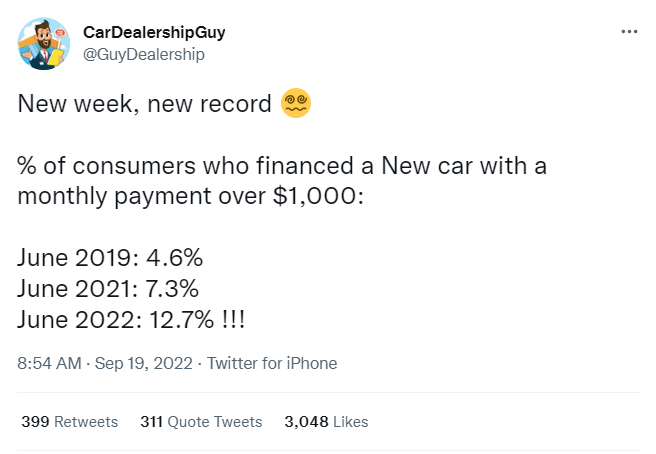
Source: https://twitter.com/GuyDealership

Examining the monthly “subscription” costs of a car.

I was scrolling through Twitter the other day when I came across the alarming little nugget that I’ve screenshotted above.

Those figures are pure insanity. Especially given that most people are not making anywhere near enough in income to justify buying a depreciating liability that costs $1,000+ a month. You make baller income or pay in cash, sure, okay. But when the average income in the U.S. is around $63,000, a monthly payment of $1,000 comes out to almost 20% of your annual income.

That’s ridiculously too much. Yet nearly an eighth of car-buying Americans are doing just that, according to the Tweet above.

Mind you, that $1,000 figure doesn’t include other ongoing vehicle expenses like gas, maintenance, or accessories. I mean, how can you live without a set of hand crafted custom crystallized wheels with genuine European crystals? I sure can’t.

And also mind you, that figure doesn’t include interest payments that can dramatically compound the costs of a vehicle over time. Especially if you miss a payment, or roll an auto loan over into another vehicle later on.

Bottom line: Americans pay WAY, WAY too much for blocks of metal, rubber, and plastic to get to work and the grocery store.

The tweet also got me thinking about how much I’ve spent on my own car. As I mentioned in an article here, I drive a “senior vehicle.” A 2006 Saturn that I purchased in 2011.

The retail cost of my car was $7,500, though I had to use sky-high interest rate financing at the time of purchase as my credit/income were not good. However, I managed to pay off the whole loan about two years later. Including interest and taxes, the total cost of “Baby” (my nickname for her) came to about $9,000.

I’ve owned Baby for going on twelve years now, as I bought her in January of 2011. That’s 141 months, including this month of September.

So, how much has it cost me overall to own a set of wheels?

It comes out to $63.80 a month.

That’s less than what I pay for my monthly Verizon smartphone bill (about $77 for unlimited data). That’s slightly more than what I pay for my electric bill on average ($50-$60). Its actually less than what I pay for gas in a typical month to feed my senior vehicle ($60-$70).

It’s also less than one tenth the cost of the average monthly car payment in the U.S. ($667).

Of course, I’ve excluded things like maintenance and fuel. I’m only factoring in the total retail cost of the vehicle itself, as the tweet above does for the financed vehicles.

Used cars, especially senior cars, often come with unexpected issues, in addition to the standard ongoing maintenance costs. I recently bought new tires for my car for about $600, for instance. I make sure she gets regular oil changes. And I’ve replaced brakes, and paid for other things as needed over our decade-long relationship. When I first bought her, I had to shell out over two thousand dollars for some electrical repairs and a new water pump. But for the vast majority of the time, she’s been remarkably reliable and cost-effective. Honestly, she could blow up right now, and she’d still have paid for herself many, many times over.

Often, new cars, and some newer used ones, will have warranties or maintenance offers from the dealership. These can make it appear that you’re “saving” money on repairs or maintenance. Except all of that is calculated into the retail price. So those “free” oil changes you’re getting, or the replacement part you need that’s “covered” by the warranty— yeah, you’re still paying for that, just maybe not directly as you would if you brought in a senior car like mine to a mechanic and paid out of pocket.

But even if you do actually save money on major repairs through a warranty, you still come out way ahead with a decent used car than a new one.

Granted, not many people are as loyal to their senior vehicles as I am. Not many people are willing to drive around in the same car for that long. Especially one that’s far from glamorous. Most people look to upgrade their cars the second they get a raise at work, or change into a better job. And to be fair, some people need newer vehicles for work, or because of where they live.

Sometimes it’s impossible to escape the money-sucking event horizon of the black hole that is car costs.

But that doesn’t mean you should purposefully set yourself up with an overpriced vehicle you don’t need that eats up your monthly budget. Do you really need to pay $37,876 just so you look cool when you go to the grocery store? That’s the average price of a new car, according to Financial Samurai.

Trust me, nobody cares what you drive. I can’t even remember the last time I saw a cool car on the road (like a Lambo, or higher-end Porsche), much less the person who drove it, because I deleted it from my memory bank so quickly.

I’ve been fortunate in that for a long time I’ve lived close to work, or driven company trucks, so I didn’t always need to 100% rely on my senior car as others do to get to work or get around town. But my car has done multiple road trips across the country, and survived ten North Dakota winters. I bought my car with about 60,000 miles on her. She now has almost 180,000. She’s done about 10,000 miles a year. According to Kelley Blue Book, the average driver in the U.S. puts 12,724 miles on their vehicle each year. So, my car has more than kept up near the average in terms of production. It’s not like she’s just sat in a garage under a tarp or something.

Oh, yeah, mileage is another way to calculate the “subscription” costs of a car. Baby has only cost me 7.5 cents a mile to drive overall. For comparison’s sake, the average cost of an Uber ride per mile is $1-$2, according to Ridester. Had I bought a new car at the above-stated average price of $37,876, I’d have paid about $0.31 per mile over the same length of time. Teslas may be cheap to charge. Solar Reviews calculates a Model X would run you an eye-popping nickel per mile. But that’s after you drop an even more eye-popping $122,190 on the base model. Over 120,000 miles, that comes to almost $1.02 per mile.

Put another way, you’d need to drive that Tesla for 1.6 million miles to get to 7.5 cents a mile like my senior car. Baby wins again big time.

Now, having said all this, I realize Major League Cheapery is not the preferred route for many, as it has been for me. I’m a rare case, most likely. I am not a car guy. There are a hundred other things I’d rather buy/invest with my money than a machine that transports me to Wal-Mart for the weekly freakshow.

However, I think breaking down the cost of something into a subscription model is a great way to examine whether what you’re getting is a good deal or not for your money. What is considered a “good deal” will mostly be proportional to your income, but there’s also a fair bit of subjectivity here, too. For instance, I find most large SUVs wastes of space and fuel. But for someone who has a large family, or goes camping a lot, or really needs the extra space, it might be a good value for them. I grew up riding around in a Chevy Suburban myself as the oldest of four kids, so I get how important an approriate-sized vehicle is for a family.

What’s important is that your monthly “subscription” be proportional to your income and needs as much as necessary. If you’re paying as much for a car as a mortgage, you’re almost certainly paying far too much. This is why I compared my monthly car costs to that of my smartphone and utility bills.

For me, my car is like any other small bill. It hardly eats up a noticable percentage of my monthly budget. It’s no big deal, cost-wise. But it’s a very big deal when you consider that saving so much money has allowed me to get far closer far faster to financial independence.