Up until last month I’d had an account for almost 15 years, starting with the DVD by mail thing that made the company famous. Giving it up was hard, even though I barely watched it anymore.
I found that increasingly there was less and less stuff on there that appealed to me. The tenth season of Stranger Things? GTFO. How old are those “kids” now anyway, like 30? Good lord, will they just get fucking eaten by a monster already and be done with it?
Netflix had its moments. Back in the day, I enjoyed Orange is the New Black. A show not exactly made for me, but one I looked forward to every year. But even then it became clear that the streaming model was built not on worthwhile storytelling, but on filling up space with “content” meant mainly to mildly appeal to different audiences. But it “appeals” only in the sense of a corny corporate joke that you laugh at out of politeness, not enjoyment.
The last straw might have been Rebel Moon, which is like the quintessential douchebag dudebro film, making 300 look like a Ken Burns documentary by comparison. Zack Snyder’s cringy Star Wars ripoff, following his 2021 Aliens ripoff Army of the Dead. Who the fuck thought that film merited a two-part release? What algo called for that? And for what audience? Lobotomy patients? Was it made for headless torsos stored in a medical school morgue waiting to be dissected? Or maybe Rebel Moon wasn’t even made for humans. Maybe it was actually meant for AI bots roaming the dead internet, to placate them from wiping out humanity.
I’m so done with some computer algo dictating how and when I watch something. Here are words that come to mind that describe what it feels like getting puppet stringed by some Silicon Valley dork’s coding: Unnatural, weird, uncomfortable, disappointing, unsettling, uncanny, unsatisfying, creepy, skeevy, and just plain wrong.
“Attention by algorithm” is such a strange thing. Letting some impersonal random code feed you “content” (hate that word) on some digital liminal space just feels bizarre. Dystopian, almost.
It’s not even how I’ve found some of the best movies I’ve watched over the years. Recently I discovered two solid thrillers, Eden Lake and Triangle, from reading posts of people I follow on X. That’s also how I found the trailers for the upcoming horror flicks Cuckoo and Longlegs, two releases I’m looking forward to seeing this year. X is where I first heard about Late Night with the Devil and last year’s Talk to Me.
I follow filmmakers I like, such as Sean Baker, and usually get the latest trailers or updates directly from the source when they post them.
I kept hearing positive things about Das Boot and Master and Commander: The Far Side of the World on Reddit before finally checking them out years ago.
It was coming across all the “Think, Mark!’ memes everywhere that got me into my new favorite show, Invincible.
There have been exceptions. Netflix spotlighted Dragged Across Concrete last year. A great, gruesome little thriller starring Mel Gibson and Vince Vaughn as crooked cops trying to procure some ill-gotten gold. I would probably have never discovered that one had it not gone to the streaming afterlife.
But for every Concrete or Spectral there’s a whole mess of uncanny valley-esque stuff that doesn’t even look like it was made for humans or by humans. Stuff like I Care A Lot or The Perfection. Or just unwatchable garbage in general, like Adam Sandler’s Netflix deal “comedies.”
Nearly every great movie I’ve ever seen I had reccomended to me from a friend or family member, or I sat down to watch it with them. In the past you might have stumbled across something on cable. But those days are mainly gone, replaced by whatever Netflix feels like throwing at you.
Lately, I’ve become a lot more selective about what I watch. It could be from getting older and becoming more conscious of the trickling sands in the hourglass. Maybe it’s due to getting tired of the endless inundation of “content” from the streaming factories. Or maybe the high junk-to-jewel ratio the streamers keep spitting out has just made it not worthwhile to sift through the silt.
Entertainment should feel more sociable, organic, and communal. Not programmable. It should feel like a fun process of discovery, not like having your head dunked in a bargain bin DVD pile at Wal-Mart.
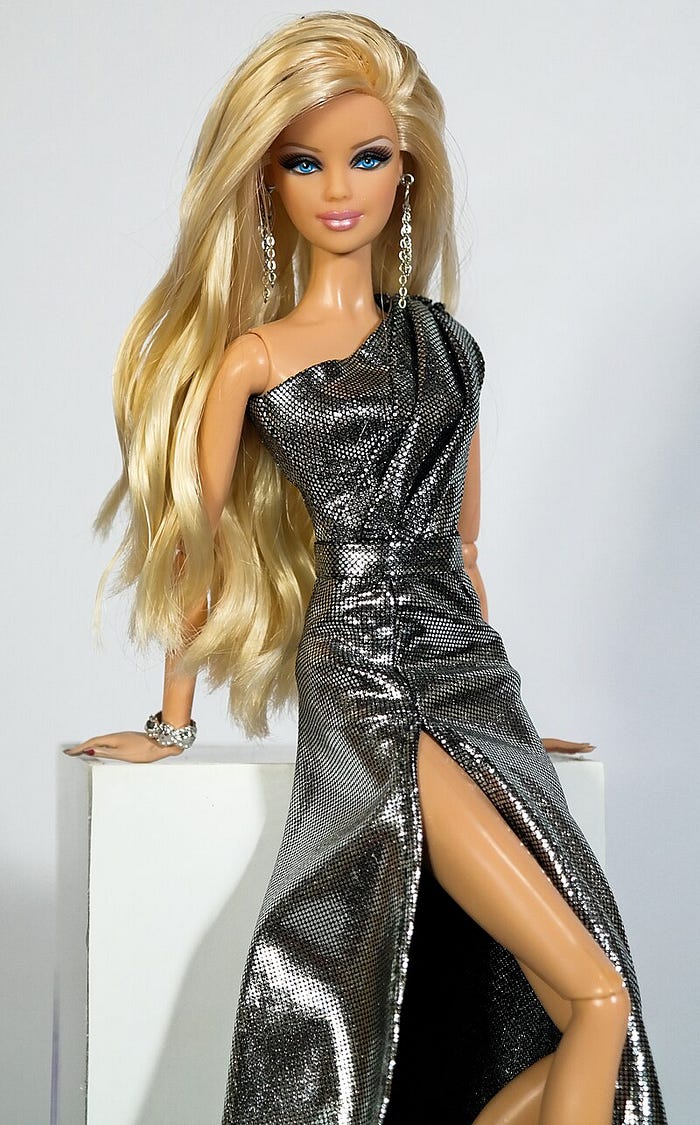
With the super successful Barbie movie in the billion dollar club at the box office, Mattel is ready to unleash the rest of its numerous branded toys into theaters.
It all started in 2018, when new CEO Ynon Kreiz, faced with declining toy sales, decided to transform Mattel’s catologue of toys into movie IP. Just like Marvel did. And like WB tried with the DCEU, and is trying again. And what Universal tried with its disastrous “Dark Universe” with 2017’s The Mummy. Everyone and their grandma is trying to make a cinematic universe. But will Barbie end up being Mattel’s Iron Man, or will the smash satirical hit prove to be a one off? Time will tell.
In the meanwhile, Mattel has 14 projects in various stages of development, according to Variety. This got me to thinking. What would they look like? What would they be about? Would they try to make them super smart, super feminist, and super socially-conscious like Barbie? Or would each be its own thing? Would they be connected, with a big Avengers-style mash-up every few years, or would they be stand-alone projects? How the hell do you even make a movie about Uno?
Well, I did some research on these upcoming films, and let’s just say I can’t wait for this MCU to get started! One thing I was very impressed with was the diversity of themes and ideas I found, and the piercing social criticisms attendant with each property. Here’s just a few of the plots and info of upcoming films I discovered coming out soon from Mattel:
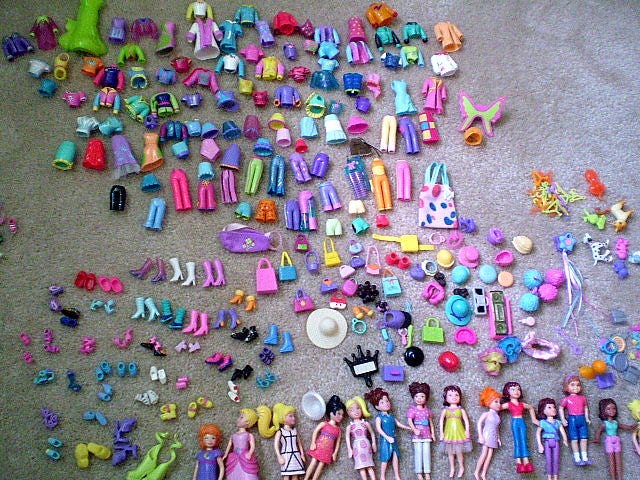
What is it? Miniature dolls and accessories that you can fit in your pocket.
Theme: Female empowerment.
Plot: Polly Pocket and her friends discover they were invented by an evil man who wanted to make little toy women that fit in your pocket, because he thinks all women should be small and easily controlled. But they turn the tables on him when, through the power of friendship (and glitter) they become super-sized, and stick him in a tiny house.
Tagline:Is that a Polly in your pocket or are you just happy to see me?
My thoughts: This is such a great idea whose time has come, and I think it will make a billion dollars at the box office easy.
Plot: A bunch of schlubby middle-aged good ol’ boy mechanics working at a car shop get put in their place when a newly hired 20-year old female with both beauty and brains, comes aboard and starts making these newfangled vehicles she calls “Hot Wheels.” When her models start selling like hotcakes, it becomes a full-on gender war. But not to worry, she easily comes out on top.
Tagline: Hot (and also Strong and Independent) Wheels
My thoughts: This is exactly the kind of deep intellectual satire you can sink your teeth into. We need more movies where stereotypically-presented alpha males are put in their place by flawless young women who are both equally beautiful and brilliant. I don’t think men realize that women can like cars, too. But after this movie comes out, the whole world will know that hell yes they can.
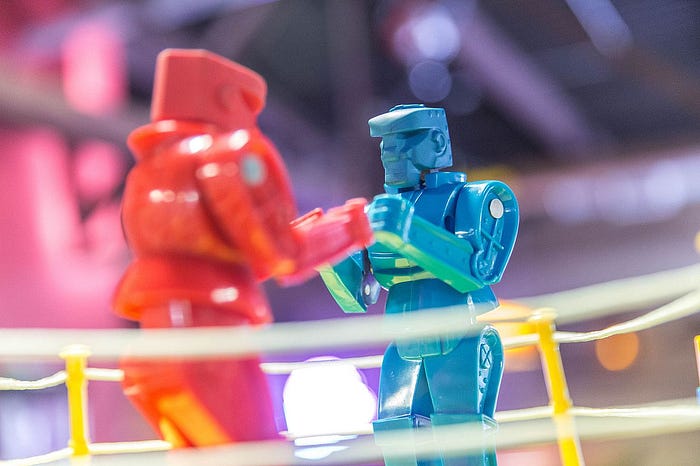
What is it? Little robots you control and punch the heads off of.
Theme: Female Empowerment.
Plot: Forced into a life of endless and mindless violence fighting in a ring, a toy robot is at last given a chance at peace when his human controller switches from a violent, mean and dumb little boy, to a peace-loving, very smart little girl.
Tagline: He won’t knock off your head, he’ll knock off your heart!
My thoughts: Such brilliant satire. And the irony, too. A violent robot boxer who learns to love peace and pacifism. I think Terminator 2: Judgment Day is going to get a run for its money for most likable robot who won’t kill when the world finally gets to meet our main robot character, Rock ’Em.
Plot: A little boy decides he’s had enough of being a little boy, and becomes a little girl instead. But not just any girl. An American Girl.
Tagline: (sung to the tune of American Girl by Tom Petty and the Heartbreakers) He was…an Americaaaan Giiiiirl!
My thoughts: Just reading the plot made tears stream down my cheeks. What a touching, smart, and very empowering story about girlhood, femininity, femaleness, and the wonder of women. I’m marking this one’s release date on my calendar. I just hope the theater provides enough tissues, LOL.
What is it? A pool ball that gives vague but somehow correct answers.
Theme: Female empowerment.
Plot: When a mysogynistic middle-aged man discovers a magic eight ball that gives 100% correct answers, he gets the shock of a lifetime when the answer to his every inquiry is: “Women are always right.”
Tagline: Are all women infallible and wonderful? All signs point to yes!
My thoughts: I don’t need a Magic 8 Ball to tell me to go see this movie when it premiers. I’ll be camped out over night to get tickets, that’s for sure.
What is it? Playing cards with rules that are way too complicated to learn. Why can’t we just play Old Maid?
Theme: Female empowerment (with a touch of anti-patriarchy)
Plot: When a woman becomes the CEO of a major toy manufacturer based in Southern California, she deftly manages to ward off every criticism from the misogynistic men in the boardroom by using magically endowed playing cards that reverse their hostile feelings.
Tagline: Meet the girlboss who’s about to be numero Uno!
My thoughts: I’m going to go ahead and call this one a royal flush. It’s like Anchorman meets The Mary Tyler Moore Show meets Big, inspired by the incredible true story of Theranos run by legendary female CEO Elizabeth Holmes. With that many classics smashed together, you know it’s going to be good.
What is it? Some cheap plastic thing you look into to see blurry pictures of things.
Theme: Female empowerment
Plot: When a nasty, 98-year old misogynistic man is gifted a magic stereoscope by a fairy princess that allows him to see the hurt his thoughts and words cause to others in the world, he changes his sexist ways, and becomes a male feminist.
Tagline: He’s had eyes his whole life, but he didn’t SEE until he was 98.
My thoughts: I’ll be very surprised if this isn’t in contention for Best Picture. It has the kind of character arc you used to only see in classic films, not to mention a very timely theme you rarely see talked about in movies today. If Clint Eastwood is still around when this gets made, he’d be perfect for the lead. It’ll be the role he’ll be most remembered for without a doubt.
That’s all I could find for now. Aren’t these great? I’m not sure any of them will be at the level of Barbie, or bring in the same kind of box office. But I do know I’ll be waiting in line at each one on opening night. See you there!
There will never be a part-Hispanic/part-White, devastatingly handsome, six foot tall, thin, modestly fit, straight, quite masculine, Colorado-born, PA to ND transplant, very late Gen-Xer like myself properly portrayed in film. Should I despair?
“Private Vasquez.” Source: 20th Century Fox
One of my favorite films as a kid, which still is to this day, is Aliens. James Cameron’s brilliant high-octane 1986 sequel to Ridley Scott’s 1979 classic horror Alien.
Set 57 years after the events of the first film, Aliens sees heroine Ellen Ripley return to face the terror that destroyed her crew and ship. This time with a platoon of badass Colonial Marines packed to the gills with awesome firepower, sent to rescue a remote colony that has been infiltrated by the monsters with acid for blood. “This time it’s war.”
This movie blew my six-year old mind when I first saw it. I loved everything about it. The sets and visuals. The story, which starts meaningfully slow, and builds up to become a runaway freight train. The mother-daughter relationship between Ripley and the only colony survivor, the 8-year old girl Newt. The unique and awesome firepower, including the pulse rifle, and the “steadicam that kills,” as Cameron describes in the script of the massive Smartgun. And of course, the flamethrowers. The memorable and very quotable lines of dialogue. “Game over, man! Game over!” “Nuke the entire site from orbit. It’s the only way to be sure.” The giant APC. The pulse-pounding score. The climactic battle between Ripley in the powerloader and the Queen Alien. The strongly written characters. Hicks, the mature corporal leader. Hudson, the smartass. Bishop, the stoic and self-sacrificial android. And especially Vasquez, the street tough Latina.
As I got older, and became more ethnically self-aware, I found myself particularly drawn to the Vasquez character. Though I was not exactly conscious of it, I was appreciative of the fact that one of my favorite movies prominantly featured someone who kind of looked like me. And, in fact, might even share some of my ethnicity. Vasquez’s precise ethnic background is never mentioned in the movie. In the screenplay, Cameron only mentions her as being from South Central Los Angeles. She could be Mexican, Colombian, Nicaraguan, etc. I didn’t really care. She was darker-skinned. That was good enough. I thought that was pretty cool, in a novel albeit trivial sort of way. Like when you meet someone who happens to have the same birthday as yourself.
Nonetheless, Vasquez was my cinema avatar. My Brown Sorta Sister. As I mentioned in another article, I’m part Mexican, Italian, English, Irish, and a host of other things. It doesn’t really matter. Point is, growing up, I was dark enough to clearly indicate that I was Not White for the most part. When you are Not White, you get Teasing Questions from other kids. To be fair, you get Teasing Questions if you look different in any way as a kid— ask most redheads or people who were “big-boned,” about their childhoods, and they’ll often get Vietnam-style PTSD flashbacks. But as a Not White, Teasing Questions take on a distinct Grand Inquisition style, with such probes as, “What are you?” and “Where are you from?” and others often hurled your way. Usually from peers, but sometimes even from random adults.
I moved around a lot, too. I averaged a new neighborhood about every 18 months. So I was always the new kid. This made it hard to become one of the Cool Not Whites. Instead, I was perpetually a Mystery Not White. This wasn’t really a big deal in grade school, where peers tended to be more concerned with your cartoon loyalties than your race. Once I got to high school, it became more pronounced, especially since one of the government daycare camps I went to was a Diversity High School. And generally speaking, most of the Not Whites didn’t exactly fit into the structure of the school. We had metal detectors. Gang fights. Rampant drug dealing and drug doing. Racial and ethnic divisions. And in the case of my school, a vocal, pronounced, and very proud Puerto Rican and Dominican presence.
An example of the racial tensions simmering under the surface of my Diversity High School: I once made the catastrophic mistake of categorizing Hispanics as White in a biology class, only for some Brooklyn-hailing Puerto Rican princess in hoop earrings and pink yoga sweats to start yelling at me about how “dat ain’t true,” in an obscenity-laced tirade. All while the biology teacher — some pudgy White beta male with an earring, wearing creased New Balance sneakers and dress shorts — did fuck all to keep order. It’s no fun being mixed in a Diversity High School. Or in life in general, for that matter.
My mother is White, and my father is Mexican. They split when I was an infant, as such inter-ethnic/racial pairings often go. She later married a White guy, and had three kids. This didn’t help me any, as now I stood out even more. Not just due to my Not Whiteness, but also because I was the oldest offspring by a good margin, and the only one from a different father.
Naturally, our family lived in White neighborhoods. I attended mainly White public schools (except for DHS). Went to all-White churches. Basically all of my friends were White. I often placed in those very special Advanced Placement classes due to my above average “smartness.” The ones with the kids who are all going to College. Maybe even (awed hush) Ivy League Universities. Those classes were always 99% White.
The notion of my “differentness” didn’t start to manifest until I was an adolescent/pre-teen. It wasn’t a big deal or anything. I was always treated nicely. I was a well-behaved lower middle class kid, and consequently well-liked. But still, I clung to my Brown Sorta Sister, Private Vasquez. And I couldn’t help but start to notice in my voracious media consumption, that there were hardly, if any, people my shade. Even though I admired many actors of all backgrounds, suddenly, inexplicably, I felt the uncanny need for a Representation Fix.
It was the late ‘80s/’90s, so the only “color TV” were shows like Family Matters, The Cosby Show, Hangin’ With Mr. Cooper, Kenan and Kel, and the ahead-of-its-time diversely cast Nickelodeon show All That. Television was still largely segregated back then, divided between White shows and Black shows, with little mixing outside of token characters or cameos. While I enjoyed some Black shows, I wasn’t Black myself, so there was no hope of getting my Representation Fix from them. There was little if any programming with Hispanic characters. Oddly enough, I had to watch I Love Lucy — a show made in the freaking ‘50s, starring Cuban-born Desi Arnaz —just to get a taste of Latin flavoring.
As for movies, they were mainly White affairs. Aryan Arnold, who was every ’80’s/’90’s kid’s idol at one point, and the Italian Stallion Stallone ruled the macho Alpha Male hero market, with Scotch/Irish-y Bruce Willis in tow. Pre-slap Will Smith was your go-to Black Guy. Keanu Reeves was your Half-White Half-Asian but White Enough to not be Not White and so therefore Basically White Guy action hero. If there were any leading Hispanic actors back then, I never saw them, or don’t recall any. Usually anyone who looked like they hailed south of the border was relegated to the sidelines, or just a random extra in the background. Gang Leader #4. Prison Cellmate #2. The darker the character, often the dirtier the character. Or if a character were actually Latin, they were whitewashed by someone with a milkier dermal disposition, or a different nationality altogether. Al Pacino as Scarface, for instance. That sort of deal. Even as recently as 2012, Christopher Nolan swapped Bane’s Latino identity for an Eastern European-hailing thug in The Dark Knight Rises. A disappointment to me not so much because of the whitewashing, but because I wanted a Bane more authentic to what I’d seen in Batman: The Animated Series.
Hey, that was alright, I thought back then. I had my Brown Sorta Sister Vasquez. She was all I needed to satisfy my Representation Fix.
And then one day I discovered that the actress who played Private Vasquez, far from being a Latina of any type, was actually a Jewish woman. And not just a Jewish woman, but a fair-skinned one at that, who essentially played Vasquez in brown face, darkened up with make-up to match the tone of the character’s possibly Mexican melanin-tinted heritage.
The actress’s name is Jenette Goldstein, a Cameron standby, playing roles in Titanic and Terminator 2: Judgment Day, amongst many others in a long and varied, on again off again TV/movie career.
This revelation wasn’t exactly earth-shattering. I was old enough to realize actors often played characters with ethnic backgrounds different from their real-life own. It was a somewhat numbing experience, however. Certainly, it was a teachable moment. It had all been a lie. My Brown Sorta Sister, like some imaginary childhood friend, never really existed. Even though it was the character that I had bonded with — which was and still is of a similar matching ethnicity — and not so much the actress herself, the fact that the actress’s ethnic background was distinctly not Not White like mine, and clearly White, nonetheless kind of ruined the suspension of disbelief. I had to make peace with the fact that this character that I had always loved was like something out of a minstrel show.
It’s bizarre to think about now, but there was a time when Hollywood had no idea what to do when it came to “ethnic” casting. There were no rules. At the least, it was much more (literally) Black and White. You had White characters and occasionally Black ones for a little spice. Rarely did they mix if it wasn’t for comedic or token effect. Or if the show or movie was racially themed, like set during the Civil War or the Civil Rights movement, or something. That was about it.
James Cameron cast and shot Aliens in England in 1985, right next door to the same lot Stanley Kubrick was filming Full Metal Jacket, in fact. The mid-’80s England theater/acting scene wasn’t exactly a huge melting pot. Goldstein came to audition for Vasquez dressed in a fancy gown she was wearing for a Victorian Age play she was in at the time. It’s not exactly surprising that Cameron was unable to find a legit Latina in merry old England in order to properly portray the tough and streety South Central L.A. character he had written for the Alien sequel. Michelle Rodriguez would have only been 7 years old at the time. Far too young to convincingly play a badass machine-gun wielding chica dura.
Now, if one were a racial grievance monger, or simply of a lesser mind (i.e. woke), they might be outraged and excessively butthurt at the fact that a movie character was portrayed in brown face as late as the late 1980s. But I am neither a monger nor of a lesser mind. (Remember, I was in all those Advanced Placement classes.) Even though “losing” Vasquez, my Brown Sorta Sister, was like losing a good friend, the conclusion that I eventually came to was not some self-righteous moral condemnation of Hollywood’s well-known history of White preferential casting. It was to realize that it had been foolish and immature of me to ever think I needed some kind of Representation Fix in the first place.
It was to realize that representation is bullshit.
Of course, nowadays, racial and ethnic representation is all the rage in Hollywood. The Big Thing to do now is swap popular, originally White lead characters, and replace them with Black actors. The Little Mermaid is the most recent example. A trend that’s been met with controversy on all sides of the debate. White nerds on YouTube decry it as “woke” and “White erasure,” or something. Proud wokesters declare it a form of “equity,” a reflection of the sensibilities of “modern audiences,” or something. And still some still call it “tokenism.” Or corporate virtue signaling to appeal to a broader market. Or something.
It’s all very silly and stupid to me. Though it does strike me as a cringy overcorrection. As if Hollywood were trying to make up for its past exclusionary casting sins by throwing in as many non-Whites as it can into lead roles. There are apparently diversity laws now that govern Hollywood, which necessitate that particular identity boxes be checked during casting before a movie can be greenlit. All in the effort to reflect the modern, diverse world in which we live in. Though it’s not as if astute observers like myself don’t see the subtext underlying the sudden good-hearted racially-minded castings— the violence wreaked in the summer of 2020 during the Black Lives Matter riots over the death of George Floyd. Amongst other supposed racially-motivated killings of Black Americans over the last decade and a half or so. And lest we forget #OscarsSoWhite, the viral hashtag denouncing the injustice of the 2015 Academy Awards nominating 20 all-White actors. The Blackening of Hollywood had been a long time coming. Whether adding more Blacks constitutes actual “diversity” or simply more tokenism to appease an activist mob is a subject for another article. For now, we’ll go along with it.
Personally, I often feel a quiet civil war within my mind over whether this latest diversifying trend is genuine or not, and by extension, good or bad. I’d like to think it’s my reasoning faculties weighing the trend impartially. But perhaps it’s just my middle-aged cynical side thinking it’s merely the actions of a few conglomerate entertainment companies attempting to hook a wider audience, while keeping themselves out of the crosshairs of the trigger-happy Twitter hashtag mafia.
There are two camps of thought on this, I’ve found. The Doomer “Who Cares It’s Just Entertainment” Camp, and the Crying Zoomer “No, What About Authenticity and the Author’s Intent!” Camp.
In the Who Cares It’s Just entertainment Camp, I ask myself why the hell do grown ass men care what color the little mermaid is? Or that Anne Boleyn is being portrayed by a dark-skinned Black actress? The former is fictional. The latter we all know was in reality a very White British lady. It’s not like seeing Boleyn portrayed by a Black actress is going to brainwash people into thinking the British monarchy was Black during the 1800s.
But then the Crying Zoomer wails that certain stories and characters are representations of ethnic history and culture. For instance, Lord of the Rings is Tolkien’s fantasy version of Middle Ages England, which is why all the characters are White. Or at least they were. Did Tolkien mean for his work to represent “modern audiences?” Or, was he making a contemplative statement on humanity’s temptation to abuse power, with a sort of Christian allegory, based off of a region that was 99.9% White up until about fifty years ago? As for The Little Mermaid, it’s a Danish fairy tale. Shouldn’t that mean it’s only meant for White characters?
There’s certainly a place for factoring in the ethnicity of characters, especially when historical accuracy is required. I’d be taken aback to see Abraham Lincoln being portrayed by Denzel Washington in an Oscar-level biopic. But if such a thing were to happen, so what? Hollywood can’t change history. Even if Denzel Washington played Lincoln, that wouldn’t suddenly change reality. He did just fine portraying Macbeth, afterall, and no harm subsequently befell the former King of Scots’ caucasian integrity. Lincoln would still be a White dude. Lincoln’s race is besides the point anyway. We discuss him to this day, and will continue to do so into the far future, because of his tremendous accomplishments, and his values as a man and as a president. That he was White is incidental in the grand scheme of things.
It’s taken me a lifetime to achieve what I believe is the highest and most enlightened mindset when it comes to this issue of representation. I speak as someone who overcame the false belief that it is in some way essential. Here’s the deal: If you are outsourcing your sense of self-worth and validation to casting agents in Hollywood, if you only feel “seen,” when people who happen to kind of match your ethnic background are on TV or in the movies playing pretend characters, then you are foolishly delusional and chasing a phantom.
What exactly is the concept of “you?” I think if you’re looking at yourself primarily, or in large part, in terms of race or ethnicity, you’re shortchanging yourself a great deal. You’re ignoring qualities or abilities that actually matter. But let’s say you can’t help but see yourself through the lens of race. And let’s say that seeing others that share your race/ethnicity on screen is of the utmost priority to your emotional well-being, or sense of “belonging,” or “being seen” within a culture or community. Ok, then, does that still apply if the person who shares your racial/ethnic identity on screen has a different nationality? Or comes from a different sub-culture or tribe within an ethnicity or race? Or has a different political persuasion? Or different religion? Why should things like race, sexuality, and gender get all the attention? Why not height, political affiliation, weight, or socio-economic class?
Besides, society likes to lump the races into big catch-all pots. But Russians are very different to the English, even if they share a similar skin tone. Just as South Africans or Nigerians are different from Haitians. Then you have very pale-skinned Whites, olive-skinned Whites, light and dark-skinned Blacks. You have white-skinned blue-eyed blonde Hispanics, and darker-skinned Hispanics. My Hispanic roots trace mostly to the Nuevo Léon territory of northeastern Mexico. I have no clue what side of the island my Irish and English roots are mostly from, or what side of the boot my Italian heritage hails. But I suppose if we’re going to take all this identity politics stuff seriously, it would make it impossible for me to feel “seen” if anyone outside of my territories of origin were to be on screen playing a character. Supposing Goldstein was actually Mexican, but hailed from Baja California. I guess that would rule her out for me.
When you start down the path of “validation by racial/gender/sexuality representation,” you begin to realize that it’s an unobtainable goal, especially taken to its granular extreme. All it does is set you up to fail, chasing some phantom snake oil elixir meant to supposedly cure your racial identity crisis and need for acceptance.
Representation, as far as what Hollywood produces, is no better than one of those useless scam products on late night TV. It’s the Shake Weight of racial reconciliation.
There are a million better ways to work your forearm muscles than one that makes it look like you’re jacking off Andre the Android. There are a million better ways to “fix” racial imbalances than sticking race-swapped characters on the boob tube and calling it good.
Supposed “identity validators” can be fluid and fall from grace anyway. Take J.K. Rowling, for instance. Once a shining feminist icon through which many young women ported their sense of value and pride. A single mom who rose up from poverty to become a billionaire author on her own power and create a mega franchise single-handedly. An inspiring story of grit and determination. During introductions at a literary analysis class in college, nearly half the room (all women) credited the Harry Potter books as their inspiration to study English and become writers. Nowadays, Ms. Rowling has fallen sharply out of favor, impaled on the social sword of “intolerance” and “bigotry” for her unacceptance of the trans community’s/activist’s interpretations of gender and sex. Former fans burn her books. Her Twitter is no longer a place of magic, but a bloody sparring ground of ideological clashes.
Perhaps I’m being a bit obtuse and simplistic here. But I’m trying to illustrate an argument by absurdity. My point is, the destination that you will ultimately arrive at in this long introspective quest for the validation of “you” is obviously yourself — you, the individual, which, as Snoop says, cannot be replicated by someone else, or duplicated.
And that’s just considering the racial/gender/sexuality angle. As implied at the very top with my laundry list of very accurate personal attributes, it would be impossible to find your exact equal anywhere on earth, much less on the screen. So why care so much? Who could be you but you?
For the record, I fall more into the Doomer camp from the aforementioned debate over diversifying casting changes. But with a twist. I don’t really care much about supposed casting diversity. If the actor is good and the story is written well, I’ll likely enjoy it no matter who’s playing what roles. I recently watched Sean Baker’s 2015 film Tangerine, about two transgender Black prostitutes living on the streets of Los Angeles. Even though I’m pretty far from the race and sexuality identities of the main characters, I still enjoyed the film, which was mainly about jealousy, jilted love, betrayal, forgiveness, repressed and closeted sexual desires, and friendship. Even if you can’t relate necessarily to the characters, or to every thread or idea in a film, a good story provides universal themes that anyone can relate to in some way. At the least, it was a fascinating look at an unusual subculture.
However, don’t sit there and expect me to believe we’re making social “progress” just because the little mermaid is Black. GTFO of here with that. And further, it’s okay to prefer actors of particular races to play certain characters, especially in stories or series you love. That doesn’t make you racist. It makes you a loyal fan. It’s okay to want to see people who look like you. But so do others who may not share your racial background. So it’s best not to get your ego and sense of identity too tied up with how fictional characters are portrayed on screen.
At the end of the day, I’m a representative of one. Myself. That’s it. I still love Vasquez. I hold nothing against the talented actress who played her. In fact, I think it’s incredible she was able to transform so effectively that she had me fooled for years. I still revere James Cameron. He’s still one of my favorite writer/directors. He’s part of the reason I’m a writer today. And, of course, I still love Aliens.
Imagine if you could make a substantial living talking about Spider-Man, the Avengers, the latest adult cartoons, anime, or pretty much anything big in pop culture news.
We are truly living in the “Age of the Geek.” When it’s possible to make a six-figure income sharing news, gossip, not to mention a good bit of outrage over the latest movie and TV show news.
I’m talking about YellowFlash 2, a prominent YouTube channel in the pop culture news niche.
Overview
YellowFlash 2, named after the popular Flash villain, obviously, pumps out A LOT of daily videos about the latest developments in the entertainment industry. Specifically focusing on controversial, trending topics, and breaking news. Common subjects are Marvel movie updates, behind the scenes studio drama, celebrity meltdowns, casting shenanigans, trailer reactions, TV show ratings, and many other things.
Video updates are usually delivered with an acerbic style with a bit of sarcasm and attitude. YellowFlash 2 is very passionate about the subject matter he covers, and doesn’t shy away from speaking his mind very bluntly and honestly.
The videos are pretty simplistic. They are basically just a voice-over from the channel creator, with a slideshow-style presentation of web articles off his screen. The emphasis is more about quantity and volume, while staying on the cutting edge of the latest developments.
The channel averages about five uploads a day. Thumbnails are VERY click-baity, featuring bleeped expletives and photoshopped faces. Titles are generally meant to trigger outrage and other emotions.
Also, I’d be remiss not to point out that YellowFlash 2 generally comes from a center-right perspective, often criticizing “woke” productions, or targeting reviled figures such as Mindy Kaling or Meghan Markle, whenever they trend in the news.
At the time of this writing, YellowFlash 2 has 400,000 subscribers and over 3,400 videos uploaded to its channel.
Monetization
YellowFlash 2 has multiple streams of revenue. There’s Google Adsense revenue, of course. The chart below shows it makes anywhere from $1,300 to as high as $21,600 a month from Adsense. The entertainment niche doesn’t pay the most when it comes RPM (revenue per thousand impressions). It may only range from $2.00 to $4.00, which after YouTube takes its cut, may only amount to a few dollars or so.
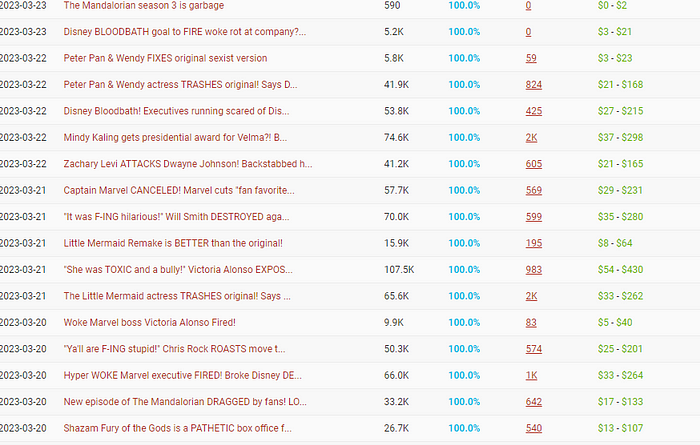
But for a channel like this, it’s better to look at it from a daily income perspective. Here’s a screenshot of its earnings by video over the last few days, from 3/20 up until its latest upload as of this writing:
As you can see, YellowFlash 2 averages somewhere around $100+ per video. At five uploads a day, that’s $500+ per day in revenue. Just from Google Adsense. Not a bad haul for a one-man entertainment news operation.
Some videos do a lot better than others traffic and income-wise depending on the subjects and whether something is hot or trending. Some have even pulled in upwards of a few thousand dollars. Most of the videos tend to get a reliable 50k–70k views, showing the channel has a strong base of subscribers who regularly tune-in to watch.
Like many YouTubers with a strong following, YellowFlash 2 has an online merch store selling everything from t-shirts, coffee mugs, hoodies, stickers, to smartphone covers.
However, I want to point out something pretty important about this channel. It also has a channel membership, ranging from $1.99 to $9.99 a month. Channel memberships can be very valuable and lucrative. Especially for channels that have a strong community following. I couldn’t find any official revenue numbers for memberships. But it’s not hard to imagine this bringing in several thousand more dollars a month. Even if there are only 500 members, that’s a minimum of $1000 a month, and possibly more if some of those members are paying for the higher tier status.
YellowFlash 2 also had a Patreon page previously, but this seems to have gone offline, or been taken down.
Niche Deets
As indicated earlier, the news entertainment/gossip/outrage niche is all about quantity over quality. It’s about clickbait. It’s about following the latest breaking news and chasing the hottend trends. This is by no means a passive “hobby channel.” It’s a full-time job.
If this sounds like a niche you’d want to try, you’d better be prepared to hustle and pump out videos constantly. You need to stay on the pulse of what’s happening as it happens.
You also need to be able to present the news with a bit of style, and be willing to employ some emotional manipulation. YellowFlash 2 is not a popular Youtube channel just because it delivers the latest news. Anyone can do that. It’s also popular because it appeals to an audience of comic book and movie fans that agree with its “anti-woke” (whatever that may mean) ethos. That audience may interesect with the red pill community, MGTOWers, and other communities that generally skew younger and male.
I point this out not because I necessarily agree, follow, or are part of those communities. But because it’s important to understand the TYPE OF AUDIENCE you are trying to appeal to with your content. You have to think about your potential audience’s perspective. Ideally, you want to start a channel that matches your personality and beliefs, and hopefully find an audience of like-minded folks. As YouTube shows constantly, there’s a community out there for just about everything and everyone.
Summary
Click-bait news, controversy, and hot takes are not for everyone. But like YellowFlash 2 demonstrates, this can be a very lucrative niche to get into for the right personality. Given the tone and style you portray, it’s probably worth considering using a pseudonym and staying faceless.
Another thing to consider, is that whenever you are straying into the world of controversial topics and celebrities, you run the risk of attracting a lot of negativity and nastiness. Meaning things that can get your channel demonetized, suspended, or even outright banned. This is especially true if you are taking certain political or social stances. Even just sharing some types of news can bring out the haters, no matter how milquetoast you are. YouTube is getting increasingly strict about these sorts of things. But opposing sides have also been known to brigade enemy channels, getting them deleted, and their owners canceled or doxxed. So beware.
All the risks aside, news content of all stripes is only going to continue in the direction of video, especially from community-specific channels like this one. If this sounds like the type of niche for you, there’s certainly lots of room for more voices.
Fiction Affliction #3 — A review of spec screenplay Hen’s Teeth, by Krishan Patel
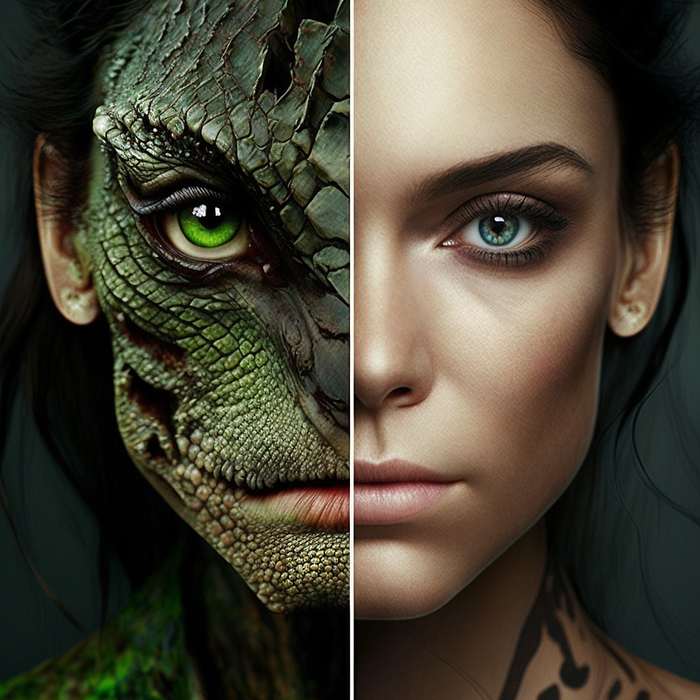
“Tara.” Made with Midjourney
Genre: Body Horror
Logline — A woman must escape the medical facility awakening reptilian traits recorded in her DNA from our distant evolutionary ancestors as a full scale transformation takes effect.
About — This is a screenplay a writer sent to me to review. The following review is an edited version of my feedback.
Writer — Krishan Patel
Length — 86 pages
For amateur screenwriters, or really for any type of writer, one of the best ways to learn the craft is to trade scripts with other writers, and provide critiques. Or at least read a lot of scripts and novels, both pro and amateur. As Stephen King said in On Writing, “Read a lot, write a lot.”
Hen’s Teeth is the second screenplay I’ve reviewed by Patel, and it inspired a good deal of feedback. That may be because it’s within a genre I enjoyed a lot in the past—body horror. Though nowadays, as I’ve gotten older, I’ve become more squeamish about things like gore, disease, and violence. But that doesn’t mean I can’t have an occassional glimpse at the grisly genre. So, here’s my review of Krishan Patel’s Hen’s Teeth.
—
Hen’s Teeth is basically a body horror thriller in the vein of Cronenberg’s The Fly, 2009’s Splice, or more recently, the 2019 horror film Eli. Stylistically, it leans more psychological and clinical instead of showing excessive gore/physical horror, though it certainly has its share of visual shocks and surprises.
The story is centered on a young woman named Tara Steventon, who since birth has suffered from an unusual affliction/illness that has made her different from other people. This difference is not necessarily readily apparent, but something people, including her own mother, pick up on more unconsciously. Due to this subtle strangeness, she’s shunned by schoolmates and peers. And even somewhat by her own mother, who keeps her distance, and doesn’t even have pictures of her daughter in her house. Tara’s one friend is the loyal and good-hearted Melanie Watkins, who grows up with Tara, and helps her to live a “normal” life. This includes going out clubbing, where in the beginning Tara is picked up by a male suitor. But prior to engaging in a one night stand, the male pulls away, and abruptly leaves, evidently put off by Tara’s uncanny different-ness. Tara vomits up something unnatural, and then ends up in the hospital. The medical staff can’t make heads or tails of her condition, and it becomes evident Tara has made her rounds in the hospital before.
Desperate to fix, or at least understand her “illness,” Tara goes to a resort/medical facility advertised online (and seen earlier on her computer), with her best friend Melanie tagging along. Upon arrival, she is greeted by Eleanor, an elegant and dedicated scientist who runs the facility/“temple retreat,” who appears to know more about Tara’s condition than she lets on. Eventually, Tara comes to learn that she’s “suffering” a form of atavism, which is, as Eleanor puts it is a “reemergence of our biology of traits from our animal ancestors.” This has caused Tara to reclaim reptilian/lizard characteristics, such as vomiting up an inhuman fluid, having an unusually-shaped skull, and possessing traces or components of venom in her blood. But rather than “curing” Tara, Eleanor has the more sinister goal of perfecting or enhancing Tara’s specialized DNA. Through the use of treatments and medical therapy, Eleanor is able to induce a radical transformation in Tara’s body that seems to work in stages. At about the midpoint, Tara goes through a major transformation, losing her skin just like a snake. However, this is only partial progress, and Tara is left a human/snake/reptile hybrid inside a vivarium, awaiting Eleanor’s final phase. The eccentric doctor intends to take Tara’s transformation all the way, by turning her into a human-snake creature, including surgically removing her limbs and fixing her spine so that Tara can slither and function just like a real snake would. At the same time, Eleanor intends to transform (or become “realized”) herself alongside Tara.
Meanwhile, Melanie wanders around the temple, where she encounters various “patients,” who call themselves the “Brothers and Sisters of Hen’s Teeth.” A group of people who operate similarly to a cult, and who evidently are in various stages of transformation to mammalian, rat-like creatures. However, Eleanor sees these earlier experiments as mere stepping stones to her grand opus, Tara. After framing Melanie for torching the mammalian creatures, Eleanor tries to win Tara over by convincing her to go through with the transformation in accordance with the mad scientist’s grand vison. But Tara turns the tables, and outmaneuvers the doctor, leaving her to die, while using her reptilian abilities to save her friend, who is injured by the mammalian creatures. All the while, a young girl named Sian, a former test subect of Eleanor, and the doctor’s daughter, interviews Tara and Melanie’s family’s to gather information, and returns to the temple under the guise of needing lodging, while in reality trying to warn the two best friends of her mother’s sinister agenda.
Overall, I enjoyed Hen’s Teeth. Body horror and the medical thriller genres appear to be in Patel’s wheelhouse. Hen’s Teeth fits the type of tone you’d expect in a body horror type movie. Patel has mentioned being a big fan of Cronenberg and other similar directors. And this story is much in that style that the writer/director is so famous for. I’ve not seen his latest film, Crimes of the Future, though the synopsis for that movie dovetails with Hen’s Teeth somewhat.
In Hen’s Teeth, I could understand for the most part what Patel was going for. It has the requisite scares and visual horror elements that you want to see in something like this. It builds slowly. There is the initial glimpse of the hen with teeth, then the mother with the multiple rows of nipples. Finally working up toward Tara’s snake-like transformation at the midpoint. Then the mammalian attacks on Melanie where she’s forced to flee with the fire extinguisher. And finally the glimpses of Tara’s “final form,” as imagined by computer screens, at the end. In addition, I felt that Patel generally staged the different scenes pretty well, especially with the temple layout. Cleverly, he tied in the atavistic scientific component thematically with the visual design of the temple, which combines the old and the new.
But most importantly, he centered the story around two best friends looking out for another, whose relationship is nearly torn apart by Tara being seduced into Eleanor’s grand scheme.
Eleanor, by the way, is a good character, being deceptive, but also a maniacal “mad scientist” type. I also liked Sian, Eleanor’s sort of daughter, who wants to stop her mother, but is internally conflicted.
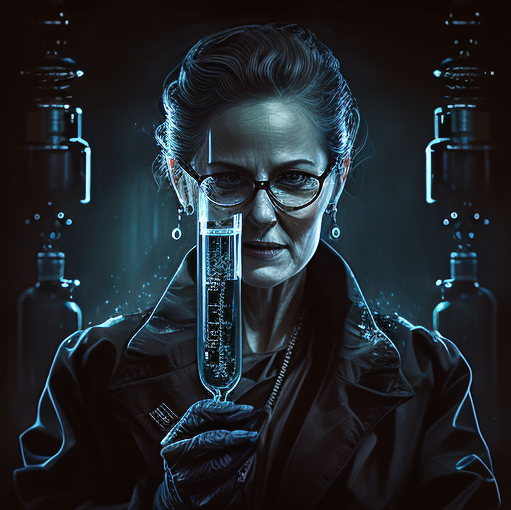
“Eleanor.” Made with Midjourney.
Where I struggled with Hen’s Teeth was chiefly in understanding Eleanor’s motivation, and the purpose of her experimentation. In Eli, for instance, Eli is being subjected to the procedures in order to (spoilers if you haven’t seen it) suppress his demonic side, as he’s the literal son of Satan. In effect, his parents and the facility are trying to save the world from him and his father. In Splice, the couple is trying to create new hybrids for medical use, and for fame. In The Fly, the fly transformation is accidental, of course. Seth is really trying to perfect teleportation. Seth later attempts to merge himself with the pregnant Veronica as a crude means to hold on to his lost humanity. “More human together than I am alone,” as he hauntingly says. Eleanor states that she wants to be “realized,” while preparing to conduct the final process on Tara. She clearly is obsessed with atavism and inducing old DNA to resurface in her subjects. But to what end? Does doing this enable these people to live longer? Does it give them any real benefit over remaining human? It appears her treatments actually hurt more than help. No matter how sinister her plan might be, there should be some underlying logic to what she’s doing. It appears she’s more doing it out of obsession and a kind of scientfic fetishism. Which wasn’t enough for me. It would make sense if atavism led to medical breakthroughs. Or added decades to someone’s life span. Or if Eleanor had some deeply personal motivation. Think of Dr. Frankenstein’s numerous encounters with death that drive him to understand the nature of death and dying, and how to overcome it. Without that needed dimension to Eleanor’s plan, the story loses a lot of substance.
Another aspect that hampered the story for me was Sian’s investigation into Tara and Melanie’s background by visiting their parents. These scenes added some important info about Tara’s childhood, yes, but in mostly an expositional manner that slowed down the narrative. Is there a more visual way to share this information? There was also something I found questionable. The story about Tara’s peers actually giving her vomit to drink, and Tara not noticing, was confusing. Why would Tara having suppressed reptlian DNA make her unable to detect that she was consuming human vomit? Reptiles and snakes eat bugs and small creatures like mice and rats. It would make more sense if Tara had been seen eating a bug or rodent by the others girls. And also, I would expand on exactly why the mother and the girls don’t like Tara. It’s stated that they sense something is off about her. Tara doesn’t have a normal “baby smell” to the mother, for instance. But if Tara has reptilian DNA that occassionally assets itself, this could be shown in a more explicit and understandable way.
Also, when introducing characters, it’s important to try and establish their relationships right away. I didn’t realize that Ruby was Tara’s mother when she visited her in the hospital. I initially thought Ruby was a nurse, or an aunt (due to her age). It wasn’t until later it’s revealed she’s her mother.
Even though there are some good visuals in this script, I don’t think it goes far enough. And that’s mostly because there are many instances where it falls back on exposition instead, or showing something on an iPad or computer. Going back to The Fly, that has a really shocking final sequence, where Seth fully transforms into his fly self. Or you think of An American Werewolf in London, where there’s the violent and climactic Piccadilly Circus sequence with the werewolf. In Eli, the boy eventually is able to defend himself, and fights back against his captors, and frees himself, though the ending in that one does peeter out somewhat. Hen’s Teeth ends rather anti-climactically, as well as ambiguously. I’m not sure what Tara and Melanie’s outcome is at the end.
Regarding the temple, I also wasn’t sure exactly why and how Tara came to know about it, and why she was drawn specifically there as a possible cure. Nothing is stated about it that would necessarily indicate that this is the place she should go. So it comes off as more as coincidental that it just happens Eleanor is running the place. It would make more sense if Eleanor is a widely known geneticist or something with a public reputation. A celebrity scientist, if you will, who is working on the cutting edge of biology research and such. Maybe Tara sees an interview with Eleanor on TV. Or perhaps Sian acts as Eleanor’s emissary, seeking out candidates for her mother’s research, and after recruitng Tara, the girl suffers a bout of conscience when she realizes her mother’s full agenda.
I would lean in more on the relationship between Melanie and Tara, which is the main emotional core of the story. I’d develop that relationship further, as well as the characters. The characters act more now as functionaries of the narrative. Existing to move the plot points along, or serve as exposition vehicles. But they should have their own motivations and background that fully flesh them out.
But overall, I’d encourage Patel to keep going with rewrites, and consider submitting this to contests or sites like Scriptshadow. Best of luck to him.









 Dean Brooks