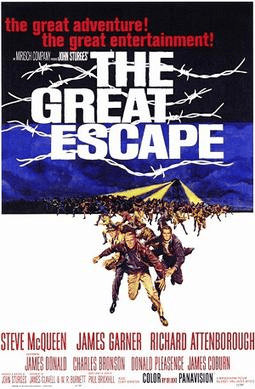
The Great Escape

(By moviegoods.com, Fair use, https://en.wikipedia.org/w/index.php?curid=6629076)

I’ve been thinking on this film for a few days and wondering why it didn’t quite connect with me.

I’m not the world’s biggest fan of WWII films, to be fair. Not because of the time period or the events. But because too often filmmakers use the setting to say something very important about war, life, or whatever, and trip all over themselves doing it. Which I get. We’re talking about a period that shaped the modern world today. It just too often reeks of tryhard. It becomes more of a vanity project for the director than a portrait of a history. Oppenheimer is a good example. So loud and bombastic just to dramatize a handful of guys in a dusty lab drawing on chalkboards. Inglorious Basterds was kind of obnoxious. Saving Private Ryan was decent, overall.

No, I mostly enjoyed The Great Escape. It’s a good film. It could have been great. But for some reason the film felt at odds with itself, and I think the main reason is the inclusion of the Steve McQueen character, Hilts, or “The Cooler King.” Now, I’ve not read the source novel, but apparently Hilts was added for the movie. Likely studios didn’t want to finance the picture unless they could insert an A-List American star like McQueen. But this editorial decision did a disservice to the story, as the Richard Attenborough character, Bartlett, or “Big X,” should have been the primary character. He’s the one driving the plot. He’s the one who concocts the whole tunneling and escape system. He’s wanted by the SS. I wanted to know more about his background and his character. He was like James Bond. Instead, he gets sidelined so we can get glamour shots of McQueen and his antics that get him stuck in the cooler.

Hilts was portrayed rather sterotypically all-American, too. Aloof, cool, daring, and, of course, a huge baseball fan.

This is what I mean when I say too often studios use WWII as a vehicle to show off rather than to tell a good story. A particularly egregious thing to do when it’s based on a true story, such as The Great Escape.

There were some tonal mismatches, too. At times it almost felt like I was watching a sitcom rather than a war drama. I’m a big fan of the TV series M*A*S*H, so I know you can balance hijinks with solemnity. I also love films like Full Metal Jacket, which is rife with dark humor and outrageousness while still sticking to its theme of dehumanization. But then at the end you have a 50-man massacre when the Nazis mow down all of Big X’s guys, including Big himself, after they’ve recaptured them, and then frame them as attempted escapees.

I guess I went into the film expecting a tone more similar to Clint Eastwood’s classic Escape from Alcatraz than something closer to The Andy Griffith Show. Might have just been the audience sensibilities at the time. Escape was released not even 20 years after the war ended. It was still fresh on everyone’s minds, and many viewers were likely veterans themselves.

The tunneling sequences were well done. I’m a huge enjoyer of technical briefing and planning scenes, which are requisite in heist or prison escape films, no matter how “boring” they may be. Such as the one in Rififi when they test out stopping the alarm system.

Overall, The Great Escape was a worthwhile watch. But it’s a good example of how sometimes unnecessarily adding a character can detract from a story, even if it makes good business sense.

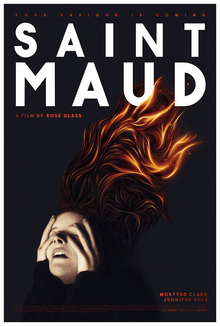
Saint Maud

(By IMP Awards, Fair use, https://en.wikipedia.org/w/index.php?curid=62765453)

This film was at threat of becoming a discarded “air conditioning movie,” but I’m glad I stuck with it. I started watching this over a year ago on Prime, gave up on it around the first act, then finally returned to it last night to finish.

I do that a lot. I just did it to Soylent Green, in fact. Some movies, however “good” they are, just fail to grab me, and I put them off. It might be the result of simply getting older. I used to plop down in front of anything and let my eyes get glazed over. Now I’m like a mid-30s professional cat lady on a date–“I just didn’t feel that spark, that tingle. I need to really feel a connection.”

Right, we’ll just ignore the hundred dates you’ve gone on over the past year that make feeling a spark about as likely as igniting a soaking wet match.

Anyway, what is Saint Maud about? This horror/drama centers on a young nurse named Katie who becomes an increasingly obsessive religious fanatic after losing a patient under her care, and is determined to save the terminal woman she’s currently assigned from damnation. It’s really a psychological portrait of mental illness. A deeply unsettling slow burn one, too. It reminded me a little of Don’t Look Now, the 1973 horror starring Donald Sutherland, which really takes its time before delivering one hell of a final stinger. The Blackcoat’s Daughter is another similar film, which is definitely one worth checking out.

Saint Maud has a pretty good last minute stinger, too. Maybe not as amazing as some claim online. But pretty good. I won’t spoil it here. But if you like waiting 90 minutes just to see if a flick’s final image makes it all worth your time, Saint Maud has got your back.

Aside from the last second bitch smack, this flick does a very good job of depicting loneliness and isolation, which are often the twin demons that lead to mental breakdown. Just ask Jack Torrance. There are some good creepy moments throughout. But you have to be patient for them. Frustrating, yes. But you need a Saint Maud once in a while to counter the roller coaster popcorn horror flicks like The Conjuring.

Saint Maud was worth it in the end, even after taking a one-year long sabbatical from my initial watch.

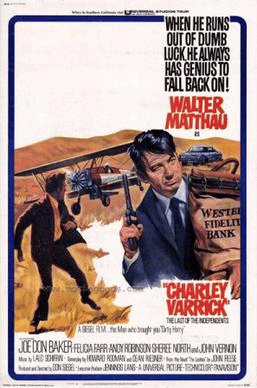
Charley Varrick (1973)

(By http://www.listology.com/content_show.cfm/content_id.21307/Movies, Fair use, https://en.wikipedia.org/w/index.php?curid=2772929)

At least now I know where Tarantino borrowed (or stole) that famous line from in Pulp Fiction.

“I’m gonna call a couple of hard, pipe-hitting niggas to go to work on the homes here with a pair of pliers and a blowtorch.”

Such a cold ass line from L.A. mob boss Marsellus Wallace. But it originally comes from the the 1973 crime thriller Charley Varrick starring Walter Matthau, based on the book The Looters by John H. Reese.

“They’ll strip you naked and go to work on you with a pair of pliers and a blowtorch.”

Like they say, “good artists copy, great artists steal.”

Varrick is a largely forgotten crime flick about a New Mexico crop duster (named Charley Varrick) who stages a daring bank robbery, only to discover he’s stolen mob money. Lots of it. About $750,000, or over $5 million in today’s dollars. Needless to say, this attracts the attention of a mob hitman, who looks like Anton Chigurh’s older white cousin.

The famous line is said by the bank owner, who is fretting about how because his local bank got hit it makes him look like the one who planned an inside job. The mob doesn’t believe in coincidences.

It’s a fun, twisty film with a creative set piece pitting a crop duster plane against a car. It reminded me a lot of No Country for Old Men. You’ve got the stolen mob money. An unstoppable hitman sent to retrieve it. A trailer park. Set in the dusty southwest. And plenty of that dry, cynical wit you expect from the genre. I also see some of the DNA that later settled in Breaking Bad. Come to think of it, Charley Varrick might be the first movie I’ve ever seen set in Albuquerque. Such an overlooked area. Most movies/TV shows pick either Texas or Cali. Almost never in-between.

Charley Varrick also features the prolific John Vernon as the troubled bank manager fretting about mob retaliation. An actor who looks like if the ’70s were a person.

This Latest He-Man Film

Mattel via Gizmodo

I finally caught Masters of the Universe, the newest He-Man film, on Amazon Prime. Which turned out to be mostly fun and engaging, but doesn’t quite land in the Franchise Zone that it was clearly aiming for.

And that may be for several reasons. One, the fantasy genre is tough as hell to break into. There are really only two major fantasy properties doing well in it–Lord of the Rings and Game of Thrones. I don’t count MCU stuff as fantasy, even when it involves Doctor Strange and Wanda Maximoff. The genre is so tough to crack that MOTU sadly bombed at the B.O., similar to another recent fantasy flick based on an IP that was largely popular in the 80s: Dungeons & Dragons: Honor Among Thieves.

Like Dungeons, MOTU follows the Guardians of the Galaxy formula practically to a T. A group of ragtag heroes led by a charismatic but clueless dude, band together to overcome a purple villain. There is a wisecracking robot, which reminded me of the other wisecracking robot from Rogue One. Even their designs are similar. There is the super badass warrior chick character in Teela to satisfy the feminist box check. You’ve got the mentor character in Man-at-Arms played by a somewhat wasted Idris Elba. I say wasted as I feel he was miscast in this. He’s a better actor than a lot of material he’s been in, like the umpteenth sequel to Fast and Furious and that weird Pacific Rim series. But he plays as a solid veteran overall.

Then, of course there’s He-Man himself, played by Nicholas Galatzine, though he goes by Adam for most of the movie until the very end. Galatzine does a pretty solid job portraying what has largely been a two-dimensional muscley avatar of goodness meant to just sell toys in the ’80s.

Now, I never watched He-Man much as a kid. It was one of the few classic cartoons of the era I missed out on, so the film couldn’t hook me with its nostalgia barbs. So, I could watch it with a more objective eye. Though I am a little familiar with He-Man’s mythology and such.

It’s hard to pinpoint why He-Man didn’t do so well at theaters. It might have been the fantasy thing. The overreliance on the Guardians formula thing. Or just the fact that it’s a nearly 45-year-old IP that really hasn’t been relevant since the Reagan Administration. The CGI and blue screen stuff was all done well for the most part. Nothing really standout.

No, I think He-Man did itself a disservice by not including a certain character–Orko, the hovering juvenile wizard thingy. As I recall from seeing bits of the cartoon, Orko is the pratfall-riddled comic relief. He’s the character meant for young kids to port themselves into the story. In the movie, he only appears at the very end, to deliver the “lesson of today’s episode” segment, as he often did in the cartoon. Seeing him, I was honestly baffled. I couldn’t believe he wasn’t in the story at all, and it struck me as a real missed opportunity. Mid-way through the film, the characters encounter a drunken and depressed Man-At-Arms character, which was obviously done to give him a redemptive arc. Something again I feel didn’t really work.

However, the characters should have encountered an imprisoned Orko instead. Then you could have had a sequence where He-Man has to motivate Orko to use his powers and help them escape. You would have set up Orko in the beginning as a young jesteresque wizard who always makes a fool of himself trying to perform magic, then arc him into a capable enough wizard who comes in clutch when needed. Orko has a fun personality, and the movie could have leaned more into the magical element of the world of Eternia. Orko would have also played very well in trailers for the film. In fact, I’d go so far as to say the film lost tens of millions by not including a kid-friendly character like Orko, and featuring him prominently. I mean, if you’re an eight-year-old kid, would you rather spend your afternoon with Orko, or a drunken bum Man-At-Arms? I know which one eight-year-old me would have picked.

Another missed opportunity was not including more Cringer/Battle Cat. He’s a cute, lovable scaredycat. You never turn down the chance to include a cuddly animal into a film that is meant for children. He-Man was basically made originally for 6-12-year-old boys. The 2026 movie seems meant for…aging Millennials in the 35-45 range? That’s a much smaller moviegoing demographic than the cohort that turned Super Mario Bros. into two billion dollar films. I mean, no kid cares about He-Man much less knows who he is anymore unless their parents showed them the cartoon or their dusty figurine collection. You have to make them care, and you do that by showing them characters that they will like and relate to. You can’t just lean on Member Berries. Think of how Pixar attracts a younger audience, even for films with more sophisticated themes, like Inside Out.

Aside from missing two huge characters that might have represented tens of millions in additional theatrical revenue (if not even more from merch sales), the rest of the film was okay. The humor mostly landed. There were perhaps a few more swear words than there needed to be. What’s with inserting profanity into films that are meant for families? I remember most family films in the ’90s and earlier to be largely free of it, save for one here or there. There are like at least ten in He-Man. There were a bunch in Spider-Man: Brand New Day as well. There’s no reason for it, really. Adult dramas more than make up the difference.

If this latest MOTU is the final word on He-Man, I think that would be just fine. We don’t really need anymore at this point.

Is ‘Heat 2’ going to be Michael Mann’s ‘The Irishman’? Or ‘Gladiator 2’?

Heat 2

For those unaware, Michael Mann is planning to direct Heat 2. He also co-authored the novel with Meg Gardiner that is, of course, a sequel to the classic 1995 hit Heat starring Robert DeNiro, Al Pacino and the late great Val Kilmer. The book is centered on the character of Chris Shiherlis, who, you’ll recall, was the lone surviving member of the ace criminal squad.

Heat is a fantastic fucking film, it goes without saying, featuring the classic shootout in downtown L.A. following the McCauley gang’s ingenious bank heist.

But what about Mann’s 2022 novel? Does it live up the legacy of the crime thriller drama that spawned a million imitators and inspired the style of Christopher Nolan’s The Dark Knight?

Well, to quote the wild Detective Vincent Hanna, “This book has a great ass, and I’ve got my head all the way up it! When I think of great books like Heat 2, something comes out of me.”

Okay, okay, I’m not that crazed. But yeah, I liked this book a lot.

And I’ve been on a thriller novel kick lately. I recently finished The Taking of Pelham One Two Three by John Godey (Morton Freedgood). I’m currently reading Death Wish by Brian Garfield.

I also liked The Irishman, the 2019 gangster flick, if at times it felt more like Scorsese was just playing his greatest hits. Plus it was ridiculously long, slow, and heavy to watch.

I haven’t seen Gladiator 2, and I doubt I ever will. I find it a little odd, this latest trend of big directors returning to the well of their best works and putting out a sequel decades removed from the original. The Irishman is not a sequel, but it feels like the spiritual successor and final missing piece to the Cinematic Universe of Goodfellas/Casino. Gladiator 2, I felt, was a strange sequel to make. What’s next? Braveheart 2?

It’s usually not best for an aging director to return to the world of their previous hits, especially this far out from the OG. However, Heat 2 definitely landed for me, and if the film is able to capture the book well enough, it should make for a fantastic sequel.

:::spoilers incoming:::

Therein lies a huge challenge. Heat 2 is basically three stories in one. Which works fine for a novel. I’m not sure how successfully that will translate to film. You have a “present” timeline set in 1995, right after the bank robbery and shootout, with Chris’s escape to Paraguay and his attempt to move up in a new crime organization. There’s the past storyline in 1988 with criminal mastermind gigachad Neil McCauley getting the band together for its first gig, and running afoul of psychopath home intruder and rapist Otis Wardell. Then you have the “future” timeline in 2000, with Chris’s return to L.A. to set up some illegal biz with weapons systems shipments or whatever with his new partner and girlfriend Ana, who’s trying to branch off independently from her crime family. All culminating in a final clash with Vincent Hanna, who’s still chomping at the bit to put bad guys six feet under and wants Chris like a junkyard dog wants a trespasser’s throat.

Well, I shouldn’t put that there is a “clash” with Hanna as he never even knows Chris is back in L.A. until the very end, and only after Chris escapes again. If I have a criticism, it’s that I would have liked to have seen more of Hanna hunting Chris.

Look, if you told me Heat 2 was going to be six hours long, I’d freaking love that. This flick is going to be The Phantom Menace for middle-aged dudes. But I’m not general audiences. I don’t see how this is going to get cut down to a coherent 2.5-3.5 hours without removing a TON. You have three movies here, really. The Paraguay stuff was less interesting to me, and frankly, a little hard to follow with all the backstabbing and double agent stuff. You have to have the 1988 sequence to introduce McCauley to set up the daughter of his girlfriend Gabriela, as she returns for the third act showdown with Wardell. So my guess is Paraguay will get cut down to make room for L.A. 2000, which will likely take up the whole second half.

Then there are the set pieces. If you thought the downtown shootout in the OG was awesome, the sequel has SIX shootouts. Yes, six. I think. I might have forgotten one or two. You’ve got Wardell’s home invasion, which turns into a shootout and car chase with Hanna and the cops. The first highway shootout in Paraguay. A cartel base robbery shootout. A shootout near the U.S.-Mexico border between McCauley and Wardell’s gang. The climactic highway shootout between Wardell and Chris. Then there’s a last-minute factory shootout. Yes, this book is packed with so much there’s even a lengthy shootout in the last THREE PAGES. Good lord.

Mann is going to have to go Avatar 2: Way of Water on this deal to fit everything in, and it looks like Amazon is going to carte blanche him. It worked out great for JC, we’ll see if it works for Mann.

Overall, I enjoyed the book a great deal and would highly recommend it. It kind of reminded me of Tom Clancy with all its globetrotting, multiple interweaving plots, and timeline shifts. Or the first half of Inception when Cobb is getting his team together across countries. Leonardo DiCaprio is perfect for this as Chris, a role he’s finally just confirmed taking. Though personally I find Neil McCauley the more interesting character. A shame he’s only in the ’88 stuff but obviously he didn’t make it past ’95. I’d like a prequel just about him.

As much as I know I’ll enjoy this coming film, I can see it getting dinged for its plot excess. Hanna is somewhat underutilized, though I think Christian Bale is a solid Pacino replacement for Hanna. Yes, Hanna is just as insane in this as he was before, and it’ll be interesting seeing Bale channel some of Al’s signature spastic energy. I’m not sure about the guy doing McCauley, Stephen Graham, but he was pretty good in The Irishman. To be fair, nobody can replace DeNiro, but we also don’t want to see a de-aged Bob like in The Irishman. I’ve heard Adam Driver is possibly doing Wardell, but I don’t see him in that role at all. And the latest is Inde Navarrette is in talks to join, so she’s either Ana or Gabriela, and I’m thinking it would be Ana. A great choice there as she was pretty iconic in Obsession.

If anything, I expect Heat 2 to serve as a strong sequel to Mann’s 1995 masterpiece. Will it break the Curse of the Underwhelming Long-Awaited Successor To A Big Director’s OG Classic that seemed to befell Gladiator Dos and made theaters allergic to the lengthy The Irishman (it premiered on Netflix)? Time will tell.

Thoughts On Adapting My Slasher Novella Into A Screenplay

So, a while back in October last year, I mentioned how I had written my first slasher novella since high school. It was a fun little project titled Cutthroat. Here’s the updated synopsis:

A group of job applicants arrive at a highrise for an interview, only to find themselves trapped and fighting for their lives against a psychopathic recruiter known as Cutthroat, who wields a briefcase full of nasty weapons and is out to kill all of them.

Cutthroat is a dark comedy/splatter horror in the vein of Happy Death Day, The Monkey, Evil Dead, or Peter Jackson’s all-but-forgotten gross-out ‘80s slasher Dead Alive. It’s bloody, profane, sickly humorous, and was a hell of a lot of fun to write.

I recommend cutting loose once in a while and writing something like a wild and crazy slasher. Especially if you get in one of those creative ruts, which I’m prone to myself periodically. Slashers may not be the most artistically satisfying things to write—God forbid we take time away from working on the next Finnegans Wake or Infinite Jest. But sometimes the writing equivalent of junk food just hits the spot.  

After finishing up the latest draft of my novella sometime in December, I decided to let the project rest for a bit. Then afterward, I thought why not go ahead and adapt it into a screenplay? I’ve been dabbling in screenwriting since around 2012. But admittedly, the format is not really my forte. There’s something I find very constraining and limiting about screenwriting. It doesn’t let you ruminate or really get into the heads of your characters. It’s like trying to pack ten pounds of material into a five-pound bag. Stuff has to get cut. Scenes truncated. Characters condensed or written out altogether. It’s tortuous, really. Which is why I stick mainly with novels and short stories.

Now, it’d been a while since I’d even written a script. My last attempt was in 2019, another horror, centered on an orphaned deaf girl who has to fend off her foster parents when they go psycho on her due to becoming influenced by a weird signal from outer space. Sort like a Twilight Zone episode meets The Shining. It predates Pluribus, the Vince Gilligan-created show on Apple that’s also about an extraterrestrial crank call from space turning everyone into zombies. While it’s a script I’m proud of, it didn’t go anywhere, and so it put me off trying again for a while. Though perhaps I’ll expand that into a short novel at some point. I’ve written twelve screenplays in total. A handful of them are worthy candidates for literary expansion.

Cutthroat the novella stands at a trim 73 pages, and just over 32,000 words. A typical screenplay of 120 pages will be about 20,000 words. Slashers have no right being any longer than 90 minutes (and preferably shorter), so you’re looking at 15,000 words, or even shorter. Most horrors are pretty Ozempic, textually speaking anyway, favoring propulsive cat-and-mouse type narratives. You’re not going to have too many, if any, dense paragraphs.

Well, you can already see an issue with the mechanics. I had to cut my story in half to make it fit.

Sounds pretty simple, right? Just take what you’ve got and divide it. Well, like those two mothers who went to Solomon arguing over custody of their baby, cutting your offspring in twain is harder to do than it looks—and I’m a very protective mom, er, dad, when it comes to my stories.

How do you decide what stays and what goes? How do you cut a nice, juicy conversation that goes on for two single-space pages in the book down to just a bite-sized half a page in the screenplay? Think of all the nuance you’re leaving on the table. Think of the plump details you’re trimming. That one banger line. Gone. Oh, man, the picking and choosing of what lives or dies on the page–that’s the true horror of adapting a horror script.

Well, turns out, it can be done, if you focus on one important thing—moving the story along as reasonably quick as you can. That’s kinda the whole point of a screenplay. It’s even in the word movie—to move. As in to zip along quickly. Even “slow” films move at light speed compared to their novel source material. Especially horror stories. We’re not digging into deep existential questions here. We want to move from one grisly slaying to the next as fast as possible.

You have to cut to the heart of the scene. Hit the broad strokes. Choose your best line or best sequence of lines that convey everything necessary and then move on.

If writing a novel is like preparing a huge rest stop buffet for hungry highway motorists, writing a screenplay is like making one specific dish, and the food critic waiting at the table is Gordon Ramsay. 

In the first draft I actually overdid the cutting, to the point that I wound up with a script at a super lean 82 pages, i.e. 82 minutes of screen time, give or take. While such length is fine and dandy for a Friday the 13th sequel (really, I have no idea how those films filled even 50 minutes, much less 80-something), for the next draft I added some more muscle and tissue to my skeletal framework. I was even able to add a few good lines here and there. As such, the screenplay version of Cutthroat and its novel source constitute two distinct visions of the same story. An unexpected and strange result considering I wrote both. I guess it’s a bit like having twins. They look the same. They share the same biology. But one’ll be an athlete obsessed with lacrosse while the other is content to spend the day watering their geraniums.                     

The latest “final” draft clocks in at a modest 88 pages. Just about perfect as far as slasher length goes. Borrowing from Ferris Bueller’s Day Off, there’s a mid-credits scene and a post-credits scene, including sequel-bait. I have plenty of ideas for additional installments in the wacky, wooly world of Cutthroat. Except, like I mentioned, slashers aren’t exactly the most calorically nourishing for the soul. Much less irreverent, darkly comic, cynical ones like this one. Time will tell whether I will revisit my psycho recruiter fiend who likes to butcher desperate job seekers in various macabre ways in the future.

For now, Cutthroat the Screenplay makes for a fine regular entry into screenwriting contests. It’s short, brutal, and to the point. It’s my attempt at making a modern “iconic” horror movie villain like Art the Clown or M3gan, by tapping into the current zeitgeisty Gen-Z terror of jobseeking by introducing the “recruiter from hell.” At some point I’ll put the novella out on KDP. I’m still tinkering with it. I may hire an artist to make some mock-up renderings, or even do an audiobook of some kind. We’ll see about all that.                             

Thoughts On Writing A Slasher

Recently, I completed the first draft of a slasher novella I’ve titled CUTTHROAT that I began in early September.

The premise is stupifyingly simple, though, like many of my works, it’s riddled with satiric malice and dark humor:

 A group of job applicants arrive at a sleek highrise for a coveted position, but find themselves trapped and fighting for their lives against a psychopathic assessor known as Cutthroat, who wields a briefcase full of nasty weapons and is out to kill all of them.

This first draft clocked in at around 31,000 words, and it proved to be both exhausting and grossly liberating at the same time. This was one of those “cutting loose” sort of writing experiments, where I didn’t feel bound by the ordinary constraints of storytelling. Though there are two character arcs, a strong mid-point shift, a late reveal, and a twisty plot with some inventive kills. Thematically, it’s centered around the tortuous difficulties attendant with job hunting, with the whole ugly process personified in the form of a psychopathic killer known as Cutthroat, who poses as a job recruiter performing interviews, only to hack his unawares applicants apart. I really tried to go for the economic malaise zeitgeist’s jugular here that mainly desperate jobseeking Millennials and Gen-Zers are suffering through or at least might relate to. Armed with briefcases filled with all kinds of nasty weapons, Cutthroat sadisticallly plays his own twisted “assessment” games with the group of twenty-somethings, and it’s up to the protagonist to figure out a way to stop him, or at least escape with his life.

Writing a slasher is brutish work, to say the least. I’ve written my share of horrors, such as The Devil’s Throne, released a few years ago, but a slasher is another beast altogether. Slashers, obviously, are less known for their elegant exploration of human themes through a lens of supernatural or psychological chills like traditional horrors, and more about delivering a certain graphic and visceral effect on the reader/viewer.

Cutthroat is sort of “Terrifier in a business suit,” as I’ve come to refer to it as a means to sum up its ethos in a pithy “elevator pitch” manner. The slasher franchise set around Art the Clown is a real phenomenon for its cult following. Walk by any Hot Topic store in a mall and you’re bound to see Art T-shirts and other merch. He’s as big as Freddy Krueger or Jason Voorhees were in their day. I’ve only seen the second film and the first half of the first one. That’s literally all I could stomach. From a writer’s perspective, I found them shockingly bereft of any “story,” even for a slasher series. The Terrifier films are more a bunch of gory vignettes strung together. A bloody highlight reel of makeup and special effects. Even Friday the 13th, with all its clumsy and meandering “plots” had a semblance of mythology what with Jason and his mommy issues. Not so for Terrifier, which seems content to just freak out audiences with new methods of bodily mutilation. Hellraiser seems tame by comparison, which seems not possible.

Honestly, I found writing my first slasher disappointingly mundane. How many ways can you really butcher human beings on paper? I found myself straining to somehow “make it more interesting.” I did this by interjecting a backstory for the villain in order to make him believable, and by adding humor wherever possible. At one point I gave up for a few days, put off by the whole thing. Only to return days later determined to finish the task.

Now that it’s done, like often happens when I’ve finished a writing project, I find myself wracked with a post-partum malaise. Though there is always the long and tedious editing process.

I remember reading about how John Carpenter, while struggling to write Halloween II (1981) hit some bad writer’s block. I wondered how in the hell could that happen. We’re talking Michael Myers here. Pehaps the most simplistic masked killer there ever was. Just set him loose in a school so he can stalk another group of dumb horny teenagers. How hard could it be, right? But after writing my first slasher, I can see where he was likely coming from, and how unfulfilled he probably felt trying his hand at the sequel. It’s no wonder he wound up throwing in the bogus development about Laurie Strode being Michael’s sister as a way to liven things up and add motivation. Something he later regretted adding to Michael’s “mythology” due to its inherent silliness. The whole point of Michael Myers is that he doesn’t need a “motivation.” That’s what makes him scary. But I can see how sheer boredom probably drove Carpenter to want to throw in anything, no matter how nonsensical, to make the writing process more palatable for him. At least The Thing had the intricate puzzlebox mysteries of “Who’s the Thing and who’s not?” “Who can you trust?” With Halloween, it’s more just about coming up with new ways Michael can kill people.

On the surface, writing a slasher is “stupidly easy,” sure. Kind of. We’re not writing a dense Cormac McCarthian Western here, even if Anton Chigurh is like a Mexican Michael Myers with a shotgun. But it takes a piece of your soul. There are also the tricky mechanics of coming up with a bigger than life villain. Something iconic. A Nightmare on Elm Street, to me, is the gold standard when it comes to slashers. It’s probably the most intelligent of them. Certainly it’s the best high-concept horror idea. A killer that stalks you in your dreams. The kind of idea that makes you go, “Why didn’t I think of that?”

Overall, I enjoyed attempting the slasher genre, though it’s not one I’d quickly want to return to. Technically, it’s not actually my first stab at it. I handwrote a short story about a group of masked killers stalking a school way back when I was a teenager in high school. It was a story obviously ripped off of Halloween as I’d just seen that film on cable, though I added a “clever” twist by not having one, or two, but three killers. Genius, obviously. With this latest attempt decades later, I like to think I’ve grown and matured. I feel I made Cutthroat suitably gory and satisfied the demands of the genre with all the requisite tropes, while putting my own touch on things and bringing something new. If anything, it was a fun writing exercise that felt perfectly appropriate with Halloween right around the corner. 🙂

There’s Something About The Endearing 90’s-ness of ‘There’s Something About Mary’

For some reason, this movie popped into my head recently, and I just had to rewatch it. I don’t know why. I seem to recall seeing it in theaters while on a beach vacation in Ocean City, Maryland back in the summer of 1998. Though the film actually stayed in theaters for over a year.

Films did that back then. Now they dip in and out in like two weeks before hitting streaming oblivion.

It’s weird watching something from the ’90s, as it is basically a period piece anymore. This film is nearly thirty-freaking years old! It is as ancient to modern audiences today as something from the mid-’60s would have been during its premier.

There’s Something About Mary is a screwball romantic comedy about a guy named Ted trying to reconnect with his old high school crush–the titual Mary. Mary Jensen, that is. Following a catalysmically awful prom date that goes sideways in the film’s second most memorable sequence when Ted gets his dick and balls stuck in his zipper after arriving at Mary’s house. Poor Ted spends the next 13 years still pining (borderline obsessing) over Mary, until he gins up a scheme to sick a private detective on her to hunt down her whereabouts. Finding her in South Florida, Ted takes off to reconnect with his old flame, encounting a series of mad-cap adventures along the way. But competing with him for Mary’s heart is the greasy private detective, an old college boyfriend, a slippery pizza delivery guy, and even a famous football QB star. Will Ted, the ultimate nice guy, win Mary’s heart in the end?

Of course, the film is BEST remembered for its “Is that hair gel?” scene when Ted and Mary are preparing to go on a date. Believe me, that line was the height of bawdy comedy in my high school during that year. Between that and the many Monica Lewinsky jokes flying around (and there were many), my junior year was beset with semen-based hilarity.

In fact, I’d say there has likely never been a time ever in human history when male ejaculation centered so prominently in the cultural psyche as it did in the year 1998. That’s all thanks to Monica and Mary.

There’s Something About Mary is beset with a hideous amount of ’90s anachronisms, both technologically and cultural. Things that just wouldn’t work in today’s self-aware uber ironic entertainment landscape. The ’90s was all about being okay with looking stupid. It was the decade of Dumb and Dumber, Jim Carrey, and wacky attitude-y cartoons like Animaniacs. Weird toys like Gak. Very stupid and cringey TV shows. And lots of bright neon colors.

People nostalgia-gazming hard on the decade often forget how damn silly the ’90s really was. And that’s probably the best way to describe Mary. Silly with a capital ‘S.’

The entire conceit of the film falls apart in the age of Facebook and Google. Now it’s not only easy to look someone up from high school, you likely can’t even get rid of them anyway if they follow you on Insta or Facebook.

Then there’s the whole stalking angle. What Ted does is technically kind of creepy. While he does sorta pay for it when he’s forced to confess at the film’s “All is Lost” beat, and is consequentially kicked to the curb, true love conquers all of course in the end.

There’s the idea of a bunch of men fixating on Mary as a sex object in a predatory way that would be seen as “problematic” now. The film gets away with it mostly due to its unflinching cartooniness. The Farrelly brothers were at their peak. The story has heart, though its punctured by a lot of slapstick nonsense.

There’s Something About Mary really is one of those films that wouldn’t be made today. It’s an odd time capsule of a film. A relic from a very niche era of cornball humor that couldn’t be replicated. A perfect representation of what the ’90s was all about.

It does have some classical elements, too. The recurring motif of the singers reminded me of the singing muses often seen in Shakespeare plays or Greek epics. The crude sexual humor harkens back to the stylings of the ancient Greek play Lysistrata. There are some borrowed elements also. The police interrogation misunderstanding feels lifted from 1992s My Cousin Vinny, for instance. But overall it’s a funny original story with a handful of memorable scenes beyond the hair gel one. The fish hook gag, as an example.

Ben Stiller stars in one of his early big roles. At the start of his early 2000s tsunami of comedy hits like Meet the Parents and Zoolander. Cameron Diaz plays the lovely and lanky Mary. And there is the adaptable Matt Dillon as the greasy private eye with the porn stache.

Need some ’90s flavor in your life? Who doesn’t, right? Check out There’s Something About Mary.

Chuck Dixon’s ‘Levon Cade’ Series (‘A Working Man’) Is Inspiring

Eleven books produced in one year. Holy shit balls.

Source: By Amazon MGM Studios — https://www.vitalthrills.com/a-working-man-trailer-featuring-jason-statham/, Fair use, https://en.wikipedia.org/w/index.php?curid=78846003

I’m a recovering “beat-em-up” fan. Back in the day as a teen I used to love those terrible Steven Seagal films like Above the Law and Marked For Death. Or Jean-Claude Van Damme stuff like Bloodsport and Death Warrant. They were constantly on rotation on USA and TBS and other freemium cable channels in the late ’90s. Films that were passably entertaining for immature adolescent minds, but in retrospect are ridiculously cheesy and absurd. But hey, if you haven’t seen Seagal break a Jamaican dude’s arm in half or Van Damme roundhouse kick a guy into a furnace, you haven’t lived.

Nowadays, Jason Statham is your go-to macho man face puncher and bad guy beater downer. Strangely, actors even higher up the talent totem pole have had a go at their own fistacuffs franchises. Bob Odenkirk is Nobody. A-lister Denzel Washington is The Equalizer. And of course Internet Jesus Keanu Reeves is John Wick.

Everyone wants to kick ass these days! Who can blame them? Have you seen the prices of things lately? Going to the grocery store anymore is like going to a Fuck Me in the Ass Parade.

The latest is A Working Man, where Statham plays a former blacks ops soldier turned construction guy who has to return to his face-stomping roots when his boss’s daughter gets kidnapped or something. I’ve not seen it, nor will I ever. Just like I didn’t see Statham’s last flick The Beekeeper, which had pretty much the same plot. The latest edition of Statham Beats Up Some Guys interests me about as much as hanging around a bunch of backwards hat-wearing dude bros talking about their fantasy football picks.

(No man should have a hobby with the word “fantasy” in it. Like, are there sparkles involved? Pink glitter? GTFO of here with that.)

Anyway…

What is pretty cool (and surprising), is that A Working Man is based on a book. Which is part of a book series, actually. By a real author. Not some A.I. trained on Seagal and Van Damme flicks. Chuck Dixon is a prolific author known mostly for his work in the comic book industry. He co-created Bane, aka the villain who broke Batman’s back. So, this guy is well-experienced in creating characters that know how to kick the crap out of people.

Dixon’s series is called Levon Cade, and features the vigilante going on various quests involving revenge and likely crushing a few throats. There are twelve books in total. The first, titled simply Levon’s Trade, premiered in December, 2021. The others came in rapid succession, sometimes as little as three weeks apart, over the course of 2022. The eleventh published in August, after which Dixon took a sabbatical before dropping the twelfth and final (?) in February, 2024. Not bad. Guy banged it all out in roughly a calendar year.

Look, these are not labyrinthine literary feasts like A Game of Thrones. These stories are Fisher-Price simple and Neanderthal stupid. No shit. But when you get down to it, there are really only two genres — “Man with Gun” and “Girl Bangs Guy.” That’s about it. James Bond, for all his British sophistication, is just another “Man with Gun” story. Titanic is the ultimate “Girl Bangs Guy.” The classics usually combine the two in interesting ways. Double Indemnity, for instance. There are some exceptions, often seen in experimental or prestige award stuff, but nobody cares. People only pay attention when someone’s fucking or getting murdered. Can you name the book that won the Nobel Prize for Literature four years ago? No? Have you ever heard of Fifty Shades of Grey? My point exactly.


I am not a fan of simple vigilante series, in either book or movie versions. I read Killing Floor once, the first Jack Reacher book, a long time ago, and the experience was akin to tattoo gunning my eyeballs. I am a fan of writers, however. Especially ones who put in the effort to carve out their own success, in whatever genre they choose. A Working Man has likely done well enough at the box office to merit a sequel. Who knows. It could even be a franchise like John Wick. I have no idea. I’ll never see the films anyway. I outgrew the need for them a long time ago. But I do appreciate them and the writers who make them.

I Watched The First Two Minutes Of Terrifier 2: WTF?

Who the hell watches this junk?

Credit: Cinedigm

I’m actually disappointed in myself. I used to really be into stuff like this when I was younger. You slap the words “obscene graphic violence” on a flick and I was there like a six-year-old kid jumping into a dark van with “FREE CANDY” written on the side.

I remember watching Peter Jackson’s ridiculously gory Dead Alive years ago and laughing my ass off. I used to watch Hellraiser on repeat. When I was a little kid I begged my mom to rent a scary movie one night. She picked Jagged Edge, which bored me. I used to run to the horror section of the video store so I could scope out any carnage shown on the backs of the video covers. The Nightmare on Elm Street series always had some gems.

Lately, I’ve been hearing about the Terrifier films. A series I know nothing about other than it involves some kind of creepy blood-covered clown named Art the Clown. I kept hearing about how people were throwing up and passing out at premiers. The other day I passed a Hot Topic in a mall and I saw Art the Clownt-shirts. Now, as much as one can glean cultural impact from a store that serves the junior goth demographic, it’s clear this Art guy has some cachet with the youngins. I’ve got to keep up with the times, thought I. I’ve got to investigate this scary new phenomenon. I know all about Pennywise the Clown. But Pennywise is yesterday’s news, and I can’t fall behind on my killer clown mythology.

To my (at the time) delight, I saw that Terrifier 2 was offered on Amazon Prime. Oh, nice, here’s my chance to check this newfangled thing out. I looked it up on Rotten Tomatoes to gauge concensus, and to my surprise I saw it not only had a fresh rating, it was actually in the 80s.

What??? A critically praised ultra gory film? Now I definitely have to see this.

I clicked on the tab. Within minutes I was greeted with a silhouette of Art the Clown walking down an alley. Okay, that’s creepy but not too bad. Then it cut immediately to a medical office, and a one-eyed Art is stalking some doctor in an office who’s been stabbed in the stomach. The doctor tries to make a phone call, only for Art to come along and start beating him to death with a hammer. Then Art rips out the doctor’s eyeball and inserts it into his own eye socket to replace his missing eye.

And that was it. I was done. I clicked away, and actually turned to The Silence of the Lambs as a form of therapy. Yes, the flick about the cross-dressing murdering sadist and psychopathic cannibal was “easy watching” compared to the bloody eyeball-snatching clown.

Who the hell watches this ultra violent gory shit? Friday the 13th, Nightmare, and the Halloween series, all of which I grew up on, are tame and nothing anymore. Terrifier is like cinematic equivalent of a heroin junkie injecting the syringe in their last good vein trying to chase that dragon high of scares.

Man, there is some imagery I just don’t care or need to put into my brain anymore. Now there’s a third Terrifier coming out this weekend. Yeah, no thanks. Fuck off, Art the Clown.