Ghostface in Space when?

I’ve been on a horror kick lately. I finally watched Barbarian. A film I wanted to see two years when it premiered, only to completely forget about until it resurfaced on Prime recently.
Barbarian is the latest in the “socially conscious” horror trend, which started with Get Out in 2018. Even our horror film franchises have to be woke nowadays. I recall a much simpler time. A time when all you needed was a mask, preferably a white one, and some maniac with a knife. A little cat and mouse. Some butchered coeds. And there you go, you had your movie.
Of course, the slasher tropes started by Halloween and Friday the 13th were tired and formularic even by the late 1980s. This is why Scream was such a refreshing hit back in 1996. It playfully toyed with the genre conventions in a fun, meta way, with characters using them as a “rulebook” to help ensure their own survival.
- Don’t go off alone.
- Never say you’ll be “right back.”
- Never, ever have sex.
Scream was the shit back in the day. It not only kickstarted the teen slasher craze all over again, it helped director Wes Craven get back in the game. It was a mega jackpot win for screenwriter Kevin Williamson, who wrote the script on spec. It’s unlikely his record for most commercially successful spec script not written by a writer/director will ever be broken. The Scream franchise has scored nearly $1 billion at the box office alone. Imagine that. Being some rank nobody 31-year-old screenwriter and you have a pdf file on your rickety old PC computer that’s worth billions. It’s the stuff dreams are made of. And he wrote it in a weekend.
Two sequels quickly followed the original hit. Then the franchise went dormant for awhile. This is back before reboots and requels and prequels became a big thing in horror. In 2011 Wes Craven directed Scream 4. That was followed by another movie lull, though the TV series Scream ran from 2015–2019. Until finally Scream (the fifth film) and Scream VI came out back to back in 2022 and ’23, with plans for a seventh on the way.
It isn’t just Scream’s almost 30-year longevity that’s amazing, but the relative high quality the franchise has maintained. Most horror series fall apart after the original. Some keep chugging along despite being objectively goddawful, i.e. Halloween, Saw, Hellraiser, etc. With the exception of Scream 3, every installment in the franchise is fresh on Rotten Tomatoes. Even Final Destination, with its clever teen-killing conceit, sits mainly in the sub-50s on RT.
So, what’s Scream’s secret? Why has it qualitatively lasted for so long while so many others have pathetically limped from one refresh to another?
Scream has some built-in requisite elements that act as quality control. Every Scream film has its gimmicks — mainly a twisty whodunnit plot with multiple meta references. A balanced measure of comedy, thrills, and melodrama. A tone that strays just outside the lines of realism into cartoonism. This precarious tight rope act isn’t easy. The latest two films are meta inside of meta; referencing the in-movie Stab series, which itself is a self-aware horror film that replicates scenes from the first Scream. The whole self-referential effect becomes like an MC Escher staircase, but with blood and knives.
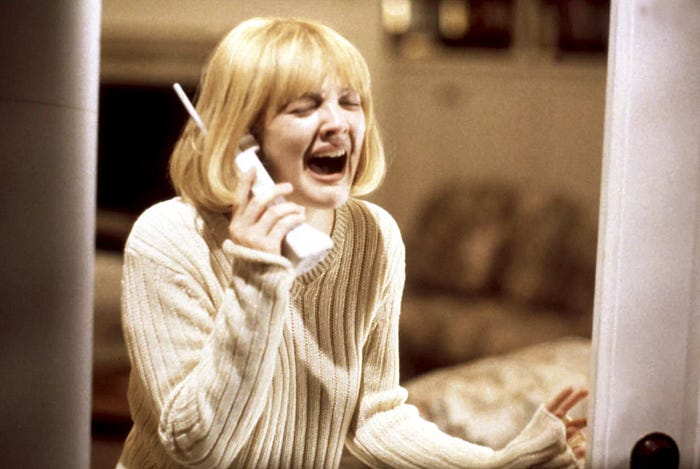
Scream has also served as a recurring mirror of the current state of horror, if not the cultural subtext influencing the genre. In 1996, it was quite innovative to introduce a beloved B-list sweetheart like Drew Barrymore, only to brutally kill her off in the opening. By 2011, the franchise had to adjust that formula with multiple twists, with mixed results. The latest two films have followed Hollywood’s latest diversity push, replacing the mainly White teen cast in the previous four with two leads of Hispanic origin — Jenny Ortega and Melissa Barrera — and assorted minority back-ups, with hardly a White male in sight (save for villainous roles, of course). All while letting OG Scream-ers like Neve Campbell, David Arquette, and Courtney Cox reenter on occasion.
It all makes for a nice adaptive organism of a franchise that can constantly reinvent itself to fit the times. I wonder what sort of State of the Horror Union address a Scream re-re-re-boot might make come the 2030s or even 2040s. The latest sequel already transplanted us to the Big Apple, à la Jason Takes Manhattan. Ghostface in Space is just a matter of time.
These days, it’s not enough to just throw another set of endangered teens out there and watch them get butchered in obscene ways. Scream films are a thinking man’s slasher flicks, dare I say. At the least they offer something a cut above your typical violent bloodletting. I find myself strangely looking forward to the next one.
 Dean Brooks