Is ‘It Ends’ Worth Watching?

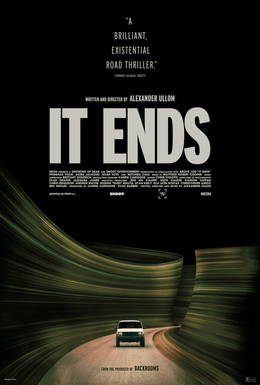
(By http://www.impawards.com/2025/it_ends_ver2.html, Fair use, https://en.wikipedia.org/w/index.php?curid=82428273)

No. Not really.

I was intrigued by this film’s conceit–characters get stuck driving on an endless road. It’s part of the newish “liminal spaces” sub-genre. It reminded me a little of the 2019 film Vivarium, which shows a married couple getting trapped in some enormous empty suburban neighborhood for years. Vivarium was tedious, dry, and unfulfilling, though it at least had a suitably creepy conclusion.

It Ends really reminds me more of The Twilight Zone episode “Five Characters in Search on Exit.” An episode that made great creative work of a very limited stage setting by including five unique characters, and one hell of a twist ending that I’m pretty sure had to have inspired the idea for Toy Story.

Really, it’s easier to sort spooky films these days into the category of those that weren’t inspired by Rod Serling’s classic TV series. And that would be a small list.

It Ends features four diverse characters, three guys and a girl, on a road trip after finishing college, who after taking a turn on a road through the woods discover that it seemingly has no ending. But not to worry. They don’t feel hungry. They don’t get tired. They don’t seem to feel much of anything, actually. If they stop the vehicle, strange people from the woods wake up and start running after them screaming, and try to rip them apart. So the foursome has to keep driving and driving if they want to survive. But where is this road taking them? Who put them on it? And why are people chasing them everytime they stop?

This was an unsatisfying film, overall, that offers little answers or resolution. Which is something you can do if your film is an artistic puzzle that’s meant to evoke individual intepretations. Such as Blue Velvet. It Ends is very minimalist and utilitarian, similar to the run of very contained thrillers in the early twenty teens, like the Ryan Reynold’s film Buried.

And it seems content not to offer any explanations, instead wanting to present a metaphor something or other about the mundanity of the adult world. The characters are suitably Gen-Z. Passionless. Devoid of any sexual agency. Suffering from various mental problems and insecurities. Automotons. If you’re going to present neurotic young adult characters, at least make them entertaining. I felt like I’d seen all these character types in films before.

I’m a fan of this budding liminal spaces sub-genre. I enjoyed Backrooms this year for the most part, and all the YouTube content built up around the creepypasta. My favorite book recently is Steven L. Peck’s A Short Stay in Hell, which deserves a cinematic release. It’s an attractive genre not just because it’s in vogue now but also because it’s high-concept and low-budget–the producer’s dream.

I just wish there had been more variety in It Ends. More menace, murder, anything. It needed to be nastier. Look at how much juice was wrung out of the 22-minute Twilight Zone episode. After a few scares in the first act it largely peters out until coming to a plopping end. There were so many realistic ways to go that could have livened it up. I mean, if four people were stuck on the same road forever, they’d eventually go so batty they’d be trying to kill each other. Instead these four just catatonically keep going forward. I just feel a lot was left on the table. At the least, there needed to be an impactful twist ending.

Prince of Darkness

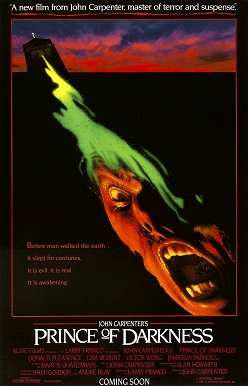
(By http://www.impawards.com/1987/prince_of_darkness.html, Fair use, https://en.wikipedia.org/w/index.php?curid=17211922)

Not one of John Carpenter’s best films, but an enjoyable cult classic all the same. To be fair, JC set the bar so high with Halloween and The Thing that anything else feels ordinary, even if it’s still better than most. The guy didn’t make horror flicks. He made horror art.

Prince of Darkness is a bit muddled in its execution, settling more for atmosphere and vibes than a coherent story, much less compelling characters. The narrative centers around a group of scientists, grad students, and one very sweaty and apocalyptically paranoid Donald Pleasence (was this guy ever not freaking out in a Carpenter film?) as a priest, trying to make sense of some creepy green goo swirling around in a cylinder in the basement of some decrepit L.A. church.

Evidently, this green slime contains pure evil, or something. It’s never really clearly stated exactly what it is. The whole thing feels made up as it goes along.

Prince of Darkness toys with some interesting ideas, while throwing around enough scientific jargon to at least sound plausible. Basically, the idea is that “evil” is a force of nature. Something that can be measured with physics and science doodads and whatnot. Except evil can also somehow influence the surrounding world telekenetically whenever it feels like it.

Earlier in the film it’s stated that the Catholic Church misrepresented evil as some figurehead, like Satan, when in fact it’s as common as gravity. But then later, after some of the college students have become influenced by the green ooze, they are are trying to conjure forth the Devil through a mirror, which acts as a portal to a dark dimension. Only the Devil’s hand appears in our world from the mirror, before Old Scratch is repelled back. Fans of Ridley Scott’s Legend will be reminded of Darkness’ appendage. And if Prince of Darkness works as anything, it’s as an unofficial sequel to the 1985 Tom Cruise-starring fantasy film. Whatever did happen to Darkness after Jack sends him hurling into the black void anyway? Now we know where he wound up.

The film is not bad, really. It has some clever ideas mixed in, and its many unexplained developments provoke questions in the viewer. What is the green ooze? Is it a personification of evil? Why does it happen to choose tonight to usher in the end of the world? Why does it need to possess college students and turn them into zombies to do its bidding? What exactly is all the scientific equipment measuring? Why do homeless vagrants surround the church, preventing the characters from escaping? Why are they killing people who try to leave? Is that really Satan trying to come through the mirror? What’s going to happen if he comes through into our reality? Is he going to end the world as we know it?

The film frustratingly doesn’t see fit to really answer anything.

Prince of Darkness boasts an impressively moody score reminiscent of the one from The Thing. There are some genuinely creepy sequences, such as the reoccuring “dream,” which is actually a signal sent from the future to warn the present. There are one or two good jump scares. Carpenter makes good use of his trademark over the shoulder shots. The make-up effects are satisfyingly gory.

While the story is not all there, Prince of Darkness is worth a watch, especially around the Halloween season. I just wish Carpenter had given the screenplay more time. It feels like a script that was two or three drafts away from being something. The ending stinger is pretty good, though. Especially if you like ambiguous Inception-like endings.

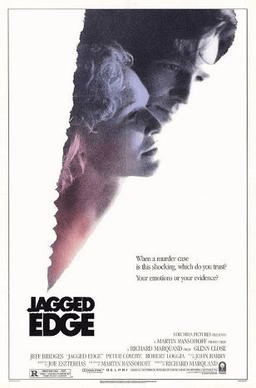
‘Jagged Edge’: A Rewatch Almost 40 Years in the Making

(Fair use, https://en.wikipedia.org/w/index.php?curid=8198266)

When I was five or six, I told my mom I wanted to watch a “scary movie.” At the time, I lived in a small town in Colorado, and right downtown there was a little video store we used to frequent every week to rent movies. This was the video store we’d rented classics like Alien, Aliens, Superman: The Movie, and many others.

I loved that video store. It’s a coffee shop now.

I saw a lot of films at that tender age that I probably shouldn’t have. But I’m glad I did. Aliens is still my number two favorite all time, just behind Jason and the Argonauts.

Anyway, for some reason, I requested to see a scary film, and for some other reason, my mom picked out Jagged Edge. Why that film and not one of the more popular releases at the time? Why not a Halloween, Friday the 13th, or A Nightmare on Elm Street? I’m not really sure. However, my mom has mentioned liking other films that star Jeff Bridges, and my mom does kinda resemble Glenn Close. So, looking back, I think I can see why she might have been drawn to the 1985 thriller. Plus, I suspect she didn’t want to expose me to a bonafide “horror film” in order to protect me from seeing anything too graphic or scary. But at that point I’d already seen the Alien rip out of John Hurt’s chest and watched Arnold blow away a whole police station after doing surgery on his eyeball. Watching Freddy Krueger eviscerate a couple of teenagers wouldn’t have really done anything traumatic to me at that point.

Like many films that imprint on us when we see them as kids, over the years, I have found myself haunted by bits of it that lodged themselves into my subconscious. Especially the creepy opening scene. So, for a long time I’ve wanted to rewatch it. But since I don’t recall ever liking the film, I kept putting it off until finally last night I gave in.

Jagged Edge is directed by the same guy who did Return of the Jedi and is written by ’80s spec script hotshot Joe Eszterhas. It tells the story of Jack Forrester (Bridges), who is accused of murdering his wealthy newspaper owner wife, and is defended by ace attorney Teddy Barnes (Close). As the trial progresses, the lawyer falls under the seductive spell of her charming client, a brief but torrid love affair begins, culminating in some twisty revelations that reveal the truth of whether Jack committed the murder.

Jagged Edge is sort of the Gone Girl of its era, and it inspired a lot of copy cats afterward. Which is surprising, as it’s quite tame by today’s standards, almost feeling more like a Lifetime TV movie than a feature that starred two A-Listers at the time.

What it’s mainly known for, of course, is the killer opening scene. A fantastic Michael Myers-esque POV of a masked killer brutally invading a posh seaside mansion, slaughtering a Hispanic maid, before turning his attention to Page Forrester, whom he ties to the bed and butchers. This is what I remember most seeing as a kid.

As for the rest of the film? It’s okay. It really sags as the trial gets underway. In Anatomy of a Murder, which was written by an actual attorney, there are excellent and realistic trial scenes. But it’s very obvious the writer of Jagged Edge had little understanding of the courtroom. There are, of course, the requisite “I object” moments, and the surprise witnesses, but on the whole, the trial stuff felt rather cliché and cartoony. Your typical Law and Order trials are done with better and more engaging verisimilitude. But remember, this was the ’80s and you could get away with half-baked legal sequences in a feature so long as they just looked right. No so much now with so much content and competition out there.

However, the writing succeeds better when it comes to the personal relationship side of things. Close’s Teddy makes for a sympathetic divorced high-powered attorney. Though not a particularly respectable one. What kind of middle-aged mother with two young kids living at home invites a man over accused of horrifically slaying his wife and maid and then makes out with him? It was just one of many questionable moments in the script. I can understand a lonely single mom falling under the spell of a handsome rich guy, but I just didn’t buy that maternal instincts wouldn’t kick in and override the lust in Teddy’s case. If anything, Teddy should have been a little younger. Close was 38 at the time. But the character feels more like she should have been around thirty, with no kids, and single. Close is a fine actress, and she sells the role mostly. But it’s an uphill climb.

Bridges is mostly good as the swarmy suspect who stands to gain millions as the husband of the deceased heiress. Though he is somewhat one-note and underutilized.

The main issue with Jagged Edge is structure. See, there was never really a doubt that Bridge’s character, Jack, did the awful deed. Maybe back in’85 it was okay to drag out the trial over most of the movie. But as I sat rewatching this, I found myself bored out of my mind because it was obvious that he was guilty but he was still going to get off. What they should have done was moved the exoneration to the mid-point. You could still plant the seeds of the love affair between attorney and client to come, but you suppress it until he’s declared not guilty. Then you can move into the romance. This would satisfy the unbelievability of a mom of two falling for Mr. Murder, if he’s believed to be innocent. It would also set up the third act a lot better. You could even have Teddy move in with him. Really seal the deal until the big revelation. Plus you would cut down on some of the courtroom stuff, which is the film’s biggest weakness. As a writer, you want to avoid scenes and sequences that expose your weaknesses, not pad them out needlessly. The Seinfeld finale had better courtroom scenes than this film.

By the way, Jagged Edge has the second best revelation scene involving a mechanical typewriter after The Shining.

But that structural fix aside, I have to say, the final twenty or so minutes of Jagged Edge are pretty good. Enough to salvage the movie, in fact. I was riveted, and once Teddy finds the piece of evidence that confirms Jack is the killer, it really took off like a rocket.

The final confrontation is the only other scene from this film I remember watching as a kid. I’m sure after the explosive opening, I tuned out and went outside before coming back in for the conclusion. I almost did the same thing as an adult. There was also a bit of a Mandela Effect. I swear when I first saw the ending, the masked killer ties Teddy’s feet to the bedpost before she shoots him. But after rewatching it, he only makes a noose with the rope, then lunges at her before she blows him away with the revolver. Strange how we misremember things.

Speaking of the gun, that should have been introduced at some point earlier in the film to satisfy the Chekhov’s Gun trope. But I don’t think it was. Which is fine, I guess. I can believe a single mom would be packing heat hidden somewhere in her bedroom just in case.

Jagged Edge is an okay thriller that’s worth a watch. But is it a scary movie, as I requested seeing almost four decades ago? Yes. At least the opening and ending parts are. They are very scary, actually. Most of the middle part sags. There are some clever red herrings and surprises during the trial. But I found I was way ahead of the film for most of it, and not because I saw it before. I didn’t remember any of the trial stuff. So it became a matter of waiting impatiently for the ending to finally come.

The music score is also quite good. Underrated, I’d say. Especially the one used for the murder scene. The movie poster is striking and memorable, also.
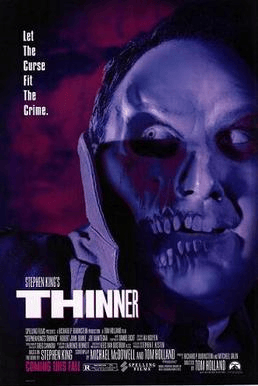
Is ‘Thinner’ Any Good?

(By Moviegoods.com, Fair use, https://en.wikipedia.org/w/index.php?curid=21786900)

I read the Stephen King novella awhile back and remember it being an effective, terse little thriller. King is a classic “over-writer,” often making up for a thin story concept with an encyclopedic catalogue of characters and their backstories, quirks, and then webbing them up in a messy convoluted plot like a cracked out Spider-Man.

Not so with Thinner, thank goodness. That book got right to the point. As if some invisible editor demanded King put his own writing on a diet, and passive-aggressively the Maine horror scribe banged this out in retaliation.

What about the movie, though?

It’s darkly hilarious. Other than that, it’s a mixed bag. King content was all the rage in the ’90s. Every producer in the world wanted to slap out a film adaptation, no matter what the budget or quality. There was the flood of TV movies like The Langoliers, Tommyknockers, The Stand, and IT.

Quick review of The Langoliers, which I also watched recently–actually not as bad as I’d thought it’d be, but that’s not saying much. It’s beyond dated, and not just in terms of it’s CGI effects. It’s also a bit padded out, like it should have been under two hours instead of three or whatever. Not really worth watching anymore, honestly, unless you are some kind of King completionist. I watched it out of curiosity as I’d only ever seen glimpses of the awful special effects (even for the time) for the Langoliers.

Back to Thinner, this tiny little nearly-forgotten almost-gem of a flick from 1996.

Thinner tells the story of fatass scumbag attorney Billy Halleck, who accidentally plows into an old gypsy lady while his wife is giving him road head, and then, after using his courtroom connections to escape consequences, suffers the wrath of the woman’s father, some kind of super gypsy, named Tadzu, who curses him to the ultimate pre-Ozempic weight loss program. Getting thinner by the day until he completely wastes away. Also getting the gypsy curse treatment are the judge, who becomes a lizard creature, or something, and a police officer who helps cover up Billy’s culpability, who becomes a boil-covered mess.

Gypsy curse films are a sub-sub-niche unto themselves. Like, there may only be a handful. Drag Me to Hell, Sam Raimi’s 2009 horror about a bank manager who gets cursed to eternal damnation when she doesn’t extend some poor old gypsy lady’s mortgage, is one of the others. Actually, that’s the only other one I can think of.

True to King’s style, the story progresses in all sorts of absurd macabre ways as Billy attempts to undo the curse, leading to an escalading series of confrontations with the gypsy chief and his itinerant tribe. At about the midpoint, likely sensing that he was almost running out of story, King reintroduces the mafia don (seen earlier when Billy gets him off on murder charges), who decides to go on a one-man crusade against the gypsies to try to force the old man to take back the curse. The lawyer’s wife also starts cheating on him for some reason, inviting Billy’s wrath. It all comes together in a sick, sad, and twisted final ending that, let’s just say, leaves almost everyone getting their just desserts. Except poor Billy’s teenaged daughter, though.

I like these dark minimalist “morality thrillers” that stick right to the point. Not just watching, either. They are the kind of things I enjoy writing the most. I’ve also tried my hand at a curse story, too. Only it centered on a witch who curses a drunk driver who hits her daughter by making everything he tries to drink turn to blood until he completes a special 12-Step Program she devises. It turned out a bit whackier than it should have, though Thinner was a big inspiration for it.

Thinner is an almost-cult classic. Just not quite there. The film is unfortunately rather shoddy in places. Which is okay in some instances. Sleepaway Camp wasn’t the most photogenic, but its clever conceit overcomes it. With a bit less daftness, Thinner might have emerged like one of John Carpenter’s lesser films. Like Prince of Darkness. Likable enough, warts and all. But it just doesn’t quite come together. Then there’s the contemptible main character. No one is really likable at all in this film. So it’s no surprise it slipped off the radar when it dropped in the mid-90s.

Despite its flaws and flagrant simplicity, I still liked it. It has some “memeable moments.” Moments that stand out due to shock or outrageousness. And I’ll never not think of the gypsy chief’s recurring address of the lawyer as “White man from town.” The book is a fun read. I just wish the movie clicked along in the same way.

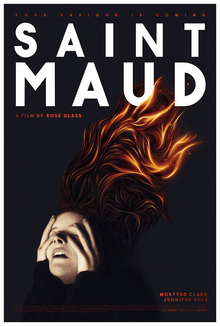
Saint Maud

(By IMP Awards, Fair use, https://en.wikipedia.org/w/index.php?curid=62765453)

This film was at threat of becoming a discarded “air conditioning movie,” but I’m glad I stuck with it. I started watching this over a year ago on Prime, gave up on it around the first act, then finally returned to it last night to finish.

I do that a lot. I just did it to Soylent Green, in fact. Some movies, however “good” they are, just fail to grab me, and I put them off. It might be the result of simply getting older. I used to plop down in front of anything and let my eyes get glazed over. Now I’m like a mid-30s professional cat lady on a date–“I just didn’t feel that spark, that tingle. I need to really feel a connection.”

Right, we’ll just ignore the hundred dates you’ve gone on over the past year that make feeling a spark about as likely as igniting a soaking wet match.

Anyway, what is Saint Maud about? This horror/drama centers on a young nurse named Katie who becomes an increasingly obsessive religious fanatic after losing a patient under her care, and is determined to save the terminal woman she’s currently assigned from damnation. It’s really a psychological portrait of mental illness. A deeply unsettling slow burn one, too. It reminded me a little of Don’t Look Now, the 1973 horror starring Donald Sutherland, which really takes its time before delivering one hell of a final stinger. The Blackcoat’s Daughter is another similar film, which is definitely one worth checking out.

Saint Maud has a pretty good last minute stinger, too. Maybe not as amazing as some claim online. But pretty good. I won’t spoil it here. But if you like waiting 90 minutes just to see if a flick’s final image makes it all worth your time, Saint Maud has got your back.

Aside from the last second bitch smack, this flick does a very good job of depicting loneliness and isolation, which are often the twin demons that lead to mental breakdown. Just ask Jack Torrance. There are some good creepy moments throughout. But you have to be patient for them. Frustrating, yes. But you need a Saint Maud once in a while to counter the roller coaster popcorn horror flicks like The Conjuring.

Saint Maud was worth it in the end, even after taking a one-year long sabbatical from my initial watch.

Thoughts On Adapting My Slasher Novella Into A Screenplay

So, a while back in October last year, I mentioned how I had written my first slasher novella since high school. It was a fun little project titled Cutthroat. Here’s the updated synopsis:

A group of job applicants arrive at a highrise for an interview, only to find themselves trapped and fighting for their lives against a psychopathic recruiter known as Cutthroat, who wields a briefcase full of nasty weapons and is out to kill all of them.

Cutthroat is a dark comedy/splatter horror in the vein of Happy Death Day, The Monkey, Evil Dead, or Peter Jackson’s all-but-forgotten gross-out ‘80s slasher Dead Alive. It’s bloody, profane, sickly humorous, and was a hell of a lot of fun to write.

I recommend cutting loose once in a while and writing something like a wild and crazy slasher. Especially if you get in one of those creative ruts, which I’m prone to myself periodically. Slashers may not be the most artistically satisfying things to write—God forbid we take time away from working on the next Finnegans Wake or Infinite Jest. But sometimes the writing equivalent of junk food just hits the spot.  

After finishing up the latest draft of my novella sometime in December, I decided to let the project rest for a bit. Then afterward, I thought why not go ahead and adapt it into a screenplay? I’ve been dabbling in screenwriting since around 2012. But admittedly, the format is not really my forte. There’s something I find very constraining and limiting about screenwriting. It doesn’t let you ruminate or really get into the heads of your characters. It’s like trying to pack ten pounds of material into a five-pound bag. Stuff has to get cut. Scenes truncated. Characters condensed or written out altogether. It’s tortuous, really. Which is why I stick mainly with novels and short stories.

Now, it’d been a while since I’d even written a script. My last attempt was in 2019, another horror, centered on an orphaned deaf girl who has to fend off her foster parents when they go psycho on her due to becoming influenced by a weird signal from outer space. Sort like a Twilight Zone episode meets The Shining. It predates Pluribus, the Vince Gilligan-created show on Apple that’s also about an extraterrestrial crank call from space turning everyone into zombies. While it’s a script I’m proud of, it didn’t go anywhere, and so it put me off trying again for a while. Though perhaps I’ll expand that into a short novel at some point. I’ve written twelve screenplays in total. A handful of them are worthy candidates for literary expansion.

Cutthroat the novella stands at a trim 73 pages, and just over 32,000 words. A typical screenplay of 120 pages will be about 20,000 words. Slashers have no right being any longer than 90 minutes (and preferably shorter), so you’re looking at 15,000 words, or even shorter. Most horrors are pretty Ozempic, textually speaking anyway, favoring propulsive cat-and-mouse type narratives. You’re not going to have too many, if any, dense paragraphs.

Well, you can already see an issue with the mechanics. I had to cut my story in half to make it fit.

Sounds pretty simple, right? Just take what you’ve got and divide it. Well, like those two mothers who went to Solomon arguing over custody of their baby, cutting your offspring in twain is harder to do than it looks—and I’m a very protective mom, er, dad, when it comes to my stories.

How do you decide what stays and what goes? How do you cut a nice, juicy conversation that goes on for two single-space pages in the book down to just a bite-sized half a page in the screenplay? Think of all the nuance you’re leaving on the table. Think of the plump details you’re trimming. That one banger line. Gone. Oh, man, the picking and choosing of what lives or dies on the page–that’s the true horror of adapting a horror script.

Well, turns out, it can be done, if you focus on one important thing—moving the story along as reasonably quick as you can. That’s kinda the whole point of a screenplay. It’s even in the word movie—to move. As in to zip along quickly. Even “slow” films move at light speed compared to their novel source material. Especially horror stories. We’re not digging into deep existential questions here. We want to move from one grisly slaying to the next as fast as possible.

You have to cut to the heart of the scene. Hit the broad strokes. Choose your best line or best sequence of lines that convey everything necessary and then move on.

If writing a novel is like preparing a huge rest stop buffet for hungry highway motorists, writing a screenplay is like making one specific dish, and the food critic waiting at the table is Gordon Ramsay. 

In the first draft I actually overdid the cutting, to the point that I wound up with a script at a super lean 82 pages, i.e. 82 minutes of screen time, give or take. While such length is fine and dandy for a Friday the 13th sequel (really, I have no idea how those films filled even 50 minutes, much less 80-something), for the next draft I added some more muscle and tissue to my skeletal framework. I was even able to add a few good lines here and there. As such, the screenplay version of Cutthroat and its novel source constitute two distinct visions of the same story. An unexpected and strange result considering I wrote both. I guess it’s a bit like having twins. They look the same. They share the same biology. But one’ll be an athlete obsessed with lacrosse while the other is content to spend the day watering their geraniums.                     

The latest “final” draft clocks in at a modest 88 pages. Just about perfect as far as slasher length goes. Borrowing from Ferris Bueller’s Day Off, there’s a mid-credits scene and a post-credits scene, including sequel-bait. I have plenty of ideas for additional installments in the wacky, wooly world of Cutthroat. Except, like I mentioned, slashers aren’t exactly the most calorically nourishing for the soul. Much less irreverent, darkly comic, cynical ones like this one. Time will tell whether I will revisit my psycho recruiter fiend who likes to butcher desperate job seekers in various macabre ways in the future.

For now, Cutthroat the Screenplay makes for a fine regular entry into screenwriting contests. It’s short, brutal, and to the point. It’s my attempt at making a modern “iconic” horror movie villain like Art the Clown or M3gan, by tapping into the current zeitgeisty Gen-Z terror of jobseeking by introducing the “recruiter from hell.” At some point I’ll put the novella out on KDP. I’m still tinkering with it. I may hire an artist to make some mock-up renderings, or even do an audiobook of some kind. We’ll see about all that.                             

Thoughts On Writing A Slasher

Recently, I completed the first draft of a slasher novella I’ve titled CUTTHROAT that I began in early September.

The premise is stupifyingly simple, though, like many of my works, it’s riddled with satiric malice and dark humor:

 A group of job applicants arrive at a sleek highrise for a coveted position, but find themselves trapped and fighting for their lives against a psychopathic assessor known as Cutthroat, who wields a briefcase full of nasty weapons and is out to kill all of them.

This first draft clocked in at around 31,000 words, and it proved to be both exhausting and grossly liberating at the same time. This was one of those “cutting loose” sort of writing experiments, where I didn’t feel bound by the ordinary constraints of storytelling. Though there are two character arcs, a strong mid-point shift, a late reveal, and a twisty plot with some inventive kills. Thematically, it’s centered around the tortuous difficulties attendant with job hunting, with the whole ugly process personified in the form of a psychopathic killer known as Cutthroat, who poses as a job recruiter performing interviews, only to hack his unawares applicants apart. I really tried to go for the economic malaise zeitgeist’s jugular here that mainly desperate jobseeking Millennials and Gen-Zers are suffering through or at least might relate to. Armed with briefcases filled with all kinds of nasty weapons, Cutthroat sadisticallly plays his own twisted “assessment” games with the group of twenty-somethings, and it’s up to the protagonist to figure out a way to stop him, or at least escape with his life.

Writing a slasher is brutish work, to say the least. I’ve written my share of horrors, such as The Devil’s Throne, released a few years ago, but a slasher is another beast altogether. Slashers, obviously, are less known for their elegant exploration of human themes through a lens of supernatural or psychological chills like traditional horrors, and more about delivering a certain graphic and visceral effect on the reader/viewer.

Cutthroat is sort of “Terrifier in a business suit,” as I’ve come to refer to it as a means to sum up its ethos in a pithy “elevator pitch” manner. The slasher franchise set around Art the Clown is a real phenomenon for its cult following. Walk by any Hot Topic store in a mall and you’re bound to see Art T-shirts and other merch. He’s as big as Freddy Krueger or Jason Voorhees were in their day. I’ve only seen the second film and the first half of the first one. That’s literally all I could stomach. From a writer’s perspective, I found them shockingly bereft of any “story,” even for a slasher series. The Terrifier films are more a bunch of gory vignettes strung together. A bloody highlight reel of makeup and special effects. Even Friday the 13th, with all its clumsy and meandering “plots” had a semblance of mythology what with Jason and his mommy issues. Not so for Terrifier, which seems content to just freak out audiences with new methods of bodily mutilation. Hellraiser seems tame by comparison, which seems not possible.

Honestly, I found writing my first slasher disappointingly mundane. How many ways can you really butcher human beings on paper? I found myself straining to somehow “make it more interesting.” I did this by interjecting a backstory for the villain in order to make him believable, and by adding humor wherever possible. At one point I gave up for a few days, put off by the whole thing. Only to return days later determined to finish the task.

Now that it’s done, like often happens when I’ve finished a writing project, I find myself wracked with a post-partum malaise. Though there is always the long and tedious editing process.

I remember reading about how John Carpenter, while struggling to write Halloween II (1981) hit some bad writer’s block. I wondered how in the hell could that happen. We’re talking Michael Myers here. Pehaps the most simplistic masked killer there ever was. Just set him loose in a school so he can stalk another group of dumb horny teenagers. How hard could it be, right? But after writing my first slasher, I can see where he was likely coming from, and how unfulfilled he probably felt trying his hand at the sequel. It’s no wonder he wound up throwing in the bogus development about Laurie Strode being Michael’s sister as a way to liven things up and add motivation. Something he later regretted adding to Michael’s “mythology” due to its inherent silliness. The whole point of Michael Myers is that he doesn’t need a “motivation.” That’s what makes him scary. But I can see how sheer boredom probably drove Carpenter to want to throw in anything, no matter how nonsensical, to make the writing process more palatable for him. At least The Thing had the intricate puzzlebox mysteries of “Who’s the Thing and who’s not?” “Who can you trust?” With Halloween, it’s more just about coming up with new ways Michael can kill people.

On the surface, writing a slasher is “stupidly easy,” sure. Kind of. We’re not writing a dense Cormac McCarthian Western here, even if Anton Chigurh is like a Mexican Michael Myers with a shotgun. But it takes a piece of your soul. There are also the tricky mechanics of coming up with a bigger than life villain. Something iconic. A Nightmare on Elm Street, to me, is the gold standard when it comes to slashers. It’s probably the most intelligent of them. Certainly it’s the best high-concept horror idea. A killer that stalks you in your dreams. The kind of idea that makes you go, “Why didn’t I think of that?”

Overall, I enjoyed attempting the slasher genre, though it’s not one I’d quickly want to return to. Technically, it’s not actually my first stab at it. I handwrote a short story about a group of masked killers stalking a school way back when I was a teenager in high school. It was a story obviously ripped off of Halloween as I’d just seen that film on cable, though I added a “clever” twist by not having one, or two, but three killers. Genius, obviously. With this latest attempt decades later, I like to think I’ve grown and matured. I feel I made Cutthroat suitably gory and satisfied the demands of the genre with all the requisite tropes, while putting my own touch on things and bringing something new. If anything, it was a fun writing exercise that felt perfectly appropriate with Halloween right around the corner. 🙂

There’s Something About The Endearing 90’s-ness of ‘There’s Something About Mary’

For some reason, this movie popped into my head recently, and I just had to rewatch it. I don’t know why. I seem to recall seeing it in theaters while on a beach vacation in Ocean City, Maryland back in the summer of 1998. Though the film actually stayed in theaters for over a year.

Films did that back then. Now they dip in and out in like two weeks before hitting streaming oblivion.

It’s weird watching something from the ’90s, as it is basically a period piece anymore. This film is nearly thirty-freaking years old! It is as ancient to modern audiences today as something from the mid-’60s would have been during its premier.

There’s Something About Mary is a screwball romantic comedy about a guy named Ted trying to reconnect with his old high school crush–the titual Mary. Mary Jensen, that is. Following a catalysmically awful prom date that goes sideways in the film’s second most memorable sequence when Ted gets his dick and balls stuck in his zipper after arriving at Mary’s house. Poor Ted spends the next 13 years still pining (borderline obsessing) over Mary, until he gins up a scheme to sick a private detective on her to hunt down her whereabouts. Finding her in South Florida, Ted takes off to reconnect with his old flame, encounting a series of mad-cap adventures along the way. But competing with him for Mary’s heart is the greasy private detective, an old college boyfriend, a slippery pizza delivery guy, and even a famous football QB star. Will Ted, the ultimate nice guy, win Mary’s heart in the end?

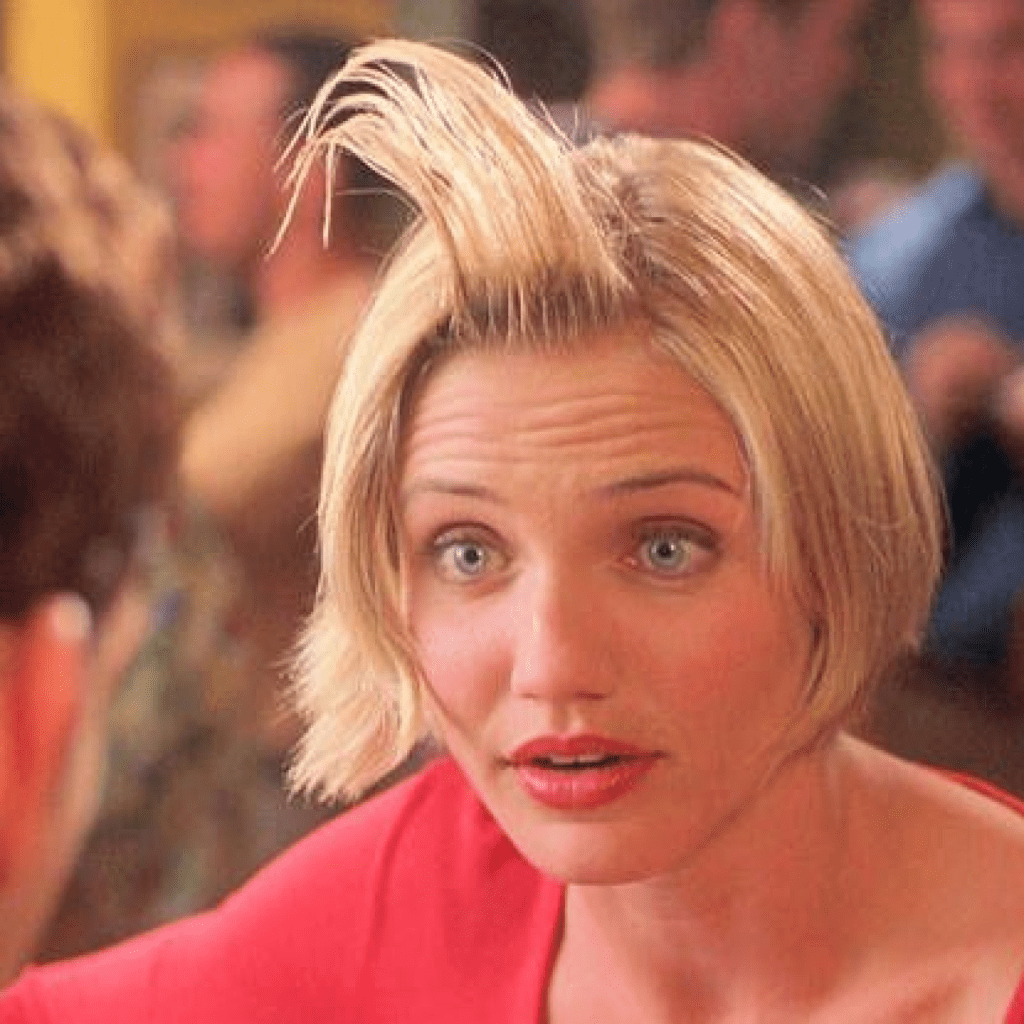
Of course, the film is BEST remembered for its “Is that hair gel?” scene when Ted and Mary are preparing to go on a date. Believe me, that line was the height of bawdy comedy in my high school during that year. Between that and the many Monica Lewinsky jokes flying around (and there were many), my junior year was beset with semen-based hilarity.

In fact, I’d say there has likely never been a time ever in human history when male ejaculation centered so prominently in the cultural psyche as it did in the year 1998. That’s all thanks to Monica and Mary.

There’s Something About Mary is beset with a hideous amount of ’90s anachronisms, both technologically and cultural. Things that just wouldn’t work in today’s self-aware uber ironic entertainment landscape. The ’90s was all about being okay with looking stupid. It was the decade of Dumb and Dumber, Jim Carrey, and wacky attitude-y cartoons like Animaniacs. Weird toys like Gak. Very stupid and cringey TV shows. And lots of bright neon colors.

People nostalgia-gazming hard on the decade often forget how damn silly the ’90s really was. And that’s probably the best way to describe Mary. Silly with a capital ‘S.’

The entire conceit of the film falls apart in the age of Facebook and Google. Now it’s not only easy to look someone up from high school, you likely can’t even get rid of them anyway if they follow you on Insta or Facebook.

Then there’s the whole stalking angle. What Ted does is technically kind of creepy. While he does sorta pay for it when he’s forced to confess at the film’s “All is Lost” beat, and is consequentially kicked to the curb, true love conquers all of course in the end.

There’s the idea of a bunch of men fixating on Mary as a sex object in a predatory way that would be seen as “problematic” now. The film gets away with it mostly due to its unflinching cartooniness. The Farrelly brothers were at their peak. The story has heart, though its punctured by a lot of slapstick nonsense.

There’s Something About Mary really is one of those films that wouldn’t be made today. It’s an odd time capsule of a film. A relic from a very niche era of cornball humor that couldn’t be replicated. A perfect representation of what the ’90s was all about.

It does have some classical elements, too. The recurring motif of the singers reminded me of the singing muses often seen in Shakespeare plays or Greek epics. The crude sexual humor harkens back to the stylings of the ancient Greek play Lysistrata. There are some borrowed elements also. The police interrogation misunderstanding feels lifted from 1992s My Cousin Vinny, for instance. But overall it’s a funny original story with a handful of memorable scenes beyond the hair gel one. The fish hook gag, as an example.

Ben Stiller stars in one of his early big roles. At the start of his early 2000s tsunami of comedy hits like Meet the Parents and Zoolander. Cameron Diaz plays the lovely and lanky Mary. And there is the adaptable Matt Dillon as the greasy private eye with the porn stache.

Need some ’90s flavor in your life? Who doesn’t, right? Check out There’s Something About Mary.

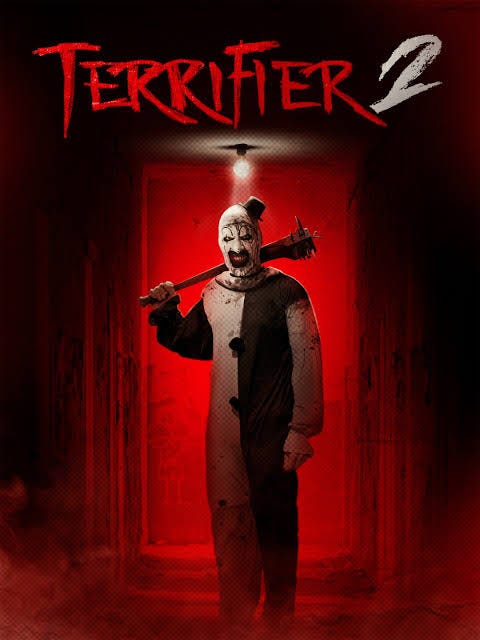
I Watched The First Two Minutes Of Terrifier 2: WTF?

Who the hell watches this junk?

Credit: Cinedigm

I’m actually disappointed in myself. I used to really be into stuff like this when I was younger. You slap the words “obscene graphic violence” on a flick and I was there like a six-year-old kid jumping into a dark van with “FREE CANDY” written on the side.

I remember watching Peter Jackson’s ridiculously gory Dead Alive years ago and laughing my ass off. I used to watch Hellraiser on repeat. When I was a little kid I begged my mom to rent a scary movie one night. She picked Jagged Edge, which bored me. I used to run to the horror section of the video store so I could scope out any carnage shown on the backs of the video covers. The Nightmare on Elm Street series always had some gems.

Lately, I’ve been hearing about the Terrifier films. A series I know nothing about other than it involves some kind of creepy blood-covered clown named Art the Clown. I kept hearing about how people were throwing up and passing out at premiers. The other day I passed a Hot Topic in a mall and I saw Art the Clownt-shirts. Now, as much as one can glean cultural impact from a store that serves the junior goth demographic, it’s clear this Art guy has some cachet with the youngins. I’ve got to keep up with the times, thought I. I’ve got to investigate this scary new phenomenon. I know all about Pennywise the Clown. But Pennywise is yesterday’s news, and I can’t fall behind on my killer clown mythology.

To my (at the time) delight, I saw that Terrifier 2 was offered on Amazon Prime. Oh, nice, here’s my chance to check this newfangled thing out. I looked it up on Rotten Tomatoes to gauge concensus, and to my surprise I saw it not only had a fresh rating, it was actually in the 80s.

What??? A critically praised ultra gory film? Now I definitely have to see this.

I clicked on the tab. Within minutes I was greeted with a silhouette of Art the Clown walking down an alley. Okay, that’s creepy but not too bad. Then it cut immediately to a medical office, and a one-eyed Art is stalking some doctor in an office who’s been stabbed in the stomach. The doctor tries to make a phone call, only for Art to come along and start beating him to death with a hammer. Then Art rips out the doctor’s eyeball and inserts it into his own eye socket to replace his missing eye.

And that was it. I was done. I clicked away, and actually turned to The Silence of the Lambs as a form of therapy. Yes, the flick about the cross-dressing murdering sadist and psychopathic cannibal was “easy watching” compared to the bloody eyeball-snatching clown.

Who the hell watches this ultra violent gory shit? Friday the 13th, Nightmare, and the Halloween series, all of which I grew up on, are tame and nothing anymore. Terrifier is like cinematic equivalent of a heroin junkie injecting the syringe in their last good vein trying to chase that dragon high of scares.

Man, there is some imagery I just don’t care or need to put into my brain anymore. Now there’s a third Terrifier coming out this weekend. Yeah, no thanks. Fuck off, Art the Clown.

The Strange Longevity Of The ‘Scream’ Franchise

Ghostface in Space when?

I’ve been on a horror kick lately. I finally watched Barbarian. A film I wanted to see two years when it premiered, only to completely forget about until it resurfaced on Prime recently.

Barbarian is the latest in the “socially conscious” horror trend, which started with Get Out in 2018. Even our horror film franchises have to be woke nowadays. I recall a much simpler time. A time when all you needed was a mask, preferably a white one, and some maniac with a knife. A little cat and mouse. Some butchered coeds. And there you go, you had your movie.

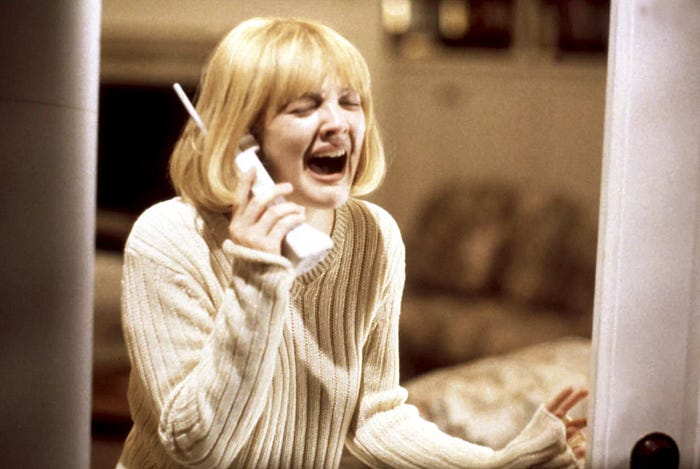
Of course, the slasher tropes started by Halloween and Friday the 13th were tired and formularic even by the late 1980s. This is why Scream was such a refreshing hit back in 1996. It playfully toyed with the genre conventions in a fun, meta way, with characters using them as a “rulebook” to help ensure their own survival.

  • Don’t go off alone.
  • Never say you’ll be “right back.”
  • Never, ever have sex.

Scream was the shit back in the day. It not only kickstarted the teen slasher craze all over again, it helped director Wes Craven get back in the game. It was a mega jackpot win for screenwriter Kevin Williamson, who wrote the script on spec. It’s unlikely his record for most commercially successful spec script not written by a writer/director will ever be broken. The Scream franchise has scored nearly $1 billion at the box office alone. Imagine that. Being some rank nobody 31-year-old screenwriter and you have a pdf file on your rickety old PC computer that’s worth billions. It’s the stuff dreams are made of. And he wrote it in a weekend.

Two sequels quickly followed the original hit. Then the franchise went dormant for awhile. This is back before reboots and requels and prequels became a big thing in horror. In 2011 Wes Craven directed Scream 4. That was followed by another movie lull, though the TV series Scream ran from 2015–2019. Until finally Scream (the fifth film) and Scream VI came out back to back in 2022 and ’23, with plans for a seventh on the way.

It isn’t just Scream’s almost 30-year longevity that’s amazing, but the relative high quality the franchise has maintained. Most horror series fall apart after the original. Some keep chugging along despite being objectively goddawful, i.e. Halloween, Saw, Hellraiser, etc. With the exception of Scream 3, every installment in the franchise is fresh on Rotten Tomatoes. Even Final Destination, with its clever teen-killing conceit, sits mainly in the sub-50s on RT.

So, what’s Scream’s secret? Why has it qualitatively lasted for so long while so many others have pathetically limped from one refresh to another?

Scream has some built-in requisite elements that act as quality control. Every Scream film has its gimmicks — mainly a twisty whodunnit plot with multiple meta references. A balanced measure of comedy, thrills, and melodrama. A tone that strays just outside the lines of realism into cartoonism. This precarious tight rope act isn’t easy. The latest two films are meta inside of meta; referencing the in-movie Stab series, which itself is a self-aware horror film that replicates scenes from the first Scream. The whole self-referential effect becomes like an MC Escher staircase, but with blood and knives.

‘Scream’ (1996): Dimension films.

Scream has also served as a recurring mirror of the current state of horror, if not the cultural subtext influencing the genre. In 1996, it was quite innovative to introduce a beloved B-list sweetheart like Drew Barrymore, only to brutally kill her off in the opening. By 2011, the franchise had to adjust that formula with multiple twists, with mixed results. The latest two films have followed Hollywood’s latest diversity push, replacing the mainly White teen cast in the previous four with two leads of Hispanic origin — Jenny Ortega and Melissa Barrera — and assorted minority back-ups, with hardly a White male in sight (save for villainous roles, of course). All while letting OG Scream-ers like Neve Campbell, David Arquette, and Courtney Cox reenter on occasion.

It all makes for a nice adaptive organism of a franchise that can constantly reinvent itself to fit the times. I wonder what sort of State of the Horror Union address a Scream re-re-re-boot might make come the 2030s or even 2040s. The latest sequel already transplanted us to the Big Apple, à la Jason Takes Manhattan. Ghostface in Space is just a matter of time.

These days, it’s not enough to just throw another set of endangered teens out there and watch them get butchered in obscene ways. Scream films are a thinking man’s slasher flicks, dare I say. At the least they offer something a cut above your typical violent bloodletting. I find myself strangely looking forward to the next one.