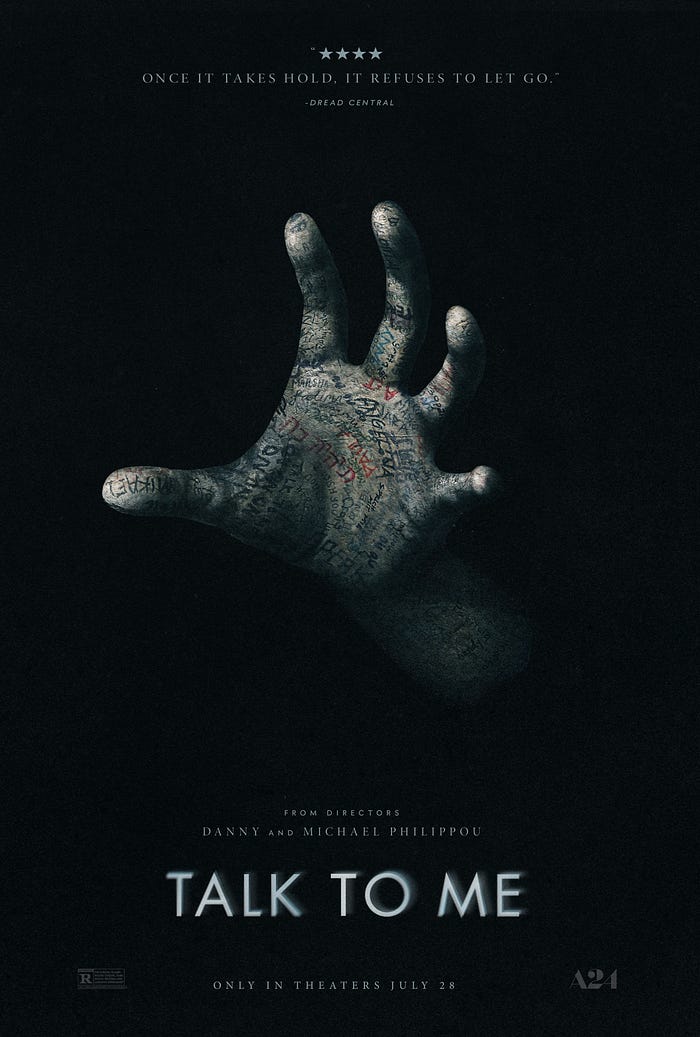
Talk to Me was a movie I instantly wanted to see immediately after catching that freaky AF trailer. It gave me Hellraiser and It Follows vibes. Plus it’s nice to see an independent horror that’s not associated with the The Conjuring universe. A24 — the Nike swoosh of the indy horror world —has done me good thus far, with prior entries like Ari Aster’s Midsommar and his instant classic Hereditary.
While I still had some reservations, being equally reminded of similar godawful teen “prop horror” films like Truth or Dare, Wish Upon, and Unfriended, I was still looking forward to checking it out.
Unfortunately, I live pretty remotely from any decent theaters. The one a two hour’s drive away from me, where I saw Mission Impossible: Dead Reckoning, Part 1 this summer, had a giant tear or rip or something going right down the middle of the screen. So I wasn’t about to waste time or money on that one again. So, I was forced to wait until Talk to Me finally arrived on streaming, and for a decent price.
Was the wait worth it? Absolutely.
The premise of Talk to Me is at-a-superficial-glance silly — a group of teens use the embalmed hand of a dead medium to conjure spirits for fun and games, until one of them takes it too far and things turn murdery. We’ve seen this sort of set-up before, in which a group of young people screw around with the spirits and quickly get in over their heads. Such as in the miniature Ouija franchise from 2014 and 2016.
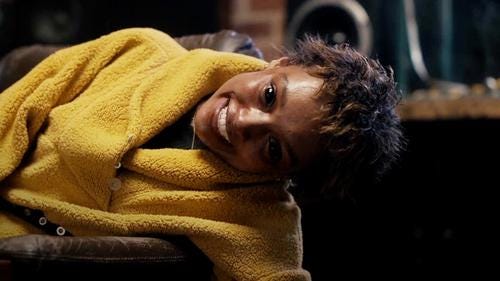
However, while many horror films have a slick and disposable feel to them, TTM boasts a strong cast that really manages to capture that elusive organic sense of a genuine group of teen friends. The standout is lead Sophie Wilde, playing Mia, whose spellbound facial contortions are ones for the ages.
Source: A24.
It Follows has a similar group dynamic aesthetic, but in a more subdued laid back Midwestern style. TTM, with its Australian energy, actually has one of the most amusing montage moments I’ve ever seen in a horror, if any film, period, where the friends all take turns getting temporarily possessed by the spirits they conjure with the evil hand. The camera work by director and writers Danny and Michael Philippou is clever and Evil Dead-esque in spots, and appropriately playful in the beginning.
But it’s not long before Mia falls prey to the tricky (and kinky) evil spirits on the other side of the hand. The rules for the game Talk to Me are pretty straightforward, if a little dubious. You light a candle to “open the door” so to speak. Grip the hand and first say, “talk to me,” Then a spirit only you can see will appear. You then say “I invite you in,” to let the spirit swoop into your body, where you experience what can only be described as a three-way cross between a rollercoaster ride, a mushroom trip, and an orgasm. But be careful not to let yourself stay possessed longer than 90 seconds, or forget to blow out the candle, or else the spirits will be able to linger, and get in your head.
When Mia’s dead mother appears to her, who died from suicide recently, she sees this as her only chance to reconnect with the parent she dearly misses. Except this is exactly what the evil spirits are looking for. They then try to manipulate Mia into killing so they can absorb another soul, with the “mom” spirit taking the lead. Evidently freshly dead spirits (or demons, it’s left amibiguous) are charged with possessing the next batch of suckers. Sort of like an afterlife pyramid scheme. Herbalife from beyond the grave. Talk about pure evil.
I judge horror on whether the story slithers into my mind and haunts me for a spell, as opposed to cheap jumpscares or profuse corn syrup. This one checked all the right boxes. As did Hereditary and even the original Saw, which is underrated as it is forgotten under the weight of a million sequels.
It’s also nice that Talk to Me doesn’t fall to the temptation of trying to be another “social horror.” Though it does make relevant thematic use of social media and drug abuse. And while the dead parent trope is often overused — Midsommar did it for instance— TTM wisely doesn’t center everything around it. Where the narrative of last year’s Smile was effective but thin, and ended somewhat unsatisfyingly, Talk’s ended in — spoilers incoming — quite frankly, terrifying fashion, if a tad predictable. I’d always imagined Jack Torrance’s spirit winding up in a similar way. Trapped discorporate at the Overlook Hotel forever and trying to bugger the living, just as our protag Mia ends up on the opposite side of the evil hand, with an ill-fitting and existentialist nightmare fate reminiscent of Craig’s demise in Being John Malkovich.
Talk to Me ia good creepy stuff that’s worth checking out.
Thanks for reading. Feel free to check out some of my other articles linked below. I’m also a novelist. You can check out my books here.
And God only knows what she could be doing to Travis Kelce.
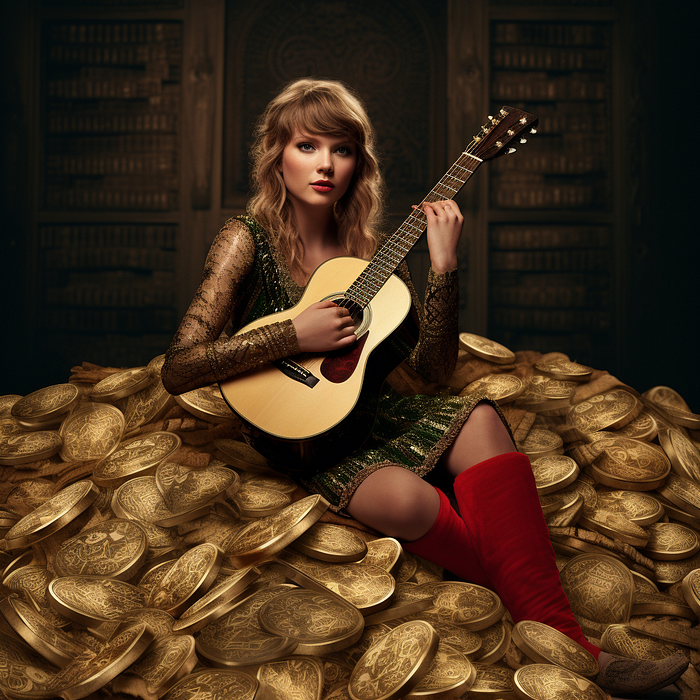
Source: Made with Midjourney by the author. Taylor sitting on her pile of gold.
Taylor Swift is a woman of many talents. A global pop queen and beauty icon, serial boyfriend dumper, and one of the OG YouTube success stories. With her massively successful Eras Tour now in its international leg, and her docu-concert movie premiering in theaters this week, Taylor Swift is well on her way to becoming a billionaire.
Well, you can add brain damager to the growing list of her innumerable accolades.
Attendees of Taylor’s Eras Tour concerts are reporting a strange side effect that’s causing them to forget large gaps of her performance.
Fox News reports, according to Dr. Nathan Carroll, a psychiatrist at the Hackensack Meridian Jersey Shore University Medical Center, that this is actually a legit neorological condition called transient global amnesia. Or TGA.
Says Dr. Carroll:
Individuals who experience TGA will attend an event (like a concert, wedding or festival) and later report undeniable gaps in their memory. For example, during the event, it may look like you’re acting normally and answering questions — but later, you may not recall some of your conversations. Unlike other amnesias, memory loss is very limited, only lasting about a day, and people don’t forget [autobiographical] information.
In other words, Taylor Swift is so damn good she’s literally blowing people’s minds. Hey, nothing wrong with that, right?
Dr. Carroll goes on to explain that other things like poor sleep, dehydration, anxiety, and anticipation can also cause the brain to blackout portions of activity. Somewhat frightening is also how Swifties don’t even realize TGA is happening to them until much later when they ironically remember that they forgot so much.
TGA reminds me of that weird driving phenomenon called “highway hypnosis.” This is where you drive for long periods of time without recollecting most of the trip. It can happen on short drives from work, or lengthy drives across the state. No doubt blasting “Shake It Off”makes it even worse.
Dr. Soha Salman, another psychiatrist working at the ridiculously wordy Hackensack Meridian Jersey Shore University Medical Center, also blames other unique aspects of Taylor’s concerts like the nostalgia vibes and the emotional connection fans have to her music.
The doctor mentions how things like elevated blood pressure, stress hormones, and the release of cortisol and adrenaline could also be causing the mass short-circuiting of Swiftie brains.
But it’s what Dr. Salman had to say about the use of cell phones that interested me most:
By simultaneously trying to use your phone and watch the concert, you may overtax your working memory and affect your ability to store those specific memories.
Studies have also found that when we are recording something with our smartphones, we are relying on them to remember for us. This could lead to poorer recall of the event later.
Experiencing concerts and other events through the smartphone is something I’ve noticed has become a bizarre modern trend. I realize many are using social media apps to share what’s happening with their friends. But then aren’t you short-changing yourself by missing out on what’s happening right in front of you by acting as a virtual host? Seems counter-productive and unnecessarily burdensome.
Real friends would tell you to pay attention and enjoy the show, and not worry about sharing every second of it with them. Live in the moment. But then I guess everyone feels entitled these days to digitally inhabit someone else’s point of view. “If phone says I can, then I should,” is the mantra.
People vastly overestimate how much “mental bandwidth” they’re capable of sustaining. And in the case of TGA, they’re overextending themselves and losing their memories in the process.
Not to mention their wallets. Taylor Swift tickets ain’t cheap. At her last U.S. stop at SoFi stadium some tickets were going into the five digits, with the cheapest in the nose bleed sections as much as $700 or more. A hefty price for what turned out to be, well, a forgettable experience.
Ms. Taylor Swift could do her devoted fans a big favor by telling them to put away the phones during the concert. At least for a little while. That is, unless she wants to be forgotten.
A term used to describe a type of film just released but not worth seeing other than for the temporary comfort provided by the theater’s climate control system during a heat wave.
“with the trailers indicating the film’s dubious quality, and its low Rotten Tomatoes score, he designated Wrong Turn an air conditioning movie.”
I’m not sure if the above term has ever been used before. If not, I’m coining it now.
There have been several points in my life where I’ve been forced to stay outdoors, or simply couldn’t stand being at home, while also being bored enough to waste my money on absolute junk films I had no real interest in seeing. All of which coincided with summer time heat waves.
Air conditioning movies serve an important purpose. One might even say a humanitarian one. They get you out of the murderous heat, at the cost of seeing a (usually) bad film. Often these films are matinees of movies that have been in theaters for a few weeks. Or they’re being shown at those dollar theaters six months after they premiered. So they often only cost a few bucks to see.
Fun Fact: One of the big draws movie theaters used in the past was air conditioning to get people in the door. Back before TV’s became ubiquitous in American homes, people would spend all day at the theater catching news reels, Three Stooges shorts, Looney Tunes, and movies, of course. It used to be relatively cheap, too.
Nowadays, you can’t sneeze in a movie theater without spending $100. And God help you if you’re seeing something in REAL ID 3D, IMAX, IMAX 3D, UltraScreen DLX, D-BOX, PRIME, RPX, Cinemark XD, DreamLoungers, attending a Movie Party, Dolby Cinema, ScreenX, 4DX, The Void, 70mm, or BigD.
Yes, you can now go to the theater to get your fill of BigD. No wonder dating is dead.
Here are five air conditioning movies I’ve seen.
Wrong Turn (2003)
Source: By The poster art can or could be obtained from 20th Century Fox (All US rights, UK DVD)Pathé (UK theatrical)New RegencySummit Entertainment (non-USA)., Fair use, https://en.wikipedia.org/w/index.php?curid=1380504
Boy, if ever a movie had a perfect title to describe what it felt like to drive to go see it.
I remember little about this film other than it was part of the early 2000s resurgence of the “killer hillbilly” horror genre originally started by The Texas Chainsaw Massacre back in the ’70s and renewed with 2001’s Jeepers Creepers.
Oh yes, one other thing. The moment the group of young people split up to look for help after their cars break down in the woods, some girl immediately offers her boyfriend a BJ. Hey, I don’t recall reading anything about that in any wilderness survival guide. Maybe it’s only in the ladies version.
Unlike Chainsaw, which was perfectly plotless, perversely original and shocking for its time, Wrong Turn is your predictable paint by numbers teens-get-slaughtered-by-maniacs film, only this time somewhere deep in the woods. It came out not long after the Scream and I Know What You did Last Summer renaissance. Lacking neither the smarts of the former, nor the bosomy charisma of the latter, Wrong Turn premiered during a time when all it took to sell a horror film was to slap a hot teen girl in a halter top on the cover looking moderatly distressed.
Apparently, this awful but profitable 2003 release launched a direct-to-video franchise and even a freaking REBOOT. There’s a Wrong Turn 6: Last Resort that came out in 2014, followed by Wrong Turn in 2021. Hmm, I wonder if some producers weren’t inspired by the same name style Halloween reboot in 2018? We can only gue$$.
I rate Wrong Turn a perfect five out of five air conditioners.
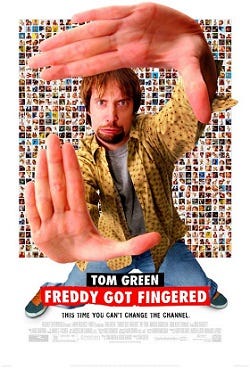
If you weren’t alive during, or don’t remember the time when Tom Green was everywhere on MTV, you sorely missed out. I’m still not sure his whole rise to fame wasn’t an elaborate CIA psyop designed to lower America’s IQ by ten points. Though to be fair, you could say that about virtually any social media star nowadays.
Freddy Got Fingered is a subtly brilliant meta deconstruction of the gross-out comedy genre. I know it’s hard to believe that about a film with a title about sexual molestation. But by the late ’90s, Tom Green had risen high enough to earn a blank check from MTV to make anything he wanted.
So what does he do? He makes a “film” with some of the most ridiculously disgusting gross out scenes ever put to celluloid. There’s a scene where he delivers a baby, and then proceeds to swing the infant around the hospital room by its umbilical cord. A scene where he gets sprayed by elephant cum. Then there’s a recurring gag about a young kid who keeps getting seriously injured.
And those are just some of the scenes I remember. I’ve suppressed the rest just like I did with all those Bill Cosby Jell-O commercials from the ’80s.
Oh hell no!
This so-called movie is essentially one man giving Hollywood the finger. Tom Green could have produced a solid high-concept comedy. He could have been like Mike Myers and done his own Austin Powers. Or like Adam Sandler and his many man baby comedies. He could have done a clever Shakespeare-inspired teen comedy like 10 Things I Hate About You. Comedy was easy in the ’90s and early 2000s, because you didn’t have to compete with the internet and streaming platforms. Seriously, there was a five-year period where Cameron Diaz having cum in her hair was the absolute height of yucks. Good times.
Instead, Tom Green made Freddy Got Fingered. For that, I feel he deserves some credit.
I rate Freddy somehow six out of five air conditoners.
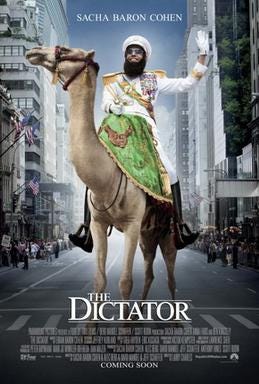
Man, what a run by Sacha Baron Cohen. After his 2006 film Borat made fifty bazillion dollars, and inspired bad impressions at parties for years to come, he popped out this little satirical nugget in 2012.
The Dictator follows an evil despot named Aladeen from a fictional North African nation called Wadiya who fish-out-of-waters in NYC after escaping an assassination plot. Like Freddy Got Fingered, this too has some weird gross-out set pieces, including a scene where Aladeen and his new hippy girlfriend Zoey (played by Anna Faris) somehow share a handshake inside some woman’s birth canal. Don’t ask me how that event came about, it’s down there with Cosby’s Pudding Pops.
The film did make a few notable contributions to the national lexicon and the meme pool cyberspace. Including a clever bit about being HIV Aladeen, a gag about Gen. Aladeen wanting his rockets to be pointy because it makes them look scary, and Aladeen and an associate freaking an American tourist couple out during a helicopter ride over the city.
It feels somewhat loathsome to consign any film starring baby-faced Anna Faris to the lowly status of “air conditioning movie.” The Dictator is a servicable enough comedy, afterall. I actually saw it during a time when I was homeless and living out of my car. The film served as a vital escape and refuge in a dollar theater during a nasty July heat wave. Considering Faris’ lengthy career powered by such films as the Scary Movie franchise and 2007’s stoner comedy Smiley Face, The Dictator is high brow by comparison.
But if I’m being honest, I never would have checked this out had it not been for the fact that it was 100 degrees outside, the local library was closed, and I wasn’t about to sit in my car all afternoon listening to Carly Rae Jepsen sing Call Me Maybe for the umpteenth goddamn time. So off to The Dictator I went.
I rate The Dictator four out of five air conditioners.
You know, I’m not quite sure of the precise moment when Hollywood slid into the barren wasteland devoid of creativity in which it currently resides. But if I had to pick a time, I’d say it was right around when it decided to make a movie based on the popular board game Battleship.
Now, at first glance you might be thinking if you were going to adapt any boardgame, Battleship makes the most sense. It’s got conflict baked into it. Besides, it’s not like you can do anything with Connect 4, Operation, or Hungry Hungry Hippos, right? With Battleship you’ve got war. You’ve got guns. You’ve got senseless action and explosions. All the ingredients you need for any successful summer popcorn film. Transformers was also popular at the time, so you had a similar toy-based property raking in billions. You’d be insane NOT to green light Battleship with a $200 million budget.
Well, there’s this whole thing called a “plot” that has to make some sense. And there’s these things called “characters” you need to have in your story in order for it to work. In Transformers, you have two sides — the Autobots and the Decepticons — locked in combat, and represented by two strong characters, the awesomely named Optimus Prime and Megatron. As silly as the whole franchise is, it kind of writes itself. Good robots smash evil robots. It’s like poetry.
But what do you have in Battleship? Nothing, really. So they had to concoct this whole cockamamie story about an alien invasion and the aliens using some cloaking technology that makes them hard to detect, in order to shoehorn in the whole gameboard conceit of having to guess which grid number to launch missiles toward. It’s all too complicated and stupid to comprehend.
Then you have quite possibly the dumbest opening to a summer “blockbuster” in history, with director Peter Berg ripping off that viral YouTube video about some guy crashing through a store ceiling of a convenence store. You’ve got Taylor Kitsch, the King of Flops, whom Hollywood was desperately (and inexplicably) trying to make a thing back then. Poor Liam Neeson must have been blackmailed or something. And Rihanna was in it too for some reason.
I don’t even recall this movie even being worthwhile even as a mild diversion. In fact, I think I even left early I was so bored. Yes, it was preferable to sit in the burning heat in my car than watch this turd of a film.
I rate Battleship two out of five air conditioners.
An honorable mention goes to Hannibal, the 2001 sequel to 1991’s The Silence of the Lambs. Except that was a film I actually wanted to see, and I recall it came out during the winter, so there were no heat-related considerations in watching it. I do remember about a third of the way through realizing that it was clearly going to fall far short of the original, in which case it’s the only film of these five that transformed into an “air conditioning movie” while I was watching it.
You know, we’re lucky to live in a time where air conditioning movies are largely a thing of the past. Like polio and lobotomies. You rarely have to go to a theater to see anything anymore. With movies streaming earlier after releasing, and video on demand, and good ol’ piracy, we can all suffer to our heart’s content at home.
Still, what are your “favorite” air conditioning movies? I can’t be the only one who’s endured here.
So, about a year ago I was driving across country somewhere in the Midwest and I had to pull in to a travel plaza for some gas. It was one of those stops on the highway that has a fast food restaurant attached. This one, as I’m sure you’ve guessed, had a Mcdonald’s.
As a rule, I avoid fast food places unless it’s late and I’m traveling, and there are no viable alternatives. I was in the middle of a long trip. Usually I pack enough food for a day or two so I don’t have to eat out. Tuna sandwiches. PB&J. Mixed vegetables. Actual sustenance. But it was my third day of driving, and I’d already burned through all my rations. It was getting dark, I had a few more hours of driving to go, and by the time I stopped again it was possible nothing would be open.
That left one hell of a Sophie’s choice. So into McDonald’s I went after parking my car.
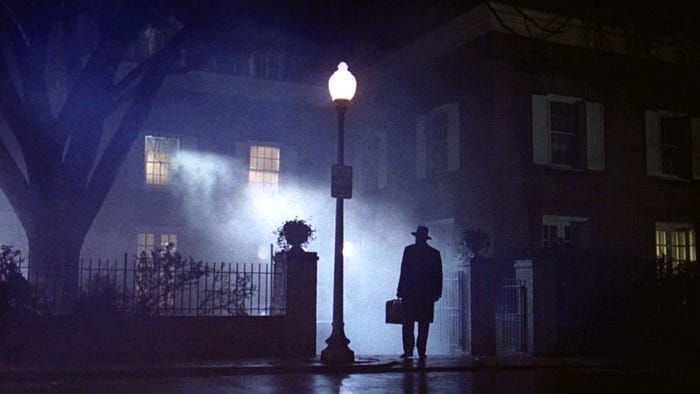
You know that shot from The Exorcist when the priest arrives to the house and it looks all foggy and ominous? That’s what I felt like standing outside the door to Ronald McDonald’s Chamber of Misfortune.
Source: “The Exorcist” or Me Entering a Mcdonald’s. Warner Bros. Pictures
“Maybe it won’t be so bad this time,” I stupidly thought as I entered, immediately smelling something that was a cross between a men’s locker room and a public bathroom. There were crumpled napkins on the floor. Crumbs left on tables. Wet rings left from soda cups. Splotches of ketchup all over the condiment counter. Like a party of five-year old’s had just left.
It wasn’t that busy. There were maybe three or four people in there. Middle-aged guys with pot bellies wearing stretched out t-shirts. Creased old white sneakers. A distinct aura of sloth and imbecility. In other words, your regular Mcdonald’s eaters. Not a visting dignitary stricken by an unstoppable masochistic urge due to severe hunger, like myself.
There were several employees wandering behind the counter and in whatever passes for a “kitchen.” Older, mean-looking ladies. I don’t blame them for looking mean. I’d turn into a one hell of a mean SOB too if I had to work at a McDonald’s. But then again, I’d be homeless and living under a bridge before doing that.
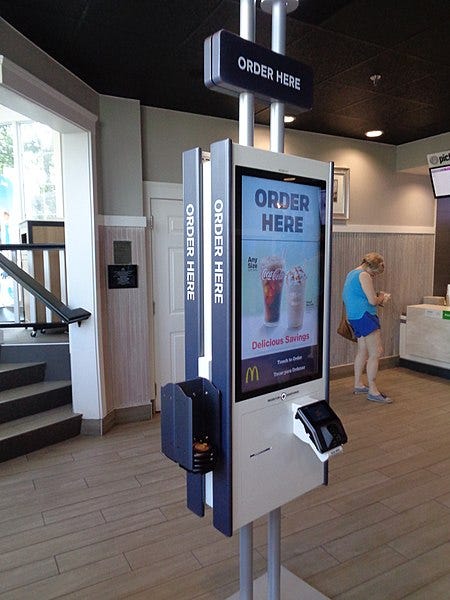
Because the old ladies looked so mean I thought better than to order at the counter. I instead turned to one of the glowing, smudgy rectangles nearby. McDonald’s has recently installed these giant smartphone-looking screens in their restaurants that you can order and pay on. This is supposed to make the food ordering process more “efficient.”
I guess they figure people can’t stand to look away from their phones for more than five seconds even to order food, so why not create a giant smartphone for them to order on? Seems genius to me. Who doesn’t want to press their fingers onto the same screen a million other people just touched with their germy, sticky hands?
But whatever, I was starved. And if this screen brought me garbage posing as food into my mouth even ten seconds faster, I’d be perfectly fine with getting hepatitis on my hands. I tapped on the digital menu selections. A simple quarter pounder “meal” with fries and a water. Paid with my card. Then took a little plastic number display to a table in the corner.
FYI, that little plastic number thing usually means someone will BRING your food to you. However, I was about to proven very wrong about this age-old tradition.
So there I waited. And waited. And waited. And no food arrived at my sticky little table. A couple of giant flies did try to land on me, though. And some goober was coughing the whole time in the other corner so hard it sounded like he was hacking up a blood clot. But besides all that unpleasantness, hey it wasn’t that bad.
About ten minutes later I get up and go to the tiny what-passes-for-a-counter counter to inquire about my missing cuisine. Mind you, I was only sitting right off to the corner. Like, if you were working that counter, I’d have been in your peripheral vision. You wouldn’t have even had to turn your head to notice me. But anyway, there my food was, sitting on the counter, getting cold, with the bag wide open. I’d input into the giant smartphone order taker that I wanted a tray as I planned on eating in, as I don’t like to eat and drive, or eat in my car period. And again, I took a plastic number to display on my table. But evidently the highly efficient new system Mcdonald’s had put in had failed to record that request. Either way, I was left with a bag of cold fries and a lukewarm “burger” (yeah right, more like a soggy greased cardboard).
I looked right at Mrs. Sourpuss Face and inquired why no one had brought me my meal.
“We don’t really do that here,” she hissed, and then ducked into the kitchen. I stood there dumbfounded for a moment.
Now, I know what you’re thinking. If you were sitting so close, why didn’t you get up earlier and check to see if your food was there? That’s besides the point. They still put it into a bag instead of on a tray. They left the bag wide open, causing it to get cold. And they weren’t that busy. Like I mentioned earlier, there were just a few buffoons in there when I arrived. They absolutely had time to hand off a simple tray of so-called food just out of courtesy. It’s literally the least the counter people can do. They don’t cook the food. They don’t even take orders for food, with those giant glowing monolith screens. They don’t clean up any tables. So what exactly do they have to do at all other than make customers feel like useless pests?
Dejected, I returned to my table. The food tasted like shit, of course. And after that horrendous service experience, I was pissed off and embarrassed. I’d have enjoyed a meal more sitting in a porta potty than sitting at that goddamn sticky table with the giant prehistoric flies buzzing around and Mr. Hack-A-Lung in the other corner.
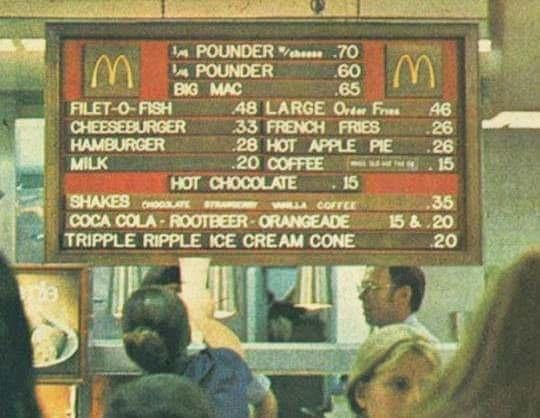
Source: McDonald’s menu from the 1970’s.
When the fuck did Mcdonald’s become an absolute dumpster buffet? I remember when Mcdonald’s had a certain mystique. It had the ball pit. It had a play place. It was lively and colorful. Then some dumbass kid probably broke a tooth off on a ball pit ball and that was that. You used to even be able to smoke there. I know it was THE place to go to in the ’70s. That was when Mcdonald’s was at its height, not to mention reasonably affordable to eat at for a regular person. I paid something like $14-$15 for that cold pile of cholesterol-soaked sponges. Now, instead of Mcdonalds being a colorful foodie wonderland, the “restaurants” look like dystopian government offices. Everything is purely utilitarian. Like it were designed for robots. If there is one subtextual message McDonald’s sends with its interior design, it’s “Give us your money, now get the fuck out, asshole.” There’s no warmth. No welcome. No quality. No humanity. And certainly no value for your hard-earned money.
McDonald’s anymore is a monument to culinary failure. It’s like prison cafeteria food a supervillain somehow conned the world into paying $10+ per meal for. It’s staffed by people who aren’t really overworked, they just don’t give a fuck. It’s architectural design looks like it was created by aliens. Literally everything about it is so disgustingly bad that it’s actually shocking that such a business could even exist, much less be a multi-billion dollar corporation.
You’re not even a customer inside a Mcdonald’s anymore. You are a sucker from which as much money as possible is to be extracted, while offering as little as possible in return. Granted, that’s most retail and fast food establishments period. But Mcdonald’s takes it to an art form.
Source: “Falling Down,” or the Typical Mcdonald’s Experience. Warner Bros.
There’s this guy on YouTube called TheReportoftheWeek who reviews fast food. Some of his videos are quite lengthy. He reviews Mcdonald’s meals from time to time. He goes into detail, and gives really good and thorough reviews. But honestly, you only need about five seconds to review any meal at all from McDonald’s. They suck ass and belong in the trash. There, review done.
Really, I don’t know what it is anymore. It’s like every place exists to see how much it can piss you off just enough so you’ll still return. I went to Wal-Mart just today for example, and I’m not even done checking out before some fucking “associate” comes up to me to pester me about doing a customer service survey on the card reader. I’m in line trying to get my groceries in my cart and I’m supposed to fill out goddamn survey? GTFO. I was in line for all of two minutes. What the hell was I even supposed to base my survey on anyway? That’s it, no more surveys. I’m done. From here on out, if I’m asked to do a survey, it’s a guaranteed zero or one star review. I don’t care.
With the super successful Barbie movie in the billion dollar club at the box office, Mattel is ready to unleash the rest of its numerous branded toys into theaters.
It all started in 2018, when new CEO Ynon Kreiz, faced with declining toy sales, decided to transform Mattel’s catologue of toys into movie IP. Just like Marvel did. And like WB tried with the DCEU, and is trying again. And what Universal tried with its disastrous “Dark Universe” with 2017’s The Mummy. Everyone and their grandma is trying to make a cinematic universe. But will Barbie end up being Mattel’s Iron Man, or will the smash satirical hit prove to be a one off? Time will tell.
In the meanwhile, Mattel has 14 projects in various stages of development, according to Variety. This got me to thinking. What would they look like? What would they be about? Would they try to make them super smart, super feminist, and super socially-conscious like Barbie? Or would each be its own thing? Would they be connected, with a big Avengers-style mash-up every few years, or would they be stand-alone projects? How the hell do you even make a movie about Uno?
Well, I did some research on these upcoming films, and let’s just say I can’t wait for this MCU to get started! One thing I was very impressed with was the diversity of themes and ideas I found, and the piercing social criticisms attendant with each property. Here’s just a few of the plots and info of upcoming films I discovered coming out soon from Mattel:
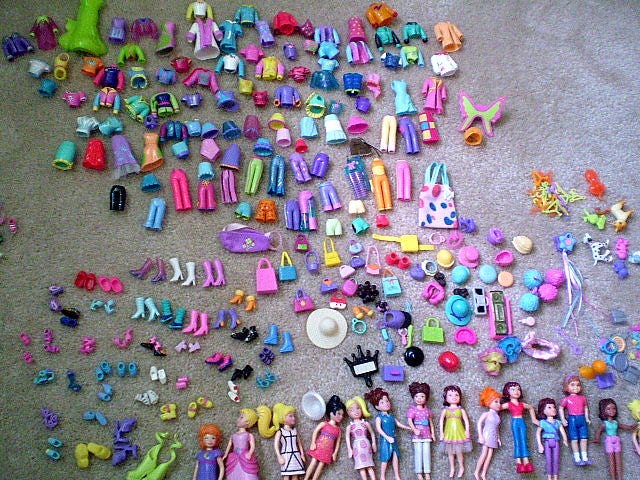
What is it? Miniature dolls and accessories that you can fit in your pocket.
Theme: Female empowerment.
Plot: Polly Pocket and her friends discover they were invented by an evil man who wanted to make little toy women that fit in your pocket, because he thinks all women should be small and easily controlled. But they turn the tables on him when, through the power of friendship (and glitter) they become super-sized, and stick him in a tiny house.
Tagline:Is that a Polly in your pocket or are you just happy to see me?
My thoughts: This is such a great idea whose time has come, and I think it will make a billion dollars at the box office easy.
Plot: A bunch of schlubby middle-aged good ol’ boy mechanics working at a car shop get put in their place when a newly hired 20-year old female with both beauty and brains, comes aboard and starts making these newfangled vehicles she calls “Hot Wheels.” When her models start selling like hotcakes, it becomes a full-on gender war. But not to worry, she easily comes out on top.
Tagline: Hot (and also Strong and Independent) Wheels
My thoughts: This is exactly the kind of deep intellectual satire you can sink your teeth into. We need more movies where stereotypically-presented alpha males are put in their place by flawless young women who are both equally beautiful and brilliant. I don’t think men realize that women can like cars, too. But after this movie comes out, the whole world will know that hell yes they can.
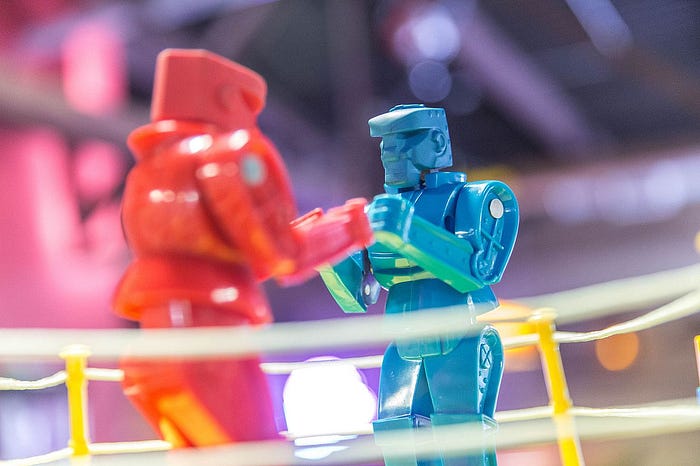
What is it? Little robots you control and punch the heads off of.
Theme: Female Empowerment.
Plot: Forced into a life of endless and mindless violence fighting in a ring, a toy robot is at last given a chance at peace when his human controller switches from a violent, mean and dumb little boy, to a peace-loving, very smart little girl.
Tagline: He won’t knock off your head, he’ll knock off your heart!
My thoughts: Such brilliant satire. And the irony, too. A violent robot boxer who learns to love peace and pacifism. I think Terminator 2: Judgment Day is going to get a run for its money for most likable robot who won’t kill when the world finally gets to meet our main robot character, Rock ’Em.
Plot: A little boy decides he’s had enough of being a little boy, and becomes a little girl instead. But not just any girl. An American Girl.
Tagline: (sung to the tune of American Girl by Tom Petty and the Heartbreakers) He was…an Americaaaan Giiiiirl!
My thoughts: Just reading the plot made tears stream down my cheeks. What a touching, smart, and very empowering story about girlhood, femininity, femaleness, and the wonder of women. I’m marking this one’s release date on my calendar. I just hope the theater provides enough tissues, LOL.
What is it? A pool ball that gives vague but somehow correct answers.
Theme: Female empowerment.
Plot: When a mysogynistic middle-aged man discovers a magic eight ball that gives 100% correct answers, he gets the shock of a lifetime when the answer to his every inquiry is: “Women are always right.”
Tagline: Are all women infallible and wonderful? All signs point to yes!
My thoughts: I don’t need a Magic 8 Ball to tell me to go see this movie when it premiers. I’ll be camped out over night to get tickets, that’s for sure.
What is it? Playing cards with rules that are way too complicated to learn. Why can’t we just play Old Maid?
Theme: Female empowerment (with a touch of anti-patriarchy)
Plot: When a woman becomes the CEO of a major toy manufacturer based in Southern California, she deftly manages to ward off every criticism from the misogynistic men in the boardroom by using magically endowed playing cards that reverse their hostile feelings.
Tagline: Meet the girlboss who’s about to be numero Uno!
My thoughts: I’m going to go ahead and call this one a royal flush. It’s like Anchorman meets The Mary Tyler Moore Show meets Big, inspired by the incredible true story of Theranos run by legendary female CEO Elizabeth Holmes. With that many classics smashed together, you know it’s going to be good.
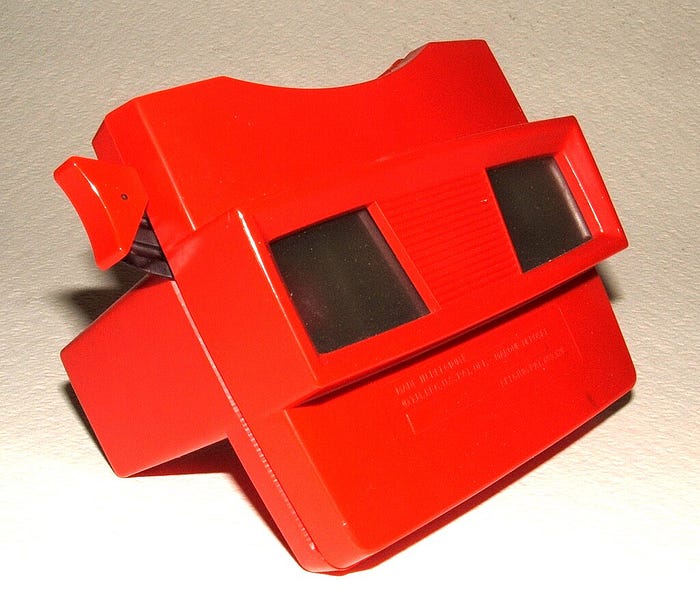
What is it? Some cheap plastic thing you look into to see blurry pictures of things.
Theme: Female empowerment
Plot: When a nasty, 98-year old misogynistic man is gifted a magic stereoscope by a fairy princess that allows him to see the hurt his thoughts and words cause to others in the world, he changes his sexist ways, and becomes a male feminist.
Tagline: He’s had eyes his whole life, but he didn’t SEE until he was 98.
My thoughts: I’ll be very surprised if this isn’t in contention for Best Picture. It has the kind of character arc you used to only see in classic films, not to mention a very timely theme you rarely see talked about in movies today. If Clint Eastwood is still around when this gets made, he’d be perfect for the lead. It’ll be the role he’ll be most remembered for without a doubt.
That’s all I could find for now. Aren’t these great? I’m not sure any of them will be at the level of Barbie, or bring in the same kind of box office. But I do know I’ll be waiting in line at each one on opening night. See you there!
So, a while back, I caught a video on good ol’ YouTube titled “Ghostbusters: A Movie About Nothing.” Basically, the video essay posits that the 1984 comedy classic lacks a unifying theme. If you scroll down through the comment section, there are over 2,000 comments of people giving their own take.
As someone who watched this movie religiously as a kid for years, like many children of the ’80s, I was actually stymied by this video’s stance. Even rewatching the film as an adult some years ago, the idea of there not being a theme never caught my attention. To me, the film always just represented pure entertainment. A silly premise played straight by three comedians at the top of their game. A perfectly executed comedy, well-directed, with cutting edge special effects for the time.
Most comedies don’t have much of a theme, or much to say about anything, really. You think of the comedy classic Airplane! with its slapstick spoof absurdist humor. What social message or statement on the human condition is that movie trying to send? The plight of overcoming PTSD from war, as Striker eventually does? Or something like The Hangover, with its multiple gag sequences. The value of friendship?
Generally, when comedies do have a theme, it’s very safe and broad, and plays out in the background. You think of Caddyshack, another Bill Murray comedy hit, with it “slobs against the snobs” class warfare themes, pitting the young middle-class kid Danny and his nouveau riche allies (Ty and Al) against the uptight wealthy Judge Smails and his stuffy old money associates. Interestingly, Titanic has similar themes, but as a drama, is more upfront and systematic about the way it goes about exploring them.
The Wikipedia page onGhostbusters has an intriguing section regarding the movie’s subtle statement on capitalism and private industry, weighing the film as a reflection of Ronald Reagan’s deregulatory pro-free market ideology. I don’t entirely disagree with this premise. I just think the real theme is much simpler.
Ghostbusters is about celebrity. More specifically, it’s about how one’s status and value to society is largely determined by one’s portrayal in the media. Even if you’re trying to save the world, you’re not a “hero” or “important” until the press says you are.
This theme is a subtlely handled. Background radiation, as it were, subordinate to the clever writing and memorable dialogue. But there’s plenty of evidence for the idea of how the media shapes reality and perception.
If ghosts existing like this were the case, this would be quite a terrifying reality. People would be demanding governments come up with some solution to deal with these afterlife visitors. And anyone involved in solving the problem would likely be getting millions, if not billions of government funding. It would be like the Manhattan Project.
In actuality, Egon Spengler, Ray Stantz, and Peter Venkman are apparently the only three scientists in the entire world working on the cutting edge of the supernatural, and they’re about to be thrown out of their jobs at Columbia University. This despite Egon and Ray having already invented the P.K.E. Meter, a tool that can track ghosts and other supernatural entities. Likely, the pair were also on the verge of building the proton packs, or even had a protoype designed and functional. Remember, the packs basically just appear later in the movie, with little explanation as to how to they work or how they were built, other than they are “nuclear accelerators.” Not to mention the ghost traps and the ghost storage unit used later. All technology that was likely very close to fruition or in different stages of design.
You’d think if two guys were actually building tools and weapons capable of ridding the world of a huge menace like free-roaming ghosts, they’d have the respect of the university, and certainly their peers. They’d be regarded like Einstein or Newton. Instead, Columbia Dean Yeager regards them all as a joke, and kicks them to the curb. They’re forced to set up shop on their own, using Ray’s family home as collateral for a massive high-interest business loan.
Even after the Ghostbusters catch the ghost at the hotel in their first job, how are they treated by the stuffy manager? Like overpriced bug exterminators. Ray almost threatens to put the ghost back when the manager intitially refuses to pay the bill. Mind you, the ghost problem is played 100% straight. The manager KNOWS the ghost is real. He knows it’s been harassing his guests for years. At issue is the bill.
As it turns out, the Sedgewick manager is the last person who treats the Ghostbusters with low regard. For immediately after, the movie goes into a montage sequence in which major media publications like The Atlantic, Time, and others, turn the trio of scientists from unknowns into national celebrities, in a matter of weeks. Business booms, as evidenced by them leaving multiple buildings with freshly caught ghosts. They even seem to get groupies, as after dealing with a “pesky poltergeist” at a night club on New Year’s Eve, they stay behind to “dance the night away” with some of the ladies.
Another turning point in how the Ghostbusters are viewed is in Dana Barrett’s reevaluation of Peter Venkman as a suitor. This despite Venkman coming onto her earlier quite creepily when he visits her apartment to assess her refrigerator terror dog problem. Rather than being repulsed by him, after observing that he’s a “big celebrity now,” she agrees to a dinner date. This despite the interest of another romantic rival — the violinist, who Venkman calls a “stiff.” And not just any violinist, but one of the “finest in the world.” Something that doesn’t matter in the context of the scene because Venkman has high media status, and therefore greater “value” as a potential sexual partner.
Another thing to note is how the the montage sequence concludes — with Ray Stanz getting blown by a beautiful female ghost. Another example in addition to the Venkman one where sexual desirability is commesurate with your celebrity status. Even if the BJ Stantz gets happens in a dream or reality, it still serves to reinforce the theme. And don’t forget how the office secretary Janine gradually falls for Egon, even after he rebuffs her advances.
The Ghostbusters’ celebrity powers are enough to get them out of jail when the Mayor summons them to deal with the city’s spiraling ghost problem. This is where I part ways with the Wikipedia theories about the movie’s themes on free market capitalism versus government bureacracy. Because I don’t regard Walter Peck, the government inspector, necessarily as a true villain. He’s a dick, for sure. Dickless even, by some reports. But he’s doing his job. What the Ghostbusters are doing is akin to a bunch of guys trying to run a nuclear power plant on their own, without regulations or oversight. Farmers get fined all the time by state governments for not calling in line patrolers before digging into their own property. The SEC right now is trying to figure out how to crack down on the largely unregulated cryptocurrency market. So I’d think four guys using experimental technology that involves nuclear energy strong enough to vaporize matter (aka “total protonic reversal”) would warrant a stern look by government inspectors. While Peck shouldn’t have made them shut down the ghost containment unit until he knew fully what the hell was going on, it doesn’t necessarily make him malicious. Just stupid.
The Ghostbusters are also so beloved by the city that thousands of citizens show up to cheer them on when they arrive at Dana Barrett’s building for the film’s climax. Actually, “cheer them on” hardly does it justice. The New Yorkers are practically euphoric, with everyone from Orthodox Jews to punk rockers coming together in celebration. Even a powerful earthquake isn’t enough to send the people away. The masses are willing to endanger their lives just to watch their heroes enter a building. Even The Beatles couldn’t claim that level of worship at their height.
Such is the all-important power of celebrity in the world of the film. Even Gozer, the film’s villain, is not immune. What’s the first thing the androgynous demon spirit asks of them when they arrive at the rooftop? “Are you a god?” A status check. When Ray foolishly answers “No,” Gozer tries to kill them. Except the Ghostbusters are “gods,” in a way, by virtue of their celebrity, and their advanced technology.
After a show of power, Gozer evidently respects them enough that he/she selects the Ghostbusters to choose the “form of the destructor.” What villain allows the heroes that kind of consideration? And why them? Why not the collective consciousness of the city? Or why not a form that’s objectively terrifying, like the terror dogs? Why should the Ghostbusters get the ridiculous choice of the Stay Puft Marshmallow Man?
Another thing to note is Gozer’s initial appearance, looking like a supernatural David Bowie or Michael Jackson. Eerie and ethereal. Not as a scary-looking demon, as you might expect. But as the ultimate stage performer, or showbiz celebrity, as such.
The film memorably ends with the entire city seeing the Ghostbusters off, as the closing credits play over the theme song. Reminiscent of the kind of jubiliation seen in the New York City Victory Parade of 1946.
The 1989 sequel continues with the theme of celebrity, with the Ghostbusters having to rebuild their lost status after being dubiously relegated to sideshow freaks again. Even the Ghostbusters cartoon that ran from 1986–1991 incorporates it. The closing credits shows the Ghostbusters strutting down the street in a ticker-tape parade.
Now, you could argue that the Ghostbusters become revered heroes not so much due to the press but because of their unique services. Except police officers and firefighters save people all the time, and usually with very little fanfare. Remember, we come into the story with ghosts already present and a serious threat, but apparently not enough of one to warrant government intervention or interest by anyone other than three schlubby scientists working at Columbia. It isn’t until the media catches on, seeing them as a means to sell copy and get ratings that they’re catapulted into fame. From then on, the Ghostbusters are taken very seriously.
I find this theme relatable even today. Many people view their own value and self-worth through the lens of their social media status, which is today’s governing agency of celebrity. Gone are newspapers, magazines, and even talk shows. Now it’s all about clicks and likes on YouTube, Twitter, Facebook, and TikTok. Think about the last time you went to a concert. How many people WEREN’T experiencing it through their smartphones? Likely very few. It’s as if people can’t properly enjoy something unless others are also enjoying it with them online. A bizarre kind of feedback loop.
Anyway, what do you think? Is the 1984 Ghostbusters about how one’s worth is relative to their status as a celebrity? Or is just about busting ghosts and nothing more? Or about something else altogether?
Over the past few months, I’ve found myself increasingly dissatisfied and disinterested with Medium, and have decided to focus my efforts toward building a Youtube channel instead.
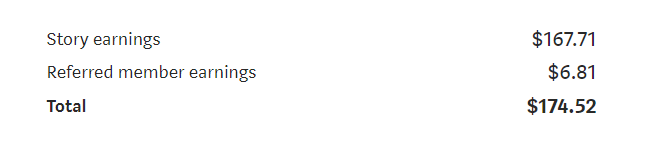
It’s not that I haven’t seen some good results on here. Back in September of last year I had my best month ever, bringing in over $170.
Source: Screenshot of my earnings.
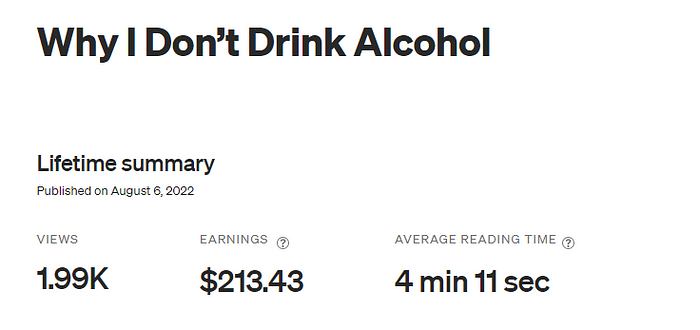
Mind you, this was accomplished mostly with an article that wasn’t even published on any major publications. My article “Why I Don’t Drink Alcohol” has brought in $213.43 and almost 2,000 views to date, 90% of which were organic internal views.
Source: Screenshot of my article earnings
I didn’t even have that many followers to help kickstart my article’s views. And the article barely got any views the first two weeks before blowing up later. This proves that Medium has a quality algorithm so that even articles with no publication promotion, and written by writers with only a small following can still get traction.
Medium is a great platform for the most part. I have no intention of leaving for good. It’s just that I think my efforts would be better rewarded on YouTube in the long term. Medium seems to have a low upper limit of success and income. Even if you’re a writer with tens of thousands of followers, you’re unlikely to realistically make more than a few thousand dollars a month sustainably.
Whereas, there are many, many people on YouTube making many times more than that.
Here are a few more reasons why I’m switching to YouTube over Medium for my content creation going forward:
Content Diversity
It’s no surprise YouTube has vastly more content than Medium, as the platform is open to everyone to use. You can find everything from academic lectures, to video essays about Batman, to just some guy who has a channel of nothing but videos of him drinking water.
Medium seems to be a place devoted to subjects like digital marketing, side hustles, and the occasional personal story.
I find myself on YouTube way more than Medium. In fact, I only passively check Medium from time to time, and usually I find the same sorts of articles again and again.
Content is Going Video Anyway
The written word is never going away. People will always be attracted to strong writing, either on the web or in printed form. But there’s no question there’s a growing preference anymore for video over blogs and articles. I find myself consuming information more through podcasts and videos over static articles on the web.
YouTube also has tons of audiobooks, if you prefer fiction instead.
You Can Build a Bigger Audience With Video
There are some people with tens of thousands of followers, and even hundreds of thousands of followers here on Medium. Those are great numbers, and having a big Medium following is a great accomplishment. But I can’t help but think if all the hard work that lead to those figures wouldn’t have been better put on YouTube instead. That guy I mentioned earlier who posts videos of himself drinking water? He has over 70,000 subscribers.
Sure, you can argue that videos of yourself drinking water is low effort content and not the same as a deep ten-minute article on the philosophical implications of AI, but numbers are numbers. I see other writers posting regularly about deeply important issues that don’t have even one tenth the followers as the “internet’s premier water drinking series.”
Better Engagement
When is the last time you saw an article with hundreds, or even thousands of comments? Never? I see videos of all kinds with immense comment engagement. Sometimes even on videos with few relative views.
Moving on from the humorous example of Jon Drinks Water, let’s look at a Youtuber I enjoy listening to regularly, and who posts the types of content you might see here on Medium, to see what I mean about engagement.
Martin Goldberg posts faceless videos talking about a range of subjects, but generally about society, culture, gender relations, politics, and other opinion and commentary type stuff. His style is like the soft-spoken “smart friend” who always has interesting and witty insights to share. His latest video talking about Vivek Ramaswamy only has 3,600 views, but has 107 comments as of right now. By constrast, my alcohol article has 2,000 views, but only 8 comments.
While I’m very appreciative of any comments or engagement on my articles, as well as for my 398 followers, it’s clear that if you’re interested in reach and engagement, YouTube is the way to go.
Medium is Strictly Leftist
My personal politics is hard to pin down and I’m agnostic about a great many issues. There are some things I agree with on the left and the right. But overall, I tend to fall on the conservative and traditionalist side of things.
Well, this is not the case with Medium whatsoever, which is largely left wing, very feminist, socialist, and generally hostile to anyone outside whatever is considered “progressive” or “woke.” In fact, I’ve seen conservative writers I’ve liked banned for seemingly no reason, even after building an audience in the thousands.
While I’m not an overtly political person or writer — I tend to avoid politics for the most part in my articles—I’m not a strictly technical writer either. Obviously one’s world view and mindset is going to bleed through the edges when writing about different topics. Medium isn’t friendly toward voices outside what I’d call the deep blue “metropolitan sophisticate” cohort who unquestionably embrace the DIE (diversity equity inclusion)/ BLM/CRT/LGBTQ+/ and whatever other leftist belief system you want to throw in there. Browsing Medium is sometimes like hearing a chorus of programmed NPC automotons. I don’t think people in that narrow mindset realize how exclusionary they really are, even while supposedly being all about “inclusivity.”
It’s not to say conservative media is any better. In fact, I think it’s largely godawful and cringe. And don’t even get me started on the “red pill” weirdos.
Increasingly, I value originality and voice, even if I may disagree with the politics of the content creator. I think maintaining a strict political mindset crushes creativity in many ways, whether you’re on the left or right.
YouTube may have issues with censorship in some cases, but for the most part it has the kind of diversity where it matters — in thought and opinion.
For example, just recently I discovered a YouTube channel called “the radical center,” created by a woman who talks about ideological bias in her academic experience. Her channel has the kind of content that would largely be a no-go here at Medium. But with just 86 videos, she’s amassed over 15,000 subscribers, and very active engagement. Something I doubt would happen here. Her latest video has only 1,500 views but 93 comments.
YouTube Offers Better Income Opportunities
Over the past months, I’ve covered a few YouTube channels in my “Niche Knowledge” series. You can make a living doing almost anything on YouTube — talking about comic books, sharing updates on cryptocurrency, making copyright-free music, or talking about controversial figures like Andrew Tate. Not necessarily the case on Medium, which again, seems more focused on things like digital marketing and “city professional” stuff.
And again, while I occasionally hear about people making $10k or so on here, those days seem to mostly be in the past.
I’m Tired of Hitting the Google Lottery and Having Nothing To Show for It
You’d think with me making this big case against Medium that I’d be some disgruntled writer who barely gets reads. On the contrary. Not only am I not disgruntled, I’m not even gruntled.
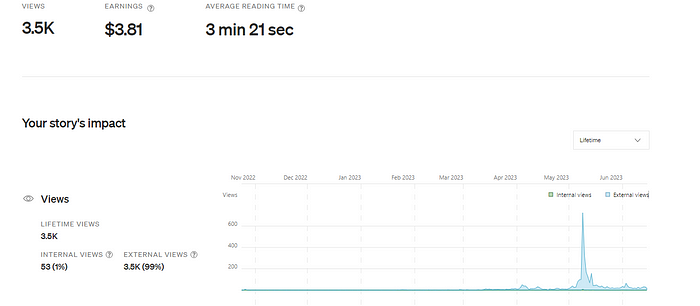
I routinely get anywhere between 60–75 or so hits daily on my articles, with no promotion or any real effort on my part. About a month ago, on May 9th, I even got almost 1,000 views in one day for my article “Three People Who Destroyed Their Lives in Less than 60 Seconds.”
Source: Screenwhot of my article’s stats.
The problem is virtually ALL of those views were external. On Medium, you only make money when other paying members view your stories, or people buy something through your affiliate links.
Now, it’s not Medium’s fault if a story does not click with an internal audience. If anything, this example shows Medium’s value in helping your articles rank in Google for different key words and topics. But what’s the point of that if any time an article hits the Google algo it doesn’t translate into actual dollars? At best all I’m doing is increasing Medium’s digital footprint, and increasing awareness of the site to other people, for free. At worst I’m short changing myself. Had that article been hosted exclusively on a website, or made into a YouTube video instead, those views might have meant actual dollars.
The majority of my regular daily traffic is external. I know that because my partner earnings increases by pennies. If over the course of a month I’m getting 2000–3,000 views or more, something like 95% of that is external, and therefore goes unmonetized. If a typical ad rate impression for a website or Youtube is around $10 RPM, then that means I’m potentially missing out on around $30 in revenue. That’s pretty small, but supposing in a year I’m getting 10,000–15,000 views a month, and it can start to really add up.
YouTube has its downsides too, in the interest of fairness. You still need 4,000 watch hours and a minimum of 1,000 subscribers in order to monetize your channel. And like almost any other platform out there, you’ve got to be put in the work and upload regularly if you want to see any results. Some niches pay more than others. Most of the higher paying ones, like dropshipping, affiliate marketing, finance, and others, are not areas I’m interested in covering. They are also hyper competitive.
Then there’s the fact that video is a different medium of information, and requires a much steeper learning curve. I can put together an article in under an hour. But shooting and editing a video properly takes time, and a good bit of knowledge. Youtube is more competitive now, and I think viewers are more demanding and discerning now than even just a couple of years ago. If you want to produce professional-looking videos but don’t have any editing skills, it’s expensive to hire a good editor. I’m not talking about AI-voiced “cash cow” video editors, either. I mean the ones who can put together videos you may actually want to watch, and convey worthwhile content. Over on Fiverr I see them usually starting at a few hundred dollars and up.
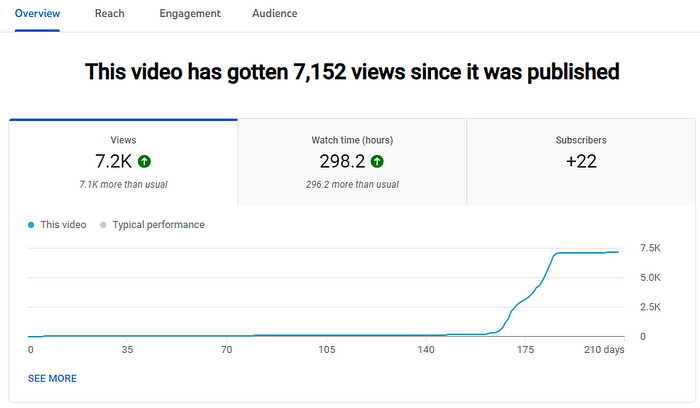
However, despite the challenges of the video medium, I’ve already seen some results on my Youtube channel. Over the last few months I’ve been mostly turning my Medium articles into faceless YouTube videos with some V.O. and either copyright-free or fair use imagery. A few weeks ago, out of nowhere, my video “Hot Blonde Bimbo Teachers Can’t Stop Banging Kids,” a video version of my article, “Hot Blonde Bimbo Teachers Can’t Stop Fucking Kids” about Marka Bodine, got over 7,000 views in a matter of days.
Source: Stats for my YouTube video.
That video brought in about 24 subscribers, bringing my current total number of YT subscribers to 32. That’s pretty small, I realize, but again, all I’ve been doing is sporadically uploading video versions of my Medium articles. Obviously, I’m not monetized yet. But small successes like this are very encouraging. I posted that video back in November. It took until this May before it got any traction. And that was purely algo-driven. I did not promote my video anywhere, or pay for views or anything. But if that’s the kind of results you can potentially get with no promotion or efforts to build SEO, imagine what you could do if you took YT really seriously. Video essays and humorous commentary on news topics tend to do really well.
In summary, I’m going to focus on making content exclusive to YouTube because I see much more long-term upside on there rather than on Medium. I’ll still going to post here once in a while, but it will be more off-the-cuff type stuff, or announcements.
I still think there’s opportunity on Medium, if you’re a certain kind of writer, and you write for a certain type of audience. But I think YouTube offers opportunities for virtually all audience types and interests. It can also prove to be a great platform for fiction writers like myself. There are many writers who use YouTube as a platform to help sell their books.
I’m certainly not a YouTube personality or a professional video editor by any means. I’m not the best at verbal communication, which is something I’m trying to improve. Except for a few videos I don’t even show my face. I think it will be a challenge to get serious traction on YT, as it would be anywhere else. But in the end I think it will be worth it.
One of the weirdest things that kept happening to me when I was younger was strangers refusing to believe I was a smoker. Maybe I looked like a Boy Scout, or put off some Mama’s Boy vibe, or looked like your central casting-style ‘Nice Guy.” Someone for whom smoking was a big no-no. Or maybe I just didn’t look cool enough to smoke. I don’t know. But whenever I’d start working a new job, or meet new people, the moment I revealed I enjoyed sampling cancer sticks now and again, the reaction was often shocking. As if I’d revealed I was in the mob or something.
But smoke I did from ages 16 to 25. I started sometime in the spring of 1998, experimenting by myself under a bridge by a bubbling stream near my house with a good ol’ pack of Marlboro Reds. I was working at a popular chain resort as a waiter at the time, and there was a cigarette machine tucked in an alcove near the front desk. Remember those machines with the little plastic knobs with the glass display? They reminded me of foosball tables because you had to pull the knob outward underneath your selection. Like an arcade game that gives you emphysema. They also don’t check your I.D., which was a nice plus.
Almost everyone I worked with smoked. I was the youngest there. The others were mainly stressed-out college students who chain-smoked like chimneys. I never encountered any of the dreaded peer pressure those corny school special PSAs warn you about, to start inhaling chemical-laden smoke into my lungs, but I suppose unconsciously, I was trying to fit in.
So one day, I took a walk and found myself under that bridge. I can still remember unwrapping the plastic shrink wrap. Cracking open the little box. Inhaling the sweet smell of fresh Marlboro tobacco. Then with a shrug, lighting up my first one. It was warm and sunny, and the stream was peaceful. It was the idyllic spot to have your first cigarette. And that’s where my smoking career started.
Eventually, I would quit on December 29th, 2007, tossing my final drag out my car window as I drove on the Schuylkill Expressway through the heart of Philadelphia. Oddly enough, it didn’t feel like my last. I had some vague notion of quitting for good. I’d tried to a dozen different times in the past. There was no big dramatic determination that this time would be the one. Then two days later, during a rooftop New Year’s Eve party at a friend’s house in the city, I decided to test my resolve. If I could resist the urge to smoke after New Year’s, maybe this time would be the one.
As it turned out, all those years of failure had prepared me well because I was able to overcome the craving to light up in celebration. Perhaps it was succeeding at this early mental test that gave me the confidence to go forward. I never smoked cigarettes again. In fact, except on very rare occasions, I never even get haunted by the Ghost of Tobacco Cravings. There was one time I dreamt I smoked and woke up flush with guilt, only to realize I hadn’t actually lit up for real. I enjoy a cigar once in a while. But those have never tempted me back into a habitual smoking habit.
My relationship with tobacco was awkward, kind of pleasant, and also masochistic. Like dating someone who you know doesn’t really like you, but you keep pressing on with them because to break up would make you feel lonely, and hey, maybe they’ll change their mind and eventually like you someday. Yeah, I’ve never done that before.
Smoking was never something I felt really driven to do. I’d started due to some fatalistic thinking that this was just one of those things you tried, combined with a desire for acceptance and some nebulous notion of thinking it would help me “fit in.” Stupid rationales, for sure. But at least I wasn’t injecting heroin into my veins.
It feels weird to think about now, but smoking was far more socially and institutionally acceptable back then. Most restaurants had a Smoking and Non-Smoking section. Workplaces often allow smoking indoors. I worked at a printing company for four years where almost everyone smoked, and inside, too. Then sometime around 2002 or so, the company said we had to take smoke breaks outside. I had several family members who smoked. Even being underage didn’t stop me the most time. I could always find a classmate who either worked at a store that sold cigarettes or a co-worker willing to buy cigarettes for me if I asked.
Oh, and cigs were cheap back then, too. This was before the government began taxing the hell out of them. I think I used to pay around $1.20-$1.70 or so for premium brands like Marlboro. You can’t find them that cheap now unless you go to some war-torn Third World country where kids wear flips flops and carry Uzis around on their shoulders. Probably not worth it to visit just to get discount mini-stogies.
E-commerce was but a dribbling cyber infant at that time, too. In one of those uniquely adolescent genius moments, I found an online company that sold loose tobacco. Using my junior debit card, I ordered a whole freaking pound of Virginia tobacco. While I couldn’t buy cigarettes under 18, I could buy paraphernalia like rolling papers at the local gas station. I even ordered a hand roller online, too.
After everything arrived, I sat my 17-year-old self on the sofa rolling my own cigarettes, watching Third Rock from the Sun, feeling like a genius because I’d outmaneuvered the ban on selling tobacco to minors.
My high school only reinforced the need to smoke. At the high school, I went to for my senior year, there was a section called The Row that bordered the street and the school property, where all the smokers went to light up. It was just too easy to step off the school bus and stroll on over. Or use one of my many free periods to dip out and satisfy my cravings.
During my brief time in foster care, I even mastered the art of dipping tobacco while smoking for the ultimate morning head rush. Dipping tobacco was never really my thing, though. It was something I tried more because my foster brothers were into it. To this day, the scent of mint dipping tobacco brings me right back to my late teen years, state-mandated counseling sessions, waiting outside at the bus stop, occasional fist fights, and tromping through backyards to get to friends’ houses and such. Not to mention those disgusting spit containers. Usually, soda bottles. Dark brown saliva sloshed around the bottom of those ridges. Gross.
I came to disdain dipping and chewing tobacco as low-class. But smoking remained cool. I moved on from Marlboros. Briefly dabbled with Camels, a brand one of my cousins smoked, but which I found too “acidy.” Tried Newports but never cared for menthol. Then Parliaments, with the classy recessed filter. Until finally discovering the brand for me, Lucky Strikes.
Whenever I have one of those once-in-a-blue-moon moments where I feel a craving, it’s Lucky Strikes that I think about. The filtered kind. Never anything else. Made popular during WWII. All cigs all loaded with bad chemicals. But for whatever reason, the chemical composition of Lucky Strikes just did it for me. It was a niche brand, too. I have not sold everywhere like the big brands. No one else I knew smoked them. Which made them feel more special and unique.
I’ll never smoke again. But if Putin were to go nuts and launch the nukes, and the apocalypse was imminently upon us, you can bet I’d be scouring every gas station and store for Lucky Strikes, just so I could light up and enjoy that final dry toasted drag as the mushroom cloud vaporized me into dust.
It wasn’t quitting smoking that was tough. It was quitting Lucky Strike cigarettes that were tough. Even now, whenever I see one of those little white boxes with the red circle in the tobacco section behind the cashier, the song True by Spandau Ballet starts playing in my head.
So, how’d I eventually quit smoking altogether? By failing a bunch of times first. It helped that, except for a brief summer in 2000, I was never much of a heavy smoker. Even though cigs were relatively cheap back then, for me at the time, with my $10-an-hour part-time job, they were a pricey luxury. So I mainly only smoked upwards of half a pack a day at most, with dry periods tossed in-between paychecks.
I encountered my first success at quitting, oddly enough, after having my wisdom teeth pulled in late 2001. All four of my teeth were impacted, so the dentist had to get in there pretty invasively with his mini jackhammer and yank them all out. I was conscious of the operation but obviously quite doped up. I couldn’t eat or drink much following the surgery. Obviously, I couldn’t smoke. But being forced to quit cold turkey like that isn’t what got me over the hump to cut down smoking going forward.
It was the Vicodin. I was only prescribed a week’s worth following the extractions. But for whatever reason, the drug, combined with the fact that my mouth felt like a gaping wound from a horror movie, put me off my regular smoking schedule for good. I never went back to smoking half a pack a day. From then on, it was 5–7 cigarettes a day, to only about 2–3. One with my morning Dunkin’ Donuts medium coffee. One after lunch. Then one, maybe two, after dinner. And that was it.
Later, after getting more serious about quitting, I tried the “filthy ashtray” technique. That’s where you leave a disgusting, smelly ashtray filled with old wet cigarette stubs in your car, so you associate smoking with a foul odor. This is supposed to help you quit. Well, it’s a terrible method. I don’t recommend it. It didn’t help me except to look for other tips and tricks to overcome the habit.
I tried nicotine patches, only to get some of the most bizarre and disturbing nightmares while using them. The feeling of my skin slowly absorbing nicotine all day was also off-putting and made me sick. Besides, it wasn’t so much the nicotine I craved. It was sucking down that warm smoke with the taste of fresh coffee on my tongue and getting that morning head rush. Or enjoying that post-lunch drag after having abstained all morning. And that final cigarette before sleep.
Sometimes compromise can keep you trapped. I felt that because I was only smoking 2–3 a day, that was good enough. That surely wasn’t enough to cause cancer, right? I was in good health otherwise. I worked out, stayed active, and had a good diet. Hey, I can smoke a few a day if I want.
It just came down to making the decision to quit and sticking to it. No magic trick, big secret, or anything. I don’t know what made me finally decide enough was enough. Maybe it was getting mid-way through my twenties and wanting to leave smoking behind as a bad habit leftover from youth. Maybe it was wanting to save money. By the mid-2000s, cigarette prices were starting to go parabolic. They were three dollars. Then four. It started to actually eat into my earnings, even at only a pack and a half a week.
In the end, I quit smoking as casually as I’d started. I flicked that final Lucky Strike cigarette out the window of my 1990 Toyota Corolla, watched it spark against the asphalt behind me, and that was that. When I overcame the urge to light up at the New Year’s Eve party two days later, I knew I could sustain being smoke-free for good. Two days turned into a week. Then a month. And finally, a year.
My senses returned. My sense of smell and taste. Things that had been inhabited for so long that I’d forgotten what it was like to have them at full capacity. As I cycled through new clothes, the familiar stench of washed-out tobacco faded from my laundry. I bought another car later and no longer had the triggering smell of lingering smoke to tempt me back into old habits. I enjoyed the reward of fresh air and clear lungs as my own reward. I felt healthier overall.
But the best part was the satisfaction of knowing I’d put my mind to something and overcome a tough obstacle. That was a way better feeling than anything even a Lucky Strike cigarette could give me.
Eventually, I stopped having to think about not smoking. It soon no longer occurred to me as something that I was “missing.” It was no longer a part of my identity. Until writing this article, smoking was something I hadn’t even thought about for years, perhaps. I’m glad to be smoke-free, even from my beloved brand. And so long as the nukes don’t start flying, I’ll never go back.
Fiction Affliction #5: Son of Rosemary, by Ira Levin
“Son of Rosemary.” Made with Midjourney
A novelist’s career is a strange thing. You can have “it” for a number of years/books, and then suddenly lose “it.” Maybe sometime later you get “it” back. Or maybe you never get “it” again.
What is “it” exactly? The good stuff. The spark. Creative synergy. Your finger on the pulse of the zeitgeist. The muse’s lips whsipering in your ear. Austin Power’s mojo.
You know, “it.”
Whatever “it” is, Ira Levin had it in abundance for the first half of his career. Starting with his global best-sellerA Kiss Before Dying. A book he wrote when he was all of 24. Then his play Deathtrap, which became the longest running thriller in Broadway history. His book Rosemary’s Baby became a smash sensation. He followed that up with classics The Boys from Brazil and The Stepford Wives. And cemented his legacy with This Perfect Day, a dystopian novel which I’ve written about previously.
The man had “it” in abundance. Everything he wrote turned to gold, or became household vernacular. To be a “Stepford Wife” meant to be a compliant Barbie doll, a terrifying prospect for any self-respecting feminist.
Ira Levin did it all before age 45. Simply astounding. Basically a reverse Cormac McCarthy, whose best novels came after he was old enough to collect social security.
But at some point, for whatever reason, Levin lost “it.” His second-half catalogue of material is decisively lackluster compared to his first. It’s also sadly deriviative. Son of Rosemary is, of course, a sequel written 30 years after the classic Rosemary’s Baby. Stephen King would eclipse that with his 2013 book Doctor Sleep, written 36 years after The Shining. Another unnecessary sequel seemingly written more for the fans than the need for the story to continue. Also a title that earns the distiction as worst sequel book I’ve ever read. Though Son gave it a run for its money.
His 1991 novel Sliver feels like something that would have come from the feverish fingertips of Dean Koontz, with its themes of obsession, control, and abuse of technology. Levin’s gift was always injecting the macabre into the mundane. Making the outlandish seem not only quite possible, but ordinary.
Levin wasn’t exactly a prolific writer. There was a 14-year gap between A Kiss Before Dying and Rosemary’s Baby. During which he wrote a handful of plays. He wrote only a total of seven novels. One of which, The Stepford Wives, is really more of a novella, at all of about 120 pages.
Son of Rosemary is Levin’s final novel. And it’s a disappointing sour note to a very long and distinguished career. Levin is one of my favorite writers. He’s like Hemingway, with sparse, minimalistic prose, but with the adrenalin of a Frederick Forysth. A literary Stanley Kubrick, with a cold, intellectual style powered by unforgettable high concepts that examine human evil within the confines of a tightly structured thriller format. His words eating across the page like the tapping of a snare drum, building to a crescendo.
“The Devil Downtown.” Made with Midjourney.
Son of Rosemary picks up about 25 years after the events of the original novel. Rosemary has been in a coma for almost three decades. During this time, her son Andy has risen to global prominance as a popular leader of a charitable organization. Apparently due to his infectious charisma, Andy appears on the cusp of political ascendency. He’s admired by world leaders, constantly recognized on the street. He even resembles Jesus Christ (or, at least the Western image of him) with his blonde locks and blue eyes. His mother’s remarkable return from the dead only raises his (and hers) status even more. Now, with the new millenium fast approaching, his organization wants to unite the world in peace with a special candle lighting ceremony. But does this agenda contain a sinister purpose? All signs point to yes.
This was a book that took me way longer to read than it should have. I actually took it out from the library twice, having had to return it early the first time due to a move. It shouldn’t be difficult to read an Ira Levin book. But I think the reason I did with this one is because Levin’s formula was pretty obvious. It almost follows the same beats as the original, staying with Rosemary’s POV, while throwing a few wrinkles along the way to spice things up, before the final big twist.
Levin makes a half-hearted attempt to show Andy’s struggle as a “half-breed,” being both human and the son of Satan, and therefore imbued with certain demonic capabilities. But it’s all minor, superficial stuff. He can grow horns, and his blue eyes turn tiger-striped when the devil in him comes out. He has insatiable lust, even going so far as to make out with his mother at one point, in a bizarre moment early on in the story. But despite his genetic predisposition to eeevil, Andy’s still a “good guy” overall, or tries to be.
It would have been more interesting to be in Andy’s POV than Rosemary’s, and explore more of that inner struggle. How does someone reconcile a human heritage with the Prince of Darkness? It would have been more compelling narratively speaking also. Rosemary is largely passive and reactive throughout the story, observing Andy and his quasi-political apparatus from afar. All the while Andy works behind the scenes.
But sadly, Levin seems more comfortable sticking with boring old Rosemary, despite the fact that her story has largely been told. We follow her around as she acclimates to all the cultural and technological changes of the ’90s. Watch her elevated into a celebrity as the mother of Andy. Get wooed by an older gentleman. Interesting stuff, sure. But it’s like sticking with an Oldsmobile when you’ve got a Porsche collecting dust in your garage. That POV made sense in the original, as the entire plot spun around her being the unwitting victim of a demonic rape so she could give birth to the devil’s spawn. In Son, she’s less involved. The evil conspiracy isn’t happening against her, but (apparently) against the whole world.
Regarding that, it’s never really made clear what the devil’s scheme is against earth. There’s something about the candles being poisoned with a virus. On New Year’s Eve, durng the countdown to midnight, in a coordinated televised event, everyone is supposed to light them. In effect wiping out millions in one go. A plot that reminds me a lot of the one from Halloween III, where an evil company plans to use a TV signal to activate Halloween masks on children, that will turn the kiddies’ heads into bugs.
But why wipe out humanity, especially in a plot that will certainly place the blame squarely on Andy’s nonprofit organization (and Andy himself), for promoting the candles? Would make it hard to set up an antichrist or rule the world when you’ve just blatantly killed millions.
Another issue I had was Andy’s inexplicable popularity. Everyone goes around wearing “I Love Andy” buttons. Everyone on earth is conveniently sucked into his cult of personality, with but a few anti-Andy stragglers. But it’s never really made clear what makes Andy so popular, or what he did to earn such a distinction. Especially at so young an age (33). Even Prince William doesn’t have that kind of clout, and he’s been a royal celebrity in the public eye for four decades.
Then there are the two twists at the end. One pretty good. The other nonsensical.
:::Spoilers:::
Turns out, the gentleman who’s been seducing Rosemary the whole time is the devil himself, in disguise. And not only does he still want a relationship with her, he’s an abusive father. Not surprising, he is Satan, afterall. When Andy tries to defy his father’s scheme to destroy the world, the Devil nails him to the wall in a crucifixion, and then drags Rosemary to hell (I think).
The second twist is a ludicrous cop-out, and bears similarity to the ending to the The Devil’s Advocate, which also came out in 1997. On the verge of the apocalypse, Rosemary suddenly finds herself back in 1965, married to Guy Woodhouse, the actor who sold her out. It was all a dream. Or perhaps this is purgatory. Almost like the ending to Advocate, where Keanu Reeves’ lawyer character finds himself unknowingly back in the courthouse where he was at the begining of the movie. Destined to repeat the same steps toward meeting devilish Al Pacino in Manhattan.
Deus ex machina is when God suddenly intervenes. What is it when the Devil pushes the big reset button? Diaboli ex machina? That sounds like an Italian dish.
It’s hard to tell what Ira Levin was trying to accomplish by writing an update to his 1967 classic domestic thriller. It’s not like the world was clamoring for a sequel. Rosemary’s Baby’s power lay in its dark implications, and subtle themes of marital deception and feminine vulnerability, not in explicit spectacle or world-building.
It’s not scary, and it’s far too tame and timid to be thrilling. This Is the End, the 2013 apocalypse-comedy starring Seth Rogen, has more frightening moments, not to mention a far more satisfying ending.
In the end, the only horrifying thing about Son of Rosemary is that it constitutes a portrait of a novelist who lost his magic touch. Even the best can lose their fastball. I’ve never quite agreed that every author really only has one story inside them, and merely writes variations of that one story again and again. But I do think that every writer has a certain fixed number of stories they were “meant” to write. Then afterwards, it’s all going through the motions, coasting on momentum as it were.
If you’re desperate to see what happened to Rosemary after the events of the first novel, or you like ’90s pop literature, or anything devil-related, then give Son of Rosemary a shot. Otherwise, you’re better off sticking with Netflix.
Today, April 16th, is my birthday. And I don’t care what anyone says. Your birthday always feels special, no matter what your age. Even if you didn’t plan anything special. Or if you’re at work on your birthday, which I am today.
Forty-one isn’t exactly a milestone year like 40. At this point in life you start to only celebrate in ten-year increments. But like my article last year mentions, death does move in a little closer. Now it’s out there watering its grass, waving to me. It hasn’t asked to come over for a barbecue, or tried to borrow anything yet. But I’m sure that time will come.
Getting older past 40 is like walking around with a sniper targeting you, not knowing if the guy will pull the trigger, or turn his attention to bigger fish. And that’s because you’ve reached the Age of Sudden Heart Attacks.
Of course, people drop dead of heart attacks and other ailments all the time at all ages. But it’s kind of rare it happens to people in their 20s and 30s. It’s really your 40s when you start hearing about it. Even though I’ve been careful and conscious about my health, stayed in shape, maintain a good diet, and avoid health-busting vices like drinking, drugs, and smoking, and don’t have a family history of early heart attacks, it doesn’t mean I’m not in the crosshairs of that Sudden Death Sniper Bulls-Eye.
But I’m not going to sit here all preoccupied with death, like in my turning 40 article. I’d rather spend the time reflecting on things. Not just “getting older” reflections, but reflections on life in general.
So here they are, by category.
Love/Marriage/Relationships/Situation-ships/Etc.
I’ve avoided the black hole of marriage or a long-term committment at this point largely by choice, but also by the nature of my location and occupation. I work in a rural area in a position related to the energy sector. Not exactly the most conducive environment to meeting people, much less finding relationships. Where I live is where relationships go to die.
Though lately, that seems like almost everywhere. Even in major cities and denser population areas, it’s become problematic to find a long-term partner for everyone. People get married later, start families later, or don’t even start ones in the first place. And half or more of those that do end up divorced or in bad relationships anyway. I’d like to think I’ve dodged the bullet of a nasty divorce or failed marriage, but the reality is I actually have a lot of respect and optimism for the institution itself. I refuse to give into cynicism as so many do nowadays, dismissing the idea of a long-term commitment as some silly pipe dream. Even seeing a lot of people in my family go through the tortuous drudgery of divorce, I won’t give up hope in the practice itself.
It’s certainly not too late to find “love” at 41. But I maintain that the most ideal time to do so is in your youth. As in late teens or early 20s. Even as young as 16. Call me a romantic, but I’d always wished I could have met someone special as a teenager, and then been able to spend my life with that person. It may have been my Christian upbringing (I’m an agnostic now), a juvenile fantasy, or just my own naivete that made me long for that, but not being able to find someone when I was in that age group remains a disappointment.
It’s not as if modern life helps any in that department. Most people would scoff at the very idea of teenagers staying together past high school. Or even in college. The world wants young people dedicated to corporate needs. It brainwashes them into attending college for mostly worthless degrees, then advanced degrees, to find jobs that many don’t even find meaningful anyway, so they can buy shit they don’t really need. The Western world may have its technological wonders and materalism, but it’s a callous, heartless place. You don’t see it when you’re young — you don’t see how mindlessly the world wants to suck you in to become just another consumer cog. I see so many young people today just get swept up on the conveyor belt. They don’t realize that colleges are businesses first, that are more than happy to stick you with an enormous debt you’ll be left paying off for years. They don’t care about you. You are just a number.
It’s a tragedy, really. So many young people trading in some of the best years of their lives for a worthless degree, tons of debt, poor job prospects, or an unfilling job anyway. Just to overpay for an apartment, or even be unable to afford a house. Society expects, even encourages, young people to screw around. Enjoy a few flings. Not to be concerned with finding a serious relationship because who cares. But the truth is you don’t have as much time as you think. And high school/college are generally your best years to find someone with whom you are compatible. It only gets tougher as you age. Mistakes begin to compound. And it’s harder and harder to meet people you connect with. Then there’s all the energy expended on finding a mate. Trust me, it’s not something you want to do in your late 20’s or 30s. It’s really best to do that as early as possible, then build from there. Before it starts to feel more like a business transaction. But I suppose there’s no stopping the social trends in the West.
Money/Finance/Getting “it” done/Etc.
This is an area I’ve focused on a lot in recent years, and I’m proud to say I’ve made some good strides. The stock market crash of ’22, the crypto winter, and some learning experiences in a few trades have set me back. But I’m back on track. Even if the economy undergoes a recession this year or next, I’m still on the upward trajectory.
I still have zero debt. No mortgage. No credit cards, except one I use for a few subscriptions that I pay off every month. No back taxes. I took the Dave Ramsey approach to all of my student loans and other debts years ago, and now I’m a giant zero in that department. Which is exactly what everyone should do. I don’t accept the idea that we have an equity crisis in this country. Most financial problems are self-inflicted, the result of bad choices, or due to tragic health events. Not because Jeff Bezos and others are “too rich” or some crap. Generally speaking, if you don’t have children out of wedlock, and can manage to finish high school, you’ll stay out of poverty. You may not become rich, but you’ll survive. And even if you can’t finish high school, there are so many free educational sources on the internet or in your local library. There are tons of government programs and loans for college or assistance. Everyone gets stuck in a bind here and there. I’ve been there myself. But there are many tools to work through any issues you have. Much of the poverty and crime you see is due to drugs, alcoholism, poor culture, or mental illness, not the “evil capitalist system.” The capitalist system is what enables welfare and other government programs to survive in the first place. I’m not against having a social safety net. But I do believe that people need to try their best to pilot their own lives.
Diet/Exercise/Fitness/Etc.
As I’ve mentioned before in other articles, I absolutely detest the middle-aged pot belly look that so many dudes seem way too comfortable having. We have an obesity epidemic not just in this country, but globally, in many developed countries. The older I get, more of a premium I put on having a healthy diet and staying fit. I don’t mean you have to be jacked. But you should have a proper BMI for your height. You should be able to feed yourself properly without having to run to the fast food place on the corner. I find myself increasingly disgusted and filled with contempt toward the increasing number of irresponsible and slovenly fat asses who take up more and more space. Especially young people. How is it okay to not even be out of your teens and both your ass cheeks are sticking out on either side of your chair? I understand a 50-year old mother of three not having the best body shape. Or an older guy with lots of responsibilities. Fatness is sometimes justifiable. But if you’re young and in the prime of life? Totally unacceptable.
Many people just don’t realize or don’t care about the health hazards that obesity and a poor diet can cause. Diebetes, joint problem, heart disease, etc. Fatness has become socially acceptable. And if no one else will say it, I certainly will. That’s fucking disgusting.
Which brings me to one very positive benefit of getting older — you care less and less what others think. You become more concerned with obtaining and speaking the truth. Traditionally, it was the job of the elders in the tribe to impart their wisdom, or at least provide a more mature perspective. But no one listens to anyone outside their social media echo chamber, which is dominated largely by political and social activists with their own axes to grind. I’m not an elder yet. I’ve got a ways to go. But I’d like to think I do a better job now of thinking things through than I did at 20.
As I write this, it is almost exactly 41 years ago to the second that I was born. It’s been a fast four decades and one year. If I’m fortunate to get another four decades and one year (or more), I’m sure they will go even faster. I guess now’s the time to think of what I’d say to my younger self. What amazing “words of wisdom” would I impart? I’d say to my younger self to worry less about what the world wants from you, and more about what you want, and what will make you happy. I’d say to not be afraid to prioritize love and relationships, even it puts you “behind the curve.” Fuck that curve. I’d say that there’s a brief time when everything is light and magic, and afterward it starts to become increasing shades of dark. Especially when you’re alone. That the world wants to isolate you, and put you on the hamster wheel, so you can keep buying junk. But that’s really no way to live.