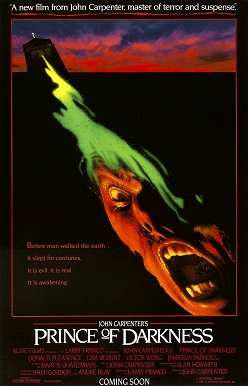
Not one of John Carpenter’s best films, but an enjoyable cult classic all the same. To be fair, JC set the bar so high with Halloween and The Thing that anything else feels ordinary, even if it’s still better than most. The guy didn’t make horror flicks. He made horror art.
Prince of Darkness is a bit muddled in its execution, settling more for atmosphere and vibes than a coherent story, much less compelling characters. The narrative centers around a group of scientists, grad students, and one very sweaty and apocalyptically paranoid Donald Pleasence (was this guy ever not freaking out in a Carpenter film?) as a priest, trying to make sense of some creepy green goo swirling around in a cylinder in the basement of some decrepit L.A. church.
Evidently, this green slime contains pure evil, or something. It’s never really clearly stated exactly what it is. The whole thing feels made up as it goes along.
Prince of Darkness toys with some interesting ideas, while throwing around enough scientific jargon to at least sound plausible. Basically, the idea is that “evil” is a force of nature. Something that can be measured with physics and science doodads and whatnot. Except evil can also somehow influence the surrounding world telekenetically whenever it feels like it.
Earlier in the film it’s stated that the Catholic Church misrepresented evil as some figurehead, like Satan, when in fact it’s as common as gravity. But then later, after some of the college students have become influenced by the green ooze, they are are trying to conjure forth the Devil through a mirror, which acts as a portal to a dark dimension. Only the Devil’s hand appears in our world from the mirror, before Old Scratch is repelled back. Fans of Ridley Scott’s Legend will be reminded of Darkness’ appendage. And if Prince of Darkness works as anything, it’s as an unofficial sequel to the 1985 Tom Cruise-starring fantasy film. Whatever did happen to Darkness after Jack sends him hurling into the black void anyway? Now we know where he wound up.
The film is not bad, really. It has some clever ideas mixed in, and its many unexplained developments provoke questions in the viewer. What is the green ooze? Is it a personification of evil? Why does it happen to choose tonight to usher in the end of the world? Why does it need to possess college students and turn them into zombies to do its bidding? What exactly is all the scientific equipment measuring? Why do homeless vagrants surround the church, preventing the characters from escaping? Why are they killing people who try to leave? Is that really Satan trying to come through the mirror? What’s going to happen if he comes through into our reality? Is he going to end the world as we know it?
The film frustratingly doesn’t see fit to really answer anything.
Prince of Darkness boasts an impressively moody score reminiscent of the one from The Thing. There are some genuinely creepy sequences, such as the reoccuring “dream,” which is actually a signal sent from the future to warn the present. There are one or two good jump scares. Carpenter makes good use of his trademark over the shoulder shots. The make-up effects are satisfyingly gory.
While the story is not all there, Prince of Darkness is worth a watch, especially around the Halloween season. I just wish Carpenter had given the screenplay more time. It feels like a script that was two or three drafts away from being something. The ending stinger is pretty good, though. Especially if you like ambiguous Inception-like endings.
The original 1987 Hellraiser was never an upper-tier horror film. It lacked the craft of Halloween, the dramatic intensity of The Exorcist, and the inventive charisma of The Nightmare on Elm Street.
Still, it stood ahead of derivative dreck like Friday the 13th, Critters, and a host of ’80s flicks largely forgotten or relegated to the cultural graveyard.
But where I always thought the original Hellraiser exceeded expectations as a gory B-movie was in its moral messaging. An odd thing to say, perhaps, about a story where deformed demons from hell torture people with chains and hooks. But Clive Barker’s story — based on his novella The Hellbound Heart — had the trappings of Catholicism’s divine retribution. The original is like a Victorian Gothic crossed with a hardcore BDSM porno, but anchored with the thematic strength of a fairy tale.
The main theme being that obsession with pleasure leads to self-destruction. In the first film, Frank, a low-life deviant always trying to push the boundaries of self-gratification through sexual experimentation, gets more than he bargained for when the Cenobites give him an experience “beyond limits.” Hell by overstimulation, if not excruciating pain. While we’re perhaps initially somewhat sympathetic to Frank’s plight — he all but assaults his brother’s wife when he comes to visit for the wedding — he quickly condemns himself when he conspires with his married lover to bring him fresh bodies to murder so he can reconstitute his flesh and return to the living. Even going so far as to murder his own brother so he can steal his skin.
Frank is deservedly recaptured by the Cenobites when he’s tricked into confessing his presence by his niece Kirsty, to be ripped apart again and sent back to hell. Kirsty, the “Snow White” of the tale, is saved, and through her ingenuity, is able to defend herself from the Cenobites, who then attempt to claim her soul for themselves after harvesting Frank’s.
As messy and dirty as the original Hellraiser is graphically, the moral is pretty tidy and clean. Perversity and deviance — explicitly sexual violence — are punished. Virtue and chastity are rewarded. And while one innocent is killed — Kirsty’s father — she avenges him by bringing the killer, Frank, to justice at the hands of the Cenobites.
I only ever saw the first two sequels, Hellbound and Hell on Earth, which seemed to largely capture the essence of that theme by degrading degrees. The rest of the sequels, which were direct-to-video, honestly looked too godawful to even warrant a glance.
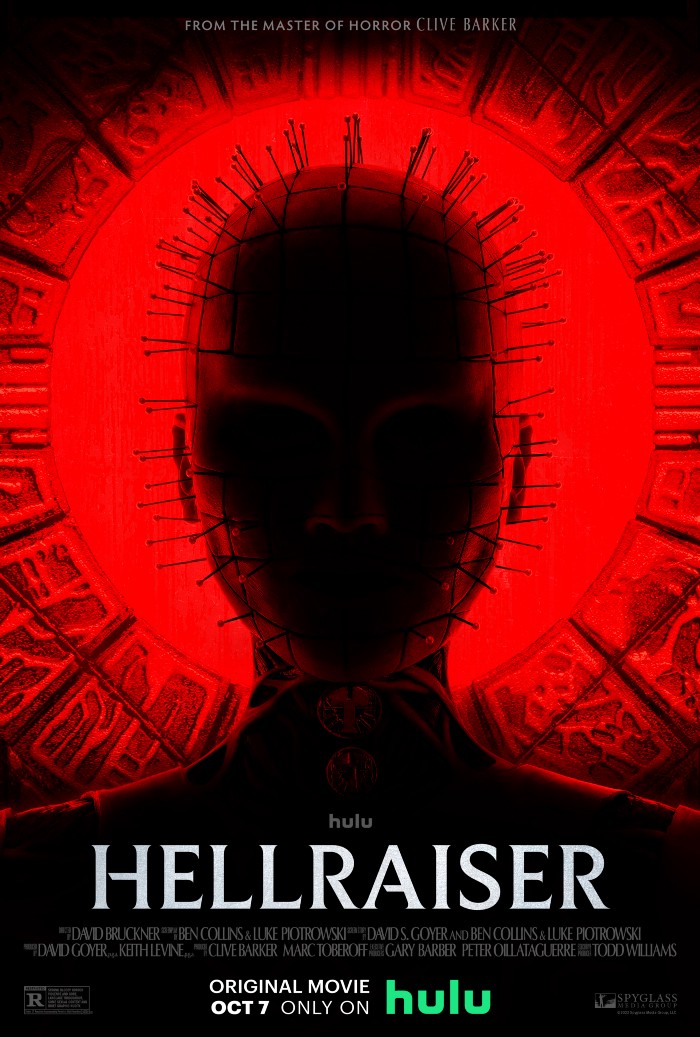
Which brings us to the latest installment, starring Jamie Clayton as the iconic Pinhead.
The new Hellraiser (2022) is mostly a return to “form,” if you considered the original, and maybe the first two sequels solid B-classics. Visually, it appears more loyal to Barker’s concept of the gender ambiguous Cenobite demons as depicted in his source novella. Their bodily desecrations are also much more sexually explicit. Gone is the bondage leather of the ’80s. In its place flesh gruesomely woven and ribboned with decorative beaded pins and jewerly. Hey, you gotta keep up with modern fashion, even in hell.
The new gang of Cenobites are freakishly cool, though lacking perhaps some of the menace of the OG four. The new Chatterer feels a step down from the first, which bore the unforgettable wide-open maw secured by tightened barbed wire. Pinhead’s grid-hammered nails receive a shiny upgrade. It’s hard to top Doug Bradley’s portrayal. He’s sort of the “T-800” Terminator model of the Hellraiser universe. All brute force and physicality. Whereas Clayton’s presence is more like the T-1000 — scary in a Portuguese man-of-war gliding under the waves sort of way. But with her synthetically-enhanced voice and gleaming black eyes, combined with a slippery seductive sadism, she makes for a refreshing and satisfying new look from from Bradley’s stolid, detached-to-almost-bored manner as the reigning Hell Priest.
Where this new Hellraiser loses bite is the puzzling abandonment of the clear morality tale that anchored the first two (and somewhat the third).
The Lament Configuration was always about man’s obsession with pleasure, with those seeking to satisfy their unholy perversions getting their comeuppance. In this new one, even innocent people can be ripped apart by pure accident, and all just because the box sticks them, in effect “marking them” for death. Even the villain Roland Voight — a sort of Jeffrey Epstein — is (apparently) given some great final reward for his maliciousness. Turned into a kind of god, merging with the Leviathan entity as an angel/Cenobite. His flesh flayed open, his cheeks stripped to resemble an X-rated version of The Joker smile, yet seemingly enjoying, or at least tolerating, his unholy transfiguration. It makes for a strong final image, yes. But a woefully unsatisfying conclusion for such a disreputable character. Whereas Frank in the original, sleazy deviant that he is, gets what’s coming to him, and by no short measure.
This makes the theme of the movie muddled and problematic, to say the least. What is the overall message here? Suffering is random, so why bother trying to be a good person? The first Hellraiser bore the markings of a twisted Christian allegory. Like an extreme reimagining of The Rich Man and Lazarus. Or a deep cut side quest from the Sodom and Gomorrah tale. This new one teased at a “corrupting nature of power” theme, but was too timid to commit. What is it with so many new films afraid to take a stand outside of obvious politically fashionable convictions?
Then you have the main character, Riley. A boozing, drug-addicted trampy human blight who, with the help of her hunky two-faced boyfriend, steals the infamous puzzlebox, wreaking havoc on everyone around her. What consequences does she face, even after indirectly causing the death of her brother Matt— the one person who cared about her, and who allowed her to live in his apartment? None, other than some half-assed idea about lifelong regret, as stated by Pinhead. Riley is even given the opportunity to reject the rewards the Cenobites offer, when she realizes their “gifts” are actually horrifying mutilations of one form or another.
Then you have her other murdered or endangered friends. Nora, brutally slain for no other reason than tagging along with Riley, and just as quickly forgotten. And Colin, Matt’s boyfriend, gashed and almost killed. For sure, Trevor, Riley’s double-crossing man candy, faces a final deserved judgement. But only because Riley happens to stick him with the pointy puzzlebox. Even the Cenobites themselves are strangely not immune from random fate, with the new Chatterer getting poked, and facing a Frank-style chain-and-hook-ripping end. Which left me wondering how a soul already condemned to hell can be targeted again by the box. I guess the concept of double jeopardy doesn’t apply to the realm of Leviathan.
In the first two Hellraiser films, and for some of the third, there was a sense of fairness. Of rules. A distinct moral line between good and evil. The Cenobites themselves occupied a gray area. Not necessarily “bad,” as they only targeted souls who asked for pleasures beyond reasonable mortal constraints, showing up to give them (more or less) what they asked for. Summoned by “desire,” not hands, as Pinhead states in the first sequel.
But in this new one nihilism and chaos apparently rule the day. Innocents are butchered. And the guilty and disreputable allowed to manipulate the levers of fate over others. Perhaps this new Hellraiser best serves as an allegory for social media than drug addiction, as it’s purported to be. Riley is no sooner flopped over brain dead from pills than suddenly up solving ancient puzzles and outwitting demons from another realm. The whole drug addiction theme goes by the wayside soon after.
If there’s a “moral” in this new Hellraiser other than the hopeless “the universe is random and cruel,” perhaps it’s to carefully mind the company that you keep. The weakest link in your group may just snap back at you with a hook on the end.