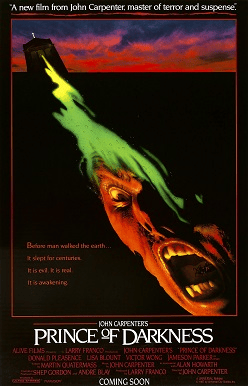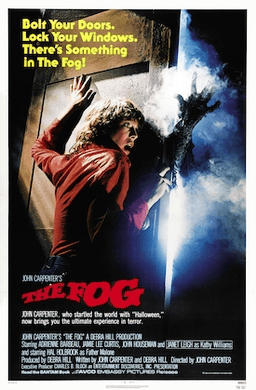
(By Avco Embassy Pictures/ Debra Hill – This image can be obtained anywhere online or directly from the film’s initial distributors. This particular image was taken from the internet, at: https://www.imdb.com/title/tt0080749/, Fair use, https://en.wikipedia.org/w/index.php?curid=48724378)
John Carpenter has recently come into the news due to weighing in on the ever-persistent debate regarding who is a Thing at the end of his classic 1982 film The Thing. MacReady and Childs are portrayed as the only survivors of the shape-shifting alien’s rampage in their blown-apart Antarctic base. But which is the Thing? MacReady or Childs? Or ar they both Things? Or possibly neither?
Carpenter says there is a clue that points to the answer, and that no one has ever gotten it quite right. However, to me, it’s obvious they are BOTH Things. And not because of any clue hidden somewhere. But mainly because of tone. As in the film’s apocalyptic doomsday tone. Even the closing music sounds like something from a funeral procession. They are both Things that don’t quite realize they are Things, which makes it scarier. Because the Thing is not a hivemind. Each particle of its whole can act independently, to the point that two separate beings who have been Thinged don’t even recognize that they are on the same team.
At least, I’m picking that option because it is the scariest version of things. There is not a note of hope whatsoever in the film. The human research crew is doomed from the start, as is the rest of humanity. As soon as a rescue crew shows up, they are going to find a few innocent-looking frozen bodies, which they’ll take back to the mainland. And then that’ll be all she wrote. No wonder the film bombed hard in 1982. It being up against the annoyingly maudlin E.T. didn’t help matters either. Thankfully, The Thing’s morphed into a cult classic and provoked an ongoing debate.
But anyway, what about a lesser known John Carpenter film, The Fog? Is it any good? Does it hold up like his alien classic or his other classic about the psycho in the mask?
I enjoy how Carpenter really lets you marinate in the setting of The Fog. The story is set in Antonio Bay, a small coastal town in California on the verge of celebrating one hundred years since its founding. Unfortunately, a major faultline exists under this quiet town that threatens to tear it apart. Its original founders ripped off gold from a leper ship, and then gave it bad coordinates so it would crash and sink. Well, the sailors are back from the dead, and they want revenge. And their gold back.
Like a lot of Carpenter’s work, there is a strong degree of fatalism in this one. As well as some very immersive staging. This is largely due to the genius work of cinematographer Dean Cundey, who lights the film in a way that is realistically heightened. I’m a fan of “real-world” lighting. Grainy shadows. Juxtaposed with appropriately artifical dramatic lighting. Videodrome is a perfect example of the type of lighting I like to see in a film. I’m also a lover of scenes that are lit deep red, such as the ventilation shaft escape sequence in Aliens, or the scene in Videodrome after Max Renn dons the headgear.
It’s very easy to see The Fog’s influence in modern stuff like Mike Flanagan’s Midnight Mass on Netflix, or the new Apple series Widow’s Bay (which I started watching but lost interest in and don’t care for). It’s perhaps Carpenter’s most underrated influential film.
As for the story itself? It’s rather light, plot-wise. The character work is absymally thin. Tom Atkins sorta plays the protagonist, who picks up hitchhiker Jamie Lee Curtis. The two then have some baffling love affair despite Atkins being twice Curtis’ chracter’s age and looking about as good as a week-old potato. Curtis’ mother Janet Leigh (of Psycho fame) is in it, as is Carpenter alum Nancy Kyes.
The fog stuff is, of course, done really well. There is a scary scene in the hospital involving a dead body that stands out. It might have been better to open the film showing the tragic event of the ship sinking, rather than revealing it as a campfire tale. But that was likely nixed due to budgetary constraints.
The Fog was a rewatch for me, as I hardly remembered most of it, except for the stinger of an ending. It’s worth checking out if mainly for Cundey’s fine work. All of Carpenter’s strengths visually are there, but also a lot of his writing weaknesses. It’ll be perhaps too low-key and bloodless for many. But what makes Carpenter films so good is how immersive, cozy, and intimate they are. He has a way of really putting you inside the world of his story. Which is not something I find a lot of horror films do today. He also writes a memorable synthesizer score, which feels very Halloween adjacent.