Is ‘Thinner’ Any Good?

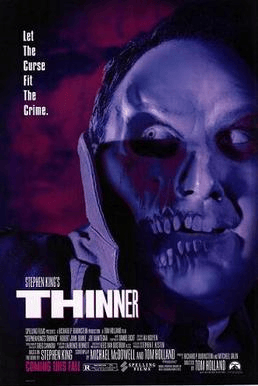
(By Moviegoods.com, Fair use, https://en.wikipedia.org/w/index.php?curid=21786900)

I read the Stephen King novella awhile back and remember it being an effective, terse little thriller. King is a classic “over-writer,” often making up for a thin story concept with an encyclopedic catalogue of characters and their backstories, quirks, and then webbing them up in a messy convoluted plot like a cracked out Spider-Man.

Not so with Thinner, thank goodness. That book got right to the point. As if some invisible editor demanded King put his own writing on a diet, and passive-aggressively the Maine horror scribe banged this out in retaliation.

What about the movie, though?

It’s darkly hilarious. Other than that, it’s a mixed bag. King content was all the rage in the ’90s. Every producer in the world wanted to slap out a film adaptation, no matter what the budget or quality. There was the flood of TV movies like The Langoliers, Tommyknockers, The Stand, and IT.

Quick review of The Langoliers, which I also watched recently–actually not as bad as I’d thought it’d be, but that’s not saying much. It’s beyond dated, and not just in terms of it’s CGI effects. It’s also a bit padded out, like it should have been under two hours instead of three or whatever. Not really worth watching anymore, honestly, unless you are some kind of King completionist. I watched it out of curiosity as I’d only ever seen glimpses of the awful special effects (even for the time) for the Langoliers.

Back to Thinner, this tiny little nearly-forgotten almost-gem of a flick from 1996.

Thinner tells the story of fatass scumbag attorney Billy Halleck, who accidentally plows into an old gypsy lady while his wife is giving him road head, and then, after using his courtroom connections to escape consequences, suffers the wrath of the woman’s father, some kind of super gypsy, named Tadzu, who curses him to the ultimate pre-Ozempic weight loss program. Getting thinner by the day until he completely wastes away. Also getting the gypsy curse treatment are the judge, who becomes a lizard creature, or something, and a police officer who helps cover up Billy’s culpability, who becomes a boil-covered mess.

Gypsy curse films are a sub-sub-niche unto themselves. Like, there may only be a handful. Drag Me to Hell, Sam Raimi’s 2009 horror about a bank manager who gets cursed to eternal damnation when she doesn’t extend some poor old gypsy lady’s mortgage, is one of the others. Actually, that’s the only other one I can think of.

True to King’s style, the story progresses in all sorts of absurd macabre ways as Billy attempts to undo the curse, leading to an escalading series of confrontations with the gypsy chief and his itinerant tribe. At about the midpoint, likely sensing that he was almost running out of story, King reintroduces the mafia don (seen earlier when Billy gets him off on murder charges), who decides to go on a one-man crusade against the gypsies to try to force the old man to take back the curse. The lawyer’s wife also starts cheating on him for some reason, inviting Billy’s wrath. It all comes together in a sick, sad, and twisted final ending that, let’s just say, leaves almost everyone getting their just desserts. Except poor Billy’s teenaged daughter, though.

I like these dark minimalist “morality thrillers” that stick right to the point. Not just watching, either. They are the kind of things I enjoy writing the most. I’ve also tried my hand at a curse story, too. Only it centered on a witch who curses a drunk driver who hits her daughter by making everything he tries to drink turn to blood until he completes a special 12-Step Program she devises. It turned out a bit whackier than it should have, though Thinner was a big inspiration for it.

Thinner is an almost-cult classic. Just not quite there. The film is unfortunately rather shoddy in places. Which is okay in some instances. Sleepaway Camp wasn’t the most photogenic, but its clever conceit overcomes it. With a bit less daftness, Thinner might have emerged like one of John Carpenter’s lesser films. Like Prince of Darkness. Likable enough, warts and all. But it just doesn’t quite come together. Then there’s the contemptible main character. No one is really likable at all in this film. So it’s no surprise it slipped off the radar when it dropped in the mid-90s.

Despite its flaws and flagrant simplicity, I still liked it. It has some “memeable moments.” Moments that stand out due to shock or outrageousness. And I’ll never not think of the gypsy chief’s recurring address of the lawyer as “White man from town.” The book is a fun read. I just wish the movie clicked along in the same way.


Pet Semetary (Or, That Creepy Ancient Indian Burial Ground BEHIND the Pet Semetary)

A review of Stephen King’s 1983 meditation on death, despair, and the heavy cost for refusing to let sleeping dogs (and cats) lie.

“CREEPY CAT” (Made with Dream by WOMBO)

Pet Semetary was always a back burner King book for me. Over the years I’ve read pretty much all of his classics. The Shining. The Stand. Carrie. The Dead Zone. Salem’s Lot. I even read Insomnia, a forgotten door stop about some guy who somehow develops super powers because he can’t sleep. I still haven’t read IT, though I’ve tried twice. Clowns don’t scare me, and King is especially rambly in that one.

But Pet Semetary. That’s more like a cult classic of King’s. It’s not his best, though I’ve often seen on Reddit threads people mention it as their favorite. I can see why. It’s his purest meditation on death. The story has a cozy and intimate feeling notwithstanding. It’s like being slowly strangled by a warm, fuzzy blanket. There are some passages that are not only great in a literary sense, but also scary as hell. The chapter where Louis’s daugher Ellie comes to him and asks him about death, for example. And how that interaction triggers his wife Rachel to remember her horrifying ordeal with her dying sister Zelda.

The whole Zelda sequence could have almost been a seperate novel in and of itself. This was King in his prime. Back when he was a cocaine-fueled boozing maniac pounding away at the typewriter in the basement, and everyone was afraid he was going to finally go nuts and hack his family to pieces.

Man, I miss that guy. He used to riff off little stories within his stories like the way a carnival barker raffles off tickets to some ungodly (and unsafe) amusement park ride. You think of the numerous stories telling the history of the teleportation equipment in his short The Jaunt. That’s a story that should get reviewed on here at some point.

King used to be encyclopediac. His books used to be little labyrinthes packed to the gills with all kinds of frightening shit.

Now King is just another Twitter tweeting avatar.

Which reminds me. Fuck Twitter. Not only is it a morphine drip distraction, but I hate how it has sucked in so many great writers into its event horizon. I think social media has a way of watering down good writing, and reducing otherwise solid writers to time-wasting clout-chasers. How many good books have been lost, their creative energy transformed into worthless tweets? You hear that giant sucking sound? That’s the sound of Twitter sucking all the brain cells out through everyone’s ear holes.

Anyway, back to Pet Semetary. A novel about a doctor named Dr. Louis Creed who moves his family from the Land of Deep Dish Pizza to Bangor, Maine in order to take a job at a local university as the school physician. He moves into a nice house in the country, which happens to be right alongside the most dangeorous road in the universe. Where giant trucks come lumbering along regularly, killing pets and other wildlife. But those trucks are nothing compared to the creepy AF pet cemetary tucked behind his house down a trail. But even that’s small potatoes compared to the ancient Indian burial ground that’s located behind the pet cemetary. Man, if this doctor prescribes drugs as well as he picks houses, he’ll have you taking shots of hydrochloric acid for the common cold.

I am a slow reader. I like taking my time. Or as I like to call it, my eyes prefer a tantric experience with the ink and paper. But I have to say, Pet Semetary really slowed me down. The book is like wading through molasses wearing cement shoes. And I think that’s because it’s a deceptively heavy book. It’s all about death and despair. It’s unrelentingly sad. It’s an existential crisis hiding within the trappings of mass market horror. There’s a subtle nihilism that creeps through. Digging deeper, it’s not only about death. It’s about the fact that after death there really is nothing. Just a void. And to try to cheat that — to bring something or someone back — is just fooling yourself. The hardest part about losing someone isn’t just that they’re gone. It’s that you’re never going to see them again. That there is no happy afterlife where we’ll see each other. It’s as if King is saying the scariest part of life isn’t anything supernatural or otherwordly. It’s the simple fact that when the light goes out, that’s it. And all you can do is accept it.

Pet Semetary is a gut punch. It’s a middle finger to the religious minded confident in their inevitable Laz-E-Boy recliner cloud awaiting them in the sky post their final raspy breath. It’s about denial and the consequences of refusing to accept reality. It’s also a metaphor for psychological trauma, as seen in the Zelda story. Of the inability to get past some tragedy or loss.

This book hurts to read. Because you’ll find yourself thinking about loved ones you lost. It’s a smart choice to explore the concept via the death of Ellie’s cat Winston Churchill, or Church. Everyone’s lost a pet at some point. I found myself thinking of my beloved Himalayan ragdoll Napoleon Cataparte. A cat who who was there for me my last year in high school, my first few years in college, and then my entry into the real world. Napoleon was a regal feline with a strong personality. He was a boss. I loved that cat. When he got on in years, we were fortunate to find a home for him with a nice older lady who only adopted Himalayan cats. He passed away peacefully one evening, perched atop his lounge by the window. A king on his throne to the end. Long live Napoleon.

“KING NAPOLEON CATAPARTE” (Made with Dream by WOMBO)

Structurally, Pet Semetary is kinda wonky. The first act takes up almost the first half of the book. The second act is basically the event and aftermath of Gage’s (Creed’s two-year old son) death. And then the third act is told in one pulse-pounding one-night sequence where the doctor goes to dig up the corpse of his son and rebury him in the Indian burial ground so the toddler can be reanimated. The whole sequence is written like a heist.

Which makes me wonder…have the Ocean’s 11 writers ever considered putting a horror element in their franchise? Like instead of robbing just another boring bank or casino, they have to rob an Egyptian pyramid, or a South American crypt? And George Clooney gets killed by a mummy or something?

Anyway…

Pet Semetary is deeply morbid, depressing, soul-crushing stuff. It’s one of those novels that goes there. What else can be said about a book that features a two-year old getting run over by a semi-truck in grisly detail. It’s every parent’s worst nightmare.

There’s also one hell of a stinger at the very end.

I recommend Pet Semetary, but only if you’ve got a cast iron mind. Reading it is like swallowing a razor blade.

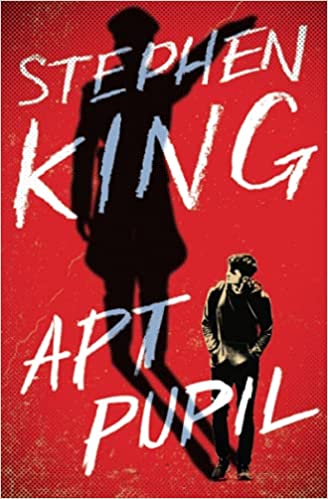
Book Review – Apt Pupil

Apt Pupil is a novella by Stephen King that comes from the short story collection Different Seasons.

It was published in 1982, and tells the story of a young Southern California teenager named Todd Bowden who discovers that his elderly neighbor, a supposed German immigrant, is actually a wanted Nazi war criminal named Kurt Dussander, who was personally responsible for committing horrible atrocities in the Holocaust.    

However, rather than reporting Dussander’s whereabouts to the authorities, Todd instead blackmails the Nazi into becoming sort of like his own personal historian. Todd is a bit of a strange kid. He’s obsessed with WWII history, in particular the Holocaust, and instead if being repulsed by Dussander’s past actions, the kid is instead enthralled. Even inspired, to a degree. 

However, the blackmail goes both ways, as the Nazi Dussander turns the tables on the kid later. See, the longer the kid has known Dussander, the more complicit he has become in keeping him from being brought to justice. Furthermore, as an “all-American” kid, with potential and college prospects, Todd risks having his future and reputation destroyed forever due to his association with an older Nazi. 

With their hands on each other’s throats in a sense, Dussander and Todd are forced into an uncomfortable alliance of secrecy over a period of four years. Ultimately, Dussander’s real identity is found out through a coincidence, and Todd, now age 17, is forced to reconcile with not only how he protected a war criminal, but his own very twisted dark side.

It’s nice to every once in a while be able to read an old Stephen King story. Because, when you ignore all the films, especially the newer ones that have been made of his works, and how slick and clean they all look, you can really appreciate just how good of a writer Classic King really was. 

King is at his best when he’s exploring the darkness of the human heart. He may be categorized as a horror writer, but really, his best work looks into human nature itself. But he’s also a great plotter, always ratcheting up the tension like an ever-turning corkscrew.

For instance, there’s a clever sequence when Todd’s grades begin to slip at school where the boy forces Dusaander to pretend to be his grandfather for a meeting with the guidance counselor. I’ll always champion the use of dramatic irony or an opportunity for a character to go undercover. You see this technique used to great effect in Tarantino’s Inglorious Basterds, where the Basterds have to constantly bluff their way through different situations, to mixed (and bloody) results.

Apt Pupil is unusual. A story about a young kid associating with a Nazi war criminal on its own would probably be enough. But King throws in the wild card that both Todd and Dussander start murdering homeless vagrants and bums around town. For me, it was sort of like smashing two concepts into one. And I was never entirely sure exactly what precipitated both of them to start killing. I never got the sense of Dussander being a serial killer. For sure, he was a brutal Nazi war criminal. But his crimes were state-directed, not necessarily ones he set out to do in order to satisfy his own desire for bloodshed. 

For Todd, his turn toward killing felt like it came out of left field. I was expecting something more along the lines of Dussander influencing the boy into killing, mirroring how the Nazi war machine, and Hitler’s propganda, tranformed Germany into a genocidal state. King, however, doesn’t go for subleties here. So essentially, what we have here is the story of two psychopaths meeting each other, and more or less provoking one another’s propensity for murder and violence. All while ironically occuring in an idyllic Southern California suburb.   

Apt Pupil is a worthwhile King novella to check out if you haven’t already. A few interesting facts: King started writing Apt Pupil immediately after The Shining. And the novella is placed right before another King classic, The Body, which of course became the film Stand By Me.