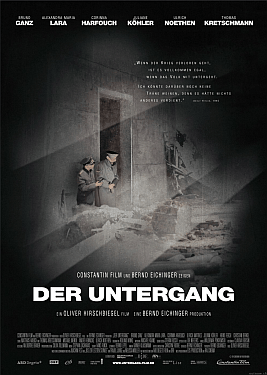
(By The poster art can or could be obtained from the distributor., Fair use, https://en.wikipedia.org/w/index.php?curid=56186129)
Nowadays you almost won’t know about a film whatsoever unless it has memeability. I guarantee you that’s why so many went to check out Obsession. All those Gumby-esque facial expressions Indy Navarrette makes–how could you not want to see it. “Think Mark! Think!” is what sucked me into the first season of Invincible.
Entertainment os so cutthroat today nothing works unless it infects you. Memes are the equivalent of the one-liners from the ’80s.
Downfall pulled it off before video internet memes were really a thing, way back in 2004. In fact, it created a pre-meme that only became a meme some ten years or so later. I don’t recall seeing clips of the Mustache Man freaking out with edited subtitles until like the mid-teens or so. It was literally ahead of its time.
But aside from the meme scene, what about the rest of the film? It’s pretty damn good, actually. Very good. Dark. Heavy. Depressing and reflective. I had no idea what kind of hijinks went on down in the bunker in the last days of the Reich. I assumed nothing upbeat. The story is largely told through the POV of a young woman named Traudi who becomes AH’s personal secretary in 1942, later joining him and the remnants of his Nazi cohorts in the Fuhrerbunker in the final 10 days of his life as the Soviets surround Berlin blasting it to kingdom come.
It’s a chilling if intimate portrait of Hitler. Most war films never depict him beyond a stock footage manner. But in the bunker, we get a glimpse past the theatrical mannerisms and famous screaming. Though he does scream. Quite a bit, in some instances. He’s a man in denial about the imminent collapse of his regime. Blasting generals and officers for failures, lambasting those he feels betrayed him, and directing imaginary regiments onto a battlefield in illogical desperation. Downfall is about a country’s literal downfall, yes, but it’s also about the Fuhrer’s mental collapse.
Hitler’s last days in the bunker are bizarre and eerie and unsettling I half expected Rod Serling to suddenly step out from a corner, cigarette in hand, and deliver some opening narration. “As Hitler is about to find out, his downfall will take place not just in this subterranean fortification deep below Berlin…but in the Twilight Zone.” Cue the music.
Hitler’s fall is a remarkable one. Almost unprecedented, save perhaps for Napoleon or Alexander the Great. But neither of those achieved so much–conquering nearly all of Europe–before losing it all so quickly. What does that plummet from power do to a man’s mental state? Especially one who was already teetering on the edge of sanity? It’s like seeing a supervillain suddenly stripped of his powers and forced to make do as an ordinary human. Hitler’s hand twitches behind his back. He prowls the bunker like a lost dog. He snaps at subordinates. Yet he’s also like a father presiding over a house of children he loves. He calmly dictates his will. Then lashes out when he hears of surrender terms. Quietly accepts an officer revealing he had been disobeying orders for weeks. Tenderly says farewell to his female staff. Turns his head away to avoid seeing his own dog put down with a cyanide pill. Then, like a wobbly machine finally winding down, departs to his room, where he Eva Braun take their own lives.
As I’ve mentioned before, WWII films too often become sensationalized, glamorized, and bombastic. Not so with Downfall. Bruno Ganz is superb as Hitler. The rest of the cast is excellent as well. I know this film received some criticism for “humanizing Hitler.” What, what exactly was it supposed to do? Have the Hitler actor wear a neon sign around his neck that says “EVIL” the whole time? I assume the events depicited were largely based in historical truth, with little embellishments or artistic flourishes added. Evil is never cartoonish anyway. It’s as it always has been–a handful of clean-shaven men conspiring in a room together, often whispering and sipping drinks.
Downfall is up there with some of my favorite war films, like Full Metal Jacket, Das Boot, and the brutally mesmerizing All Quiet on the Western Front.