Movie Review – Barbarian

Barbarian: Timely Treatise On Sexual Assault, Or B-Movie Schlock? Or both? A well-crafted but weirdly-structured flick.
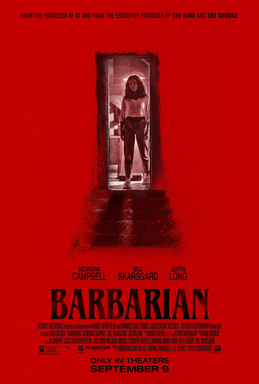
Last night I finally had the chance to catch Barbarian, the 2022 horror film written and directed by Zach Cregger. Like most films with memorable twists that I’m not able to see the very second it premiers, I had this one spoiled massively for me due to rampant YouTube reviews with certain images in the thumbnails.

Can we talk for a second about the humanitarian crisis this clickbait spoiler-craze really is? Barbarian is the just the latest in a string of highly anticipated films and shows that had plot reveals ruined for me. Don’t Look Now was, too. I’ve also had every major plot twist of Invincible (my new favorite show) shoved in my face thanks to YouTube shorts and “critical analysis” vids. It’s frustrating, but I suppose that’s the way things are now.

That said, SPOILERS incoming.

Barbarian starts off appearing to be your standard Hitchcock-style roommate stalker thriller, like The Resident or Single White Female. A young woman named Tess (Georgina Campbell) shows up late at night during a thunderstorm to her AirBnB in a decrepit part of Detroit, only to find someone else staying there. A young man named Keith, who looks nice enough. But can she really trust this guy? Somehow their reservations were booked simultaneously, leading to the awkward situation of two strangers having to share a house for the evening.

After Tess is unable to find a hotel due to a medical conference, she’s forced to spend the night. But soon she discovers this AirBnB has dark, macabre secrets, including a creepy basement room with a dirty mattress and a subterranean labyrinthine that seems straight out of a Kane Pixels “backrooms” video. But that’s only the beginning of the terror. A hideous humanoid monster also lives down there, too. And she feels the need, the need to feed.

Then suddenly we cut to Southern California, where working actor AJ (Justin Long) is cruising along in his convertible when he receives word from his agent/producer that he’s been accused of rape by a former co-star. With his life in shambles, he’s forced to liquidate some assets to pay for legal defense. So he flies off to Michigan to visit his, you guessed it, AirBnB rental property, where Tess and Keith just disappeared. It isn’t long before he too is captured by the monster, who has a bizarre need to “mother” her captives by forcibly breastfeeding them.

Suddenly, we’re launched into a flashback to the early 1980s, when the neighborhood was in good shape. We’re introduced to Frank, a middle-aged single man who kidnaps young women and holds them prisoner in his house of horrors. The “mother” creature there now is the hideous offspring of numerous inbreeding generations over four decades. Essentially, the ultimate thematic representation of male sexual assault coming home to roost.

—

Barbarian is mostly a smartly-written B-movie flick with a tight opening act. But I’m not sure the transition from its tense-filled beginning into a sequence straight out of The Hills Have Eyes, entirely works. It feels like two seperate stories were mashed together in the service of creating a Get Out-style socially conscious horror film. It’s tonal shift and plot twist is basically Psycho. Even Keith, played by Bill Skarsgård, reminded me of Norman Bates. The underlying theme regarding male violence, sexual harassment, and rape, is a relevant and timely one.

The movie is a cut-above the “hilbilly horror” schlock of the early 2000s, such as Wrong Turn or Jeepers Creepers. I enjoyed it, overall. But the film was far more engaging during its subtext-soaked first act, when even something like a simple bottle of wine appears menacing. When it becomes a freaky monster mash, it loses its thematic impact. Sexual predators rarely appear like the monsters they are. They’re often smooth talkers, manipulating their victims emotionally, only implying the threat of violence, until finally trapping them. Sexual assault is a grotesque physical crime, but much of it is psychological, too. Such ghastly human behavior is better explored realistically to relay its horror. AJ has a conversation with his best friend at a club, where he confesses how he had to “convince” the young actress to have sex with him, which is far creepier and more true to life. As is his later drunken phone call to his victim. AJ is a classic “mild-mannered” wolf in sheep’s clothing abuser. Clark Kent, except he rapes instead of changes into a hero in a phone booth. That sort of everyday psychopath is far more intriguing to observe than just another mutated creature.

There are many illogical plot turns and character choices that no sane person would ever make. While it’s believable that a single woman might stay at an AirBnB with a strange man by herself due to a reservation mix-up, you’re telling me she never even checked out the surrounding neighborhood? Google Maps is your friend. I also highly doubt anyone, male or female, would keep heading down into a creepy labyrinthe, even if their new guy friend was supposedly in trouble. The irritated police showing up, only to dismiss Tess as just another slumming crackhead, was far too convenient. Most police have very good sixth senses. Tess comes across as clearly educated and articulate, i.e. someone you take seriously. And wouldn’t there have been a history of young women disappearing in the general neighborhood that would trigger some suspicion from the cops? Frank’s abductions numbered in the dozens. There was no logical need for AJ to even visit his rental property, as liquidating it could all be done via email and pdf file signatures. He only went there because the plot needed him to. And how did a malnourished inbred freak develop super strength and become a giant? Most victims held prisoner in similar cases have usually turned up bony and uncoordinated due to isolation and vitamin deficiencies.

Then there’s that ending, which was almost laughable.

These questionable elements aside, and its jarring narative shifts, Barbarian is a decent film worth checking out.
NEW BOOK: The Devil’s Throne


My new novel has just been released, and is available for purchase now on Amazon. 

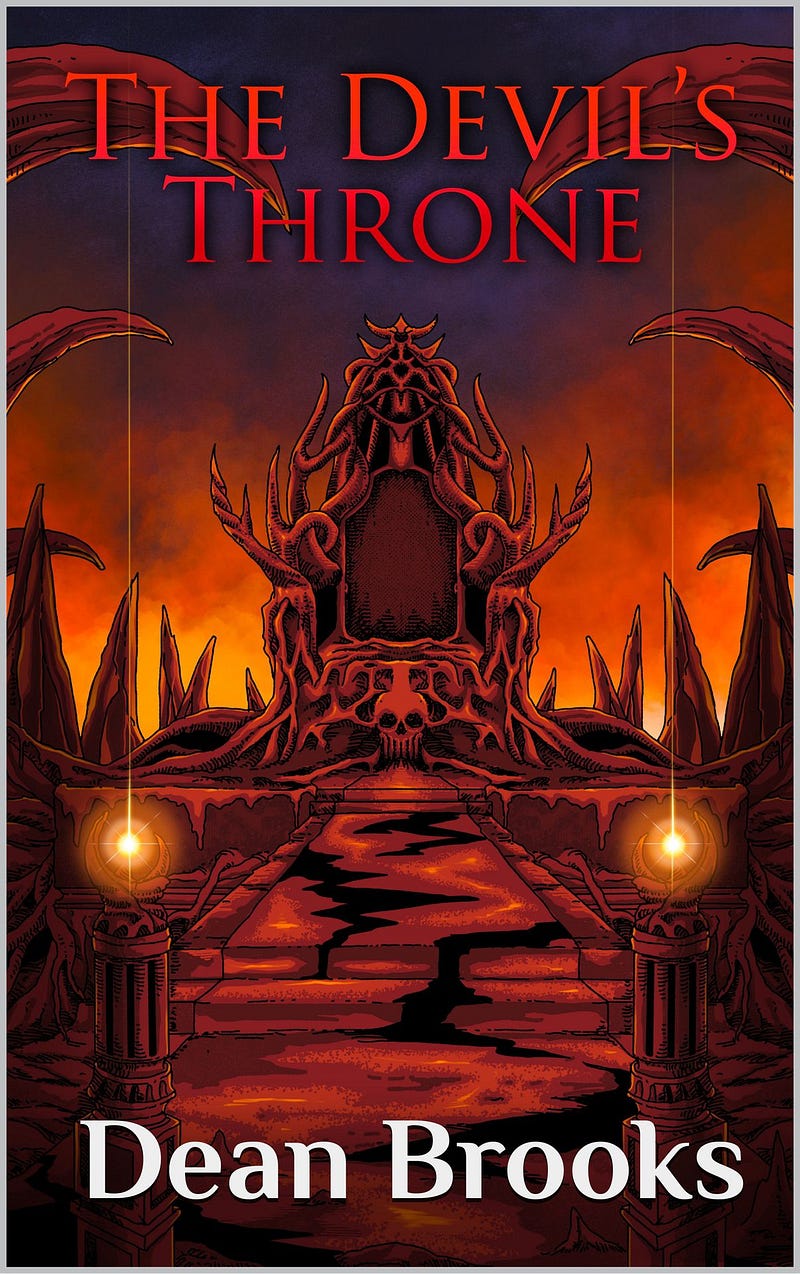
“The Devil’s Throne.” Cover design by “Denywicka.”

I’ve just released my third self-published, and fourth overall novel, THE DEVIL’S THRONE.

Available here on Amazon for purchase, and through Kindle Unlimited. 

Here’s the synopsis:

Christian “Flick” Stevenson and his fiancé Margo Bennett are both American graduate students studying demonology. They and two colleagues and their professor are in Prague to investigate the Devil’s Throne — a mysterious chair built by members of the Occult, that supposedly can summon the Devil.

When Margo is brutally attacked, and left dying in a hospital, Flick determines to do whatever necessary to save the love of his life. Even if it means allying with the demonic forces behind the Devil’s Throne. Even if it means sacrificing others for a frightening ritual that will grant the Prince of Darkness dominion over the earth for eternity.

A modern Gothic set in the Heart of Europe. A love story that inspires even the Devil. An ancient artifact promising power and immortality, but at a deadly price.

Come in, have a seat, and enjoy…

The Devil’s Throne.


I wrote The Devil’s Throne back in 2019, right after The Lek. It’s primarily in the horror genre, as can be gathered from the front cover design, but possesses a balanced mix of dark humor. It’s inspired from such classics as Dracula and the Clive Barker novella The Hellbound Heart, that formed the basis for Hellraiser. If you like films like An American Werewolf in London, Drag Me to Hell, The Evil Dead, This Is the End, and other horror/comedies that place a little more emphasis on the chills than on the giggles, than you’ll likely enjoy The Devil’s Throne. 

At its heart, my novel is a love story. One centered around the question: How far would you go to save the person you love? My main character, Flick, engages in the ultimate Faustian bargain to save his fiancé, Margo, which just may bring about the apocalypse.

Good God, what some men will do for love.

I’ve always wanted to write a “romance.” Not one of those steamy ones, mind you, with some barechested sexy pirate with long hair on the front cover manhandling a swooning damsel. Something more grounded and relatable, but with a supernatural element. Something with a frightful, tooth-lined edge. Something gory, with a moral dilemma component. I’ve always liked stories where ordinary people are compelled to commit depraved acts out of necessity. 

I’m not sure where or exactly when the idea initially came to me for the novel. It was certainly during my time finishing my degree at NDSU in Fargo, ND. It might have been during one of my long walks through a bitter winter blast. Or during a class where I was wishing to be someplace else. Or maybe I just awoke with the idea one morning. 

As I usually do with ideas, I wrote out the bones of it in an email, and then sent it to myself. And there it sat for perhaps a year or two before I eventually scrounged up the flesh and blood to complete its body. 

It took me several more years to publish it. Until finally, the day came at last. This day. Now. 

I hope you’ll check out The Devil’s Throne. If you do, I hope you’ll enjoy it. 

-Dean

By the way, the artist who designed the front cover goes by the name “Denywicka” on Fiverr. He’s brilliant, and I was overjoyed at what he came up with for my novel. He specialises in high quality, detailed dark art illustration. Please check out his profile here. 

The Problematic Morality of the New Hellraiser Film

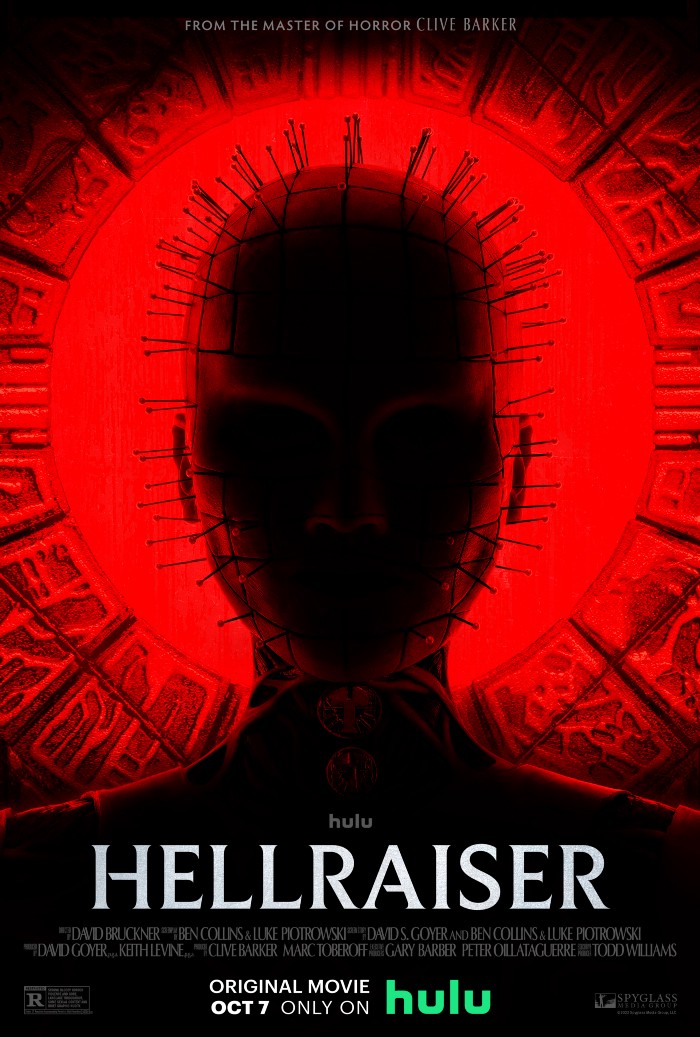
Source: Spyglass Media Group

The original 1987 Hellraiser was never an upper-tier horror film. It lacked the craft of Halloween, the dramatic intensity of The Exorcist, and the inventive charisma of The Nightmare on Elm Street.

Still, it stood ahead of derivative dreck like Friday the 13th, Critters, and a host of ’80s flicks largely forgotten or relegated to the cultural graveyard.

But where I always thought the original Hellraiser exceeded expectations as a gory B-movie was in its moral messaging. An odd thing to say, perhaps, about a story where deformed demons from hell torture people with chains and hooks. But Clive Barker’s story — based on his novella The Hellbound Heart — had the trappings of Catholicism’s divine retribution. The original is like a Victorian Gothic crossed with a hardcore BDSM porno, but anchored with the thematic strength of a fairy tale.

The main theme being that obsession with pleasure leads to self-destruction. In the first film, Frank, a low-life deviant always trying to push the boundaries of self-gratification through sexual experimentation, gets more than he bargained for when the Cenobites give him an experience “beyond limits.” Hell by overstimulation, if not excruciating pain. While we’re perhaps initially somewhat sympathetic to Frank’s plight — he all but assaults his brother’s wife when he comes to visit for the wedding — he quickly condemns himself when he conspires with his married lover to bring him fresh bodies to murder so he can reconstitute his flesh and return to the living. Even going so far as to murder his own brother so he can steal his skin.

Frank is deservedly recaptured by the Cenobites when he’s tricked into confessing his presence by his niece Kirsty, to be ripped apart again and sent back to hell. Kirsty, the “Snow White” of the tale, is saved, and through her ingenuity, is able to defend herself from the Cenobites, who then attempt to claim her soul for themselves after harvesting Frank’s.

As messy and dirty as the original Hellraiser is graphically, the moral is pretty tidy and clean. Perversity and deviance — explicitly sexual violence — are punished. Virtue and chastity are rewarded. And while one innocent is killed — Kirsty’s father — she avenges him by bringing the killer, Frank, to justice at the hands of the Cenobites.

I only ever saw the first two sequels, Hellbound and Hell on Earth, which seemed to largely capture the essence of that theme by degrading degrees. The rest of the sequels, which were direct-to-video, honestly looked too godawful to even warrant a glance.

Which brings us to the latest installment, starring Jamie Clayton as the iconic Pinhead.

The new Hellraiser (2022) is mostly a return to “form,” if you considered the original, and maybe the first two sequels solid B-classics. Visually, it appears more loyal to Barker’s concept of the gender ambiguous Cenobite demons as depicted in his source novella. Their bodily desecrations are also much more sexually explicit. Gone is the bondage leather of the ’80s. In its place flesh gruesomely woven and ribboned with decorative beaded pins and jewerly. Hey, you gotta keep up with modern fashion, even in hell.

The new gang of Cenobites are freakishly cool, though lacking perhaps some of the menace of the OG four. The new Chatterer feels a step down from the first, which bore the unforgettable wide-open maw secured by tightened barbed wire. Pinhead’s grid-hammered nails receive a shiny upgrade. It’s hard to top Doug Bradley’s portrayal. He’s sort of the “T-800” Terminator model of the Hellraiser universe. All brute force and physicality. Whereas Clayton’s presence is more like the T-1000 — scary in a Portuguese man-of-war gliding under the waves sort of way. But with her synthetically-enhanced voice and gleaming black eyes, combined with a slippery seductive sadism, she makes for a refreshing and satisfying new look from from Bradley’s stolid, detached-to-almost-bored manner as the reigning Hell Priest.

Where this new Hellraiser loses bite is the puzzling abandonment of the clear morality tale that anchored the first two (and somewhat the third).

The Lament Configuration was always about man’s obsession with pleasure, with those seeking to satisfy their unholy perversions getting their comeuppance. In this new one, even innocent people can be ripped apart by pure accident, and all just because the box sticks them, in effect “marking them” for death. Even the villain Roland Voight — a sort of Jeffrey Epstein — is (apparently) given some great final reward for his maliciousness. Turned into a kind of god, merging with the Leviathan entity as an angel/Cenobite. His flesh flayed open, his cheeks stripped to resemble an X-rated version of The Joker smile, yet seemingly enjoying, or at least tolerating, his unholy transfiguration. It makes for a strong final image, yes. But a woefully unsatisfying conclusion for such a disreputable character. Whereas Frank in the original, sleazy deviant that he is, gets what’s coming to him, and by no short measure.

This makes the theme of the movie muddled and problematic, to say the least. What is the overall message here? Suffering is random, so why bother trying to be a good person? The first Hellraiser bore the markings of a twisted Christian allegory. Like an extreme reimagining of The Rich Man and Lazarus. Or a deep cut side quest from the Sodom and Gomorrah tale. This new one teased at a “corrupting nature of power” theme, but was too timid to commit. What is it with so many new films afraid to take a stand outside of obvious politically fashionable convictions?

Then you have the main character, Riley. A boozing, drug-addicted trampy human blight who, with the help of her hunky two-faced boyfriend, steals the infamous puzzlebox, wreaking havoc on everyone around her. What consequences does she face, even after indirectly causing the death of her brother Matt— the one person who cared about her, and who allowed her to live in his apartment? None, other than some half-assed idea about lifelong regret, as stated by Pinhead. Riley is even given the opportunity to reject the rewards the Cenobites offer, when she realizes their “gifts” are actually horrifying mutilations of one form or another.

Then you have her other murdered or endangered friends. Nora, brutally slain for no other reason than tagging along with Riley, and just as quickly forgotten. And Colin, Matt’s boyfriend, gashed and almost killed. For sure, Trevor, Riley’s double-crossing man candy, faces a final deserved judgement. But only because Riley happens to stick him with the pointy puzzlebox. Even the Cenobites themselves are strangely not immune from random fate, with the new Chatterer getting poked, and facing a Frank-style chain-and-hook-ripping end. Which left me wondering how a soul already condemned to hell can be targeted again by the box. I guess the concept of double jeopardy doesn’t apply to the realm of Leviathan.

In the first two Hellraiser films, and for some of the third, there was a sense of fairness. Of rules. A distinct moral line between good and evil. The Cenobites themselves occupied a gray area. Not necessarily “bad,” as they only targeted souls who asked for pleasures beyond reasonable mortal constraints, showing up to give them (more or less) what they asked for. Summoned by “desire,” not hands, as Pinhead states in the first sequel.

But in this new one nihilism and chaos apparently rule the day. Innocents are butchered. And the guilty and disreputable allowed to manipulate the levers of fate over others. Perhaps this new Hellraiser best serves as an allegory for social media than drug addiction, as it’s purported to be. Riley is no sooner flopped over brain dead from pills than suddenly up solving ancient puzzles and outwitting demons from another realm. The whole drug addiction theme goes by the wayside soon after.

If there’s a “moral” in this new Hellraiser other than the hopeless “the universe is random and cruel,” perhaps it’s to carefully mind the company that you keep. The weakest link in your group may just snap back at you with a hook on the end.

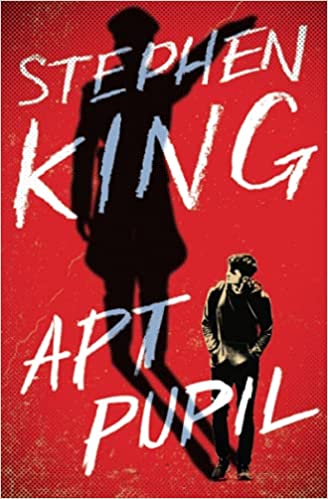
Book Review – Apt Pupil

Apt Pupil is a novella by Stephen King that comes from the short story collection Different Seasons.

It was published in 1982, and tells the story of a young Southern California teenager named Todd Bowden who discovers that his elderly neighbor, a supposed German immigrant, is actually a wanted Nazi war criminal named Kurt Dussander, who was personally responsible for committing horrible atrocities in the Holocaust.    

However, rather than reporting Dussander’s whereabouts to the authorities, Todd instead blackmails the Nazi into becoming sort of like his own personal historian. Todd is a bit of a strange kid. He’s obsessed with WWII history, in particular the Holocaust, and instead if being repulsed by Dussander’s past actions, the kid is instead enthralled. Even inspired, to a degree. 

However, the blackmail goes both ways, as the Nazi Dussander turns the tables on the kid later. See, the longer the kid has known Dussander, the more complicit he has become in keeping him from being brought to justice. Furthermore, as an “all-American” kid, with potential and college prospects, Todd risks having his future and reputation destroyed forever due to his association with an older Nazi. 

With their hands on each other’s throats in a sense, Dussander and Todd are forced into an uncomfortable alliance of secrecy over a period of four years. Ultimately, Dussander’s real identity is found out through a coincidence, and Todd, now age 17, is forced to reconcile with not only how he protected a war criminal, but his own very twisted dark side.

It’s nice to every once in a while be able to read an old Stephen King story. Because, when you ignore all the films, especially the newer ones that have been made of his works, and how slick and clean they all look, you can really appreciate just how good of a writer Classic King really was. 

King is at his best when he’s exploring the darkness of the human heart. He may be categorized as a horror writer, but really, his best work looks into human nature itself. But he’s also a great plotter, always ratcheting up the tension like an ever-turning corkscrew.

For instance, there’s a clever sequence when Todd’s grades begin to slip at school where the boy forces Dusaander to pretend to be his grandfather for a meeting with the guidance counselor. I’ll always champion the use of dramatic irony or an opportunity for a character to go undercover. You see this technique used to great effect in Tarantino’s Inglorious Basterds, where the Basterds have to constantly bluff their way through different situations, to mixed (and bloody) results.

Apt Pupil is unusual. A story about a young kid associating with a Nazi war criminal on its own would probably be enough. But King throws in the wild card that both Todd and Dussander start murdering homeless vagrants and bums around town. For me, it was sort of like smashing two concepts into one. And I was never entirely sure exactly what precipitated both of them to start killing. I never got the sense of Dussander being a serial killer. For sure, he was a brutal Nazi war criminal. But his crimes were state-directed, not necessarily ones he set out to do in order to satisfy his own desire for bloodshed. 

For Todd, his turn toward killing felt like it came out of left field. I was expecting something more along the lines of Dussander influencing the boy into killing, mirroring how the Nazi war machine, and Hitler’s propganda, tranformed Germany into a genocidal state. King, however, doesn’t go for subleties here. So essentially, what we have here is the story of two psychopaths meeting each other, and more or less provoking one another’s propensity for murder and violence. All while ironically occuring in an idyllic Southern California suburb.   

Apt Pupil is a worthwhile King novella to check out if you haven’t already. A few interesting facts: King started writing Apt Pupil immediately after The Shining. And the novella is placed right before another King classic, The Body, which of course became the film Stand By Me.