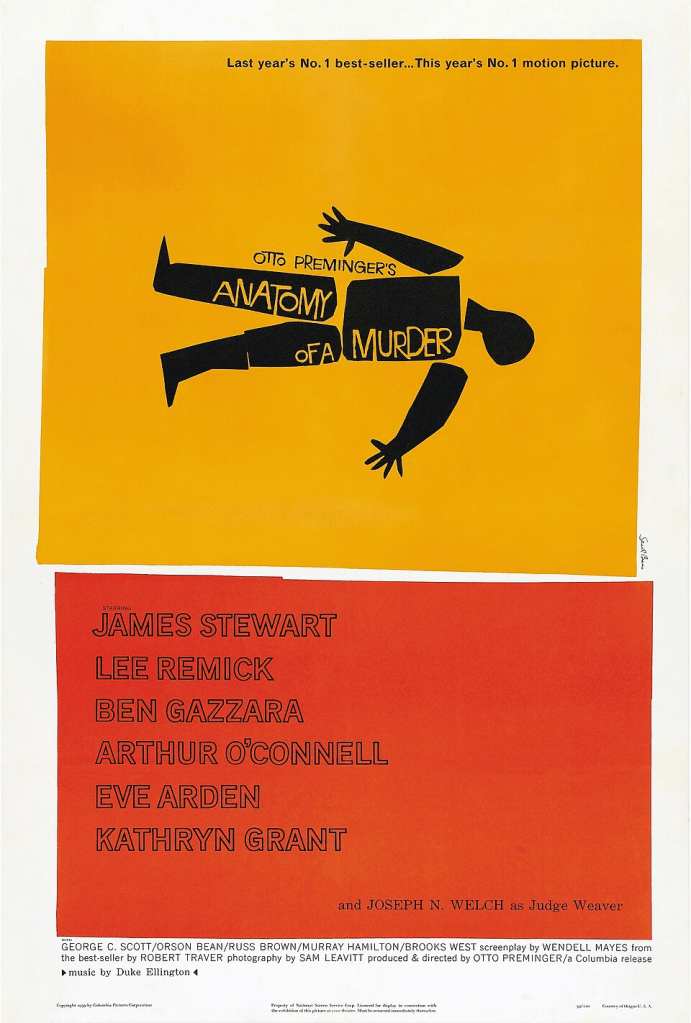
(By Saul Bass – http://ilovegraphicdesign.wordpress.com/2007/05/29/anatomy-of-a-murder/, Public Domain, https://commons.wikimedia.org/w/index.php?curid=25500751)
It’s kind of weird how there are so many legal and courtroom dramas now that it’s hard to appreciate some of the classics that founded the genre and made it what it is today.
There are so many Law and Order spinoffs I can’t even keep track of them anymore. They’re like Covid variants. Just as innocous, too. I got into an SVU kick a long time ago, a show that is somehow still going since 1999, even after one of its main leads, Christopher Meloni, left. That’s a lot of sex crimes for the TV-viewing public to absorb over nearly thirty years.
Then you have the numerous films. Such as Anatomy of a Fall, the 2023 French drama that won the Oscar for Best Original Screenplay, about a wife accused of murdering her husband. Or 1992’s A Few Good Men.
Which brings me to the Jimmy Stewart-starrer Anatomy of a Murder, the 1959 classic about a young Army lieutenant accused of murdering a bar owner who had allegedly raped his wife. The story is based on a bestselling 1958 book, which is based on a real case that took place in 1952 in northern Michigan. It was also written by the actual defense attorney for the case himself, John D. Voelker, who used the pen name Robert Traver. Bet you no one on money Twitter has considered that side hustle. Go to law school, become a lawyer, wait for a socially compelling case with moral ambiguity and complexity, win the case (important), write a tell-all, and then WHAMMO, wait for the Hollywood riches to flow. It’s so simple I can’t believe more people aren’t doing it.
Anatomy is a deeply intriguing and well-crafted film that still feels very modern and relevant. Especially due to the story’s legal outcome–(spoiler alert)–the officer gets off on a temporary insanity due to a psychological condition of “irresistible impulse” that rendered him not criminally responsible for his actions.
Irresistible impulse. That sounds like the kind of excuse the world’s most sophisticated five-year-old would come up with.
Mom: Why’d you push your little sister down the stairs?
Kid (cute little kid voice): Irresistible impulse.
Hey, didn’t we just see something similar in the Lindsay Clancy trial outcome? At issue there was not whether she commited murder or not, but her mental state during the deed. What was Clancy’s excuse for killing her three children? Well, you see, she had a nasty bout of postpartum depression. It was the fault of wonky hormones.
The characters are engaging and complex, too. Especially the officer’s violated wife, Laura Manion, who is unashamedly flirtateous. Typically, you’d expect the female victim to get the pedestal treatment. But no. The film points out she has a reputation around the Army base for being a “slut.” She’s a fascinating psychological portrait, even more so than her jealous significant other. The woman is blasé even about her own husband’s apparent regular domestic abuse. As if she accepts the idea that rape and assault just go with the territory of being a hot flirt.
Is Anatomy of a Murder still worth watching in a world filled to the brim with formularic courtroom dramas? I would put it this way. If you’ve been numbed to death by the automoton-style scripting of endless legal shows, you’ll find yourself refreshed after watching Anatomy. The performances are all top-notch. James Stewart is his likable everyman self. George C. Scott makes an Oscar-nominated appearance. The judge is even played by a real-life lawyer. And you can’t beat a story written by the actual attorney who defended the real-life defendant.
Overall, I really liked this film. I’ve never been so gripped by a trial proceeding. In fact, I found the first act, which is all mainly set-up, to be quite boring by comparison. But once the trial gets underway, I dare you to try to turn it off. You will be struck with…irresistible impulse to keep watching.

